Open Access
Research
Immune response modulation by curcumin in a latex allergy model
Viswanath P Kurup*
1,2,3, Christy S Barrios
1, Raghavan Raju
4,5,
Bryon D Johnson
1, Michael B Levy
1and Jordan N Fink
1,2Address: 1Department of Pediatrics, Medical College of Wisconsin, 8701 Watertown Plank Road, Milwaukee, WI 53226, USA, 2Department of
Medicine, Medical College of Wisconsin, 8701 Watertown Plank Road, Milwaukee, WI 53226, USA, 3Research Service, V A Medical Center, 5000
West National Avenue, Milwaukee, WI 53295, USA, 4Neuromuscular Diseases Section, National Institute of Neurological Disorders and Stroke,
National Institute of Health, Bethesda, MD 20892, USA and 5University of Alabama School of Medicine, Department of Surgery and Department
of Microbiology and Immunology, Volker Hall, Room G094, 1670 University Boulevard, AL 35294, USA
Email: Viswanath P Kurup* - [email protected]; Christy S Barrios - [email protected]; Raghavan Raju - [email protected]; Bryon D Johnson - [email protected]; Michael B Levy - [email protected]; Jordan N Fink - [email protected]
* Corresponding author
Abstract
Background: There has been a worldwide increase in allergy and asthma over the last few decades, particularly in industrially developed nations. This resulted in a renewed interest to understand the pathogenesis of allergy in recent years. The progress made in the pathogenesis of allergic disease has led to the exploration of novel alternative therapies, which include herbal medicines as well. Curcumin, present in turmeric, a frequently used spice in Asia has been shown to have anti-allergic and inflammatory potential.
Methods: We used a murine model of latex allergy to investigate the role of curcumin as an immunomodulator. BALB/c mice were exposed to latex allergens and developed latex allergy with a Th2 type of immune response. These animals were treated with curcumin and the immunological and inflammatory responses were evaluated.
Results: Animals exposed to latex showed enhanced serum IgE, latex specific IgG1, 4, 5, IL-13, eosinophils and inflammation in the lungs. Intragastric treatment of latex-sensitized mice with curcumin demonstrated a diminished Th2 response with a concurrent reduction in lung inflammation. Eosinophilia in curcumin-treated mice was markedly reduced, co-stimulatory molecule expression (CD80, CD86, and OX40L) on antigen-presenting cells was decreased, and expression of MMP-9, OAT, and TSLP genes was also attenuated.
Conclusion: These results suggest that curcumin has potential therapeutic value for controlling allergic responses resulting from exposure to allergens.
Background
Recent years have witnessed an increased prevalence of allergy and asthma among people in developed countries [1-4]. Although not of the same magnitude, similar increases in allergic diseases have also been observed in
developing countries [5]. Search for novel treatments have significantly advanced in recent years. This increased attention has led to the exploration of alternative medi-cines with particular interest in plant products that have been in use for many years in the old world countries.
Published: 25 January 2007
Clinical and Molecular Allergy 2007, 5:1 doi:10.1186/1476-7961-5-1
Received: 12 December 2006 Accepted: 25 January 2007
This article is available from: http://www.clinicalmolecularallergy.com/content/5/1/1
© 2007 Kurup et al; licensee BioMed Central Ltd.
Reviews published in recent years suggest that some of these folklore medicines have significant effect in reduc-ing the severity of respiratory disease symptoms and improving patient's quality of life [6,7].
Alternative medicines, particularly plant extracts have shown acceptance by patients and physicians alike [6-8]. However, no detailed scientific studies have been con-ducted to further the understanding of the anti-allergic mechanisms associated with these products. In spite of the lack of information, a substantial interest has been shown to alternative and supplementary medicines. Cur-rently, closer to 2,000 herbal products are available for the treatment of various ailments and the list is steadily grow-ing [6,7].
A number of herbs and herbal products have been used in the treatment of allergy and asthma in ancient traditional Chinese medicine, Indian Ayurvedic medicine, and Japa-nese Kampo medicine [8-14]. However, few scientific studies have been carried out to ascertain their action and effectiveness [15,16]. In recent years, turmeric, a spice used in Asian countries, has attracted the attention of researchers due to its reported effectiveness in inflamma-tory and other disorders [17,18]. The effectiveness of cur-cumin, the active component of turmeric, has been evaluated in various diseases, but not for asthma and allergy, in spite of the fact that it has been used in the treat-ment of asthma and allergy for many centuries [17-19]. Here, we report our findings on the immunomodulatory role of curcumin in a mouse model of latex allergy. The results indicate that curcumin downregulated Th2 responses and reduced lung inflammation in latex sensi-tized mice, suggesting a possible role for curcumin in con-trolling allergic responses.
Materials and methods
Sensitization of Mice with Latex Allergens
Latex allergy in BALB/c mice was induced according to a protocol described previously [20-22]. In brief, 8–10 week old BALB/c mice were divided into three groups. The first group (Group 1) was challenged with latex allergens, the second group (Group 2) was challenged with latex and treated with curcumin (Sigma Chemicals), and the third group (Group 3) consisted of controls treated with curcu-min only. 100 μg of a Malaysian non-ammoniated (MNA) latex extract, isolated from sap collected from the rubber plant Hevea brasiliensis, was injected intraperito-neally into the mice, once a week for two weeks. Remain-ing challenges were done intranasally twice a week for four weeks (50 μg of latex in 30 μl of PBS per challenge) (Groups 1 and 2). Intranasal inoculations with latex anti-gen and intragastric administration of curcumin (250 μg in 250 μl PBS) (Group 2) were carried out after anesthe-tizing the mice with xylazine. Control animals (Group 3)
received PBS intranasally and curcumin intragastrically. The levels of total serum IgE and latex specific IgG1 were measured by ELISA as described previously [22]. When a significant antibody response was detected, the animals were challenged with a final dose of latex allergens, and euthanized 48 hours later. Blood, lung tissue, and spleens were collected and evaluated as described below. The ani-mal studies were approved by the Veterans Affairs Aniani-mal Care Committee.
Total Serum IgE
Total serum IgE levels were determined in all mice before sensitization and after euthanization as previously reported [22,23]. Serum IgE levels was expressed as ng/ml after comparing the optical density (O.D. at 480nm) values
to mouse IgE standards.
Latex Specific IgG1 and IgG2a in the Sera of Mice
Levels of latex antigen-specific IgG1 and IgG2a in collected serum samples were studied by ELISA as previously described [22]. In brief, micro titer plate wells (Immulon II, Fisher Scientific, Itasca, IL) were coated with 5 μg/ml of latex proteins in PBS (pH 7.4). The plates were incubated at room temperature for 3 hours, followed by overnight incubation at 4°C. The plates were then washed with PBS and after blocking the wells with 0.5% Bovine serum albu-min in PBS, 100 μl of serum diluted in PBS containing 0.05% Tween 20 (PBS-T) was added to the wells, and the plates incubated at room temperature for three hours. The wells were washed with PBS-T and isotype specific bioti-nylated anti-mouse antibody was added for an additional hour. The plates were washed again and streptavidin con-jugated horse radish peroxidase was added to the wells for one hour. After washing the plates, the substrate was added and the color developed with O-phenylene diamine (OPD). The color development was stopped by adding 2N H2S04, and the optical density (O.D.) read at 490nm using an ELISA reader. The O.D. values of several serum dilutions were used to calculate log10 titer, and the
different groups were compared.
Eosinophils
Peripheral blood eosinophils were plated on slides stained with Eosin-Y and enumerated using a hemacy-tometer [23]. Eosinophil numbers were assessed before and during sensitization and at the end of the experiment.
Lung Histology
Immunohistochemistry
Lung sections were examined for cells producing IFN-γ, IL-4, IL-5, IL-10, and IL-13 by immunohistochemistry as pre-viously described [25]. Lungs were frozen in liquid nitro-gen and frozen sections from different groups of mice were fixed in 4% paraformaldehyde. The sections were incubated in 0.3% H2O2 in PBS for 15 minutes. After
washing three times with PBS for five minutes each, the sections were blocked with PBS containing 5% bovine serum albumin (BSA) for three hours. The sections were then incubated for two hours at room temperature with 1:20 diluted biotinylated anticytokine antibodies (Pierce, R&D) in PBS containing 3% BSA. The slides were then incubated for 30 minutes at room temperature with streptavidin peroxidase (1:50 diluted). The color was developed with 3,3-diaminobenzidine tetra chloride (DAB) (Sigma). Numbers of cytokine positive cells were determined by counting five different microscopic fields.
Spleen Cells
Spleens were processed into single cell suspensions and antigen dependent proliferation studied by tritiated thy-midine uptake [26]. Briefly, spleen cells (1 × 10⁵/well)
were cultured for seven days in 96 well plates in 200 μl of RPMI 1640 medium supplemented with glutamine, sodium pyruvate, 10% heat inactivated fetal bovine serum (FBS), and penicillin and streptomycin (complete RPMI). Latex antigen (5 μg/ml) or Concanavalin A (5 μg/ml) was added to experimental wells [27]. One μCi of 3 [H]
thymi-dine was added for the final 18 hours of culture. The incorporated 3H thymidine was measured by liquid
scin-tillation counting, and the stimulation indices (SI) were calculated as described before [26].
Cytokine Production by Spleen Cells
Spleen cells (1 × 10⁷) were placed in complete RPMI and
cultured in 24 well plates for 60 hours. Latex antigen (5
μg/ml) was added to experimental wells at the beginning of culture. After incubation, cell free supernatants were collected and analyzed for cytokines by ELISA, including IL-4, IL-5, IL-10, IL-13, and IFN-γ [26].
Flow Cytometric Analysis of Lung Cells
Lungs were removed aseptically and cut into small pieces of about 2 to 3 mm in size. The pieces were digested enzy-matically by treating with 120 μg/ml Dispase (Invitrogen) and Collagenase (Sigma) for one hour at 37°C. After incu-bation, the tissue was homogenized gently in a tissue grinder and the cells were collected. These cells were washed three times, and the lung cells for each group were pooled (equal numbers from each mouse) and suspended in complete RPMI. The cells were stained with combina-tions of FITC and PE conjugated antibodies specific for CD4, CD8, CD25, CD28, CD80, CD86, CD152, OX40, B220, or Mac-1 (26). The stained cells were run through a
FACS Calibur flow cytometer (Becton-Dickinson, Moun-tain View, CA) and analyzed using FlowJo software (Tree Star, San Carlos, CA).
RNA Isolation
Total RNA was isolated using RNeasy mini kits (Qiagen, Valencia, CA) [28]. Briefly, lung tissues were homoge-nized using disposable pestles and tubes (Kontes Glass Company, Vineland, NJ) in the presence of lysis buffer. Lysates were transferred to QIAshredder spin columns (Qiagen), spun for 2 minutes, the eluates collected, and RNA isolated as per the manufacturer's protocol. The RNA was quantified by measuring OD (Nanodrop ND-1000, Wilmington, DE).
One Step RT-PCR
One-step RT-PCR reactions were performed in triplicate using TaqMan one-step RT PCR (Applied Biosystems, Branchburg, NJ) [29]. Briefly, the sequence specific FAM-labeled Taqman primer-probe pairs (Applied Biosystems, Foster City, CA) and 10 ng total RNA were mixed with reaction buffer supplied by the manufacturer in a 20 μl reaction volume. The sequential one-tube reverse tran-scription and real time PCR were performed in an Opti-con 2 thermal cycler (MJ Research/Bio Rad Laboratories, Hercules, CA). The temperature conditions included an initial 48°C incubation for 30 minutes, followed by AmpliTaq Gold activation at 95°C for 10 min, 40 cycles of amplification at 95°C for 30 sec and 60°C for 1 min cycles. Glyceraldehyde-3-phosphate dehydrogenase (GAPDH; assay id: Mm99999915_g1) was used as an internal control. Applied Biosystem Taqman gene expres-sion primer-probe pairs specific to lymphocyte antigen 75 (Ly5, Assay id: Mm00522144_m1), matrix metallopepti-dase 9 (MMP9; Assay id: Mm00600163_m1), ornithine amino transferace (OAT; Assay id: Mm00497544_m1) and thymic stromal lymphopoietin (TSLP; Assay id: Mm00498739_m1) were used.
Statistical Analysis
Total serum IgE levels, latex specific IgG1 and IgG2a, peripheral blood eosinophils, cytokine production and stimulation of spleen cells in response to latex antigens in
vitro were compared among different groups of mice. The
data were analyzed and compared using student 't' test with unequal variance and the results expressed as means ± SEM. 'P values' < 0.05 were considered significant. The flow cytometric studies were conducted with pooled lung cells and the results are presented as such. PCR values were calculated as the mean results of three separate mice.
Results
Total Serum IgE and Latex Specific IgG
(Fig. 1A). This increase was arrested in mice challenged with latex and treated with curcumin. However, the differ-ence between curcumin treated and untreated mice was not statistically significant.
Latex specific IgG1, IgG2a, IgG2b, and IgG3 was readily detected in the serum of latex-sensitized mice (Fig. 1C). This increase in specific antibody was several fold greater than the baseline antibody levels detected in unexposed controls. The control mice treated with curcumin only (no latex sensitization) showed only baseline values.
Peripheral Blood Eosinophils
The numbers of eosinophils in the peripheral blood of latex-sensitized mice were markedly elevated as compared to PBS controls (Fig. 1B). Notably, curcumin treatment significantly decreased the numbers of eosinophils in latex sensitized mice (p < 0.05). Control mice treated with curcumin alone had normal numbers of eosinophils.
Antigen Induced Lymphocyte Stimulation
Latex allergens (MNA) were unable to induce the prolifer-ation of spleen cells from latex sensitized mice (data not shown), possibly due to toxicity of the latex extract prepa-ration [19]. In contrast, the recombinant latex allergen, Hev b 6 was used to stimulate spleen cells, enhanced pro-liferation was detected in cells from latex antigen exposed mice (data not shown). Curcumin treatment of latex sen-sitized mice only marginally affected Hev b 6 induced lymphocyte proliferation (data not shown). Concanava-lin-A induced stimulation of lymphocytes from latex chal-lenged mice showed reduced proliferation as compared to controls, and this decreased proliferation was partially restored in latex challenged mice treated with curcumin (results not shown).
Cytokine Production by Spleen Cells
Cytokines were not detected in the culture supernatants of cultured spleen cells from curcumin treated or PBS treated control mice (Fig. 1D &1E). Spleen cells stimulated with Hev b 6 also failed to produce detectable levels of cytokines. Varying levels of cytokines were detected in the culture supernatants of antigen stimulated cells and from latex sensitized mice treated with curcumin. Reduced lev-els of IFN-γ were detected from cells of latex sensitized mice compared to cells from normal mice, while increased amounts of IFN-γ were produced from the cells of mice challenged with latex and treated with curcumin (Fig. 1D). Although, IL-4 production was only slightly reduced in culture supernatants from latex sensitized mice treated with curcumin (Fig. 1E), overall the cytokine pro-files indicated that curcumin shifted the latex-induced Th2 response towards a Th1 type of response. No major differences were detected for IL-5, IL-10, and IL-13 (results not shown).
Analysis of Lung Tissue
Messenger RNA was isolated from the lung tissue and studied for Ly75 (CD205), MMP9, OAT and TSLP expres-sion. The results indicated that there were diverse responses in the different groups of mice (Fig. 2). Expres-sion of OAT, MMP9, and Ly75 (CD205) were increased in latex sensitized mice as compared to untreated PBS con-trols, while TSLP levels were similar. There was a marked reduction in the expression of all four genes in latex sensi-tized mice treated with curcumin.
Flow Cytometric Analysis of Lung Cells
Expression of costimulatory molecules on lung cells from experimental mice were examined by flow cytometry, including CD28, OX40, and CTLA-4 on T-cells, and CD80, CD86, and OX40L on B cells and macrophages. A representative histogram shown in panel A1 of Figure 3 depicts CD80 expression on lung B cells from the different treatment groups. Increased percentages of B cells express-ing CD80 were detected in the lungs of latex-sensitized mice as compared to PBS controls (Fig. 3A2). Curcumin treatment reduced the expression of CD80 on lung B cells of latex-sensitized mice (Fig. 3A1), and the reduced expression was reflected by decreased percentages of lung B cells expressing CD80 (Fig. 3A2) and decreased CD80 median fluorescence values (Fig. 3A3). Lung B cells from mice sensitized with latex and treated with curcumin also showed reduced CD86 and OX40L expression as com-pared to lung B cells from latex-sensitized mice (Fig. 3B and 3C, respectively), and the expression of CD80, CD86, OX40L on lung macrophages exhibited a similar pattern (Fig. 3D–F). Finally, percentages of lung CD4+ T cells
expressing OX40 and OX40 median fluorescence values were decreased in latex-sensitized/curcumin treated mice as compared to latex-sensitized mice (Fig. 3G). Curcumin treatment also resulted in slightly reduced percentages of lung CD4+ T cells expressing CTLA-4 (21.6% vs. 29.3% in
latex-sensitized mice as compared to 7.6% in control mice), while no differences were observed in regard to CD28 expression (data not shown).
Lung Histology
Total serum IgE, peripheral blood eosinophils, latex specific antibodies, and cytokine responses
Figure 1
Relative mRNA expression of CD205, MMP-9, OAT, and TSLP in the lungs of control and experimental mice
Figure 2
Expression of costimulatory molecules on cells from the lungs of control, latex-sensitized, and latex-sensitized mice treated with curcumin
Figure 3
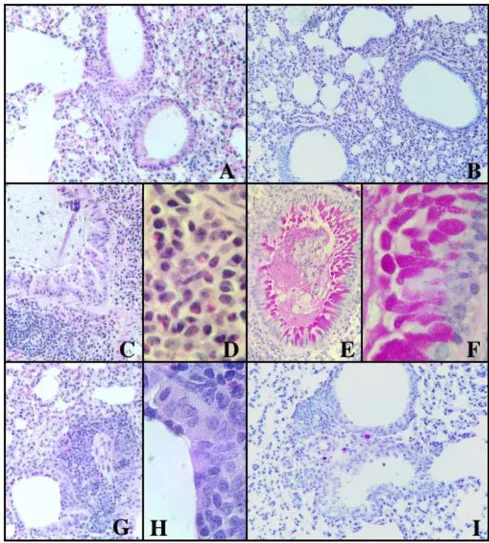
minimal perivascular edema and moderate perivascular cuffing with infiltration of neutrophils and mononuclear cells. These mice also had fewer lesions consistently devoid of eosinophils, although some neutrophils and mononuclear cells were discernible (Fig. 4G &4H). There was also less bronchial epithelial hyperplasia and no gob-let cells (Fig. 4G, H &4I). Control mice treated with PBS and curcumin showed normal lung pathology (Fig. 4A &4B).
Immunohistochemistry
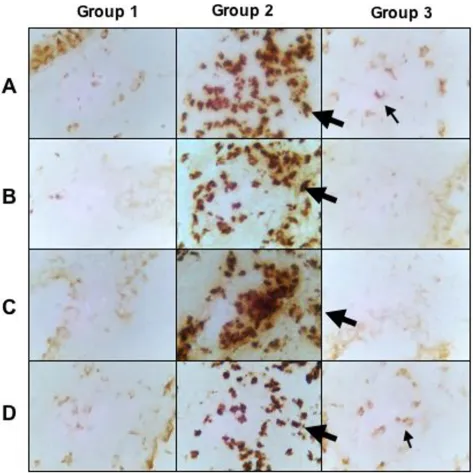
Lung tissue sections were stained for 4, 5, 10, IL-13 and IFN-γ. Cytokine producing cells in the lungs of PBS-treated control mice could only be detected in low numbers for IL-10 and IFN-γ (Fig. 5D). There was a marked increase in lung cells secreting IL-4, IL-5, IL-13, and IFN-γ in the latex-challenged mice (Fig. 5A, B, C, D). Curcumin treatment of latex sensitized mice resulted in a marked decrease in IL-4, IL-5, and IL-13 expressing cells (Fig. 5A, B &5C).
Discussion
Intranasal challenge with latex allergens induced a strong IgE and eosinophil response with characteristic inflamma-tory changes in the lungs of mice as reported previously [21,22]. Other features of this model included enhanced IL-4 secretion by antigen stimulated spleen cells and reduced production of IFN-γ. We also detected slightly enhanced mRNA levels of Ly75 (CD-205), MMP-9, and OAT in mice challenged with latex allergens. Immunohis-tochemistry consistently revealed increased numbers of cells secreting Th2 cytokines in the lungs of mice particu-larly, IL-4, IL-5, and IL-13. All these features are significant biomarkers detected in allergic subjects and particularly in latex allergy [30]. One of the more striking features was the accumulation of large numbers of inflammatory cells in the perivascular and peribronchiolar regions of the lung parenchyma. The infiltrating cells included lym-phocytes, macrophages, and occasional neutrophils with strikingly large numbers of infiltrating eosinophils. Co-stimulatory molecules including CD80, CD86, and OX40L all had increased expression in latex sensitized mice as compared to normal mice [26]. Thus, the model has all the distinguishing features of IgE mediated allergy.
Mice exhibiting allergic responses to latex upon treatment with curcumin showed either reduced expression of sev-eral Th2 parameters or they remained unchanged from normal control mice. It is interesting that no major differ-ences were noted in the antibody levels of the latex chal-lenged mice from those sensitized with latex and treated with curcumin. However, total serum IgE was reduced in the latter group of mice. A complete disappearance of eosinophils in the lungs and a consistent reduction in the inflammatory response as indicated by fewer
inflamma-tory loci were two of the more remarkable features in cur-cumin-treated, latex-sensitized mice. Reduced expression of co-stimulatory molecules on T-lymphocytes, B-lym-phocytes, macrophages, and granulocytes was also noted.
Taken together, our data indicate that curcumin is capable of down regulating the allergic response in mice chal-lenged with latex allergens. Although some of the Th2 responses were only marginally reduced in curcumin-treated, latex-sensitized mice, other Th2 parameters were strikingly reduced. The number of IFN-γ expressing cells in the lungs of latex treated mice also increased indicating an admixture of both Th1 and Th2 responses in this model. It is possible that the lung inflammation may be a result of the IFN-γ mediated Th1 response (Fig. 4C, D, E &4F), while the type 1hypersensitivity is the result of a Th2 cytokine and IgE response [24,31,32]. The fewer lesions and less inflammation in the lung of curcumin-treated, latex-sensitized mice support this contention. IFN-γ levels in the lungs of these animals were much lower than those detected in latex challenged and curcumin treated mice where IFN-γ secreting cells were almost comparable to normal control mice treated with curcumin only. This may have profound influence in eliciting the allergic inflammation, a switch from a Th2 cytokine profile in acute lesions to increased IFN-γ levels and high numbers of cytolytic T cells in chronic lesions, while type 2 cytokines still remain high. The results suggest that curcu-min reduced the IFN-γ producing cells in the lung result-ing in the reduced inflammation that was detected in latex-sensitized mice. Curcumin treatment also reduced various Th2 cytokines producing lung cells.
Histology of the lungs studied from control and experimental mice
Figure 4
Immunohistochemical staining for IL-4, IL-5, IL-13, and IFN-γ of control mice (Group 1), latex challenged mice (Group 2), and latex challenged treated with curcumin (Group 3)
Figure 5
Immunohistochemical staining for IL-4, IL-5, IL-13, and IFN-γ of control mice (Group 1), latex challenged mice (Group 2), and latex challenged treated with curcumin (Group 3). A. IL-4; B. IL-5; C. IL-13; and D. IFN-γ.
markers of lung inflammation showed an overall reduc-tion in latex sensitized and curcumin treated mice.
Previous studies have indicated that curcumin reduces inflammation through inhibition of STAT3 phosphoryla-tion [40]. These same findings also indicated that curcu-min does not inhibit STAT5 or IFN-γ inducible STAT1
expression. However, curcumin has been shown to inhibit
Dermatophagoides farineae induced IL-4 and IL-5
produc-tion similar to what we observed in the present study [15]. It has been reported that NO production by Leishmania
Conclusion
The results presented in this report clearly suggest that cur-cumin, the active ingredient of turmeric, is capable of reducing or suppressing the Th2 response induced in mice by exposing them to latex allergens. Although the exact mechanism is not clearly understood, it is possible that a number of different mechanisms are concurrently at work. This may include suppression of Th2 responses as evidenced by reduced IL-4 and IL-13 production and depletion of eosinophils in the lungs, and attenuation of lung inflammation through expression of molecules such as TSLP, MMP-9, and OAT. The results indicate that curcu-min has potential therapeutic value in allergy. However, further studies are needed to understand the exact mecha-nism involved in curcumin induced suppression of aller-gic responses.
Abbreviations
PBS – phosphate buffered saline; OD – optical density; ELISA – enzyme linked immunosorbent assay; NO – nitric oxide; PAS – periodic acid Schiff; DAB – 3-3-Diaminoben-zidine tetra chloride; MNA – Malaysian non-ammoniated latex; OAT – ornithine amino transferase; MMP – matrix metalloproteinase; TSLP – thymic stromal lymphopoitin
Declaration of Conflicting interests
The author(s) declare that they have no competing inter-ests.
Authors' contributions
VPK was responsible for the overall planning of the exper-iments. CSB contributed towards animal experiments and cell culture studies. RR conducted the molecular biology studies. BDJ carried out the flowcytometric studies. MBL and JNF contributed in the planning and discussions. All the authors contributed to the manuscript preparation.
Acknowledgements
This investigation was partly supported by the U.S. Veterans Administration Medical Research. The technical assistance of Laura Castillo and Nancy Elms and the editorial assistance of Donna Schrubbe are gratefully acknowl-edged.
References
1. Bousquet J, Bousquet PJ, Godard P, Daures JP: The public health implications of asthma. Bull World Health Org 2005, 83:548-554. 2. Masoli M, Fabian D, Holt S, Beasley R: The global burden of
asthma: executive summary of the GINA dissemination committee report. Allergy 2004, 59:469-478.
3. Verlato G, Corsico A, Villani S, Cerveri I, Migliore E, Accordini S, Car-olei A, Piccioni P, Bugiani M, Lo Cascio V, Marinoni A, Poli A, de Marco R: Is the prevalence of adult asthma and allergic rhini-tis still increasing? Results of an Italian Study. J Allergy Clin Immunol 2003, 111:1232-1233.
4. Woolcock AJ, Peat JK: Evidence for the increase in asthma worldwide. In The Rising Trend in Asthma. Ciba Foundation Symposium 206 Chichester, UK: Wiley; 1997:122-134.
5. Bousquet J, Ndiaye M, Alt-Khaled N, Annesi-Maesano I, Vignola AM: Management of chronic respiratory and allergic diseases in
developing countries. Focus on sub-saharan Africa. Allergy 2003, 58:265-283.
6. Bielory LB, Lupoli K: Herbal intervention in asthma and allergy. J Asthma 1999, 36:1-65.
7. Markham AW, Wilkinson JM: Complimentary and alternative medicines (CAM) in the management of asthma: An exami-nation of the evidence. J Asthma 2004, 41:131-139.
8. Huntley A, Ernst E: Herbal medicines for asthma: a systematic review. Thorax 2000, 55:925-929.
9. Bensky D, Gamble A: Chinese herbal medicine. In Materia Medica Seattle : Eastland Press; 1993:360-361.
10. Dai Y, Kon JP, Liu LH: Antiallergic effect of aqueous extract of Wu-hu-tang. J Ethnopharmacol 1997, 55:127-132.
11. Dorsch W, Wagner H: New antiasthmatic drugs from tradi-tional medicine. Int Arch Allergy Appl Immunol 1991, 94:262-265. 12. Hsu CH, Lu CM, Chang TT: Efficacy and safety of modified
Mai-Men-Dong-Tang for treatment of allergic asthma. Ped Allergy Immunol 2005, 16:76-81.
13. Kubo Y, Hossain M, Horie S, Momose T, Suzuki J, Isobe M, Sekiguchi M: Effect of herbal medicine (Sho-seiryu-to and Ryo-kan-kyo-mi-shin-ge-nin-to) on human eosinophil biological function. Phytotherapy Res 1997, 11:485-489.
14. Sakaguchi M, Iizuka A, Yuzurihara M, Ishige A, Komatsu Y, Matsumiya T, Takeda H: Pharmacological characteristics of Sho-seiryu-to, an antiallergic Kampo medicine without effects of hista-mine H1 receptors and muscarinic cholinergic system in the brain. Methods Find Exp Clin Pharmacol 1996, 18:41-47.
15. Kobayashi T, Hashimoto S, Horie T: Curcumin inhibition of Der-matophagoides farinae-induced Interleukin-5 (IL-5) and granulocyte macrophage colony stimulating factor (GM-CSF) production by lymphocytes from bronchial asthmatics. Biochem Pharmacol 1997, 54:819-824.
16. Shivapuri DN, Singhal SC, Prakash D: Treatment of asthma with an alcoholic extract of Tylophora indica: A cross-over, dou-ble blind study. Ann Allergy 1972, 30:407-412.
17. Bharti AC, Takada Y, Aggarwal BB: Curcumin (Diferuloylmeth-ane) inhibits receptor activator of NF-KB Ligand-induced NFB activation in osteoclast precursors and suppresses oste-oclastogenesis. J Immunol 2004, 172:5940-5947.
18. Bremnon P, Heinrich M: Natural products as targeted modula-tors of the nuclear factor-KB pathway. J Pharmacy Pharmacology 2002, 54:453-472.
19. Skrzypczak-Jankun E, Zhon K, McCabe NP, Selman SH, Jankun J: Structure of curcumin in complex with lipoxygenase and its significance in cancer. Int J Mol Med 2003, 12:17-24.
20. Kurup VP, Kumar A, Choi HY, Murali PS, Resnick A, Kelly KJ, Fink JN: Latex antigens induce IgE and eosinophils in mice. Int Arch Allergy Immunol 1994, 103:370-377.
21. Thakker JC, Xia J-Q, Rickaby DA, Krenz GS, Kelly KJ, Kurup VP, Daw-son CA: A murine model of latex allergy-induced airway hyperreactivity. Lung 1999, 177:89-100.
22. Xia J-Q, Rickaby DA, Kelly KJ, Choi HY, Dawson CA, Kurup VP: Immune response and airway reactivity in wild and IL-4 knockout mice exposed to latex allergens. Int Arch Allergy Immunol 1999, 118:23-29.
23. Kurup VP, Mauze M, Choi H, Seymour BWP, Coffman RL: A murine model of allergic bronchopulmonary aspergillosis with ele-vated eosinophils and IgE. J Immunol 1992, 148:3783-3788. 24. Ford JG, Rennick D, Donaldson DD, Venkayya R, McArthur C,
Hansell E, Kurup VP, Warnock M, Grunig G: IL-13 and IFN-γ: Interactions in lung inflammation. J Immunol 2001, 167:1769-1777.
25. Banerjee B, Kelly KJ, Fink JN, Henderson JD Jr, Bansal NK, Kurup VP: Modulation of airway inflammation by immunostimulatory CpG oligodeoxynucleotides in a murine model of allergic aspergillosis. Infect Immun 2004, 72:6087-6094.
26. Barrios CS, Johnson BD, Henderson JD Jr, Fink JN, Kelly KJ, Kurup VP: The costimulatory molecules CD80, CD86, and OX40L are up0regulated in Aspergillus fumigatus sensitized mice. Clin Exp Immunol 2005, 142:242-250.
Publish with BioMed Central and every scientist can read your work free of charge "BioMed Central will be the most significant development for disseminating the results of biomedical researc h in our lifetime."
Sir Paul Nurse, Cancer Research UK
Your research papers will be:
available free of charge to the entire biomedical community
peer reviewed and published immediately upon acceptance
cited in PubMed and archived on PubMed Central
yours — you keep the copyright
Submit your manuscript here:
http://www.biomedcentral.com/info/publishing_adv.asp
BioMedcentral
28. Kurup VP, Guo J, Murali PS, Choi HY, Fink JN: Immunopathologic responses to Aspergillus antigen in interleukin-4 knockout mice. J Lab Clin Med 1997, 130:567-575.
29. Raju R, Dalakas MC: Gene expression profile in the muscles of patients with inflammatory myopathies: effect of therapy with IVIG and biological validation of clinically relevant genes. Brain 2005, 128:1887-1896.
30. Kurup VP, Fink JN: The spectrum of immunologic sensitization in latex allergy. Allergy 2001, 56:2-12.
31. Dixon AE, Mandac JN, Madtes DK, Martin PJ, Clark JG: Chemokine expression in Th1 cell-induced lung injury: Prominence of IFN-γ-inducible chemokines. Am J Physiol Lung Cell Mol Physiol 2000, 279:L592-L599.
32. ten Hacken NHT, Oosterhof Y, Kauffman HF, Guevarra L, Satoh T, Tollerud DJ, Postma DS: Elevated serum interferon -γ in atopic asthma correlates with increased airways responsiveness and circardian peak expiratory flow variation. Eur Respir J 1998, 11:312-316.
33. Al-shami A, Spolski R, Kelly J, Keane-Myers A, Leonard WJ: A role for TSLP in the development of inflammation in our asthma model. J Exp Med 2005, 202:829-839.
34. Gillet M, Vassili S, Watanabe N, Hanabuchi S, Antonenko S, de-Waal-Malefyt R, Liu Y-J: Human dendritic cells activated by TSLP and CD40L induce proallergic cytotoxic T cells. J Exp Med 2003, 197:1059-1063.
35. Zhou B, Comeau MR, De Smedt T, Liggitt HD, Dahl ME, Lewis DB, Gyarmati D, Aye T, Campbell DJ, Ziegler SF: Thymic stromal lym-phopoietin as key initiator of allergic airway inflammation in mice. Nature Immunol 2005, 6:1047-1053.
36. Ricciardolo FLM, Zaagsma J, Meurs H: The therapeutic potential of drugs targeting the arginase pathway in asthma. Expert Opinion on Investigational Drugs 2005, 14:1221-1231.
37. Kurup VP, Raju R, Manickam P: Profile of gene expression in a murine model of allergic bronchopulmonary aspergillosis. Infect Immunity 2005, 73:4381-4384.
38. Zimmermann N, King NE, LaPorte J, Yang M, Mishra A, Pope SM, Muntel EE, White DP, Pagg AA, Foster PS, Anid QH, Rothenberg ME: Dissection of experimental asthma with DNA microarray analysis identified arginase in asthma pathogenesis. J Clin Invest 2003, 111:1863-1874.
39. Simonen-Jokinen T, Maisi P, Tervahartiala T, McGorum B, Pirie S: Direct activation of gelatinase B (MMP-9) by haydust suspen-sion and different components of organic dusts. Vet Immunol Immunopath 2006, 109:289-295.
40. Bharti AC, Donato N, Aggarwal BB: Curcumin (Diferuloylmeth-ane) inhibits constitutive and IL-6 inducible STAT3 phospho-rylation in human multiple myeloma cells. J Immunol 2003, 171:3863-3871.