R E S E A R C H
Open Access
Facilitating evidence uptake: development
and user testing of a systematic review
summary format to inform public health
decision-making in German-speaking
countries
Laura K. Busert
1, Margot Mütsch
2, Christina Kien
3, Aline Flatz
4, Ursula Griebler
3, Manfred Wildner
1, Jan M. Stratil
1,
Eva A. Rehfuess
1*and on behalf of Cochrane Public Health Europe
Abstract
Background:Systematic reviews are an important source of evidence for public health decision-making, but length and technical jargon tend to hinder their use. In non-English speaking countries, inaccessibility of information in the native language often represents an additional barrier. In line with our vision to strengthen evidence-based public health in the German-speaking world, we developed a German language summary format for systematic reviews of public health interventions and undertook user-testing with public health decision-makers in Germany, Austria and Switzerland.
Methods:We used several guiding principles and core elements identified from the literature to produce a prototype summary format and applied it to a Cochrane review on the impacts of changing portion and package sizes on selection and consumption of food, alcohol and tobacco. Following a pre-test in each of the three countries, we carried out 18 user tests with public health decision-makers in Germany, Austria and Switzerland using the‘ think-aloud’method. We analysed participants’comments according to the facets credibility, usability, understandability, usefulness, desirability, findability, identification and accessibility. We also identified elements that hindered the facile and satisfying use of the summary format, and revised it based on participants’feedback.
Results:The summary format was well-received; participants particularly appreciated receiving information in their own language. They generally found the summary format useful and a credible source of information, but also signalled several barriers to a positive user experience such as an information-dense structure and difficulties with understanding statistical terms. Many of the identified challenges were addressed through modifications of the summary format, in particular by allowing for flexible length, placing more emphasis on key messages and relevance for public health practice, expanding the interpretation aid for statistical findings, providing a glossary of technical terms, and only including graphical GRADE ratings. Some barriers to uptake, notably the participants’wish for actionable recommendations and contextual information, could not be addressed.
(Continued on next page)
* Correspondence:[email protected]
1Institute for Medical Information Processing, Biometry and Epidemiology,
Pettenkofer School of Public Health, Ludwig-Maximilians-Universität München, Marchioninistr. 15, 81377 Munich, Germany
Full list of author information is available at the end of the article
(Continued from previous page)
Conclusions:Participants welcomed the initiative, but user tests also revealed their problems with understanding and interpreting the findings summarised in our prototype format. The revised summary format will be used to communicate the results of Cochrane reviews of public health interventions.
Keywords:Systematic review, public health, decision-making, knowledge dissemination, knowledge translation, evidence synthesis, evidence-based public health, GRADE
Background
Systematic reviews that identify, appraise and synthesise all available research findings in relation to a specific re-search question constitute an important source of evi-dence for public health decision-making. Cochrane has become the world’s largest producer of systematic reviews of health interventions and, within this network, Cochrane Public Health is specifically concerned with the effects of population-level health interventions that address the structural and social determinants of health. Cochrane Public Health Europe (CPHE) is the European satellite of Cochrane Public Health [1, 2]. In line with the recently launched Cochrane Collaboration’s Knowledge Transla-tion Strategy [3], one of CPHE’s aims is to support the dis-semination of evidence from Cochrane reviews in the European region and to facilitate an increased and more rapid uptake of findings in public health policy and practice.
Several studies have examined factors that influence the use of evidence in policy-making [4–9]. The literature tends to distinguish between ‘push’activities undertaken by research organisations to disseminate research evi-dence,‘pull’ activities undertaken by decision-makers to access and use research evidence, and‘exchange’activities to build and maintain relationships between researchers and decision-makers [10–13]. Among these activities, decision-makers usually prioritise formal or informal exchange efforts to support evidence-informed decision-making [11]. Furthermore, decision-makers benefit from having highlighted information that is relevant for them and their specific decision-making context (e.g. contextual factors that affect local applicability) and from having sys-tematic reviews presented in a way that allows for rapid scanning for relevance and a graded entry (e.g. key mes-sages followed by a short summary) [14,15]. Factors that inhibit the use of systematic reviews are the length of arti-cles, use of jargon and exclusive publishing for a scholarly audience in academic journals [14, 15]. A systematic re-view of the effectiveness of systematic rere-view summaries in increasing policy-makers’ use of such evidence con-cluded that summaries are somewhat easier to understand than full reviews [16].
In non-English speaking countries, the language of the full systematic reviews often constitutes an additional barrier to accessing evidence, which Cochrane attempts
to overcome by providing translations of abstracts and Plain Language Summaries of Cochrane reviews in mul-tiple languages. With ‘Cochrane Kompakt’ [17], Cochrane groups in the three German-speaking coun-tries undertake and promote the translation of selected up-to-date Plain Language Summaries into German. We are not aware of any other concerted effort to promote the uptake of evidence from systematic reviews in the German language.
In line with our vision to strengthen evidence-based public health in the German-speaking countries and elsewhere and in working towards an increased and more rapid uptake of findings in public health policy and practice, CPHE member institutions joined forces to develop a German language summary format for system-atic reviews of public health interventions. Our objec-tives were to develop a summary format suitable for public health decision-makers in Germany, Austria and Switzerland, and to undertake formal user-testing. While our initial focus was on Cochrane Public Health reviews, ultimately, the summary format should be applicable to Cochrane as well as non-Cochrane reviews of public health interventions.
Methods
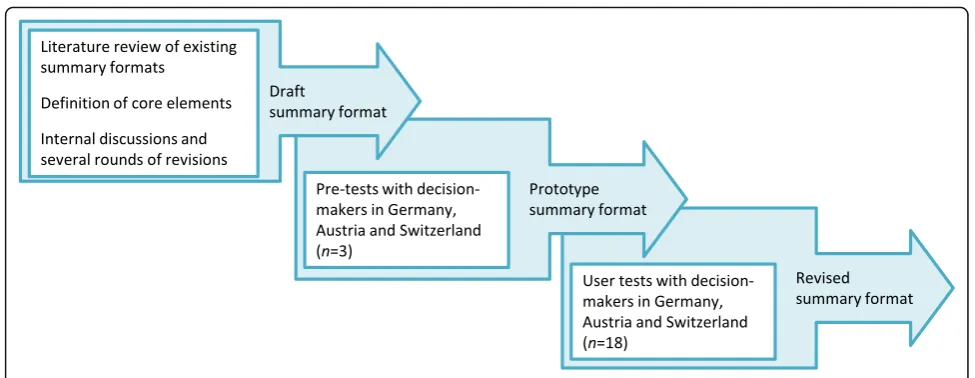
Ethical approval was granted by the Ethics Committee of the Ludwig-Maximilians-Universität München (Munich, Germany), and responsibility waived by the Ethics Committee of the University for Continuing Education (Krems, Austria) and the Ethics Committee Zurich (Zurich, Switzerland). The protocol for this study is available from the corresponding author upon request. Figure1 outlines the process for developing and testing the summary format.
Development of the prototype summary format
Overall structure
The overall structure of the summary format was guided by the so-called‘1–3–25’strategy developed and used by the Canadian Health Services Research Foundation [18]. This strategy proposes a one-page outline of the key mes-sages, a three-page executive summary and a 25-page complete research report. For our purposes, we set out to implement the‘1–3’part and to produce a summary for-mat of four pages. The full systefor-matic review represents the ‘25’ part, even though full systematic reviews, espe-cially Cochrane reviews, are often significantly longer.
Elements specific to systematic reviews
Given its routine use in Cochrane reviews, we decided to include the Summary of Findings (SoF) table to present the main results. This table was critically informed by the Grading of Recommendations Assessment, Development and Evaluation (GRADE) approach to assess the certainty of evidence [19]. In addition to the GRADE rating (i.e. high, moderate, low or very low certainty of evidence), the SoF table also provides information concerning the magnitude of effect of the interventions examined and the available data on all important outcomes for a given com-parison. In those instances, where the SoF table was not considered the best way to present findings or where in-formation provided in this manner was considered insuffi-cient, text was also used.
Public health-relevant aspects
Public health interventions are often highly context dependent [20] and public health decision-makers are thus concerned with factors that may influence the local applicability of findings from systematic reviews. Relevant factors include the specific context in which in-dividual studies were conducted (e.g. setting, country), feasibility of the intervention, acceptability, equity
considerations, differential effects in subgroups, risks as-sociated with the intervention, resource use (costs, inter-vention providers) and value for money [14, 21–23]. One section of the summary format provides space for these aspects to be addressed.
Based on these guiding principles and core elements, we produced a draft summary format and applied it to a recent Cochrane review on the effectiveness of portion, package or tableware size for changing selection and consumption of food, alcohol and tobacco [24]. Given rising obesity rates in Europe and much public debate on the best means to tackle this pressing public health problem at national and international levels, including through regulation, this topic was considered to be highly relevant for public health decision-makers in Germany, Austria and Switzerland.
reference of the systematic review, the authors of the summary and relevant web-links.
User tests
We performed user tests guided by the ‘think-aloud’ method described in the ‘User Test Package’ of Cochrane Norway [25]. In user tests applying the think-aloud method, representatives of the target audi-ence are asked to continuously verbalise their thoughts as they use a prototype of a product, while researchers observe them and listen to their comments [26]. The aim is to obtain a better understanding of the user ex-perience, to observe the users’problems with the prod-uct, to collect their suggestions and to improve the product on the basis of the structured observations and participant feedback. It has been applied to a variety of Cochrane products [27–29] and other knowledge trans-lation formats [30,31].
Participant inclusion criteria and the recruitment process We set out to recruit at least six participants in each of the three countries (18 in total), representing different institutions and levels of decision-making. For the purposes of this project, we defined public health decision-makers as those responsible for or involved in formulating or financing public health-relevant policies, programmes and regulatory measures. In each country, members of the research team identified relevant institu-tions representing public health decision-makers at na-tional and sub-nana-tional levels (i.e. Bavaria for Germany, German-speaking part of Switzerland, lower Austria for Austria). Within these institutions, we identified depart-ments relevant to our work and with whom we either had existing ties or with whom we were planning to es-tablish such ties in the future. We recruited participants to cover a wide range of decision-making experiences and contexts, including heads of department (strategic decision-making) as well as members of staff with re-sponsibility for specific programmes and content matter expertise (programmatic decision-making). We sent an invitation letter to identified individuals within relevant institutions informing them about the aims and process of the study. In case of no response, reminders were sent after 1–2 weeks or the invited individuals were con-tacted by phone.
User test procedure
User testing sessions were conducted face-to-face with individual participants and facilitated by one researcher at each site (LKB, MM, CK). Time and place were agreed upon with each participant individually; user test-ing sessions took place between June and August 2016, usually at the participant’s workplace. Participants were asked whether their contribution could be recorded and
were assured anonymity. Every interviewee agreed to these terms and provided written informed consent. At the start of the interview, the participant was given a printed copy of the prototype summary to read on their own. Using a semi-structured interview guide, the inter-viewer then led participants through each part of the document, encouraging them to keep up a running monologue. The interview guide (Additional file 3) was based on the framework for user experience by Morville [32], which was adapted by Rosenbaum [33]. The eight facets that we chose to cover in our interview guide were credibility, usability, understandability, usefulness, desir-ability, identification, value and findability. An additional ninth facet, accessibility, assessed where the participant would expect to find the summary, and was included to help us develop a dissemination strategy and place fu-ture systematic review summaries appropriately.
The sessions were audio-taped and the interviewer took notes on the participant’s monologue and on their observations of the user experience. Finally, the inter-viewers asked the participants additional questions, e.g. about barriers to the use of systematic reviews in their everyday working life and their familiarity with system-atic reviews.
Analysis
At each of the three study sites, one researcher (LKB, MM, CK) excerpted relevant passages from the respective audio recordings. All data were de-identified before ana-lysis. In a first round, each researcher paraphrased the relevant excerpt, entered it into Microsoft Excel, and manually coded it against the nine pre-determined facets, related it to the section of the product concerned (e.g. SoF table, key messages, GRADE, background), and cate-gorised its quality (general comment; low, medium or ser-ious problem; explicitly positive statement). A second researcher (LKB, MM, CK) checked the initial codings; disagreements were resolved within the team to ensure a consistent coding process. The coded excerpts were ana-lysed for themes and issues that commonly applied across countries. The results of this analysis informed the con-tent and design changes to the summary format.
Revision of the summary format
participants’comments primarily on the feasibility of in-tegrating them within the summary format, the pertin-ence of the comment and the recommendation of the communication specialist.
Results
Participants
We conducted 18 interviews, six at each participating study site. Decision-makers were affiliated with different national and regional public health institutions, predom-inantly government agencies, and represented different levels of seniority ranging from research associate to head of department. Participants had been working in their current position between 6 months and 15 years. When asked whether they believed that the use of re-search evidence was valued in their position, 16 an-swered affirmatively, but four of them did not believe that it was common practise. All but one participant said they knew what a systematic review was, 12 said they had read one, and five had read selected chapters or a summary of a systematic review.
In the analysis, we could not discriminate the facet
‘value’from other facets and found that participants’ re-sponses to that question were already covered in previ-ous responses. We therefore decided not to analyse this facet separately and reported related aspects under the best-fitting facet.
Overall, the summary was well-received and the par-ticipants indicated interest in receiving information about systematic reviews presented in this manner. The following sections present findings across the three countries for each of the eight facets.
Credibility: is the product trustworthy?
At the beginning of the interview, the participants were asked how they rated the document’s credibility based on their first impression. Most considered the summary to be trustworthy. A large majority attributed this to the Cochrane logo placed on top of the first page.
“If it says Cochrane, I know, I can trust it.”
Another reason mentioned frequently was the provision of numbers and the inclusion of the grading of the certainty of the evidence.
“I see RCTs, I see concrete numbers, specifications
regarding percentages, participants–it does give the
impression that it was carefully researched and it
seems that it is a reliable source, that I would trust.”
Furthermore, participants assumed credibility of the summary because it referred to the conflict of interest statements of the included primary studies and followed
a clear and transparent design. Nevertheless, participants missed information that can be expected in a document from a credible source, such as a publication date and the names of the authors of the summary.
Usability: how easy and satisfying is this product to use? Many aspects of the layout and structure (e.g. headings and sub-headings, boxes) received praise. The box ‘ Rele-vance for decision-makers’and key messages were consid-ered to be the most important sections of the summary.
Many participants described the information density as overwhelming and found that it hindered easy use of the document and quick extraction of relevant informa-tion. Feedback regarding the SoF table was particularly controversial. On the one hand, participants praised its structure and noted that they generally liked tables to obtain an overview. On the other hand, the actual use of the SoF tables presented a challenge, where several par-ticipants said that they preferred text and would like to receive more explanations. Another factor that limited the summary’s usability was the time needed to read and actually understand it.
“If I want to understand the text in-depth, then I would
need 10–15 minutes. That’s long. That’s a lot of time. To read the key messages, which frequently show up in
practice, 1–1.5 minutes is the most. If I can’t find what
I am looking for, I put it aside.”
The participants suggested a range of specific changes to formatting and structure that would make the docu-ment easier to use, e.g. more prominent sub-headings and placing the box‘Relevance for public health practice’ together with the key messages on the first page.
Understandability: do users recognise the product category and understand its content?
Most participants found the text-based parts of the sum-mary understandable and the wording appropriate for decision-makers, public health practitioners and lay people.
However, understanding the SoF tables and GRADE ratings caused considerable problems. In the SoF tables, the most important source of confusion were statistical terms such as standard deviation, confidence interval, relative effect, illustrative comparative risk, outcome, and the differences between studies and independent comparisons. Participants appreciated the interpretation aid and said it helped them understand the tables, but additionally suggested the inclusion of the definitions of statistical terms used.
“This is quite a lot of information in such limited
space, particularly in the[SoF]tables. I have the
people with a strong background in statistics. For
example:‘standard deviations higher’. And it is also
somehow assumed that one is familiar with the
evidence rating.[...].I am not sure that this statistical
language is ideal for decision-makers.”
The explanations provided about GRADE and what the different ratings implied did not help participants in-terpret the results, often because they were not familiar with the term ‘effect estimate’. It was also mentioned that there was a discrepancy between the graphical rep-resentation of the ratings and the labels used to describe them, e.g. three out of four points to indicate‘moderate’ quality. They also pointed out that ‘moderate’could be interpreted very differently from its intended meaning and therefore recommended only stating the symbols.
“From our own studies, we know that people interpret
these labels very differently. For me,[‘moderate’]
would mean‘in the middle’. This is not consistent with
three crosses out of four. Therefore, symbols would be clearer to me.”
The participants also wanted information about what GRADE actually implies and how authors arrived at the respective rating.
Usefulness: does this product have practical value for users?
Most participants stated that a summary was useful be-cause it would allow them and their colleagues to obtain a quick overview of the respective topic. Moreover, the language used was considered to be appropriate for both experts and lay people; as the summary was provided by a credible source (Cochrane) it could be presented to ex-ternal partners such as the Ministry of Health.
“Yes, very helpful. We have a high workload and we
need to get the general idea fast. In the department we mostly have lawyers, who need the results presented
in a condensed manner, without too many details.”
The most cited reasons for limitations in the sum-mary’s usefulness were that the certainty of the evidence (‘moderate’or lower) did not allow clear conclusions to be drawn and that it did not provide concrete recom-mendations adapted to the local situation.
“I would expect to find a recommendation for action,
for implementation here.”
Accordingly, participants suggested giving practical ex-amples of how the results could be implemented. They also said that it would help them if the summary already
included contextual information about the legal and pol-itical conditions in their respective country or region.
Desirability: is it something users want and have a positive emotional response to?
Participants much appreciated a summary in German that was easy to understand. The elements carrying a lot of information condensed into simple messages, e.g. key messages, the graphical GRADE ratings and the box on
‘Relevance for decision-makers’, were found particularly appealing.
“What I thought was good is the box with the key
messages. I would, of course, dive into it right away.”
Many participants disliked the high density of infor-mation, particularly in the SoF tables. Graphical illus-trations and more explanations in text form were two examples named to overcome these problems.
Findability: can users locate what they are looking for? Participants liked the visual emphasis of important infor-mation, either by placing such information in a box or by having key terms in bold letters.
“What I always like is that the key messages, like an
abstract, including the results can be easily found right at the beginning, I find that nice because they are
also visually highlighted.”
They also said that some aspects of the formatting made them miss important information, e.g. they over-looked the sub-headings because the font colour was too faint and the surrounding elements very dominant. One participant was confused because the results on alcohol-specific interventions were not found, although this was explicitly described in the title and background as one aspect of the review question.
Identification (Affiliation): do users feel that the product is for people like them?
Participants’ opinions diverged as to whether the summary was for people in positions like their own. Some welcomed the initiative and said that they were looking forward to receiving more such summaries. Others did not think of themselves as the right audi-ence for this format because they lacked the necessary statistical knowledge or needed more comprehensive information.
“The question is who should use this[summary]. […]If
“If I were better at statistical things, but that is just
my personal background[…]My background is
specifically qualitative…”
On a similar note, several participants said that the depth of information was too much for political decision-makers. Title, key messages and a link to more detailed results would be more suitable for this audience.
Accessibility: where would users expect to find the product? How can it be made more accessible?
When asked where they would expect to find systematic review summaries, most participants named those web-based sources where they would usually look for scientific information namely Google, Google Scholar, PubMed, the Cochrane Library, and the homepages of academic and government institutions. When asked how these summaries could be best disseminated, most of them mentioned newsletters and mailing lists and ex-plained that they did not want to have to actively look for them. One participant, however, pointed out that a summary may easily get lost in the daily flood of emails. The need for advertising, for example, at suitable confer-ences, was emphasised.
Barriers to the use of evidence from systematic reviews When asked what stopped them from using evidence from systematic reviews, half of the participants named time constraints. The second most frequent reason was somehow related, i.e. that reviews are usually published in English, which takes longer to read and is more diffi-cult to understand than one’s native language.
“We all speak English to some degree. But it does
make a difference whether I have a review in English in front of me and for only a quick reading think
‘Hmm, not for now.’But if I have this[summary]in
German with key messages and[a section]‘Relevance
for decision-makers’I think‘Oh, yes, that does look
quite interesting, I will have a quick look.’That
definitely helps.”
Other reasons mentioned were lacking access to publi-cations and that reading scientific studies did not fall within their area of responsibility but within that of their members of staff.
Changes to the summary format
We made five substantive changes on the basis of user test results:
(1) Flexible length of summaries: As several participants stated that they would rather receive the information
on more but better-structured pages, we departed from our initial plan of restricting the summary to four pages to make the document more readable. Depending on the systematic review, the summary may range from four to seven pages.
(2) Key messages and relevance for public health practice on front page: As many participants
considered the key messages and‘Relevance for
public health practice’to be the most important
components, we moved these to the first page. This should allow readers to quickly scan the document for relevance and then, if desired, assess detailed information on the following pages.
(3) Expanded interpretation aid: All participants liked the interpretation aid, but nevertheless had problems understanding the results due to the technical terms used and their limited statistical literacy. We expanded the interpretation aid and added an example on what these results could mean for a real-world setting for each outcome in the tables.
(4) Standardised glossary: All participants liked the SoF table, but most had problems understanding the information. We added a glossary on the final pages, in which key technical terms are defined using simple language. This glossary will be included with every summary.
(5) Presentation of GRADE ratings: Participants, most of whom were not familiar with the GRADE approach, reported that a GRADE rating of less
than‘high’would lead them to dismiss the findings
as unusable. We therefore removed the attributes
describing the certainty of the evidence (e.g.‘moderate’)
and solely display this information using symbols.
With support from a health communication specialist, we made a number of additional minor changes to the structure and layout of the summary format (e.g. colour shadings). We also added the names of the authors of the summary on the last page of the summary format. The revised example summary for the Cochrane review on ‘Portion, package or tableware size for changing se-lection and consumption of food, alcohol and tobacco’ was translated into English and is available online (Additional file4). Table1provides a comparison of the structure of the prototype and revised summary format.
Discussion
Key findings
format was well-received and participants indicated their interest in it; they particularly appreciated the key mes-sages, the section ‘Relevance for public health practice’ and to have information readily available in their own language. However, the user tests also revealed a range of problems. Many of these, for example, participants’ difficulties with understanding statistical terms and their wish for a less information-dense structure, were re-solved through our revision of the summary format. Others, however, are more difficult to address, for example, the expressed need for recommendations and contextual information, and are discussed in more detail below.
Comparison with other studies
Participants originated from different professional back-grounds and positions, and hence expressed diverging needs regarding the length of the summaries and related depth of information, ranging from a one-pager to be read in 2 minutes to a more detailed summary of eight pages or more. Sometimes, even individual participants gave conflicting feedback, at one point indicating that the document should be shorter to cater to their limited time frame, at a later point suggesting that more infor-mation should be added. Decision-makers’ preference for short texts and simple messages [4, 5, 14, 31], the seemingly contradictory wish for both brevity and detail [30], and the preference for an accessible structure [34] have also been reported by others. The revised summary format should cater to different types of decision-makers. Most likely strategic decision-makers with very limited time will only scan through the first page whereas programmatic decision-makers with more subject-specific knowledge and a scientific interest will use the full summary.
Participants generally appreciated the inclusion of a SoF table and stated that the provision of GRADE rat-ings conveyed credibility to the information; however, the problems in relation to the interpretation of GRADE
ratings are well-known [31, 35]. Because previous user tests [29, 31] had demonstrated difficulties with under-standing SoF tables and because a previous study [36] found that users want to have an explanatory comment, we included an interpretation aid in the prototype sum-mary format and expanded this in the revised sumsum-mary format. Our user tests corroborated the need for detailed explanations of technical terms found in former studies. There might be a learning effect where participants ex-pect to find the SoF tables and GRADE ratings easier to understand upon repeated exposure [29].
Another challenging observation was the participants’ wish for information outside the scope of a systematic review. Many decision-makers deplored the absence of detailed recommendations and guidance for the imple-mentation of findings, an observation also made in other user testing studies on knowledge translation products [30,31]. Despite acknowledging the importance of these factors, the time and person-power needed to compile such information will make it difficult to produce locally adapted systematic review summaries in a standardised manner and on an ongoing basis.
Strengths and limitations
A strength of our study lies in the participation of a broad range of public health decision-makers from dis-tinct institutions and areas of competence in Germany, Austria and Switzerland. It reflects the diverse needs of strategic as well as more programmatic decision-makers at national and regional levels. In employing user testing, we pursued a non-quantitative approach to capturing the users’ experience with the systematic review sum-mary. We only included six participants per country and may not have captured the full range of experiences with the product in relation to characteristics of sex, age, sociocultural or professional backgrounds.
We conducted our user testing with the summary of a single recent Cochrane review [24]. It is therefore pos-sible that reactions to the summary format by some
Table 1Comparison of the structure of prototype and revised summary format
Prototype Summary Format Revised Summary Format
Page 1 Title; Background, box with Key messages; table listing the review’s inclusion criteria and characteristics of the studies included
Title; box with Key messages categorised by Background, Results, Scientific Background; box‘Relevance for Public Health Practice’
Page 2 Results in Summary of Findings (SoF) table; box with explanation of GRADE ratings
Table listing the review’s inclusion criteria and characteristics of the studies included; box with explanation of GRADE ratings
Page 3 Results in SoF table Results in SoF table
Page 4 Box‘Relevance for decision-makers’listing information on‘Differential effects by subgroup’,‘Funding and conflicts of interest’, and
‘Relevance for Public Health Practice’, Box "Further Information"
Results in SoF table
Page 5 Boxes listing information on‘Differential effects in subgroups
and special characteristics’,‘Study funding and conflicts of interest’,‘Further information’
participants were specific to the content of this system-atic review (e.g. not finding results for alcohol-specific interventions due to the non-availability of eligible stud-ies). In a similar manner, reviews of other public health interventions may present with additional challenges. Further user testing could also serve to explore to what extent it might be useful to split larger reviews into sev-eral summaries (e.g. by splitting the systematic review on portion, package or tableware sizes for changing se-lection and consumption into three shorter summaries focusing on food, alcohol and tobacco, respectively).
The think-aloud method employed in this study has been successfully applied in several previous studies with similar aims [27,29–31], and we found it very suitable to this study’s needs. However, user testing creates an artifi-cial situation and thus cannot fully reflect the real-life situ-ation it is intended to shed light on. By conducting the user tests in the participants’ work places, where they would usually access and read a systematic review sum-mary, we have attempted to attenuate this problem.
In addition, participants were likely aware that the in-terviewers had been involved in the preparation of the summaries, and this may have biased their responses. By continuing to encourage participants to think aloud, to describe their problems with the summary and to make suggestions for improvement, we sought to minimise any social desirability bias. One further strength lies in our analytical rigour. Three researchers independently coded and then cross-checked their colleagues’ work, thereby reducing subjectivity of interpretation.
There is one significant limitation with respect to our overall approach, namely that Cochrane systematic re-views focus on the validity of research findings, and–in line with a‘knowledge shapes policy model’ [37], where evidence affects decision-making through either short-term direct use or longer term thought enlighten-ment [38] – efforts to increase the uptake of research findings are primarily concerned with better dissemin-ation and communicdissemin-ation of evidence. However, uptake of research findings also requires that evidence obtained through a global systematic review be examined with re-spect to its applicability in a local decision-making con-text. A systematic review summary format can help with this translation from generic findings to specific circum-stances, but the summary format by itself is not suffi-cient to enable evidence uptake and use.
Conclusions
Public-health decision-makers in Germany, Austria and Switzerland welcomed the development of a German language summary format for systematic reviews of pub-lic health interventions and indicated their need for and intention to use systematic review summaries presented in this manner. Most participants in the user tests found
the prototype summary format useful and a credible source of information, but the user tests also revealed their problems with understanding and interpreting the findings. As much as possible, the participants’ reflec-tions and suggesreflec-tions were incorporated in the revised summary format. This revised summary format will be used by CPHE to communicate the results of current and future Cochrane reviews of public health interven-tions. By itself, it will not be sufficient to increase the uptake and use of evidence in decision-making, but must be complemented by larger ‘exchange’ efforts. Feeding back to participants and providing summaries of system-atic reviews that respond to their specific information needs presents an important entry-point for establishing longer-term relationships between research and policy and practice, and facilitating exchange efforts to inform evidence-informed decision-making.
Based on the summary format developed for and tested in German-speaking countries, we plan to also de-velop and test an English version. Depending on the ex-perience with both language versions, we also envisage versions to be developed for other languages. In addition, we will explore whether an online summary format is worthwhile, which could contain both standard sections as well as optional sections with variable con-tent designed for specific target audiences such as decision-makers at different levels or the media. We in-vite users to share their experience with the summary format–this will help us to further improve the uptake of research evidence in public health decision-making.
Additional files
Additional file 1:Inventory of existing tools for summarising the findings of systematic reviews in the health field (last search 03/2017). (DOCX 33 kb)
Additional file 2:The prototype summary format applied to the Cochrane review on‘Portion, package or tableware size for changing selection and consumption of food, alcohol and tobacco’(in German). (PDF 126 kb)
Additional file 3:The interview guide as used in the user testing (in German). (DOCX 48 kb)
Additional file 4:The revised summary format applied to the Cochrane review on‘Portion, package or tableware size for changing selection and consumption of food, alcohol and tobacco’(in English). (DOCX 122 kb)
Abbreviations
SoF:summary of findings; CPHE: Cochrane Public Health Europe; GRADE: Grading of Recommendations Assessment, Development and Evaluation
Acknowledgements
summary format. We are grateful to all those who participated in the user testing and who helped us improve the summary format.
Funding
We acknowledge the contribution of the Bavarian Health and Food Safety Authority who supported this work through financing LKB’s and JMS’s positions. The Lower Austria Health and Social Fund supported this research by providing funds for CK’s and UG’s position, and the Swiss School of Public Health by providing funds for AF’s position. The funding bodies had no role in the design of the study, the collection, analysis and interpretation of data, or writing of the manuscript.
Availability of data and materials
The data collected during this study (in German) are available from the corresponding author upon reasonable request.
Authors’contributions
LKB and EAR conceived the study. MM, CK, AF, UG and MW participated in the design of the study. LKB, MM and CK conducted the user tests and analysed results. JMS led the re-design of the summary format. All authors provided comments on previous versions of the manuscript. All authors read and approved the final manuscript.
Ethics approval and consent to participate
Ethical approval was granted by the Ethics Committee of the Ludwig-Maximilians-Universität München (Munich, Germany), and responsibility waived by the Ethics Committee of the University for Continuing Education (Krems, Austria) and the Ethics Committee Zurich (Zurich, Switzerland). All participants gave their written consent to participate.
Competing interests
The authors declare that they have no competing interests.
Publisher’s Note
Springer Nature remains neutral with regard to jurisdictional claims in published maps and institutional affiliations.
Author details
1
Institute for Medical Information Processing, Biometry and Epidemiology, Pettenkofer School of Public Health, Ludwig-Maximilians-Universität München, Marchioninistr. 15, 81377 Munich, Germany.2Epidemiology, Biostatistics and Prevention Institute, University of Zurich, Hirschengraben 84, 8001 Zurich, Switzerland.3Department for Evidence-based Medicine and Clinical Epidemiology, Danube University Krems, Dr.-Karl-Dorrek-Straße 30, 3500 Krems, Austria.4Cochrane Switzerland, Institute of Social and Preventive Medicine (IUMSP), Lausanne University Hospital, Biopôle 2, Route de la Corniche 10, 1010 Lausanne, Switzerland.
Received: 26 July 2017 Accepted: 2 April 2018
References
1. Lhachimi SK, Busert LK, Flatz A, Gartlehner G, Griebler U, Heise TL, Mutsch M, Rehfuess EA. Reaching out to Europe-Cochrane Public Health Europe and its research agenda. Z Evid Fortbild Qual Gesundhwes. 2016;110-111:104–6. 2. Cochrane Public Health Europe.
http://ph.cochrane.org/cochrane-public-health-europe. Accessed 15 April 2018.
3. Cochrane Knowledge Translation Strategy Working Group: Cochrane Knowledge Translation Strategy. n.p.: Cochrane; 2017.http://community. cochrane.org/sites/default/files/uploads/inline-files/Cochrane
%20Knowledge%20Translation%20Strategy%20FINAL%20for%20website.pdf
4. Dobbins M, Jack S, Thomas H, Kothari A. Public health decision-makers’ informational needs and preferences for receiving research evidence. Worldviews Evid-Based Nurs. 2007;4(3):156–63.
5. Dobbins M, Thomas H, O'Brien MA, Duggan M. Use of systematic reviews in the development of new provincial public health policies in Ontario. Int J Technol Assess. 2004;20(4):399–404.
6. Dobbins M, Cockerill R, Barnsley J. Factors affecting the utilization of systematic reviews. A study of public health decision makers. Int J Technol Assess Health Care. 2001;17(2):203–14.
7. Dobbins M, Rosenbaum P, Plews N, Law M, Fysh A. Information transfer: what do decision makers want and need from researchers? Implement Sci. 2007;2:20.
8. Jewell CJ, Bero LA.“Developing good taste in evidence”: facilitators of and hindrances to evidence-informed health policymaking in state government. Milbank Q. 2008;86(2):177–208.
9. Tricco AC, Cardoso R, Thomas SM, Motiwala S, Sullivan S, Kealey MR, Hemmelgarn B, Ouimet M, Hillmer MP, Perrier L, et al. Barriers and facilitators to uptake of systematic reviews by policy makers and health care managers: a scoping review. Implement Sci. 2016;11:4.
10. Ellen ME, Léon G, Bouchard G, Lavis JN, Ouimet M, Grimshaw JM. What supports do health system organizations have in place to facilitate evidence-informed decision-making? a qualitative study. Implement Sci. 2013;8:84.
11. Ellen ME, Leon G, Bouchard G, Ouimet M, Grimshaw JM, Lavis JN. Barriers, facilitators and views about next steps to implementing supports for evidence-informed decision-making in health systems: a qualitative study. Implement Sci. 2014;9:179.
12. Lavis JN, Lomas J, Hamid M, Sewankambo NK. Assessing country-level efforts to link research to action. Bull World Health Organ. 2006;84(8):620–8. 13. Ellen ME, Lavis JN, Ouimet M, Grimshaw J, Bédard PO. Determining research
knowledge infrastructure for healthcare systems: a qualitative study. Implement Sci. 2011;6:60.
14. Lavis J, Davies H, Oxman A, Denis JL, Golden-Biddle K, Ferlie E. Towards systematic reviews that inform health care management and policy-making. J Health Serv Res Policy. 2005;10(Suppl 1):35–48.
15. Lavis JN. How can we support the use of systematic reviews in policymaking? PLoS Med. 2009;6(11):e1000141.
16. Petkovic J, Welch V, Jacob MH, Yoganathan M, Ayala AP, Cunningham H, Tugwell P. The effectiveness of evidence summaries on health policymakers and health system managers use of evidence from systematic reviews: a systematic review. Implement Sci. 2016;11(1):162.
17. Cochrane Kompakt.http://www.cochrane.org/de/evidence. Accessed 15 April 2018.
18. Reader-friendly writing - 1:3:25.http://www.cfhi-fcass.ca/
PublicationsAndResources/ResourcesAndTools/CommunicationNotes/10-06-01/d497a465-5398-4ec8-addf-d7cbf86b1e43.aspx. Accessed 15 April 2018. 19. What is GRADE?http://www.gradeworkinggroup.org/. Accessed 15 April
2018.
20. Pfadenhauer LM, Gerhardus A, Mozygemba K, Lysdahl KB, Booth A, Hofmann B, Wahlster P, Polus S, Burns J, Brereton L, et al. Making sense of complexity in context and implementation: the Context and
Implementation of Complex Interventions (CICI) framework. Implement Sci. 2017;12(1):21.
21. Vogel JP, Oxman AD, Glenton C, Rosenbaum S, Lewin S, Gulmezoglu AM, Souza JP. Policymakers’and other stakeholders’perceptions of key considerations for health system decisions and the presentation of evidence to inform those considerations: an international survey. Health Res Policy Syst. 2013;11:19.
22. Guindo LA, Wagner M, Baltussen R, Rindress D, van Til J, Kind P, Goetghebeur MM. From efficacy to equity: Literature review of decision criteria for resource allocation and healthcare decisionmaking. Cost Eff Resour Alloc. 2012;10(1):9.
23. Cromwell I, Peacock SJ, Mitton C. Real-world’health care priority setting using explicit decision criteria: a systematic review of the literature. BMC Health Serv Res. 2015;15:164.
24. Hollands GJ, Shemilt I, Marteau TM, Jebb SA, Lewis HB, Wei Y, Higgins JP, Ogilvie D. Portion, package or tableware size for changing selection and consumption of food, alcohol and tobacco. Cochrane Database Syst Rev. 2015;9:CD011045.
25. Cochrane Norway. Our user test package. Retrieved 03.06.2016. 2013.http:// www.cochrane.no/our-user-test-package
26. Thinking Aloud: The #1 Usability Tool.https://www.nngroup.com/articles/ thinking-aloud-the-1-usability-tool/. Accessed 15 April 2018.
27. Rosenbaum SE, Glenton C, Cracknell J. User experiences of evidence-based online resources for health professionals: User testing of The Cochrane Library. BMC Med Inform Decis Mak. 2008;8:34.
29. Rosenbaum S, Glenton C, Nylund H, Oxman A. User testing and stakeholder feedback contributed to the development of understandable and useful summary of findings tables for Cochrane Reviews. J Clin Epidemiol. 2010;63:607–19. 30. Mijumbi-Deve R, Rosenbaum SE, Oxman AD, Lavis JN, Sewankambo NK.
Policymaker experiences with rapid response briefs to address health-system and technology questions in Uganda. Health Res Policy Syst. 2017; 15(1):37.
31. Rosenbaum S, Glenton C, Wiysonge C, Abalos E, Mignini L, Young T, Althabe F, Ciapponi A, Marti S, Meng Q, et al. Evidence summaries tailored to health policy-makers in low- and middle-income countries. Bull World Health Organ. 2011;89:54–61.
32. User Experience Design.http://semanticstudios.com/user_experience_design/. Accessed 15 April 2018.
33. Rosenbaum S. Improving the user experience of evidence. Oslo: AHO: The Oslo School of Architecture and Design; 2010.
34. Ellen ME, Lavis JN, Wilson MG, Grimshaw J, Haynes RB, Ouimet M, Raina P, Gruen R. Health system decision makers’feedback on summaries and tools supporting the use of systematic reviews: a qualitative study. Evid Policy. 2014;10(3):337–59.
35. Rehfuess EA, Akl EA. Current experience with applying the GRADE approach to public health interventions: an empirical study. BMC Public Health. 2013;13:9. 36. Carrasco-Labra A, Brignardello-Petersen R, Santesso N, Neumann I, Mustafa RA, Mbuagbaw L, Etxeandia Ikobaltzeta I, De Stio C, McCullagh LJ, Alonso-Coello P, et al. Improving GRADE evidence tables part 1: a randomized trial shows improved understanding of content in summary of findings tables with a new format. J Clin Epidemiol. 2016;74:7–18.
37. Boswell C, Smith K. Rethinking policy“impact”: four models of research-policy relations. Palgrave Communications. 2017;44(3):1–11