AIRCRAFT PERFORMANCE: THE EFFECTS OF THE MULTI
ATTRIBUTE DECISION MAKING OF NON TIME DEPENDANT
MAINTAINABILITY PARAMETERS
Olja Čokorilo1
University of Belgrade, Faculty of Transport and Traffic Engineering, Vojvode Stepe 305, 11000 Belgrade, Serbia
Received 15 December 2010; accepted 18 March 2011
Abstract: The aircraft maintenance is a complex and costly procedure (12-15% of total annual company costs). In this paper, aircraft maintainability was investigated by multi-attribute analyzing of non-time dependant parameters. With the aim of defining aircraft maintainability rank, the modified MAXMIN method was developed. The research was realized on the sample of five representative regional aircraft: Do328JET, CRJ-200, ERJ145, ATR42 and Fokker 50. The results obtained would help determine airline’s fleet.
Key words: aircraft, maintenance, multi-attribute decision making, modified MAXMIN method
1 Corresponding author:[email protected]
1. Introduction
Regular maintenance is necessary in order to maintain (or restore) the aircraft structure, systems and components in an airworthy condition. These can be grouped as: airframe, engine and APU components and “rotables” (Parts that are repaired/re-conditioned and returned to service). Aircraft and engine manufacturers publish documentation for maintenance planning purposes for their aircraft and engine families. These contain the minimum required maintenance tasks and how and when they should be carried out, for example: Airbus – Maintenance Planning Document (MPD); Boeing – Maintenance Planning Data (MPD) document (Kinnison, 2004). Traditionally, these maintenance tasks are divided into categories – ‘line’/‘transit’,
‘A’, ‘B’, ‘C’ and ‘D’ (from the lightest to the heaviest) – enabling aircraft operators to plan regular inspections.
The aircraft maintenance is a complex and costly procedure (12-15% of total annual company costs. Since variety of costs cannot be affected (e.g. fuel prices, airport handling and landing fees, navigation fees, aircraft market price), airlines could control technical maintenance through an established maintenance program. Each of the maintenance programs is aimed at optimizing the number of operations and maximizing the aircraft safety.
flown on a given route. This is the primary constraint faced by the maintenance planners who must schedule inspection for each plane in the fleet in compliance with the regulations. In this paper, aircraft maintainability was investigated by multi-attribute analyzing of non-time dependant parameters. With the aim of defining aircraft maintainability rank, the modified MAXMIN method was developed. The research was realized on the sample of five representative regional aircraft: Do328JET, CRJ-200, ERJ145, ATR42 and Fokker 50. The results obtained would help determine airline’s fleet. Models and algorithm for fleet assignment are given in (Čokorilo et al., 2010; Abara, 1989; Hane et al., 1995; and Subramanian et al., 1994).
2. Aircraft Maintainability
To provide the public with a perpetually safe, reliable air transportation system, it is important to have a sound aircraft maintenance system (FAA, 1991). The maintenance system is a complex one with many interrelated human and machine components (Kraus and Gramopadhye, 1999). Positioning of some aircraft systems may facilitate or hinder access to them. Even if the systems are accessible, the need for extra equipment for the access to components may arise. In practice, in cases that occur at small airports that are not adequately equipped with necessary machinery where it is not possible to eliminate the defect the plane has to be withdrawn from scheduled traffic and to make an “empty” flight to the airport where it is possible to remove the damage. Aircraft maintenance takes place in a series of checks of increasing diligence with the exception of unscheduled fixes. The frequency of these checks depends on the combination of flight hours and number of take-off and landing cycles, and may be performed at any site appropriately equipped. Because each aircraft
type has a different inventory requirement, little savings can be achieved by combining facilities for different fleets (Sriram and Haghani, 2003).
During the operation process, a system performs a desired function and produces certain yield and gain, and during the maintenance process, system functionability is maintained/restored (Vasov et al., 2009).
Aircraft size defines maintenance costs in terms of the number of workers, their qualifications, additional equipment, machinery and materials. It is therefore important to compare similar aircraft (such as the ones we havechosen Do328JET, CRJ-200, ERJ145, ATR 42 and Fokker 50) and use outputs as a recommendation to the companies that plan to purchase regional aircraft for their fleet. Therefore, multiple criteria methods could be used for considering characteristics of the observed aircraft and determine their ranking in terms of maintainability.
Aircraft maintainability of Do328JET, CRJ-200, ERJ145, ATR 42 and Fokker 50 could be compared by variety of criteria. This paper analyses the most important criteria based on its practice during the normal operations. The list of analyzed criteria is listed below:
1. Economical parameters – DMCunit
(Average unit direct maintenance costs defined by A.E.A. method).
2. Wingspan. Complexity of flight commands which are the function of wing dimensions could cause harder and longer maintenance process. Furthermore, long wingspan could be the limitation for parking an aircraft into certain hangar space.
foreign objects into the engine. The advantage of such a position is the easiest access to power plant without using additional equipment which is necessary in case of positioning the engine on fuselage close to the tail unit.
4. Wing height to sill. Lower height provides easier access to flight commands and fuel tanks.
5. Main landing gear leg length. The complexity of landing gear leg and thus the complexity of its maintenance depending on whether the aircraft is high or low wing constructed.
6. Power plant positioning related to wing/ fuselage. From the maintenance point of view the best solution is positioning the engine on wing section. It causes simpler approach and servicing, even if the wing is by itself a very complex system (flight controls, fuel tanks). Positioning on fuselage section provides additional danger due to the engine’s closeness to passenger cabin. It also requires complexity of fuel distribution system installations.
7. Door height to sill service. Lower height provides easier access into aircraft without additional equipment.
8. Baggage door height to sill. Lower height provides easier access and the possibility of cargo department servicing.
9. Horizontal tail height to sill. Lower height provides easier and faster access to horizontal tail unit. When it is located on the fuselage, it is possible to make an access without additional equipment, using only stairways or similar utilities.
10. Vertical tail height to sill. Vertical tail height defines hangar usage, as well as the possibility of tail unit access.
11. Auxiliary Power Unit (APU) height to sill.
Positioning APU close to the runway surface provides easier access to this system.
12. Fuselage overall length. In practice it may happen that the fuselage overall length does not match the dimensions of the hangar, which could provide difficulties for aircraft visual check.
From the maintenance requirements point of view, presented criteria are not equally ranked. For example, it is important to have low horizontal tail height to sill, but it is even more important to provide DMCunite as
low as possible. Although, there is a causal relationship between some of the individual criteria, some may be given priority in selecting an aircraft suited for maintenance works.
3. Data Collection
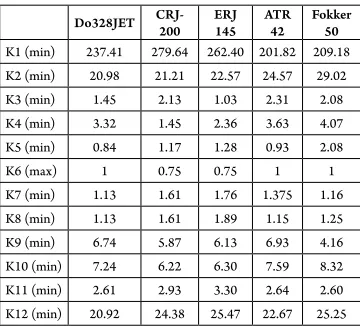
The objective of this paper is to present an innovative mathematical formulation and an effective methodology to solve the aircraft maintenance problem. In this paper, the above defined criteria were evaluated based on real values, except for criteria related to power plant positioning upon wing / fuselage which was estimated subjectively by the scale from 0 to 1 (Table 1).
Table 1
Evaluated criteria assessment
Do328JET CRJ-200 ERJ 145 ATR 42 Fokker 50
K1 (min) 237.41 279.64 262.40 201.82 209.18 K2 (min) 20.98 21.21 22.57 24.57 29.02
K3 (min) 1.45 2.13 1.03 2.31 2.08
K4 (min) 3.32 1.45 2.36 3.63 4.07
K5 (min) 0.84 1.17 1.28 0.93 2.08
K6 (max) 1 0.75 0.75 1 1
K7 (min) 1.13 1.61 1.76 1.375 1.16
K8 (min) 1.13 1.61 1.89 1.15 1.25
K9 (min) 6.74 5.87 6.13 6.93 4.16
K10 (min) 7.24 6.22 6.30 7.59 8.32
K11 (min) 2.61 2.93 3.30 2.64 2.60
Data collection is based on the published manuals of a manufacturer (Lockheed, 1972; Fairchild Dornier, 1998; Bombardier, 1994), aircraft annual publications (Lambert, 1991) and other available recourses (BADA, 2007) except for the data provided for economical parameters which were calculated based on direct maintenance costs. Direct maintenance costs (DMC) present part of aircraft direct operating costs and could be expressed by Eq. (1).
(1)
Where is:
DMC - Direct Maintenance Costs
MMHon – Maintenance Man Hours on
Aircraft
MMHoff – Maintenance Man Hours off
Aircraft
LR – Labor Rate
MC – Material Cost
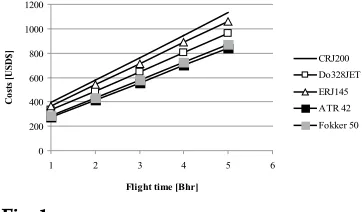
Calculated DMC for aircraft Do328JET, CRJ-200, ERJ145, ATR42 and Fokker 50 based on A.E.A. method are presented in Fig 1.
Fig. 1.
Direct Maintenance Costs
According to the presented results (Fig.1), average unit direct maintenance costs (DMCunit) were obtained as it is presented in
Table 2.
Table 2
Average Unit Direct Maintenance Costs (DMCunit) in USD$
CRJ200 Do328JET ERJ145 ATR 42 Fokker 50 279.64 237.41 262.40 201.82 209.18
4. DESCRIPTION OF THE METHOD
FOR AIRCRAFT RANKING BASED ON
MAINTAINABILITY PARAMETERS
The paper describes a decision making methodology for aircraft ranking based on different criteria. With the aim of defining aircraft rank, the modified MAXMIN method was developed. Generally, MAXMIN method presents the most widely used rule of inference. According to (Mamdani and Gaines, 1981), the MAXMIN method was based on the ideas of (Zadeh, 1975) and is based on the linguistically expressed rule. Therefore, the method based on the Saaty scale (Saaty, 1977; Saaty, 1980) was used for developing the weights of different criteria. This analytic hierarchy process has emerged in the last two decades as a major tool for multi attribute decision analysis.
As noticed before, the final outputs of this method are the normalized weights of criteria. The following algorithm performs a methodology for weight normalization presented in Eq. (2):
1. Define the total number of criteria for alternative ranking (nk).
2. Estimate relationship between each pair of criteria (ki, kj; i,j=1..m) by applying the Saaty scale (1-9).
(2)
Based on the proposed method, normalized weights for certain criteria were calculated (Table 3).
Table 3
Normalized criteria’s weight
k1 k2 k3 k4 k5 k6
0.241 0.174 0.125 0.124 0.080 0.079
k7 k8 k9 k10 k11 k12
0.054 0.036 0.036 0.018 0.018 0.014
4.1. Algorithm
The proposed algorithm takes into consideration the following steps:
1. Select 2 or more aircraft (alternatives); 2. Select maintainability parameters
(criteria) for certain conditions (e.g. unit direct maintenance costs);
3. Apply the method of the normalized weightsof criteria based on the Saaty scale to compare each pair of criteria by transforming subjective linguistic expressions into the normalized weights; 4. Apply the modified MAXMIN method for
the chosen alternatives (aircraft), defined criteria (maintainability parameters) and the normalized weights of criteria;
5. Analyze the obtained results and propose countermeasures (the obtained aircraft rank presents an aircraft sorted list from the best to the worst solution for the observed conditions).
4.2. Modified MAXMIN method
Ai – alternative, i = 1..n kj – criteria, j = 1..m
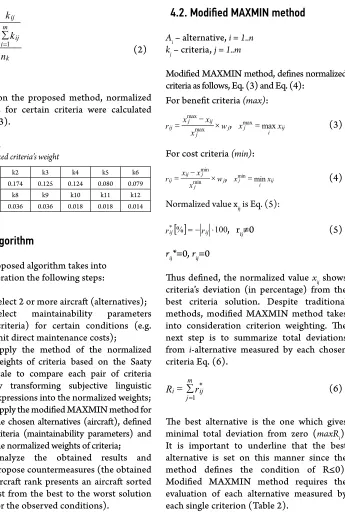
Modified MAXMIN method, defines normalized criteria as follows, Eq. (3) and Eq. (4):
For benefit criteria (max):
, (3)
For cost criteria (min):
, (4)
Normalized value xij is Eq. (5):
, rij≠0 (5)
rij*=0, rij=0
Thus defined, the normalized value xij shows
criteria’s deviation (in percentage) from the best criteria solution. Despite traditional methods, modified MAXMIN method takes into consideration criterion weighting. The next step is to summarize total deviations from i-alternative measured by each chosen criteria Eq. (6).
(6)
The best alternative is the one which gives minimal total deviation from zero (maxRi).
5. Results
For pre-defined inputs (normalized relative weights of criteria and evaluated values of alternatives), modified MAXMIN method gives the following aggregate deviation from zero: RDo328= -27,84; RCRJ200= -33,77; RERJ145=
-30,48; RATR42= -42,18; RF50= -55,94. Based
on the obtained results, MAXMIN modified method determines the following aircraft maintainability rank:
(1)Do328JET (2) ERJ 145 (3) CRJ-200 (4) ATR 42 (5) Fokker 50.
6. Conclusion
This paper aims at aircraft rank assessment based on aircraft maintainability parameters. Therefore, aircraft maintainability was investigated by multi-attribute analyzing of non-time dependant parameters. The proposed multi attribute decision-making methodology considers the items determined to be important for understanding the most important maintainability characteristics of a regional aircraft. These items include average unit direct maintenance costs, wingspan, baggage and service door height to sill, APU, vertical and horizontal tail height to sill, etc. Although this research considers five representative regional aircraft (Do328JET, CRJ-200, ERJ145, ATR42 and Fokker 50), it is probably exportable to any regional aircraft.
In addition, airline management could use this method as assistance in determining the fleet. The proposed methodology applied to different regional aircraft types could provide a consistent database. Further research can debate the utilization of the outputs from
the proposed methodology to establish an extended database to improve a tool for airline decision-making that depends on the maintainability conditions and financial soundness of the carrier.
Acknowledgements
This paper is based on the project TR36027: “Software development and national database for strategic management and development of transportation means and infrastructure in road, rail, air and inland waterways transport using the European transport network models” which is supported by the Ministry of science and technological development of Republic of Serbia (2011-2014).
References
Abara, J., 1989. Applying integer linear programming to the fleet assignment problem. Interfaces 19(4): 20–28. BADA, 2007. Base of Aircraft Data. Brussels: EUROCONTROL. 68 p.
Bombardier Regional Aircraft Division. 1994. Canadair Regional Jet Program Overview, Market Research & Product
Strategy. Montreal: Bombardier Inc. 192 p.
Čokorilo, O.; Gvozdenović, S.; Mirosavljević, P.; Vasov, L. 2010. Multi attribute decision making: assessing the technological and operational parameters of an aircraft. Transport 25(4): 352-356. DOI: 10.3846/ transport.2010.43.
FAA, 1991. Human factors in aviation maintenance -–Phase one progress report, DOT/FAA/AM-91/16. Washington, DC: Office of Aviation Medicine.
Fairchild Dornier, 1998. 328JET Program. Germany: Fairchild Dornier GmbH. 40 p.
Hane, C.A.; Barnhart, C.; Sigismindi, G. 1995. The fleet assignment problem: solving a large scale integer program. The Mathematical Programming Society 70: 211– 231.
Kinnison, H. A. (2004). Aviation Maintenance Management. Europe: McGraw-Hill Education. Europe. 291 p. Kraus, D.; Gramopadhye, A.K. 1999. Team training: role of computers in the aircraft maintenance environment.
Lambert, M., 1991. Jane’s all the World’s Aircraft 1990-91. Virginia: Eighty-first edition. 807 p.
Lockheed., 1972. Maintainability and Reliability Features. California: Lockheed - California Company. 115 p. Mamdani, E.H.; Gaines, B.R. 1981. Fuzzy Reasoning and
its Applications. Academic Press, London: Academic Press.
381p.
Saaty, T.L., 1977. A scaling method for priorities in hierarchical structures. J. Math. Psychol. 15: 234-281. Saaty, T.L., 1980. The Analytic Hierarchy Process. McGraw-Hill , New York: McGraw-McGraw-Hill. 287 p.
Sriram C.; Haghani A. 2003. An optimization model for aircraft maintenance scheduling and re-assignment.
Transportation Research Part A 37: 29–48.
Subramanian, R.; Scheff Jr., R.P.; Quillinan, J. D. 1994. Coldstart: fleet assignment at Delta Airlines. Interfaces
24(1): 104–120.
Vasov, Lj.; Stojiljković, B.; Mitrović, Č. 2009. Reward level evaluation of parallel systems, Strojniski Vestnik -
Journal of Mechanical Engineering 55(9): 542-548.
Zadeh, L.A. 1975. The concept of a linguistic variable and its application to approximate reasoning I, II, III. Inf.Sci.
8(1975): 199-257, 301-357; 9(1975): 43-80.
ODRŽAVANJE VAZDUHOPLOVA
PRIMENOM VIŠEKRITERIJUMSKE
ANALIZE PARAMETARA KOJI NISU U
FUNKCIJI VREMENA
Olja Čokorilo
Sažetak: Održavanje vazduhoplova predstavlja složenu proceduru koja za posledicu ima visoke troškove održavanja (12% do 15% ukupnih godišnjih troškova aviokompanije). U ovom radu, razmatrana je pogodnost aviona za održavanje, višekriterijumskom analizom parametara koji nisu u funkciji vremena. U tom cilju razvijena je modifikovana MAXMIN metoda koja za unapred definisane ulazne parametre daje izlazni rang pogodnosti aviona za održavanje. Istraživanje je sprovedeno na uzorku od pet reprezentativnih regionalnih aviona: Do328JET, CRJ-200, ERJ145, ATR42 i Fokker 50. Dobijeni rezultati se mogu iskoristiti kao preporuka aviokompaniji prilikom izbora flote.