ISSN: 2231-5381
http://www.ijettjournal.org
Page 230Keyless Car Entry Authentication System Based on
A Novel Face-Recognition Structure
I.Amulya Mr. K. Sreenivasa Rao, M.Tech VLSI System Design, Associate Professor, Dept: ECE,
AITS, Rajampet, AITS, Rajampet,
Kadapa (DT) Kadapa (DT)
Abstract: In this paper, a smart car security
system is proposed, which consists of a face detection subsystem, a GPS (Global Positioning System) module, a GSM (Global System for Mobile Communications) module and a FPGA. The face detection subsystem bases on optimized PCA algorithm and can detect faces in cars and make interaction with the car owner through GSM. The GPS sends the location of the car. Even when the car is lost we can get thief face image as well as location of the car so this is most reliable car security system. The car owner may allow new persons also to drive the car using the password. So this car security system is more secure and comfortable.
I. Introduction
The main aim of this project is to offer an
advance security system in automotives, in which
consists of a face detection subsystem, a GPS (Global
Positioning System) Module, a GSM (Global System
for Mobile Communications) module and a control
platform.
This Keyless car entry Authentication System
Based on A Novel Face-Recognition Structure is
used to detect the face of the driver and compare it
with the predefined face, for example, in the night
when the car’s owner is sleeping and someone theft
the car then FDS obtains images by one tiny web
camera which can be hidden easily in somewhere in
one car. FDS compares the obtained image with the
predefined images if the image doesn’t match then
the information is send to the owner through MMS.
So now owner can obtain the image of the theft in his
mobile as well as he can trace the location through
GPS. The location of the car can be displayed to the
owner through SMS. So by using this system owner
can identify the theft image as well as the location of
the car.
II. Existing system
In modern world, communication techniques
have been integrated into car security systems. At the
same time, the amount of cars lost still remains high.
Previous techniques are sensor based systems,
ISSN: 2231-5381
http://www.ijettjournal.org
Page 231 security systems rely on many sensors and cost a lot.When one car is really lost, no more feedback could
be valid to help people to find it back. No
information to the Owner if Car get Lost about car
position in Alarm and physical key systems.
Communication techniques using transmitters also
fails to give complete information and also some
systems uses Bluetooth, mails should also not give
information about thief face. Some systems with face
detection system also not have the password facility
to allow new persons to drive the car.
III. Proposed System
The proposed system bases on face
recognition which is most important biometric used
by humans. So security is high in this system. In this
system Spartan 3An FPGA is used for controlling all
the units. Here a webcam is used for taking the
image. GSM is used for sending the MMS; GPS is
used for sending the location of the car.
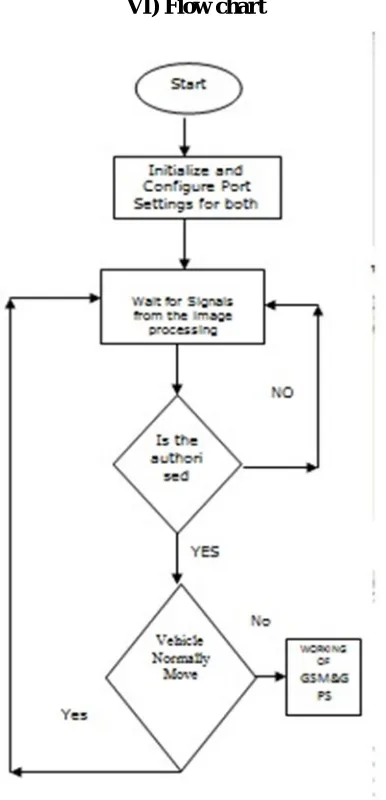
When a new person is entered into the car the
webcam will take the face image and sends it to the
computer. PC compares the image with the database
images. If it matches then it sends person i9s
authorized message otherwise it gives person is not
authorized message. When the person is not
authorized then GSM and GPS Starts working. GSM
sends MMS to the mobile and GPS sends location of
the car. If the car owner wants to allow the new
person then he use a password.
Fig: Proposed system architecture
This system is built on the base of one FPGA
SPARTAN 3AN which controls all the processes.
Experimental results illuminate the validity of this car
security system.
IV. Basic Commands of Matlab:
MATLAB is a high-level language and interactive
environment for numerical computation,
visualization, and programming. Using MATLAB,
you can analyze data, develop algorithms, and create
models and applications. The language, tools, and
built-in math functions enable you to explore
multiple approaches and reach a solution faster than
with spreadsheets or traditional programming
languages, such as C/C++ or Java.
A. Vectors
A vector in MATLAB is defined as an array which has only one dimension with a size greater
than one. For example, the array [1, 2, 3] counts as a
ISSN: 2231-5381
http://www.ijettjournal.org
Page 232 with vectors which don't make a lot of sense withother arrays such as matrices. However, since a
vector is a special case of a matrix, any matrix
functions can also be performed on vectors as well
provided that the operation makes sense
mathematically (for instance, you can
matrix-multiply a vertical and a horizontal vector). This
section focuses on the operations that can only be
performed with vectors.
Declare vectors as if they were normal arrays, all
dimensions except for one must have length 1. It
does not matter if the array is vertical or horizontal.
For instance, both of the following are vectors:
>> Horiz = [1, 2, 3];
>> Vert = [4; 5; 6];
B.Functions
MATLAB allows you create variables on the fly.
To create a variable just use it on the left hand side of
an equal sign. The following examples show how to
assign values to three variables, x, y and z. It also
shows the MATLAB response to the assignment
statements.
>> x = 5
x = 5
>> y = pi/4
y = 0.7854
>> z = y + x^0.25
z = 2.2807
Note that z exists only as a numerical value, not as
the formula with which it was created.
V)IMAGE RECOGNISATION:
Image Recognition consists of three parts database,
feature extraction and classification. Database
consists of set of known faces. Feature extraction
means calculating the Eigen values and Eigen
vectors. Classification means comparing the Eigen
values of database images with new image.
Fig: Face database
ISSN: 2231-5381
http://www.ijettjournal.org
Page 233VI) Flow chart
Fig. flow chart of the project
VII) Experimental Results
Experiments are performed on gray level
images to verify the proposed method. These images
size is 640x480. Images shows experiment outputs
are shown in below figure.
Fig: when code is firstly run this image
Will be appeared
Fig: Image when database is added
Fig: Image when person is not authorized
ISSN: 2231-5381
http://www.ijettjournal.org
Page 234 VIII. ConclusionThis project implements a secured and safe
system for cars Face is the most important biometric
so security is high in the systems. By using face
recognition we can get the thief image as well as
location, so we can easily find the car. It is also used
for home, ship and Bank security applications.
IX. References
1] Joseph A. O'Sullivan, Robert Pleas, “Advances in
SecurityTechnologies: Imaging, Anomaly Detection,
and Target and Biometric Recognition”, Microwave
Symposium IEEE/MTT-S International Volume,
Page(s):761 – 764, 2007.
[2] Viola P, Jones M, “Rapid Object Detection using
a Boosted Cascade of Simple Features” Proceedings
of the 2001 IEEE Computer Society Conference on
Computer Vision and Pattern Recognition, p511,
2001
[3]Jian Xiao, Haidong Feng. “A Low-cost
Extendable Framework for Embedded Smart Car
Security System “Proceedings of the 2009 IEEE
International Conference on Networking, Sensing
and Control, Okayama, Japan, March 26-29, 2009
[4]Lihe, LvFlang “Design of Intelligent Mobile
Vehicle Checking System Based on ARM7”
[5] Lien hart R, Kuranov A, Pisarevsky, “Empirical
analysis of Detection cascades of boosted classifiers
for rapid object Detection” Technical report, MRL,
Intel Labs, 2002.
[6] Viola P, Jones M, “Fast and robust classification
using Asymmetric AdaBoost and a detector cascade”
NIPS 14, 2002.
[7] Inigo R.M., Application of machine vision to
traffic Monitoring and control, IEEE Transactions on
Vehicular Technology, 1989, 38(3):112-122.
ACKNOWLEDGMENT
I. Amulya born in Kadapa, A.P., India in
1990. She received her B.Tech Degree in Electronics and Communication Engineering from J.N.T University
Anantapur, India. Presently pursuing M.Tech (VLSI SYSTEM DESIGN) from Annamacharya Institute of
Technology and Sciences, Rajampet, A.P., India. Her research interests include VLSI, Digital Signal Processing and Digital Design.