Independent Microevolution Mediated by Mobile Genetic
Elements of Individual
Clostridium difficile
Isolates from Clade
4 Revealed by Whole-Genome Sequencing
Yuan Wu,a,bChen Liu,cWen-Ge Li,aJun-Li Xu,cWen-Zhu Zhang,aYi-Fei Dai,cJin-Xing Lua,b
aState Key Laboratory of Infectious Disease Prevention and Control, National Institute for Communicable Disease Control and Prevention, Chinese Center for Disease
Control and Prevention, Beijing, China
bCollaborative Innovation Center for Diagnosis and Treatment of Infectious Diseases, Hangzhou, China cNovogene Bioinformatics Institute, Beijing, China
ABSTRACT Horizontal gene transfer of mobile genetic elements (MGEs) accounts
for the mosaic genome of Clostridium difficile, leading to acquisition of new
pheno-types, including drug resistance and reconstruction of the genomes. MGEs were
ana-lyzed according to the whole-genome sequences of 37C. difficileisolates with a
vari-ety of sequence types (STs) within clade 4 from China. Great diversity was found in each transposon even within isolates with the same ST. Two novel transposons were identified in isolates ZR9 and ZR18, of which approximately one third to half of the genes showed heterogenous origins compared with the usual intestinal bacterial
genes. Most importantly, catD, known to be harbored by Tn4453a/b, was replaced by
aac(6=) aph(2==)in isolates 2, 7, and 28. This phenomenon illustrated the frequent
occur-rence of gene exchanges between C. difficileand other enterobacteria with individual
heterogeneity. Numerous prophages and CRISPR arrays were identified inC. difficile
iso-lates of clade 4. Approximately 20% of spacers were located in prophage-carried CRISPR arrays, providing a new method for typing and tracing the origins of closely related iso-lates, as well as in-depth studies of the mechanism underlying genome remodeling. The rates of drug resistance were obviously higher than those reported previously around the world, although all isolates retained high sensitivity to vancomycin and
metronida-zole. The increasing number ofC. difficileisolates resistant to all antibiotics tested here
suggests the ease with which resistance is acquiredin vivo. This study gives insights into
the genetic mechanism of microevolution within clade 4.
IMPORTANCE Mobile genetic elements play a key role in the continuing evolution of Clostridium difficile, resulting in the emergence of new phenotypes for individual isolates. On the basis of whole-genome sequencing analysis, we comprehensively explored transposons, CRISPR, prophage, and genetic sites for drug resistance within
clade 4C. difficileisolates with different sequence types. Great diversity in MGEs and
a high rate of multidrug resistance were found within this clade, including new
transposons, Tn4453a/b with aac(6=) aph(2==) instead of catD, and a relatively high
rate of prophage-carried CRISPR arrays. These findings provide important new in-sights into the mechanism of genome remodeling within clade 4 and offer a new method for typing and tracing the origins of closely related isolates.
KEYWORDS Clostridium difficile, antifungal resistance, horizontal gene transfer, microevolution, mobile genetic elements
C
lostridium difficile, a Gram-positive, anaerobic bacterium, has emerged as theleading cause of antimicrobial and health care-associated diarrhea in humans (1).C.
difficileis widespread in the environment and the gastrointestinal tracts of humans and
CitationWu Y, Liu C, Li G, Xu J-L, Zhang W-Z, Dai Y-F, Lu J-X. 2019. Independent microevolution mediated by mobile genetic elements of individualClostridium difficile
isolates from clade 4 revealed by whole-genome sequencing. mSystems 4:e00252-18. https://doi.org/10.1128/mSystems.00252-18.
EditorSergio Baranzini, University of California, San Francisco
Copyright© 2019 Wu et al. This is an open-access article distributed under the terms of theCreative Commons Attribution 4.0 International license.
Address correspondence to Jin-Xing Lu, [email protected].
Y.W. and C.L. contributed equally to this study.
Received11 October 2018 Accepted18 January 2019 Published26 March 2019
Ecological and Evolutionary Science
crossm
on September 8, 2020 by guest
http://msystems.asm.org/
et al. (14), five distinct phylogenetic lineages (clades 1 to 5) are widely recognized, and an additional clade, clade C-I, was identified, which was confirmed by WGS studies (15–17). Clade 1 is highly heterogeneous and includes many clinically significant toxigenic and nontoxigenic MLST sequence types (STs) and PCR ribotypes (RTs), such as RTs 014, 002, and 018 and STs 2, 14, and 49 (18, 19). A representative of clade 2 is hypervirulent RT027, which has caused severe outbreaks, especially in Europe and North America (20–23). Within clade 3, RT023 and STs 5 and 22 were isolated from humans in Europe (18, 24). In clade 4, RT017 (ST37) has been associated with outbreaks
in Europe (25, 26) and North America (27) and is responsible for most C. difficile
infections (CDIs) in Asia (28). In addition, RT017 is often clindamycin and fluoroquino-lone resistant. Clade 5 contains not only RT078 but also RTs 033, 045, 066, 126, 127, 237, 280, 281, and 288 from a diverse collection of clinical, animal, and food sources worldwide and also demonstrates great heterogeneity (29, 30).
In this study, the WGS of 37 clinicalC. difficileisolates from clade 4 with divergent
origins in China were obtained, annotated, and analyzed. The genomic regions encod-ing toxins A and B (PaLoc) and the binary toxin (CdtLoc), MGEs and molecular typencod-ing (MLST and PCR ribotyping) were compared and analyzed systematically based on the WGS data. In addition, antibiotic resistance genes, putative resistance point mutation sites, and the relationship with the results of drug susceptibility tests were evaluated. These results will further our knowledge of the genetic characterization of clade 4 and further elucidate the role of MGEs in the evolution, pathogenicity, and transfer of drug
resistance genes and toxin-related genes ofC. difficile.
RESULTS
Genomic characteristics and population structure in clade 4. Details of the
genome sizes of these 37 C. difficileisolates (range from 3.9 to 4.3 Mb), and other
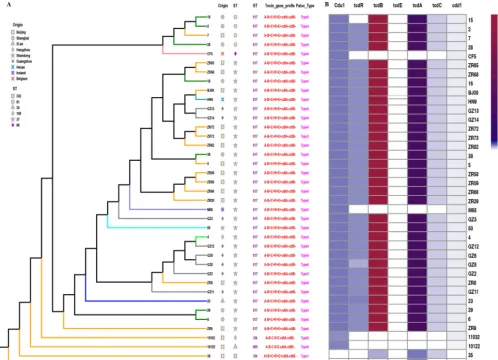
common features are summarized in Table S1 in the supplemental material. The population structure of clade 4 based on the neighbor-joining (N-J) phylogenetic tree correlated well with groups defined according to MLST, PCR ribotyping, and toxin profile but showed no obvious correlation with geographic distribution (Fig. 1). RT017 had two distinct sublineages, ST37 and ST81 (Fig. 1). Each ST cluster was highly conserved, although within the ST37 cluster, ZR18 displayed obvious distinctions compared with the rest of the ST37 isolates (Fig. 1). In the subsequent analysis, we explored the reasons for these distinctions at the genomic level. ST332 was a novel ST
that we identified with a unique positivetcdAgene, which formed a singleton in the N-J
tree (Fig. 1). Two nontoxigenic isolates (ST109 and ST39) also spread as singletons (Fig. 1).
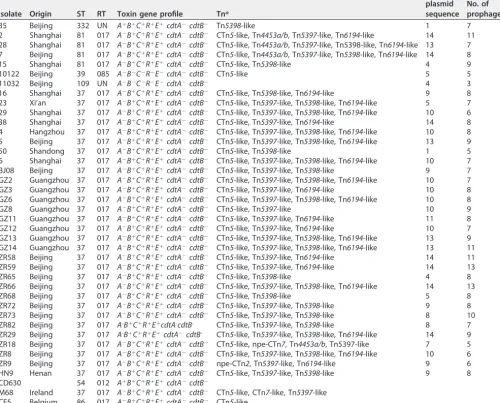
Genetic diversity of MGEs in clade 4 (transposons, prophages, CRISPRs, and plasmids). (i) Transposons and conjugative transposons.Several transposons (Tns)
and conjugative transposons (CTns), including CTn5, Tn4453a/b, Tn5397, Tn5398,
Tn6194, Tn916, and novel putative transposons containing regions homologous with
CTn2and CTn7(Table 1), were identified by comparison with reference genomes. A
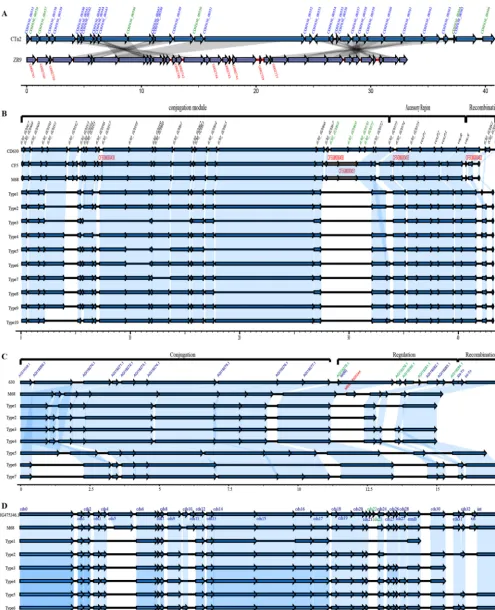
novel putative transposon element was discovered in isolate ZR9. This element was
on September 8, 2020 by guest
located in scaffold 35 from 2,689 to 3,4943 bp and contained 36 coding sequences (CDS), of which 10 were unique in this element, while the remaining 26 genes
demonstrated 83.33% to 100% identity with CTn2 (Fig. 2A). Among the 10 unique
genes, G002737, G002739, G002743, G002760, and G002761 were annotated as C.
difficileputative conjugative transposon protein Tn1549-like, CTn2-ORF30, CTn2-ORF32,
CTn5ORF2, 18, and 19, respectively. G002741 was annotated as putative RNA
methyl-transferase ofC. difficileE7. G002744, G002747, G002748, and G002759 were defined as
hypothetical protein, bacterial regulatory helix (AraC family protein), transcriptional regulator (effector binding domain protein), and transcriptional regulator (AbrB family domain protein), respectively. In isolate ZR18, another putative novel mobile element
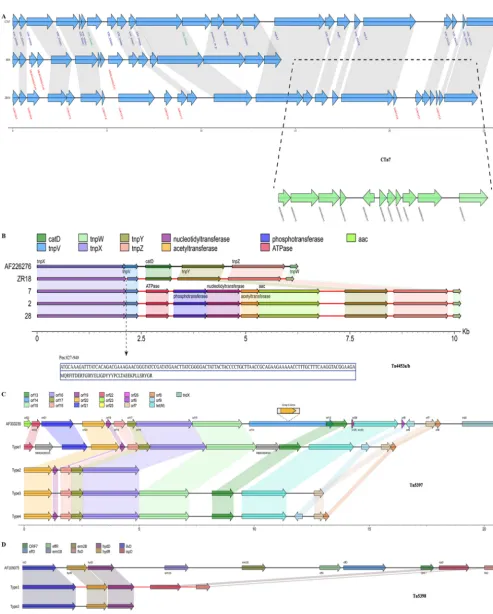
was found, including 24 coding sequences, of which 10 genes were absent in CTn7,
while the other genes were similar to those in CTn7(Fig. 3A). Large fragment insertions
and deletions located in 630_03693 to 630_03688, and 630_03686 to mgtA2 were
identified in isolate ZR18 (Fig. 3A). The 10 novel genes (G001824, G001827, G001828, G001967, G001969, G001972, G001974, G001975, G001976, and G001977) in ZR18 were
annotated as hypothetical protein, CTn7-ORF 4, 6, and conjugal transfer protein ofC.
difficile, and also proteins of other gut pathogens such asFirmicutesandEnterococcus faecium. In addition, a CTn7-like element was identified in reference M68, showing
⬎85% identity with 630 CTn7(Fig. 3A). Two genes (M68GM003529 and M68GM003530)
were inserted between 630_03695 and 630_03694. In M68, M68GM003535 replaced 630_03690 at the same site, while 630_03685 was missing (Fig. 3A). It is noteworthy
FIG 1 Population structure of clade 4 based on the neighbor-joining (N-J) phylogenetic tree and single nucleotide polymorphisms in the PaLoc of all tested isolates. (A) N-J tree of 37C. difficileisolates with diverse origins and STs. (B) SNPs identified within the PaLoc ofC. difficileisolates.
on September 8, 2020 by guest
http://msystems.asm.org/
that nearly half of genes in CTn7were lost in M68, with the addition of another 11 coding genes (Fig. 3A), encoding transcriptional regulator, ABC transporter,
antimicro-bial resistance geneermB(M68GM003552), and bcrA(M68GM003544), putative
trun-cated zeta protein, ATPase-associated proteins, and other genes originating from C.
difficileand other enteric bacteria (Erysipelotrichaceae,E. faecalis,E. faecium, Campylo-bacter jejuni,Firmicutes,andStaphylococcus aureus).
CTn5-like transposons, belonging to the Tn1549family, were detected widely in the
testedC. difficileisolates of clade 4, with the exception of isolate 35 and 11032 (Fig. 2B).
Ten types were divided according to gene composition as follows (Fig. 2B): type 1 (HN9), type 2 (BJ08), type 3 (15), type 4 (GZ8), type 5 (ZR18), type 6 (GZ3), type 7 (29), type 8 (2, 28, 5, 7, ZR8, ZR9), type 9 (23, 38, 4, 50, 6, GZ11, GZ12, GZ2, GZ6, ZR29, ZR58, ZR59, Z566, 10122), and type 10 (16, GZ13, GZ14, ZR65, ZR68, ZR72, ZR73, ZR82). Two common major deletions in the conjugative region were observed in these 10 types, one being a deletion of 630_02052, and the other one located between 630_02066 and 630_02072 (Fig. 2B). Especially for types 3, 5, and 8, other large fragment deletions were also discovered in the conjugative region (Fig. 2B).
5 Beijing 37 017 A⫺B⫹C⫹R⫹E⫹cdtA⫺cdtB⫺ CTn5-like, Tn5397-like, Tn5398-like, Tn6194-like 13 9
50 Shandong 37 017 A⫺B⫹C⫹R⫹E⫹cdtA⫺cdtB⫺ CTn5-like, Tn5398-like 1 5
6 Shanghai 37 017 A⫺B⫹C⫹R⫹E⫹cdtA⫺cdtB⫺ CTn5-like, Tn5397-like, Tn5398-like, Tn6194-like 10 7 BJ08 Beijing 37 017 A⫺B⫹C⫹R⫹E⫹cdtA⫺cdtB⫺ CTn5-like, Tn5397-like, Tn5398-like 9 7
GZ2 Guangzhou 37 017 A⫺B⫹C⫹R⫹E⫹cdtA⫺cdtB⫺ CTn5-like, Tn5397-like, Tn5398-like, Tn6194-like 10 7
GZ3 Guangzhou 37 017 A⫺B⫹C⫹R⫹E⫹cdtA⫺cdtB⫺ CTn5-like, Tn5397-like, Tn6194-like 10 8
GZ6 Guangzhou 37 017 A⫺B⫹C⫹R⫹E⫹cdtA⫺cdtB⫺ CTn5-like, Tn5397-like, Tn5398-like, Tn6194-like 10 8 GZ8 Guangzhou 37 017 A⫺B⫹C⫹R⫹E⫹cdtA⫺cdtB⫺ CTn5-like, Tn5397-like 10 9
GZ11 Guangzhou 37 017 A⫺B⫹C⫹R⫹E⫹cdtA⫺cdtB⫺ CTn5-like, Tn5397-like, Tn6194-like 11 8
GZ12 Guangzhou 37 017 A⫺B⫹C⫹R⫹E⫹cdtA⫺cdtB⫺ CTn5-like, Tn5397-like, Tn6194-like 10 7
GZ13 Guangzhou 37 017 A⫺B⫹C⫹R⫹E⫹cdtA⫺cdtB⫺ CTn5-like, Tn5397-like, Tn5398-like, Tn6194-like 13 9 GZ14 Guangzhou 37 017 A⫺B⫹C⫹R⫹E⫹cdtA⫺cdtB⫺ CTn5-like, Tn5397-like, Tn5398-like, Tn6194-like 13 11
ZR58 Beijing 37 017 A⫺B⫹C⫹R⫹E⫹cdtA⫺cdtB⫺ CTn5-like, Tn5397-like, Tn6194-like 14 11
ZR59 Beijing 37 017 A⫺B⫹C⫹R⫹E⫹cdtA⫺cdtB⫺ CTn5-like, Tn5397-like, Tn6194-like 14 13
ZR65 Beijing 37 017 A⫺B⫹C⫹R⫹E⫹cdtA⫺cdtB⫺ CTn5-like, Tn5398-like 4 8 ZR66 Beijing 37 017 A⫺B⫹C⫹R⫹E⫹cdtA⫺cdtB⫺ CTn5-like, Tn5397-like, Tn5398-like, Tn6194-like 14 13
ZR68 Beijing 37 017 A⫺B⫹C⫹R⫹E⫹cdtA⫺cdtB⫺ CTn5-like, Tn5398-like 5 8
ZR72 Beijing 37 017 A⫺B⫹C⫹R⫹E⫹cdtA⫺cdtB⫺ CTn5-like, Tn5397-like, Tn5398-like 9 8
ZR73 Beijing 37 017 A⫺B⫹C⫹R⫹E⫹cdtA⫺cdtB⫺ CTn5-like, Tn5397-like, Tn5398-like 8 10 ZR82 Beijing 37 017 A-B⫹C⫹R⫹E⫹cdtA-cdtB- CTn5-like, Tn5397-like, Tn5398-like 8 7 ZR29 Beijing 37 017 A-B⫹C⫹R⫹E⫹cdtA⫺cdtB- CTn5-like, Tn5397-like, Tn5398-like, Tn6194-like 14 9 ZR18 Beijing 37 017 A⫺B⫹C⫹R⫹E⫹cdtA⫺cdtB⫺ CTn5-like, npe-CTn7, Tn4453a/b, Tn5397-like 7 5
ZR8 Beijing 37 017 A⫺B⫹C⫹R⫹E⫹cdtA⫺cdtB⫺ CTn5-like, Tn5397-like, Tn5398-like, Tn6194-like 10 6 ZR9 Beijing 37 017 A⫺B⫹C⫹R⫹E⫹cdtA⫺cdtB⫺ npe-CTn2, Tn5397-like, Tn6194-like 9 6
HN9 Henan 37 017 A⫺B⫹C⫹R⫹E⫹cdtA⫺cdtB⫺ CTn5-like, Tn5397-like, Tn5398-like 9 8
CD630 54 012 A⫹B⫹C⫹R⫹E⫹cdtA⫺cdtB⫺
M68 Ireland 37 017 A⫺B⫹C⫹R⫹E⫹cdtA⫺cdtB⫺ CTn5-like, CTn7-like, Tn5397-like CF5 Belgium 86 017 A⫺B⫹C⫹R⫹E⫹cdtA⫺cdtB⫺ CTn5-like
anpe, novel putative element.
bTotal number of incomplete, intact, and questionable prophage.
on September 8, 2020 by guest
FIG 2 Schematic representation and comparisons of CTn2, CTn5, Tn916, and Tn6194in target isolates. Blue arrows indicate homologous genes. ORF names in red are unique in related isolates, and ORF names in green are unique to the reference isolates. Regions of homology among isolates are indicated by gray (A) and light blue shading (B to D). (A) Schematic comparisons of CTn2and new putative Tn in ZR9. (B to D) Schematic comparisons of different types of CTn5
(B), Tn916(C), and Tn6194(D).
on September 8, 2020 by guest
http://msystems.asm.org/
FIG 3 Schematic representation and comparisons of CTn7, Tn4453a/b, Tn5397, and Tn5398in target isolates. (A) For CTn7, blue arrows refer to homologous genes. ORF names in red are unique in related isolates, and ORF names in green are unique to reference isolates. Regions of homology among isolates are indicated by gray shading. The missing genes of M68 are displayed in regions between the dashed lines in green. For the remaining Tns, different ORFs are represented by distinct colors, and homologous regions are shown in related colors. (B) In Tn4453a/b, the deleted fragment (amino acids and nucleotides) in thetnpVgene is indicated in the dark blue box below the dashed arrow line. (C and D) Schematic comparisons of different types of Tn5397(C) and Tn5398(D).
on September 8, 2020 by guest
Tn4453a/bwas found with typical gene organization in isolates ZR18, 2, 7, and 28 (Fig. 3B). The composition and location of genes in ZR18 was identical to that in
reference Tn4453a/b, with the exception of a⫺114-bp deletion intnpv(Fig. 3B). The key
feature of this element was the presence of catD, which mediates resistance to
chloramphenicol. Interestingly,catDwas absent in isolates 2, 7, and 28 and replaced by
five new genes: aminoglycoside acetyltransferase (aac), three transferases
(phospho-transferase, nucleotidyl(phospho-transferase, and acetyltransferase) and an ATPase (Fig. 3B). The
aacgene, which confers resistance to aminoglycoside antibiotics, such as gentamicin,
tobramycin, and netilmicin has been widely reported inEnterococcusand
Enterobacte-ria, and can be transferred between Gram-positive and Gram-negative bacteria by
transposons (Tn5281, Tn4001, and IS256) or plasmids (31). BLAST analysis revealed that
the DNA sequences ofaacin isolates 2, 7, and 28 showed 100% coverage and identity
withaac(6=) aph(2==)inC. jejuni. The total length of the gene was 1,455 bp, encoding
a bifunctional aminoglycosideN-acetyltransferase and aminoglycoside
phosphotrans-ferase, which is one of the aminoglycoside-modified enzymes (AMEs), playing critical
role in high-level gentamicin-resistant (HLGR) ofEnterococcus(32).
Tn5397, also known as CTn3in CD630, was recognized in most isolates in this study
and was classified into four types as follows: type 1, ZR18 and M68; type 2, ZR73 and 5; type 3, BJ08, GZ8, and HN9; type 4, ZR82, ZR9, 2, 23, 28, 29, 38, 4, 6, 7, GZ11, GZ12,
GZ13, GZ14, GZ2, GZ3, GZ6, ZR29, ZR58, ZR59, ZR66, ZR72, and ZR8 (Table 1). ThetndX
gene, encoding a large serine recombinase, which is essential for insertion/excision of
Tn5397, was absent in all types (Fig. 3C). Furthermore, a group II intron within orf14 was
also deleted (Fig. 3C). Significantly, in type 2, Tn5397 was missing some of the
downstream genes, including an antimicrobial resistance genetetM, compared with the
reference Tn5397(Fig. 3C). Type 1 displayed the most similar gene composition and
structure compared with the reference Tn5397, although two new genes were inserted
(Fig. 3C).
Tn5398, first reported in strain 630, contains erm 1B and erm 2B, and can be
transferred betweenC. difficileisolates, or betweenC. difficileandS. aureusorBacillus
subtilis(33). Two types of Tn5398-like elements were identified here, in whicherm 1B
anderm 2Bgenes were absent (Fig. 3D). Type 1 consisted of 35, ZR73, ZR82, 16, 23, 28, 29, 4, 5, 50, 6, 7, BJ08, GZ13, GZ14, GZ2, GZ6, HN9, ZR29, ZR65, ZR66, ZR68, ZR72, and ZR8, while type 2 was represented only by isolate 15 (Table 1).
Tn916 is a major family transposon reported in C. difficile and carries the tetM
resistance gene. The Tn916 element of these tested isolates were subdivided into
multiple types as follows: type 1, GZ8; type 2, ZR18; type 3, ZR73; type 4, 23, 29, 4, 6, GZ11, GZ12, GZ13, GZ14, GZ2, GZ3, GZ6, ZR72, ZR8, ZR82, and ZR9; type 5, BJ08 and
HN9; type 6, 5; type 7, 2, 28, 38, 7, ZR29, ZR58, ZR59, and ZR66 (Table 1). The tetM
resistance andintgene (responsible for Tn insertion), which are responsible for
inser-tion, appeared in all types (Fig. 2C). With the exception of type 6 with deletions in three large regions, deletions occurred in a single area of the regulation region in all the other
types (Fig. 2C). Intact xis and intgenes were retained in types 3, 4, 6, and 7. The
conjugative region was highly homologous within most types, except for types 3, 6,
and 7, which had large fragment deletions (Fig. 2C). Isolate ZR18 carried no typicalxis
andintgenes of Tn916, while BJ08, GZ8, and HN9 containintwithoutxis.
The representative gene cluster of Tn6194carrying ermB of strain CII7 (GenBank
accession no.HG475346) was used as a reference in this study. Tn6194has a
conjuga-tion region that is closely related to that of Tn916but contains an accessory region that
is related to Tn5398. M68 demonstrated high-level homology with only the absence of
cds22 and cds 23, and indels within cds5 and cds 11, while intactxisandintgenes were
retained for excision and insertion (Fig. 2D). The following six types were defined here: type 1, 16, 2, 28, 38, 5, 7, GZ13, and GZ14; type 2, 23; type 3, ZR66; type 4, ZR29, ZR58, and ZR59; type 5, 29, 4, 6, GZ11, GZ12, GZ2, GZ6, ZR8, and ZR9; type 6, GZ3 (Table 1).The
ermB gene was present in all types except type 2 (Fig. 2D). The xis gene, which is
involved in the excision of Tn916from the donated strain were deleted in all types
on September 8, 2020 by guest
http://msystems.asm.org/
(Fig. 2D).The intgene, which plays a key role in the integration of Tn916 into the recipient isolate, appeared in types 2, 5, and 6 only (Fig. 2D).
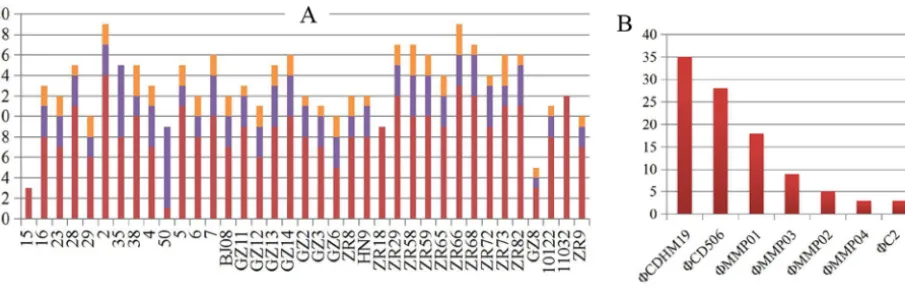
(ii) Prophages, plasmids, and CRISPR. Prophages were identified in various amounts in all tested isolates (Table S2). In total, 497 prophages were predicted in this study. Isolates 2 and ZR66 contained the highest number of prophages (19 prophages), while isolate 15 had the fewest (3 prophages) (Table S2 and Fig. 4A). A total of 115 intact prophages was confirmed among in all the isolates, except ZR18, 15, and 11032
(Fig. 4A). Among the intact prophages, the number of⌽CDHM19,⌽CD506,⌽MMP01,
⌽MMP03,⌽MMP02,⌽MMP04, and ⌽C2 was more than three per isolate (Fig. 4B).
⌽CDHM19 and⌽CD506 represented more than half (54.78%) of all intact prophages
(Fig. 4B). All of these prophages belonged to theMyoviridae family, and some were
induced duringC. difficileinfection (34). Most prophages identified here were
homol-ogous to known phages reported inC. difficile, although a few were similar to other
bacterial phages, such asC. jejuni,S. aureus,Enterobacteria,Bacillus, and other unusual
bacteria, such asProchlorococcus,Gordonia,andSphingomonas(Table S2). Isolates 50
and 35 carried the highest number of intact prophages, 8 and 7, respectively (Table S2
and Fig. 4A). The P-SSM2-like phage ofProchlorococcusfound in isolate 50 showed the
highest number of proteins similar to those in the region (Table S2), while the⌽C2-like
phage in isolate 35 displayed a high number of “hit_genes_count” in bracket (8 out of
9) with⌽C2 (Table S2). The prophages found within the ST 37 and ST 81 isolates were
diverse, although ⌽CD506 was predominant. No obvious correlation was found
be-tween prophage type and STs. Future studies will focus on the role of these elements
in theC. difficileevolution and infection.
A total of 464 CRISPR arrays, composed of different copies of direct repeat (DR) sequences, and separated by unique spacers were identified in the tested isolates from clade 4 (Table S3). The number in each isolate varied from 5 to 19, and the length ranged from 60 to 1,608 bp (Table S3). In total, 90 of the CRISPR arrays displayed homology with prophages (Table S3). Isolates 10122, 11032, 29, and GZ8 harbored prophages without homologous CRISPR sequences (Table S3).
Sixteen potential plasmid sequences with almost 100% coverage were identified among the 37 isolates (Table S4) and were found to contain important antimicrobial
resistance genes (aadE,aad9,ermB,tetM,tetS, andtetO) (Table S4).
Distinctions of PaLoc and CdtLoc regions in clade 4.Three types of toxin gene
profiles in clade 4 were covered in this study: A⫹B⫹(ST332), A⫺B⫹(ST81 and ST37), and
A⫺B⫺(ST39 and ST109) (Table 1). All isolates in this study were binary toxin negative
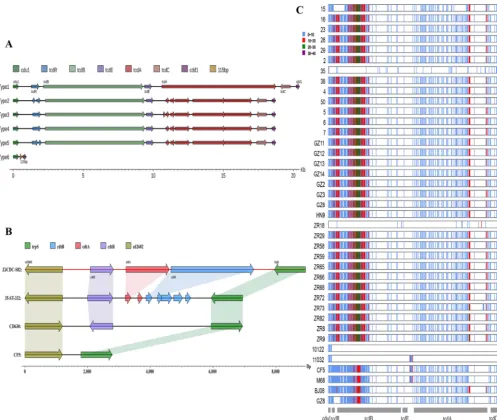
(Table 1). Based on gene formation, six types of PaLoc were classified in this study (Fig. 5A). Type 1 (ST332) displayed intact gene composition and sequences, while all genes were lost with the exception of 115 bp remaining in type 6 (ST39 and ST109)
FIG 4 Prophage analysis of 37C. difficileisolates from clade 4. (A) Details of the prophages in each isolate. (B) The most predominant prophages identified in clade 4. Isolates or prophages are shown on thexaxes, and the number of prophages is shown on theyaxes.
on September 8, 2020 by guest
(Fig. 5A). The other four types lack a complete and continuingtcdAgene, attributed to insertions and single nucleotide polymorphisms (SNPs), which led to termination of
tcdAgene translation (Fig. 5A). Compared with CD630, the SNPs of genes located within
PaLoc regions are shown for each isolate in Fig. 5B. In general, diversity within PaLoc regions correlated with its ST type, with some exceptions (Fig. 5B). For example, isolate 15 within ST81 and ZR18 within ST37 showed distinct SNP distribution (Fig. 5B). The
tcdBgene demonstrated great heterogeneity, followed bytcdA. With the exception of
isolate 35, all tested isolates lacked the CdtLoc region (Fig. 5C). Isolate 35 contained a
completecdtRgene and fragments ofcdtAandcdtBgenes (Fig. 5C).
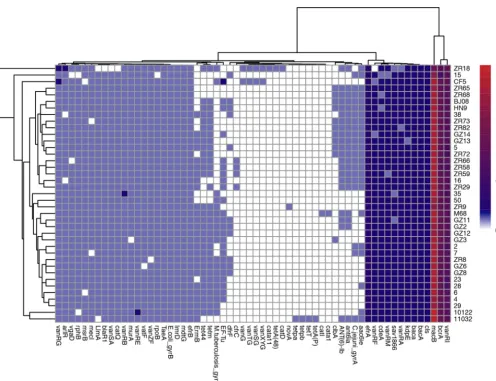
Antimicrobial resistance gene and related antimicrobial susceptibility. In this study, 60 antibiotic resistance genes were identified by comparison with the ARDB and CARD databases (35, 36). These antibiotic resistance genes belonged to the following
antimicrobial classes: fluoroquinolones, -lactam antibiotics, macrolides,
aminocou-marin, rifampin, glycopeptides, tetracycline, macrolide-lincosamide-streptogramin (MLS), chloramphenicol, trimethoprim, streptomycin, aminoglycoside, bacitracin, and
lipopeptide (Fig. 6). Most isolates carried approximately 13 to 16 copies of themacB
FIG 5 PaLoc and CdtLoc analysis of 37 C. difficileisolates from clade 4. (A) Several types were divided based on gene composition of PaLoc. (B) Gene composition of CdtLoc within clade 4. (C) SNPs distributed within PaLoc of all 37C. difficileisolates from clade 4.
on September 8, 2020 by guest
http://msystems.asm.org/
gene, except for ZR18 carrying 9 copies. The next highest numbers of copies were for thevanRIandbcrAgenes (Fig. 6). Remarkably, some isolates carried a unique antibiotic resistance gene cassette, for example, ZR18 and CF5 contained a unique antibiotic
resistance gene cluster of approximately 6 kb comprisingvanXYG,vanSG,vanTG, and
vanG, which were integrated as glycopeptide resistance gene (Fig. 6). Additionally,
ZR18 also carried catD (carried by Tn4453a/b), and cata11, which are related to
chloramphenicol resistance, andtetA(48)(Fig. 6). No functional vancomycin resistance
operon was identified here. Furthermore, isolate 11032 contained uniquetetA(P),tetT,
tetpb, andtetpagenes (Fig. 6). In addition, ZR9 carried a uniquenovAgene, and M68
had uniquecata1andcatlgenes (Fig. 6).
According to the Etest results, all isolates except for 10122 and 35 were MDR strains, maintaining a resistance rate as high as 97.30%. Details are summarized in Table 2. Almost all MDR strains displayed high levels of drug resistance (Table 2) with quinolone exhibiting 100% resistance to CIF, followed by LVX (97.30%) and MXF (56.76%) (drug abbreviations in “Antimicrobial susceptibility tests” in Materials and Methods) (Table 2).
The quinolone resistance is due to a point mutation and substitution withingyrAand/or
gyrB. Clade 4C. difficileretained high-level resistance (91.89%) to ERY compared with
the other isolates of other clades reported in Table 2. TheermB gene, encoding an
antibiotic target-modifying enzyme, is related to MLS resistance. TheermB gene was
detected in 25 of 34 ERY-resistant isolates (73.53%). ERY resistance is attributed to
FIG 6 Antibiotic resistance genes of 37C. difficileisolates predicted through comparison with the CARD and ARDB databases. The vertical coordinates refer to 37C. difficileisolates, while the horizontal coordinates refer to the antibiotic-resistant genes identified.
on September 8, 2020 by guest
methylation of position 2058 in 23S rRNA; however, the exact mutation in ERY-resistant
C. difficileisolates remains to be identified in the future. In addition, high copy numbers
of the macrolide resistancemacBgene, encoding a macrolide ABC transporter protein,
were identified in all the tested isolates (Fig. 6). The rate of resistance to CLI was 89.19%, with a high level of resistance detected among the isolates. The rate of resistance to
CHL was lower (29.73%) and related tocata11andcata1, which were identified only in
isolates ZR18 and M68, respectively, indicating the existence of other mechanisms of
CHL resistance. It is worth mentioning thatcatD, normally carried byTn4453a/band
also responsible for CHL resistance (Fig. 3), was present in isolate ZR18, which showed
an intermediate level of CHL resistance (MIC⫽64g/ml). However,catDwas replaced
by another five genes in isolates 7, 2, and 28, which were CHL susceptible. The five new
replacement genes includedaac(6=) aph(2=), which is correlated significantly with HLGR
and is responsible for aminoglycoside resistance, leading to gentamicin and amikacin resistance in isolates 7, 2, and 28. The rates of MEM (51.35%) and RIF (48.65%) resistance
were similar among the clade 4C. difficileisolates. All isolates resistant to CHL and RIF
were ST37 (Table 2). TherpoB andrphBgenes with several mutations related to RIF
TABLE 2Antimicrobial resistance results and correlation with ST types and antibiotic resistance genes
Drug (concn range [g/ml])
No. of resistant
isolates (%)a STb No. of genes identifiedb MIC (g/ml)b MXF (0.002–32) 21 (56.76) ST81 (4), ST109 (1), ST37 (16) E.coli gyrB(37),M. tuberculosis gyrA(18),
C. jejuni gyrA(20)
ⱖ32 (21)
LVX (0.002–32) 36 (97.30) ST332 (1), ST39 (1), ST109 (1), ST81 (4), ST37 (29)
As above ⱖ32 (35)
ⱖ8⬍32 (1)
CIF (0.002-32) 37 (100) ST332 (1), ST39 (1), ST109 (1), ST81 (4), ST37 (30)
As above ⱖ32 (36)
ⱖ8⬍32 (1)
CLI (0.016–256) 33 (89.19) ST81 (4), ST109 (1), ST37 (28) ermB(25),cfrC(4),clbA(11) ⱖ256 (32)
ⱖ8⬍256 (1)
TET (0.016–256) 13 (35.14) ST81 (2), ST37 (11) tetA(P),tetT,tetpb,tetpawere only in isolate 11032;tetA(48)cwas only in ZR18; tetM(31),tet44(30)
ⱖ16⬍32 (13)
ERY (0.016–256) 34 (91.89) ST81 (4), ST39 (1), ST109 (1), ST37 (28)
ermB(25),macB(37),cfrC(4) ⱖ256 (32)
ⱖ128⬍256 (2)
ⱖ8⬍128 (1)
CHL (0.016–256) 11 (29.73) ST37 (11) cata11was only in ZR18;cata1was only in M68
ⱖ256 (8)
ⱖ128⬍256 (1)
ⱖ32⬍128 (2)
MEM (0.002–32) 19 (51.35) ST81 (1), ST109 (1), ST37 (17) blaR1(36),mecI(35) ⱖ32 (15)
ⱖ16⬍32 (4)
RIF (0.002–32) 18 (48.65) ST37 (18) rpoB(36),rphB(34) ⱖ32 (18)
VAN (0.016–256) 0 0 vanXYG-vanSG-vanTG-vanGgene cluster was only in ZR18;vanRI(37),vanRM(37), vanRA(37),vanRF(36),vanZF(36), vanRE(37),vanRB(37),vanSA(36), vanRG(37),arlR(34)
ⱕ0.5
MET (0.016–256) 0 0 None ⱕ1
aValues in parentheses show the percentage of isolates resistant to a single drug. bValues in parentheses show the number of isolates with the ST, gene, or MIC. cGene name.
on September 8, 2020 by guest
http://msystems.asm.org/
resistance were detected in almost all isolates. The mechanism underlying this
resis-tance involves substitution of several nucleotides in therpoBgene. None of the clade
4 isolates were resistant to VAN or MET, although VAN-related genes or gene cassettes were identified.
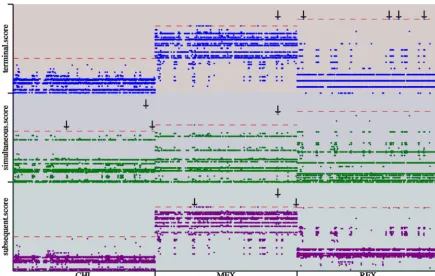
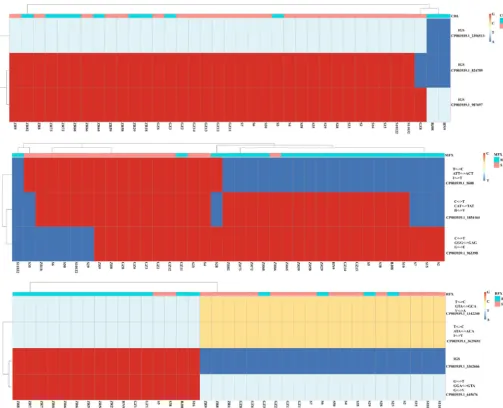
Genome-wide association analysis of resistance genes.According to our analy-sis, antimicrobial susceptibility does not correlate well with genotypes. To explore other potential sites responsible for drug resistance, we performed genome-wide association study (GWAS) analysis. Significantly related SNPs were detected in relation to resistance to CHL, MFX, and RIF (Fig. 7). Three significant SNPs associated with CHL resistance were located within an intergenic genetic region (IGS) (Fig. 8), which may play a role in methylation and regulation of cell function. Three remarkable nonsynonymous SNPs associated with MFX resistance (Fig. 7) were detected in genes encoding inosine-uridine-preferring nucleoside hydrolase family protein and the ABC transporter and in
thegyrAgene, which are reported to be associated with quinolone resistance, and were
detected using all three methods (Fig. 7). All MFX-resistant isolates except for GZ11 and 28
displayed the point mutation (Thr¡IIe) ingyrAcompared with susceptible isolates (Fig. 8).
In addition, only one MFX-susceptible isolate ZR66 carried the Thr¡IIe mutation ingyrA
(Fig. 8). As shown in Fig. 7, four significant SNPs significantly related to RIF resistance were
identified as following: a gene (dacCordacD) encoding D-alanyl-D-alanine
carboxypepti-dase protein, also known as penicillin-binding protein (WP_022616436.1), gene merR
encoding the transcriptional regulator (WP_022616524.1), a gene involved in
replica-tion, recombinareplica-tion, and repair (WP_022616400.1), and a gene in an IGS region (Fig. 8).
Most of the RIF-resistant isolates carried the point mutation Ala¡Val, Thr¡IIe, and
Val¡Gly in these genes, respectively, with the exception of isolates GZ3, 6, 29, and 23
(Fig. 8). The RIF-susceptible isolates 5 and 38 carried the same mutations (Fig. 8).
DISCUSSION
Due to rapid progress in WGS techniques, the global population structure of C.
difficileis defined as 5 main clades (clades 1 to 5). ST37 (RT017), which is a well-known
FIG 7 The whole-genome sequence analysis of antimicrobial resistance among 37C. difficileisolates using treeWAS software. The vertical coordinates represent three different calculating methods, which are displayed in three distinct colors. The horizontal coordinates refer to three drugs. The significant SNPs related to each drug are highlighted by black arrows.
on September 8, 2020 by guest
representative of clade 4, has caused outbreaks in Europe and in the United States, and is documented as the major type associated with CDI in Asia (8). In addition to ST37,
clade 4 contained some diversity, such as ST332 (A⫹B⫹), ST39 and ST109 (A⫺B⫺), ST81
(A⫺B⫹), and ST86 (A⫺B⫹). ST332 is a novel type previously identified by our group (37).
In this study, we analyzed and compared the whole-genome sequences of 37 clinical
C. difficileisolates from clade 4. M68 and CF5 were included as isolates of clade 4, and CD630 was used as reference. We further explored the presence of Tn/CTns, prophages, and CRISPRs and compared their characteristics among the isolates in this clade. The antimicrobial phenotypes of these isolates were determined, and possible antibiotic resistance-related genes were identified. In this study, we aimed to clarify the genetic heterogeneity and microevolution within clade 4 to provide potential explanations for
the mechanisms of pathogenesis and antibiotic resistance ofC. difficile.
The basic features, including GC% and genome size, of the clade 4 isolates from China investigated in this study were similar to those have been reported previously (3). TheC. difficile genome is highly mosaic and dynamic in structure because of a high proportion of MGEs. CTns, also known as integrated conjugative elements (ICEs), are capable of excision, transfer, and integration into the chromosome or plasmids,
result-FIG 8 Heatmap of point mutations associated with drug resistance among all 37C. difficileisolates. The drug, nucleotide, codon, amino acid, and gene ID are shown on the right vertical axes. The name of each isolate is shown on the horizontal axes. Nucleotides A, T, C, G are represented by dark blue, light blue, yellow, and red, respectively. R, resistance; S, susceptible.
on September 8, 2020 by guest
http://msystems.asm.org/
having regions of homology with CTn2and CTn7were identified in isolates ZR9 and
ZR18, respectively. It is remarkable that in Tn4453a/b,catD was replaced byaac(6=)
aph(2==) in isolates 2, 7, and 28, resulting in susceptibility to CHL but resistance to gentamicin and amikacin. The three isolates, which were all ST8, were obtained from elderly hospitalized patients treated with quinolone and carbapenem for 5 days.
How-ever, isolate ZR18 carried a typical Tn4453a/b element with catD, leading to CHL
resistance. The aac(6=) aph(2==)gene, displaying 100% identity and coverage with C.
jejuni, was first reported inC. difficile. This gene encodes a bifunctional AME, accounting
for HLGR resistance rates in⬎90%E. faecalisandE. faeciumisolates (38). This illustrated
that HGT may occur betweenC. difficileand other intestinal bacteria, leading to unique
microevolution of individual isolates. However, the mechanisms by which the local
microenvironment causes HGT and the ability of Tn4453a/bcontainingaac(6=) aph(2==)
to transfer betweenC. difficileisolates and/orC. difficileand other bacteria remains to
be elucidated. Furthermore, two novel transposons with regions with homology to
CTn2and CTn7were identified. One novel transposon, in isolate ZR9, contained 10
unique genes showing identity with diverse transposons of diverse origins inC. difficile,
although the remaining 26 genes were homologous with CTn2. The other transposon,
in isolate ZR18, lacked 10 out of 24 coding genes present in CTn7. The 10 novel genes
also displayed identity withC. difficileor other gut pathogens of heterogeneous origins.
This situation further suggested that “personalized” HGT occurred in individual isolates,
resulting in diversity and genome evolution in C. difficile. Great diversity was also
exhibited among the other CTns identified in this study even within the same STs, and several types were classified according to their gene structure and composition.
Sequencing of a number ofC. difficilegenomes has facilitated the identification of
numerous putative prophages by bioinformatic analyses, and the role of prophages in its evolution and virulence has become the focus of recent research. So far, only a
limited number of temperate phages infectingC. difficilehave been fully characterized
in terms of WGS and morphology by transmission electron microscopy (TEM).⌽CD119,
⌽C2,⌽CD27, ⌽MMP02, and⌽MMP04 are members of the Myoviridae family, while
⌽CD38-2 and⌽CD6356 are members of theSiphoviridaefamily. In this study, WGS
revealed distribution of various numbers of prophages in all isolates. The top seven
main prophages in clade 4 were⌽CDHM19,⌽CD506,⌽MMP01,⌽MMP03,⌽MMP02,
⌽MMP04, and⌽C2, all of which belong to theMyoviridae family. Some prophages
(⌽MMP01,⌽MMP03,⌽MMP02, and⌽MMP04) were induced and isolated from fecal
supernatant of CDI patients (34). In addition, ⌽C2 mediates transduction of Tn6215,
encoding erythromycin resistance, betweenC. difficileisolates (11). Our next step is to
induce phages of these isolates and confirm their function experimentally.
The CRISPR-Cas systems, which are present in most archaea and many bacteria, provide adaptive resistance against invasive genetic elements, such as phages and plasmids (40, 41). CRISPR array consists of partial palindromic repeats (DR) interspersed by unique DNA sequences (spacers) that are derived from foreign genetic elements in
a linear, time-resolved manner (41, 42). Whole-genome analysis ofC. difficilestrain 630
(ST54/RT012) showed that the CRISPR spacer sequence exhibited similarity toC. difficile
on September 8, 2020 by guest
phages and plasmids, suggesting CRISPR interference against these mobile elements, which was later experimentally confirmed in the R20291 strain (ST1/RT027/B1) (3, 43).
Recently, in a comprehensive analysis of the CRISPR-Cas system in 217C. difficile
genomes, a single type IB CRISPR-Cassystem and a total of 1,865 CRISPR arrays were
identified withcasgene clusters present at conserved chromosomal locations (44). The
CRISPR arrays ofC. difficilewere markedly enriched (12.5 arrays/genome) in this study
compared with other species and previous reports ofC. difficile (8.5 arrays/genome)
(45). Numerous CRISPR arrays (90/464) were homologous to prophages identified
among the clade 4C. difficile isolates in this study. CRISPR-Cas has been used for
outbreak tracking inYersinia pestis(46) and Salmonella entericasubspecies (47), and
correlating with important phenotypes, such as antibiotic -resistance cassettes in
enterococci (48), and prophages in Streptococcus pyogenes genomes (49). All these
correlations reflect the role of CRISPR-Cas systems in controlling HGT, as well as the uptake and dissemination of particular genes and operons involved in bacterial adap-tation and pathogenesis (50), and hence the evolution of specific species. In our study, we identified another potential method of phylogenetic analysis and genotyping within clade 4 or closely related isolates according to the CRISPR arrays.
Rates of antibiotic resistance vary considerably in different studies, probably de-pending on the geographic regions and local or national antibiotic policy. In our study, the MDR isolates account for 94.6% of all resistant isolates, which is a much higher proportion than reported previously (55%) in Europe and China (19, 51, 52). Many of the hypervirulent RT027 and RT078 strains are known to exhibit MDR. In a 4-year study in China, MDR isolates with ST37 accounted for the highest proportion (78.2%) of all the tested isolates (53–55). A similar situation was observed in our study, which further illustrates that antibiotic usage promotes independent acquisition of drug resistance, regardless of molecular type.
Resistance to fluoroquinolones has increased dramatically in recent years; for ex-ample, the rates of resistance to LVX and CIP reached almost 100% in many studies
around the world (51), including our study. Genomic mutations ingyrA and/orgyrB,
known as the quinolone resistance-determining region, QRDR, are involved with resis-tance to fluoroquinolones (56). The amino acid substitution Thr-82Ile in GyrA was found
to be responsible for moxifloxacin resistance (57). Some other substitutions in gyrA
and/or gyrB have been reported in other studies, such as Ser-366Val, Ser-416Ala,
Asp-426Asn, and Glu-466Val (58). According to our GWAS analysis, the Thr¡IIe
muta-tion in thegyrAgene is highly related to MXF resistance in clade 4C. difficileisolates.
RIF resistance was very recently detected, and studies conducted from 2008 to 2010 in different European countries showed variability in the rates of resistance to this
antibiotic inC. difficilestrains, ranging from 6.3% to 36.8% (58). In our study, the rate
of RIF resistance reached 48.65%, which is even higher than that reported in a
systematic meta-analysis of drug resistance ofC. difficileinfections in mainland China
(52). Different SNPs (His-502Asn and Arg-505Lys) within the rpoBgene encoding the
-subunit of the RNA polymerase have been identified in RIF-resistant strains (59).
Another RIF resistance-related gene,rphB, was also detected in 34 isolates in this study
but at a low related rate. The existence of some specific substitution inrphBthat is
responsible for RIF remains to be investigated.
In C. difficile, resistance to CLI and ERY is common in Europe (55% and 47%, respectively) (19), and in China (70% to 80%) (60), while in our study the rate was more
than 90%. In this study, several genes were identified withermB, high copy numbers of
macB, andcfrC, although the correlation between the phenotype and the harbored
gene is low. In pan-Europe studies, the rate of TET resistance has been reported to range from 2.4% to 41.67% (51), and the rate in the present study was slightly lower than the highest level at 35.14%. Moreover, the emergence of reduced TET
suscepti-bility increased in our study. InC. difficile, TET resistance is commonly conferred by a
tet(M) carried by a Tn5397 transposon. In our study, 29 isolates contained Tn5397;
however,tetMwas absent from isolates ZR73 and 5. Among these 27 isolates, the rate
of TET resistance was 40.74% (11/27). For eight isolates without Tn5397, two resistant
on September 8, 2020 by guest
http://msystems.asm.org/
isolates with reduced MTZ susceptibility were found here, although reduced MTZ susceptibility was occasionally reported in Europe (61). The mechanism of MTZ
resis-tance is still not completely understood. Nitroimidazole (nim) genes conferring
resis-tance to MTZ inHelicobacter pylorihave not been identified inC. difficile. The defined
mechanism of resistance is a multifactorial process involving alterations in different metabolic pathways, such as nitroreductase activity, iron uptake, and DNA repair (59).
A vanBoperon originally described inE. faecalis harboring Tn1549is responsible for
resistance to VAN (62). Although several Tn1549-like elements have been reported inC.
difficile, no functionalvanB operon was identified. Recently, avanG-like gene cluster,
homologous to the cluster found inE. faecalis, has been reported in a number ofC.
difficile isolates. However, although this cluster is expressed, it does not promote resistance to VAN (63). The same situation was found in isolate ZR18 in our study with
a series ofvanG-like gene clusters identified, without resistance to VAN.
In conclusion, we analyzed HGT-related elements involved in shaping the genome
and biological features, including antibiotic susceptibility phenotype ofC. difficilefrom
clade 4 with varied STs isolated in China. Our findings provide important new insights into the mechanism of genome remodeling within clade 4 and offer a new method for typing and tracing the origins of closely related isolates.
MATERIALS AND METHODS
Isolates and preparation of genomic DNA.A total of 37 clinicalC. difficileisolates from clade 4 with divergent origins in China were included in this study (Table 1). These isolates comprised five ST types: one ST332 isolate (a new type identified in our previous study), four ST 81 (RT 017), one each of ST 39 (RT 085) and ST109, and 30 ST 37 (RT 017) isolates. Details of these isolates are summarized in Table 1. Strains CD630 (GenBank accession no.AM180355), CF5 (FN665652), and M68 (FN668375) were used as references throughout the investigation.
All 37 isolates were cultured on brain heart infusion (BHI) agar plates (Oxoid, Basingstoke, UK) supplemented with 5% sheep blood (BaoTe, Beijing, China) in an anaerobic environment (80% nitrogen, 10% hydrogen, and 10% carbon dioxide) (Mart, NL) at 37°C for 48 h. Typical colonies were picked and recultured on BHI for 24 h before preparation of genomic DNA using the Wizard Genomic DNA purification kit (Promega, Madison, WI, USA) according to the manufacturer’s instructions.
MLST, PCR ribotyping, and toxin gene profiling. The MLST, PCR ribotyping, and toxin gene profiling information was obtained according to previously reported methods (37, 64).
Whole-genome sequencing and assembly.Whole-genome sequencing (WGS) was performed on the Illumina PE150 (Illumina Inc., USA) with average insert lengths of 350 bp. Raw data were processed in four steps: removal of reads with 5 bp of ambiguous base, reads with 20 bp of low quality (ⱕQ20), adapter contamination, and duplicated reads. Finally, filtered reads were assembled using SOAP denovo v2.04 (65, 66).
Genome annotation and phylogenetic analysis.Genes were predicted using GeneMarkS version 3.05 (67) and aligned with databases to obtain the annotation corresponding to their homologs, with the highest quality alignment result chosen as the gene annotation. Gene functions were predicted by whole-genome BLAST (http://blast.ncbi.nlm.nih.gov/Blast.cgi) searches against the following databases: Gene Ontology (GO) (68), Kyoto Encyclopedia of Genes and Genomes (KEGG) (69), Clusters of Ortholo-gous Groups (COG) (70), Non-Redundant Protein (NR) databases (71), Transporter Classification Database (TCDB) (72), and Swiss-Prot (73). tRNA genes were predicted by tRNA scan-SE (74). rRNA genes were analyzed by rRNAmmer (75). Small nuclear RNAs (snRNA) were predicted by BLAST searches against the Rfam (76) database.
on September 8, 2020 by guest
Single core genes were obtained from the clustering results of all sample genes used by CD-HIT version 4.6. A phylogenetic tree was built using the neighbor-joining method based on 2,456 single core genes using MEGA6.0 with 1,000 replicates (77).
Analysis of MGEs.All the transposons (Tns) and conjugative transposons (CTns) were identified using BLAST searches of theC. difficilegenome sequences or transposon sequences available at NCBI (https://www.ncbi.nlm.nih.gov/) with identity and coverage requirements set at⬎80%. Prophages were identified using the PHASTER web server (http://phast.wishartlab.com). The intact, questionable, and incomplete prophage sequences were defined by score values of⬎90, 70 to 90, and⬍70, respectively (78). To identify plasmids, reads were assembled into contigs using the SOAP denovo. Contigs were then screened for plasmids using Microbial Genome BLAST searches against the NCBI complete plasmid database (ftp://ftp.ncbi.nlm.nih.gov/genomes/refseq/plasmid/). The potential plasmids were defined as
ⱖ70% coverage andⱖ80% identity. The CRISPRFinder (79) was used for CRISPR identification.
Sequence analysis of PaLoc and CdtLoc.The PaLoc and CdtLoc were confirmed by comparison with the reference CD630 genome. Orthologous genes were detected by BLAST (version 2.2.12) searches with⬎80% coverage and⬎90% nucleotide identity. The genetic structure as well as insertions and deletions (indels) were studied.
Antimicrobial susceptibility tests.C. difficileisolates were tested for susceptibility to moxifloxacin (MXF), vancomycin (VAN), clindamycin (CLI), tetracycline (TET), erythromycin (ERY), rifampin (RIF), levo-floxacin (LVX), chloramphenicol (CHL), metronidazole (MTZ), ciprolevo-floxacin (CIP), and meropenem (MEM) using Etest strips (bioMérieux, France, and Liofilchem, Italy). Tests to gentamicin (CEN) and amikacin (AMK) were also performed with isolates 2, 7, 28, and ZR18 using Etest strips (bioMérieux, France, and Liofilchem, Italy). The MICs for MTZ, MXF, CLI, CIP, LVX, and TET were determined according to recommendations of the Clinical and Laboratory Standards Institute (CLSI) M11-A7 and M100-S24 (80, 81), and the European Committee on Antimicrobial Susceptibility Testing (EUCAST) (http://www.eucast .org). The breakpoints for VAN, RIF, ERY, CHL, and meropenem were determined according to a previous study (54, 58). Multidrug resistance (MDR) was defined as resistance to at least three antimicrobial classes.
C. difficileATCC 700057 was included as a control in each experiment (82).
Antimicrobial resistance genes were predicted through comparison with the Antibiotic Resistance Genes Database, ARDBhttps://ardb.cbcb.umd.edu/(35), and the Comprehensive Antibiotic Resistance Database, CARDhttps://card.mcmaster.ca/(36). Heatmap analysis was performed using the pheatmap package, and statistics packages in R software (version 2.15.3).
Single nucleotide polymorphisms detected and association analysis.Single nucleotide polymor-phisms (SNPs) were detected by comparing the sequence of each isolate with that of strain BJ08. SNP calling was detected using the NUCmer program in the MUMer package (V3.23). All primary SNPs were further evaluated in contigs to validate alleles. Sequence regions of 201 bp, which included 100 bp extracted from either side of the referenced SNP site, were subjected to BLAST analysis with sample contigs. The SNPs were removed if the alignment length was less than 101 bp. In addition, the SNPs located in repeat regions predicted by RepeatMasker (version open-4.05) and TRF (Tandem Repeats Finder; version 4.07b) of the reference were also excluded. Genome-wide association studies (GWAS) were conducted using the open-source R package treeWAS, which is freely available athttps://github .com/caitiecollins/treeWAS (83). Three methods (terminal, simultaneous, and subsequent tests) were used to confirm the results in this study.
Data availability. The sequence information from this whole-genome shotgun project of 37C. difficileisolates has been submitted to DDBJ/EMBL/GenBank under the following BioProject accession numberPRJNA479396.
SUPPLEMENTAL MATERIAL
Supplemental material for this article may be found at https://doi.org/10.1128/
mSystems.00252-18.
TABLE S1, PDF file, 0.1 MB.
TABLE S2, XLSX file, 0.1 MB.
TABLE S3, XLSX file, 0.04 MB.
TABLE S4, PDF file, 0.1 MB.
ACKNOWLEDGMENTS
This research was supported by the National Sci-Tech Key Project (grant 2018ZX10733402).
We thank Lei Zhao from Iowa State University for critically reviewing the manuscript.
REFERENCES
1. He M, Miyajima F, Roberts P, Ellison L, Pickard DJ, Martin MJ, Connor TR, Harris SR, Fairley D, Bamford KB, D’Arc S, Brazier J, Brown D, Coia JE, Douce G, Gerding D, Kim HJ, Koh TH, Kato H, Senoh M, Louie T, Michell S, Butt E, Peacock SJ, Brown NM, Riley T, Songer G, Wilcox M, Pirmo-hamed M, Kuijper E, Hawkey P, Wren BW, Dougan G, Parkhill J, Lawley TD. 2013. Emergence and global spread of epidemic
healthcare-associated Clostridium difficile. Nat Genet 45:109 –113.https://doi.org/ 10.1038/ng.2478.
2. Warriner K, Xu C, Habash M, Sultan S, Weese SJ. 2017. Dissemination of Clostridium difficile in food and the environment: significant sources of C. difficile community-acquired infection? J Appl Microbiol 122:542–553.
https://doi.org/10.1111/jam.13338.
on September 8, 2020 by guest
http://msystems.asm.org/
Sebaihia M, Quail MA, Rose G, Gerding DN, Gibert M, Popoff MR, Parkhill J, Dougan G, Wren BW. 2009. Comparative genome and phenotypic analysis of Clostridium difficile 027 strains provides insight into the evolution of a hypervirulent bacterium. Genome Biol 10:R102.https:// doi.org/10.1186/gb-2009-10-9-r102.
7. He M, Sebaihia M, Lawley TD, Stabler RA, Dawson LF, Martin MJ, Holt KE, Seth-Smith HM, Quail MA, Rance R, Brooks K, Churcher C, Harris D, Bentley SD, Burrows C, Clark L, Corton C, Murray V, Rose G, Thurston S, van Tonder A, Walker D, Wren BW, Dougan G, Parkhill J. 2010. Evolu-tionary dynamics of Clostridium difficile over short and long time scales. Proc Natl Acad Sci U S A 107:7527–7532.https://doi.org/10.1073/pnas .0914322107.
8. Knight DR, Elliott B, Chang BJ, Perkins TT, Riley TV. 2015. Diversity and evolution in the genome of Clostridium difficile. Clin Microbiol Rev 28:721–741.https://doi.org/10.1128/CMR.00127-14.
9. Didelot X, Eyre DW, Cule M, Ip CL, Ansari MA, Griffiths D, Vaughan A, O’Connor L, Golubchik T, Batty EM, Piazza P, Wilson DJ, Bowden R, Donnelly PJ, Dingle KE, Wilcox M, Walker AS, Crook DW, Peto TE, Harding RM. 2012. Microevolutionary analysis of Clostridium difficile genomes to investigate transmission. Genome Biol 13:R118.https://doi.org/10.1186/ gb-2012-13-12-r118.
10. Mullany P, Allan E, Roberts AP. 2015. Mobile genetic elements in Clos-tridium difficile and their role in genome function. Res Microbiol 166: 361–367.https://doi.org/10.1016/j.resmic.2014.12.005.
11. Goh S, Hussain H, Chang BJ, Emmett W, Riley TV, Mullany P. 2013. Phage phiC2 mediates transduction of Tn6215, encoding erythromycin resis-tance, between Clostridium difficile strains. mBio 4:e00840-13.https:// doi.org/10.1128/mBio.00840-13.
12. Brouwer MS, Warburton PJ, Roberts AP, Mullany P, Allan E. 2011. Genetic organisation, mobility and predicted functions of genes on integrated, mobile genetic elements in sequenced strains of Clostridium difficile. PLoS One 6:e23014.https://doi.org/10.1371/journal.pone.0023014. 13. Wasels F, Monot M, Spigaglia P, Barbanti F, Ma L, Bouchier C, Dupuy B,
Mastrantonio P. 2014. Inter- and intraspecies transfer of a Clostridium difficile conjugative transposon conferring resistance to MLSB. Microb Drug Resist 20:555–560.https://doi.org/10.1089/mdr.2014.0015. 14. Griffiths D, Fawley W, Kachrimanidou M, Bowden R, Crook DW, Fung R,
Golubchik T, Harding RM, Jeffery KJ, Jolley KA, Kirton R, Peto TE, Rees G, Stoesser N, Vaughan A, Walker AS, Young BC, Wilcox M, Dingle KE. 2010. Multilocus sequence typing of Clostridium difficile. J Clin Microbiol 48:770 –778.https://doi.org/10.1128/JCM.01796-09.
15. Eyre DW, Cule ML, Wilson DJ, Griffiths D, Vaughan A, O’Connor L, Ip CLC, Golubchik T, Batty EM, Finney JM, Wyllie DH, Didelot X, Piazza P, Bowden R, Dingle KE, Harding RM, Crook DW, Wilcox MH, Peto TEA, Walker AS. 2013. Diverse sources of C. difficile infection identified on whole-genome sequencing. N Engl J Med 369:1195–1205.https://doi.org/10 .1056/NEJMoa1216064.
16. Stabler RA, Dawson LF, Valiente E, Cairns MD, Martin MJ, Donahue EH, Riley TV, Songer JG, Kuijper EJ, Dingle KE, Wren BW. 2012. Macro and micro diversity of Clostridium difficile isolates from diverse sources and geographical locations. PLoS One 7:e31559. https://doi.org/10.1371/ journal.pone.0031559.
17. Janezic S, Rupnik M. 2015. Genomic diversity of Clostridium difficile strains. Res Microbiol 166:353–360.https://doi.org/10.1016/j.resmic.2015 .02.002.
18. Bauer MP, Notermans DW, van Benthem BH, Brazier JS, Wilcox MH, Rupnik M, Monnet DL, van Dissel JT, Kuijper EJ. 2011. Clostridium difficile
22. Tickler IA, Goering RV, Whitmore JD, Lynn AN, Persing DH, Tenover FC. 2014. Strain types and antimicrobial resistance patterns of Clostridium difficile isolates from the United States, 2011 to 2013. Antimicrob Agents Chemother 58:4214 – 4218.https://doi.org/10.1128/AAC.02775-13. 23. Kuijper EJ, Barbut F, Brazier JS, Kleinkauf N, Eckmanns T, Lambert ML,
Drudy D, Fitzpatrick F, Wiuff C, Brown DJ, Coia JE, Pituch H, Reichert P, Even J, Mossong J, Widmer AF, Olsen KE, Allerberger F, Notermans DW, Delmee M, Coignard B, Wilcox M, Patel B, Frei R, Nagy E, Bouza E, Marin M, Akerlund T, Virolainen-Julkunen A, Lyytikainen O, Kotila S, Ingebre-tsen A, Smyth B, Rooney P, Poxton IR, Monnet DL. 2008. Update of Clostridium difficile infection due to PCR ribotype 027 in Europe, 2008. Euro Surveill 13(31):pii⫽18942.https://doi.org/10.2807/ese.13.31.18942 -3en.
24. Chen R, Feng Y, Wang X, Yang J, Zhang X, Lu X, Zong Z. 2017. Whole genome sequences of three Clade 3 Clostridium difficile strains carrying binary toxin genes in China. Sci Rep 7:43555.https://doi.org/10.1038/ srep43555.
25. Kuijper EJ, de Weerdt J, Kato H, Kato N, van Dam AP, van der Vorm ER, Weel J, van Rheenen C, Dankert J. 2001. Nosocomial outbreak of Clos-tridium difficile-associated diarrhoea due to a clindamycin-resistant en-terotoxin A-negative strain. Eur J Clin Microbiol Infect Dis 20:528 –534. 26. Drudy D, Harnedy N, Fanning S, Hannan M, Kyne L. 2007. Emergence and control of fluoroquinolone-resistant, toxin A-negative, toxin B-positive Clostridium difficile. Infect Control Hosp Epidemiol 28:932–940.https:// doi.org/10.1086/519181.
27. Alfa MJ, Kabani A, Lyerly D, Moncrief S, Neville LM, Al-Barrak A, Harding GK, Dyck B, Olekson K, Embil JM. 2000. Characterization of a toxin A-negative, toxin B-positive strain of Clostridium difficile responsible for a nosocomial outbreak of Clostridium difficile-associated diarrhea. J Clin Microbiol 38:2706 –2714.
28. Collins DA, Hawkey PM, Riley TV. 2013. Epidemiology of Clostridium difficile infection in Asia. Antimicrob Resist Infect Control 2:21.https:// doi.org/10.1186/2047-2994-2-21.
29. Knight DR, Thean S, Putsathit P, Fenwick S, Riley TV. 2013. Cross-sectional study reveals high prevalence of Clostridium difficile non-PCR ribotype 078 strains in Australian veal calves at slaughter. Appl Environ Microbiol 79:2630 –2635.https://doi.org/10.1128/AEM.03951-12.
30. Suo J, Yan Z, Wu Y, Li WG, Zhang WZ, Liu XS, Liu Y, Lu J. 2017. Clostridium difficile RT 078/ST11: a threat to community population and pigs identified in elder hospitalized patients in Beijing, China. Infect Control Hosp Epidemiol 38:1383–1385.https://doi.org/10.1017/ice.2017 .206.
31. Hallgren A, Saeedi B, Nilsson M, Monstein HJ, Isaksson B, Hanberger H, Nilsson LE. 2003. Genetic relatedness among Enterococcus faecalis with transposon-mediated high-level gentamicin resistance in Swedish inten-sive care units. J Antimicrob Chemother 52:162–167.https://doi.org/10 .1093/jac/dkg315.
32. Donabedian SM, Thal LA, Hershberger E, Perri MB, Chow JW, Bartlett P, Jones R, Joyce K, Rossiter S, Gay K, Johnson J, Mackinson C, Debess E, Madden J, Angulo F, Zervos MJ. 2003. Molecular characterization of gentamicin-resistant Enterococci in the United States: evidence of spread from animals to humans through food. J Clin Microbiol 41: 1109 –1113.https://doi.org/10.1128/JCM.41.3.1109-1113.2003. 33. Roberts AP, Allan E, Mullany P. 2014. The impact of horizontal gene
transfer on the biology of Clostridium difficile. Adv Microb Physiol 65:63– 82.https://doi.org/10.1016/bs.ampbs.2014.08.002.
34. Meessen-Pinard M, Sekulovic O, Fortier LC. 2012. Evidence of in vivo