Licensed under Creative Common Page 238
http://ijecm.co.uk/
ISSN 2348 0386
COMPARATIVE STUDY OF OPTIMAL PORTFOLIO
SELECTION USING ALGORITHM IMPERIALIST
COMPETITIVE AND CULTURAL EVOLUTION
Mehdi Zeynali
Department of accounting, college of management, economic and accounting, Tabriz branch, Islamic Azad University, Tabriz, Iran
Amir Mohammadi Kahran
Graduate student in Industrial Engineering, Alghadir College, Tabriz, Iran [email protected]
Abstract
Due to the growing capital markets and the increasing volume of data, investors are looking for a quick solution to maximize efficiency and minimize risk to their formation of the optimal portfolios. Today, there are varieties of methods to optimize decisions and choices, these methods which are inspired by nature, such as intelligent search algorithms alongside traditional methods, have shown considerable success. The aim of the present study is selection of portfolio optimization algorithms based on Markowitz's mean-variance model and use of the colonial competition and cultural evolution algorithm for companies listed in Tehran Stock Exchange during the years 2007 to 2013 and comparing them with each other. The results show imperialist competitive algorithm has fast convergence to the cultural evolution algorithm and lead to a solution, even with a lot of calculations done in the least possible time and with the best results.
Licensed under Creative Common Page 239 INTRODUCTION
At first glance, what may seem to the novice investors is that they invest the entire amount on companies that have maximum efficiency and by this way they could get most profitable income, but the biggest company's shares may decline. Allocation of funds to purchase one share will carry a high risk. Thus forming a portfolio of companies and diversification of the shares will lead to lower investment risk. Question is that which of the shares will have choose and put them in your cart and how much investment should be allocated to each of the shares? The purpose of diversification is not that high number of shares that make up the basket and keep up the great number of shares does not necessarily lead to a reduction in the risk portfolio that is made. But also to reduce the risk of the portfolio, those shares should be chosen that have less dependent to each other and to the extent possible, if one of them falling stocks, they should have a negative correlation with each other, until caused losses have offset by another profits of stock. (Shahr Abadi, 2010).
According to expert opinion, one of the reasons of underdevelopment of the developing countries is low levels of fixed investment in these countries. The most important issues of third world countries were absence of appropriate structure for individuals and organizations' money. On the other hand, the importance of active participation of investors in the stock market is so important that the nature of exchange existence is dependent on investment (Ramooz 2005).
The existence of an active and thriving capital market is always fitted as a sign of developed countries at the international level. In developing countries, most investments are done through financial markets. Active participation of the population is voucher in lives of the capital markets and sustainable development of the country. The major problem that investors faced in these markets is the decision to select securities for investment and the optimal stocks portfolio. Because of the complexity of the problem of optimal portfolio selection, algorithms, which have been proposed for the administrative standpoint is very time consuming and are not suitable for practical applications. In this study, the stock market will be presented to test competing colonial of innovative algorithms and cultural development to optimize the portfolio at the Tehran Stock Exchange.
LITERATURE REVIEW
Licensed under Creative Common Page 240 analysis of the numbers, and independence possible time horizon (non-deterministic) to market standards, is proved.
Sefyani and Boziyani (2012), form five simple portfolios in a study entitled "Portfolio Selection Using Genetic Algorithm" and achieved remarkable results show that genetic algorithm has high efficiency and fast convergence which optimal solutions in the shortest possible time and with the best results.
Bermudez et al (2011) began to select the optimal portfolio in a study using genetic algorithms and fuzzy ranking. In this research, returns and portfolio risk of data exchange companies in Spain has been modeled by using fuzzy values and genetic algorithms and concluded that the use of genetic algorithm is an efficient method for portfolio selection.
Zhou et al. (2011), in a study entitled "portfolio optimization using particle swarm algorithm" has been modeled the algorithm to solve the problem of portfolio optimization and they concluded that the particle swarm algorithm with higher computational efficiency than the genetic algorithm, selects the optimal portfolio.
Anagnostopoulos (2010), in the research of portfolio selection problem, in addition to taking measures of risk and return, they considered minimizing the number of stocks in the portfolio as a third criterion. Also, they have been involved the main limitations and restrictions in the model category. The resulting optimization problem is a mixed-integer nonlinear three objective that to solve this problem, three kinds of evolutionary multi-objective optimization technique, is proposed. Their risk measure is also mean-variance risk measure.
Zare Mehrjouie and Rasaie (2013), in a study entitled, "Comparison of innovative methods for portfolio optimization under semi-variance risk criteria by using the t statistics test ", are considered information about the historical value of shares DAX, Hang Seng, S & P 100, in the period 2007 to 2008 as an input to the model. In this study, simulated annealing algorithm and prohibited search algorithm is used. The results show that the ability of these two algorithms in the semi-variance optimization model and consequently finding the efficient frontier is the same. In general, due to more quickly prohibited search algorithm to achieve optimal results, the use of this algorithm is proposed, to find efficient frontier under the semi-variance model.
Licensed under Creative Common Page 241 Abbasi and Abovaly (2012), in a study entitled, "Optimal Portfolio Selection Using Genetic Algorithm NSGA-II", are used the data of the top 50 companies in Tehran Stock Exchange for the 2006-2010 years and they are considered the value at risk measure as a measure of risk. The results indicate that the multi-objective genetic algorithms can be used to select the optimum portfolio and portfolio performance designed by genetic algorithm is different with the top 50 companies with equal weights.
Sajjadi (2011), in a study entitled, "portfolio optimization using Imperialist competitive algorithm based on value at risk and its assessment" has participated in Tehran Stock Exchange. In this research, the purpose of an investment is to have maximum and minimum risk that risk measure used in this model is a value at the worth risk. Following the Imperialist competitive algorithm implementation and comparison with the genetic algorithm, the results show the significant superiority of the Imperialist competitive algorithm, meaning that the Imperialist competitive algorithm in addition to gain more profit, it spends less time to reach.
THE MEAN SEMI - VARIANCE
One of the most used models for portfolio selection is the model of Markowitz. He was the first one who extends formally the concept of diversification in portfolio. Markowitz model has data or inputs that are:
1. The expected return per share
2. The expected return standard deviation as a measure for determining the risk per share 3. Covariance, as a measure to show the alignment of the output portion.
Markowitz model is used of the two measures of return and risk associated with the investment budget constraints in the form of a second quadratic programming that was presented in 1952 with the name average - variance. According to the Markowitz model, optimal portfolio should optimize the risk in exchange for a maximum level of efficiency or the optimal portfolio maximizes the investment return for maximum acceptable level of investment risk.
Licensed under Creative Common Page 242 Markowitz's mean- variance standard method attempts to intercept an efficient frontier to select a portfolio. This boundary is a continuous curve that shows exchange between return and portfolio risk. Briefly Markowitz's optimization model is presented as follows (Estrada, 2007):
Min Z 1 1
n n
i j ij
i j
subject
to
:
1 1 1 n i i i n i i R
(1)0
i
i1, 2,3,....,N ,
j 0 j1, 2,3.... NThe result is called the efficient frontier when R is favorable investment returns and the model is solved for different number of R and results obtained from the objective function, that is in fact
the risk, are drawn with equivalent number of R on a graph. In above model
ij shows stockcovariance; i &
j
،
i and
j show stock weight, i &j
،
i show the average yield and i &R show a certain level of efficiency.
Due to the fact that in practice the efficiency of the portfolio is often asymmetrical distribution, in 1959, Markowitz offered a semi-variance model for asymmetric random returns. The researchers found that asymmetric returns turn out variance to an inefficient measure for risk (Estrada, 2007).
Using variance or the square root of the standard deviation as a measure of risk is difficult. These criteria for an asset that is normally distributed and traded in an efficient market, is an acceptable criterion. If these two features are not available for the assets, using the variance can be difficult. For this reason, other criteria are considered for the risk, which the mean-variance is among them (Abdolali Zadeh and Eshghi, 2003).
According to this criterion, only the random returns that are lower than average yields are used in the calculation of risk. In fact, in this risk definition deviation where the expected return deviation is dangerous that is losses to investor, otherwise, deviation of returns does not make any risks. Therefore, we replace zero with the difference between them in the calculating risk, when the random yield is higher than expected returns. (Jin et al, 2006).
Licensed under Creative Common Page 243 In fact, is only a weighting parameter that its value is changing in the range [0, 1] and the value of the investor to risk or returns is applied by itself. Le by increasing , increasing efficiency became important and at the same time as the value ( ) decreases, the weight of minimum target of risk become less. The proposed model can be rewritten as follows:
Subject to:
i= 1, 2, 3… N
In the above model, is j, i covariate, and the weight of stock j, i, ، indicates the average return i.
But the main limitation and disadvantage of this method is to inability to optimize the portfolio selection problem under the constraints of integer. Since in the real world and in the real financial decisions, most investors need to determine the exact number of assets in their portfolio, so entering an integer constraints, make the model closer to real world and therefore, the solution is offering practical and profitable decisions in the hands of investors.
Integer constraints are added to the model as follows:
Based on these limitations, if we invest in i share, the amount of zi is equal to one and if not
invested in this share, the zi value is equal to zero. In this formula, k is the number of shares
that the investor is willing to have it and invest in his shopping cart. As can be seen, entering this limited convers a continuous search space to a discrete non-linear space, which rise to a complex combination of quadratic programming, and integer nonlinear, which is a difficult problem to solve. Finally the proposed model will be provided to the following to optimize the portfolio subject:
Subject to:
(2)
Licensed under Creative Common Page 244
i1, 2,3.,..., n
Z
iIn this study, with the use of semi-variance instead of the variance in the above model, the new model is achieved that is called average- semi variance model which is offered in the following way (Gazkar, M., 2010):
Subject to:
i1, 2,3,...,n
Z
i1, 2,3,...,
t T
META-HEURISTIC ALGORITHMS
Imperialist competitive algorithm
Imperialist competitive algorithm is a technique in the field of evolutionary computation to find the optimal solution of the optimization problem deals. This algorithm offers algorithms for solving optimization mathematical problems with mathematical modeling process of socio-political evolution.
The main bases of this algorithm are formed of matching policy, competition colonial and revolutionary. This algorithm offers regular functions in the form of an algorithm that can help to solve complex optimization by imitating the evolutionary process of social, economic and political and with the mathematical modeling of the process. In fact, this algorithm is looking for the optimization problem answer in the countries and trying to improve this answer gradually during the iterative process.
Licensed under Creative Common Page 245 Like other evolutionary algorithms, this algorithm begins with a random initial population that each of them called "country". Some of the best elements of the population (Equivalent elite in genetic algorithm) are selected as the imperialists. The remaining population is considered as a colony. Colonizers, depending on their power, attract these colonies with a special process. The total power of each empire depends on both its constituent parts, namely, the imperialists (the central core) and its colonies. In mathematics mood, this dependence is modeled with definition of imperial power, as the sum of the imperialists, plus a percentage of the average of its colonies.
With the formation of early empires, imperial rivalry begins between them. Each colonial empire, which cannot succeed in colonial compete and expand their power (or at least prevent its influence reduction), will be removed from scene of colonial competition. Therefore, the survival of the empire will depend on its ability to attract rival colonial empires, and bringing them to dominate. As a result, during the imperialist rivalries, strength will add gradually to larger empires and weaker empires will be removed. Empires will be forced to develop their own colonies to increase their power. Over time, the colonies will be closer to the empires in terms of power and we will be witnessing a convergence. The extreme of the colonial rivalry will happen when a single empire exists in the world that is very close to the imperialist countries themselves, with colonies of position (Atashpaz, 2008).
Cultural evolution algorithm
Cultural algorithm was proposed in 1994 by Reynolds. This algorithm is inspired by the evolution of human culture and the influence of a community and its impact on future generations. This algorithm uses the knowledge for the search process. Adding knowledge evolutionary is effective in improving the efficiency of evolutionary algorithms and makes the search process more intelligently. In fact, adding knowledge of mechanized is to reduce the scope of the search space by pruning the inappropriate part of it. This algorithm has different knowledge in its belief space that helps the search.
Cultural algorithm is a dual system inherited that offers two search space; one is space population, which is based on Darwin's theory of genetic and the other is belief space, which offers a part of culture, that, this case is distinction between genetic algorithm with cultural algorithm.
Licensed under Creative Common Page 246 is to select a group of people to form a belief space and the other is a method to affect this belief space on people's producing in the population space.
Generally, the cultural algorithm works as: In every generation, first people arrive such as genetic algorithms in the population space and evaluated by a fitness function. Then, people are selected who are appropriate for forming belief space by the acceptance function and people's accepted practices are applied to make and change belief space (here, culture is simulated).
Created culture in belief space affected on the evolution of the population. This effect takes place with changing the mutation operator and its application in the production of children (Becerra, and Coello, 2006).
METHODOLOGY
In the present study to determine the sample, the specific relationship is not used to estimate sample size and sampling but due to the limited number of qualified firms, the removal method is applied. In other words, those population companies that have the following conditions are selected as sample and the others are deleted. To select a sample of the target population the following conditions are considered:
• Companies should be accepted until March 2005 in stock.
• Financial history companies should lead to the end of March each year.
• The company should not have to change their financial year during the periods. • Companies should not have suspension during the periods.
• Companies should not have to be component of investment companies and their activity should not have to be generating.
• Annual equal volume of companies should not have to be less than 50 (on average one transaction per week).
Data required for this study, financial data of 106 different companies with both risk and return operating for 8 consecutive years since 2007 to 2013 which were collected by the Rahavard Novin application and various sites in Tehran Stock Exchange. To implement the algorithms, MATLAB tools, version 7.6 is used.
Licensed under Creative Common Page 247 min
max min
(
)
L
i
i i i i
y
y
Y
h
L
y
y
(6)Where
Y
i is the input values normalized by the equation,y
i is the values of the input,y
min isthe smallest input value,
y
max is the largest amount of input (here + 1) =h
i is the high value innormalized distance and (here -1) =
L
i is the bottom in normalized distance.EMPIRICAL ESTIMATION
The results of the 1000 iteration of the algorithm implementation, caused to the appropriate convergence and Figure (1) shows path traveled by the evaluation function to reach the optimum point by imperialist competitive algorithm.
Figure 1. results of imperialist competitive algorithm
100 101 102 103
-0.03 -0.025 -0.02 -0.015 Iterations B e st C o st Best Cost=-0.02986 Best Fitness
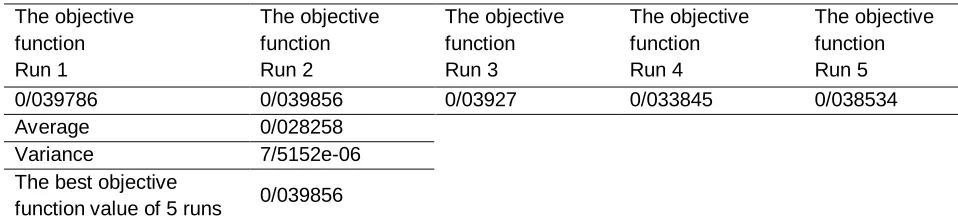
To test the stability of imperialist competitive algorithm, we repeat the algorithm 5 times to make sure after test, we obtained almost identical results. Variance 7 / 5152e-06 shows the stability of this algorithm.
Table 1. Study of the stability of colonial competitive algorithm in selecting the optimal portfolio The objective function Run 1 The objective function Run 2 The objective function Run 3 The objective function Run 4 The objective function Run 5
0/039786 0/039856 0/03927 0/033845 0/038534
Average 0/028258
Variance 7/5152e-06
The best objective
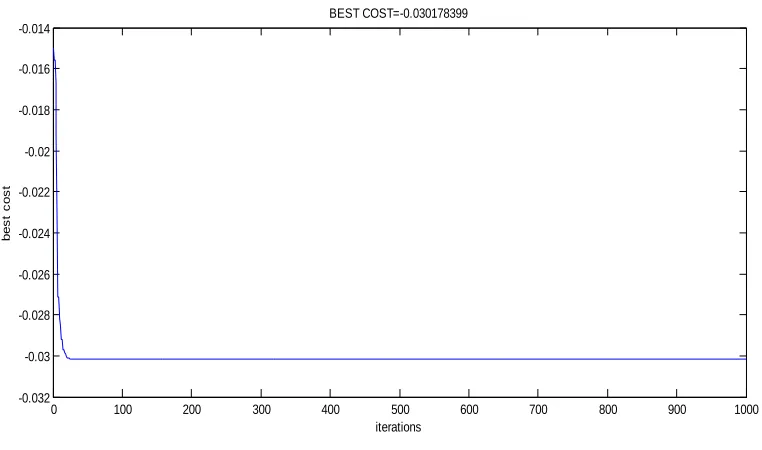
Licensed under Creative Common Page 248 The results of the 1000 iteration of the algorithm caused the appropriate convergence and Fig (2) shows path traveled by the evaluation function to reach the optimum point by cultural algorithm.
Figure 2. Path traveled by the evaluation function to reach the optimum point by cultural algorithm
0 100 200 300 400 500 600 700 800 900 1000
-0.032 -0.03 -0.028 -0.026 -0.024 -0.022 -0.02 -0.018 -0.016 -0.014
iterations
b
e
s
t
c
o
s
t
BEST COST=-0.030178399
To test the stability of imperialist competitive algorithm, we repeat the algorithm 5 times to make sure after test, we obtained almost identical results. Variance 2 / 97792e-06 shows the top stability of this algorithm.
Table 2. Study of the stability of the cultural algorithm in selecting optimum portfolio The objective
function
The objective function
The objective function
The objective function
The objective function
Run 1 Run 2 Run 3 Run 4 Run 5
0/030178399 0/0299969 0/0301128 0/03002334 0/029988 Average 0/030062045
Variance 2/97792e-06 The best objective
function value of 5 runs
Licensed under Creative Common Page 249 COMPARISON OF ALGORITHMS WITH DIFFERENT
INPUT INFORMATION IN PORTFOLIO
Table (3) shows the results of the algorithm portfolios based on model of Markowitz. The results of the optimization aspects and the point of convergence rate (objective function) are comparable.
Table 3. The results of the algorithms portfolios comparison
Algorithm Returns Cart Risk Cart The objective function Imperialist competitive
algorithm
27.047662 9.983187 00.039856
Cultural algorithm 24.935890 9.069320 0.030178399
Two following tables display the ranking results of algorithm selected portfolios based on semi-variance average model of Markowitz. Table (4) has been ranked in aspects of convergence and the table (5) has been ranked in aspects of the most optimal portfolio.
Table 4. ranking algorithms information portfolio regard to the return and risk Cart, based on the criteria Markowitz mean semi-variance aspects of convergence
Algorithm The objective function Ranking Algorithm Imperialist competitive algorithm 00/039856 First
Cultural algorithm 0/030178 Second
Table 5. ranking algorithms information portfolio regard to the return and risk Cart, based on the criteria Markowitz mean semi-variance aspects of convergence
Algorithm The objective function Ranking Algorithm
Imperialist competitive algorithm 2/709321 First
Cultural algorithm 2/749477 Second
CONCLUSIONS AND RECOMMENDATIONS
Licensed under Creative Common Page 250 algorithm for 5 times; among the functions obtained, the best objective function is selected and we obtained the optimal portfolio for each algorithm by the objective function. Imperialist competitive algorithm gained first and cultural algorithm gained second rank of the optimality and imperialist competitive algorithm gained first and cultural algorithm gained second rank of the convergence.
In this model to assess the risk of assets, annual stock return has been used. Using monthly stock returns, increase the accuracy of the model. Moreover, the following is suggested to improve the designed model, which forms implications for the further research:
• In this paper only the information about the risks and returns of assets is used. In order to more efficient algorithms, we can also consider the liquidity of the securities.
• Design an algorithm taking into account transaction costs and taxes. • Design an algorithm by considering the lower risk.
• The shares offered in the Stock Exchange are considered as existing assets in this algorithm.
• We can also consider a mix finance of stocks and other assets such as bank deposits, bonds, currencies, gold and real estate and implement the algorithm according to them.
REFERENCES
Atashpaz Gargari, Ismail, MA thesis, (2008), "The introduction of Imperialist competitive algorithm", Higher Center of Artificial Intelligence and Control Engineering Faculty of Electrical, Tehran University. Islami Bigdeli, Gholamreza and Heibati, Farshad, (2006), "portfolio management using an index model", Journal of Financial Research, numbers 9 and 10, pages 25-6.
Pourkazemi, Mohamed Hossein and Fattahi, Mostafa and mazaheri, Sasan and Asadi, Behrang, (2013), " optimization portfolio algorithm with interaction and with use of Imperialist competitive algorithm ", Industrial Management, Volume 5, Number 1, Page 20 -1.
Raie, Reza and Mohammadi, Shapur and Ali Beygi, Hedayat, (2011), "Stock optimization with approach mean- semi variance" and using the "harmony search" method. Research Management in Iran, Volume 15, Number 3.
Mehrjouie, Yahya and Resaie, Hasan, (2013), "Compare innovative methods to optimize portfolio statistical under semi - variance risk criteria and using statistical test t", International Journal of Industrial Engineering and Management, Issue 2, Volume 24, p 153-142.
Sajjadi, Zeinab, (2011), "optimization portfolio using Imperialist competitive algorithm based on value at risk", Master Thesis, Department of Mathematics and Computer Science, University of Sheikh Bahaie. Abbasi, Ebraham and Abolvali, Mahdi and Sarbazi, Mahdi, (2012), "Optimal Portfolio Selection Using Genetic Algorithm NSGA-II", Journal of Financial and Management Engineering Exchange, No. I.
Abolalizadeh Shahir, Simin and Eshghi, Corosh, (2003), “Application of genetic algorithms to select a range of assets from the stock exchange", Quarterly Journal of Iran Economic Research, No. 17, pages 192-175.
Licensed under Creative Common Page 251 Bermudez J.D., Segura J.V., Vercher E., (2011), "A Multi-Objective Genetic Algorithm for Cardinality Constrained Fuzzy Portfolio Selection.
Becerra, R.L., and Coello Coello, C.A., (2006), “Cultured differential evolution for constrained optimization”, Computer Methods in Applied Mechanics and Engineering, Vol. 195, No. 3336, pp. 4303-4322.
Huiling Wu, Yan Zeng, HaixiangYao, (2014), "Multi-period Markowitz's mean–variance portfolio selection with State-dependent exit probability", journal Of Elsevier Economic Modelling, Volume 36, P 69–78. Markowitz .H, (1959),” Portfolio Selection: Efficient Diversification of Investments”, New York, Wiley.
Sefiane, S., Benboouziane, Mohamed, (2012), "Portfolio Selection Using Genetic Algorithm", Journal of Applied Finance & Banking, vol.2, no.4, 143-154.
Strada, Javier, (2007), "Mean- Semi variance Optimization: A Heuristic Approach", Electronic copy available at: http://ssrn.com.