Developing Ethnomatematics In Geometry
Learning For Elementary Schools Students: A
Preliminary Design
Meita Fitrianawati, Mukti Sintawati, Marsigit, Endah Retnowati
Abstract: This study aims to development the design of hypothetical learning trajectory (HLT) in solid geometry learning for elementary school students grade 2 in Indonesia. The research method used in design research with 3 phase, namely preliminary design, teaching experiment phase, and retrospective analysis phase. In this study, steps are discussed are preliminary design. The main activities carried out include needs investigations, curriculum analysis, literature studies, and designing initial prototypes. Further, have generated HLT using an ethnomatematics. ethnomatematics is mathematics in culture. HLT is used as a guideline in the implementation of learning as well as a follow-up to all possible problems faced by students in the learning process. HLT patterns found can be used as material for consideration to design appropriate learning designs with the learning path of students so that they can increase student success in learning.In this study, HLT is a follow-up of needs analysis based on the results of identification carried out by the researcher. The article about needs analysis were published in The 2nd International Conference On Child-Friendly Education (ICCE) 2018.
Index Terms: Ethnomathematics, Geometry Learning, Elementary Schools Students, Preliminary Design. —————————— ——————————
1. INTRODUCTION
athematics is a science with the object of study each topic in sequential and interrelated [1]. Mathematical materials are structured gradually from basic to easier material the next one is more complex and difficult. Higher the level, the higher the difficulty level. Therefore, to learn math must be gradual. Furthermore, a teacher should teach mathematics in stages according to the stages [2]. Learning activities in class are the part of the task that requires skill separate for the teacher to run it. In the learning process, the teacher is required to can plan a learning can help students learn with well [3]. Helping students means helping their learning difficulties, revealing learning difficulties can manifest as a deficiency in one or more academic fields, both in specific subjects such as reading, writing, mathematics, and spelling; or in a variety of skills that are more general in nature such as listening, speaking, and thinking. " In an effort to accommodate this situation Simon introduced a Hypothetical Learning Trajectory (HLT) or learning trajectory rovided by the teacher based on thoughts on choosing a learning design specifically, so the best learning results are very possible to achieve [4]. This can be seen in thinking and planning that occurs in teaching, including spontaneous responses made in responding to students' thinking.
1`The hipotesis for the teacher being flexible in changing the direction of learning and adapting the planned aspects of activities in response to student responses throughout learning Based on this, the author is interested to use HLT in making a learning design [5]. HLT can be used as a guideline for implementing learning at class as well as an action anticipatory for possible problems faced by students in following the process learning. Then after compiling the HLT on selected mathematics material, teachers and prospective teachers are expected to also know how diverse abilities
students are formed when HLT implementation is implemented [6]. Therefore, through this study, the response profile is expected and a variety of students' abilities in HLT-based mathematics learning can be identified and analyzed by teacher candidates to then map the prospective teacher's ability profile as an important ability profile for a teacher to have. An ideal learning process cannot be separated from the planning and design process of learning. Learning Plans Learning or lesson plans are one of the concrete forms of learning planning and design processes.[7] However, in reality a Learning Implementation Plan only contains things that are formalities in the form of learning administration, namely a brief description of opening activities, core activities and activities cover [8]. Information other than the three stages of learning is merely summary of material to be delivered. Very rarely do teachers prepare hypotheses problem solving strategies that students use so the process learning tends to be less creative. There is an alternative hypothesis problem solving strategies used by students will help the teacher in determine strategies for handling possible difficulties faced by students. Learning difficulties Geometry has been expressed by many researchers before. According to [9] there were several errors made by students in solving geometry problems such as 1) concepts error (82.8%), 2), defective algorithm (78.1%), misused data (71.4%), calculation error (73.3%), technical error (76.2%). Meanwhile according to [10] there are several factors that cause low septic geometry value 1) Skills of students who are weak in sketching both flat and geometry, 2) Giving students knowledge about geometry of flat fields and space is very weak, especially at the secondary school level, 3) Lecturers who teaching geometry is still only using media to just sketch or draw and there are still few lecturers who use software-based media that facilitate subject abstraction for students. 4) Students are still weak in solving problems related to geometry that come from everyday life. Ethnomathematics is mathematics that arises and develops in society and in accordance with local culture, is the center of the learning process and teaching methods [11]. It can also be said that ethnomatematics can be considered that students' knowledge gained from learning outside the classroom. Culture-based learning must pay attention to four things, namely the
M
————————————————
Meita Fitrianawati, Mukti Sintawati, Universitas Ahmad Dahlan (UAD), Indonesia
Marsigit, Endah Retnowati , Universitas Negeri Yogyakarta (UNY), Indonesia
substance and competence of the field of science/field of study, meaningfulness and learning processes, assessment of learning outcomes, and the role of culture [12]. Culture-based learning emphasizes the achievement of integrated understanding rather than just deep understanding. The process of creating meaning through a culture-based learning process has several components, namely meaningful tasks, interaction, explanation and application of contextual science, and the use of a variety of learning resources [13].
2 RESEARCH
METHODOLOGY
The type of research that we used was design research [14]. Design research consists of three phases, namely developing a preliminary design, conducting pilot and teaching experiments, and carrying out a retrospective analysis [15]. In this study, we designed Hypothetical Learning Trajectory (HLT) as a design and research instrument. During the preliminary design, HLT guided the design of instructional materials that had to be developed or adapted. During pilot and teaching experiments, the HLT functioned as a guideline for the teacher and researcher what to focus on in teaching, interviewing, and observing. During the retrospective analysis, HLT functioned as guideline in determining what the researcher should focus on in the analysis [16].
4 RESULTS
AND
DISCUSSION
At the stage design preliminary, design of learning activities and development of alleged learning trajectories for students feed important parts to be observed and studied. [17,18] Before designing learning activities, first analyzed learning pathways and student learning trajectories for flat wake topics for grade 2 students. Next guess student learning trajectory, learning activities and the context used in mathematics learning will be a learning trajectory. Based on syllabus and purpose learning, researchers drafted initial HLT geometry of flat plane. HLT contains three main components of learning trajectory, namely: 1) learning objectives what you want to achieve, 2) activities that are support goals, and 3) expectations mathematically as a result of activity. Activity which was created later based on level of thinking and material concepts with media assistance and appropriate context with student character. This initial HLT draft refers to the content of geometry material according to the Curriculum 2013 which was given material emphasis accordingly by identifying the needs analysis researchers did before.
TABLE1
ASPECTANDMATERIALATGRADE2
Aspect Material
Geometry and Measurement
Numbers
Location/ position and distance of a place
Line width plane and solid characteristics
Raw units (length, weight, time)
symbol number Value place
Compare and sort numbers Addition and reduction of
enumeration numbers to 999 Multiplication and division up
to 100 Simple split
The scope of mathematics learning in Elementary Schools is then developed into Basic Competency and Competency Standards [19]. Basic competencies developed aim to improve life skills, especially in building reasoning, communication, and problem solving. [20, 21] The development of mathematical competencies in Elementary Schools also emphasizes skills or skills using technology tools to perform technical calculations and presentation in the form of images and graphics, which are important to support other skills that are skillful across non-cognitive disciplines and the development of values, norms and ethics [22, 23]. HLT compilers must also pay attention to the thinking stage and cognitive development of students. In aspects stage of thinking, [24, 25] describes the level of conceptual learning trajectory, namely: 1) Condition Level, students be in a context that situation Specific; 2) Reference Level, model and strategy refers to that situation explained in the problem; 3) Basic Level, the focus of mathematics on mastery strategies that refer to context; and 4) Formal Level, work with procedures conventional and notation. After going through these four levels, students must be able applying concepts that obtained for new problems inside different context [26,27]. Some topics mathematics requires later vertical mathematical (through process) abstraction, cooking, or generalization) later describe these stages to be the six levels of the stage of thinking passed by a grade 2 student in understanding a material. This stage starts from think informally starting from searches made by students themselves get to the formal stage where students can use the concept for solve the problem. At this stage students no longer depend on context which has been given, but can abstracting yourself the solution to a problem by using the right concept. The level of thinking stage is [28, 29] :
Level 1: Informal thinking, build meaning a concept by digging students' abilities through context informal
Level 2: basic meaning, students develop strategies informal and initial meaning that he understood from previous activities.
Level 3: Procedures, students determine strategies for complete a simple count operation.
Level 4: expand strategy to other problems by manipulating and comparison.
Level 5: Identification of different problems types, Identify various types problem in diverse contexts.
The lesson learning used ethnomathematics with scientific approach used in the 2013 curriculum, the stages of learning carried out by students refer to the five activities as follows:
1.Observing
Students are asked to observe several objects in the Prambanan temple complex, such as Shiva Temple, Goose Temple, Apit Temple, Lumbung Temple etc. Through the process of observing objects directly, students are able to find new information which will then be proposed in making questions about the material to be studied, namely introducing the shape of the curved side of the tube and looking for its surface area. The stages of observing objects directly are included in the active stages for students because they use observations of real objects directly.
Learners observe the Shiva Temple which is located in the middle of the main courtyard of Prambanan Temple. Observe the shapes of the stupas around the Shiva Temple.
2. Questioning
After making observations, students have information about the material being studied. Then students are asked to make questions that have not been understood regarding the material. In this case it can be done in group discussions to formulate questions or individually. Furthermore, the teacher and students conclude questions that are relevant to the learning objectives to be achieved. Students make questions by referring to 5w + 1h regarding geometric shapes on each temple observed in the Prambanan temple complex whether it has the same shape or not, etc.
Example:
- Students write questions, for example each stupa has the same shape?
- Students write questions, for example each end of the stupa has the same shape?
Fig 1. Stupa in Temple
3. Experimenting
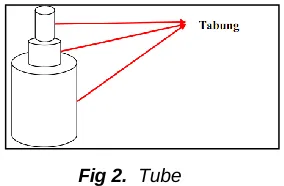
The results of the questioning activities are the basis for carrying out data collection or information activities. To do this activity, the teacher needs to provide a reference to students knowledge about methods of data collection such as observation, interviews, and documentation. Learners gather information / try to find out whether geometric shapes that resemble the temple results observed above. In this step the students are given media that resembles building a curved side space (tube) to try to find out about the surface area of the building.
Example:
- From the results of the questions that you convey, what form resembles the stupa is to build a curved side chamber (tube). Then the students try to find the surface area of the tube by cutting the tube media so that they form tube nets.
Fig 2. Tube
4. Associating
Associating or analyzing data is basically an activity to follow up on data that has been obtained. Students gather information and try to find the surface area of the tube.
Learners can find the surface area of cube using previous information about the area of circle and the area of rectangle. At this stage the peseta students associate or analyze observations including the iconic stage, where they can re-imagine the results of observations in the visual picture.
5. Communicating
Presenting research results is one way to communicate research results. Presenting the results of the research is done in front of the class then the other students give feedback. In the discussion, students can also exchange questions with other students then find solutions to the problems found. At that time, students can crosscheck the information they have obtained from the previous process. Learners can find and prove errors in a mathematical problem (evaluation), both derived from the questions they make and questions obtained from other students. The last stage is applying Mathematics, where students are required to apply the Mathematical concepts they have found. At this stage students make conclusions from a Mathematical problem, which can then be used to solve other problems (decisions) accompanied by the teacher. Students have entered into the symbolic stage, where they can express the shadow obtained from the second stage into the symbolic form of language.
Example:
Students are given a problem, then asked to solve it, namely looking for the surface area. Then the students presented the results of the discussion regarding the discovery of the tube surface area and the results of the discussion looking for the tube surface area.
From the five steps above, students are expected to be able to find a concept about recognizing the shape of a curved side (tube) and looking for its surface area and its relation to the culture of Prambanan Temple.Ethnomatematics describes all things that shape the cultural identity of a group, namely language, code, values, jargon, beliefs, food and clothing, habits, and physical traits. While Mathematics includes a broad view of arithmetic, classifying, sorting, concluding, and modeling [30,31]. Ethnomatematics serves to show the relationship between culture and Mathematics [32, 33]. Thus, ethnomatematics is an educational development approach that is used to construct how Mathematics is adapted from a culture and subsequently used in Mathematics learning activities.
4
CONCLUSION
Based on the description of the example of the application of hypothetical learning trajectory, it can concluded several things as follows: HLT provides understanding to the teacher about how important it is to attention to students' initial knowledge and also differences students' ability to develop learning designs. In other, HLT can be used as a teacher's instructions divide the stages of learning, namely by making several sub-goals learning to achieve the main learning goals. Futher more, HLT is useful as an implementation guide learning while providing various alternative strategies or scaffolding to help students overcome difficulties in understanding concepts learned.
ACKNOWLEDGMENT
Higher Education for funding this research through the skema ―PKPT‖.
REFERENCES
[1] Atiyah, M. (2001). Mathematics in the 20th century. American Mathematical Monthly, 108(7), pp. 654-666. [2] Baker, D., Knipe, H., Cummings, E., Blair, C. and
Gamson, D. (2010). One hundred years of elementary school mathematics in the United States: A content analysis aand cognitive assessment of textbooks from 1900 to 2000. Journal for Research in Mathematics, 41(4), pp. 383-423.
[3] Kang Hsuan Educational Publishing Group (Ed.) (2009). KH middle school mathematics textbooks. Taipei: Kang Hsuan Educational Publishing Group
[4] Sarumaha, Yenny Anggraeni. 2012. Design Reseach on Mathematics Eduction: Investigating the Development of Indonesia Fifth Grade Students in Learning Percentages. Palembang : FKIP Universitas Sriwijaya
[5] Daro, Phil, Frederic A. Mosher, dan Tom Corcoran. 2011. Learning Trajectories in Mathematics: A Foundation for Standards, Curriculum, Assessment, and Instruction. United States: Consortium for Policy Research in Education
[6] Orey, D.C. dan M. Rosa. (2004). Ethnomathematics and the teaching and learning Mathematics from a multicultural perspective. IV Festival Internacional de Mathemática, San José Costa Rica 2004
[7] Powell, A. B. dan Frankenstein, M.. (1997). Ethnomathematics praxis in the curriculum. Dalam A. B. Powell & M. Frankenstein (Eds.), Challenging Eurocentrism in mathematics education (pp. 249- 259). New York, NY: SUNY
[8] Simon, M. A. (1995) Reconstructing mathematics pedagogy from a constructivist perspective. Journal for Research in Mathematics Education, 26, 114–145. [9] Bofferding, L. (2014). Negative integer understanding:
Characterizing first graders' mental models. Journal for Research in Mathematics Education, 45(2), 194-245. [10] Pöhler,B., dan Prediger, S. (2014). Intertwining lexical and
conceptual learning trajectories – A design research study on dual macro - scaffolding towards percentages. Eurasia Journal of Mathematics, Science dan Technology Education, 11(6), 1697-1722.
[11] Sanchez dan Varcarcel. (1999). Science teachers‘ views and practices in Fuadia, N.F. http://e-mosharafa.org/index.php/mosharafa 24 Jurnal―Mosharafa‖, Volume 6, Nomor 1, Januari 2017 planning for teaching. Journal of Research in Science Teaching, 36(4), 493 – 513. Simon, M. A.
[12] Presmeg, N. C. (1998). Ethnomathematics in Teacher Education. Journal of Mathematics Teacher Education, 1, 317–339.
[13] Eerde, Van Dolly. 2013. Design Research: Looking Into Heart of Mathematics Education. 1 st Sea-DR Proceeding. Palembang: Universitas Sriwijaya.
[14] Gravemeijer, Koeno dan Paul Cobb. 2006. Design Research from a Learning Design Perspective. In: Jan Van Den Akker, Koeno Gravemeijer, Susan McKenney dan Nienke Nieveen. Educational Design Research. London: Routledge
[15] Almeida, R., dan Bruno, A. (2014). Strategies of pre-servise primary school teachers for solving addition
problems with negative numbers. International Journal of Mathematical Education in Science and Technology [16] Altiparmak, K., dan Ozdogan, E. (2010). A Study on the
teaching of the concept of negative numbers.International Journal of Mathematical Education in Science and Technology, 41(1): 31-47.
[17] Artigue, M., Haspekian, M., dan CorblinLenfant, A. (2014). Introduction to the theory of didactical situation (TDS). In: Ahsbahs dan Prediger (Eds.),Networking of theories as a research pratice in mathematics education (47 – 65). Switzerland: Springer International Publishing.
[18] Prahmana, Rully & Kusumah, Yaya. (2016). The Hypothetical Learning Trajectory on Research in Mathematics Education Using Research-Based Learning. Pedagogika. 123. 42-54. 10.15823/p.2016.32.
[19] Keklikci, Hilal & Ersozlu, Zara & Arslan, Mehmet. (2012). A Research on the Elementary School Students‘ Maths Fears. Research Journal of International Studies. 59-68.
[20] Lamb, L. L., Bishop, J. P., Philipp, R. A., Schappelle, B. P., Whitacre, I., dan Lewis, M. (2012). Developing symbol sense for the minus sign. Mathematics Teaching in the Middle School, 18(1), 5-9.
[21] Aishath Nasheeda, Haslinda Binti Abdullah, Steven Eric Krauss & Nobaya Binti Ahmed (2019) A narrative systematic review of life skills education: effectiveness, research gaps and priorities, International Journal of Adolescence and Youth, 24:3, 362-379, DOI: 10.1080/02673843.2018.1479278
[22] Lamb, L. L., Bishop, J. P., Philipp, R. A., Schappelle, B. P., Whitacre, I., dan Lewis, M. (2012). Developing symbol sense for the minus sign. Mathematics Teaching in the Middle School, 18(1), 5-9
[23] Bakar, R. (2018). The influence of professional teachers on Padang vocational school students' achievement. Kasetsart Journal of Social Sciences, 39(1), 67-72. [24] Clements, D., dan Sarama, J. (2004). Learning
trajectories in mathematics education. Mathematical Thinking and Learning, 6(2), 81-89
[25] Sarama, Julie & Clements, Douglas & Barrett, Jeffrey & Van Dine, Douglas & McDonel, Jennifer. (2011). Evaluation of a learning trajectory for length in the early years. ZDM - International Journal on Mathematics Education. 43. 667-680. 10.1007/s11858-011-0326-5.
[26] Fuadiah, N. F. (2015). Epistemological obstacles on mathematics‘learning in junior high school students: a study on the operations of integer material. In Proceeding of International Conference On Research, Implementation And Education Of Mathematics And Sciences 2015 (ICRIEMS 2015), Yogyakarta State University, 17-19 May 2015. Fakultas MIPA Universitas Negeri Yokyakarta [27] Stewart, Martyn. (2012). STEWART, M. (2012)
‗Understanding learning: theories and critique‘, in L.Hunt and D. Chalmers (eds) ―University teaching in focus: a learning-centred approach‖, London, Routledge.
[28] Buckley, Jane & Archibald, Thomas & Hargraves, Monica & Trochim, William. (2015). Defining and Teaching Evaluative Thinking: Insights From Research on Critical Thinking. American Journal of Evaluation. 36. 10.1177/1098214015581706.
[30] Rosa, M. Orey, D. C. (2011). Ethnomathematics: the cultural aspects of mathematics. Revista Latinoamericana de Etnomatem tica, 4(2). 32-54
[31] Suharta, I. G. P., Sudiarta, I. G. P., & Astawa, I. W. P. (2017). Ethnomathematics of Balinese traditional houses. International Research Journal of Engineering, IT & Scientific Research, 3(4), 47-56. Retrieved from https://sloap.org/journals/index.php/irjeis/article/view/550 [32] Massarwe, Khayriah & Verner, Igor & Bshouty, Daoud. (2012).
Ethnomathematics and Multi-Cultural Education: Analysis and Construction of Geometric Ornaments. Journal of Mathematics and Culture. 6. 344-360.
[33] Ilyyana, K., & Rochmad, R. (2018). Analysis of Problem Solving Ability in Quadrilateral Topic on Model Eliciting Activities Learning Containing Ethnomathematics. Unnes Journal of Mathematics Education Research, 7(1),
130-137. Retrieved from