
Article
1
Projecting Drivers of Human Vulnerability under the
2
Shared Socioeconomic Pathways
3
Guillaume Rohat 1,2*
4
1 Institute for Environmental Sciences, University of Geneva, Switzerland
5
2 Faculty of Geo-Information Science and Earth Observation, University of Twente, The Netherlands
6
* Correspondence: [email protected]; Tel.: +41-22-379-33-65
7
8
Abstract: The Shared Socioeconomic Pathways (SSPs) are the new global development trends that
9
inform global and regional climate change research. They have the potential to foster the integration
10
of socioeconomic scenarios within assessments of future climate-related health impacts. To date,
11
such assessments have primarily superimposed climate scenarios on current socioeconomic
12
conditions only. Until now, the few assessments of future health risks that employed the SSPs have
13
focused on future human exposure—i.e., mainly future population patterns—neglecting future
14
human vulnerability. This paper first explores the research gaps—mainly linked to the paucity of
15
available projections—that explain such a lack of consideration of human vulnerability under the
16
SSPs. It then highlights the need for projections of socioeconomic variables covering the wide range
17
of determinants of human vulnerability, available at relevant spatial and temporal scales, and
18
accounting for local specificities through sectoral and regional extended versions of the global SSPs.
19
Finally, this paper presents two innovative methods of obtaining and computing such
20
socioeconomic projections under the SSPs—namely the scenario matching approach and an
21
approach based on experts’ elicitation and correlation analyses—and applies them to the case of
22
Europe. They offer a variety of possibilities for practical application, producing projections at
sub-23
national level of various drivers of human vulnerability such as demographic and social
24
characteristics, urbanization, state of the environment, infrastructure, health status, and living
25
arrangements. Both the innovative approaches presented in this paper and existing methods—such
26
as the spatial disaggregation of existing projections and the use of sectoral models—show great
27
potential to enhance the availability of relevant projections of determinants of human vulnerability.
28
Assessments of future climate-related health impacts should thus rely on these methods to account
29
for future human vulnerability—under varying levels of socioeconomic development—and to
30
explore its influence on future health risks under different degrees of climate change.
31
Keywords: Shared Socioeconomic Pathways; climate change; vulnerability; projections; Europe
32
33
1. Introduction
34
It has long been acknowledged that socioeconomic determinants play an important role in the
35
characterization of climate risks, through vulnerability and exposure [1]. As a result, nearly all
36
assessments of climate risks consider both climatic (hazard) and socioeconomic (vulnerability and
37
exposure) conditions [2]. Nevertheless, when it comes to modelling future climate-related health
38
risks, the overwhelming majority of studies have been based on projections of future climatic
39
conditions – through climate models and scenarios – superimposed on current socioeconomic
40
conditions only [3-5]. By making the implicit assumption that drivers of risk other than climate
41
change will remain the same, most of the existing studies have failed to account for the influence that
42
socioeconomic development might have on future climate-related health impacts [6].
43
This crucial issue of temporal scale mismatch was raised more than a decade ago [7,8], the
44
dynamics of vulnerability have been long recognized [9], and several papers have stressed the need
45
for improved understanding of future vulnerability [1,4,10-12]. In spite of this, future socioeconomic
1
conditions have been very rarely accounted for until now and projections of human vulnerability are
2
largely lacking [6]. Given that a large share of climate risk assessments serve adaptation purposes,
3
such a practice is likely to introduce systematic bias into climate and health adaptation strategies [3].
4
Partly to counteract such shortcomings and to foster the use of socioeconomic scenarios and
5
projections within climate risk assessments, the climate change research community has been
6
engaged over the past few years in the development of a new scenario framework, in which climate
7
and socioeconomic scenarios were developed in parallel [13]. This new scenario framework for
8
climate change research comprises a set of greenhouse gas emissions trajectories, namely the
9
Representative Concentration Pathways – RCPs [14] and a set of global socioeconomic development
10
trends, namely the Shared Socioeconomic Pathways – SSPs [15]. These global pathways have been
11
designed to be combined in a scenario matrix architecture [16] – assuming that given RCPs can be
12
reached by different SSPs – to explore the wide range of challenges to mitigation and adaptation.
13
While much of the climate research has been focused on understanding the impacts of different RCPs
14
on a wide array of socioeconomic and natural systems [17], very little has been done until now to
15
explore the influence of temporal dynamics of socioeconomic systems – under the SSPs – on future
16
human vulnerability and climate-related health risks [18]. In fact, despite the rapidly growing array
17
of studies making use of both the RCPs and SSPs to explore future climate-related health impacts, the
18
influence of changes in socioeconomic conditions is still largely underestimated and mostly
19
constrained to changes in exposure only, utterly neglecting the effect of changes in human
20
vulnerability [19]. Drawing on this, the aim of this paper is twofold. First, it aims to critically discuss
21
the current state of practice in relation to the use of SSPs in the assessment of future climate-related
22
health impacts, in order to identify and better characterize the research gaps and needs, particularly
23
in terms of availability of socioeconomic projections. Second, through a European case-study, this
24
paper aims to present two innovative methods that complement existing projection methods and
25
have the potential to address the aforementioned research needs.
26
2. Current State of Practice
27
2.1. Shared Socioeconomic Pathways – Ssps
28
The SSPs are the latest set of IPCC-guided global socioeconomic development trends that
29
provide a global context to guide climate change research at both global and regional levels [15,20].
30
They are made up of five contrasting global development pathways that depict plausible alternative
31
future states of the society and the environment. They have been purposely designed to span the
32
wide range of socioeconomic challenges to adaptation and mitigation. A substantial body of literature
33
has documented (i) their development [13,15,20-25], (ii) their quantification at the national level up
34
to 2100 for a few key socioeconomic variables – freely available online [26] – such as demography
35
and education [27,28], urbanization [29], economic growth [30-32], and land use [33], (iii) their
36
integration with climate change [34], and (iv) their links with future atmospheric concentration of
37
greenhouse gases [35-38].
38
2.2. Extended Ssps
39
An important feature of the SSPs lies in their flexibility. They have been purposely conceived to
40
be extended, i.e. contextualized, detailed, and eventually quantified for specific regions and/or sectors
41
[39]. Extended versions of the global “basic” SSPs have an increased suitability and usefulness for
42
local and/or sectoral studies, are of greater relevance for policy-making, and are more likely to be
43
used by local stakeholders. A growing number of studies have employed the narratives of the global
44
SSPs to develop extended SSPs for specific regions and/or sectors. So far, extended SSPs include
45
extended SSPs of urban and population development worldwide [40,41], in coastal areas [42,43], and
46
in large cities [44], extended SSPs for health [45,46], for the water sector [47,48], for fisheries [49], for
47
Asia [53], and extended SSPs for specific regions, e.g. the Barents region [54], the Arctic [55], Tokyo
1
[56], Iberia [57], Scotland [57], the US [58], and Europe [5,59].
2
2.3. Integration within Climate-Related Health Impact Assessments
3
The SSPs have been purposely designed to be used within Impacts, Adaptation, and
4
Vulnerability (IAV) studies. Therefore, they have the potential to enhance the integration of
5
socioeconomic scenarios within future-looking IAV research [39,60] and to improve the
6
comparability between different case studies [61,62]. Over the past few years, a rapidly growing
7
number of IAV studies have made use of the SSPs – coupled with different RCPs – to assess future
8
climate-related health impacts under multiple combinations of socioeconomic and climate scenarios.
9
So far, these studies have been conducted in the fields of food security and hunger risks [53,63-69],
10
fire risk [70], exposure to vector-borne diseases [71,72], water scarcity [73-78], flood risks [79-81], air
11
pollution risks [82,83], and heat-related health impacts [84-97].
12
2.4. Research gaps and needs
13
The aforementioned studies that use SSPs and RCPs to explore future climate-related health
14
impacts show a number of recurrent shortcomings, which can be translated into research gaps and
15
needs. These drawbacks are mainly related to the lack of regional and sectoral contextualization of
16
the global SSPs and to the lack of consideration for vulnerability. These are detailed below.
17
Lack of extended SSPs: a number of existing studies make a straightforward use of the global
18
SSPs’ narratives and of their quantification at the country level, without contextualizing them for the
19
region and/or sector of interest, thus neglecting the processes that are specific to a given region and/or
20
sector and that influence future socioeconomic and environmental trends. The most common practice
21
linked to this shortcoming is to assume a homogeneous population or economic growth rate within
22
an entire country to downscale national projections of the global SSPs at the sub-national scale,
23
without accounting for local socioeconomic processes that may influence the distribution of
24
population or economic growth within the region. For instance, Marsha et al. [92] have applied the
25
global SSPs’ population change rates at the national level (US) to estimate future population growth
26
in Houston, without considering Houston’s specific socioeconomic and urban development.
27
Similarly, Koutroulis et al. [78] and Alfieri et al. [81] have employed national-level quantitative
28
projections of the global SSPs (for GDP and population growth) in their assessments of future water
29
security and flood risk in Europe, without accounting for specific European socioeconomic
30
developments [59]. Another recent example lies in a study [76] in which the authors assumed a
31
similar population growth rate in flood-prone areas as the growth rate at the national level, despite
32
recognizing that population usually tends to grow faster in flood-prone areas than in other places
33
(due to the higher growth rate of low-income populations). In this particular case, such an
34
assumption led to an underestimation of the number of people exposed to river flooding.
35
Lack of consideration of vulnerability: the overwhelming majority of existing assessments of
36
future climate-related health impacts account only for future exposure (i.e. the future size of the
37
populations exposed to climatic hazards) – under different SSPs – and neglect the future populations’
38
vulnerability (i.e. their abilities to prepare for, respond to, and recover from climatic hazards). Such
39
lack of consideration of vulnerability can be found in most of the existing studies, e.g. in assessment
40
of future heat stress risk [85,88,90,94,95], of future flooding risk [76], of future risk of vector-borne
41
diseases [71], and so on. While most of the aforementioned authors acknowledge that future research
42
should attempt to integrate projections of drivers of human vulnerability, these are still very rarely
43
found. By disregarding the future states of vulnerability, past studies have focused only on the
44
“population effect” (i.e. the influence of population growth on future populations’ exposure) [88,95]
45
and have substantially underestimated the influence that varying levels of socioeconomic
46
development may have on future climate-related health impacts [3]. Up until now, the few studies
47
that have employed projections of vulnerability under the SSPs have been limited to projections of
48
age, education [86], income level, water demand [75,78], urbanization [87], crop demand, and share
49
been employed at a very coarse spatial resolution – country-level mainly –, hence limiting their
1
usefulness for policy-making and their intake by local stakeholders as well as their compatibility with
2
climate projections – often realized at 0.5° [98].
3
To justify such paucity of contextualization of socioeconomic projections under the SSPs and
4
such lack of consideration of future populations’ vulnerability, authors traditionally point out the
5
scarcity of socioeconomic projections, in terms of diversity, spatial scale, consistency with the SSPs,
6
and relevance at local scale (Table 1). This research gap provides a convincing explanation of the
7
aforementioned drawbacks.
8
This close look at the current state of practice clearly highlights the needs to develop quantitative
9
projections of socioeconomic variables that are consistent with the global SSPs (i.e. linked to global
10
contexts) while accounting for local and sectoral specificities (i.e. making use of extended SSPs), that
11
are produced at relevant spatial and temporal scales – in line with climate models’ outputs and with
12
the scale at which socioeconomic processes happen –, and that cover the broad range of drivers that
13
influence human vulnerability to climate change.
14
Table 1. Statements from assessments of future climate-related health impacts based on SSPs and
15
RCPs – with, in addition, one review study (*) and two IAV studies (**) that do not make use of the
16
SSPs but which reflect typical statements found in the literature. These highlight both the need to
17
consider future vulnerability under the SSPs and the lack of available projections to do so.
18
Study Statement
[92]
“[…] this study utilized SSP national-level demographic and economic projections rather than city-specific projections of Houston because SSP-based projections were unavailable for the city.
The national-level SSP projections […] are likely inaccurate given the city’s rapid growth of racially and ethnically diverse populations.”
[84]
“The health impacts of heat vary by personal susceptibility factors like age, and heat effects might be compounded by concurrent exposures like high air pollution or power outages. Future research could explore [….] whether such characteristics could be projected for future heatwaves
with enough resolution to be usefully incorporated into projections.”
[95]
“Our initial exploration of a potentially transformative risk factor for humans only considers population exposure. However, the impacts of heat on humans depend on both exposure and vulnerability, with the latter depending on many other factors including population age, degree
and type of pre-existing health conditions, […]. The SSPs may offer a means of exploring potentially critical correlations between heat, population density, vulnerability, and the potential
for adaptation.”
[85]
“[…] in this work we only analyzed the change in exposure to extreme heat as a function of a change in the hazard […] and population. To properly estimate a change in risk of mortality/morbidity resulting from this exposure, demographic and socioeconomic characteristics
[97]
“Finally, quantifying exposure is a starting point for estimating future risks, but further work is necessary on vulnerability to the impacts of extreme heat, including population age structure and
income, as well as possible changes in social and institutional factors over time, which will pay important roles in heat-related impacts.”
[94]
“SSP3 assumes a fragmented world following varied regional social, political, and economic pathways. This may be considered difficult to reconcile with the international collaborative effort
that would be required in order to keep the global temperature from exceeding 1.5ºC. However, we consider it here on the grounds that what applies as a general rule globally does not necessarily need to apply for India itself (notwithstanding India's outsized contribution to world
population), and that having a population scenario that spans a larger range will allow a more expanded study of the relation between heatwaves, national population, and MPEHWd.”
[91]
“[…] the lethality of deadly climatic conditions can be mediated by various demographic (for example, age structure), socio-economic (for example, air conditioning, early warning systems)
and urban planning (for example, vegetation, high albedo surface) factors that were not considered in our study. Consideration of these factors would improve the understanding of
global human vulnerability to heat exposure […].”
[71]
“Other study limitations are related to human and mosquito behavior. […] how human interventions aimed at reducing Ae. Aegypti populations may change in the future is unknown.
For example, controversial releases of genetically-modified “sterile” male mosquitoes may become more common in the future, and, if they do, would differ between the SSPs. Additionally,
how other human factors such as cultural practices, water access, urbanization, transportation networks and global trade may evolve and impact the spread of Ae. aegypti is unclear.”
[76]
“[…] the SSP characterizations are preliminary. […] only simple indicators of changes in exposure to water resources scarcity and river flood frequency are used. These indicators consider only population, and do not incorporate other differences between socio-economic scenarios such as differences in water withdrawals or rate of urbanization. Including such additional dimensions
would increase the differences between the SSPs. Future assessments should include more sophisticated measures of exposure and impact […].”
[73]
“In future studies, we would like to account for more demographic characteristics in addition to growth, i.e., age, sex, education, and income, which are likely to be stronger factors for demographic change in the 1.5 ºC target. However, we currently lack the required sophisticated
data.”
[75]
“[…] we used a simplistic model to estimate industrial and municipal water use. Progress in this area of modeling has long been obstructed by a lack of data, but further efforts are needed. […] the water use scenario that is used significantly affects the results; hence further efforts are needed
[74]
“To come to a full risk assessment framework more work needs to be done to make the transfer from risk estimates in terms of exposed population towards estimates covering ‘economic’ impacts. A first step therein should be to include vulnerability, including: the sensitivity of a population to water scarcity, the available infrastructure and (financial) resources to cope with water scarcity, […] and capability of the responsible government to deal with water scarcity in a
quick and efficient manner.”
[72]*
“[…] final suggestion related to making better use of the new generation of socioeconomic scenarios. It is somewhat ironic that climatic impacts, adaptation and vulnerability (IAV) research,
which is so dependent upon assumptions about socioeconomic development, has tended to underutilize socioeconomic scenarios. This is no different for the health sector, but there are opportunities to rectify the situation. […] one solution would be for climate change and health researchers to work to extend the SSPs so that they have more specific health-related variables. […] one key issue is the availability and parameterization of relevant vulnerability indicators within the SSPs. […] the availability of high-resolution projections for broader-level vulnerable
indicators such as income distribution, population, health, and governance would be an important starting point.”
[99]**
“[…] it was decided to base adaptive capacity on present day data rather than future projections because it is much harder to obtain future projections of relevant socioeconomic data than it is for climate data: the great uncertainty inherent in any socioeconomic projections would contribute to
the multiplication of overall model uncertainties.”
[100]**
“Although vulnerability is dynamic and changes over time, there is no quantitative information available about how this may affect damages. Hence, we assumed no future changes in
vulnerability.”
3. Methods to project drivers of human vulnerability
1
In light of the aforementioned research gaps and needs, I introduce here several methods that
2
have the potential to address the need for quantitative projections of drivers of human vulnerability
3
(e.g. age structure, income, infrastructure, access to resources, urbanization, education, pre-existing
4
medical conditions), consistent with the SSPs, contextualized, and produced at relevant spatial and
5
temporal scales. I first briefly discuss the two main approaches that have been applied so far, namely
6
the use of sectoral models and the spatial disaggregation of existing projections, and then detail two
7
new and innovative methods that can complement the existing approaches. These are based (i) on
8
the matching of existing scenario sets to generate consistent projections and (ii) on the quantification
9
of experts’ opinions coupled with correlation analyses. These have been recently applied to Europe
10
to explore future social vulnerability [5] and future heat-related health impacts [19].
11
3.1. Existing methods
12
3.1.1. Use of sectoral models
13
Until now, the most common approach to quantifying the SSPs has been the use of sectoral
14
models. For instance, the global SSPs have been quantified for key socioeconomic variables at the
15
national level with sectoral models such as urbanization models [29], demographic models [27,28],
16
and economic models [31,101]. At the regional level, urbanization and demographic sectoral models
17
have been applied, for instance, to produce urbanization and population projections under the SSPs
18
for the 101 largest cities [44], for the coastal zones [42], for the Mediterranean area [43], and for Europe
19
variables related to water demand and food consumption, mainly at the global scale [47,69,103]. It
1
should be noted here that the use of sectoral models to project drivers of human vulnerability – other
2
than population and urbanization – at the local scale and based on regional/sectoral extensions of the
3
global SSPs has yet to be explored.
4
3.1.2. Spatial Disaggregation
5
Another fairly common approach to obtaining projections at a relevant spatial scale in IAV
6
studies is the spatial disaggregation of existing projections, which have been produced at the national
7
scale under the global SSPs [26]. To disaggregate these national-level projections, authors
8
traditionally employed current statistics at sub-national level – considered as the benchmark – and
9
applied country- and SSPs-specific growth/decline rates over all the sub-national units of a given
10
country, ensuring that the relationship between the distance from a given sub-national value to the
11
national mean and the distance from the national mean to the minimum and maximum sub-national
12
values remain similar to those in the benchmark. A few examples of studies that have employed this
13
approach to downscale national projections under the SSPs include (i) Xing et al. [104] who have
14
downscaled projections of population, GDP per capita, and urban population share under SSP2 for
15
31 provinces in China, (ii) Marsha et al. [92] who have downscaled national projections of GDP and
16
population in the US for each block group of Houston city, and (iii) Rohat et al. [5] who have
17
downscaled projections of education under SSP1, SSP3, and SSP4 at the NUTS-2 level for 30 European
18
countries.
19
While such a downscaling approach based on current figures is useful to approximate the
20
national projections at a local scale, it fails to account for context-specific characteristics – usually
21
described in extended versions of the SSPs – that influence local socioeconomic development trends.
22
To account for these local trends, the downscaling process of the national projections should be
23
informed by context-specific downscaling scenarios. In Europe, Hurth et al. [105] and Lückenkötter
24
et al. [106] have downscaled national projections of GDP per capita and population density (under
25
the five SSPs) on the basis of the coupling of the latest scenarios of the European Commission
26
Directorate General for Economic and Financial Affairs (ECFIN) – namely the trend and convergence
27
scenarios [107] – with current figures of GDP per capita and population density at very high spatial
28
resolution. The resulting contextualized and downscaled projections of GDP per capita and
29
population density are available at a very high spatial resolution (10*10km spatial grid), accounting
30
for the local context – through the regionalization with the European scenarios –, and are consistent
31
with the global SSPs’ national projections. Such projections have been used in Rohat et al. [19] and
32
are expected to be integrated within a number of forthcoming European IAV studies.
33
3.2. Scenario matching
34
The use of scenarios in environmental studies has substantially increased over the past decades
35
[108], leading to the development of a large number of different scenario sets in Europe [109-112].
36
Although their scientific acceptance and their relevance for climate-related issues may vary [113],
37
these existing scenario sets represent an extremely valuable basis of knowledge regarding the
38
multiple ways the future could unfold and in relation to the impacts of varying levels of
39
socioeconomic development on a range of sectors such as demography, urbanization, housing,
40
economy, health, land use, agriculture, transportation, and so on [114,115]. Although it has been
41
argued that it would be unwise not to employ such a great source of knowledge [116], the re-use of
42
existing scenario sets in IAV studies has been limited until now to the use of their storylines to extend
43
the global SSPs’ narratives [57,58,117]. To my knowledge, the quantitative elements of existing
44
scenario sets (i.e. their quantitative projections) have never been re-used in assessments of future
45
climate-related health impacts. I argue here that the use of existing quantitative projections of
46
previously-developed scenario sets has the potential to address the need for projections of drivers of
47
human vulnerability, provided that they are consistent with the SSPs. The latter consideration is of
48
the utmost importance to ensure the inter-compatibility between SSPs-based IAV studies [39]. The
49
systematic methods to match the narrative of a given existing scenario with the storyline of a given
1
SSP [50,52,54,58].
2
Building upon a forthcoming paper [5], I present here the results of a scenario matching
3
approach that was applied to match the global SSPs with three European scenario sets, namely
4
ET2050, DEMIFER, and CLIMSAVE. These can be characterized as follows.
5
6
• ET2050 comprises four scenarios of territorial development and cohesion in Europe [118] that
7
have been quantified for variables related to urbanization, accessibility, and transport nodes, at
8
the sub-national level [119]. The four scenarios are named Baseline (Base), MEGAS (A), Regions
9
(B), and Cities (C).
10
• DEMIFER is made up of five European demographic scenarios [120] that have been quantified
11
for a number of key demographic and lifestyle variables such as labor force, ageing,
12
employment, life expectancy, and different types of migration, at sub-national level [121]. The
13
five scenarios are named Status Quo (STQ), Growing Social Europe (GSE), Expanding Market Europe
14
(EME), Limited Social Europe (LSE), and Challenged Market Europe (CME).
15
• CLIMSAVE comprises four cross-sectoral European scenarios [122-124] that have been
16
quantified for variables related to ecosystems services and provisions and environmental
17
conditions, at high spatial resolution (16*16km) [125]. The four scenarios are named We are the
18
World (WW), Icarus (Ica), Riders on the Storm (RS), and Should I stay or Should I go (SSG).
19
20
Employing a systematic scenario matching approach (i.e. a semi-quantitative approach which
21
aims to quantify the similarities between several scenarios originating from different sets of
22
scenarios), authors identified three different groups of scenarios – made of one scenario of each set –
23
, each sharing significantly similar storylines (Table 2). These groups of scenarios are then viewed as
24
extended versions of the SSPs (hereafter Ext-SSPs), which showcase an increased relevance (i) at the
25
European level and (ii) for sectors related to human vulnerability, compared to the global SSPs’
26
storylines.
27
Table 2. Groups of scenarios sharing similar storylines, matched with the scenario matching approach
28
[5]. Each group constitutes a given extended SSP (Ext-SSP).
29
Group of scenarios Global SSPs ET2050 scenarios DEMIFER scenarios CLIMSAVE scenarios
Ext-SSP1 SSP1 B GSE WW
Ext-SSP3 SSP3 Base CME Ica
Ext-SSP4 SSP4 A EME RS
Being made up of a combination of scenarios – one from of each of the four scenario sets – the
30
newly-created Ext-SSPs can be readily quantified through the co-use of the quantitative outputs of
31
each scenario set. As an example, the quantitative projections made under ET2050-B, DEMIFER-GSE,
32
and CLIMSAVE-WW are viewed as consistent with one another and with SSP1 – because their
33
respective storylines have been matched – and therefore constitute the quantitative part of Ext-SSP1.
34
In this way, authors were able to readily quantify the three Ext-SSPs at the sub-national level, up to
35
2050, for a wide number of variables related to territorial development and cohesion (from ET2050
36
scenarios), demography and lifestyle (from DEMIFER scenarios), and environment (from CLIMSAVE
37
scenarios). A large proportion of these variables are considered as important determinants of human
38
vulnerability and could therefore be integrated within assessments of future climate-related health
39
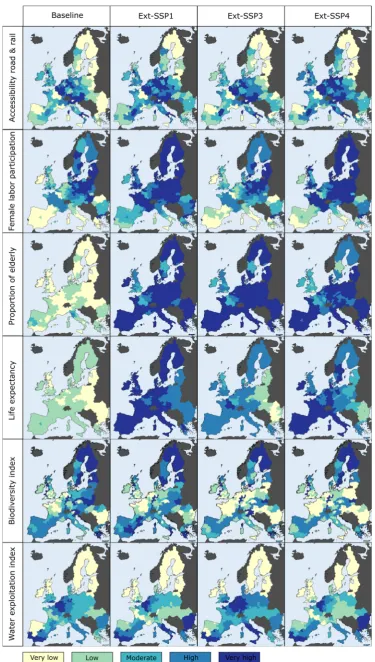
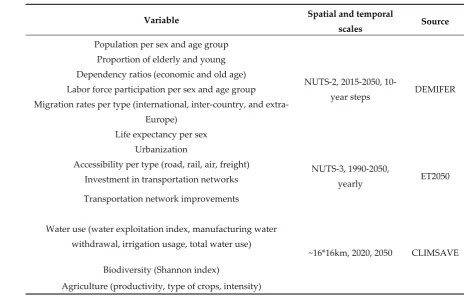
impacts. Figure 1 and Table 3 present a sample of these readily available and spatially-explicit
40
1
Figure 1. Sample of the available projections of variables related to human vulnerability, under the
2
three extended SSPs (2050) and the baseline (2015) conditions, for the 28 member countries of the
3
Table 3. Quantitative projections of relevant variables related to human vulnerability that are readily
1
available through the scenario matching approach for the three Ext-SSPs. All these projections cover
2
the 28 member countries of the European Union.
3
Variable Spatial and temporal
scales Source
Population per sex and age group
NUTS-2, 2015-2050,
10-year steps DEMIFER Proportion of elderly and young
Dependency ratios (economic and old age) Labor force participation per sex and age group Migration rates per type (international, inter-country, and
extra-Europe) Life expectancy per sex
Urbanization
NUTS-3, 1990-2050,
yearly ET2050
Accessibility per type (road, rail, air, freight) Investment in transportation networks
Transportation network improvements
Water use (water exploitation index, manufacturing water withdrawal, irrigation usage, total water use)
~16*16km, 2020, 2050 CLIMSAVE
Biodiversity (Shannon index)
Agriculture (productivity, type of crops, intensity)
3.3. Experts’ elicitation and correlation analyses
4
For a certain number of determinants of human vulnerability – e.g. those related to health
5
conditions, governance efficiency, or human behavior – quantitative projections under different
6
socioeconomic scenarios simply do not exist (or are extremely scarce) and models are not available
7
or not yet well developed. In such cases, more simplistic approaches may be considered in order to
8
obtain rough projections under the different SSPs. This should be preferred to discarding a variable
9
and/or assuming fixed conditions, particularly if the variable in question is an important driver of
10
vulnerability.
11
I present here an innovative approach based on experts’ elicitation and correlation analyses to
12
quantitatively project two significant determinants of vulnerability to heat stress in Europe, namely
13
the proportion of elderly people living alone and the prevalence of overweight. It has been shown
14
that social isolation among the elderly considerably increases the risk of death during extreme
15
temperatures events [126-128], mostly due to their lower access to transportation and their lack of
16
support during heat waves [129,130]. Similarly, research has shown that pre-existing medical
17
conditions, such as overweight, lead to significantly higher risk of death during heat waves
18
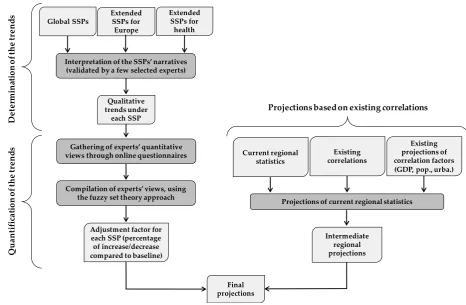
[126,131,132]. The workflow of this innovative method is presented in Figure 2 and each step is
19
1
Figure 2. Workflow of the projection method based on experts’ elicitation and correlation analyses.
2
3.3.1. Determination of local trends
3
Due to the global SSPs’ lack of explicitness regarding future developments in public health
4
conditions and in living arrangements of the elderly, I first interpreted the global SSPs – using the
5
existing European SSPs developed within the IMPRESSIONS project [59,117] and the preliminary
6
version of the extended SSPs for health [45] – to determine future trends in the proportion of the
7
elderly living alone and in the prevalence of overweight, under each SSP. The interpretation of these
8
existing extended versions of the SSPs led to a fairly straightforward establishment of future trends
9
in overweight prevalence in Europe, as presented in Table 4. These were validated by three different
10
experts.
11
Conversely, determining the future trends in the proportion of the elderly living alone was a
12
much less straightforward process, as trends in living arrangements are not mentioned – even
13
implicitly – in the European SSPs’ narratives. Therefore, I first conducted a short literature review to
14
identify the main drivers of living arrangements among the elderly in Europe [133-136]. With the
15
help of two experts in household composition, I identified the following key drivers: (i) ageing of the
16
population, (ii) health conditions (elderly people in better health are more likely to live alone), (iii)
17
economic situation (better-off elderly people are more likely to live alone), (iv) type of society
18
(familistic or individualistic), and (v) social cohesion. In light of these drivers of the elderly’s living
19
arrangements, I then determined the trends direction under each SSP (Table 5).Unlike the trends in
20
future overweight prevalence, the trends in future proportions of elderly people living alone were
21
not only determined for the whole Europe, but also for three different clusters of European countries
22
(namely the Northern cluster, the Central/Western cluster, and the Southern cluster). These clusters
23
were determined based on current figures of the proportion of elderly people living alone, with the
24
current proportion being 40% on average in the Northern cluster, 33% in the Central/Western cluster,
25
and 25% in the Southern cluster. Such elicitation of the trends at the sub-European level allows better
26
accounting for the differential intra-Europe development pathways.
27
Compilation of experts’ views, using the fuzzy set theory approach
D
e
te
rm
in
at
io
n
o
f
th
e
tre
n
d
s
Q
u
a
n
ti
fi
ca
ti
o
n
o
f th
e
tre
n
d
s
Projections based on existing correlations
Interpretation of the SSPs’ narratives (validated by a few selected experts) Global SSPs
Extended SSPs for
Europe
Extended SSPs for
health
Qualitative trends under
each SSP
Adjustment factor for each SSP (percentage of increase/decrease compared to baseline)
Existing projections of correlation factors (GDP, pop., urba.)
Projections of current regional statistics
Final projections
Intermediate regional projections Gathering of experts’ quantitative
views through online questionnaires Existing
correlations Current regional
Table 4. Trends in future prevalence of overweight in Europe under each European SSP (EU-SSPs),
1
based on the interpretation of the existing EU-SSPs [59] and extended SSPs for health (the latest
2
version of the extended SSP for health [46] were not yet available when this research was conducted,
3
so the preliminary version [45] was used instead).
4
EU-SSPs
Citations extracted from the narratives of the European SSPs and the health-SSPs
Trend in prevalence of overweight in Europe
EU-SSP1
“Population health improves significantly”
“Increased emphasis on enhancing health and health care functions” “Reduced burden of health outcomes”
“Changes in dietary patterns to lower burden of some chronic diseases”
“High investments in human health and education”
Large decrease
EU-SSP3
“Population health decreases significantly”
“Countries experience double burden of infectious and chronic climate-related health outcomes”
“Reduced funding for surveillance and monitoring programs” “Low investments in human health and education”
“Phasing out of social security system”
Large increase
EU-SSP4
“Unequal world, with limited access to high quality education and health services”
“Lower burden of some chronic diseases from changes in dietary patterns”
“High investments in human health and education for elites only, low for others”
Increase
EU-SSP5
“World attains human sustainable goals”
“Health improves significantly, but not as much as in SSP1” “Because the challenges for local management of environmental quality are larger, the burden of chronic diseases is somewhat higher
than in SSP1”
“High investments in human health and education”
Decrease
Table 5. Trends in future proportion of elderly living alone in Europe under each European SSP
(EU-5
SSPs), at the European level (EU) and for each of the three countries’ clusters. .
6
EU-SSPs EU Northern Central/Western Southern
EU-SSP1 Increase Stable Increase Increase
EU-SSP3 Large decrease Decrease Large decrease Decrease
EU-SSP4 Decrease Stable Decrease Decrease
EU-SSP5 Large increase Increase Large increase Large increase
3.3.2. Quantification of the local trends based on experts’ elicitation
7
To quantify the aforementioned trends in the proportion of elderly people living alone and in
8
the prevalence of overweight under each European SSP (EU-SSPs), I employed the fuzzy set theory
9
designed two distinct online questionnaires (Figures S1 and S2) oriented towards health experts and
1
living arrangement experts respectively. In each questionnaire, experts were first presented with a
2
short description of the four EU-SSPs, then with trends in the proportion of elderly people living
3
alone (or in overweight prevalence), under each EU-SSP. Experts were then asked to give their level
4
of agreement with these trends, considering the EU-SSPs’ description given beforehand. They were
5
then asked to give a numerical range, for each scenario trend, of the proportion of elderly people
6
living alone at the sub-European level (or the future overweight prevalence at the European level).
7
These online questionnaires were distributed to 300 European experts in overweight and 420
8
European experts in living arrangements, identified through extensive literature research. The
9
response rate approximated 7% for both questionnaires, yielding 21 and 29 different answers for the
10
questionnaires on overweight prevalence and on the proportion of elderly living alone respectively.
11
Based on these experts’ quantitative views, I then determined the center of gravity (using the average
12
of the median, minimum, and maximum values) for each scenario trend [138]. Figure 3 displays such
13
centers of gravity for the prevalence of overweight.
14
These centers of gravity were then translated into adjustment factors (Table 6), i.e. percentages
15
of increase/decrease (in overweight prevalence at the European level or in the proportion of elderly
16
people living alone at the Sub-European level) compared to the baseline (current situation), for the
17
period 2015-2050. These adjustment factors represent the unified experts’ quantitative view on the
18
future trends of these two socioeconomic variables in Europe.
19
20
Figure 3. Center of gravity (blue line) for each trend category ([- -] = large decrease; [-] = decrease; [+]
21
= increase; [++] = large increase), computed as the average of the minimum, maximum, and median
22
values (in red) of the experts’ quantitative ranges (in black).
23
24
25
Table 6. Scenario-specific adjustments factors, i.e. percentage of increase or decrease for the period
1
2015-2050, for overweight prevalence at the European level and for the proportion of elderly living
2
alone at the Sub-European level.
3
Variable Area Trend Center of
gravity
Adjustment factor (%)
Overweight prevalence Europe
Large
increase 63.3 +19.5
Increase 55.8 +0.1
Decrease 51.3 -14.1
Large
decrease 45 -27.6
Proportion of elderly living alone
Northern Europe
Increase 46.6 +16.7
Decrease 33.6 -15.8
Central/Western Europe
Large
increase 42.7 +29.3
Increase 39.5 +19.7
Decrease 30.8 -6.5
Large
decrease 26.7 -19.2
Southern Europe
Large
increase 34.5 +38.0
Increase 29.3 +17.3
Decrease 23.7 -5.3
3.3.3. Final projections
4
Before producing the final projections of the proportion of elderly people living alone and of the
5
prevalence of overweight, I first computed intermediate regional projections, employing correlation
6
analyses. To do so, I relied on existing correlations between the variable to project and other variables
7
for which projections under the SSPs already exist, e.g. GDP, population, and urbanization. In the
8
case of overweight prevalence, current statistics [139] show that large differences exist across
9
different age groups and urbanization levels. Based on these correlations at the country level and
10
employing existing projections of population (for each age group) and urbanization under the
11
European SSPs – produced at the NUTS-2 level and on a 10*10km spatial grid respectively [106,140]
12
–, I then computed intermediate regional projections of overweight prevalence that account for future
13
changes in population structure and urbanization, under each EU-SSPs.
14
Employing the scenario-specific adjustment factors – determined by the experts –, I then
15
computed the final projections of the overweight prevalence under the four EU-SSPs (Figure 4). While
16
these projections are performed at both NUTS-2 level and on a 10*10km spatial grid, the adjustment
17
factors are assumed to be homogeneous over Europe (in the case of the prevalence of overweight) or
18
over each countries’ cluster (in the case of the proportion of elderly people living alone).
19
It has to be mentioned here that due to the lack of established correlations between the
20
proportion of elderly people living alone and common socioeconomic factors such as GDP,
21
population, and urbanization, no regional intermediate projections of the proportion of elderly
22
people living alone were produced and scenario- and region-specific adjustment factors were directly
23
1
Figure 4. Projections of the prevalence of overweight and of the proportion of elderly living alone,
2
under the four European SSPs (2050) and for current conditions (2015), aggregated at the NUTS-3
3
level, for the 28 member countries of the European Union.
4
4. Discussion
5
4.1. Addressing the research needs
6
The evaluation of the current state of practice (section 2) clearly highlights the needs to produce
7
quantitative projections of socioeconomic variables that (i) cover the wide range of determinants of
8
human vulnerability to climate change, (ii) are both consistent with the global SSPs and
locally-9
relevant (i.e. based on extended SSPs), and that (iii) are available at relevant spatial resolution – in
10
line with climate models’ outputs and at the scale at which socioeconomic processes take place. The
11
two innovative methods presented in this paper – namely the scenario matching approach and the
12
approach based on experts’ elicitation and correlation analyses – showed great potential to address
13
these needs. On the one hand, the scenario matching approach (section 3.1) led to the quantification
14
of a dozen socioeconomic variables – linked to urbanization, territorial development, demography,
15
employment, and biodiversity – at the sub-national scale (mainly NUTS-2 level), up to 2050, under
16
three different European SSPs. The latter are extended versions of the global SSPs that account for
17
the local specificities of the European Union. Such projections of drivers of human vulnerability have
18
the potential to be integrated in assessments of future climate-related health impacts in Europe, which
19
have so far failed to account for the dynamics of vulnerability [96,141,142].
20
On the other hand, the approach based on experts’ elicitation and correlation analyses (section
21
3.2) showed that singular – but highly important – determinants of human vulnerability, such as
22
social isolation and pre-existing medical conditions, can also be quantitatively projected under the
23
SSPs at relevant spatial and temporal scales. Here I quantified the future proportion of elderly people
24
living alone and the future prevalence of overweight in Europe, at high-spatial resolution (NUTS-3
25
and 10*10km spatial grid), under four different European SSPs. As for the projections obtained with
26
the scenario matching approach, these projections can be readily included within assessments of
27
future climate-related health risks in Europe, as highlighted in Rohat et al. [19].
28
In addition to these two innovative approaches, which appear to be useful alternatives, existing
29
methods to quantify the SSPs (e.g. the use of sectoral models and the spatial disaggregation of existing
30
national projections) also show great potential to address the aforementioned research needs. To
31
better address these needs, spatial disaggregation approaches should ideally be informed by local
32
assessments of climate-related health impacts. Similarly, in order to produce relevant projections for
1
local IAV studies, sectoral models’ inputs should preferably originate from the modelers’ and/or
2
stakeholders’ interpretation of extended versions of the global SSPs rather than from the
3
interpretation of the global SSPs, which largely lack regional and sectoral details [113,138].
4
4.2. Limitations
5
Although the two innovative approaches presented in this paper have the potential to address
6
the IAV research needs in terms of spatially-explicit, local, and contextualized projections of the wide
7
variety of drivers of human vulnerability – consistent with the SSPs framework –, these are associated
8
with a number of limitations. On the one hand, the scenario matching approach requires the
9
availability of a number of existing scenario sets that showcase specific characteristics, such as
10
detailed narratives that do not contain any assumptions about climate change – so that they can be
11
matched with different RCPs afterwards – and freely available quantitative projections of the
12
socioeconomic variables of interest, performed at relevant temporal and spatial scales. While
13
appropriate scenario sets were easily found at the European level [5], this may not be the case for
14
scenario-poor regions and for studies aiming at matching the SSPs with more local (e.g. national or
15
sub-national) scenario sets. In addition, the scenario matching approach is unlikely to lead to the
16
local/sectoral extension and quantification of all the five SSPs, but rather of a limited number of them.
17
It is indeed very unlikely that existing scenario sets would be found to comprise an analogous
18
scenario for each of the five SSPs. Nevertheless, bearing in mind that most of the IAV studies do not
19
use the five SSPs but rather focus on the few SSPs that best fit with their research needs [84], such a
20
drawback does not appear to limit the potential applicability of the scenario matching approach in
21
assessments of future climate-related health impacts.
22
On the other hand, the approach based on experts’ elicitation and on correlation analyses makes
23
use of a number of normative judgments. For instance, to produce the projections of overweight
24
prevalence with this approach, I assumed that the existing correlations at the national scale – between
25
overweight prevalence and urbanization as well as between overweight prevalence and age groups
26
– were homogeneous within all the sub-national units of a given country and that they will remain
27
the same in the future under all scenarios. Furthermore, I also assumed that the adjustment factors –
28
retrieved from the experts’ quantitative views – were homogeneous over Europe. To account for the
29
potential different regional dynamics across the European countries under each SSP, experts should
30
have been asked to quantify the trends for each of the 28 member countries of the European Union,
31
but this would have inevitably lowered the engagement rate of the experts. In addition to these
32
normative judgments, the projections of overweight prevalence and of the proportion of elderly
33
people living alone could not have been checked for consistency and compared with other
34
projections, as no comparable European scenario exercise was found. Therefore, although they
35
represent the experts’ quantitative views, the accuracy of these projections remains unknown.
36
Finally, it is worth mentioning that the use of different methods will inevitably lead to different
37
projections under the same SSPs, posing underappreciated problems of consistency [143] and of
inter-38
comparability across different studies. For instance, population projections in Europe under the SSPs
39
can be chosen from (i) Terama et al. [102], available at the NUTS-2 level, using a regional urbanization
40
growth model and residential preferences under four different European SSPs, (ii) Jones and O’Neill
41
[40], performed with a gravity-based model and available on a 0.125° grid for the five global SSPs,
42
and (iii) Lückenkötter et al. [106], realized with the regional downscaling of national projections,
43
available for the five global SSPs and the two downscaling scenarios, on a 0.1° spatial grid. Although
44
such issue of inter-comparability between different sets of projections is limited to a few common
45
variables (primarily population and GDP), it should be scrutinized and accounted for.
46
5. Conclusion
47
Following the development of the new scenario framework for climate change research – which
48
includes the SSPs –, a rapidly growing number of assessments of future climate-related health
49
development (i.e. using different SSPs). Nevertheless, as highlighted in this paper throughout the
1
evaluation of the current state of practice, the vast majority of these assessments have focused only
2
on future exposure (i.e. future population patterns) and have failed to account for future populations’
3
abilities to prepare for, respond to, and recover from climatic hazards. Scrutinizing the research gaps
4
and needs, this paper underlined the rapidly emerging demand for projections of socioeconomic
5
variables that (i) are both consistent with the global SSPs and linked to the local context – i.e. making
6
use of extended SSPs –, (ii) are available at relevant spatial and temporal scales, and (iii) cover the
7
broad range of drivers that influence human vulnerability to climate change. So far, such projections
8
are largely lacking. While the well-structured climate modelling community has been engaged in
9
recent decades in the production of high-level climatic projections, the production of socioeconomic
10
projections to inform IAV studies has been left aside [18]. In this paper, I showed that methods to
11
obtain quantitative projections of socioeconomic variables under the SSPs at relevant
12
spatial/temporal scales exist, and that innovative methods can be developed to complement the
13
existing approaches. I presented two innovative approaches – namely the scenario matching
14
approach and an approach based on experts’ elicitation and correlation analyses – that both use
15
contextualized (i.e. extended) European SSPs and that enable the quantification of a wide range of
16
determinants of human vulnerability drivers in Europe, at a relevant spatial (sub-national units) and
17
temporal (2050) scale. Although associated with a number of caveats, these approaches –
18
complemented by existing approaches – show great potential for use by the IAV community to
19
enhance the availability of contextualized projections of drivers of human vulnerability under the
20
SSPs and overcome the supposed scarcity of relevant socioeconomic projections. Assessments of
21
future climate-related health impacts should thus rely on these methods to project and account for
22
future populations’ vulnerability. This way, these studies could explore how socioeconomic changes
23
will affect future health risks under different levels of climate change, e.g. 1.5°C and 2°C.
24
Further research should be conducted to expand the diversity of approaches to produce
25
socioeconomic projections under the SSPs, and to refine the existing projection methods. In particular,
26
further research is needed to (i) better interpret and translate the narratives of the SSPs (both global
27
and extended versions) into quantitative inputs for sectoral models [138,144] – bearing in mind that
28
a given SSP can lead to both negative and positive outcomes on different health issues [46,96] –, (ii)
29
explore the use of sectoral models developed in other research fields (e.g. housing, energy, and
30
transport planning) – which may provide projections of relevant socioeconomic variables [145], (iii)
31
explore the inter-comparability of the different projection methods, and (iv) explore the potential
32
combinations of existing approaches. Such further research would have the objective of advancing
33
our understanding of future vulnerability patterns, so enabling a more accurate assessment of future
34
climate-related health impacts and the design of more appropriate health adaptation strategies.
35
Supplementary Materials: Figure S1: Questionnaire distributed to experts in overweight, Figure S2:
36
Questionnaire distributed to experts in household composition.
37
Acknowledgments: I wish to acknowledge Prof. Heike Köckler and Prof. Gabriele Bolte for their constructive
38
comments on the questionnaires. I am grateful to the selected experts that informed the interpretation of the
39
global SSPs, and also to the 50 anonymous experts who completed the questionnaire. Finally, I wish to thank Dr.
40
Johannes Flacke and Prof. Hy Dao for their constructive comments on the draft version of this paper and Juliet
41
Wilson for proofreading services. This work was partly funded by the State Secretariat for Education, Research,
42
and Innovation (SERI, Switzerland), within the framework of its program “Cotutelles de these”.
43
Author Contributions: Guillaume Rohat conceived the article and wrote the paper.
44
References
1
1. IPCC. Managing the risks of extreme events and disasters to advance climate change adaptation. A special report of
2
working groups I and II of the Intergovernmental Panel on Climate Change. Cambridge University Press:
3
Cambridge, UK, and New York, USA, 2012.
4
2. De Sherbinin, A. Climate change hotspots mapping: What have we learned? Climatic Change 2014, 123,
23-5
37.
6
3. Ebi, K.L.; Hess, J.J.; Isaksen, T.B. Using uncertain climate and development information in health
7
adaptation planning. Curr. Environ. Health. Rep. 2016, 3, 99-105.
8
4. Preston, B.L.; Yuen, E.J.; Westaway, R.M. Putting vulnerability to climate change on the map: A review of
9
approaches, benefits, and risks. Sustain. Sci. 2011, 6, 177-202.
10
5. Rohat, G.; Flacke, J.; Dao, H.; Van Maarseveen, M. Co-use of existing scenario sets to extend the shared
11
socioeconomic pathways: Quantified futures of social vulnerability in europe. Glob. Environ. Chang. under
12
review.
13
6. Jurgilevich, A.; Räsänen, A.; Groundstroem, F.; Juhola, S. A systematic review of dynamics in climate risk
14
and vulnerability assessments. Environ. Res. Lett. 2017, 12, 013002.
15
7. UKCIP. Socioeconomic scenarios for climate change impact assessment: A guide to their use in the UK Climate
16
Impacts Programme. UKCIP: Oxford, UK, 2000.
17
8. Lorenzoni, I.; Jordan, A.; Hulme, M.; Turner, R.K.; O'Riordan, T. A co-evolutionary approach to climate
18
change impact assessment: Part I: Integrating socio-economic and climate change scenarios. Glob. Environ.
19
Chang. 2000, 10, 57-68.
20
9. Adger, W.N. Vulnerability. Glob. Environ. Chang. 2006, 16, 268-281.
21
10. Birkmann, J.; Cutter, S.L.; Rothman, D.S.; Welle, T.; Garschagen, M.; van Ruijven, B.; O’Neill, B.; Preston,
22
B.L.; Kienberger, S.; Cardona, O.D., et al. Scenarios for vulnerability: Opportunities and constraints in the
23
context of climate change and disaster risk. Climatic Change 2013, 133, 53-68.
24
11. Garschagen, M.; Kraas, F. Assessing future resilience to natural hazards - the challenges of capturing
25
dynamic changes under conditions of transformations and climate change, Proceedings of the International
26
Disaster and Risk Conference, Davos, Switzerland, 2010.
27
12. Dilling, L.; Daly, M.E.; Travis, W.R.; Wilhelmi, O.V.; Klein, R.A. The dynamics of vulnerability: Why
28
adapting to climate variability will not always prepare us for climate change. Wiley Interdiscip. Rev. Clim.
29
Change 2015, 6, 413-425.
30
13. Moss, R.H.; Edmonds, J.A.; Hibbard, K.A.; Manning, M.R.; Rose, S.K.; van Vuuren, D.P.; Carter, T.R.; Emori,
31
S.; Kainuma, M.; Kram, T., et al. The next generation of scenarios for climate change research and
32
assessment. Nature 2010, 463, 747-756.
33
14. van Vuuren, D.P.; Edmonds, J.; Kainuma, M.; Riahi, K.; Thomson, A.; Hibbard, K.; Hurtt, G.C.; Kram, T.;
34
Krey, V.; Lamarque, J.-F., et al. The representative concentration pathways: An overview. Climatic Change
35
2011, 109, 5-31.
36
15. O’Neill, B.C.; Kriegler, E.; Riahi, K.; Ebi, K.L.; Hallegatte, S.; Carter, T.R.; Mathur, R.; van Vuuren, D.P. A
37
new scenario framework for climate change research: The concept of shared socioeconomic pathways.
38
Climatic Change 2013, 122, 387-400.
39
16. van Vuuren, D.P.; Kriegler, E.; O’Neill, B.C.; Ebi, K.L.; Riahi, K.; Carter, T.R.; Edmonds, J.; Hallegatte, S.;
40
Kram, T.; Mathur, R., et al. A new scenario framework for climate change research: Scenario matrix
41
architecture. Climatic Change 2013, 122, 373-386.
42
17. IPCC. Climate Change 2014: Impacts, Adaptation, and Vulnerability. Contribution of the Working Group I and II
43
to the Fifth Assessment Report of the Intergovernmental Panel on Climate Change, Cambridge University Press:
44
Cambridge, UK, and New York, USA, 2014.
45
18. Lutz, W.; Muttarak, R. Forecasting societies' adaptive capacities through a demographic metabolism model.
46
Nat. Clim. Change 2017, 7, 177-184.
47
19. Rohat, G.; Flacke, J.; Dosio, A.; Pedde, S.; Dao, H.; Van Maarseveen, M. Influence of changes in
48
socioeconomic and climatic conditions on future heat-related health challenges in Europe. Environ. Sci.
49
Policy under review.
50
20. O’Neill, B.C.; Kriegler, E.; Ebi, K.L.; Kemp-Benedict, E.; Riahi, K.; Rothman, D.S.; van Ruijven, B.J.; van
51
Vuuren, D.P.; Birkmann, J.; Kok, K., et al. The roads ahead: Narratives for shared socioeconomic pathways
52
21. Nakicenovic, N.; Lempert, R.J.; Janetos, A.C. A framework for the development of new socio-economic
1
scenarios for climate change research: Introductory essay. Climatic Change 2014, 122, 351-361.
2
22. Ebi, K.L.; Kram, T.; van Vuuren, D.P.; O'Neill, B.C.; Kriegler, E. A new toolkit for developing scenarios for
3
climate change research and policy analysis. Environment 2014, 56, 6-16.
4
23. van Vuuren, D.P.; Carter, T.R. Climate and socio-economic scenarios for climate change research and
5
assessment: Reconciling the new with the old. Climatic Change 2013, 122, 415-429.
6
24. Kriegler, E.; O’Neill, B.C.; Hallegatte, S.; Kram, T.; Lempert, R.J.; Moss, R.H.; Wilbanks, T. The need for and
7
use of economic scenarios for climate change analysis: A new approach based on shared
socio-8
economic pathways. Glob. Environ. Chang. 2012, 22, 807-822.
9
25. Schweizer, V.J.; O’Neill, B.C. Systematic construction of global socioeconomic pathways using internally
10
consistent element combinations. Climatic Change 2013, 122, 431-445.
11
26. IIASA. Shared socioeconomic pathways database, version 1.1. Available online:
12
https://tntcat.iiasa.ac.at/SspDb/dsd?Action=htmlpage&page=about (accessed on 05 February 2018).
13
27. Kc, S.; Lutz, W. The human core of the shared socioeconomic pathways: Population scenarios by age, sex
14
and level of education for all countries to 2100. Glob. Environ. Chang. 2017, 42, 181-192.
15
28. KC, S.; Lutz, W. Demographic scenarios by age, sex and education corresponding to the ssp narratives.
16
Popul. Environ. 2014, 35, 243-260.
17
29. Jiang, L.; O’Neill, B.C. Global urbanization projections for the shared socioeconomic pathways. Glob.
18
Environ. Chang. 2017, 42, 193-199.
19
30. Crespo Cuaresma, J. Income projections for climate change research: A framework based on human capital
20
dynamics. Glob. Environ. Chang. 2017, 42, 226-236.
21
31. Dellink, R.; Chateau, J.; Lanzi, E.; Magné, B. Long-term economic growth projections in the shared
22
socioeconomic pathways. Glob. Environ. Chang. 2017, 42, 200-214.
23
32. Leimbach, M.; Kriegler, E.; Roming, N.; Schwanitz, J. Future growth patterns of world regions – A GDP
24
scenario approach. Glob. Environ. Chang. 2017, 42, 215-225.
25
33. Popp, A.; Calvin, K.; Fujimori, S.; Havlik, P.; Humpenöder, F.; Stehfest, E.; Bodirsky, B.L.; Dietrich, J.P.;
26
Doelmann, J.C.; Gusti, M., et al. Land-use futures in the shared socio-economic pathways. Glob. Environ.
27
Chang. 2017, 42, 331-345.
28
34. Riahi, K.; van Vuuren, D.P.; Kriegler, E.; Edmonds, J.; O’Neill, B.C.; Fujimori, S.; Bauer, N.; Calvin, K.;
29
Dellink, R.; Fricko, O., et al. The shared socioeconomic pathways and their energy, land use, and
30
greenhouse gas emissions implications: An overview. Glob. Environ. Chang. 2017, 42, 153-168.
31
35. Velders, G.J.M.; Fahey, D.W.; Daniel, J.S.; Andersen, S.O.; McFarland, M. Future atmospheric abundances
32
and climate forcings from scenarios of global and regional hydrofluorocarbon (HFC) emissions. Atmos.
33
Environ. 2015, 123, 200-209.
34
36. Marangoni, G.; Tavoni, M.; Bosetti, V.; Borgonovo, E.; Capros, P.; Fricko, O.; Gernaat, D.E.H.J.; Guivarch,
35
C.; Havlik, P.; Huppmann, D., et al. Sensitivity of projected long-term CO2 emissions across the shared
36
socioeconomic pathways. Nat. Clim. Chang. 2017, 7, 113-117.
37
37. Guivarch, C.; Rozenberg, J.; Schweizer, V. The diversity of socio-economic pathways and CO2 emissions
38
scenarios: Insights from the investigation of a scenarios database. Environ. Modell. Softw. 2016, 80, 336-353.
39
38. Böhmelt, T. Employing the shared socioeconomic pathways to predict CO2 emissions. Environ. Sci. Policy
40
2017, 75, 56-64.
41
39. van Ruijven, B.J.; Levy, M.A.; Agrawal, A.; Biermann, F.; Birkmann, J.; Carter, T.R.; Ebi, K.L.; Garschagen,
42
M.; Jones, B.; Jones, R., et al. Enhancing the relevance of shared socioeconomic pathways for climate change
43
impacts, adaptation and vulnerability research. Climatic Change 2013, 122, 481-494.
44
40. Jones, B.; O’Neill, B.C. Spatially explicit global population scenarios consistent with the shared
45
socioeconomic pathways. Env. Res. Lett. 2016, 11, 084003.
46
41. Murakami, D.; Yamagata, Y. Estimation of gridded population and GDP scenarios with spatially explicit
47
statistical do
![Table 2. Groups of scenarios sharing similar storylines, matched with the scenario matching approach [5]](https://thumb-us.123doks.com/thumbv2/123dok_us/1065093.1607042/8.595.79.521.483.552/groups-scenarios-sharing-similar-storylines-scenario-matching-approach.webp)
![Table 4. Trends in future prevalence of overweight in Europe under each European SSP (EU-SSPs), based on the interpretation of the existing EU-SSPs [59] and extended SSPs for health (the latest version of the extended SSP for health [46] were not yet avail](https://thumb-us.123doks.com/thumbv2/123dok_us/1065093.1607042/12.595.85.516.626.713/prevalence-overweight-europe-european-interpretation-existing-extended-extended.webp)
![Figure 3. Center of gravity (blue line) for each trend category ([- -] = large decrease; [-] = decrease; [+] = increase; [++] = large increase), computed as the average of the minimum, maximum, and median values (in red) of the experts’ quantitative ranges](https://thumb-us.123doks.com/thumbv2/123dok_us/1065093.1607042/13.595.88.505.341.627/figure-category-decrease-decrease-increase-increase-computed-quantitative.webp)


