Graph-based Semi-supervised Learning for Indoor
Localization Using Crowdsourced Data
Liye Zhang1, Shahrokh Valaee2, Yubin Xu1,∗, Lin Ma1and Farhang Vedadi2
1 Communication Research Center, Harbin Institute of Technology, Harbin 150001, China;
[email protected] (L. Z.); [email protected] (L. M.)
2 Department of Electrical and Computer Engineering, University of Toronto, Toronto, ON, M5S 3G4, Canada;
[email protected] (S.V.); [email protected] (F.V.) * Correspondence: [email protected]; Tel.: +86-451-8641-3513 (ext. 8203).
Abstract: Indoor positioning based on the received signal strength (RSS) of the WiFi signal has become the most popular solution for indoor localization. In order to realize the rapid deployment of indoor localization systems, solutions based on crowdsourcing have been proposed. However, compared to conventional methods, crowdsourced RSS values are more erroneous and can result in large localization errors. To mitigate the negative effect of the erroneous measurements, a graph-based semi-supervised learning (G-SSL) method is used to exploit the correlation between the RSS values at nearby locations to estimate an optimal RSS value at each location. Before using the G-SSL method, the Linear Regression (LR) algorithm is proposed to solve the device diversity problem in crowdsourcing system. Since the spatial distribution of the APs is sparse, the Compressed Sensing (CS) method is applied to precisely estimate the location of the APs. Based on the location of the APs and a simple signal propagation model, the RSS difference between different locations is calculated and used as an additional constraint to improve the performance of G-SSL. Furthermore, to exploit the sparsity of the weights used in the G-SSL, we use the CS method to reconstruct these weights more accurately and make a further improvement on the performance of the G-SSL. Experimental results show improved results in terms of the smoothness of the radio map and the localization accuracy.
Keywords: indoor localization; crowdsourcing; received signal strength; graph-based semi-supervised learning; linear regression; compressed sensing.
1. Introduction
Indoorlocation-based services(LBS) such as indoor positioning, tracking and navigation, have been receiving a lot of attention in recent years [1,2]. However, it remains a challenge to provide the users with an accurate and robust location estimation. Global Positioning System (GPS) is the most widely used localization system and provides precise positioning in outdoor environments. However, due to the lack of sufficient signal strength in most of the indoor areas, GPS is not a reasonable solution for indoor environments. Therefore, various alternatives to GPS have been proposed for indoor localization. Examples include but are not limited to the methods using Ultra-Wideband, Ultrasound, Infrared and Radio Frequency signals[2–6]. These alternatives provide a good localization accuracy for many applications, however, they require additional infrastructure that would be a disadvantage to their large-scale deployment.
With the growing deployment of WiFi access points in indoor environments and the widespread use of mobile devices such as smart phones, WiFireceived signal strength(RSS)-based indoor localization methods are getting popular due to their low deployment cost and relatively high localization accuracy.
In general, there are two main categories of localization methods that use WiFi RSS readings. The first category comprises those methods that rely on the radio propagation model of the WiFi signal in indoor environments as well as the locations of the WiFi Access Points (AP). Specifically, the RSS readings from different access points are used to estimate the distance of a mobile device from those access points. Then a triangulation methods is used to estimate the location of the mobile
device. The next category includes those methods that are based on WiFi RSS fingerprints also known as fingerprint-based methods. Originally proposed by P. Bahl et al [7], various fingerprint-based localization systems have been designed and developed during the last decade [7–9].
Typically, fingerprint-based methods consist of an offline phase followed by an online phase [7]. In the offline phase, RSS values from different WiFi access points are measured at some known locations throughout the indoor area. These location are referred to as Reference Points (RP) and the measured RSS vector for each RP is called afingerprints. All fingerprints and their corresponding RPs are stored in a database called theradio map. In the online phase, a user’s position can be estimated by comparing the RSS values measured by the user with the RSS fingerprints stored in the radio map.
A disadvantage to the offline phase of the fingerprint-based methods is the required time and labor to collect sufficient number of fingerprints throughout the indoor area. In addition, the RSS value of an AP at a certain location can change over time due to a number of reasons including but not limited to multipath fading, shadowing, moving objects and people [11]. To mitigate these RSS fluctuations, a large number of RSS measurements are collected at every reference point in the offline training phase. However, collecting more RSS measurements at any location, makes the offline phase even more time-consuming and labour-intensive. Several works have been proposed to reduce the workload of the offline phase[12–14]. The crowdsourcing method has been shown to be a promising approach to solving this problem[15–17]. In a crowdsourcing-based system, each user can contribute to the construction and updating of the radio map. Consequently, the number of RSS values collected in the offline training phase is greatly reduced. On other other hand, RSS measurements collected by the users moving in the environment is potentially more erroneous than those collected by the experts at the exact location of reference points.
One of the problems in the crowdsourcing localization system is that numerous of mobile devices is applied to build the radio map in the offline training phase and provide LBS for the device holders in the online phase. Due to the different WLAN adapter equipped in the mobile devices, the RSS values collected by the mobile device are subject to the difference of the WLAN adapter. As a result, different data collection devices may have different signal sensing capacities and yield different data distributions. Numerous studies show that, due to the hardware differences, the RSS differences collected by different devices exceeds more than 25dB [18–20]. Therefore, the localization accuracy is degraded significantly by the problem of RSS variations across different devices.
Another issue of indoor localization is the knowledge of the location of the access points. In most fingerprint-based methods, the location of the access points is considered to be unknown. This is a convenient simplifying assumption in many situations, especially when the signal strengths are measured in a passive mode. However, the knowledge of the location of the access points can enhance the localization accuracy. This is especially important since the location of an access point can be estimated using some signal processing techniques [10]. The location of an access point can then be used to correlate the received signal strength across neighbouring locations, as will be discussed in this paper.
The rest of the paper is organized as follows. The related works are given and discussed in Section II. Section III formulates the indoor localization problem. In Section IV, the device diversity problem in crowdsourcing localization system is solved by linear regression method. The CS-based AP positioning method is explained in Section V. Section V also explains some experiments with the proposed CS-based AP positioning method. In Section VI, RG-SSL method is proposed with some experimental results. Finally, we explain the RSG-SSL method in Section VII and provide the localization results using RSG-SSL. Section VIII concludes the paper.
2. Background and Related Works
[2] and [12] proposed the CS-based method and the G-SSL method respectively, to reduce the workload of the radio map construction in the offline phase. Both methods, aim to reduce the number of reference points (RP) and RSS measurements. Also, [15–17] explore crowdsourcing-based methods to reduce the deployment workload by engaging the users to participate in radio map construction.
In [22], an RSS pre-processing method called the "sliding correlation time window filter" (SCTW) is used to reduce the noise in the measured RSS values. Similarly, in this paper, a sliding time window is used to average the RSS values collected in every RP to improve the accuracy of RSS measurements. However, this filter only uses a small number of the RSS values in the radio map and most of the information in the radio map is abandoned.
M. Hasani et al. [23] used a path-loss model to improve the reliability of the measured RSS values. In the offline phase of their method, a set of channel parameters are estimated for each access point. In the online phase, the user’s location is found based on the calculated RSS values using the stored channel parameters. Their method results in a reliable localization thanks to the stability of the estimated channel parameters. In [24], S. Latif et al. proposed a D-model to estimate the radio signal strength in indoor areas. The experiments in their paper proved that the proposed D-model is caplable of estimating the RSS values with a high accuracy. Also their method models the wall attenuation more accurately compared to the method of [23]. Although the simulation result showed that the proposed method is fit for RFID positioning system, when this method is used in WiFi positioning system, the result is not satisfactory.
The signal propagation method gives us some inspiration, we proposed signal propagation-based outlier reduction technique (SPORT) to smooth the RSS collections in both the offline phase and the online phase and improve the localization accuracy [25]. In this method, we investigate the relationship of RSS values between adjacent locations using a signal propagation model and show that the outliers can be corrected using a signal propagation model. Experimental results show that SPORT greatly smoothens the radio map and improves the location accuracy.
In order to minimize the fluctuation of RSS values, M. S. Rahman Sakib et al. [26] developed a method using a Particle Filter (PF). Particle filters are used to perform non-linear and non-Gaussian estimations. However, in the online phase, a large number of particles have to be used in order to obtain a high positioning accuracy. Consequently, the computational cost is high which may be unacceptable for some indoor positioning applications.
L. Ma et al. [27] proposed a method based on the singular value thresholding (SVT) to recover the missing RSS values both in offline and online phases. In that paper, the authors argued that the positioning performance degrades significantly when some of the APs are occasionally turned off such as in a green WLAN system. Therefore, they proposed an SVT-based method to estimate the missing RSS values both in the radio map and the online RSS readings. They showed that their SVT-based method could achieve an acceptable positioning performance.
3. Problem Formulation
Suppose a set of`RPs are selected throughout the indoor area andMAPs are visible at each RP
location. In the offline training phase, we collect thei-thfingerprint(ci,ri)at RPSi, whereci= (xi,yi)T
labeleddata. In the online phase, the user’s location can be estimated by comparing the RSS valuerk
collected at the unknown location of the userSkwith the fingerprints in the radio map. Ifrkis similar
to a particularri, then we reason that user’s locationSkmust be close to RP locationSi.
In practice, the RSS values measured by a mobile device are subject to multiple sources of noise,
such as multi-path fading and shadowing. Fig.1illustrates the histogram of 100 RSS values from a
single AP at a particular location inside the Bahen Building at the University of Toronto. The RSS
values are distributed in a wide range of−70 dBm to−50 dBm. Occasionally, we cannot receive any
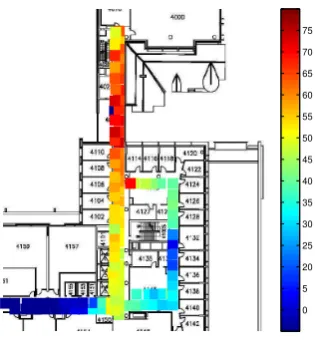
power from this AP and a value of−110 dBm is used to denote the missing RSS value. Fig.2shows
the RSS value from a single AP throughout the fourth floor of the Bahen Building after removing−110
dBm measurements and averaging over RSS values at each location.
−110 −100 −90 −80 −70 −60 −50 0
5 10 15 20 25 30 35
RSS(dBm)
Number of RSS
Figure 1.Histogram of 100 RSS values of a single AP measured at a location.
0 5 20 25 30 35 40 45 50 55 60 65 70 75
Figure 2.RSS values of an AP over the corridor area of the fourth floor of the Bahen Building, University of Toronto.
Next, we explain how we apply the G-SSL method to reduce the effect of noise in the radio map. Consider a set ofulocations within the localization area that are not associated with RSS measurements
hence we call themunlabelleddata. In addition to these unlabelled locations, there are`labelled RP
data. In the G-SSL method, a weighted graph is constructed using both labelled and unlabelled data. In this graph, the vertices represent the training data and all the vertices are connected by edges. The edge weight matrix which is calculated by the training data, represents the relationship between vertices in the graph by assigning a weight to each edge connecting two vertices in the graph. Each vertex on the graph corresponds to a location and the weighted edges between vertices represent the relationship between both RSS values and locations corresponding to those vertices. As mentioned earlier in this section, measured RSS values in an indoor environment are affected by different types of noise. However, in the graph representation of the G-SSL method, any two vertices on the graph are related not only by the RSS values measured at those vertices but also by the physical locations corresponding to those vertices. Therefore, the G-SSL is able to reduce the effect of noise in the measured RSS value by incorporating both RSS and location information. Next, we will explain the G-SSL method with more details.
SupposeΩ = (V,E)denotes the graph of the G-SSL method. The vertices of the graph,V, is
defined asV={c1,c2, . . . ,c`,c`+1, . . . ,c`+u}where the first`elements are the location coordinates of
the labelled data and the nextuelements are the location coordinates of the unlabelled data. For every edge between two vertices atSiandSj, we can calculate its weightwij. wijindicates the similarity
between the two vertices and takes values in the range[0, 1]with 0 indicating no similarity between the vertices. The result is an(`+u)×(`+u)weight matrixWcontaining all the calculated weights. The graph edges are usually undirected, so the edge(i,j)(weighted bywij) and the edge(j,i)(weighted
bywji) are the same edge in the graph, which meanswij =wji. In addition, the edge(i,i)does not
exist, therefore, there are 12[(`+u)×(`+u)−(`+u)]edges in the graph. In summary, only the
corresponding number of graph weights are calculated which makes the weight matrixWa symmetric
matrix. To calculate the weights, here we use the well-knownheat-kernelfunction:
wij=exp
−kc
i−cjk2
τ
, (1)
wherekci−cjk2=d2(Si,Sj)is the square of the Euclidean distance between locationSiandSjandτ is a parameter based on the application which controls how quickly the weight decreases.
The G-SSL usesWto estimate the labels of the unlabelled data using the relationship between
different vertices in the graph. The result is a set of estimated labels ˆrifori ∈ {1, 2, . . . ,`+u}. Ifci
is close tocj, the estimated label ˆriis close to the given labelrjfor allj∈ {1, 2, . . . ,`}. The estimated
labels ˆrihave to satisfy two conditions. First, for the labelled data, since the labels are already known,
the estimated labels ˆri must be close to the real labels. For the labelled data(ci,ri), we should have
ˆ
ri=ri. This condition is enforced by minimizing the following loss function
min
ˆ R
`
∑
i=1
krˆi−rik2, (2)
where ˆRis theM×(`+u)matrix of all estimated RSS values andk • kis the Euclidean distance. The second condition is that the graph should be smooth. The smoothness of the graph comes from the fact that data points which are close to each other should have similar labels. To satisfy the smoothness condition, the estimated labels ˆriand ˆrjshould meet the following loss function
min
ˆ R
`+u
∑
i=1
`+u
∑
j=1
wijkrˆi−rˆjk2, (3)
Ifciandcjare close to each other, the weightwijwould be large, and the labels ˆriand ˆrjmust be
close in order for the whole term to be minimized. On the other hand, ifciandcjare far away from
each other, the weightwijwould be very small and the choice of the labels does not have much effect
on the minimization.
ˆ
R∗=arg min
ˆ R
`
∑
i=1
krˆi−rik2+
γ 2
`+u
∑
i=1
`+u
∑
j=1
wijkrˆi−rˆjk2
, (4)
whereγis a the weight of the smoothness term based on the application. γis a design parameter
used to enforce which term is of higher importance. In conclusion, the first term of the equation (4) penalizes the difference between the actual labels and the estimated labels and the second term ensures the smoothness of the graph.
In the offline phase, since the actual coordinates ofSiandSjare already known, the RSS values
can be calculated by G-SSL method. In the online phase, the data collected simultaneously from
sensors on the mobile device can be used to estimate the relative displacement betweenSi andSj,
that is, the distanced(Si,Sj). The RSS values can then be calculated using this additional information.
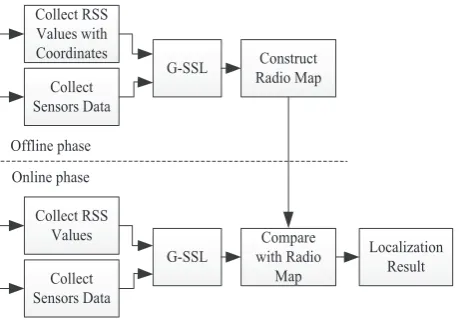
The proposed G-SSL-based RSS smoothing method for crowdsourcing is summarized in the system
diagram shown in Fig.3.
Collect RSS Values with Coordinates
Compare with Radio
Map Offline phase
Online phase
Construct Radio Map
Localization Result G-SSL
Collect Sensors Data
Collect RSS Values
G-SSL Collect
Sensors Data
Figure 3.The system view of the proposed G-SSL based Localization.
4. Linear Regression Algorithm Against Device Diversity Problem
In the existing experimental systems, the same device is used to collect the RSS values in both the offline phase and the online phase. However, when the crowdsourcing method is widely applied to the indoor localization systems, a large number of different mobile devices have been used in the establishment of the radio map. In the online phase, a variety of mobile devices are also used by the users which are different from the device used to build the radio map. In this section, the linear regression (LR) algorithm is proposed to solve the device diversity problem in RSS-based crowdsourcing localization system.
We defineX andY are the signal space of different devices. Assume that the fingerprintrX
belongs toX is the nearest neighbor to the online pointrYbelongs toY. As described above, although
they were collected at close physical locations, the RSS values have obvious difference. In order to solve the device diversity problem, the relationship between different devices have to be studied. Therefore, these RSS values collected by different devices could be processed to make therYin closer
torX. Mathematically
X ≈ f(Y), (5)
By learning f, the radio map build by the training device could be used to localize any other devices. Aiming to explore the mapping function between RSS values collected by distinct devices, the
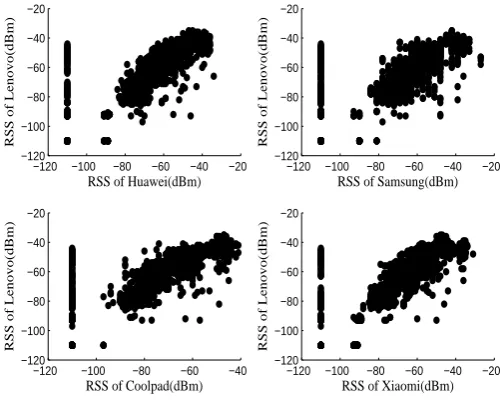
comparison results of RSS values across different training/tracking devices are plotted in Fig. 4.
the RSS values measured by Lenovo laptop and Huawei mobile device. From Fig. 4, we can get a linear correlation between the RSS values measured by different devices. Hence, the following linear regression method can be employed as the mapping function.
rY =arX +b (6)
where(a,b)are the coefficients in the mapping function.
−120 −100 −80 −60 −40
−120 −100 −80 −60 −40 −20
RSS of Lenovo(dBm)
RSS of Coolpad(dBm)
−120 −100 −80 −60 −40 −20
−120 −100 −80 −60 −40 −20
RSS of Lenovo(dBm)
RSS of Samsung(dBm)
−120 −100 −80 −60 −40 −20
−120 −100 −80 −60 −40 −20
RSS of Lenovo(dBm)
RSS of Xiaomi(dBm)
−120 −100 −80 −60 −40 −20
−120 −100 −80 −60 −40 −20
RSS of Lenovo(dBm)
RSS of Huawei(dBm)
Figure 4.Linear correlation between RSS values for different devices.
4.1. Pre-processing of RSS Values
In the typical WLAN localization scenario, the RSS values collected by the mobile device are subject to multiple sources of noise, such as multi-path fading and shadowing. To mitigate these RSS fluctuations, a large number of RSS measurements are collected from each AP at every location. Let RSSli={rss1,rss2, . . . ,rssp}be the set of RSS values collected at locationlfrom thei-th AP. As shown
in Fig. 4, if we cannot receive any power from the AP, a value of−110 dBm is used to denote the
missing RSS value.
rssli=
(
rssli, ifrssli>−110 dBm
−110 dBm, otherwise (7)
In order to obtain a high localization accuracy, the first step in localization system is to stabilize the collected RSS values prior to the localization process. Aiming to overcome the fluctuations, the average of the collected RSS values is calculated. In the calculation of the average value, the filled RSS
values of−110 dBm could produce meaningless RSS values and will have a adverse impact. These
filled RSS values could affect the localization process and produce erroneous location estimations. As a result, the average is calculated using the collected RSS values exclude the filled RSS values as the following equation:
rli = p
∑
j=1
rssjI(rssj 6=−110 dBm) p
∑
j=1
I(rssj6=−110 dBm)
(8)
The average valuerliis used to build the radio map in offline training phase and estimate the
current location in online localization phase.
4.2. Linear Regression Algorithm Against Device Diversity Problem
Before using the linear regression method, the parameters aand b in equation 6should be
computed. Since the outliers appear in the collected RSS values frequently and seriously affect the performance of the linear least squares (LLS) algorithm, the fast least trimmed squares (FAST-LTS) algorithm is used in this paper.
When the number of measured RSS values isc, the FAST-LTS solution for linear regression with
intercept is given by
min
a,b h
∑
i=1
d(i)2 (9)
whereh=int[(c+2)/2],d(i) =krY−(arX +b)kandk • kis norm 2 of a vector,d(i)2are the ordered
squared residuals:d(1)2≤d(2)2≤ · · · ≤d(i)2≤ · · · ≤d(c)2.
Given theh-subsetHoldof all nearest neighbors, theC-stepis used to compute theaandbas
follows [21]:
1. computeaoldandbold:=least squares regression estimator based onHold
2. compute the residualsdold(i)fori=1,· · ·,c
3. sort the absolute values of these residuals,|dold(1)| ≤ |dold(2)| ≤ · · · ≤ |dold(c)|
4. arrange the absolute values of the residuals in ascending order, letHnewbe a subset consisting
of the nearest neighbors corresponding to the firsththe absolute values of the residuals in the sequence
5. computeanewandbnew:=least squares regression estimator based onHnew
Repeating C-step with numerous Hold, a lot of regression coefficients will be gotten. The
approximate solution is the coefficient corresponding to the least∑h
i=1d(i)2. After getting the regression
coefficientaandb,rX is transformed as follows
r0X =arX +b (10)
wherer0X ∈ Y. As a result, bothr0X andrY belong to the same signal space, and a uniform radio map
could be built usingr0X andrY in the offline training phase and a higher positioning accuracy could be
obtained in online phase.
To verify the LR method, five distinct devices, namely Lenovo, Huawei, Samsung, Xiaomi and Coolpad, are used to collect RSS values at all RPs and the linear regression coefficients could be calculated based on the measured RSS values and the corresponding coordinates. When the regression coefficients are gotten, all the RSS values could be mapped into the same signal space by LR method and a uniform radio map could be built. Using the processed radio map, the user’s location will be estimated with a high accuracy in online phase.
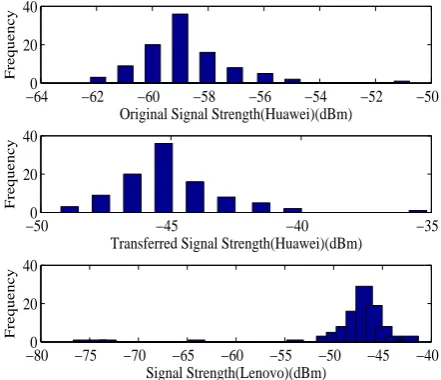
In our localization systems, we use the Lenovo device as the standard device, and all the RSS values collected by other devices are mapped into the signal space of Lenovo device. We take the
(Huawei, Lenovo) pair as an example. As shown in Fig. 5, the collected data are more stable after
−110 −100 −90 −80 −70 −60 −50 −40 −110
−100 −90 −80 −70 −60 −50 −40
RSS of Lenovo(dBm)
RSS of Huawei(dBm)
y=1.2283*x+27.1961
Figure 5.Linear correlation between Lenovo and Huawei.
−640 −62 −60 −58 −56 −54 −52 −50
20 40
Original Signal Strength(Huawei)(dBm)
Frequency
−800 −75 −70 −65 −60 −55 −50 −45 −40
20 40
Signal Strength(Lenovo)(dBm)
Frequency
−500 −45 −40 −35
20 40
Transferred Signal Strength(Huawei)(dBm)
Frequency
Figure 6.Comparison of signal distribution.
5. AP Localization Using Compressed Sensing Method
Typically, fingerprint-based localization methods don not rely on the location of the APs. In other words, the AP locations are assumed to be unknown. Nonetheless, better localization can be achieved if one could estimate the AP locations. Next, we discuss a compressed-sensing (CS)-based approach to estimating the AP locations.
Consider a set ofNdiscrete locations throughout the indoor area. Suppose a set ofMaccess
points can be seen at each location. It is a practical assumption that the number of grid points is much
larger than the number of access point in the indoor area i.e.,MN. We will use this assumption to
apply a CS-based method to recover the location of the APs.
to one theNelement and zero for the rest of the element. For example, ifθi(n) =1 then the location of
thei-th AP is estimated to be the location of then-th grid point in the indoor area. Concatenating all such vectors for allMAPs results in a so-called index matrix,ΘN×Mas,
Θ= [θ1, . . . ,θm, . . . ,θM], (11)
According to the CS theory, rather than measuring theM-sparse signal or its sparse representationΘ
directly, compressive noisy RSS measurements in an`-dimensional space are used. These compressive
measurements are obtained by multiplying a random matrix by the original signal,
y=ΦΨΘ+ε, (12)
where
1. y`×Mare the compressive noisy RSS measurements.
2. Φ`×Nis the measurement matrix. Each row in this matrix represents the location of one RP, with
an element of 1 to indicate the grid point at which the RP is located. Thus, only a few of RSS values are collected on the locations of RPs instead of measuring all the RSS values on the overall grid, which reduces the workload in the offline phase.
3. ΨN×Nis the sparsity basis on which the measured signals have sparse coefficientsΘ. In this
matrix,Ψij =RSS(dij)indicates the RSS values collected at grid pointifrom the AP located at
grip pointj, for all 1≤i≤ Nand 1≤j ≤N. Assume that the transmition power of an AP is
Pt(dBm). ThenRSS(d)is calculated based on the empirical indoor propagation model of [10]:
RSS(d) =
(
Pt−40.2−20log(d), ifd≤8
Pt−58.5−33log(d), ifd>8 (13)
wheredis the physical distance from the transmitter (AP) to the receiver.
4. εis the measurement noise.
The locations of the APs can be recovered by the following`0-minimization:
ˆ
Θ=arg min
Θ kΘk0, s.t.y=ΦΨΘ, (14)
Unfortunately, solving (14) is both numerically unstable and NP-hard. Therefore,`1-minimization is used to recover the AP locations:
ˆ
Θ=arg min
Θ kΘk1, s.t.y=ΦΨΘ, (15)
This is a convex optimization problem and various methods have been proposed to find the solution such as BP [32], OMP [33] and SP [34]. In this paper, we use OMP algorithm.
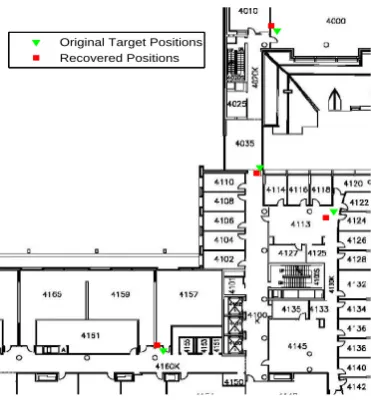
To evaluate the performance of the proposed CS-based AP localization algorithm, a few number of APs on the fourth floor of the Bahen Building at the University of Toronto have been localized. Fig.
7shows the AP localization results. As seen in the figure, all the AP locations are estimated with a
Original Target Positions Recovered Positions
Figure 7.AP positioning results using CS method
6. RSS Difference-Aware Graph-Based Semi-Supervised Learning RSS Smoothing Method
The G-SSL method tries to set the same value for ˆriand ˆrjif the coordinatesciandcjat locations
SiandSjare similar. However, since the distance between each RP and each of the unlabelled locations
is known, we can use this information to estimate the expected difference in RSS based on the known locations of the APs and the radio propagation model. Thus, we define ˆRd(Si,Sj)as the estimated RSS
difference betweenriandrjat locationSiandSj. We change the smoothing constraint to reflect that
the differencekrˆi−ˆrjkof estimated RSS values ˆriand ˆrjshould be close to ˆRd(Si,Sj). Accordingly, (4)
can be written as:
ˆ
R∗=arg min
ˆ R
`
∑
i=1
krˆi−rik2+
γ 2
`+u
∑
i=1
`+u
∑
j=1
wij
krˆi−rˆjk −Rˆd(Si,Sj)
2
. (16)
6.1. Estimation ofRˆd(Si,Sj)
Consider one of the APs as shown in Fig.8. The location of the AP,cAP, can be estimated using
the CS-based method in [10]. We use the indoor signal propagation model in [35]. Therefore, the RSS value at locationSican be calculated as,
ri=10log10
Phi
dα
i
−10log10(10−3), (17)
wheredi denotes the distance between the location of thei-th measurement and the AP,P is the
transmission power of the AP,αis the propagation loss exponent andhis the combined effect of
path loss, fading, and shadowing. Using this model and assuminghi =hj, we derive the following
expression for ˆRd(Si,Sj):
ˆ
Rd(Si,Sj) =kri−rjk=k10αlog10
dj
di
i
S Sj
i d
j d
!
d S Si, j
AP
Figure 8.Mobile device is moving away from AP.
6.1.1. Offline Training Phase
In the offline training phase, the coordinates of RPsSiandSj,ciandcj, are already given in the
radio map and the location of APcAPcan be calculated precisely using the CS-based method. Thus,
the Euclidean distancedianddjbetween the RPs and AP can be obtained. Finally, the RSS difference
ˆ
Rd(Si,Sj)can be calculated directly using (18).
6.1.2. Online Localization Phase
In the online localization phase, since the actual location ofSjis unknown,djcannot be calculated
directly. However,d(Si,Sj)can be estimated using inertial sensor data and step counting algorithms
anddican then be calculated. We can usedj=di−d(Si,Sj)(the mobile device moves towards AP) or
dj =di+d(Si,Sj)(the mobile device moves away from AP) instead.
6.2. Finding the optimal solution
The cost function in (16) can be written as:
C= `
∑
i=1
krˆi−rik2+
γ 2
`+u
∑
i=1
`+u
∑
j=1
wijkrˆi−rˆjk2
+γ
2 `+u
∑
i=1
`+u
∑
j=1
wijRˆ2d(Si,Sj) +γ `+u
∑
i=1
`+u
∑
j=1
wijRˆd(Si,Sj)krˆi−rˆjk,
(19)
In order to find the optimal solution, we need to find the derivative of the cost function with respect to ˆR. Since the cost function of (19) is not convex, we use the gradient descent method to solve the optimization problem. Next, we derive the derivative for each part of the cost function in (19). The first part of (19) can be written as:
C1=
`
∑
i=1
krˆi−rik2
=trace Rˆ −R
JTJ RˆT−RT ,
(20)
whereR = [r1 r2 . . . r`+u]is the RSS matrix and if the labels are not given, we use0M×1instead.
J=diag(δ1,δ2, . . . ,δ`+u)is a Hermitian indication matrix whereδi =1 means that the corresponding
i-th node in the graph is labelled andδi=0 otherwise. Using (20),∂∂CRˆ1 can be written as:
∂C1
∂Rˆ
= Rˆ −R
J+JT
=2J Rˆ −R ,
(21)
C2=
γ 2
`+u
∑
i=1
`+u
∑
j=1
wijkrˆi−rˆjk2
=γ `+u
∑
i=1
ˆ
rTi rˆi
`+u
∑
j=1
wij−γ `+u
∑
i=1
`+u
∑
j=1
wijrˆiTrˆj
=γtrace ˆRDRT)−γtrace ˆRWRT)
=γtrace ˆRLRT),
(22)
whereL =D−Wis the graph Laplacian andD=diag(µ1,µ2, . . . ,µ`+u)whereµi =
`+u
∑
j=1
wijfor all
i∈ {1, 2, . . . ,`+u}. DifferentiatingC2yields,
∂C2
∂Rˆ
=2γRLˆ , (23)
The derivative of the third part of the cost with respect to ˆRis equal to 0. The last part of (19) is:
C4=γ `+u
∑
i=1
`+u
∑
j=1
wijRˆd(Si,Sj)krˆi−rˆjk
=γ `+u
∑
i=1
`+u
∑
j=1
κijkrˆi−rˆjk,
(24)
whereκij=wijRˆd(Si,Sj). In order to find ∂∂CRˆ4, first we find
∂C4
∂ˆrn for 1≤n≤`+u. Using [35], ∂C4
∂rˆn
= ∂
∂rˆn
γ
`+u
∑
i=1
`+u
∑
j=1
κijkrˆi−rˆjk
= ∂
∂rˆn
γ
`+u
∑
j=1,j6=n
κnjkrˆn−rˆjk
+ ∂
∂ˆrn
γ
`+u
∑
i=1,i6=n
κinkrˆi−rˆnk
(25)
Sinceκij=wijRˆd(Si,Sj),κni=κin. Therefore:
∂C4
∂rˆn
=2× ∂
∂rˆn
γ
`+u
∑
j=1,j6=n
κnjkrˆn−rˆjk
=2×γ `+u
∑
j=1,j6=n
κnj
ˆ
rn−rˆj krˆn−rˆjk
=2γgn,
(26)
where gn =
`+u
∑
j=1,j6=n
κnj ˆ rn−ˆrj
kˆrn−ˆrjk and ∂C4
∂Rˆ is obtained using:
∂C4
∂Rˆ
=2γG, (27)
whereG,[g1g2 . . . g`+u]. Finally, in order to find the optimal solution, we set∂∂CRˆ =0:
∂C1
∂Rˆ
+∂C2
∂Rˆ
−∂C4
∂Rˆ
=0. (28)
Using (21), (23) and (27):
ˆ
In summary, to find the optimal solution, initializeG=0M×(`+u). Then use an iterative procedure as follows: First, find ˆRas the solution of (29). Second, updateGbased on the result of the first step and the definition ofG. Repeat the two steps until convergence.
6.3. Experimental Results
In order to verify our method, we collected RSS data from the 4th floor of the Bahen Building at the University of Toronto. The radio map was constructed using a step-counter-assisted RSS measurement method. Sensor information from the accelerometer is used to estimate the distance between the RPs. Using this system, a radio map consisting of 251 RPs thorughout the entire 4th floor of the Bahen building has been created in less than 30 minutes. However, the resulting radio map has only 5 RSS measurements at each RP. Consequently, it is more error-prone compared to the traditionally generated radio maps in which for each RP hundreds of measurements are collected. The Proposed localization
procedure is tested on a sequence of 35 test points collected on a path from Room 4000 (top of Fig.9)
to Room 4148 (bottom of Fig.9).
Figure 9.Actual locations of Test Points.
The RSS values from a single AP in the original radio map and the test points are shown in Fig. 10(a) and11(a) respectively. As can be seen, although the RSS values are generally consistent with the signal propagation model, there are some large fluctuations at some RPs. To eliminate the negative effects caused by this fluctuation, the proposed RG-SSL method is applied to smooth the RSS values. In order to obtain more accurate results, 125 unlabelled data throughout the whole 4th floor of the Bahen Building are considered. Following steps are repeated until all the labelled points are smoothed:
1. Set one of the labelled points as unlabelled.
2. Use the rest of the labelled points, 125 unlabelled points and RG-SSL method to estimate the RSS value of the above unlabelled point.
As comparisons, the G-SSL method, SCTW method and SPORT method are also simulated in
this paper. The simulation results are shown in Fig.10and11. We can see that the RG-SSL method
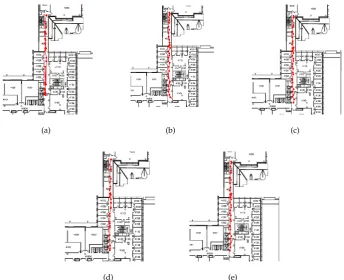
the modified radio map can be seen in Fig. 12(b) to Fig. 12(e). We see that the localization results
are improved compared to the results in Fig. 12(a). Most of the test points that were erroneously
localized to one location in Fig.12(a) are now localized to correct distinct locations. These incorrect estimates were causing a large amount of localization error in the original method however are greatly reduced using both the RG-SSL method and the other methods. Clearly, the localization results of the proposed RG-SSL method are closer to actual locations than the results calculated by the other methods. Furthermore, the trajectory obtained in Fig.12(b) is clearly smoother than those in Fig.12(c) to Fig.12(e).
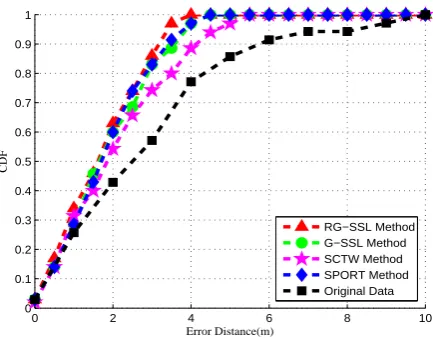
We can readily see the performance gain of the RG-SSL method in the cumulative distribution function (CDF) of the localization error for the RG-SSL method and the other methods, as shown in Fig.13. It is clear that the proposed localization method outperforms the other methods. The average localization error has been reduced from 2.89m to 2.07m, and notably, the maximum localization error has been reduced from 10m to 4m.
0 5 20 25 30 35 40 45 50 55 60 65 70 75 (a) 0 5 20 25 30 35 40 45 50 55 60 65 70 75 (b) 0 5 20 25 30 35 40 45 50 55 60 65 70 75 (c) 0 5 20 25 30 35 40 45 50 55 60 65 70 75 (d) 0 5 20 25 30 35 40 45 50 55 60 65 70 75 (e)
0 5 20 25 30 35 40 45 50 55 60 65 70 75
(a)
0 5 20 25 30 35 40 45 50 55 60 65 70 75
(b)
0 5 20 25 30 35 40 45 50 55 60 65 70 75
(c)
0 5 20 25 30 35 40 45 50 55 60 65 70 75
(d)
0 5 20 25 30 35 40 45 50 55 60 65 70 75
(e)
Figure 11.Comparison of signal distribution of test data. (a) Original radio map (b) RG-SSL method (c) G-SSL method (d) SCTW method (e) SPORT method
(a) (b) (c)
(d) (e)
0 2 4 6 8 10 0
0.1 0.2 0.3 0.4 0.5 0.6 0.7 0.8 0.9 1
Error Distance(m)
CDF
RG−SSL Method G−SSL Method SCTW Method SPORT Method Original Data
Figure 13.Cumulative distribution function of the localization error.
7. RSS Difference-aware Sparse Graph-based Semi-Supervised Learning Method and Experimental Results
7.1. Sparse Graph Construction for RG-SSL using CS Method
Since the radio map is constructed using a step-counter-assisted RSS measurement method, the coordinate of each RP calculated by this method contains a lot of noise. In the proposed RG-SSL
method, theheat-kernelfunction is used to construct the graph and calculate the edge weights based
on the Euclidean distance. However, the Euclidean distance and consequently the weights, are very sensitive to noise.
The accuracy of the generated graph will greatly affect the positioning performance. When the vertices in the graph are far away from each other, the graph weight is much smaller than the graph weight calculated for neighboring vertices. Therefore, the graph weight matrix is sparse. Since the CS method is robust to noisy data, we can use it to estimate the graph weight matrix[36]. As mentioned in Section II, we denote the vertex setV={c1,c2, . . . ,c`,c`+1, . . . ,c`+u}. Given the measurement matrix
Aand the matrix for unknown reconstruction coefficientsWwe can reconstruct a sparse Wfrom
V=AWusing:
min
W kWk0, s.t.V=AW, (30)
wherek • k0denotes the`0-norm. The`0-norm minimization is NP-hard. However, if the solution
is sparse enough, the following convex `1-norm minimization can be used to solve the sparse
representation problem:
min
W kWk1, s.t.V=AW, (31)
Suppose the noise in the collected RSS is denoted byξ. Then,
V=AW+ξ= [A I] "
W ξ
#
=BW0, (32)
whereB= [A I]andW0=
" W
ξ #
. Thus the`1-norm minimization can be rewritten as:
min W0 kW
0k
For each ci in the vertex set, the measurement matrix Bi is constructed as B =
[c1, . . . ,ci−1,ci+1, . . . ,c`+u,I]andw0iis calculated using`1-norm minimization:
min
w0i kw
0
ik1, s.t.ci =Biw0i, (34)
wherew0iis thei-th column of the matrixW. Then the graph weightswijare obtained using:
wij=
w0i(j), ifj<i w0i(j−1), ifj>i
0, ifj=i
, (35)
wherei,j∈ {1, 2, . . . ,`+u}andwi0(j)denotes thej-th element of vectorw0.
7.2. Experimental Results
Since the labels of all the vertices in the graph are necessary for sparse reconstruction of the graph weight matrix, CS method can only be used in the offline phase. The weighted matrices calculated by theheat-kernelfunction and CS method are shown in Fig.14(a) and Fig.14(b), respectively. Each pixel in the figure represents the weight valuewijbetween two vertices and 0≤wij≤1. A larger value of
wijbetween vertexSiandSjmeans a stronger correlation between them. If the vertices around the
vertexSihave strong correlations with the vertexSi, we can get a more accurate RSS estimates for the
vertexSi. As we can see from Fig.14(a), since the measurements are noisy, the weight matrix contains
some errors. In the weight matrix, the weight values are very small between different vertices, which means the relationship between different vertices is very weak. Therefore, the information transferred between different vertices is inaccurate and the estimated RSS values using this weight matrix are not accurate enough. As a result, the localization accuracy is reduced by the inaccurate relationship between different locations.
(a) (b)
Figure 14.Comparison of Weighted graph. (a) Weighted graph calculated by heat kernel method. (b) Weighted graph calculated by CS method
Due to the sparsity of the graph and robustness to noise, the weight matrix is recovered more precisely than the traditionalheat-kernelfunction. The relationship between different vertices in Fig. 14(b) is much clearer than Fig.14(a). Comparing Fig.14(b) with Fig.14(a), the graph weight values calculated by the CS method are much larger than those obtained using theheat-kernel. As a result, it
Therefore, the estimated RSS values are more accurate than those calculated by theheat-kernelas shown in Fig.15(a) and Fig.10(b). Based on the matrix calculated by the CS method, the localization results are more accurate in Fig.15(b). From Fig.16we can learn that the maximum localization error has been reduced from 4 to 3.5m thanks to the more accurate radio map. Meanwhile, the average localization error has been reduced from 2.07m to 1.98m.
0 5 20 25 30 35 40 45 50 55 60 65 70 75
(a) (b)
Figure 15. Smoothed signal distribution of radio map and localization results using RSG-SSL. (a) Smoothed signal distribution of radio map. (b) Localization results.
0 1 2 3 4 5 6
0 0.1 0.2 0.3 0.4 0.5 0.6 0.7 0.8 0.9 1
Error Distance(m)
CDF
RG−SSL Method RSG−SSL Method
Figure 16.Cumulative distribution function of localization error.
8. Conclusion
using a weighted graph connecting different locations. Additionally, the RSS difference is introduced in the traditional G-SSL method to achieve a better performance. In order to obtain the RSS difference, a CS-based method is used to precisely localize the location of the APs. Noisy RSS values can be corrected using the proposed RG-SSL method, resulting in a higher localization accuracy. Due to the sparsity of the weighted graph in the G-SSL, the weighted graph is reconstructed more accurately by the CS method compared to the traditional heat-kernel function which is the idea of the proposed RSG-SSL method. The experimental results performed at the University of Toronto show that a smoothed radio map and online RSS values are obtained by RG-SSL method and the localization accuracy is improved. The RSG-SSL method applied in the offline phase also resulted in an improved performance.
Acknowledgments:This paper is supported by National Natural Science Foundation of China (61571162), Natural Science Foundation of Hei Longjiang Province China (F2016019), Postdoctoral Science-Research Development Foundation of Hei Longjiang Province China (LBH-Q12080), and Science and Technology Project of Ministry of China Public Security Foundation (2015GABJC38).
Author Contributions:Liye Zhang, Shahrokh Valaee, Yubin Xu and Lin Ma conceived the idea of the paper; Liye Zhang designed and performed the experiments; Shahrokh Valaee, Yubin Xu and Lin Ma analyzed the data; Liye Zhang wrote the paper; Shahrokh Valaee, Farhang Vedadi, Yubin Xu and Lin Ma revised the paper.
Conflicts of Interest:The authors declare no conflict of interest.
Abbreviations
The following abbreviations are used in this manuscript:
MDPI Multidisciplinary Digital Publishing Institute DOAJ Directory of open access journals
TLA Three letter acronym LD linear dichroism
References
1. Sorour, S.; Lostanlen Y.; Valaee S.; Majeed K. Joint indoor localization an radio map construction wiht limited deployment load.IEEE Transactions on Mobile Computing.2015,14, 1031-1043.
2. Feng C.; Valaee S.; Au A. W. S.; Tan Z. Received-signal-strength-based indoor positioning using compressive sensing. IEEE Transactions on Mobile Computing.2012,11, 1983-1993.
3. Gu Y.; Lo A.; Niemegeers I. A survey of indoor positioning systems for wireless personal network. IEEE Communications Surveys and Tutorials.2009,11, 13-32.
4. Alarifi, A.; Al-Salman, A.; Alsaleh, M.; Alnafessah, A.; Al-Hadhrami, S.; Al-Ammar, M.A.; Al-Khalifa, H.S. Ultra Wideband Indoor Positioning Technologies: Analysis and Recent Advances. Sensors.2016,16, 707. 5. Feng C.; Valaee S.; Tan Z. Localization of wireless sensors using compressive sensing for manifold
learning. In Proceedings of 2009 IEEE 20th International Symposium on Personal, Indoor and Mobile Radio Communications (PIMRC), Tokyo, Japan, 13-16 September 2009; pp. 2715-2719.
6. Harle R. A survey of indoor inertial positioning systems for pedestrians.IEEE Communications Surveys and Tutorials.2013,15, 1281-1293.
7. Bahl P.; Padmanabhan V. Radar: an in-building RF-based user location and tracking system. In Proceedings of 2000 Nineteenth Annual Joint Conference of the IEEE Computer and Communications Societies (INFOCOM), Tel Aviv, Israel, 26-30 March 2000; pp. 775-784.
8. Kushki A.; Plataniotis K. N.; Venetsanopoulos A. N. Kernel-based positioning in wireless local area networks. IEEE Transactions on Mobile Computing.2007,6, 689-705.
9. Rai A.; Chintalapudi K. K.; Padmanabhan V. N.; Sen R. Zee: Zero-effort crowdsourcing for indoor localization. In Proceedings of 18th Annual International conference on Mobile Computing Network, Istanbul, Turkey, 22-26 August 2012; pp. 293-304.
11. Viel B.; Asplund M. Why is fingerprint-based indoor localization still so hard?. In Proceedings of 2014 IEEE International Conference on Pervasive Computing and Communications Workshops (PERCOM Workshops), Budapest, Hungary, 24-28 March 2014; pp. 443-448.
12. Pan J. J.; Pan S. J.; Yin J.; Ni L. M.; Yang Q. Tracking mobile users in wireless networks via semi-supervised colocalization.IEEE Transactions on Pattern Analysis and Machine Intelligence.2012,34, 587-600.
13. Au A. W. S.; Feng C.; Valaee S.; Reyes S.; Sorour S.; Markowitz S. N.; Gold D.; Gordon K.; Eizenman M. Indoor tracking and navigation using received signal strength and compressive sensing on a mobile device. IEEE Transactions on Mobile Computing.2013,12, 2050-2062.
14. Redzic M.; Brennan C.; O’Connor N. SEAMLOC: seamless indoor localization based on reduced number of calibration points. IEEE Transactions on Mobile Computing.2014,13, 1326-1337.
15. Yang S.; Dessai P.; Verma M.; Gerla M. FreeLoc: calibration-free crowdsourced indoor localization. In Proceedings of The 32nd IEEE International Conference on Computer Communications (INFOCOM), Turin, Italy, April 14-19 2013; pp. 2481-2489.
16. Wu C.; Yang Z.; Liu Y. Smartphones based crowdsourcing for indoor localization. IEEE Transactions on Mobile Computing.2015,14, 444-457.
17. Yu N.; Xiao C.; Wu Y.; Feng R. A Radio-Map Automatic Construction Algorithm Based on Crowdsourcing. Sensors.2016,16, 504.
18. Kaemarungsi K., Distribution of wlan received signal strength indication for indoor location determination. in Wireless Pervasive Computing, 2006 1st International Symposium on, 16-18 Jan. 2006; pp. 2952-2957. 19. Zheng V. W.; Pan S. J.; Yang Q. and Pan J. J., Transferring Multi-device Localization Models using Latent
Multi-task Learning. In Proceedings of the 23rd national conference on Artificial intelligence, Chicago, USA, 13-17 July 2008; pp. 1427-1432.
20. Tsui A. W.; Chuang Y. H. and Chu H. H. Unsupervised Learning for Solving RSS Hardware Variance Problem in WiFi Localization.Mobile Networks and Applications,2009,14, 677-691.
21. Rousseeuw P. J. and Driessen K. V. Computing LTS Regression for Large Data Sets.Data Mining and Knowledge Discovery,2006,12, 29-45.
22. Liu X. D.; He W.; Tian Z. S. The improvement of RSS-based location fingerprint technology for cellular networks. In Proceedings of 2012 International Conference on Computer Science and Service System (CSSS), Nanjing, China, 11-13 August 2012; pp. 1267-1270.
23. Hasani M.; Lohan E.-S.; Sydanheimo L.; Ukkonen L. Path-loss model of embroidered passive RFID tag on human body for indoor positioning applications. In Proceedings of 2014 IEEE RFID Technology and Applications Conference (RFID-TA), Tampere, Finland, 8-9 September 2014; pp. 170-174.
24. Latif S.; Memon A.; Chawdhry B.; Zielinski R.; Khan G. Accuracy Assessment of D-Model for Modeling Wall Attenuation in Indoor Environment. In Proceedings of 2014 Sixth International Conference on Computational Intelligence, Communication Systems and Networks (CICSyN), Tetovo, Macedonia, 27-29 May 2014; pp. 71-76.
25. Zhang L.; Shahrokh V.; Zhang L.; Xu Y.; Ma L. Signal propagation-based outlier reduction technique (SPORT) for crowdsourcing in indoor localization using fingerprint. Personal, Indoor, and Mobile Radio Communications (PIMRC), 2015 IEEE 26th Annual International Symposium on, Hong Kong, China, 30 Aug.-2 Sept. 2015; pp. 2008-2013.
26. Rahman Sakib M. S.; Quyum M. A.; Andersson K.; Synnes K.; Korner U. Improving Wi-Fi based indoor positioning using Particle Filter based on signal strength. In Proceedings of 2014 IEEE Ninth International Conference on Intelligent Sensors, Sensor Networks and Information Processing (ISSNIP), Singapore, 21-24 April 2014; pp. 1-6.
27. Ma L.; Xu Y. Received signal strength recovery in green WLAN indoor positioning system using singular value threholding.Sensors.2015,15, 1292-1311.
28. Zelnik-Manor L. Self-tuning spectral clustering.Advances in Neural Information Processing Systems. 2004,17, 1601-1608.
29. Cand`es E. J. Compressive sampling. In Proceedings of the international congress of mathematicians, Madrid, Spain, 22-30 August 2006; pp. 1433-1452.
30. Baraniuk R. G. Compressive sensing.IEEE Signal Processing Magazine.2007,24, 118-121.
32. Chen S. S.; Donoho D. L.; Saunders M. A. Atomic decomposition by basis pursuit. SIAM Journal on Scientific Computing,1998,20, 33-61.
33. Tropp J.; Gilbert A. Signal Recovery from Random Measurements Via Orthogonal Matching Pursuit. IEEE Transactions on Information Theory.2008,53, 4655-4666.
34. Dai W.; Milenkovic O. Subspace pursuit for compressive sensing signal reconstruction. IEEE Signal Processing Magazine.2009,55, 2230-2249.
35. Pourahmadi V.; Valaee S. Indoor Positioning and distance-aware graph-based semi-supervised learning method. In Proceedings of 2012 IEEE Global Communications Conference (GLOBECOM), Anaheim, USA, 3-7 December 2012; pp. 315-320.