O R I G I N A L A R T I C L E
Applicability of effective medium theory to wood density
measurements using terahertz time-domain spectroscopy
Soichi Tanaka•Keiichiro Shiraga•
Yuichi Ogawa•Yoshihisa Fujii•Shogo Okumura
Received: 28 October 2013 / Accepted: 6 December 2013 / Published online: 14 January 2014
ÓThe Japan Wood Research Society 2014
Abstract The use of an effective medium theory is important when accurately measuring wood density using millimeter and terahertz wave techniques. To confirm the applicability of this theory to the evaluation of wood density, the relative permittivity and dielectric loss of oven-dry flat-sawn specimens of 11 different wood species were measured in a frequency range of 0.15–1.2 THz using a transmission measurement system for terahertz time-domain spectroscopy. A mixture model based on the effective medium theory well explained the density dependence of relative permittivity over the entire fre-quency range, while it did not fully explain that of dielectric loss, especially for higher frequencies. This indicates that wood scatters the terahertz wave with a wavelength close to the transverse sectional dimensions of the pores in wood in the same way as Mie scattering. It was found from the dielectric loss spectrum of wood substance that the frequency around 0.23 THz was preferable for the nondestructive evaluation of wood.
Keywords Oven-dry woodEffective medium theory Dielectric mixtureTHz-TDSDensity evaluation
Introduction
Wood is a natural material and there are fluctuations in its physical properties, such as its moisture content, grain direction, and density, and thereby it should be evaluated nondestructively to promote its wide usage in industry [1]. The fluctuation of density in wood is especially important in determining the strength of wood [2].
Terahertz and millimeter wave techniques, which use electromagnetic waves with frequencies of 0.1–10 and 0.03–0.3 THz, respectively, have been developed so that the waves that penetrate through and reflect from a wood specimen can be detected with low noise [3–14]. These techniques have attracted notice as new tools for the non-destructive evaluation (NDE) of wood density because they are contact-free, noninvasive and safe, and can provide higher resolution images [6–8] than the microwave tech-niques [15–21].
The method to evaluate density while using these tech-niques is generally based on effective medium theory [22– 24], in which wood is regarded as a mixture of pores (air in the cell lumina) and wood substance (cell wall) [3,11] and responds to electromagnetic excitation as if it were homo-geneous [23]. This theory, however, has a lower wavelength limit and the following rule of thumb is often employed [23]: ‘‘the size of an inclusion in the mixture must not exceed a tenth of the wavelength in the effective medium’’. In gen-eral, wood has many pores of transverse sectional sizes ranging from about 10 to 200lm, and thereby the lower wavelength limit for wood is to be about 100–2000lm or 0.15–3 THz in frequency. Therefore, to correctly evaluate
Part of this report was presented at the 72nd annual meeting of the Japan Society of Agricultural Machinery and Food Engineering, Obihiro, September 2013.
S. Tanaka (&)
Materials Research Institute for Sustainable Development, National Institute of Advanced Industrial Science and Technology, Nagoya 463-8560, Japan
e-mail: [email protected]
K. ShiragaY. OgawaY. Fujii
Graduate School of Agriculture, Kyoto University, Kyoto 606-8502, Japan
S. Okumura
Formerly Graduate School of Agriculture, Kyoto University, Kyoto 606-8502, Japan
wood density using the terahertz and millimeter wave techniques, it is necessary to examine the validity of the effective medium theory in this frequency range.
In our other paper, which was submitted to theJournal of Wood Scienceand is currently under review, the effect of pores on wood dielectric anisotropy was examined with the assumption that the effective medium theory is applicable to the relative permittivity of oven-dry wood obtained by terahertz time-domain spectroscopy (THz-TDS) at 0.15 THz. The purpose of this paper is to examine the applicability of the effective medium theory to the density evaluation of wood over a frequency range of 0.15–1.2 THz. The complex permittivity along the longi-tudinal axis of flat-sawn oven-dry specimens of 11 different wood species was measured using a THz-TDS transmission measurement system. The fitness of a mixture model based on the effective medium theory to the measured relative permittivity and dielectric loss was examined, and the relationships of the averages and standard deviations of the dielectric parameters of wood substance to the frequency were also examined.
Theory
On the basis of effective medium theory, wood is regarded as a mixture of pores (air) and wood substance [11,25–27], and the relative permittivity and dielectric loss along the longitudinal axis,e0ande00, of a piece of oven-dry wood are generally related to its density,q0, by using the following
equations [11]:
e0¼1þðe
0
WS1Þq0
qWS
ð1Þ
e00¼e
00 WSq0
qWS
ð2Þ
where e0WS, e00WS, and qWS are the relative permittivity,
dielectric loss, and density (=1.5 g/cm3), respectively, of wood substance. The effective medium theory, however, has a lower wavelength limit, which is at least ten times larger than the size of the mixture element [23]. In the wavelength range close to this limit, the elements of the mixture scatter the electromagnetic waves in the same way as Mie scattering [28].
Experimental
Sample preparation
Flat-sawn specimens, 25 mm square and 3 mm thick, were prepared from softwoods: hinoki (Chamaecyparis
obtusa), sugi (Cryptomeria japonica), and akamatsu (Pinus densiflora); ring-porous hardwoods: kiri ( Paulow-nia tomentosa), kuri (Castanea crenata), and keyaki (Zelkova serrata); diffuse-porous hardwoods: kusunoki (Cinnamomum camphora), tochinoki (Aesculus turbinata), buna (Fagus crenata), and isunoki (Distylium racemo-sum); and radial-porous hardwood: shirakashi (Quercus myrsinaefolia). Five specimens were prepared from each species. All specimens were dried to a constant weight at 105 °C.
THz-TDS transmission measurement
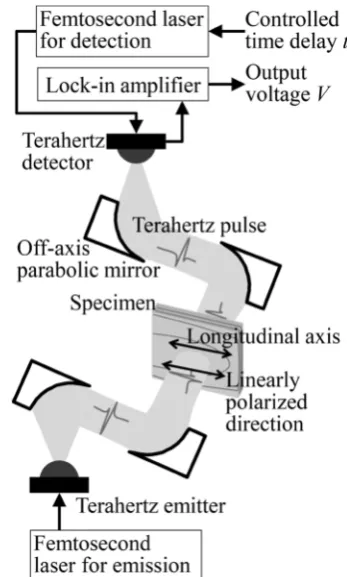
Figure1 shows an experimental setup of the THz-TDS transmission measurement system (TAS7500SP, Advantest Co.). A terahertz emitter was irradiated by a femtosecond laser pulse to obtain a terahertz pulse. The terahertz pulse was radiated perpendicular to a wood specimen via a set of off-axis parabolic mirrors. The transmitted pulse was focused by another set of off-set parabolic mirrors on a terahertz detector, in which the pulse component was synchronized with another femtosecond laser pulse, of which the time delay, t (ps), was changed stepwise at constant intervals (2 fs), detected, and processed into a
voltage,V(mV), in a lock-in amplifier. The voltageVfor each time delaytwas measured 4096 times and averaged to obtain the waveformV(t).
The phase and amplitude spectrums,h(f) (rad) andA(f) (mV), at frequenciesf of 0.15–1.2 THz with a frequency resolution of 7.6 GHz were obtained through Fourier transformation of the wave signal V(t). The relative per-mittivity and dielectric loss spectrums of the specimen,e0(f) ande00(f), were obtained using the following equations:
e0ðfÞ ¼ fnðfÞg2 fjðfÞg2 ð3Þ
e00ðfÞ ¼2nðfÞjðfÞ ð4Þ where n and j are the refractive index and extinction coefficient, respectively, and formulated as follows: nðfÞ ¼1þcfhðfÞ h0ðfÞg
2pfd ð5Þ
jðfÞ ¼ c 2pfdln
f1þnðfÞg2 4nðfÞ
AðfÞ A0ðfÞ
ð6Þ
where h0(f) and A0(f) represent the phase and amplitude
without a specimen, respectively,dis the specimen thick-ness (=3 mm), and c is speed of light in a vacuum (=3.09108m/s). A specimen was set on the measurement system so that the linearly polarized direction of the tera-hertz pulse, the beam of which was approximately colli-mated and found to have a width of about 10–20 mm, was parallel to the longitudinal axis to obtain the dielectric parameters along this axis (Fig.1).
Results and discussion
Relation between dielectric parameters and density of wood at a low frequency
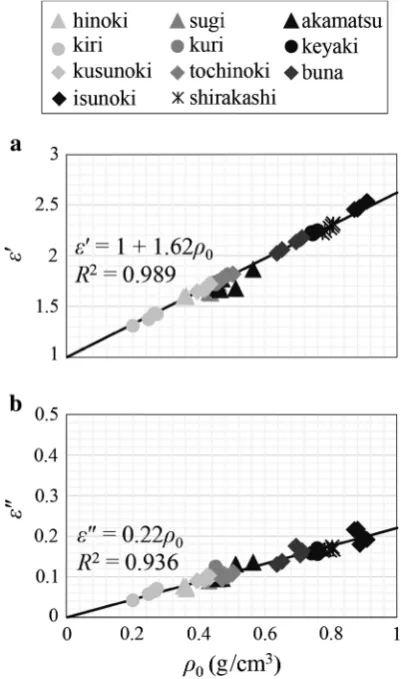
Figure2shows the relations of the relative permittivitye0
and dielectric losse00to the densityq0of oven-dry wood at
a frequency of 0.15 THz. In the figure, the regression lines derived from Eqs. (1) and (2) were fitted to the plots using the least-squares method. These regression lines fitted well to the plots fore0ande00and had determination coefficients
ofR2=0.989 and 0.936, respectively. From the slopes and determination coefficients of the regression lines, the rel-ative permittivity and dielectric loss of wood substance were estimated to be e0WS=3.43 and e00WS=0.33 with
standard deviations of 1.08910-3 and 0.35910-3, respectively. This indicates that the effective medium theory is valid at 0.15 THz, because the transverse sec-tional dimension of the wood cells, about 10–200lm, is much smaller than the wavelength, 2 mm at 0.15 THz. The estimated dielectric parameters,e0WSande00WS, were close
to and apart from those obtained using a millimeter wave technique, 3.5 and 0.14, at a frequency of 0.1 THz, respectively [11]. This indicates that the relative permit-tivities obtained using terahertz and millimeter wave techniques can be used in common with each other. The dielectric loss may be more precise in this study than that in the previous study [11], because it was shown in the previous study that the dielectric loss of wood substance was largely affected by the relative permittivity along longitudinal and transverse axes of wood [11]. The esti-mated values for the frequencies of 0.15–1.2 THz are discussed later.
Dielectric properties of wood substance
Figure3shows relations of the relative permittivity (e0WS),
dielectric loss (e00
WS), and their standard deviations to the
frequency (f). e0WS decreased constantly as f increased,
whilee00WShad a minimum value of 0.31 around 0.23 THz
(Fig.3a), at which the relations of e0 and e00 to q
0 were
Fig. 2 Relations ofarelative permittivity,e0, andbdielectric loss,
e00, along the longitudinal axis to the density,q
0, of oven-dry wood at
similar to the linear relations at 0.15 THz (Fig.2). Tor-govnikov [29] reported that dielectric loss decreases with increases in frequency above 10 MHz to about 0.1 THz. These findings indicate that wood substance has a maxi-mum transmittance around 0.23 THz for the millimeter and terahertz waves, and that this frequency is more preferable for the NDE of oven-dry wood when using the terahertz and millimeter wave techniques, since the highest gain of the detected signal is obtained.
The standard deviation ofe0WSslightly increased withf,
while that ofe00
WSsignificantly increased withf(Fig.3b).
This indicates that the applicability of effective medium theory is inferior at a higher frequency or at a shorter wavelength, especially for dielectric loss.
Effect of frequency on relation between dielectric parameters and wood density
The relations of relative permittivitye0 and dielectric loss
e00to densityq
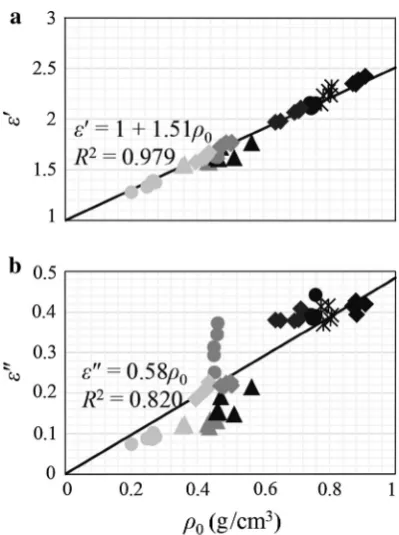
0are shown in Figs.4and5for frequencies
of 0.6 and 1.2 THz, respectively. In Figs.4a and5a,e0and
q0show a good linear relation similar to that for 0.15 THz
(Fig.2a). On the other hand, some plots that relatee00toq 0
deviate considerably from the best-fit line (Figs.4b, 5b). This indicates that the effective medium theory is not well applicable for dielectric loss at higher frequencies. This probably results from the scattering of the terahertz wave in wood. At a lower frequency of 0.15 THz, the Fig. 3 Relation of theaaverages andbstandard deviations of the dielectric parameters (e0WS,e00WS) of wood substance to the frequency
(f) Fig. 4 Relations ofarelative permittivity,e0, andbdielectric loss,
e00, along the longitudinal axis to the density,q
0, of oven-dry wood at
a frequency of 0.6 THz. Theplot symbolsare the same as in Fig.2
Fig. 5 Relations ofarelative permittivity,e0, andbdielectric loss,
e00, along the longitudinal axis to the density,q
0, of oven-dry wood at
corresponding wavelength of 2 mm is much larger than the transverse sectional dimension of the wood cells (approx-imately 10–200lm) and wood responds to the excitation of the terahertz wave as if it is homogeneous, where the waves are not scattered. At higher frequencies of 0.6 and 1.2 THz, the corresponding wavelengths of 500 and 250lm are of the same order as the dimensions of the wood cells, and thereby the terahertz wave is scattered by the pores of the cells in the same way as Mie scattering [28]. The influence of the scattering on the relative per-mittivity is smaller than that of the dielectric loss. This is because the scattering significantly affects the terahertz wave attenuation, which primarily determines the amount of dielectric loss, due to the constructive and destructive wave interference, and because it does not affect the tera-hertz wave phase shift, which primarily determines the amount of relative permittivity [12]. Further studies are needed to quantitatively evaluate the effect of the scatter-ing on the dielectric loss.
Conclusion
To examine the applicability of an effective medium theory to the evaluation of wood density in the terahertz frequency range, the complex permittivity along the longitudinal axis of flat-sawn oven-dry specimens of 11 wood species was measured in a frequency range of 0.15–1.2 THz using a transmission measurement system for THz-TDS. The effective medium theory explained the density dependence of relative permittivity for the entire frequency range, but did not explain that of the dielectric loss for a higher fre-quency range. This indicates that the terahertz waves are more scattered at higher frequencies. It was concluded from the dielectric loss spectrum of wood substance that a fre-quency of approximately 0.23 THz is preferable for the NDE, since a high gain of the detected signals was obtained. A quantitative evaluation of the effect of the scattering on the dielectric loss should be examined in the future. Acknowledgments The authors would like to express their grati-tude to Motoki Imamura and Akiyoshi Irisawa (Advantest Corpora-tion, Japan) for their technical support.
References
1. Beall FC (2000) Subsurface sensing of properties and defects in wood and wood products. Subsurf Sens Tech Appl 1:181–204 2. Forest Products Laboratory (1999) Wood handbook: wood as an
engineering material. USDA Forest Service, Madison (chap 4) 3. Inagaki T, Hartley ID, Tsuchikawa S, Reid M (2013) Prediction
of oven-dry density of wood by time-domain terahertz spectros-copy. Holzforschung. doi:10.1515/hf-2013-0013
4. Jackson JB, Mourou M, Labaune J, Whitaker JF, Duling IN, Williamson SL, Lavier C, Menu M, Mourou GA (2009) Terahertz pulse imaging for tree-ring analysis: a preliminary study for dendrochronology applications. Meas Sci Technol 20:075502–075511
5. Jiang L, Li C, Huang L, Zhang Z, Zhang C, Liu Y (2012) Investigation of terahertz spectral signatures of DNA of pine wood nematode. Adv J Food Sci Technol 4:426–429
6. Koch M, Hunsche S, Schuacher P, Nuss MC, Feldmann J, Fromm J (1998) THz-imaging: a new method for density mapping of wood. Wood Sci Technol 32:421–427
7. Laurinavicˇius A, Baltrusˇaitis A, Pranckevicˇiene V, Ukvalber-giene K (2010) Wood characterization by scanning millimeter_
wave beam. Mater Sci (Medzˇiagotyra) 16:63–66
8. Oyama Y, Zhen L, Tanabe T, Kagaya M (2009) Sub-terahertz imaging of defects in building blocks. NDT E Int 42:28–33 9. Reid M, Fedosejevs R (2006) Terahertz birefringence and
attenuation properties of wood and paper. Appl Opt 45:2766– 2772
10. Tanaka S, Fujiwara Y, Fujii Y, Okumura S, Togo H, Kukutsu N, Nagatsuma T (2011) Effect of grain direction on transmittance of 100-GHz millimeter wave for hinoki (Chamaecyparis obtusa). J Wood Sci 57:189–194
11. Tanaka S, Fujiwara Y, Fujii Y, Okumura S, Togo H, Kukutsu N, Shoji M (2013) Dielectric anisotropy of oven- and air-dried wood evaluated using a free space millimeter wave. J Wood Sci 59:367–374
12. Tanaka S, Fujiwara Y, Fujii Y, Okumura S, Togo H, Kukutsu N, Shoji M (2013) Effect of annual rings on transmission of 100 GHz millimeter waves through wood. J Wood Sci 59:375–382
13. Todoruk TM, Hartley ID, Reid ME (2012) Origin of birefrin-gence in wood at terahertz frequencies. IEEE Trans Terahertz Sci Technol 2:123–130
14. Todoruk TM, Schneider J, Hartley ID, Reid M (2008) Birefrin-gence of wood at terahertz frequencies. In: Proceedings of the SPIE photon north, vol 7099, 70992Q-1, Montreal
15. Bucur V (2003) Nondestructive characterization and imaging of wood. Springer, Berlin, pp 125–179
16. James WL, Yen Y-H, King RJ (1985) A microwave method for measuring moisture content, density, and grain angle of wood. In: USDA forest service research note FPL-0250
17. Lundgren N, Hagman O, Johansson J (2006) Predicting moisture content and density distribution of Scots pine by microwave scanning of sawn timber II: evaluation of models generated on a pixel level. J Wood Sci 52:39–43
18. Martin P, Collet R, Barthelemy P, Roussy G (1987) Evaluation of wood characteristics: internal scanning of the material by microwaves. Wood Sci Technol 21:361–371
19. Schajer GS, Orhan FB (2005) Microwave non-destructive testing of wood and similar orthotropic materials. Subsurf Sens Technol Appl 6:293–313
20. Schajer GS, Orhan FB (2006) Measurement of wood grain angle, moisture content and density using microwaves. Holz als Roh-und Werkstoff 64:483–490
21. Shen J, Schajer G, Parker R (1994) Theory and practice in measuring wood grain angle using microwaves. IEEE Trans In-strum Meas 43:803–809
22. Reynolds JA, Hough JM (1957) Formulae for dielectric constant of mixtures. Proc Phys Soc B 70:769–775
23. Sihvola A (2000) Mixing rules with complex dielectric coeffi-cients. Subsurf Sens Tech Appl 1:393–415
25. Kro¨ner K, Pungs L (1952) Zur dielektrischen Anisotropie des Naturholzes im großen Frequenzbereich. Holzforschung 6:13–16
26. Norimoto M, Yamada T (1971) The dielectric properties of wood V, on the dielectric anisotropy of wood. Wood Res Bull Wood Res Inst Kyoto Univ 51:12–32
27. Uyemura T (1960) Dielectric properties of woods as the indicator of the moisture. Bull Gov For Exp Stat 119:96–172
28. Zhao Q, Zhou J, Zhang F, Lippens D (2009) Mie resonance-based dielectric metamaterials. Mater Today 12:60–69