J Wood Sci (1999) 45:373-377 © The Japan Wood Research Society 1999
W a h y u D w i a n t o • T o s h i r o M o r o o k a • M i s a t o N o r i m o t o
Method for measuring viscoelastic properties of wood under high
temperature and high pressure steam conditions
Received: December 15, 1998 / Accepted: February 4, 1999
A b s t r a c t A method for measuring the viscoelastic proper- ties of wood undei" high temperature and high pressure steam was developed using a testing machine with a built-in autoclave. A newly developed load cell capable of resisting a steam pressure of 16kgf/cm 2 and a temperature of 200°C was installed in the autoclave. This load cell could be used to determine precisely the loads while steaming at tempera- tures from 100°C to 200°C. In addition to load-detection problems, it was necessary to avoid the nonuniform thermal degradation of wood during the measurement process un- der steaming at high temperatures. This nonuniform degra- dation could be minimized by shortening the time required for the wood to attain thermal equilibrium using specimens conditioned to the fiber saturation point. According to this method, a stress relaxation curve for sugi
(Cryptomeria
japonica
D. Don) wood being compressed while steaming at180°C was obtained. The stress was seen to decrease rapidly with time, reaching almost zero at 3000s.
K e y w o r d s S t e a m i n g • Viscoelastic properties • A u t o c l a v e • Pressure-resistant load cell • Heat-resistant load cell
Introduction
High temperature (or high pressure) steaming is effective as a method for permanently fixing large compressive defor- mations of wood. Because most of the deformation of com- pressed wood steamed at temperatures up to 100°C can be recovered by boiling in water, steaming at much higher temperatures is required to obtain permanent fixation. For
W. Dwianto • T. Morooka ([~) • M. Norimoto
Property Enhancement Laboratory, Wood Research Institute, Kyoto University, Kyoto 611-0011, Japan
Tel. +81-774-38-3657; Fax +81-774-38-3600 e-mail: [email protected]
This paper is a translation of a report published in
Mokuzai
Gakkaishi
(Journal of the Japan Wood Research Society) 44:77-81, 1998example, permanent fixation can be achieved by steaming at 180°C for 8min or at 200°C for l m i n while the wood is compressed. 1 Considerable permanent fixation can also be achieved by presteaming compressed w o o d ]
To clarify the mechanisms of permanent fixation, de- tailed information regarding the viscoelastic properties of wood under such conditions is necessary. For this, precise viscoelastic measurement of wood in an autoclave built-in testing machine and the avoidance of nonuniform thermal degradation of wood during measurement are required but have not yet been accomplished. In this paper, a method for measuring the viscoelastic properties of wood under high temperature (or high pressure) steam conditions is described.
Materials and equipment
Equipment
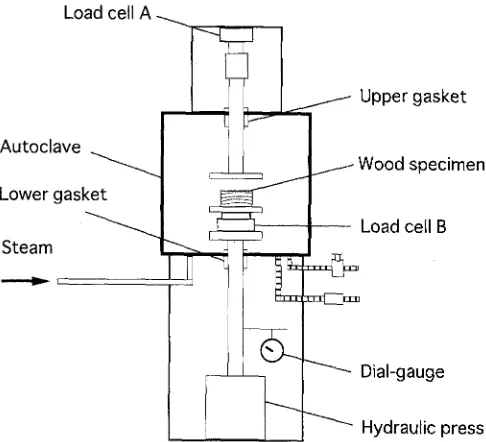
The testing machine with a built-in autoclave is described in Fig. 1. The autoclave, made from stainless steel, can with- stand pressures of 30 kgf/cm 2 and temperatures up to 230°C. Two parallel plates to compress the specimen are installed in the autoclave. The lower plate can be moved up and down by an electric hydraulic press placed at the bottom of the apparatus. Displacement of the lower plate is detected by a dial gauge. The load is detected by a load cell on the outside (position A) or inside (position B) of the autoclave. The temperature in the autoclave and of the upper rod near the gasket are measured by thermocouples. The tempera- ture (or pressure) in the autoclave reaches the prescribed level within 10s after steaming.
Wood specimens
To measure the temperature of specimens under high tem- perature (or high pressure) steam, water-saturated hinoki
(Charnaecyparis obtusa
Endl.) wood specimens 37 (R) × 67Lo 8o
Autoclave
Lower gasl
Steam
tasket
pecimen
.,11 B
Jge
lic press
_hg -13 O - J
60
40
20
\
o
o
3oo
6o0
96o
1,z'oo
1,5oo
Time (sec)
Fig. 2a. Load variation at load cell A in Fig. 1 with time
Fig. 1. Testing machine with a built-in autoclave 200 ]
150 hinoki wood specimens 20 × 30 × 20 or 9 mm were used. p Hinoki wood specimens 20 x 30 × 9 mm conditioned to the ~ 100 fiber saturation point (FSP) were also used. To measure ~ ] stress relaxation, 20 × 30 × 9mm FSP sugi
(Cryptomeria
japonica
D. Don) wood specimens were used. ~- 50Specimens conditioned to the FSP were prepared as fol- lows: Air-dried specimens were placed over distilled water
in a closed chamber for at least 1 week; they were then 0 steamed at 120°C for 30rain in an autoclave, cooled slowly
in the moisture-saturated condition for about 10h to room temperature, and then placed over distilled water in a closed chamber at room temperature.
ave
gasket
0 300 600 900 1,200 1,500
Time (sec)
Fig. 2b. Temperature variation near the gasket and in the autoclave over time
Method of load detection
Load measurement by conventional load cell
To maintain the prescribed steam pressure in the autoclave, gaps around rods were sealed with rubber gaskets so the force acting on the upper rod was decreased by friction, and the real force may not be transmitted to the load cell (load cell A in Fig. 1). Changes in loadtransmitted to the load cell, changes in temperature in both the autoclave and the upper rod near the gasket when the introduction (gauge pressure 10kgf/cm 2) and removal (normal pressure 0kgf/cm 2) of steam were repeated are shown in Figs. 2a and 2b. The load acting on the plate can be obtained from the gauge pressure and cross-sectional area of the rod. As the area of the rod was 7.07 cm 2, the load acting on the plate was estimated to be 71 kgf. The load transmitted to the load cell approximated the expected value of 71kgf on the first intro- duction of steam. However, the load gradually decreased with repeated introduction and removal of steam, and it decreased below 50kgf with the fourth introduction of
steam. A load of about 20kgf remained following the release of pressure.
Load measurements by heat- and pressure-resistant load cell
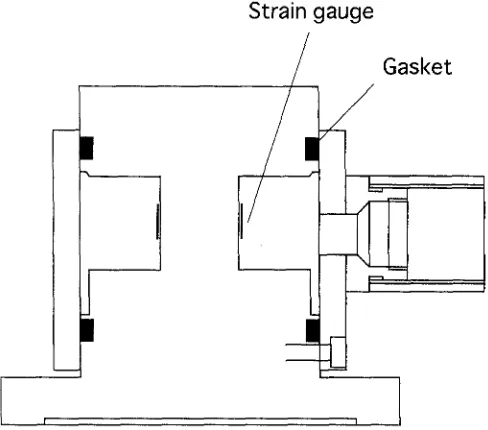
To solve the problem mentioned above, a heat- and pressure-resistant, waterproof load cell (maximum load 500kgf) was developed and installed in the autoclave (load cell B in Fig. 1). That load cell is described in Fig. 3. Strain gauges, sealed at the upper and lower parts using circular rubber gaskets, were coated with a waterproof material to avoid steam penetration. The area of contact between the gaskets and the strain gauges was too small to induce a decrease in the detected load by friction. Furthermore, a leading wire from the strain gauges extending to the outside
Strain gauge
Gasket
/
[ r
Fig, 3. Load cell capable of resisting a steam pressure of 16kgf/cm 2 (200°C)
375 of the autoclave was covered with a seamless tube made from flexible stainless steel to avoid steam penetration.
To determine whether this load cell operates accurately under such conditions a weight of 7.2kg was applied. The results under steam at 180°C (gauge pressure 10kgf/cm 2) and normal pressure at room temperature are compared in Fig. 4. The measurement under steam was carried out after 30min to minimize baseline drift. The results were almost the same, although the load curve under steam showed slight fluctuations with time. The same results were ob- tained at temperatures between 100°C and 200°C.
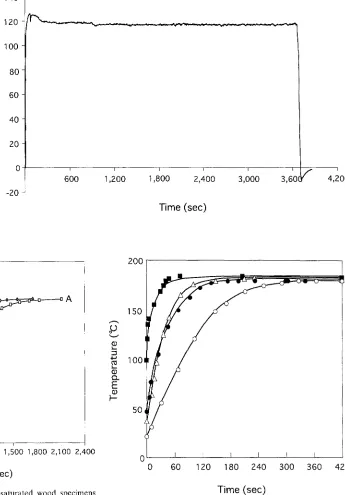
The result at a much larger load (125.6kgf) is shown in Fig. 5. A load of 126kgf was detected at the moment of loading but decreased slightly with time; it had a constant value of 119kgf after 200s. The load decreased to about - 9 kgf by unloading after l h . Therefore, the load change by loading and unloading was 127 kgf, closely corresponding to the applied load. These results indicated that the newly developed load cell could be used under conditions of high temperature and pressure. The distance between plates due to thermal expansion changed by about 0.1mm but returned to its original value by preheating for l h .
Uniform heating of wood specimens
When measuring wood properties under high temperature and steam conditions, it is necessary to avoid the nonuni- form thermal degradation of wood by rapid heating. Tem- perature changes at the center of specimens with various sizes (37 × 67 × 80, 40, 20, or 9mm) were measured. Figure 6 shows the results of water-saturated specimens when steamed at 180°C. The temperature at the center of the specimen was measured by a thermocouple inserted through a small hole ( l m m in diameter) drilled on the
Fig. 4. Load variations under steaming at 180°C (a) and at room temperature and atmo- spheric pressure (b)
0 J
I0
8 ¸
4 -
-2
J
(a)
i
0 30 60 90 120 150
(b)
1
30
t
6O
i
9 O i 120
i
150
1 40
120
I O0
A
8O
q . -
-~ 60
o
._I 40
20
0
-20
Fig. 5. Load variation with time while steaming at 180°C
i I I I I i
600 1,200 1,800 2,400 3,000 3,6(
T i m e
(sec)
f i
4,200
200 D C
oO
4,,a
E I -
180
16O
140
120~
I00- 0
200
I
g
F--
i i i i i i i
300 600 900 1,200 1,500 1,800 2,100 2,400
Time (sec)
Fig. 6. Temperature variations in water-saturated wood specimens with different dimensions in the longitudinal direction under steaming at 180°C. Dimension in the longitudinal direction: A, 80 mm; B, 40 mm; C, 20mm; and D, 9mm
t a n g e n t i a l p l a n e of the s p e c i m e n and filled with w a t e r p r o o f adhesive. T h e t e m p e r a t u r e of specimens with thicknesses of 80 and 4 0 m m did n o t r e a c h 180°C even after 1000s. O n the o t h e r hand, specimens with thicknesses of 20 and 9 m m r e a c h e d 180°C in 500 a n d 180s, respectively.
F i g u r e 7 shows the results of w a t e r - s a t u r a t e d specimens and a i r - d r i e d specimens u n d e r s t e a m at 180°C. T h e size of the s p e c i m e n was 20 × 30 × 20 or 9 mm. T h e time r e q u i r e d for w a t e r - s a t u r a t e d specimens to r e a c h 180°C was a b o u t 420 s for a thickness of 20 m m and 180 s for 9 mm. T h e results shown in Figs. 6 and 7 indicate t h a t t h e r e was no difference
G
0 60 120 180 240 300 360 420
T i m e ( s e c )
Fig. 7. Temperature variations inside dry and water-saturated wood specimens with different dimensions in the longitudinal direction under steaming at 180°C. Squares, dry, 9 mm; filled circles, dry, 20 ram;
triangles, water-saturated, 9mm; open circles, water-saturated, 20ram
Fig.
8. Stress relaxation curves for sugi wood in compression while steaming at 180°C and 100°C14
12
&-", 10 E
(O
q-- 8
v
09
6
4..a
oo 4
~"'--- ...
~
100°¢
180°C
I I r I I I
0
600
1,200
1,800
2,400
3,000
3,600
Time (sec)
m i n i m i z e d b y s h o r t e n i n g the time r e q u i r e d for the w o o d to attain t h e r m a l e q u i l i b r i u m using specimens c o n d i t i o n e d to the FSP.
Stress relaxation measurement
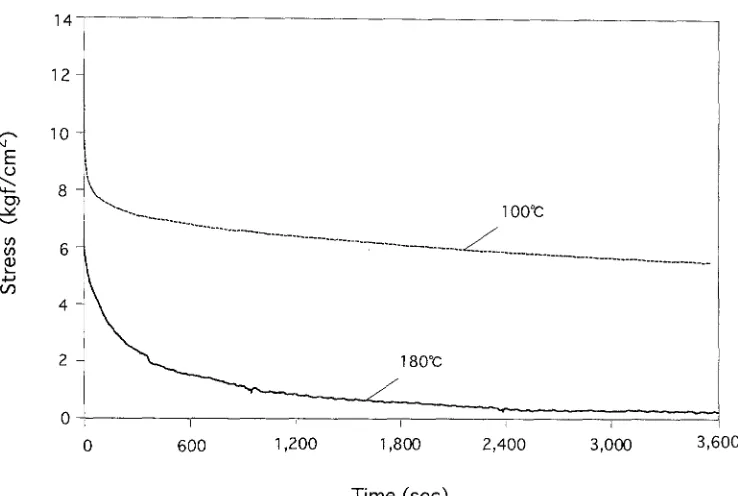
F i g u r e 8 shows an e x a m p l e of r a d i a l c o m p r e s s i v e stress r e l a x a t i o n curves u n d e r s t e a m i n g at 180°C for sugi w o o d c o n d i t i o n e d to the F S P using the m e t h o d m e n t i o n e d above. T h e m e a s u r e m e n t was s t a r t e d after the t e m p e r a t u r e r e a c h e d 180°C and was h e l d t h e r e for 90s with 50% com- pression. To o b t a i n a large c o m p r e s s i v e force c o m p a r e d with the force v a r i a t i o n d u e to s t e a m p r e s s u r e variations in the autoclave, 10 specimens of 20 × 30 × 9 m m were com- p r e s s e d simultaneously. T h e result at 100°C m e a s u r e d in b o i l e d w a t e r is also i n c l u d e d in Fig. 8. T h e stress at 100°C d e c r e a s e d instantly and t h e n c o n t i n u e d to decline g r a d u a l l y after 300s. T h e r e l a x a t i o n curve at 180°C was c o n s i d e r a b l y
different f r o m that at 100°C. H e r e the stress c o n t i n u o u s l y d e c r e a s e d and r e a c h e d 0.3kgf/cm 2 after 4 0 m i n (2400s). It was t h o u g h t that the stress d e c r e a s e at 180°C was due to d e g r a d a t i o n as well as the m o l e c u l a r m o v e m e n t of the cell wall polymers. T h e stress did n o t d i s a p p e a r in 8 m i n at 180°C, although it h a d b e e n r e p o r t e d that the c o m p r e s s i v e d e f o r m a t i o n was p e r f e c t l y fixed at the s a m e time and t e m - p e r a t u r e conditions. 1 This fact includes an i m p o r t a n t sug- gestion that m a y clarify the m e c h a n i s m of p e r m a n e n t fixation. It will b e d e s c r i b e d in the next p a p e r .
References
i. Inoue M, Norimoto M, Tanahashi M, Rowell RM (1993) Steam or heat fixation of compressed wood. Wood Fiber Sci 25:224-235 2. Inoue M, Sekino N, Morooka T, Norimoto M (1996) Dimensional