© 2016 IJSRSET | Volume 2 | Issue 4 | Print ISSN : 2395-1990 | Online ISSN : 2394-4099 Themed Section: Engineering and Technology
Clash Detection - A New Tool in Project Management
Pranav Bhagwat, Rahul Shinde
ABSTRACT
Project management is an important element in any project in the world. A better Project management leads any project to its optimum output. For better project management, it is mandatory to know advance techniques used for project execution in order to have thorough knowledge of all the aspects of resource management. This research paper focuses on implementing Autodesk Revit software as a Building Information Modelling tool for 3D modelling of residential building. This research paper evaluates the advantages of Autodesk Revit on the basis of ease of modelling, clash detection and efficiency achieved.
Keywords : Autodesk Revit, BIM, Clash detection, 3D Synchronization, 4D modelling
I.
INTRODUCTION
Project management is a vital part of any project in the world. A better Project management leads any project to its optimum output. For better project management, It is necessary to know different techniques used for project completion and must have thorough knowledge of all the aspects of resource management. [1]
Nowadays, we stand in the field, where numerous management tools are available. When utilized correctly, these tools not only assist in the planning, design and construction part of facilities management to save limited funds, but also in the life-cycle management of assets and investments. All these emergent, technological tools will assist with the management of assets.
BIM represents the development and use of computer-generated n-dimensional models to simulate the planning, design, construction and operation of a facility. It helps architects, engineers and constructors to visualize what is to be built in simulated environment and to identify potential design, construction or operational problems. Building Information Modelling (BIM) has recently attained widespread attention in the Architectural, Engineering and Construction (AEC) industry. [1]
According to the National Building Information Modeling Standard Committee, a building information
model (BIM) is defined as “a digital representation of physical and functional characteristics of a facility. [2]
II.
METHODS AND MATERIAL
About Autodesk Revit
A.General
Autodesk Revit is building information modelling software for architects, structural engineers, MEP engineers, designers and contractors. It allows users to design a building and structure and its components in 3D, annotate the model with 2D drafting elements, and access building information from the building model's database. Revit is 4D BIM capable with tools to plan and track various stages in the building's lifecycle, from concept to construction and later demolition.
B. Types
In order to satisfy the specific needs of the different types of specialist using Revit, Autodesk divided the product into three main branches – Revit Architecture, Revit Structure and Revit MEP.
a) Revit Architecture
designers. The architecture section is mostly a CAD platform that facilitates building and site planning.
b) Revit Structure
This part is focused on aiding structural engineers and designers. Here the user has the possibility to perform analysis on the structure, plan structural reinforcement and generally perform all necessary actions to guarantee the structural stability and reliability of the building.
c) Revit MEP
Mechanical Electrical and Plumbing (MEP) section of Revit allows mechanical, electrical and other similar types of engineers to design and simulate different kinds of technical systems. Piping and electrical systems can be modeled and integrated into a building with Revit MEP. Energy analysis of a construction can also be performed in MEP Revit.
Clash detection is an important and integral part of the BIM modeling process. Clash detection arises out of the fact that, in BIM modeling, there is not just one model, but several, that are, in the end integrated into a composite master model. Each discipline: structural engineering, MEP engineering, environmental engineering, etc. creates a model, independently of all the others, based upon the architects original model, which is the starting point for all the other disciplines. After each of the disciplines has finished their work, the next step in BIM modeling is clash detection, which is the process of finding where the models "clash": elements of separate models occupying the same space, or with parameters that are incompatible, or in 4D BIM modeling, a time sequence that is out of order. Finding these inconsistencies is vital, as they would severely impact the construction process, causing delays, design changes, materials costs and a cascade of headaches and budget overruns.
Background of Research
There is increasing support from industry professionals and software vendors for the utilization of BIM for improving project performance and processes within the AEC industry in whole world. But in India, under
current scenario we are still far behind. We are still using outdated 2D drafting softwares and conventional methods of executing work on site. There is lack of coordination among engineers, architects and contractors. Now the time has come to change these conventional methods of designing, planning and constructing structures.
Designers are also aware of this situation; hence there is growing demand of BIM based softwares like Autodesk Revit. The purpose of this research paper is implementing this software on a site which is being constructed. For this purpose one three story building was selected. The 3D model of that building is created according to the drawings available. For this purpose Students version of Autodesk Revit is used. Extensive literature survey is carried out for having references for drawing model in Autodesk Revit.
Literature Survey
[1] Autodesk Revit: Implementation in practice
The intent of this paper is to provide detailed information on how Revit is currently being implemented in architectural practice, selected data on measurable ROI collated from a survey of Revit users, and some key insights into the successful deployment of Revit and Building Information Modeling (BIM). The author conducted a detailed research study between October–December 2003 to investigate how Autodesk’s premier BIM solution, Revit, was being implemented in architectural practice, determine its key strengths and identify the challenges involved in implementing it, and gauge the impact of Revit deployment on business processes. Author found that there is a resistance in field to use BIM tools for efficiency. This resistance to change can be a difficult obstacle to overcome, since it deals with the architectural profession as a whole rather than just the technology group in a firm. Education and awareness, not just about Revit but about BIM is well, are critical to tackle the resistance to change. [3]
[2] Building Information Modeling (BIM) application framework: The process of expanding from 3D to computable nD
categories based on the project management tasks that are aimed for, the project stakeholders that are involved in and the different phases that BIM is used. Such a framework could possibly help in understanding the landscape of the existing work and identifying gaps in the prior research.
[3] Appraising effectiveness of Building Information Management (BIM) in project management
The purpose of this paper is to analysis how BIM (Building Information Modelling) can be utilized by project managers as a good tool to simulate project condition to avoid redundant works and waste of time and cost. The project manager must make decisions in the project process. When BIM is used, it is easy to see the consequences of the decisions. BIM leads to a better communication with stakeholders, which is a crucial element in creating a mutual understanding of aims of the project, and therefore fulfill the requirements of the client. The quality benefits that BIM provides are most valuable for project managers concerning maintaining control of a project. During the design phase, the project manager can easily see how much the work has progressed in the building information model; giving the project manager a better basis for assessing the schedule and budget more accurately. The result is a better control over the project.
[4] Building Information Modeling (BIM)
partnering framework for public construction projects
Organizational and people centered issues pose the greatest challenge for Building Information Modeling (BIM) implementation. This paper proposes a ‘BIM partnering’ based public procurement framework to ensure ‘best value’ in construction projects. The case study presented in the paper proved the feasibility of proposed BIM based procurement in publicly-funded construction projects. The suggested contractual arrangement for the project resulted in improved productivity, better coordination, and reduced error, and rework.
[5] Analysis of modeling effort and impact of different levels of detail in building information models.
The main objectives of this paper are to evaluate the modeling effort associated with generating building information modeling (BIM) at different levels of detail (LoD) and the impact of LoD in a project in supporting mechanical, electrical and plumbing (MEP) design coordination. Results show an increase in total modeling time ranging from doubling the modeling effort to eleven folding it, when going from one LoD to another. This study showed that more detail in a model does not necessarily mean more modeling work; and such additional effort can lead to higher precision better supporting decisions during design and construction. Results also showed that for the modeling effort analysis, there was an increase in total modeling time ranging from doubling the effort to eleven folding it, when going from one LoD to another.
Methodology
To understand the concept of BIM, an on-going construction project is selected. Information of selected project is collected through site visit, interviews with organizational personnel, contractors and suppliers. This collected information is used for making an information model of concerned building. Experienced engineers and experts in the field have helped for making the necessary assumption whenever required. This collected data is used for project scheduling through Autodesk Revit. Brief Research Methodology:
For accomplishing this project, following points will be considered
1) Studying BIM and its framework.
2) Comparing BIM and traditional methods. 3) Studying Autodesk Revit.
4) Preparing BIM model for practical problem. 5) Analyzing practical BIM model.
6) Interpreting results of BIM model for considered practical problem.
III.
RESULTS AND DISCUSSION
Work done
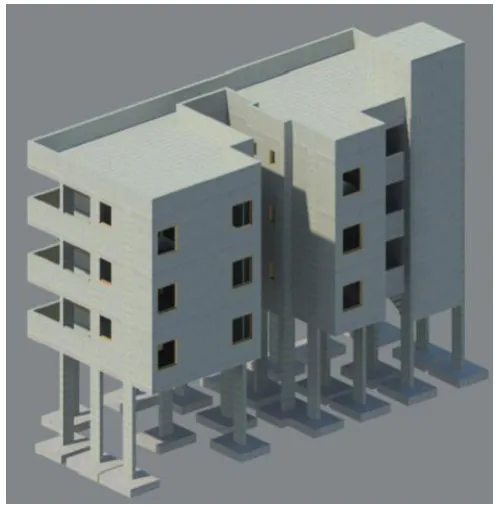
situated near Pune-Satara Highway in Satara city. It is a private residential building in the outskirt of satara city. It is a G+3 residential building with 6 flats among which three are two BHK and other three are 1BHK.
Before making 3D model studying and learning process of Autodesk Revit was completed. The software used for this purpose is a student’s version of Autodesk Revit. After studying, a 3D model of the site is created using the software.
Figure 1. 3D model created in Autodesk Revit.
Next step after completing 3D model is using the Revit Interface Check tool to find out the clashes and flaws in the different elements of the building.
Figure 2. Interface check (example clashed elements)
Clash detection helps in effective identification, inspection and reporting of interferences in a project model. It is used for checking completed/ongoing work and reduces the risk of human error during model inspections.
Clash detection is important because numbers of different models are integrated into one main BIM model. With clash detection, errors and mistakes which normally would have been discovered on the site can now are seen in the office even before anyone sets foot on the site. BIM even makes clash detection possible for objects within objects like reinforcement in beam.
IV.
CONCLUSION AND FUTURE SCOPE
After applying BIM on actual residential project this paper finds that the Autodesk Revit is the best tool for Building Information modeling. This paper concludes that BIM and Autodesk Revit in particular have expensive scope for the future. Autodesk Revit provides an easy way for 3D modeling, interface checking (clash detection), synchronizing time schedule with 3D model as fourth dimension. We can use Autodesk Revit as a BIM tool to anticipate future hurdles that might come at actual execution of the project.
For the future expansion we can use Autodesk Revit for material management and can introduce cost as fifth dimension. There is further scope for introducing energy analysis as sixth dimension in Building Information Modeling.
V.
ACKNOWLEDGMENT
VI.
CONCLUSION
The proposed payment system combines the Iris recognition with the visual cryptography by which customer data privacy can be obtained and prevents theft through phishing attack [8]. This method provides best for legitimate user identification. This method can also be implemented in computers using external iris recognition devices.
VII.
REFERENCES
[1] Sachin S. Nalawade, M.B. Kumathekar, "Building
Information Modeling a New Tool of Project Management for Construction Managers," Civil Engineering Systems and Sustainable Innovations ISBN: 978-93-83083-78-7
[2] Fernanda Leite, Asli Akcamete, Burcu Akinci,
Guzide Atasoy, "Analysis of modeling effort and impact of different levels of detail in building information models," Elsevier 17 November 2010
[3] Lachmi Khemlani, "Autodesk Revit:
Implementation In Practice," white paper, March 22, 2004
[4] Lieyun Ding, Ying Zhou, Burcu Akinci, "Building
Information Modeling (BIM) application
framework: The process of expanding from 3D to computable nD," Elsevier 14 April 2014
[5] Abdulsame Fazlia, Sajad Fathia, Mohammad Hadi
Enferadi, Mayram Fazlib, "Appraising effectiveness of Building Information Management (BIM) in project management," ScienceDirect, june 12, 2014
[6] Atul Porwal a, Kasun N. Hewage, "Building