An Accuracy-Assured Privacy-Preserving Recommender
System for Internet Commerce
Zhigang Lu1and Hong Shen1,2
1 School of Computer Science, The University of Adelaide
5005 Adelaide, Australia {zhigang.lu, hong.shen}@adelaide.edu.au
2
School of Information Science and Technology, Sun Yat-Sen University 510006 Guangzhou, China
Abstract. Recommender systems, tool for predicting users’ potential prefer-ences by computing history data and users’ interests, show an increasing importance in various Internet applications such as online shopping. As a well-known recom-mendation method, neighbourhood-based collaborative filtering has attracted con-siderable attentions recently. The risk of revealing users’ private information during the process of filtering has attracted noticeable research interests. Among the current solutions, the probabilistic techniques have shown a powerful privacy preserving ef-fect. The existing methods deploying probabilistic methods are in three categories, one [18] adds differential privacy noises in the covariance matrix; one [1] intro-duces the randomisation in the neighbour selection process; the other [28] applies differential privacy in both the neighbour selection process and covariance matrix. When facing thekNearest Neighbour (kNN) attack, all the existing methods pro-vide no data utility guarantee, for the introduction of global randomness. In this paper, to overcome the problem of recommendation accuracy loss, we propose a novel approach, Partitioned Probabilistic Neighbour Selection, to ensure a required prediction accuracy while maintaining high security against thekNN attack. We define the sum ofkneighbours’ similarity as the accuracy metricα, the number of user partitions, across which we select thekneighbours, as the security metricβ. We generalise thekNearest Neighbour attack to theβkNearest Neighbours attack. Differing from the existing approach that selects neighbours across the entire can-didate list randomly, our method selects neighbours from each exclusive partition of sizekwith a decreasing probability. Theoretical and experimental analysis show that to provide an accuracy-assured recommendation, our Partitioned Probabilistic Neighbour Selection method yields a better trade-off between the recommendation accuracy and system security.
Keywords:privacy preserving, differential privacy, neighbourhood-based collabo-rative filtering recommender systems, Internet commerce.
1.
Introduction
Recommender systemspredict users’ potential preferences by aggregating history data
recommender system to make their business more profitable [10,14,24]. Currently, in rec-ommender systems, Collaborative Filtering (CF) is a famous technology with three main popular techniques [16], i.e., neighbourhood-based methods [13], association rules based prediction [23], and matrix factorisation [15]. Among these techniques, neighbourhood-based methods are the most widely used in the industry because of its easy implementation and high prediction accuracy.
One of the most popular neighbourhood-based method is thek Nearest Neighbour (kNN) method, which provides recommendations by aggregating the opinions of a user’s
k nearest neighbours [2]. Although the kNN recommender systems present very good performance of recommendation accuracy efficiently, the risk of revealing users’ private information during the process of filtering is still a growing concern, e.g., thekNN attack presented by Calandrino et al. [5] exploits the property that the users are more similar when sharing same rating on corresponding items to reveal user’s private data. Thus pre-senting an efficient privacy preserving neighbourhood-based CF algorithm against the
kNN attack, which achieves a trade-off between the system security and recommendation accuracy, has been a natural research interest.
The literature in CF recommender systems has developed several approaches to pre-serve users’ privacy. Generally, cryptographic, obfuscation, perturbation, probabilistic methods and differential privacy are applied [28]. Among them, cryptographic meth-ods [11, 20] provide the most reliable security but the unnecessary computational cost cannot be ignored. Obfuscation methods [21, 26] and Perturbation methods [3, 4] intro-duce designed random noise into the original matrix to preserve customers’ sensitive in-formation; however the magnitude of noise is hard to calibrate in these two types of meth-ods [9, 28]. The probabilistic methmeth-ods [1] provided a similarity based weighted neigh-bour selection of theknearest neighbours. Similar to perturbation, McSherry et al. [18] presented a naive differential privacy method which adds calibrated noise into the co-variance (similarity between users/items) matrix. Similar to the probabilistic neighbour selection [1], Zhu et al. [28] proposed a Private Neighbour Selection to preserve pri-vacy against thekNN attack by introducing differential privacy in selecting theknearest neighbours randomly (also adding noise into covariance matrix with differential privacy). Although the methods in [1, 18, 28] successfully preserve users’ privacy against thekNN attack, the low prediction accuracy due to the global randomness should be noted. Even worse, [28] failed to maintain differential privacy in the process of neighbour selection. Therefore, none of the existing privacy preserving CF recommender systems can provide enough utility while preserving users’ private information.
Motivation.The current privacy preserving neighbourhood-based CF methods did not guarantee the data utility against the kNN attack. Therefore, in this paper, we aim to present a privacy preserving neighbourhood-based CF recommendation scheme which satisfies the following properties:
(1) Easy implementation.
(2) Absolutely keep differential privacy.
(3) Significantly decrease the magnitude of noise in differential privacy. (4) Quantify the level of recommendation accuracy and system security.
is impacted significantly. Thus, to decrease the magnitude of differential privacy noise, we may propose the following approach: we can simply add Laplace noise to the final rating prediction after the normalkNN CF recommendation. But Sarathy et al. has shown in [22] that the above method will release users’ privacy because Laplace mechanism does not work well in numeric data. So, to control the neighbour quality and to decrease the mag-nitude of noise, it is natural to avoid the global randomness and repeatedly adding noise. Therefore, we present a partitioned probabilistic neighbour selection method without any perturbations in the process of rating prediction.
Contributions.In this paper, to overcome the problems of low recommendation ac-curacy, we propose a novel method, Partitioned Probabilistic Neighbour Selection. The main contributions of this paper are:
(1) We expand the classic kNN attack to a more general case, theβ-kNN attack, which flexibly adjusts the size of fake user’s set to improve the attack effectiveness.β is essentially regarded as a security measure denoting the degree of difficulty for an attacker to break the neighbourhood-based CF recommender systems. We are the first to consider the case whenβ >1.
(2) To protect users’ data privacy against theβ-kNN attack, we propose a novel dif-ferential privacy preserving neighbourhood-based CF method, which ensures a required prediction accuracy while achieving a better trade-off between the system security and recommendation accuracy against thekNN attack.
(3) To the best of our knowledge, we are the first to propose a theoretical analy-sis of the recommendation accuracy and system security on the recommendation results from any randomised neighbour selection methods in the neighbourhood-based CF rec-ommender systems. Previous related work only gave the experimental analysis on the same issues.
Organisation.The rest of this paper is organised as follows: In Section 2, we sum-marise both the advantages and disadvantages in the existing privacy preserving methods on CF recommender systems. In Section 3, we introduce the relevant background knowl-edge in this paper. In Section 4, we introduce an existing attack to neighbourhood-based CF recommender systems, then expand it to a general case, theβ-kNN attack. Next, We proposed a novel differential privacy recommendation approach, Partitioned Probabilistic Neighbour Selection, in Section 5. Afterwards, the theoretical analysis of our approach on the performance of both recommendation accuracy and system security are provided in Section 6. Then, in Section 7, we show the experimental evaluation results. Finally, in Section 8, we conclude this paper.
2.
Related Work
2.1. Traditional Privacy Preserving Recommender Systems
Amount of traditional privacy preserving methods have been developed in CF recom-mender systems [28], including cryptographic [11, 20], obfuscation [21, 26], perturba-tion [3,4] and probabilistic methods [1]. Erkin et al. [11] applied homomorphic encrypperturba-tion and secure multi-party computation in privacy preserving recommender systems, which allows users to jointly compute their data to receive recommendation without sharing the true data with other parties. Nikolaenko et al. [20] combined a famous recommendation technique, matrix factorization, and a cryptographic method, garbled circuits, to provide recommendations without learning the real user ratings in database. The Cryptographic methods provide the highest guarantee for both prediction security ans system security by introducing encryption rather than adding noise to the original record. Unfortunately, unnecessary computational cost impacts its application in industry [28]. Obfuscation and perturbation are two similar data processing methods. In particular, obfuscation meth-ods aggregate a number of random noises with real users rating to preserve user’s sen-sitive information. Parameswaran et al. [21] proposed an obfuscation framework which exchanges the sets of similar items before submitting the user data to CF server. Weins-berg et al. [26] introduced extra reasonable ratings into user’s profile against inferring user’s sensitive information. Perturbation methods modify the user’s original ratings by a selected probability distribution before using these ratings. Particularly, Bilge et al. [4] added uniform distribution noise to the real ratings before the utilisation of user’s rating in prediction process. While, Basu et al. [3] regarded the deviation between two items as the adding noise. Both perturbation and obfuscation obtain good trade-off between predic-tion accuracy and system security due to the tiny data perturbapredic-tion, but the magnitude of noise or the percentage of replaced ratings are not easy to be calibrated [9, 28]. The prob-abilistic method [1] applied weighted sampling in neighbour selection which preserves users’ privacy against thekNN successfully; however, it cannot provide enough accuracy due to its global randomness. Because the performance of the neighbourhood-based CF methods largely depends on the quality of neighbours. We suppose the topkneighbour as the highest quality neighbour set, the randomised weighted selection process will return neighbours with lower similarity with a high probability. Then the prediction accuracy will be impacted significantly [28]. Therefore, achieving a trade-off between privacy and utility, while calibrating the adding noise are difficult tasks for these techniques.
2.2. Differential Privacy Recommender Systems
As a well-known privacy definition, the differential privacy technology [7] has been ap-plied in the research of privacy preserving recommender systems. For example, McSherry et al. [18] provided the first differential privacy neighbourhood-based CF recommenda-tion algorithm. In fact, their naive differential privacy protects the neighbourhood-based CF recommender systems against the kNN attack successfully, as they added Laplace noise into the covariance (similarity between users/items) matrix globally, so that the out-put theknearest neighbours set is no longer the original topkneighbours. However, the global noise decreases the accuracy of their recommendation algorithms significantly.
at both neighbour selection stage and rating prediction stage. They proposed a Private Neighbour Collaborative Filtering (PNCF) by introducing exponential differential pri-vacy [19] to the process of neighbour selection to guarantee the system security against thekNN attack. After selecting thekneighbours, same with McSherry et al. [18], they also added Laplace noise into the similarity matrix to make the final prediction.
Unlike theknearest neighbour method which selects thekmost similar candidates, the PNCF method [28] randomly selects thekneighbours with each candidateui’s weight
ωi. According to exponential mechanism of differential privacy, the selection weight is measured by a score function and its corresponding sensitivity as follow,
ωi= exp(
ϵ
4k×RSqa(U(ua), ui)), (1)
whereq is the score function, RS is the Recommendation-Aware Sensitivity of score functionqfor any user pairsuianduj,ϵis differential privacy parameter, andU(ua)is the set of userua’s candidate list. For a userua, the score functionqand its Recommendation-Aware Sensitivity are defined as follows:
qa(U(ua), ui) =simai, (2)
RS= max
{
max s∈Sij
(
ris·rjs ∥r′i∥∥r′j∥
)
, max
s∈Sij
(
ris·rjs(∥ri∥∥rj∥−∥r′i∥∥rj′∥)
∥ri∥∥rj∥∥r′i∥∥r′j∥
)}
, (3)
whererisis userui’s rating on itemts,simaiis the similarity between useruaandui,ri is userui’s average rating on every item,Sijis the set of all items co-rated by both users
iandj, i.e.,Sij={s∈S|ris̸=∅&rjs̸=∅}.
However, the above naive differential privacy neighbour selection is nearly the same to the probabilistic neighbour selection [1]. To address the above problem of low predic-tion accuracy in [1], a truncated parameterλwas introduced in [28]. Simply speaking, the candidates whose similarity is greater than(sim(a, k) +λ)are selected to the neigh-bour set, while, whose similarity is less than(sim(a, k)−λ)will not be selected, where
sim(a, k)denotes the similarity of userua’skth neighbour. Theorem 3.1 in [28] provided an equation to calculate the value ofλ, i.e.λ= min(sim(a, k),4k·ϵRSlnk(nρ−k)), where
ρis a constant,0< ρ <1.
We observe that the above idea in [28] has three weaknesses. Firstly, it adds random noise in the process of neighbour selection twice; however, it is not necessary. Because we can preserve privacy against thekNN successfully only by introducing randomness once, the extra randomness will decrease the prediction accuracy significantly. Secondly, the value ofλmay not be achievable. This is because when computing the value ofλ
3.
Preliminaries
In this section, we introduce the foundational concepts and mathematical model related with this paper in collaborative filtering, differential privacy, and Wallenius’ non-central hyper-geometric distribution.
3.1. kNearest Neighbour Collaborative Filtering
A collaborative filtering based recommender system predicts users’ potential preferences by aggregating the relevant historical data. Collaborative filtering, a popular technique in recommender systems, is in three categories: neighbourhood-based methods, association rules based methods, and matrix factorisation methods [16]. The neighbourhood-based methods generally provides recommendations by combining the opinions of a user’sk
nearest neighbours [2].
Neighbour Selection and Rating Prediction are two main stages in neighbourhood-based CF [28]. At the Neighbour Selection stage, a target userua’s neighbours are se-lected according to their similarity value in the target userua’s similarity arraySa, where similarities between any two users/items are calculated by a measurement metric. Two of the most popular similarity measurement metrics are the Pearson correlation coeffi-cient and Cosine-based Similarity [2]. In thekNN method, we select thekmost similar neighbours of a target user/item.
(1) Pearson Correlation Coefficient (user-based):
simij =
∑
s∈Sij(ris−r¯i)(rjs−r¯j)
√∑
s∈Sij(ris−r¯i) 2∑
s∈Sij(rjs−¯rj) 2
, (4)
(2) Cosin-based Similarity (user-based):
simij = cos(ri,rj) = ri·rj
∥ri∥×∥rj∥ =
∑
s∈Sijrisrjs
√∑
s∈Sijris2
√∑
s∈Sijr2js
, (5)
whererisis userui’s rating on itemts,ris∈ R,Ris the user-item rating dataset,simijis the similarity between useruiand useruj,¯riis userui’s average rating on every item,Sij is the set of all items co-rated by both usersiandj, i.e.,Sij ={s∈S|ris̸=∅&rjs̸=
∅}.
At the stage of Rating Prediction in user-based CF methods, the predicted ratingrˆaxof useruaon itemtxis calculated as an aggregation of other users’ rating on itemtx[2, 28]. The prediction ofˆraxis computed as follow:
ˆ
rax=
∑
ui∈Nk(ua)sim(a, i)rix
∑
ui∈Nk(ua)|sim(a, i)|
, (6)
3.2. Differential Privacy
Informally, differential privacy [7, 8] is a scheme that minimises the sensitivity of out-put for a given statistical operation on two different (differentiated in one record to pro-tect) datasets. Specifically, differential privacy guarantees no matter whether one specific record appears in a database, the privacy mechanism will shield the specific record to the adversary. The strategy of differential privacy is adding a random noise to the result of a query function on the database.
To understand the spirit of differential privacy clearly, several items will be introduced in advance. Firstly,X(x1, x2,· · · , xn)andX′(x′1, x′2,· · · , x′n)are two databases withn entries which differ in only one entry, wherexi andx′1 are theith entry ofX andX′. We call X andX′ are neighbouring dataset. Secondly,f(X)is the query function on databaseX, the respond is the combination of the real answera =f(X)and a chosen random noise. Thirdly, the privacy mechanismT, namely, the respond, is computed by
T(X) =f(X) +N oise. A formal definition of Differential Privacy is shown as follow:
Definition 1 (ϵ-Differential Privacy [7]).A randomised mechanismT isϵ-differential privacy if for all neighbouring datasetsXandX′, and for all outcome setsS⊆Range(T),
T satisfies:Pr[T(X)∈S]≤exp(ϵ)·Pr[T(X′)∈S], whereϵis a privacy budget.
The privacy budgetϵ is set by the database owner. Usually, a smaller ϵ denotes a higher privacy guarantee because the privacy budgetϵreflects the magnitude of difference between two neighbouring datasets.
There are two main applications of the randomised mechanismT: the Laplace anism [7] and the Exponential mechanism [19]. As we mainly use the exponential mech-anism in this paper, the definition of exponential mechmech-anism is shown as below:
Definition 2 (Exponential Mechanism [19]).Given a score function of a databaseX,
q(X, x), which reflects the score of query respondx. The exponential mechanismT pro-videsϵ-differential privacy, ifT(X)={the probability of a query respondx∝exp(ϵ·q(X,x)2∆q )}, where∆q= max|q(X, x)−q(X′, x)|, denotes the sensitivity ofq.
3.3. Wallenius’ Non-central Hyper-geometric Distribution
Wallenius’ non-central hyper-geometric distribution is a distribution of weighted sam-pling without replacement. Formally, it is defined as follow [12]: We assume there arec
distinct categories in the population, each category containsmi individuals,i ∈ [1, c]. All the individuals from category i have the same weight ωi, i ∈ [1, c]. The proba-bility of an individual is sampled at a given draw is proportional to its weightωi. Let
xv = (x1v, x2v, . . . , xcv)denote the total number of the individuals in each colour
sam-pled after the firstvdraws. The probability that the next draw gives a individual of colour
iis:
pi(v+1)(xv) =
(mi−xiv)ωi
∑c
j=1(mj−xjv)ωj
. (7)
Wallenius [25] proposed the probability mass function for this distribution in the univariate case(c = 2). Chesson [6] expanded Wallenius’s solution to the multivariate
case(c > 2). In this paper, we focus on the multivariate Wallenius’ non-central
hyper-geometric distribution’s probability mass function because we regard one user/item in a recommender system as one individual in Wallenius’ non-central hyper-geometric distri-bution. The multivariate probability mass function (PMF) is shown as blow:
mwnchypg=Λ(x)I(x), (8)
whereΛ(x) = ∏ci=1
(
mi
xi
)
,I(x) = ∫01∏ci=1(1−tωi/d)xidt, d = ω·(m−x) =
∑c
i=1ωi(mi−xi),x= (x1, x2, . . . , xc),m= (m1, m2, . . . , mc),ω= (ω1, ω2, . . . , ωc). While in this paper, we mainly use the following properties to evaluate different proba-bilistic relevant approaches. Manly [17] gave the approximated solutionµ∗= (µ∗1, µ∗2, . . . , µ∗c)to the meanµ= (µ1, µ2, . . . , µc)ofxafter the final draw:
(
1− µ
∗
1
m1
)1/ω1 =
(
1− µ
∗
2
m2
)1/ω2
=. . .=
(
1− µ
∗
c
mc
)1/ωc
, (9)
where∑ci=1µ∗i =k,∀i∈C: 0≤µ∗i ≤mi.
Fog [12] stated the following properties of Equation (9): firstly, the solutionµ∗ is valid under the conditions that∀i∈C:mi>0andωi>0. Secondly, the mean given by Equation (9) is a good approximation in most cases. Thirdly, Equation (9) is exact when allωiare equal.
4.
A Generalised Privacy Attack for Recommender Systems
In this section, we firstly introduce a popular attack,knearest neighbour attack, then we expand the concept to a general attack,β-knearest neighbour attack.
4.1. kNearest Neighbour Attack
Calandrino et al. [5] stated a user-based attack calledk Nearest Neighbour(kNN) attack. Simply, thekNN attack exploits the property that the users are more similar when sharing same rating on corresponding items to reveal user’s private data.
We assume that the recommendation algorithm (kNN CF recommendation) and its parameterkare known to the attacker. Furthermore, the attacker’s auxiliary information consists of a target userua’s partial history rating values, i.e., he already knows the ratings ofmitems thatua has rated. Usually,m≈8. He aims to catchua’s transactions that he does not yet know about.
4.2. β-kNearest Neighbours Attack
According to the existing privacy preserving neighbourhood-based CF recommendation methods, we expand thekNN attack to a more general case, namedβ-kNearest Neigh-bour (β-kNN) attack.
As we know, to preserve the target userua’s private information against the kNN attack, we should avoid selecting the trueknearest neighbours, so the existing methods applied the randomness techniques. However, suppose the finalkneighbours are selected from the topβkusers ofua’s candidate list, also the parametersβ andkare known to the attacker, the attacker would catchua’s private data with a high probability by creating
βk fake users. Whenβ is not great enough, it is still not difficult to break the privacy preserving neighbourhood-based CF recommender systems. Therefore, theβ-kNN attack can flexibly adjust the size of fake user’s set to improve the attack effectiveness. Actually, thekNN attack can be regarded as the 1-kNN attack in the expanded case of theβ-kNN attack.
In theβ-kNN attack,β can be treated because a security measure as a greater value ofβrepresents a higher fraud cost. We will show the relationship between the prediction utility andβin Section 6.
5.
Privacy Preservation by Partitioned Probabilistic Neighbour
Selection
In this section, we firstly provide two performance metrics on the privacy preserving neighbourhood-based CF recommender systems against theβ-kNN attack. Then we pro-pose our Partitioned Probabilistic Neighbour Selection algorithm based on the previous analysis.
5.1. Performance Metrics
Accuracy Metric For any privacy preserving neighbourhood-based CF recommender systems, if the sum of similarity of the selectedk neighbours is greater, the predicted rating value will be better. The reason is simple: the neighbour is closer to the target user
uameans the predicted result is more reliable, namely, we prefer the method which selects the greater similarity sum. Therefore, we define the accuracy metricαas the sum of the
kselected neighbours’ similarity.
Because we propose a random neighbour selection method, the accuracy metricα
should be regarded as the expected sum of thekselected neighbours’ similarity. However, it is not obvious to directly compute the expectation of thekneighbours similarity sum:
E(∑i∈N
k(ua)sim(a, i)), as we need to find all the user combinations and corresponding probabilities. So we give another way to compute this expectation,
E( ∑ i∈Nk(ua)
sim(a, i)) =
n
∑
i=1
(sim(a, i)E(xi)) = n
∑
i=1
sim(a, i)µi, (10)
see Section 3.3 for the definition ofxiandµi. So we compute the accuracy by the follow-ing equation in this paper:
α=
n
∑
i=1
Security Metric According to the β-kNN attack, suppose the finalk neighbours are selected from the topβkusers ofua’s candidate list. We assume that the parametersβ
andk are known to the attacker, so the attacker would catchua’s privacy with a high probability through the same process of thekNN attack by creatingβkfake users. When
β’s value is not great, it is still not difficult to break the privacy preserving recommender systems. Therefore, we defineβas the security metric, the greater value ofβdenotes the higher fraud cost for the attacker, namely, we want to achieve a trade-off between the security metricβand a fixed prediction accuracy metricα.
5.2. Partitioned Probabilistic Neighbour Selection Algorithm
According to the motivation and previous analysis, we provide an original version of our Partitioned Probabilistic Neighbour Selection algorithm. We firstly partition the a target user’s candidate list (descending order of similarity value) by the givenk, then apply a geometric distribution on the candidate list to select⌈p(1−p)i−1k⌉neighbours (apply exponential differential privacy in every partition) from partitioniuntil we have a total of k neighbours, where integer i ∈ [1,+∞),pis a geometric distribution parameter. It is clear that our original partitioned probabilistic neighbour scheme satisfies property (1) (easy implementation) in Section 1, for it does not introduce any extra computational cost. In fact, it is natural to regard the low neighbour quality as the noise in the process of neighbour selection, since the low neighbour quality has the same impact on the prediction accuracy as the noise. So our method satisfies property (3) (decreasing the magnitude of noise) in Section 1 in two ways: 1. it only adds noise in the process of neighbour selection. 2. it controls the neighbour quality by tuning the geometric distribution parameterpin the process of neighbour selection. However, the original version does not satisfy the property (2) (keeping differential privacy) and (4) (quantifying the accuracy and security), we now show the reasons and modify it to satisfy the property (2) and (4).
In the original version, we select⌈p(1−p)i−1k⌉neighbours with exponential differ-ential privacy from partitioniuntil we havekneighbours. Actually, it breaks differential privacy with the same reason (see details in Section 2.2) of the PNCF method [28]. Sim-ply speaking, there may exist some users whose probability of selection will be changed from zero to a positive number because of a tiny change in rating set. To guarantee the prediction accuracy, we only modify the original scheme by changing the way we select the last neighbour (see details in next paragraph). The modified scheme keeps absolute differential privacy because no matter how we change the dataset, every candidate’s prob-ability of selection cannot be zero. To quantify the level of recommendation accuracy and system security, we use the performance metricsαandβ. We compute the parameterp
and the security metricβby a givenαby Equation (20).
Algorithm 1Partitioned Probabilistic Neighbour Selection.
Input:
Original user-item rating set,R; Target user,uaand prediction item,tx;
Number of neighbours,k; Differential privacy parameter,ϵ; Accuracy metric,α.
Output:
Target userua’sk-neighbour set,Nk(ua);
Security metric,β.
1: Compute the similarity list for target userua,Sa;
2: SortSain descending order,Sa;
3: Compute exponential differential privacy sensitivity,RS; 4: Compute userui’s selection weight,ωi;
5: Compute the geometric distribution parameter,p; 6: Partition the sortedSabyk;
7: fori= 1tondo
8: ifNeighbour Number̸=k−1then
9: Select⌈p(1−p)i−1k⌉neighbours from partitionitoNk(ua);
10: Mark partitionias visited;
11: Neighbour Number +=⌈p(1−p)i−1k⌉; 12: else
13: break; 14: end if
15: end for
16: Select one neighbour from unvisited partitions; 17: β=last neighbour’s partition index number; 18: return Nk(ua),β;
6.
Theoretical Analysis
In this section, we use multivariate Wallenius’ non-central hyper-geometric distribution to analyse any randomised neighbour selection methods on both performance of accu-racy and security against thekNN attack theoretically. The reason is both multivariate Wallenius’ non-central hyper-geometric distribution and randomised neighbour selection methods are weighted sampling without replacement, the samples are selected one by one from universe, and the sampling weight is only depends on each sample’s attribute, i.e., the ball’s colour or user’s similarity.
6.1. Accuracy Analysis
In this part, to analyse the accuracy performance, we will firstly modify the Equation (9) to match with a general randomised neighbour selection method. As the selection weight in a general probabilistic neighbour selection method only relies on the user’s similarity, we regard userui’s similaritysim(a, i)as the sample’s colour in multivariate Wallenius’ non-central hyper-geometric distribution. Thus in randomised neighbour selection methods,
mi = 1,c=n,N =
∑c
i=1mi =
∑n
as:
A= (1−µ1)1/ω1 = (1−µ2)1/ω2 =. . .= (1−µn)1/ωn, (12)
whereAis a constant.
Now we start evaluating the Partitioned Probabilistic Neighbour Selection by Equa-tion (12). To make it easy, we also partiEqua-tion the candidate list in PNCF method [28] and Probabilistic Neighbour Selection [1] by the givenk.
Lemma 1. C is an n sized set. We independently sample several samples with multi-variate Wallenius’ non-central hyper-geometric distribution from C twice, suppose µi
andµˆi are the expected number of sampleifrom the two samplings. Then∀i ∈ [1, n],
µi>µˆi⇔
∑n i=1µi>
∑n i=1µˆi.
Proof. Let∑ni=1µi=X,
∑n
i=1µˆi= ˆX,A= (1−µi)1/ωi,Aˆ= (1−µˆi)1/ωi. (1) Proof of sufficient condition,µi>µˆi⇒
∑n i=1µi>
∑n i=1µˆi: ∵the size of the setCkeep the same.
∴∀i∈[1, n], µi>µˆi⇒
∑n i=1µi>
∑n i=1µˆi. (2) Proof of Necessary condition,∑ni=1µi>
∑n
i=1µˆi⇒µi>µˆi: According to Equation (12), we have,
A= (1−µi)1/ω1 ⇒µi= 1−A1/ω1
⇒∑n
i=1µi=k−
∑n i=1A
1/ω1=X. Similarly,k−∑ni=1Aˆ1/ω1 = ˆX. ∵X=∑ni=1µi>
∑n
i=1µˆi= ˆX, andµiandµˆishare the sameωi, ∴ ∑n
i=1A
1/ω1 <∑n i=1Aˆ
1/ω1
⇒A <Aˆ
⇒(1−µi)1/ω1 <(1−µˆi)1/ω1 ⇒µi>µˆi.
Therefore, we have∀i∈[1, n],µi>µˆi⇔
∑n i=1µi>
∑n i=1µˆi.
Lemma 1 shows the fact that when selecting neighbours with multivariate Walle-nius’ non-central hyper-geometric distribution by several randomised neighbour selection methods from a same sized partition, if one method selects more neighbours, then the expected number of each neighbour in that method is greater too, and vice versa.
Lemma 2. The method, which selects more users from the first partition (contains user
u1 touk) of a descending order similarity list, yields a better rating prediction, i.e.,
∑k i=1µi>
∑k
i=1µˆi⇒α≥αˆ, whereαdenotes the accuracy metric value.
Proof. Let Xj =
∑
i∈groupjµi, ˆ
Xj =
∑
i∈groupjµˆi, e.g., X1 =
∑
i∈group1µi =
∑k
i=1µi. Assume an extreme case:
X1>Xˆ1
X2<Xˆ2
X3<Xˆ3 .. . < ... ∵k=∑jXj =
∑
jXˆj,
It is obvious that, in both sides of the above equation, every item>0. According to Lemma 1,∑ X >Xˆ ⇔µi>µˆi, we have,
group1(µi−µˆi) =
∑
group2( ˆµi−µi) +
∑
group3( ˆµi−µi) +· · ·, and every(·)>0.
∵1≥sim(a, i)≥sim(a, j)≥0,(i < j),
∴∑group1sim(a, i)(µi−µˆi)≥
∑
group2sim(a, i)( ˆµi−µi) +∑group3sim(a, i)( ˆµi−µi) +· · ·
.
∴∑n
i=1sim(a, i)µi≥
∑n
i=1sim(a, i) ˆµi. According to Equation (11), we haveα≥ ˆ
α.
Therefore, the method, which selects more users from the first group, is more reliable on the predicted rating value.
Theorem 1. Ifp >1−(n−k n
)ω1
, the recommendation accuracy performance of Parti-tioned Probabilistic Neighbour Selection is better than PNCF method [28] and Proba-bilistic Neighbour Selection [1].
Proof. We firstly demonstrate the best case for the PNCF method [28] and Probabilistic Neighbour Selection [1]:sim(a,1) = · · · = sim(a, k) = 1 > 0 = sim(a, k+ 1) = · · ·=sim(a, n).
∴k=kµ1+ (n−k)µn.
According to Equation (12),A = (1−µ1)1/ω1 = (1−µn)1/ωn,µn = 1−(1−
µ1)1/ω1.Let∆=µ1−µn= (1−µ1)1/ω1−(1−µ1), thenµ1= kn+(n−nk)∆< kn +∆, namely,µ1<kn + (1−µ1)1/ω1−(1−µ1), thenµ1<1−
(n−k
n
)ω1
.
In PNCF method [28] and Probabilistic Neighbour Selection [1],∑i∈group 1µi ≤
kµ1, while in Partitioned Probabilistic Neighbour Selection,
∑
i∈group1µi =pk. There-fore, according to Lemma 2, when p > 1−(nn−k)ω1,α ≥ αˆ, namely, the recom-mendation accuracy of Partitioned Probabilistic Neighbour Selection is better than PNCF method [28] and Probabilistic Neighbour Selection [1].
Since we have qualitatively analysed the recommendation accuracy performance be-tween Partitioned Probabilistic Neighbour Selection and PNCF method [28] and Proba-bilistic Neighbour Selection [1], now we provide the quantitative analysis of our Parti-tioned Probabilistic Neighbour Selection. Letα0be the initial accuracy metric.
∵∑∑ki=1sim(a,i)µi k
i=1sim(a,i) −
∑k i=1µi
∑k i=11
=
∑k−1 i=1
∑k
j=i+1(sim(a,i)−sim(a,j))(µiµj) k∑k
i=1sim(a,i) ≥ 0,
then we have
∑k i=1µi
∑k i=11 ≤
∑k
i=1sim(a,i)µi
∑k
i=1sim(a,i) .
Namely, p=pkk =
∑k i=1µi
∑k i=11 ≤
∑k
i=1sim(a,i)µi
∑k
i=1sim(a,i) ≤ ∑ki=1sim(a,i)µi+∑i2=kk+1sim(a,i)µi+···
∑k
i=1sim(a,i) = ∑k α0
i=1sim(a,i)
.
Thus,p≤ ∑k α0 i=1sim(a,i)
. Namely, whenp≥ ∑k α0 i=1sim(a,i)
the actual accuracyαmust be greater thanα0. Therefore, we give the range ofp’s value to guarantee the accuracy metricα≥α0,p∈[∑k α0
i=1sim(a,i)
6.2. Security Analysis
In this section, we firstly provide the range ofp, so that our approach guarantees the system security against the kNN attack. Next, we present the quantitative analysis by providing a relationship between the the probabilistic parameterpand the security metric
β.
In PNCF method [28], according to Equation (8), the probability mass function is:
P M F =I(x)=
∫ 1
0 n
∏
i=1
(1−tωi/d)xidt, (13)
d=ω·(m−x)=
n
∑
i=1
ωi(1−xi), (14)
where,x= (x1, x2, . . . , xn),ω= (ω1, ω2, . . . , ωn). For the case of selecting the top-kusers, we have:
xi=
{
1 i∈[1,k]
0 i∈[k+ 1, n]. (15)
Thus, the probability of selecting the top-kusers in PNCF method [28] and Probabilistic Neighbour Selection [1] is:
Pr =I(x)=
∫ 1
0 k
∏
i=1
(1−tωi/d)dt >0, (16)
d=ω·(m−x)=
n
∑
i=k+1
ωi. (17)
In Partitioned Probabilistic Neighbour Selection, because we actually select⌈pk⌉users from the top-kusers, whenp≤ k−k1, the probability of selecting top-kusers as the final
kneighbours is0, namely, we provide the absolute security against thekNN attack when settingp≤ k−k1.
To compute the value ofβaccording to our selection process, we selectp(1−p)i−1k users from groupi, so the first time we select one user from a group, the numberjof this group obeys the following inequation:
p(1−p)j−1k < 3 2
⇒j >1 +(ln 3−ln(1ln 2)−p)−lnpk. (18)
Before the groupj+ 1, we have selectedpk+p(1−p)k+· · ·+p(1−p)j−1kusers, there are(1−p)j−1kusers can be selected. Since the each of the(1−p)j−1kcomes from one group, the total number of the groups where thekneighbours come from is:
β= (j−1) +(1−p)1j−1k
6.3. Analysis Results
According to the previous analysis, when setting the probabilistic parameter pas 1−
(n−k
n
)ω1
< p ≤ k−1
k , our Partitioned Probabilistic Neighbour Selection achieve bet-ter performance of recommendation accuracy than Private Neighbour Selection [28] and Probabilistic Neighbour Selection [1]. Then we give the the relationship between the ac-curacy metricαand security metricβof our Partitioned Probabilistic Neighbour Selection by the following equation:
p∈[∑k α0
i=1sim(a,i)
,1]
j=
⌈
1 +(ln 3−ln(1ln 2)−p)−lnpk
⌉
β= (j−1) + (1−p)j−1k
(20)
We guarantee to achieveα0accuracy against theβ-kNN attack.
6.4. A representative Example
In this section, we show a simple but representative example of the range of the prob-abilistic parameter p. Suppose k = θn,θ ∈ (0,1], we know the lower bound of p, 1−(n−nk)ω1 = 1−(1−θ)ω1, is a monotone-increasing function ofθ. Because the value ofθis always small(k ∈[30,50]andnis always greater than 1000), the value of the lower bound ofpwill be very small. In the mean time, consider the upper bound ofp, it would be a number close to 1. Therefore, the range of valuepis very large in the set of (0,1).
Now we will show an example in a real scenario. Letk = 50,n = 500,ϵ = 1,
RS= 1, so the lower bound ofpwould be
1−
(
n−k
n
)exp( ϵ 4k×RS)
= 1−
(
500−50 500
)exp( 1 4×50×1)
≈0.1, (21)
and the upper bound ofpwould bek−1 k =
50−1
50 = 0.98. Thus, in the above real scenario, when we setpin the range of(0.1,0.98]⊂[0,1), the Partitioned Probabilistic Neighbour Selection would yield better performance of recommendation accuracy against thekNN attack.
7.
Performance Evaluation
In Section 6, we theoretically analyse the performance on both recommendation accuracy and system security, and prove that to successfully preserve customer’s privacy against thekNN attack, our method ensures a better performance of recommendation accuracy than the PNCF method [28] and Probabilistic Neighbour Selection [1]. In this section, we compare the recommendation accuracy between Partitioned Probabilistic Neighbour Selection and global Neighbour Selection [28] and Probabilistic Neighbour Selection [1] by the experiments on real world dataset.
The dataset in the experiments is the MovieLens dataset3. The MovieLens dataset
con-sists of 100,000 ratings (1-5 integral stars) from 943 users on 1682 films, where each user
3
has voted more than 20 films, and each film received 20−250 users’ rating. Specifically, we randomly select one rating of a random user, and then predict this user’s potential value by thekNearest Neighbour (kNN), Partitioned Probabilistic Neighbour Selection (PPNS), Probabilistic Neighbour Selection (nPNS) [1], Private Neibgbhour Selection Col-laborative Filtering (PNCF) [28].
In this paper, we use a famous measurement metric, Mean Absolute Error (MAE) [27, 28], to measure the recommendation accuracy:
M AE = 1
T ∑
i∈T
|rai−rˆai|, (22)
whererai is the real rating of userua on item ti, andrˆai is the predicting rating,T is the test times. To guarantee a reasonable experimental result, in our experiments,rai ̸= 0. Clearly, a lower MAE value denotes a better prediction accuracy. Note that in each experiment, we consider the kNN CF recommendation method as a baseline (the best method on accuracy performance).
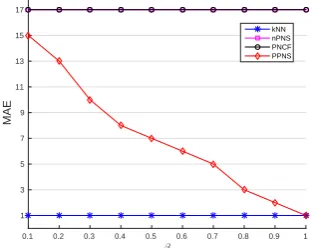
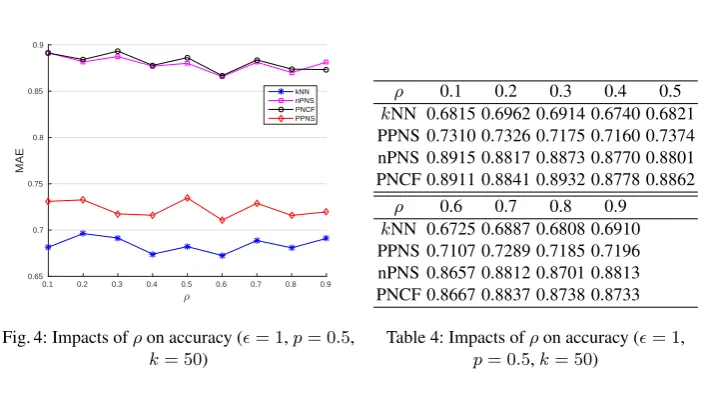
In our experiments, we compute the parameterRSby the previous theory [28]. We setT = 10,000, namely, we do the experiments 10,000 times to compute the MAE. Specifically, we randomly select one target user and item at each time. Our experiments are run on user-based CF (because both thekNN attack and theβ-kNN attack are user-based attack), and we use the cosine-user-based metric to compute the similarity between users. Table 1 and Figure 1 show the relationship between accuracy performance of Partitioned Probabilistic Neighbour Selection and parameterp, where we setϵ= 1,k= 50,ρ= 0.5. Table 2 and Figure 2 show the relationship between security performance of Partitioned Probabilistic Neighbour Selection (value ofβ) and parameterk, where the total partition number is 19. Table 3 and Figure 3 show the relationship between accuracy performance of all the four methods and parameterk, where we setϵ= 1,p= 0.5,ρ = 0.5. Table 4 and Figure 4 show the relationship between accuracy performance of PNCF [28] and parameterρ, where we setϵ= 1,p= 0.5,k= 50.
p
0.1 0.2 0.3 0.4 0.5 0.6 0.7 0.8 0.9 1
MAE
0.65 0.7 0.75 0.8 0.85 0.9
kNN nPNS PNCF PPNS
Fig. 1: Impacts of p on accuracy (ϵ= 1,k= 50, ρ= 0.5)
p 0.1 0.2 0.3 0.4 0.5 kNN 0.6956 0.7027 0.6908 0.6835 0.7074 PPNS 0.8333 0.7813 0.7289 0.7134 0.7085 nPNS 0.8762 0.8918 0.8884 0.8797 0.8878 PNCF 0.8798 0.8928 0.8885 0.8738 0.8753 p 0.6 0.7 0.8 0.9 1.0 kNN 0.6849 0.6899 0.6847 0.6746 0.6897 PPNS 0.6872 0.6914 0.6854 0.6792 0.6897 nPNS 0.8863 0.8889 0.8873 0.8781 0.8893 PNCF 0.8790 0.8845 0.8869 0.8783 0.8940 Table 1: Impacts of p on accuracy (ϵ= 1,
β
0.1 0.2 0.3 0.4 0.5 0.6 0.7 0.8 0.9 1
MAE
1 3 5 7 9 11 13 15 17
kNN nPNS PNCF PPNS
Fig. 2: Impacts of p on security (total partition number = 19)
p 0.1 0.2 0.3 0.4 0.5 kNN 1 1 1 1 1 PPNS 15 13 10 8 7 nPNS 17 17 17 17 17 PNCF 17 17 17 17 17 p 0.6 0.7 0.8 0.9 1.0 kNN 1 1 1 1 1 PPNS 6 5 3 2 1 nPNS 17 17 17 17 17 PNCF 17 17 17 17 17
Table 2: Impacts ofpon security (total partition number = 19)
k
10 20 30 40 50 60 70 80 90 100
MAE
0.65 0.7 0.75 0.8 0.85 0.9 0.95 1
kNN nPNS PNCF PPNS
Fig. 3: Impacts of k on accuracy (ϵ= 1,p= 0.5, ρ= 0.5)
k 10 20 30 40 50 kNN 0.8065 0.7149 0.7288 0.6942 0.6957 PPNS 0.8962 0.8017 0.7716 0.7395 0.7430 nPNS 0.9687 0.9131 0.9034 0.8867 0.8904 PNCF 0.9856 0.9245 0.9094 0.8862 0.8941 k 60 70 80 90 100 kNN 0.6644 0.6679 0.6574 0.6699 0.6746 PPNS 0.7140 0.7225 0.7140 0.7258 0.7362 nPNS 0.8698 0.8695 0.8592 0.8599 0.8604 PNCF 0.8669 0.8687 0.8528 0.8624 0.8650 Table 3: Impacts of k on accuracy (ϵ= 1,
p= 0.5,ρ= 0.5)
According to the experiments results, we have:
(1) From Fig. 1, when settingp >1−(n−nk)ω1, the accuracy performance of Partitioned Probabilistic Neighbour Selection is always better than the PNCF method [28] and Probabilistic Neighbour Selection [1]. When the value ofpis close to 1, the perfor-mance of Partitioned Probabilistic Neighbour Selection is close to thekNN method. Particularly, whenp= 1, the Partitioned Probabilistic Neighbour Selection method is the same as thekNN method.
ρ
0.1 0.2 0.3 0.4 0.5 0.6 0.7 0.8 0.9
MAE
0.65 0.7 0.75 0.8 0.85 0.9
kNN nPNS PNCF PPNS
Fig. 4: Impacts ofρon accuracy (ϵ= 1,p= 0.5, k= 50)
ρ 0.1 0.2 0.3 0.4 0.5 kNN 0.6815 0.6962 0.6914 0.6740 0.6821 PPNS 0.7310 0.7326 0.7175 0.7160 0.7374 nPNS 0.8915 0.8817 0.8873 0.8770 0.8801 PNCF 0.8911 0.8841 0.8932 0.8778 0.8862
ρ 0.6 0.7 0.8 0.9 kNN 0.6725 0.6887 0.6808 0.6910 PPNS 0.7107 0.7289 0.7185 0.7196 nPNS 0.8657 0.8812 0.8701 0.8813 PNCF 0.8667 0.8837 0.8738 0.8733
Table 4: Impacts ofρon accuracy (ϵ= 1, p= 0.5,k= 50)
(3) From Fig. 3, the size of neighbour set impacts the accuracy performance of all of the neighbourhood-based CF recommendation approaches. A large value of neighbour set sizekyields a better accuracy performance.
(4) From Fig. 4, the value ofλin [28] is not achievable because the value ofρdoes not impact the accuracy performance of PNCF [28].
8.
Conclusion
Recommender systems play an important role in e-commerce. To protect users’ private in-formation during the process of filtering, the existing privacy preserving neighbourhood-bases CF methods fail to protect users’ privacy in rating prediction. The global probabilis-tic neighbour selection methods, such as the PNCF method [28] and Probabilisprobabilis-tic Neigh-bour Selection [1] though can protect users’ privacy against thekNN attack successfully, but provide no data utility guarantee. To overcome the weaknesses of the current meth-ods, we propose a novel privacy preserving neighbourhood-based CF method, Partitioned Probabilistic Neighbour Selection, to ensure a required recommendation accuracy while maintaining high system security against the β-kNN attack (generalisation of thekNN attack). Theoretical and experimental analysis show that to provide an accuracy-assured recommendation against the most popular attack, thekNN attack, our Partitioned Proba-bilistic Neighbour Selection method yields a better trade-off between the recommendation accuracy and system security than the PNCF methods [28] and Probabilistic Neighbour Selection [1].
References
1. Adamopoulos, P., Tuzhilin, A.: On over-specialization and concentration bias of recommenda-tions: Probabilistic neighborhood selection in collaborative filtering systems. In: Proceedings of the 8th ACM Conference on Recommender Systems. pp. 153–160. RecSys ’14, ACM, New York, NY, USA (2014)
2. Adomavicius, G., Tuzhilin, A.: Toward the next generation of recommender systems: A survey of the state-of-the-art and possible extensions. IEEE Trans. on Knowl. and Data Eng. 17(6), 734–749 (2005)
3. Basu, A., Vaidya, J., Kikuchi, H.: Perturbation based privacy preserving slope one predictors for collaborative filtering. In: Trust Management VI, pp. 17–35. Springer (2012)
4. Bilge, A., Polat, H.: An improved privacy-preserving dwt-based collaborative filtering scheme. Expert Systems with Applications 39(3), 3841–3854 (2012)
5. Calandrino, J.A., Kilzer, A., Narayanan, A., Felten, E.W., Shmatikov, V.: “you might also like:” privacy risks of collaborative filtering. In: Proceedings of the 2011 IEEE Symposium on Secu-rity and Privacy. pp. 231–246. SP ’11, IEEE Computer Society, Washington, DC, USA (2011) 6. Chesson, J.: A non-central multivariate hypergeometric distribution arising from biased sam-pling with application to selective predation. Journal of Applied Probability 13(4), 795–797 (1976)
7. Dwork, C.: Differential privacy. In: Bugliesi, M., Preneel, B., Sassone, V., Wegener, I. (eds.) Automata, Languages and Programming, Lecture Notes in Computer Science, vol. 4052, pp. 1–12. Springer Berlin Heidelberg (2006)
8. Dwork, C.: Differential privacy: A survey of results. In: Proceedings of the 5th International Conference on Theory and Applications of Models of Computation. pp. 1–19. TAMC ’08, Springer-Verlag, Berlin, Heidelberg (2008)
9. Dwork, C., McSherry, F., Nissim, K., Smith, A.: Calibrating noise to sensitivity in private data analysis. In: Proceedings of the Third Conference on Theory of Cryptography. pp. 265–284. TCC ’06, Springer-Verlag, Berlin, Heidelberg (2006)
10. Ekstrand, M.D., Riedl, J.T., Konstan, J.A.: Collaborative filtering recommender systems. Found. Trends Hum.-Comput. Interact. 4(2), 81–173 (2011)
11. Erkin, Z., Beye, M., Veugen, T., Lagendijk, R.L.: Privacy enhanced recommender system. In: 31st Symposium on Information Theory in the Benelux, WIC 2010. pp. 35–42. IEEE Benelux Information Theory Chapter (2010)
12. Fog, A.: Calculation methods for wallenius’ noncentral hypergeometric distribution. Commu-nications in Statistics-Simulation and Computation 37(2), 258–273 (2008)
13. Herlocker, J., Konstan, J.A., Riedl, J.: An empirical analysis of design choices in neighborhood-based collaborative filtering algorithms. Information retrieval 5(4), 287–310 (2002)
14. Kabbur, S., Ning, X., Karypis, G.: Fism: factored item similarity models for top-n recommender systems. In: Proceedings of the 19th ACM SIGKDD international conference on Knowledge discovery and data mining. pp. 659–667. ACM (2013)
15. Koren, Y., Bell, R., Volinsky, C.: Matrix factorization techniques for recommender systems. Computer 42(8), 30–37 (2009)
16. Liu, B., Mobasher, B., Nasraoui, O.: Web Data Mining: Exploring Hyperlinks, Contents, and Usage Data. Data-Centric Systems and Applications, Springer (2011)
17. Manly, B.F.J.: A model for certain types of selection experiments. Biometrics 30(2), 281–294 (1974)
18. McSherry, F., Mironov, I.: Differentially private recommender systems: Building privacy into the net. In: Proceedings of the 15th ACM SIGKDD International Conference on Knowledge Discovery and Data Mining. pp. 627–636. KDD ’09, ACM, New York, NY, USA (2009) 19. McSherry, F., Talwar, K.: Mechanism design via differential privacy. In: Proceedings of the
20. Nikolaenko, V., Ioannidis, S., Weinsberg, U., Joye, M., Taft, N., Boneh, D.: Privacy-preserving matrix factorization. In: Proceedings of the 2013 ACM SIGSAC Conference on Computer & Communications Security. pp. 801–812. CCS ’13, ACM, New York, NY, USA (2013) 21. Parameswaran, R., Blough, D.M.: Privacy preserving collaborative filtering using data
obfus-cation. In: Granular Computing, 2007. GRC 2007. IEEE International Conference on. pp. 380– 380 (2007)
22. Sarathy, R., Muralidhar, K.: Evaluating laplace noise addition to satisfy differential privacy for numeric data. Trans. Data Privacy 4(1), 1–17 (2011)
23. Sarwar, B., Karypis, G., Konstan, J., Riedl, J.: Item-based collaborative filtering recommenda-tion algorithms. In: Proceedings of the 10th Internarecommenda-tional Conference on World Wide Web. pp. 285–295. WWW ’01, ACM, New York, NY, USA (2001)
24. Schafer, J.B., Konstan, J., Riedl, J.: Recommender systems in e-commerce. In: Proceedings of the 1st ACM conference on Electronic commerce. pp. 158–166. ACM (1999)
25. Wallenius, K.T.: Biased sampling: The non-central hypergeometric probability distribution. Tech. Rep. 70, Stanford University (1963)
26. Weinsberg, U., Bhagat, S., Ioannidis, S., Taft, N.: Blurme: inferring and obfuscating user gender based on ratings. In: Proceedings of the sixth ACM conference on Recommender systems. pp. 195–202. ACM (2012)
27. Willmott, C.J., Matsuura, K.: Advantages of the mean absolute error (mae) over the root mean square error (rmse) in assessing average model performance. Climate research 30(1), 79 (2005) 28. Zhu, T., Ren, Y., Zhou, W., Rong, J., Xiong, P.: An effective privacy preserving algorithm for neighborhood-based collaborative filtering. Future Generation Computer Systems 36, 142–155 (2014)
Zhigang Lureceived his B. Eng degree from Xidian University in 2011. He received his M.Phil degree from the University of Adelaide in 2015. He is currently a teaching and research assistant at the School of Computer Science, the University of Adelaide. His research interests are privacy preserving, recommender systems and machine learning.
Hong Shenis Professor (Chair) of Computer Science in University of Adelaide, Aus-tralia, and ”1000 People Plan” Professor and Director of Advanced Computing Institute in Sun Yat-Sen University, China. He received Ph.Lic. and Ph.D. degrees from Abo Akademi University, Finland, M.Eng. degree from University of Science and Technology of China, and B.Eng. degree from Beijing University of Science and Technology, all in Computer Science. He was Professor and Chair of the Computer Networks Laboratory in Japan Advanced Institute of Science and Technology (JAIST) during 20012006, and Professor (Chair) of Compute Science at Griffith University, Australia, where he taught 9 years since 1992. With main research interests in parallel and distributed computing, algorithms, data mining, privacy preserving computing and high performance networks, he has published more than 300 papers including over 100 papers in international journals such as a vari-ety of IEEE and ACM transactions. Prof. Shen received many honours/awards including China National Endowed Expert of ”1000 People Plan” (2010) and Chinese Academy of Sciences ”Hundred Talents” (2005). He served on the editorial board of numerous jour-nals and chaired several conference.