The Vital Pillar of the Implementation of
Knowledge Management on High Schools
Hilda Ainissyifa
Abstract—The purpose of the study is to analyze the influence of human resources, organization culture and technology utilization toward knowledge management implementation on high school level. This study was conducted to formal education institute on an educational foundation which covers five formal High Schools. Using path analysis as a methodology. The respondents used as the profession references are teachers, and the sampling technique used is random stratified sampling with 86 people as the respondents base d on Slovin method. The result of the study shows that human resources, organization culture and technology utilization bring a significant and positive influence toward insight management on high schools.
Index Terms— human resources, organization culture, technology utilization, knowledge management.
————————————————————
1
I
NTRODUCTIONTHE The strategic steps which are run by the educational institute, especially directed to create the education quality by forming learning climate, strengthening the culture in one organization of life in a learning society system which realize the importance of standardization, information, communication, technology, efficiency, professionalism and to give a meaning and use every momentum in order to be able to have a power use in accessing all system sources, politics, economics, social culture, science, technology and information more attractively and aggressively. The focus of the educational institute in human resources development which based on the human thought is a determined success factor of building all sectors, because the human is an active agent who thinks and acts and by utilizing some devices they made, human conduct a digging, accessing, and natural resources, capital accumulation, and continuing the building. However, by these advantages of human resources, the competitive benefit and comparative nation can be reached. This makes believe that the existence of educational institute, developing human resources activity needs to be given an orientation of essential load for the student’s life. By the tracking framework, it is expected that it can make a description in attempts to increase en education institute in human resources development, and how the development can be actualized in the middle of building attempts in all sectors. Education institution has a core duty in developing the knowledge, and relevance of education institute by knowledge development will show the question how far the existence of formal education institute in attempting knowledge management development, so it creates the high-quality of formal education institute. The knowledge management can be conducted by managing the asset which is sourced on knowledge resources (human resources who has an intellectual capital) which is owned by education institute. This paradigm gives a pressing toward important values of knowledge resources (intellectual capital) as a source of education institute richness as the intense of education organizers competition running.
Nowadays, in education field, it has happened point of view change concerning with any resources which has strategic characteristic for the course organizer. The quality increase which occurred in education institute organizer is viewed as the effect of paradigm moving and it stated that education institute is the organization which needs to live by having adaptive power and high competition with same kind of the institution. This study is aimed to discuss the influence of technology human resources, organization culture and utilization toward knowledge management implementation on formal education institute of high school level located in Garut District, West Java Province, Indonesia. This study is based on various research that show that the vital pillars on the knowledge management implementation are human resources, organization culture and technology utilization.
2
L
ITERATURER
IVIEWAccording to Santosus and Surmacz as cited by Sangkala (2007), knowledge management is a process in which the company delivers values and intellectual assets and knowledge base asset. According to that statement, Santosus and Surmacz as cited by Indrajit dan Djokopranoto (2007) explained that knowledge management is the process through which organizations generate value from their intellectual and knowledge based assets. Most often, generating value from such assets involves sharing them among employes, departments and even with other companies in an effort to devise best practies. Meanwhile, Jennex (2007) gave a definition of knowledge management is the practice of selectively applying knowledge from previous experiences of decision making to current and future decision-making activities with the express purpose of improving the organization’s effectiveness. Sveiby (2001) strongly stated that knowledge management is the art of value creation from intangible assets. Furthermore, Bergerson on Sangkala (2007) explained that knowledge management is an approach which systematically manages intellectual assets and other information, so it can give the superiority to compete for the company. Knowledge management focuses on the exploitation and assets development on the organization with future point of view and organization goal.
———————————————— Hilda Ainissyifa is currently pursuing doctor degree
133 Same as above concepts, so the knowledge management can
be concluded as follow:
1. Knowledge management covers information gathering, arranging, storing and accessing in building the knowledge. The appropriate utilization of information technology by computer can support knowledge management; however, the information technology is not the knowledge information.
2. Knowledge management covers sharing knowledge. Without sharing knowledge, the attempts to increase knowledge management will fail. The social aspect and culture of knowledge management is a significant challenge.
3. Knowledge management is related to people knowledge. Someday, organization will need competent people to comprehend and use the information effectively. The related organization with the individual to make innovation and give guidance to organization. The organization is also related to the matters of proficiency which provide the input in implementing knowledge management. Therefore, organization must consider how to draw, develop and maintain the members’ knowledge as a part of knowledge management domain.
Knowledge management is related to organization affectivity increase. The organization needs to concentrate on the knowledge management because it’s believed that knowledge management can give contribution to vitality and success of organization. The attempts to measure intellectual capital and to assess knowledge management affectivity which can help organization to comprehend knowledge management widely. Hovland (2003) explained that there are two generations in knowledge management. The first generation knowledge management, the strategy is aimed to help increase the share knowledge in the organization, but the effort is focused on systems and information technology. Technical device used to collect and codify existing knowledge, the goal is that the organization can develop rapidly. Second-generation knowledge management, strategy is more focused on the organization and creation of new knowledge, the goal is that the organization can step further than its competitors. For example, the most successful organizations are switching from a strategy based prediction/ estimation, to a strategy based on the anticipation of change. They also switched from the utilization of existing knowledge to new knowledge creation and knowledge management applications from a pure technology into applications that also involve the process.
Stankosky (2005) divides knowledge management into four pillars, namely as follows:
1) Leadership/ management, with regard to environmental issues, strategic and corporate level decision-making process to determine the values, goals, needs knowledge, knowledge resources, priority setting and resource allocation of knowledge assets of organization. Emphasizing the need for enterprising integration principles and techniques, and it is mainly based on the approach and the system of thinking.
2) Organization, relating to the operational aspects of knowledge assets, including the functions, processes, formal and informal organizational structures, control
measures, process improvement and business process reengineering. This pillar involves the principles and techniques of systems engineering to ensure that knowledge can continue to flow on all lines that need it, so that all existing knowledge assets within an organization can be utilized optimally.
3) Learning, relating to aspects of organizational behavior and social engineering. Pillars of learning focus on principles and practices to ensure that individuals cooperate and share knowledge to the fullest. This pillar emphasizes the identification and application of important attributes for the creation of the learning organization. 4) Technology, deals with various applications of information
technology (IT), which can be used to support KM strategies and processes. This pillar focuses on the development of the technology that supports collaboration and codification functions and KM strategy.
In line with the opinion Stankosky, Tobing (2007) suggested an important element in knowledge management, namely: (1) human resources, (2) leadership, (3) technology, (4) organization and learning.
3 M
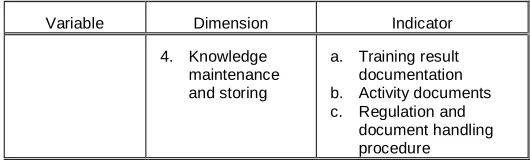
ETHODOLOGYTabel 1. Variables Operationalization
Variable Dimension Indicator Human
Resources
1 Knowledge needs
a. Cognitive b. Affective c. Psychomotor 2. Access on
knowledge
a. Education b. Training
c. Discussion partner 3. Pre-conditional
knowledge
a. Education level b. Experience level 4. Absorbing
power
a. Analytical ability b. Practical ability 5. Opportunity on
implementing the knowledge
a. New experience b. Creativity and
innovation Organizational
Culture
1. Belief a. Delegation task from director
b. Believe each other c. Participative decision
making
2. Team work a. Individual Interaction b. Appreciation to the
group
c. Cares to the team 3. Appreciation a. Acknowledgement of
achievement b. Award Granting 4. Senior
management support
a. Senior management initiative
b. Senior management openness
Technology utilization
1. Technology availability
a. The availability of Information technology tools 2. The ease of
Technology using
a. Service providing time
b. Consultation service and fixing
3. The ability of Technology using
a. Technology using experience b. Technology usage
education Knowledge
management Implementation
1. Knowledge acquisition
a. Training plan b. Overseas joint c. Knowledge
developing facility 2. Distribution and
Various Knowledge
a. Training result presentation b. Information openness c. Apprentice to Senior 3. Knowledge
Development and Utilization
a. Experimental opportunity b. Training result
implementation c. Functional cross team
Variable Dimension Indicator 4. Knowledge
maintenance and storing
a. Training result documentation b. Activity documents c. Regulation and
document handling procedure
4 R
ESULT ANDD
ISCUSSIONAccording to the result of calculation by using AMOS® 18, a calculation of human resources (X1), organization culture (X2),
and technology utilization (X3) toward knowledge management
implementation (Y) is served on Table 2.
Table 2 The influence of human resources (X1), organization
culture (X2), and technology utilization (X3) toward knowledge
management implementation (Y)
No Item Value
1 Path coefficient ( YX1) of influence of
human resources, (X1) toward knowledge
management implementation (Y)
0. 274
2 Path coefficient ( YX2) of influence of
organization culture (X2) toward
knowledge management implementation (Y)
0. 255
3 Path coefficient (
3
YX ) of influence of
technology utilization (X3) toward
knowledge management implementation (Y)
0. 268
4 Determinant factor(ρ 2
) 43,39%
5 Epsilon (ɛ) 56,61%
6 Fcount 5,2402
7 Ftable 1,5061
8 Influence level of human resources (X1),
organization culture (X2), and technology
utilization (X3) toward knowledge
management implementation (Y)
Significant
According to calculation result, it results that line coefficient
1
YX is 0.274, YX2is 0.255, and YX3 is 0.268 these three coefficients produced positive value, and it means that human resources (X1), organization culture (X2), and
technology utilization (X3) have a positive influence toward
knowledge management implementation (Y). On the other side, it’s identified that Fcount>Ftable (5,2402>1,5061), so H0 is
denied, or on the other word, it can be stated that there is sufficient evidence to state that human resources (X1),
organization culture (X2), and technology utilization (X3) have a
significant and positive influence toward knowledge management implementation (Y). Each value increment on human resources(X1), organization culture (X2), and
technology utilization (X3) toward knowledge management
implementation (Y) The calculation result showed that determinant factor produced 0,4339; it means that human resources (X1), organization culture (X2), and technology
utilization (X3) are able to explain knowledge management
135 of 56.61% can be explained by another variable that is not
involved in model. The correlation of variable structure is illustrated in Figure 1.
Figure 1 The influence of human resources (X1), organization
culture (X2), and technology utilization (X3) toward knowledge
management implementation (Y).
The correlation between of human resources and organization culture
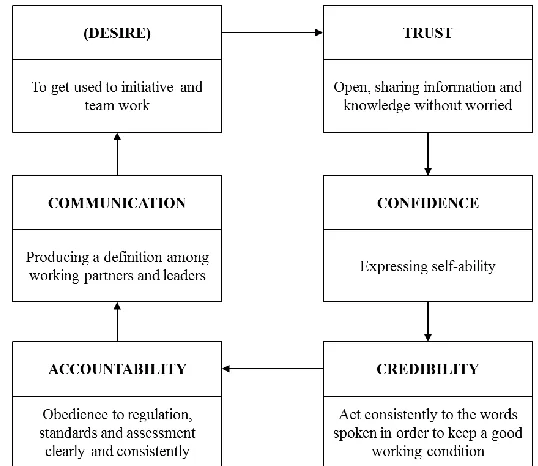
According to the result of the study, it showed that the human resource capacity has positively and significantly tight correlation with organizational culture. This was same opinion with Sutrisno (2010) who stated that the management act through organizational culture can give a guarantee to the success of human resources utilization. On the other side, the success of organizational culture implementation depends on the human resources capacity. For a clear meaning, the correlation between organizational culture and human resource can be seen on Figure 2. From the model of human resources utilization (the increase of human knowledge capacity), we can see that the utilization will be able to do as the organizational culture runs well, and the human can be utilized as he or she has a sufficient intellectual capital. On the research object, it can be seen that the individual who has a good academics achievement generally attempts to obligate to the school culture which is developed by school and organizational culture as it is conducted well and it will give an effect to the increase of human resources capacity.
Figure 2 Empowerment through organization culture model
The correlation between of human resources and technology utilization
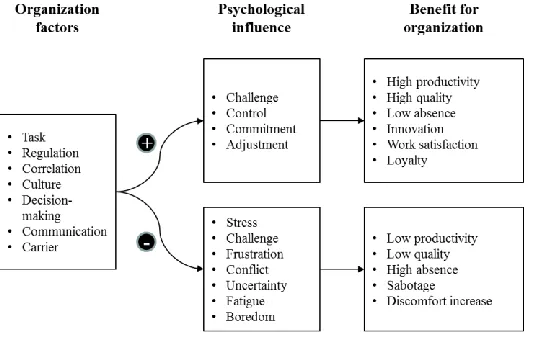
Figure 3 Technology utilization influence (Nazaruddin, 2008)
Mondy (2008) strongly stated that technology has apply its immense role in changing the knowledge path which is conveyed to the employee more effectively and efficiently. This statement supported the research result which stated that the technology utilization has a positive and significant correlation with human resources quality. The technology utilization can give a positive effect toward human resources, and the quality of human resources determines the degree of using and technology utilization affectivity.
The correlation of organizational culture and technology utilization
Concerning with the discussion of organizational culture correlation with technology utilization, Nazarudin (2008) stated that the technology utilization has a dynamic characteristic and it can grow anytime. Technology grows in activity side, knowledge creation, they increase human ability. The technology change brings the consequence on life style change. It indicates that the technology utilization has a positive and significant toward organizational culture. This statement supports the research result that shows that technology utilization has a positive and significant correlation toward organizational culture. The observation result on the research showed that there is a change in organizational culture on communication format with technology utilization, the change occurs as teacher and the student communicate each other, the teacher communicates with his or her working partner. They are all facilitated by technology which seems to occur in the research object; they are Short Message Service (SMS) using, e-mail and facebook® using. Furthermore, Nazarudin (2008) stated that the organizational culture covers believes and values which are applied by the organization members. The organizational culture is a software side of organization structure, which can be grown by communication system, training, and management. In this context, the organizational culture cab be understood as a tool for fastening technology utilization.
The influence of independent variable toward knowledge management implementation
According to the result of calculation by using line analysis, it gained that human resources, organization culture and technology utilization have a positive and significant influence toward knowledge management implementation. This was as
same opinion with Setiarso (2009). Furthermore, Setiarso et. al. (2009) stated that the characteristics of learning organization are:
1. It has a human with good resources, it is the organization member who has a superior human potential (intellectuality, social and ethics);
2. It has an effective organizational culture which is characterized by the relatedness among discipline learners.
3. It has a learning motivation covers structural facilitator(information technology, achievement system, and organization structure) and relational catalisator (believe each other, transformational culture and leadership)
This study produced a formula that stated that sharing knowledge which has an important part in knowledge management implementation is a people social interaction, and it is affected by the individual characteristic (human resources), organizational culture, and facilitation affectivity/ technology utilization for its affair.
The influence of human resources toward knowledge management implementation
Referring to the research result, the knowledge management implementation affectivity was influenced significantly and positively based on human resources capacity on the organization, this was same opinion as Szulanski statement as cited by Setiarso et. al. (2009) which stated that the divert process of knowledge from individual/ group to individual/ other groups, depended on the individual ability as reflected on process as follow:
1. Access to information/ knowledge. The ability of knowledge creation depends on the individual ability in organization in order to get an access to idea, information or experience.
2. Past experience reflection. The ability of knowledge creation depends on the ability of past experience evaluation by organization member which increase understanding on the event or process happened. The reflection on this aspect increases a possibility of induction giving like information and experience for perspective reconstruction process of decision making. 3. Absorbing ability. The ability of assimilating the
knowledge depends on the reality whether the individuals have a pre-conditional knowledge which related to a newly accepted knowledge. The ability to absorb new knowledge depends on the one’s competence.
4. Learning ability. Productive combination happened in the organization depends on the learning ability of organization members. Therefore, organization members need to keep on learning and always follow the updated knowledge changes and technology.
5. Perception which states that the exchange activity or various knowledge is valuable.
137 information ownership/ the knowledge they have.
Meanwhile, Tobing (2007) stated that besides as knowledge sources, genuinely, human is a doer who involves in knowledge management process. If a process of various knowledge and knowledge creation don’t work well, the main issue is there is no will and ability on the human for doing that. All the processes in implementing knowledge management can work well as long as human has his or her own motivation to do it or if there’s no technology aids, the human can still do. Furthermore, Setiarso et. al. (2009) stated that the characteristics of knowledge society are:
1. It consists of the members who have an awareness of understanding their true self, have adult attitude, and wish to have welfare and advance together.
2. It is an organization which consists of various individuals who live in the conducive organization habitat, and have a n effective motivation in order to make a process of sharing mental model and knowledge with partners.
3. It has a potential to produce intangible organization capital, it is the capital which is able to produce extending value, organization richness, and society/ consumer welfare together.
According to the observation result on research object, it can be seen that the behavior of various knowledge occurred as the teaching staffs have a will and ability to do that. The open and intelligent individuals have relatively an ability and a will to do the activity in various knowledge. The study showed that human resources have a positive and significant influence toward knowledge management implementation of formal education institutes as the research object. The result is principally recommending human resources development through the increase of active employer participation in order to share the knowledge they have and to increase their learning ability independently and innovatively as the attempt to increase the education quality.
The influence of organizational culture toward knowledge management implementation
Referring to the hypotheses test, the knowledge management implementation affectivity was influenced significantly and positively based on organizational culture capacity on the organization, this was same opinion and relevant with Robbins and Coulter (2010) statement they stated that the organization is based on the spiritual awareness of values and dignity from the individual. This organization is not only providing a job, but also creating a culture which can make its employee grow and learn continually. Above statement is relevant with Munir (2008) statement, he stated that the knowledge is an input for learning process, and it’s also an output for the learning process. The information and knowledge accepted by the individual will be processed on his or her mind and thoughts, and it’s defined and combined by the information and knowledge they have before to create the new knowledge. The internalization of the new knowledge will make this human’s point of view or attitude or behavior change. Therefore, a human who learns is a human who gets ready and has a capability of changing his or her behavior as the learning result, being more adaptive and anticipative human in his or her neighborhood. Wahjono (2010) stated that a culture is a social set which can support organization unity by giving an appropriate standard. A culture function is for a meaning
maker mechanism and the controller of guiding and forming an attitude and organization members’ behavior. Furthermore, as cited by Setiarso (2009), it was stated that Schein explained that principally, the knowledge management implementation is based on organization ability for learning, building memory, and sharing knowledge, so it depends on its organizational culture. A culture becomes a basic assumption for the organization members for sharing the knowledge. Furthermore, Tobing (2007) stated that the organization which supports knowledge management implementation is the organization which has a culture in honoring knowledge and has knowledge. This organization is flexible and easy to adapt with the change. According to the researchers’ observation through the research object, the organizational culrure affected interaction pattern among organization members (education institute). And it can be understood that organization is one social unity which is coordinated consciously, and it tries to reach a goal continually. This individual group frequently interact each other with the organization members or the others.
The influence of technology utilization toward knowledge management implementation
According to inference statistical analysis which assesses the correlation between technology utilization toward knowledge management implementation concludes that there is a positive and significant correlation between technology utilization toward knowledge management implementation. This was supported by Tobing (2007) statement which stated that technology development has come into all aspects of all human activities and it makes the technology utilization becomes one of the enabler of knowledge management. The technology development with various applications within makes technology becomes a main basic of knowledge management tools development. This was as same opinion as Setiarso et. al. (2009) who stated that human resources knowledge which is owned by organization, so technology has an in important role as supporter or facilitator in implementing knowledge management. The researcher observation on the research object can be observed by using technology and it’s an approach in providing the access to much information and ability to find, create, gain and spread the important knowledge for the organization, it can give an important contribution in implementing knowledge management strategy.
5 C
ONLUSIONeducation quality by forming learning climate, especially strengthening the culture in one organization of life in one learning society system which realize the importance of standardization, information, communication, technology, efficiency, professionalism and to give a meaning and use every momentum in order to be able to have a power use in accessing all system sources, politics, economics, social culture, science, technology and information more attractively and aggressively.
R
EFERENCES[1] Hovland, I. 2003. Knowledge Management and Organisational Learning: An International Development Perspective an Annotated Bibliography, http://www.odi.org.uk/publications/working_papers/wp2 24.pdf, download at 10th Agust 2011.
[2] Indrajit, R. E. and Djokopranoto. 2007. Manajemen Perguruan Tinggi Modern. Andi, Jogyakarta
[3] Mondy, R. W. 2008. Manajemen Sumberdaya Manusia. Erlangga, Jakarta.
[4] Munir, N. 2008. Knowledge Management Audit: Pedoman Evaluasi Kesiapan Organisasi Mengelola Pengetahuan. Penerbit PPM, Jakarta
[5] Nazaruddin. 2008. Manajemen Teknologi. Graha Ilmu, Jogyakarta
[6] Noegroho, A. 2010. Teknologi Komunikasi. Graha Ilmu, Jogyakarta.
[7] Robbins, S. P. and M. Coulter. 2010. Manajemen. Erlangga, Jakarta
[8] Sangkala. 2007. Knowledge Management; Sebuah Pengantar Bagaimana Organisasi Mengelola Pengetahuan Sehingga Menjadi Organisasi yang Unggul. Raja Grafindo Persada, Jakarta
[9] Setiarso, B., N. Harjanto, Triyono, dan H. Subagyo. 2009. Penerapan Knowledge Management pada Organisasi. Graha Ilmu, Jogyakarta.
[10] Stankosky, M. 2005. Advances in Knowledge Management: University Research Toward an Academic Discipline in Creating The Discipline of Knowledge Management: The Latest in University Research. Elsevier Butterworth-Heinemann, Amsterdam.
[11] Sutrisno, E. 2010. Budaya Organisasi. Kencana, Jakarta.
[12] Sveiby, K. E. 2001. A Knowledge Based Theory of the Firm to Guide Strategy Formulation. (Journal of Intellectual Capital), www.sveiby.com download at 21th May 2011
[13] Tobing, L. P. 2007. Knowledge Management: Konsep, Arsitektur dan Implementasi. Graha Ilmu, Jogyakarta. [14] Wahjono, S. I. 2010. Perilaku Organisasi. Graha Ilmu,