Nonlinear Electron-Acoustic Waves In Relativistic Plasma In The Presence Of Nonthermal Electrons Sona Bansal,
Sikh National College, Banga-144505(Punjab),
ABSTRACT
The problem of relativistic electron acoustic waves is discussed using the reductive perturbation theory in Collisionless, Unmagnetized plasma consisting of relativistic cold electrons, hot electrons obeying non maxellian distributions and stationary ions. The Korteweg De Vries (KdV) equation has been derived. finally the effects of relativistic electrons on the amplitude and width of small amplitude electron acoustic waves are investigated.
Keywords: Electron acoustic wave; Relativistic electrons; KdV equation.
1. INTRODUCTION
The investigations of the electron acoustic waves (EAW) have attracted much attention in the studying of nonlinear waves in plasmas because of their potential importance in interpreting the electrostatic component of the broadband electrostatic noise observed in the cups of the terrestrial magnetosphere [1,2] and in the geomagnetic tail [3]. The electron acoustic wave plays an important role in space environment [4-7]. EA wave is characterized by two electron populations, referred to as cool and hot electrons. The cool electrons provide the inertia necessary to maintain the electrostatic oscillations, while the restoring force comes from hot electron pressure. The propagation of EASWs in a plasma system has been studied by several investigators in Unmagnetized two electon plasmas [9-11] as well as in magnetized plasma [12-16]. Space plasma observations indicate clearly the presence of electron populations which are far away from their thermodynamic equilibrium [17–25]. Numerous observations of space plasmas [26–27] clearly prove the presence of superthermal electron and ion structures as ubiquitous in a variety of astrophysical plasma environments. Ghosh et al. demonstrated that both negative as well as positive nonplanar ion acoustic solitons are formed in the plasmas with superthermal electrons and positrons.
In this paper we will drive the phase velocity from the basic set of equation for plasma by reductive perturbation theory and study the effect of relativistic electrons on Unmagnetized Collisionless plasma consisting of cold relativistic electron fluid, non Maxwellian hot electrons and stationary ions. This paper is organised as follow, in section 2, we present the basic set of fluid equations in three component plasma model and KdV equation is derived using reductive perturbation method. Results are discussed in section 3 by plotting graph. Finally some conclusions are given in section 4.
2. BASIC EQUATIONS
We consider Unmagnetized Collisionless plasma consisting of cold relativistic electron fluid, non Maxwellian hot electrons and stationary ions. The non linear dynamics of the electron acoustic solitary waves is governed by the continuity and motion equations for relativistic cold electron and Poisson's equation.
𝜕𝑛𝑐
𝜕𝑡 +
𝜕(𝑛𝑐𝑢𝑐)
𝜕𝑥 = 0
(1)
𝜕(𝛾𝑐𝑢𝑐)
𝜕𝑡 + 𝑢𝑐
𝜕(𝛾𝑐𝑢𝑐)
𝜕𝑥 +
3𝛼(1+𝛼)2𝑛 𝑐 𝜃
𝜕𝑛𝑐
𝜕𝑥 − 𝛼
𝜕𝜙
𝜕𝑥 = 0 (2)
𝜕2𝜙 𝜕𝑥2 =
1
𝛼𝑛𝑐+ 𝑛ℎ− 1 + 1
𝛼 (3)
where
𝑛ℎ = 1 − 𝛽𝜙 + 𝛽𝜙2 𝑒𝜙,𝛾𝑐 = 1 + 𝑢𝑐2 2𝑐2
𝜃 =𝑇ℎ
𝑇𝑐 and 𝛼 = 𝑛ℎ 0
𝑛𝑐0, 𝑛𝑐 and 𝑛ℎ are the normalized number densities of cold and hot electrons, respectively. 𝜙 is the normalized electrostatic potential, uc is the normalized velocities of cold electron in
the x direction. x and t are also normalized. The normalization is as follows. The densities of cold and hot electrons are normalized by 𝑛𝑐𝑜 and 𝑛ℎ𝑜. The space coordinates x time t, velocity and electrostatic potential 𝜙 are normalized by the hot electron Debye length (𝐾𝐵𝑇ℎ/4𝜋 𝑛ℎ𝑜𝑒2)1/2, inverse of cold electron plasma frequency 𝜔𝑝𝑐−1= (𝑚/4𝜋 𝑛𝑐𝑜𝑒2), 𝑐𝑒 = (𝐾𝐵𝑇ℎ/𝛼𝑚), and
𝐾𝐵𝑇ℎ
𝑒 , respectively. Here m is the electron mass, e is the magnitude of the electron charge and KB is the Boltzmann constant.
According to RPM, the independent variables are scaled as
𝜉 = 𝜖1/2 𝑥 − 𝑣𝑔𝑡 , (4)
𝜏 = 𝜖3/2𝑡, (5)
𝑛𝑐= 1 + 𝜖𝑛1+ 𝜖2𝑛2+ 𝜖3𝑛3+ … . … ..
𝑢𝑐= 𝑢0+ 𝜖𝑢1+ 𝜖2𝑢2+ 𝜖3𝑢3+ … . … ..
𝜙𝑐= 𝜖𝜙1+ 𝜖2𝜙2+ 𝜖3𝜙3+ … . … .. (6)
Using stretching coordinates Eqs.(4-5) and Eq.(6) in Eqs.(1-3) and collecting the terms of 𝜖 . We obtain the following equations in lowest power of :
−𝑣𝑔 𝜕𝑛1
𝜕𝜉 + 𝜕𝑢1
𝜕𝜉 + 𝑢0 𝜕𝑛1
𝜕𝜉 = 0 (7)
−𝑣𝑔𝛾1 𝜕𝑢1
𝜕𝜉 + 𝑢0𝛾1 𝜕𝑢1 𝜕𝜉 + 3𝛼(1+𝛼)2 𝜃 𝜕𝑛1 𝜕𝜉 − 𝛼 𝜕𝜙1
𝜕𝜉 = 0
(8)
1 − 𝛽 𝜙1+ 1
𝛼𝑛1 = 0 (9)
From (7) to (9), we can express the first order quantities in terms of 𝜙1 as
𝑛1= −𝛼 1 − 𝛽 𝜙1 (10)
𝑢1= −𝛼 1 − 𝛽 (𝑣𝑔− 𝑢0)𝜙1 (11)
where
𝛾1= 1 + 3 2𝑈
2 , U =𝑢0 𝑐
Algebraic manipulations of these equations lead to the following dispersion relation
𝑉 = 𝑣𝑔− 𝑢0= 1 𝛾1
3𝛼(1+𝛼)2
𝜃 +
1
1−𝛽 (12)
The phase velocity given by Eq.(12) depends on relativistic factor U(𝑢0/𝑐), cold to hot electron density ratio(𝛼), hot to cold electron temperature ratio(𝜃) and nonthermal electrons distribution parameter β.
To next order of 𝜀, we get
𝜕𝑛1
𝜕𝜏 − (𝑣𝑔− 𝑢0) 𝜕𝑛2
𝜕𝜉 + 𝜕𝑢2
𝜕𝜉 +
𝜕(𝑛1𝑢1)
𝜕𝜉 = 0
(13)
𝛾1 𝜕𝑢1
𝜕𝜏 − 𝑣𝑔 − 𝑢0 𝛾1 𝜕𝑢2
𝜕𝜉 + [𝛾1− 2𝛾2 𝑣𝑔−𝑢0
𝑢0 𝑢1 𝜕𝑢1
𝜕𝜉 +
3𝛼 1+𝛼 2
𝜃 𝑛1
𝜕𝑛1 𝜕𝜉 + 3𝛼(1+𝛼)2 𝜃 𝜕𝑛2 𝜕𝜉 − 𝛼 𝜕𝜙2
𝜕𝜉 = 0
(14)
𝜕2𝜙1
𝜕𝜉2 = 1 − 𝛽 𝜙2+ 1 𝛼𝑛2+
1 2𝜙1
2
where
𝛾1= 1 + 3 2𝑈
2 , 𝛾
2=
3 2𝑈
2, U =𝑢0 𝑐
After some algebraic manipulations, second order quantities are eliminated and 𝜙1 is found to satisfy the following KdV equation
𝜕𝜙1
𝜕𝜏 + 𝐴𝜙1 𝜕𝜙1
𝜕𝜉 + 𝐵
𝜕3𝜙1
𝜕 𝜉3 = 0 (16)
where A is the coefficient of non - linear term and B is the coefficient of dispersion term.
The non - linearity coefficient A and dispersive coefficient B are defined as follow :
𝐴 = 𝑣𝑔−𝑢0
2 1−𝛽 − 3
2 𝑣𝑔 − 𝑢0 1 − 𝛽 𝛼 + 𝛾2 𝑢0
𝛼 1−𝛽 𝑣𝑔−𝑢0 2
𝛾1 −
3𝛼 1+𝛼 2 2𝜃𝛾1 𝑣𝑔−𝑢0 1−𝛽 −
3𝛼2 1+𝛼 2 2𝜃𝛾1 𝑣𝑔−𝑢0 (17)
and
𝐵 = 1
2𝛾1 𝑣𝑔−𝑢0 1−𝛽 2 (18)
On introducing the new variable 𝜂 = 𝜉 − 𝑣𝜏 , where v is a constant velocity, the solution of Eq.(16) is given as
𝜙1 𝜂 = 𝜙𝑚 𝑠𝑒𝑐ℎ2 𝜂
𝐿 (19)
where peak amplitude 𝜙𝑚 and width L of soliton are respectively given by
𝜙𝑚 = 3𝑣
𝐴 (20)
And
𝐿 = 4𝐵
𝑣
(21)
3. RESULTS AND DISCUSSION
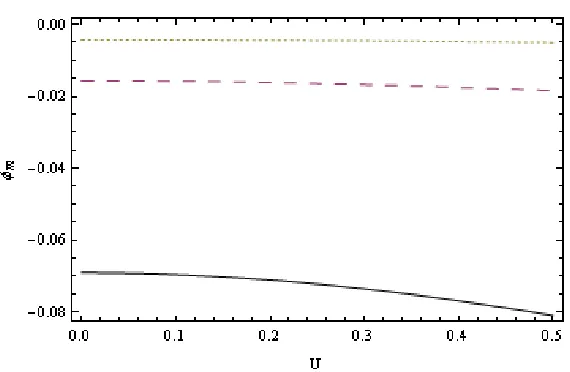
Fig. 1: The amplitude of solitary wave 𝜙𝑚 with respect to the relativistic factor U for 𝛽=0.1, 𝜃=20, v= 0.01 and 𝛼= 0.5, (solid curve), 1.0 (dashed curve), 2.0 (dotted curve).
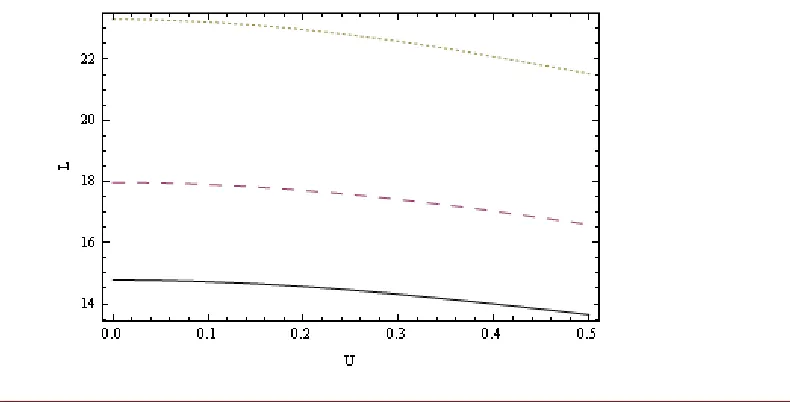
Fig. 3: The width of solitary wave L with respect to the relativistic factor U for 𝛽=0.1, 𝜃=20, v= 0.01 and
𝛼= 0.5, (solid curve), 1.0 (dashed curve), 2.0 (dotted curve).
In order to study the variation of the amplitude and the width of EASW with respect to the relativistic factor U for different parameters, we select a set of parameters are 𝛼= 0.5,𝛽=0.1, 𝜃=20 .Figure 1 shows how the amplitude 𝜙𝑚 changes respect to the relativistic factor U for different values of density ratio (𝛼), superthermal parameter (𝛽). Absolute value of the soliton amplitude 𝜙𝑚 decreases when ‘‘U’’ increases. Increasing in the soliton amplitude is more sensible for the larger values of . This figure also shows that the soliton amplitude is an increasing function of 𝛼. Thus the soliton amplitude finds its maximum value in smaller values of U. Figure 2 presents 𝜙𝑚 as a function of U with different values of
Fig. 4: The width of solitary wave L with respect to the relativistic factor U for α=0.5, 𝜃=20, v= 0.01 and β= 0.1, (solid curve), 0.3 (dashed curve), 0.5(dotted curve)
Figures 3 and 4 show the variation of width of solitary waves with respect to the to the relativistic factor U. It is shown that the width L decreases as the relativistic factor increases. The width of soliton increases with increasing the value of 𝛼 and 𝛽. The maximum value of the soliton width increases as ‘‘𝛽’’ increases. It is mentioned that superthermal distribution reduces to Maxwellian distribution for large values of ‘‘𝛽’’.
4. CONCLUSION
REFRENCES
[1] Watanabe K , Taniuti T . J. Phys. Sco. Jpn 1977; 43, 1819. [2] Gary S P, Tokar R L phys. Fluids 1985 ; 28,2439.
[3] (3) Dubouloz N, Pottelette R., Malingre M., Holmgren G.,Lindqvist P. A. J. Geophys. Res. 1991; 96, 3565.
[4] Tokar R L, Gary S P. Geophys. ResLett 1984; 11 1180.
[5] Dubouloz N, Pottelette R., Malingre M., Treumann R.,Geophys. Res. Lett 1991b; 18, 155. [6] Mozer F S., Ergun R., Temerin M., Catte C.1, Dombeck J., Wygant J. Phys. Rev. Lett 1997,
79,1281.
[7] Ergun R E., Carlson C W.,McFadden J P.et al., Geophys. Res. Lett 1998; 25, 2041.
[8] Pottelette R., Ergun R E., Treumann R A.,Berthomier M., Carlson C W., McFadden J P., RothI.,Geophys. Res. Lett. 1999, 26, 2629. 8R. L.
[9] P Chatterjee, B Das and C S Wong Indian J. Phys. 2012, 86, 529.
[10] M Berthomier, R Pottelette M Malingre and Y Khotyaintsev Phys. Plasmas 2000, 7, 2987. [11] A A Mamun and P K Shukla J. Geophys. Res. 2002, 107, 1135 .
[12] N Dubouloz, R A Treumann, R Pottelette and M Malingre J. Geophys. Res. [Atmos.] 1993,98, 17415.
[13] M Berthomier, R Pottelette, L Muschietti, I Roth and C W Carlson Geophys. Res. Lett. 2003,30, 2148.
[14] P K Shukla, A A Mamun and B Eliasson Geophys. Res. Lett. 2004, 31, L07803. [15] R L Mace and M A Helberg Phys. Plasmas 2001, 8, 2649.
[16] A A Mamun, P K Shukla and L Stenflo Phys. Plasmas 2002, 9, 1474. [17] M G M Anowar and A A Mamun Phys. Plasmas 2008,15, 102111.
[18] T P Armstrong, M T Paonessa, E V Bell and S M Krimigis J. Geophys. Res. 1983, 88, 8893. [19] N Kumar, P Kumar, A Kumar and R Chauhan Indian J. Phys. 2011,85, 1879.
[20] S Younsi and M Tribeche Astrophys. Space Sci. 2010,330, 295. [21]B Sahu and R Roychoudhury Indian J. Phys. 2012,86, 401. [22]H R Pakzad Indian J. Phys. 2010,84, 867.
[23]M Dutta, N Chakrabarti, R Roychoudhury and M Khan Phys. Plasmas 2011,18, 102301. [24] A Danehkar, N S Saini, M A Hellberg and I Kourakis Phys. Plasmas 2011,18, 072902. [25] K Roy and P Chatterjee Indian J. Phys. 2011,85, 1653.