Themed Section: Science and Technology
Analyses on the “Six Sigma” Methodological Approaches Tram
in Web of Science Database During 2007-2018
Dr Rahul K. Deshmukh
Assistant Librarian, Rajiv Gandhi College of Food Technology, Parbhani, Maharashtra, India
ABSTRACT
The term "six sigma" comes from statistics and is used in statistical quality control, which evaluates process capability. Originally, it referred to the ability of manufacturing processes to produce a very high proportion of output within specification In this regard the web of Science is a premier research platform, helping to find, analyze, and share information in the sciences, social sciences, arts, and humanities. The present paper discusses the term “Six Sigma” as reflected in web of science during the period during 2007 to 2018. The present paper investigates the highly productive authors, Document Types; it aims to find out the top contributing institutions, the preferred sources for publications, documents by country, Subject area, Source Type, Affiliation,
Keywords: Web of Science, Six Sigma
I.
INTRODUCTION
The term "six sigma" comes from statistics and is used in statistical quality control, which evaluates process capability. Originally, it referred to the ability of manufacturing processes to produce a very high proportion of output within specification. Processes that operate with "six sigma quality" over the short term are assumed to produce long-term defect levels below 3.4 defects per million opportunities (DPMO). The 3.4 dpmo is based on a "shift" of +/- 1.5 sigma created by the psychologist Dr Mikel Harry. He created this figure based on the tolerance in the height of a stack of discs. Six Sigma's implicit goal is to improve all processes, but not to the 3.4 DPMO level necessarily. Organizations need to determine an appropriate sigma level for each of their most important processes and strive to achieve these. As a result of this goal, it is incumbent on management of the organization to prioritize areas of improvement.
II.
CONCEPTUAL ANALYSIS
2.1 Six Sigma - is a method that provides organizations tools to improve the capability of their business processes. This increase in performance and decrease in process variation lead to defect reduction and improvement in profits, employee morale, and quality of products or services. Six Sigma quality is a term generally used to indicate a process is well controlled
2.2 Differing opinions on the definition of Six Sigma:
Philosophy: The philosophical perspective views all work as processes that can be defined, measured, analyzed, improved and controlled. Processes require inputs (x) and produce outputs (y). If you control the inputs, you will control the outputs. This is generally expressed as y = f(x).
and process mapping. Six Sigma professionals do not totally agree as to exactly which tools constitute the set.
Methodology: This view of Six Sigma recognizes the underlying and rigorous approach known as DMAIC (define, measure, analyze, improve and control). DMAIC defines the steps a Six Sigma practitioner is expected to follow, starting with identifying the problem and ending with the implementation of long-lasting solutions. While DMAIC is not the only Six Sigma methodology in use, it is certainly the most widely adopted and recognized.
Metrics: In simple terms, Six Sigma quality performance means 3.4 defects per million opportunities (accounting for a 1.5-sigma shift in the mean).
2.3 Scopus:
Scopus launched in November 2004. It is the largest abstract and citation database of peer-reviewed literature, featuring smart tools to track, analyze and visualize research. With over 21,500 titles from more than 5,000 international publishers, Scopus delivers the most comprehensive overview of the world‟s research output in the fields of science, technology, medicine, social science and arts and humanities.
III.
OBJECTIVES OF STUDY
3.1 To Study the Document types and number
of documents in which „Six Sigma‟ have been
used.
3.2 To find out highly productive authors on Six
Sigma.
3.3 To classify Document Type by country on
Six Sigma
3.4 To identify documents on Six Sigma by year
of publications.
3.5 To provide information writing for Research
areas.
IV.
SCOPE & LIMITATION OF STUDY
Document types and number of documents in which „Six Sigma‟ have been used hence, the present Study is limited to search results on the title of „Six Sigma‟ in web of science database during 2007 to 2018. The result indicates that there were total 4027 (3 March 2018) documents on “Six Sigma” in Scopus during the period.
V.
METHODS AND MATERIALS
The growth of publications on the „Six Sigma‟ was derived from the web of Science published by Elsevier. During the period 2007–2018, a total of 6528 records were found by the Title ("Six Sigma") And ( Limit-To ( Pubyear , 2018 ) or Limit-To (Pubyear,2017) or Limit-To (Pubyear, 2016) or Limit-To (Pubyear, 2015 ) or Limit-To ( Pubyear , 2014 ) or Limit-To ( Pubyear , 2013 ) or Limit-To (Pubyear , 2012) or Limit-To (Pubyear, 2011) or Limit-To ( Pubyear , 2010) or Limit-To ( Pubyear , 2010), Limit-To ( Pubyear , 2009), Limit-To (Pubyear, 2008), Limit-To (Pubyear,2007), Necessary data was tabulated into separate sheets in terms of authorship pattern, geographical distribution of contributors, ranking list of Sources and collaborative measures, etc.
VI.
REVIEW OF RELATED LITERATURE
Kimberly Watson (2018) 17th Lean six sigma world conference “Enhancing Leadership Support for Your Lean Six Sigma Deployment” Review the literature on leadership. Talk to experts. Think about any corporate initiative you‟ve been involved in. Every source will tell you that the single most important success factor for any major operational excellence deployment is leadership support. That‟s why no matter how well or poorly your deployment is going, looking for ways to further engage and support leaders is always going to be a step you should consider if you want to improve results.
Alessandro Laureani.,(2011) Emerald Group Publishing Limited publication the research paper "Standards for Lean Six Sigma certification", Purpose This paper aims to provide an overview of current Lean Six Sigma certification practices among different industries and organizations and puts forward a public standard.
Veer D. K., Khiste G.P., Deshmukh Rahul k., (February 2018)., Publication Productivity of 'Information Literacy„ in Scopus during 2007 to 2016., Asian Journal of Research in Social Sciences and Humanities., Vol. 8, No. 2, February 2018, pp.171-183. Deshmukh Rahul K. & Ghumare S.K (2018) Bibliometrics, analyses on the “Six Sigma” Methodological Approaches to Scopes Database during 2007-2018
VII.
RESPONSE OF SCOPES DATABASE
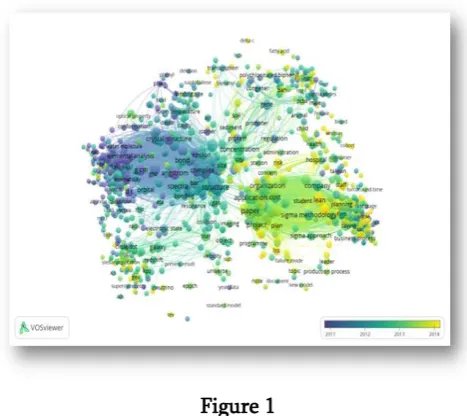
Publication tram State us of Six Sigma over all on Web of Science database the collected data is analyzed in Following Chat
Figure 1
In Web of Science during the period during 2007 to 2018. The result indicates that there were total 4027 (3 March 2018) documents on “Six Sigma” in Web of Science during the period.
VIII.
CHRONOLOGICAL ANALYSIS
Year wise productivity means the publication of Author counted chronologically to see most productive year in a particular year.
Figure 2. Chronological
IX.
RESEARCH AREAS WISE ANALYSIS
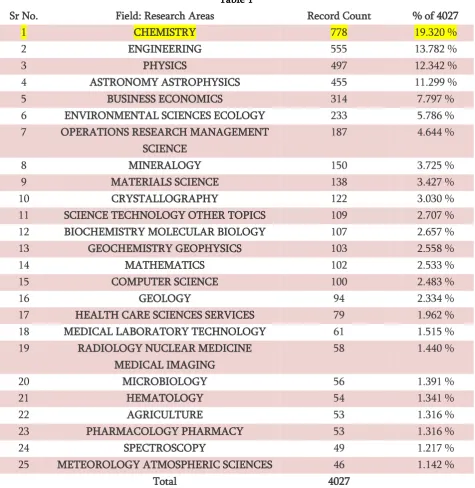
The author has analyses the compiled data by 25 different types of subjects and presented it in the Table 1
Table 1
Sr No. Field: Research Areas Record Count % of 4027
1 CHEMISTRY 778 19.320 %
2 ENGINEERING 555 13.782 %
3 PHYSICS 497 12.342 %
4 ASTRONOMY ASTROPHYSICS 455 11.299 %
5 BUSINESS ECONOMICS 314 7.797 %
6 ENVIRONMENTAL SCIENCES ECOLOGY 233 5.786 %
7 OPERATIONS RESEARCH MANAGEMENT
SCIENCE
187 4.644 %
8 MINERALOGY 150 3.725 %
9 MATERIALS SCIENCE 138 3.427 %
10 CRYSTALLOGRAPHY 122 3.030 %
11 SCIENCE TECHNOLOGY OTHER TOPICS 109 2.707 %
12 BIOCHEMISTRY MOLECULAR BIOLOGY 107 2.657 %
13 GEOCHEMISTRY GEOPHYSICS 103 2.558 %
14 MATHEMATICS 102 2.533 %
15 COMPUTER SCIENCE 100 2.483 %
16 GEOLOGY 94 2.334 %
17 HEALTH CARE SCIENCES SERVICES 79 1.962 %
18 MEDICAL LABORATORY TECHNOLOGY 61 1.515 %
19 RADIOLOGY NUCLEAR MEDICINE
MEDICAL IMAGING
58 1.440 %
20 MICROBIOLOGY 56 1.391 %
21 HEMATOLOGY 54 1.341 %
22 AGRICULTURE 53 1.316 %
23 PHARMACOLOGY PHARMACY 53 1.316 %
24 SPECTROSCOPY 49 1.217 %
25 METEOROLOGY ATMOSPHERIC SCIENCES 46 1.142 %
Total 4027
The details of the Research area wise analysis of the articles are shown in the Table No.1 the tram Six Sigma constituted the highest number of articles use in Chemistry 778 (19.32%). The lowest constituted use in Meteorology Atmospheric Sciences Research Area 46 (1.142%) number of articles.
X.
RANKING OF CONTRIBUTORS OF
AUTHORS
Figure 3. Top Four Authors
It was observed above authors rank table fist Top Four Antony, J. fist rank in web of Science database for 45 data Six Sigma terms. Second rank authorship Wang L he was published 19 data & third ranks on Liu B., Hawthorne FC, Demartin F,. he was published 17 data
XI.
GEOGRAPHICAL DISTRIBUTION OF
CONTRIBUTORS OF ARTICLES
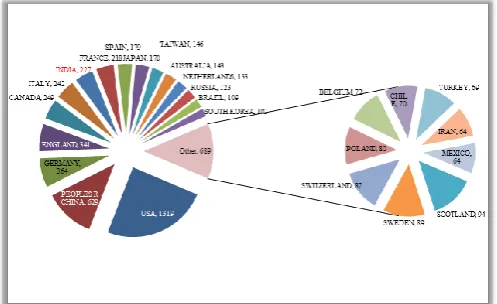
Geographical distribution of contributors of articles is shown in Figure 4
Figure 4. Geographical Distribution of contributors of articles
From the figure it is found that there are a total of 4027 contributors from the analysis it has been observed that the highest numbers of contributors are from United States with 1319 articles and the percentage is (32.75%) as well as the India number is of 227 ( 5.63%) article.
XII.
TOTAL PUBLICATION OUTLET
Publication outlet means a form in which the articles, Abstract and books are published. Publication outlet by College Librarian to publish the total 4027 publications which is presented in Table 2
Table 2
Document Types Record Count % of 4027
ARTICLE 3684 91.482 %
MEETING ABSTRACT 150 3.725 %
REVIEW 128 3.179 %
PROCEEDINGS PAPER 98 2.434 %
EDITORIAL MATERIAL
43 1.068 %
LETTER 11 0.273 %
BOOK REVIEW 9 0.223 %
Total 4027 100 %
It can be observed from table 2 Revels that out of the total publications the highest percentage i. e. 3684 (91.482%) of publications were articles; followed by 150 (3.72 %) Publications were published in Meeting Abstract from. While, 128 (3.725%) Publication was published in Review writing. 98 (2.434%) publication were published in Proceedings Paper.
XIII.
LANGUAGES OUTLET
Publication Language outlet means a form in which the articles Publication different Languages outlet by Authors to publish the total 4027 publications which is presented in Table 3
Table 3
Languages Record Count % of 4027
ENGLISH 3940 97.840 %
CHINESE 38 0.944 %
SPANISH 16 0.397 %
PORTUGUESE 9 0.223 %
GERMAN 8 0.199 %
CROATIAN 4 0.099 %
It can be observed from Table 3. that out of the 4027 publication, 3940 (97.840%) publications were in English Language. While 38 (0.944%) publications were in Chinese. Six sigma tram gives the first preference to the English Language.
XIV.
SOURCE TITLES OF ARTICLES
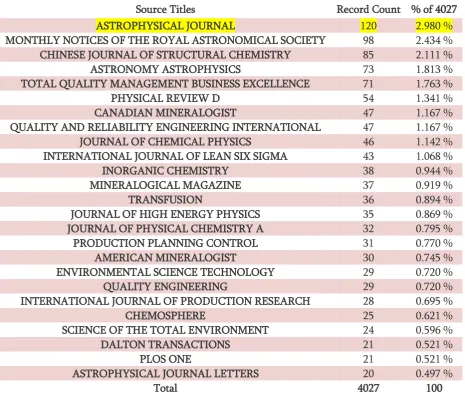
Affiliation trends distribution of articles is shown in table 4
Table 4. Source Titles
Source Titles Record Count % of 4027
ASTROPHYSICAL JOURNAL 120 2.980 %
MONTHLY NOTICES OF THE ROYAL ASTRONOMICAL SOCIETY 98 2.434 %
CHINESE JOURNAL OF STRUCTURAL CHEMISTRY 85 2.111 %
ASTRONOMY ASTROPHYSICS 73 1.813 %
TOTAL QUALITY MANAGEMENT BUSINESS EXCELLENCE 71 1.763 %
PHYSICAL REVIEW D 54 1.341 %
CANADIAN MINERALOGIST 47 1.167 %
QUALITY AND RELIABILITY ENGINEERING INTERNATIONAL 47 1.167 %
JOURNAL OF CHEMICAL PHYSICS 46 1.142 %
INTERNATIONAL JOURNAL OF LEAN SIX SIGMA 43 1.068 %
INORGANIC CHEMISTRY 38 0.944 %
MINERALOGICAL MAGAZINE 37 0.919 %
TRANSFUSION 36 0.894 %
JOURNAL OF HIGH ENERGY PHYSICS 35 0.869 %
JOURNAL OF PHYSICAL CHEMISTRY A 32 0.795 %
PRODUCTION PLANNING CONTROL 31 0.770 %
AMERICAN MINERALOGIST 30 0.745 %
ENVIRONMENTAL SCIENCE TECHNOLOGY 29 0.720 %
QUALITY ENGINEERING 29 0.720 %
INTERNATIONAL JOURNAL OF PRODUCTION RESEARCH 28 0.695 %
CHEMOSPHERE 25 0.621 %
SCIENCE OF THE TOTAL ENVIRONMENT 24 0.596 %
DALTON TRANSACTIONS 21 0.521 %
PLOS ONE 21 0.521 %
ASTROPHYSICAL JOURNAL LETTERS 20 0.497 %
Total 4027 100
The details of the Source Titles wise analysis of the articles are shown in the Table No.5 the title of Astrophysical Journal constituted the highest number of articles 120. The Monthly Notices of the Royal constituted 98 numbers of Title.
XV.
CONCLUSION
During 2007 to 2018. The result indicates that there were total 4027 documents on “Six Sigma” in web of Science during the period. The most
productive year was 2016 as total productivity in this year was 426 articles.
The highest number of articles use in CHEMISTRY 778 (19.320%) subject.
Contributors are from India with 227 articles and the percentage is (5.637 %)
An Epilogue
period. The contribution of documents on Six Sigma indicates that healthy pattern of progress in this field.
XVI.
REFERENCES
[1]. Deshmukh Rahul K., Taksande Pratibha G.,(2015), DrB.A.M.USalgnit Mahavidhylayin Granthpalanche Sahitya Nirmiti (Marathi), International Multilingual Research Journal Printing area, Issue-12,Vol-01,Dec.2015
[2]. Deshmukh Rahul K., Taksande Pratibha G.,(2015), Mahavidhyalyin Granthpalncha samajik Darja (Marathi), Granthparivar, January 2015
[3]. Deshmukh Rahul K., Taksande Pratibha G., A Study of college Librarian Contribution in his Publication(Marathi Language Article), The Rubrics Journal of Interdisciplinary Studies, August 2015,1,(3), 121-127
[4]. Deshmukh Rahul K., Veer D.K, (2014), Mahavidhyalayin Granthpalanche Prakashnathil Yogdan (Marathi), Conference: Institute of English Language, Literature & Research, Jalgaon
[5]. Deshmukh Rahul K., Pratibha Gautam Taksande (2018) Impact of Correlation on Research Productivity, IJSRCSEIT, Volume 3, Issue 1, January-February.
[6]. Khiste G.P., Deshmukh R.K& Kale V.A(2017) Mapping of Literature on Bibliometric by J-Gate Database, In Re-Envisaging Knowledge Resource Centers: Roles and Responsibilities, New Delhi: Ess Ess Pub, 391-402
[7]. Khiste Gajanan., Maske D.B., Deshmukh Rahul K., (2018) Big Data Output in J-gate during 2013 to 2017: A Bibliometrics Analysis, IJSRCSEIT, Volume 3, Issue 1, January-February
[8]. Khiste G.P., Maske D.B.& Deshmukh R.K(2018) Knowledge Management Output in Scopus during 2007 to 2016, Asian Journal of Research in Social Sciences and Humanities,8(1),10-19.
[9]. Kale Vilas A., Deshmukh Rahul K& Khiste Gajanan P(2017) A Bibliometric Survey of the Literature Published by Web of Science on 'Consortia' From 1989 - 2016New Man International Journal of Multidisciplinary Studies, 4(10), 75 - 82
[10]. Maske Dnyaneshwar B, Deshmukh Rahul K & Khiste Gajanan P.(2018) Mapping of Publication Productivity of 'Information Literacy' in J-Gate Database, Knowledge Librarian, Special Issue, 480-486