A Survey on Web Structure and Web Usage
Mining Algorithms for Web Applications
R. Suganya
Department of Computer Applications Bon Secours College for Women Thanjavur, India
Abstract
In this paper I have taken the problem called web applications which are in relay to work with two web mining algorithms they are web usage and web structure mining. Using these mining algorithms a survey is made in regards to web applications in accord of which algorithm is more liable to web applications according to the survey. With the rapid increase in internet technology, users get easily confused in large hypertext structure. The primary goal of the web site owner is to provide the relevant information to the users to fulfill their needs. Web mining technique is used to categorize users and pages by analyzing users behavior, the content of pages and order of URLs accessed. Web Structure Mining plays an important role in this approach. In this paper we discuss and compare the commonly used algorithms i.e. PageRank, Weighted PageRank, Weighted Page Content Rank and HITS.
Keywords: Web Mining, Web Content, Page Rank, Weighted Page Rank and Weighted Page Content Rank, HITS, Web Usage and Web Structure
________________________________________________________________________________________________________
I. INTRODUCTION
The World Wide Web is a rich source of information and continues to expand in size and complexity. Whenever a user wants to search the relevant pages, he/she prefers those relevant pages to be at hand. Relevant web page is one that provides the same topic as the original page but it is not semantically identical to original page. Retrieving of the required web page on the web, efficiently and effectively[1]. As the Web is unstructured data repository, which delivers the bulk amount of information and also increases the complexity of dealing information from different perspective of knowledge seekers, business analysts and web service providers. According to Google report on 25th July 2008 there are 1 trillion unique URLs on the web. Web has grown tremendously and the usage of web is unimaginable so it is important to understand the data structure of web. The bulk amount of information becomes very difficult for the users to find, extract, filter or evaluate the relevant information. This issue raises the necessity of some technique that can solve these challenges. Web mining can be easily executed with the help of other areas like Database (DB), Information retrieval (IR), Natural Language Processing (NLP), and Machine Learning etc. These can be used to discuss and analyze the useful information from WWW.
Following are some challenges [2]
Web is huge.
Web pages are semi structured.
Web information stands to be diversity in meaning.
Degree of quality of the information extracted.
Conclusion of knowledge from information extracted.
II. WEB MINING
Web mining is the Data Mining technique that automatically discovers or extracts the information from web documents [3]. It is the extraction of interesting and potentially useful patterns and implicit information from artifacts or activity related to the World Wide Web.
Web Mining Process
The complete process of extracting knowledge from Web data is follows in Fig.1:
Fig. 1: Web Mining Process
Resource finding: It is the task of retrieving intended web documents.
Information selection and pre-processing: Automatically selecting and pre- processing specific from information retrieved Web resources.
Generalization: Automatically discovers general patterns at individual Web site as well as multiple sites.
Analysis: Validation and interpretation of the mined patterns.
Web Mining Categories
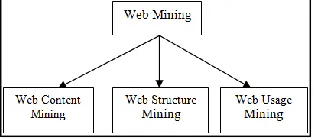
Web mining research overlaps substantially with other areas, including data mining, text mining, information retrieval, and Web retrieval. The classification is based on two aspects: the purpose and the data sources. Retrieval research focuses on retrieving relevant, existing data or documents from a large database or document repository, while mining research focuses on discovering new information or knowledge in the data. On the basis of this, Web mining can be classified into web structure mining, web content mining, and web usage mining as shown in Fig. 2.
Fig. 2: Web Mining Categories
Web Content Mining
Web Content Mining [2,3] is the process of extracting useful information from the contents of Web documents. Content data corresponds to the collection of facts a Web page was designed to convey to the users. Web content mining is related but is different from data mining and text mining. It is related to data mining. It is related to text mining because much of web contents are text based. It is different from data mining because web data are mainly semi-structured and or unstructured. Web content mining is also different from text mining because of the semi-structure nature of the web, while text mining focuses on unstructured texts. The technologies that are normally used in web content mining are NLP (Natural language processing) and IR (Information retrieval).
Web Structure Mining
It is the process by which we discover the model of link structure of the web pages. The goal of Web Structure Mining [1,3] is to generate structured summary about the website and web page. It tries to discover the link structure of hyper links at inter document level. The other kind of the web structure mining is mining the document structure. It is using the tree-like structure to analyze and describe the HTML (Hyper Text Markup Language) or XML (Extensible Markup Language).
Web Usage Mining
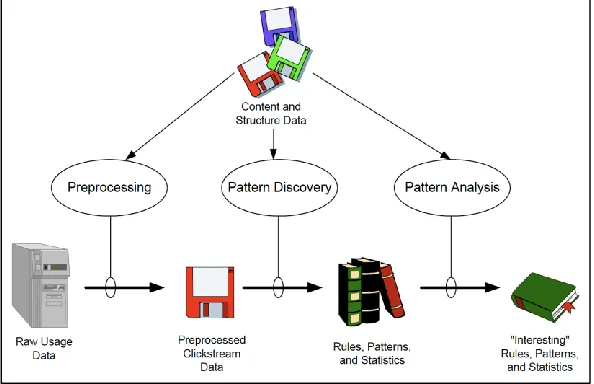
Web Usage Mining [1,3]is the process by which we identify the browsing patterns by analysing the navigational behavior of user [1,3]. It focuses on techniques that can be used to predict the user behaviour while the user interacts with the web. It uses the secondary data on the web. This activity involves the automatic discovery of user access patterns from one or more web servers. Through this mining technique we can ascertain what users are looking for on Internet. It consists of three phases, namely preprocessing, pattern discovery, and pattern analysis. Web servers, proxies, and client applications can quite easily capture data about Web usage.
III. LINK ANALYSIS ALGORITHMS
Web mining technique provides the additional information through hyperlinks where different documents are connected. We can view the web as a directed labeled graph whose nodes are the documents or pages and edges are the hyperlinks between them. This directed graph structure is known as web graph. There are number of algorithms proposed based on link analysis.
Four important algorithms Page Rank, Weighted Page Rank, HITS and Weighted Page Content Rank. Here for web applications any of these four algorithms are needed to make a structured form of web applications. To make the end user feel easy when they work with web applications.
IV. LITERATURE SURVEY
Web Structure Mining
these efforts had resulted in a newly emerging research area called Link Mining [8], which is located at the intersection of the work in link analysis, hypertext and web mining, relational learning and inductive logic programming, and graph mining. There is a potentially wide range of application areas for this new area of research, including Internet.
The Web contains a variety of objects with almost no unifying structure, with differences in the authoring style and content much greater than in traditional collections of text documents. The objects in the WWW are web pages, and links Web mining Web content mining Web Structure mining Web usage mining Text and multimedia documents Hyperlink structure Web log records 591 are in-, out- and co-citation (two pages that are both linked to by the same page). Attributes include HTML tags, word appearances and anchor texts. This diversity of objects creates new problems and challenges, since is not possible to directly made use of existing techniques such as from database management or information retrieval. Link mining had produced some agitation on some of the traditional data mining tasks. As follows, we summarize some of these possible tasks of link mining which are applicable in Web structure mining.
Link-based Classification
Link-based classification is the most recent upgrade of a classic data mining task to linked domains. The task is to focus on the prediction of the category of a web page, based on words that occur on the page, links between pages, anchor text, html tags and other possible attributes found on the web page.
Link-based Cluster Analysis
The goal in cluster analysis is to find naturally occurring sub-classes. The data is segmented into groups, where similar objects are grouped together, and dissimilar objects are grouped into different groups. Different than the previous task, link-based cluster analysis is unsupervised and can be used to discover hidden patterns from data.
Link Type
There are a wide range of tasks concerning the prediction of the existence of links, such as predicting the type of link between two entities, or predicting the purpose of a link.
Link Strength
Links could be associated with weights. Link Cardinality
The main task here is to predict the number of links between objects. There are many ways to use the link structure of the Web to create notions of authority. The main goal in developing applications for link mining is to made good use of the understanding of these intrinsic social organization of the Web.
HITS Concept and Pagerank Method
In this section we review two approaches: HITS concept and PageRank method. Both approaches focus on the link structure of the Web to find the importance of the Web pages.
HITS: Computing Hubs and Authorities
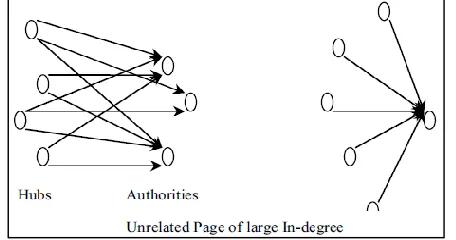
In HITS concept, Kleinberg [3] identifies two kinds of pages from the Web hyperlink structure: authorities (pages with good sources of content) and hubs (pages with good sources of links). For a given query, HITS will find authorities and hubs. According to Kleinberg [14], “Hubs and authorities exhibit what could be called a mutually reinforcing relationship: a good hub is a page that points to many good authorities; a good authority is a page that is pointed to by many good hubs”.
See Fig. 3.HITS associates a non-negative authority weight x <p> and a non-negative hub weight y <p>.See Fig. 4. The weights of each type are normalized so that their squares sum to 1.
Fig. 3: A densely linked set of Hubs and Authorities Fig. 4: A basic operation of HITS
Page Rank Model
L. Page and S. Brin [6,7] proposed the Page Rank algorithm to calculates the importance of web pages using the link structure of the web. In their approach Brin and Page extends the idea of simply counting in-links equally, by normalizing by the number of links on a page.
The parameter d is a damping factor, which can be set between 0 and 1. We usually set d to 0.85. There are more details about d in the next section. Also C (A) is defined as the number of links going out of page A. The Page Rank of a page A is given as follows:
PR (A) = (1-d) + d (PR (T1)/C (T1) + ... + PR (Tn)/C (Tn)) (1)
Note that the Page Ranks form a probability distribution over web pages, so the sum of all web pages’ Page Ranks will be one.” And “The d damping factor is the probability at each page the “random surfer” will get bored and request another random page.”
Note that the rank of a page is divided evenly among its out-links to contribute to the ranks of the pages they point to the equation is recursive, but starting with any set of ranks and iterating the computation until it converges may compute it. Page Rank can be calculated using a simple iterative algorithm, and corresponds to the principal eigen vector of the normalized link matrix of the web. Page Rank algorithm needs a few hours to calculate the rank of millions of pages [5].
Applications
HITS was used for the first time in the Clever [7] search engine from IBM, and PageRank is used by Google [18] combined with other several features such as anchor text, IR measures, and proximity. The notion of authoritativeness comes from the idea that we wish not only to locate a set of relevant pages, but rather the relevant pages of the highest quality. However, the Web consists not only of pages but also of links that connect one page to another. This structure contains a large amount of information that should be exploited.
PageRank and HITS belong to a class of ranking algorithms, where the scores can be computed as a fixed point of a linear equation. Bianchini [6] noted that HITS and PageRank are used as starting points for new solutions, and there are some extensions of theses two approaches. There are other link-based approaches to be applied on the Web. For further information please refer to [3; 5; 9].
Beside being used for weighting Web pages, link resource can also be used for clustering or classifying Web pages. The principle is based on the assumption that (1) if page p1 has a link to page p2, p1 should be similar to p2 in content, and (2) if p1 and p2 are co-cited by some common pages, p1 and p2 should also similar. Web pages can be clustered into a lot of connected page communities with respect to their citation and co-citation strengths among the pages. In fact, Ziv Bar-Yossef and Sridhar Rajagopalan put all the algorithms, which uses links, to three categories.
Relevant Linkage Principle: Links points to relevant resources.
Topical Unity Principle: Documents often co-cited are related, as are those with extensive bibliographic overlap. This idea is previous addressed by Kesseler for bibliographic information retrieval in [7].
Lexical Affinity Principle: Proximity of text and links within a page is a measure of the relevance of one to another. Even though those link algorithms can always provide a good support for Web information retrievals, clustering and knowledge discoveries on the Web, authors also find problems associated with those technologies [5].
Taher H. Haveliwala notices that original PangeRank algorithm, introduced by Page et al. [7], pre-compute ranking vector based on all the Web pages. This ranking vector is computed once and used for any queries later. The ranking is actually independent of the specific queries when using it. The authors tried to solve this limitation by computing a set of PageRank vectors, each biased with a different topic. In other words, for each topic, they assigned a weight for each page. Therefore , searches in different topics could select corresponding vectors for ranking. Ziv Bar-Yossef and Srihar Rajagopalan [9], Deng Cai et al. [10], and Shian-Hua Lin et al. [2,3] addressed problems caused by topic drift of Web pages. In other words, it is easy to find a Web page with multiple topics. In such cases, two links from the same Web page may lead to different semantics if they are anchored in the areas of different topics. Or maybe some links only links to some advertisements. One effective solution for topic drift problems is page segmentation.
Web Usage Mining Frameworks
With about 30 million new web pages posted every day, the WWW is the largest, most used, and most important knowledge source and the most perspective marketplace. In order to successfully retain users in this rapidly developing environment, a web site must be built in such a way that supports user personalization. To achieve this, an organization can keep track of user activities while browsing their web sites. Although there are many tools that help analyze this data using some of the web statistics methods, they provide sufficient information only for the web site administrator (e.g. discovering part of a day with the most traffic, most frequently visited pages, etc.) and not for the designer. One of the ways to overcome this shortcoming is by applying data mining techniques on the Web.
This process is referred to as web mining. There are three constituents of web mining: content mining, usage mining and structure mining. As most web servers keep logs, the most common data sources are Web access logs (click stream data). Since web usage mining is a relatively new area of data mining, many authors (and software companies) have developed frameworks for it. Today there is a multitude of tools that support web usage mining based on various frameworks. The difference between frameworks ranges from slight to completely different philosophy.
way is then presented to some of the pattern discovery methods. The way this method can be used for web personalization is described in Cooley et al. (1999).
In another model, proposed by Zaini, web access logs are inserted into a multidimensional cube and then analyzed using OLAP and data mining techniques. In this approach we analyze data stored in fact and dimension tables (star schema). There are three kinds of fact tables: click table that stores data about each log entry, session facts (a user session is a set of pages visited by the user in one visit to a web page) and a subsession (sequence of clicks in a session). Combining two approaches, Jespersen, Thorhauge, & Pedersen (2002) developed a hybrid approach to web usage mining, which combines the compact HPG (Hyper Probability Grammar) approach with the explicit OLAP approach. In this model, data is stored into a database through the XML and Quilt Query. The constraints for the analysis are built on the top of this database and data together with the constraints are used for modeling Hypertext Probabilistic Grammars, which are then mined using Breadth First Search (BFS) based algorithm for mining association rules.
Web Usage Mining Process
We can identify three basic steps that the web usage mining process must follow. These steps are data preprocessing, pattern discovery and pattern analysis.
To successfully complete an analysis of a web site, we must obtain data suitable for data mining at the beginning of a process. Most of the authors in their papers agree that data preprocessing step is the most time-consuming step in web usage analysis projects (from 60 to 90 % of the time necessary for the completion of an entire project). The task of data preprocessing is t o prepare the data for the application of some data mining algorithm.
After data has been preprocessed, it is ready for the application of knowledge extraction algorithms. When exposed to these algorithms, data in web access logs can be transformed into knowledge, most commonly, about association rules, sequential patterns and user clusters. The last phase in WUM process is the analysis of the obtained results in order to distinguish trivial, useless knowledge from knowledge that could be used for Web site modifications, system improvement and/or Web personalization.
Fig. 5: simplified view of web usage mining
Data Preparation
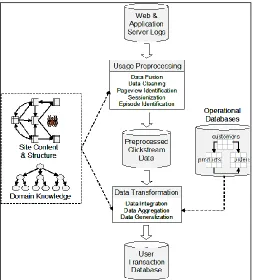
There are a number of sources for web usage mining, such as web access logs, cookies, data tags,login information, client or server side scripts, packet sniffing, etc. Each of these so-called e-sources has its advantages and disadvantages, but web access logs are the main sources for web usage mining. They are recorded in standard formats, usually the CLF – Common Log Format and ECLF – Extended Common Log Format by leading Web Server (Apache, IIS, Netscape). The structure of these log formats is defined by W3C. The CLF has the following 7 elements (shown in Table 1):
The Role of Web Usage Mining in Web Applications Evaluation Management Information Systems
remotehost - domain name or IP address
rfc931 - the remote logname of the user
Authuser - user identification used in a successful SSL request
[date] - the date and time of a request (e.g. day, month, year, hour, minute, second, zone)
"request" - the request line exactly as it came from the client
status - three-digit HTTP status code returned to the client (such as 404 for Page not found, or 200 for Request fulfilled)
bytes - number of bytes returned to the client browser for the requested object ECFL has two additional elements:
referrer - URL of the referring server and the requested file from a site
Fig. 6: simplified view of data preparations
In this data preparation we use to follow patterns. These patterns are aligned using the algorithms called HITS and weighted page content rank. How it is been connected is only by the content of the page is been patterned and how many counts of HITS is given to the data preparation is been calculated.
Weighted Page Content Rank
Weighted Page Content Rank Algorithm (WPCR) is a proposed page ranking algorithm which is used to give a sorted order to the web pages returned by a search engine in response to a user query. WPCR is a numerical value based on which the web pages are given an order. This algorithm employs web structure mining as well as web content mining techniques. Web structure mining is used to calculate the importance of the page and web content mining is used to find how much relevant a page is? Importance here means the popularity of the page i.e. how many pages are pointing to or are referred by this particular page. It can be calculated based on the number of inlinks and outlinks of the page. Relevancy means matching of the page with the fired query. If a page is maximally matched to the query, that becomes more relevant.
Algorithm: WPCR calculator
Input: Page P, Inlink and Outlink Weights of all backlinks of P, Query Q, d (damping factor).
Output: Rank score
1) Step 1: Relevance calculation:
Find all meaningful word strings of Q (say N)
Find whether the N strings are occurring in P or not?
Z= Sum of frequencies of all N strings.
S= Set of the maximum possible strings occurring in P.
X= Sum of frequencies of strings in S.
Content Weight (CW)= X/Z
C= No. of query terms in P
D= No. of all query terms of Q while ignoring stop words.
Probability Weight (PW) = C/D 2) Step 2: Rank calculation:
Find all backlinks of P (say set B).
PR(P)=(1-d)+d
Output PR(P) i.e. the Rank score.
HITS (Hyper-Link Induced Topic Search)
and a good authority page is a page which is pointed by many good hub pages on the same content. A page may be a good hub and a good authority at the same time.
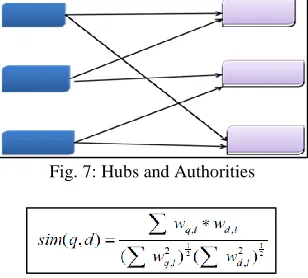
The HITS algorithm treats WWW as directed graph G(V,E), where V is a set of vertices representing pages and E is set of edges corresponds to link. Figure 7 shows the hubs and authorities in web.
Fig. 7: Hubs and Authorities
It has two steps:
Sampling Step: In this step a set of relevant pages for the given query are collected.
Iterative Step: In this step Hubs and Authorities are found using the output of sampling step. Following expressions are used to calculate the weight of Hub (Hp) and the weight of Authority (Ap).
Hp = ∑ Aq … (5) q €I ( p)
Ap = ∑ Hq … (6) q €B( p)
Here Hq is Hub Score of a page, Aq is authority score of a page, I(p) is set of reference pages of page p and B(p) is set of referrer pages of page p, the authority weight of a page is proportional to the sum of hub weights of pages that link to it. Similarly a hub of a page is proportional to the sum of authority weights of pages that it links to.
V. CONCLUSION
After taking a survey on web structure mining & web usage mining the main algorithm is found out to follow for the further development of web applications that is HITS algorithm. This paper described several purposed web structure mining algorithms like Pagerank algorithm, weighted content Pagerank algorithm (WCPR), HITS etc. We analyzed their strengths and limitations and provide comparison among them. So we can say that this paper may be used as a reference by researchers when deciding which algorithm is suitable. We also try to overcome from the problem that particular algorithms have. This paper gives an insight into the possibility of merging data mining techniques with Web application analysis for achieving a synergetic effect of Web usage mining and its utilization in Web Applications Evaluation. The paper firstly describes the data preprocessing and pattern discovery steps, as pages based upon visits using weighted page content ranking and HITS. User clustering tries to discover groups of users having similar browsing patterns. Such knowledge is especially useful in Ecommerce applications for inferring user demographics in order to perform market segmentation while in the evaluation of Web site quality and developing web applications this knowledge is valuable for providing personalized Web content to the users. For the further research of web applications HITS will be the best.
REFERENCES
[1] Rekha Jain, Dr G.N.Purohit, “Page Ranking Algorithms for Web Mining,” International Journal of Computer application,Vol 13, Jan 2011.
[2] Pooja Sharma, Pawan Bhadana, “Weighted Page Content Rank For Ordering Web Search Result”, International Journal of Engineering Science and Technology, Vol 2, 2010.
[3] R. Kosala, H. Blockeel “Web mining research” A survey. ACM Sigkdd Explorations,2(1):1-15, 2000.
[4] Agrawal, R., & Srikant, R. (1994). Fast Algorithms for Mining Association Rules. Proceedings of the 20th LDB Conference (pp. 487-499). Santiago: Morgan Kaufmann.
[5] Borges, J., & Levene, M. (1999). Data mining of user navigation patterns. Retrieved April 21, 2009, from Computer Science and Information Systems Birkbeck University of London: http://www.dcs.bbk.ac.uk/~mark/download/web_mining.pdf
[6] Chelcea, S., DaSilva, A., Lechevallier, Y., Tanasa, D., & Trousse, B. (2005,November 30). Benefits of InterSite Pre-Processing and Clustering Methods in E-Commerce Domain. Retrieved April 21, 2009, from HAL :: Accueil: http://hal.archives-ouvertes.fr/docs/00/04/97/92/PDF/2005- DiscoveryChallenge_ChelceaEtAll.pdf
[7] Cooley, R., Mobasher, B., & Srivastava, J. (1999). Data preparation for mining world wide web browsing patterns. Journal of Knowledge andInformationSystems , 1 (1), 5-32.
[8] Q. Lu and L. Getoor. Link-based classification. In Proceedings of ICML-03, 2003.
[9] L. Page, S. Brin, R. Motwani, and T. Winograd. The pagerank citation ranking: Bringing order to the web. Technical report Stanford Digital Libraries SIDL-WP-1999-0120, 1999.