A Study on Student Self-efficacy and Technology
Acceptance Model within an Online Task-based
Learning Environment
Yu-Li Chen
Lunghwa University of Science and Technology, Department of Applied Foreign Language, Taoyuan, Taiwan, ROC Email: [email protected]
Abstract—Higher education institutions are continuously seeking new and functional technologies to enhance productivity and to effectively reconstruct the curriculums in order to meet the needs and expectations of diverse students. Among them, creating a virtual environment for students to conduct e-Learning is a growing tendency. With recent emphasis on developing English for Occupational Purposes (EOP) competencies of students in mind, this study is focused on combining both technology and curriculum design to achieve this goal. A virtual reality (VR) learning environment is created to enhance student learning experience. A total of 154 English major students participated in the study. A survey was administered to collect the students’ perception towards the courseware after 3 months of usage. Results suggest that students are indeed affected by their self-efficacy and technological acceptance. Further implications are also provided for future studies.
Index Terms—virtual reality, experiential learning scenario, technology acceptance model, self-efficacy in online learning environment, English for Specific Purposes
I. INTRODUCTION
Globalization and computer technology have increasingly transformed higher education institutions all over the world [1, 2]. In addition, there is growing diversity in the student populations in many universities around the globe [3]. Hence, higher education institutions are continuously seeking new and functional technologies to enhance productivity, to strategically manage development, and to effectively reconstruct curriculums in order to meet the needs and expectations of diverse students and to engage students in learning [4]. Among them, creating virtual environments for students to conduct e-Learning is a growing tendency [5] as contemporary students are recognized as the ‘Net Generation’ [6, 7] or ‘Digital Natives’ [8-10], and many university students use social networking, such as Twitter and Facebook, to communicate [11-14]. As the educational potential of virtual worlds is gradually being recognized [15-17]; educators in various fields can consider the pedagogical opportunities of immersive learning spaces for student learning.
The value of a virtual learning environment is threefold: a) realization and feasibility of distance and remote learning [18]; b) facilitation of sharing of information and knowledge; c) enhancement of learning by doing [19]. Virtual worlds provide an online immersive learning environment where students can participate, explore, interact and have fun, and hence construct their own knowledge [20]. They allow real time and synchronous communication, active learning, experiential learning, and cooperative/collaborative learning [21]. In essence, such learning environments are learner-centered and contextualized compared to the traditional bricks and mortars where students learn passively in a decontextualized environment [22].
As with the recent emphasis on the importance of English as a Foreign Language (EFL) learners’ EOP development, English language practitioners have been pressured to adapt to the needs of the learners within their specific environment. For English is also being regarded as the de-facto language not only in the business sector, but also in engineering and sciences. In its role as a global language, English has already become one of the most important academic and professional tools [23]. Therefore, it is quite important to find effective ways in integrating current educational technology with teaching English.
Besides these issues, it is also said that a person’s self-efficacy and technological acceptance are also related to their online learning performances. Hence, this case study shall focus on evaluating the effectiveness of a virtual reality courseware in learning occupational English through the student self-efficacy and technological acceptance within an online learning environment.
II. LITERATURE REVIEWS
A. Self-efficacy and Virtual Reality Learning
remarkable differences, the latter group reported higher computer self-efficacy and a greater sense of satisfaction with their learning process. The sense of control over the learning process (learner control) influences a learner’s sense of self-efficacy [25] in which people with a higher self-efficacy are more willing to tackle a difficult task rather than avoid it.
Self-efficacy can be defined as the belief of one’s capability to successfully act in a way to achieve a certain goal [26, 27]. In addition, self-efficacy level influences the amount of effort exerted and the persistence in performing certain actions, the emotional responses of the person attempting the behavior, and the actual action of the person [27, 28]. In contrast to the idea of being individualistic, a person with high self-efficacy is cooperative, helpful and willing to share in social situations [29]. The theory of self-efficacy includes performance accomplishments, vicarious experience, social persuasion, and physiological and emotional states [30].
The sense of technological self-efficacy, including computers, affects the learner’s decision to use computers and is not dependent on their beliefs on the value of using that technology [31]. One type of self-efficacy is computer self-efficacy. It is “an individual’s belief in his or her ability to use a computer effectively” [32]. A measuring scale was developed by Compeau and Higgins [28] and used in many studies. Some discovered that those who are more confident about their computer skills are motivated more to learn, and having more experience would lead to higher self-efficacy.
Teaching through a virtual learning environment can influence self-efficacy in learners through adjusting various factors to reach “the perception of task difficulty, motivation, and locus of control” [33]. In addition, learning though experience in a VLE would help increase self-efficacy in real life. Meanwhile, students who showed an active interest in taking VLE courses have higher self-efficacy in technology and course content than those who chose the course based on availability [34]. B. Virtual Reality Courseware and Language Learning
The educational advantages and potentials of virtual world learning environments (VWLEs) are revealed in various studies. Ward [35] designed activities in a virtual world Second Life (SL) with the aim to introduce the concept of avatar-based marketing and for students to evaluate the potential of SL as a marketing communication tool. Students enjoyed the new approach to learning and felt it aided their understanding. Wang and Braman [36] proposed that the immersive nature of a virtual environment can provide students with a sense of real world experience, and it also allows students to actively explore and understand the content instead of just listening to lectures or watching videos. Kalyuga [37] found that virtual worlds (VWs) are highly interactive in that learners can experiment, explore, select personalized tasks and receive dynamic feedback. Darbey [38] explored the potential of a VW to support guidance counselors’ preparation for a Teacher Professional Development (TPD) program. The results of the study
demonstrated that VWs have huge potential for providing TPD and can support an action research approach .
In addition, virtual worlds allow real time and synchronous communication, active learning, experiential learning, and cooperative/collaborative learning in an online immersive learning environment [21, 39]. Jones [40] pointed out the educational advantages of VWLEs, such as engaged immersion, situated learning, multi-modal communications, breakdown of socio-cultural barriers, bridging the digital divide, problem solving, and the ability to create empathy and understanding for complex systems [41]. Other benefits of VWLEs entail the capabilities to provide opportunities for social interaction and forming communities, to create a sense of shared presence, to reduce anxiety in learning, to enhance learner motivation and engagement, and to accommodate learning styles of digital residents [42-44]. Furthermore, VWLEs can provide experiences, which may not be available in real life situations, such as creating objects, simulations, field trips, experiential learning tasks and re-enactments [39, 45-47].
C. Task-based Language Learning
Task-based language learning approach is generated because of the assumption that errors occur during the natural process of learning, gradually moving from interlanguage forms toward target language forms. This is in contrast with the traditional PPP (presentation, practice, production) model of language learning in that errors are the results of poor learning, and learners can achieve fluent and accurate performance of language structure through controlled practice. Accordingly, task-based learning (TBL) provides students with tasks to interact with, instead of practicing a linguistic item. Within TBL approach, it provides an environment for students to engage in meaningful activities such as problem-solving, group work and discussion, or narratives, which best promote the natural language learning process. During the learning process, transfer of meaning is successful by focusing on language intelligibility [48].
task has a clearly defined communicative outcome (p.16). In essence, the purpose of designing a task is for language learners to use the language for communication purpose, and negotiations of meaning can be elicited by the designed tasks.
Technology advancement has contributed to the creation of virtual language learning environments and thus adding a new dimension to real-world language learning and cultural experiences. Since the best way to learn a language is immersion in the language and culture, the simulated immersion of virtual reality environments arouse the interest of language professionals [53], who can design virtual world language learning tasks or activities, which allow learners to be immersed in language learning environment similar to real world situation.
D. Experiential Learning
Experiential learning theory originated in the experiential works of Dewey’s philosophical pragmatism, Lewin’s social psychology, and Piaget’s cognitive-developmental genetic epistemology [54]. Learning is defined as "the process whereby knowledge is created through the transformation of experience. Knowledge results from the combination of grasping and transforming experience" (p.81). Education is a process of continuous reconstruction and growth of experience, and the role of teachers is to provide learning activities built on their previous experiences. Therefore, a curriculum should be developed and structured to direct students to new experiences. When education for professions is limited and when simulations, demonstrations and experiences are not always available in real life, virtual environments offer experiential opportunities for students to learn and explore through practice [15].
Kolb’s [54] model of experiential learning indicates that individuals learn through experience, reflection, thought, and experimentation. The model consists of four forms of learning, namely: Concrete experience, Abstract conceptualization, Reflective observation, and Active experimentation. Learners learn best when they can cycle through all four stages of learning [55-57]. However, there is great variation in the learning process, and individuals rely on one form over another, even though they may acquire and transform information in all manners.
Through the interaction of minds and the complexity of outside environments, learners obtain different knowledge, including convergent knowledge, divergent knowledge, assimilative knowledge, or accommodative knowledge [55]. The justification for experiential learning can be based on the following arguments: a) it facilitates personal growth; b) it helps learners adapt to social change; c) it takes account of differences in learning ability; and d) it responds to learner needs and practical pedagogical considerations [58].
The experiential model of education is based on constructivism in that a teacher’s authority is not emphasized; instead, the teacher is a learner among learners. The role of the teacher is to facilitate learning.
Learners are no longer passive recipients of knowledge; they actively participate in cooperative group work and discussion. Yet, they identify problems themselves and construct their own knowledge. Their view of curriculum is dynamic and the organization of the subject matter is not hierarchical. Instead of focusing on content and product, the whole learning experience is process-oriented; learners continuously reflect during the process of learning. The control of the process is not mainly structured by the teacher; students take the initiative and direct their own learning. Overall, the constructivism’s view of learning is that knowledge is not transmitted by the teacher; instead, knowledge is constructed through inquiry, learning skills, reflection on process, self-assessment, and social and communications skills. The whole learning process is transformation of knowledge, and it is a student-centered approach where learning-by-doing is emphasized [58-60].
Despite the fact that relatively few research studies on the effectiveness of instruction using 3D virtual worlds exist, studies using similar technology, such as MOOs (MUD Object Oriented) and Multi-User Domains (MUDs), indicate that 3D virtual worlds may support the constructivist learning [61-64]. 3-D virtual worlds offer many opportunities for learning by doing. For example, learners can create objects and different settings. Virtual worlds allow social networking, and people can collaboratively create and edit objects in the world. In addition, the use of VWs has been shown to facilitate better reflection and learners’ exchange of stories, which can lead to better community building [65, 66] (see Figure 1).
Figure 1. 3D Virtual world
E. English for Specific Purposes
Strevens [69] described ESP as English language teaching designed to meet the needs of a specific group of learners. Dudley-Evans and St. John [70] defined ESP as “the wide area that all aspects of the specific-purpose teaching of English and encompasses the academic (EAP) and occupational (EOP) frameworks” [71]. Others depict ESP as the instruction of English for academic, occupational or professional purposes, which is in contrast to EGP, English for general knowledge and skills [71-73].
Dudley-Evans and St John [74] divided the characteristics of ESP into two categories as follows:
• Absolute characteristics: a) ESP is designed to meet the specific needs of the learner; b) ESP makes use of the underlying methodology and the activities of the discipline it serves; c) ESP is centered on the language (grammar, lexis, and register), skills, discourse and genres appropriate to these activities (pp. 4-5).
• Variable Characteristics: a) ESP may be related to or designed for specific disciplines; b) ESP may use, in specific teaching situations, a different methodology from that of General English.
They also state that “the main concerns of ESP have always been, and remain, with needs analysis, text analysis, and preparing learners to communicate effectively in the tasks prescribed by their study or work situation” (p.1).
IV. RESEARCH METHODOLOGY
This research project is designed as a case study, wherein the primary objective is to investigate the phenomenon within its real-life context, in this case the actual application of virtual reality courseware [75]. Furthermore, Merriam [76] views a case as an individual, a program, a class or students, a school, or a community. She fashions the distinctiveness of case studies as particularistic, because of the focus on one social unit; descriptive, because they result in a rich thick portrait; and heuristic, because case studies sharpen readers’ understanding while leading to new meanings. For the current presentation, the case selected is the analysis of the effects of student self-efficacy and technology acceptance in their virtual reality courseware usage. A. Participants of the Study
Table I shows the participants of the study. A total of 154 freshmen and sophomore students from the Department of Applied Foreign Languages at a Science and Technology University in Taiwan participated. 69 freshmen and 85 sophomore students with an overall average age of 19 years old, participated in the three- month long project. In addition, students’ initial English language competencies were tested prior to enrollment; hence, participants of the study were approximately the same level.
TABLE I.
PARTICIPANTS’DEMOGRAPHY (N=154) Age
Mean n SD
Year level
1 18.49 69 0.72 2 20.28 85 0.72 Total 19.48 154 1.14
B. Research Process
The study was accomplished during the 1st semester of
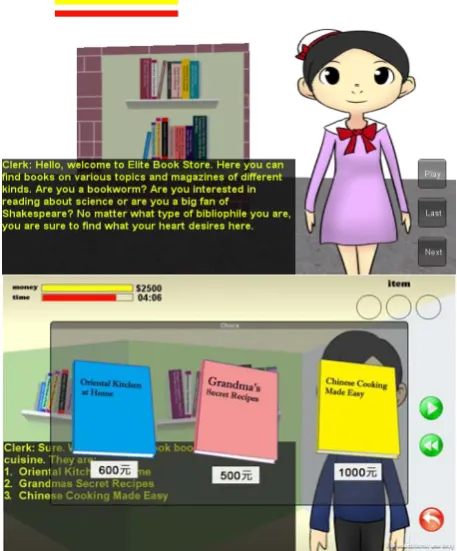
the 2012 and 2013 academic year. In the beginning, the students were first given an orientation regarding the project. The courseware was shown and navigation tools were explained and simulated. The courseware mainly focused on developing English as a Foreign Language (EFL) English competencies. The courseware was designed with 3 main themes involving certain tasks, such as: a) buying items for mom; b) looking for a mobile-phone for dad; and c) buying business attire for oneself (see Figures 2 and 3). After the three-month-long project and undergoing courseware thematic lessons, students were asked to complete a survey. Survey results were then tabulated and analyzed with the use of the Statistical Software Package for Social Science (SPSS) version 20. Implications were then organized and synthesized with the issues at hand.
Figure 2 - 3. Virtual learning courseware screenshots
C. Research Objectives
self-efficacy and technological acceptance in an online learning environment. More detailed objectives are as follows:
1. To describe student self-efficacy and
technological acceptance.
2. To provide the relationships among student self-efficacy and technological acceptance.
3. To provide a model based on the technological acceptance theory.
D. Research Tools
In order to determine student self-efficacy and perceived technological acceptance, a survey is used. Surveys are used to gather information at a particular point in time with the intention of describing the nature of existing conditions, or identifying standards against which existing conditions can be compared, or determining the relationships that exist between specific events [77]. Most surveys will combine nominal data on participant backgrounds and relevant personal details with other scales [78]. Surveys are often administered to a large number of respondents; hence, survey research is often coined as quantitative research, which has a high level of structure and a low level of researcher involvement with the study population [79].
The survey is separated into 3 parts, namely: student background information together with their TOEIC (Test of English for International Communication) scores, self-efficacy in an Internet-based learning environment (SIBLE), and the technology acceptance inventory (TAM). Self-efficacy is commonly known as the belief in one’s capability in achieving (or accomplishing) a goal [23]. Therefore, a student with a strong sense of self-efficacy is more likely to challenge themselves with difficult tasks and be intrinsically motivated.
The SIBLE is adapted from a combination of the online academic help seeking (OAHS) survey and the web-based learning self-efficacy (WLSE) survey. The concept of the OAHS is the notion that although the students with high self-efficacy are learning on their own, they need to know when to seek for help and clear up questions [80]. OAHS consists of 3 factors, namely: information searching (α=0.76), formal query (α=0.81), and informal query (α=0.77) [81]. These are said to be the 3 most common help seeking behaviors of students [80].
As for the WLSE, items asked are generally geared towards determining the integration of the concept of academic learning and Internet self-efficacy [82]. The WLSE is separated into the general WLSE (α=0.60) and functional WLSE (α=0.65), which is considered a quite reliable instrument [81].
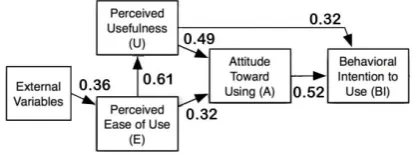
As for technology acceptance, TAM (technology acceptance model) is one of the most widely used models for evaluating technology used [83]. Within the TAM, two factors are measured: perceived ease of use and perceived usefulness [84-86]. Perceived usefulness is said to be the degree in which an individual believes that using a particular technology would enhance their performance; whereas, perceived ease of use is the degree
in which a person believes that using a particular technology would be free of effort [87]. These in turn affect attitudes toward the technology and the intentions to use, as well as the acceptance of the system. Lastly, perceived ease of use positively affects perceived usefulness. In addition, both perceived ease of use and perceived usefulness are influenced by external variables [84, 85] (see Figure 4).
Figure 4. Davis (1986) Technology Acceptance Model
V. RESULTS AND DISCUSSIONS
To answer the various objectives of this study, the results are further separated into 3 sections: a) describing student self-efficacy and technological acceptance; b) providing the relationships among student self-efficacy and technological acceptance; and c) providing a model based on the technological acceptance theory.
A. Student Self-efficacy and Technological Acceptance
TABLE II.
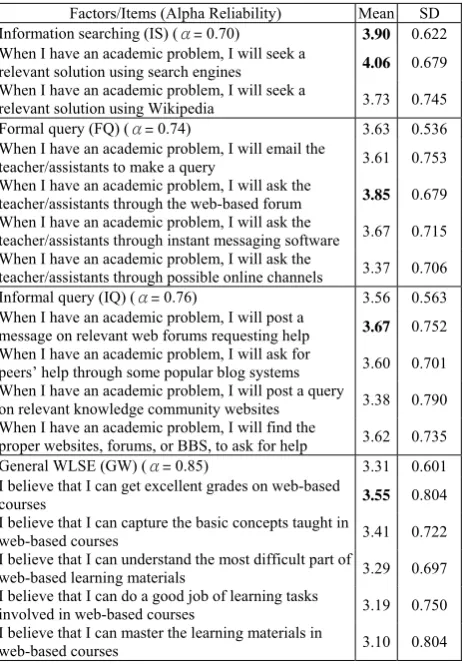
SELF-EFFICACY IN INTERNET-BASED LEARNING ENVIRONMENT (N=154) Factors/Items (Alpha Reliability) Mean SD Information searching (IS) (α= 0.70) 3.90 0.622
When I have an academic problem, I will seek a
relevant solution using search engines 4.06 0.679 When I have an academic problem, I will seek a
relevant solution using Wikipedia 3.73 0.745 Formal query (FQ) (α= 0.74) 3.63 0.536 When I have an academic problem, I will email the
teacher/assistants to make a query 3.61 0.753 When I have an academic problem, I will ask the
teacher/assistants through the web-based forum 3.85 0.679 When I have an academic problem, I will ask the
teacher/assistants through instant messaging software 3.67 0.715 When I have an academic problem, I will ask the
teacher/assistants through possible online channels 3.37 0.706 Informal query (IQ) (α= 0.76) 3.56 0.563 When I have an academic problem, I will post a
message on relevant web forums requesting help 3.67 0.752 When I have an academic problem, I will ask for
peers’ help through some popular blog systems 3.60 0.701 When I have an academic problem, I will post a query
on relevant knowledge community websites 3.38 0.790 When I have an academic problem, I will find the
proper websites, forums, or BBS, to ask for help 3.62 0.735 General WLSE (GW) (α= 0.85) 3.31 0.601 I believe that I can get excellent grades on web-based
courses 3.55 0.804
I believe that I can capture the basic concepts taught in
web-based courses 3.41 0.722
I believe that I can understand the most difficult part of
web-based learning materials 3.29 0.697 I believe that I can do a good job of learning tasks
involved in web-based courses 3.19 0.750 I believe that I can master the learning materials in
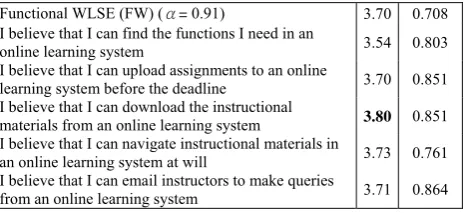
Functional WLSE (FW) (α= 0.91) 3.70 0.708 I believe that I can find the functions I need in an
online learning system 3.54 0.803
I believe that I can upload assignments to an online
learning system before the deadline 3.70 0.851 I believe that I can download the instructional
materials from an online learning system 3.80 0.851 I believe that I can navigate instructional materials in
an online learning system at will 3.73 0.761 I believe that I can email instructors to make queries
from an online learning system 3.71 0.864
Table II shows that the mean values of the SIBLE with their corresponding Cronbach alpha reliabilities are from 0.70 to 0.91, which denotes very reliable results. Table II also shows that the highest factor rated by the students is Information searching with a mean of 3.90. The item “when I have an academic problem, I will seek a relevant solution using search engines” has a mean of 4.06. The results suggest that the students are quite adept at using the Internet for their academic purposes. Overall, the students scored in the SIBLE as moderately ranked in their self-efficacy.
TABLE III.
TECHNOLOGICAL ACCEPTANCE MODEL (N=154) Factors/Items (Alpha Reliability) Mean SD Perceived usefulness (U) (α= 0.91) 3.41 0.621 Using the courseware enhances my learning
effectiveness 3.35 0.730
Using the courseware as a tool for learning in classroom increases my learning and academic
performance 3.45 0.794
Using this courseware as a tool for learning in
classroom helps me become more productive 3.26 0.716 Using this courseware as a tool for learning in
classroom increases my self-efficacy 3.46 0.764 Learning turns out to be easier for me by using this
courseware 3.41 0.731
These courseware is useful in supporting my learning 3.47 0.761
Perceived ease of use (E) (α= 0.87) 3.54 0.569 It is easy to use this courseware as a tool for learning 3.56 0.697 It is easy to use this courseware in improving my
academic performance 3.44 0.715
I found it flexible to interact with the virtual learning
environment 3.51 0.708
It’s easy to master the virtual learning environment 3.59 0.721 I found virtual learning easy to use 3.61 0.689
Attitudes toward using (A) (α= 0.89) 3.41 0.586 I enjoy learning English in a virtual environment 3.34 0.681 I can perform better while learning in a virtual
environment 3.45 0.726
I am hoping (expect) to learn English in virtual
environments frequently 3.37 0.715
I am eager to (intend to) know the content every time I
learn English in a virtual environment 3.41 0.713 I feel enjoyable (pleasant) every time when I learn
English in a virtual environment 3.48 0.699 Behavioral intention to use (BI) (α= 0.85) 3.54 0.672 I am willing to continue using this type of program for
English learning 3.57 0.840
I am willing to use this type of program for English
learning after class 3.55 0.799
I will try to use this type of program more for English
learning 3.51 0.843
I am willing to spend more after-class time to discuss
the related content of this virtual learning 3.47 0.749 Table III shows the various mean scores of the technological acceptance survey. Results implicate that student acceptance levels are quite similar with means ranging from 3.41 to 3.54. The highest item is “I found
virtual learning easy to use” within the perceived ease of use factor with an average of 3.61. Such results also suggest that students moderately accepted the technology, which in this case, is the virtual learning courseware. More importantly, students found the courseware quite easy to use.
B. Relationships among Student Self-efficacy and Technological Acceptance
In terms of the relationships among student self-efficacy and technological acceptance factors, correlation analysis is undertaken. Table IV shows that student TOEIC scores are not correlated to any of the factors. These scores, in turn, indicate that the students’ prior English competency is independent of their tendency for technological acceptance to some extent. Furthermore, Table IV also shows that while the SIBLE factors are correlated to each other, they are also correlated to the students’ perceived usefulness and ease of use of the virtual reality courseware. With regard to the technology acceptance factors, Table IV also shows that they are quite correlated with each other denoting that students’ responses are similar.
TABLE IV. CORRELATION ANALYSIS
Factors TOEIC IS FQ IQ GW FW U E A
TOEIC R 1 Sig. N 113
IS R -0.012 1 Sig. 0.898 N 112 153
FQ R 0.103 .662** 1 Sig. 0.284 0 N 111 152 152
IQ R 0.057 .607** .730** 1 Sig. 0.55 0 0
N 111 151 150 151
GW R -0.164 .432** .521** .649** 1 Sig. 0.088 0 0 0
N 110 151 150 149 151
FW R 0.134 .559** .505** .659** .499** 1
Sig. 0.159 0 0 0 0
N 112 153 152 151 151 153
U R -0.073 .195* .175* .231** .198* .305** 1 Sig. 0.445 0.017 0.032 0.005 0.016 0 N 111 151 150 149 149 151 151
E R 0.156 .178* .216** .186* .167* .288** .528** 1 Sig. 0.1 0.028 0.008 0.022 0.04 0 0 N 112 153 152 151 151 153 151 153
A R 0.143 0.078 0.11 0.153 0.092 .178* .608** .504** 1 Sig. 0.149 0.353 0.189 0.069 0.274 0.033 0 0 N 103 144 143 142 142 144 142 144 144
BI R -0.015 0.161 .243** .184* 0.117 .188* .607** .451** .646** Sig. 0.885 0.061 0.005 0.034 0.18 0.029 0 0 0 N 97 136 135 134 134 136 135 136 135 Note. ** Correlation is significant at the 0.01 level (2-tailed).
* Correlation is significant at the 0.05 level (2-tailed). Values in bold denotes significant correlations.
C. Technological Acceptance Model
To understand the Technology Acceptance Model (TAM), structured equation modeling (SEM) was used to determine the various relationships among the technology acceptance factors. SEM analysis can be viewed as a combination of path analysis and factor analysis. It is also described as a combination of exploratory factor analysis (EFA) and multiple regression [88]. SEM, in comparison with CFA, extends the possibility of relationships among the latent variables and encompasses two components, namely: a) a measurement model (essentially the CFA) and; b) a structural model. The interpretation and evaluation of SEM results require knowledge of the methods used to obtain parameter estimates and the criteria by which the overall model and individual estimates will be evaluated [89]. Researchers use numerous goodness-of-fit indicators to assess a model. However, Tanaka [90] and Maruyama [91] mentioned that there are several types of fit indices, namely: absolute fit indices, relative fit indices, parsimony fit indices, and those based on the non-centrality parameter. In general, if the vast majority of the indexes indicate a good fit, then there is probably a good fit [92].
For the current model, the effective SEM results show that technology acceptance factors are quite related to each other and conform to what Davis [80, 81] originally proposed. However, external factors, such as the frequency of Internet usage, students’ mobile phone Internet capability, and home Internet usage frequency, do show some discrepancies. SEM results show that such external factors are only significantly related to the students’ perceived ease of use. In essence, results show that students who use the Internet more frequently (or are exposed to online environments) accept more easily a new technological learning tool.
Figure 5. Virtual reality courseware technology acceptance model CFI = 0.94, TFI = 0.94, and RMSEA = 0.094
VI. CONCLUSIONS
As with the recent increased emphasis on the improvement of educational technology, many have ventured into creating virtual reality learning scenarios. With this in mind, the current study empirically tested the courseware designed for improving the student occupational English language competency. After three months of usage, students were given a survey regarding their self-efficacy on online environments and their perceived technological acceptance, for it is quite important to determine the driving forces to successful learning. Results show that the students ranked their
self-efficacy quite moderately. Furthermore, the results from the technology acceptance model showed that the students moderately accepted the courseware. These results are quite promising, since self-efficacy is one of the important factors in effective learning.
ACKNOWLEDGMENTS
This work was supported, in part, by a grant from the Paradigm Technological University Project, Taiwan Ministry of Education and the National Science Council.
REFERENCES
[1] P. G. Altbach, "Globalization and the university: Myths
and realities in an unequal world," in The NEA 2005
Almanac of Higher Education Washington, DC: National
Education Association, 2005, pp. 63-74.
[2] K. H. Mok, Education reform and education policy in East
Asia. New York, NY: Routledge, 2006.
[3] Organization for Economic Co-operation and Development, "Education at a glance: OECD indicators," Organization for Economic Co-operation and Development, Paris 2008. [4] S. Jeschke, H. Scheel, T. Richter, and C. Thomsen, "On
remote and virtual experiments in elearning," Journal of
Software, vol. 2, pp. 76-85, 2007.
[5] C. Inman, V. H. Wright, and J. A. Hartman, "Use of Second Life in K-12 and higher education: A review of
research," Journal of Interactive Online Learning, vol. 9,
pp. 44-63, 2010.
[6] D. Oblinger, "Boomer, Gen-Xers, and Millennials:
Understanding the 'New Students.'" EDUCAUSE Review,
vol. 38, pp. 37-47, 2003.
[7] J. Sandars and C. Morrison, "What is the Net Generation? :
The challenge for future medical education," Medical
Teacher, vol. 29, 2007.
[8] S. Bayne and J. Ross, "'Digital native' and 'digital
immigrant' discourses; A critique," in Digital Differences:
Perspectives on Online Education, S. Bayne and R. Land,
Eds. Rotterdam: Sense Publishers, 2011, pp. 159-170. [9] S. Bennett, K. Maton, and I. Kervin, "The 'digital natives'
debate: A critical review of the evidence," British Journal
of Educational Technology, vol. 39, pp. 775-786, 2008.
[10] M. Prensky, "Digital game-based learning," ACM
Computers in Entertainment, vol. 1, pp. 1-4, 2003.
[11] Facebook, "Facebook statistics." vol. 2010, 2011.
[12] M. Thomas, Digital education: Opportunities challenges,
and responsibilities. New York, New York: Macmillan,
2011.
[13] J. B. Ohler, Digital community digital citizen. Thousand
Oaks, California, USA: Corwin, 2010.
[14] G. Blattner and M. Fiori, "Virtual social network communities: An investigation of language learners' development of sociopragmatic awareness and
multiliteracy skills," CALICO, vol. 29, pp. 24-43, 2011.
[15] M. Savin-Baden, A practical guide to using Second Life in
higher education. New York, NY: Open University Press,
2010.
[16] M. Savin-Baden, "From cognitive capability to social reform? Shifting perceptions of learning in immersive
virtual worlds," ALT-J: Special issue on Learning in
Immersive Virtual Worlds, vol. 16, pp. 151-161, 2008.
[17] C. Zhang, "Using virtual world learning environment as a course component in both distance learning and traditional classroom: Implications for technology choice in course
Information Systems Conference, March 26th-27th, Atlanta,
GA, USA 2010.
[18] M. Hobbs, E. Brown, and M. Gordon, "Using a virtual world for transferable skills in gaming education,"
Innovation in Teaching and Learning in Information and Computer Sciences, vol. 5, pp. 1-13, 2006.
[19] C. Wagner and R. K. F. IP, "Action learning with Second
Life - A pilot study," Journal of Information Systems
Education, vol. 20, pp. 249-258, 2009.
[20] C. Dreher, T. Reiners, N. Dreher, and H. Dreher, "Virtual worlds as a context suited for information systems education: Discussion of pedagogical experience and
curriculum design with reference to Secon Life," Journal
of Information Systems Education, vol. 20, pp. 211-224,
2009.
[21] S. Z. Schiller, "Practicing learner-centered teaching: Pedagogical design and assessment of a Second Life
project," Journal of Information Systems Education, vol.
20, pp. 369-381, 2009.
[22] M. Ellis and P. Anderson, "Learning to teach in second life:
A novice adventure in virtual reality," Journal of
Instructional Pedagogies, vol. 6, pp. 1-12, 2011.
[23] R. Schutz, English made in Brazil, 2006.
[24] G. Piccoli, R. Ahmad, and B. Ives, "Web-based Virtual Learning Environments: A Research Framework and a Preliminary Assessment of Effectiveness in Basic IT Skills
Training," MIS Quarterly, vol. 25, pp. 401-426, 2001.
[25] J. M. Keller, "Motivational design of instruction," in
Instructional Design Theories and Models: An Overview of Their Current Status, C. M. Reigeluth, Ed. Hillsdale, NJ:
Lawrence Erlbaum Associates, 1983, p. 392.
[26] A. Bandura, "Self-efficacy: Toward a Unifying Theory of
Behavioral Change," Psychological Review, vol. 84, pp.
191-215, 1977.
[27] P. Eachus and S. Cassidy, Development of the Web Users
Self-Efficacy Scale (WUSE). Proceedings from Education in a Changing Environment. Manchester, UK: University
of Salford, 2004.
[28] D. Compeau and C. A. Higgins, "Computer Self-Efficacy:
Development of a Measure and Initial Test," MIS
Quarterly, vol. 19, pp. 189-211, 1995.
[29] A. Bandura, "Exercise of Human Agency through
Collective Efficacy," American Psychology Society, vol. 9,
pp. 75-78, 2000.
[30] D. S. Staples, J. S. Hulland, and C. A. Higgins, "A Self-Efficacy Theory Explanation for the Management of
Remote Workers in Virtual Organizations," in Journal of
Computer-Mediated Communication. vol. 2013, 1998.
[31] T. Hill, N. D. Smith, and M. F. Mann, "Role of efficacy expectations in predicting the decision to use advanced
technologies: The case of computers," Journal of Applied
Psychology, vol. 72, pp. 307-313, 1987.
[32] M. J. Simmering, C. Posey, and G. Piccoli, "Computer self-efficacy and motivation to learn in a self-directed
online course," Decision Sciences Journal of Innovative
Education, vol. 7, pp. 99-121, 2009.
[33] P. Backlund, H. Engström, M. Johannesson, M. Lebram, and B. Sjödén, "Designing for self-efficacy in a game based simulator: An experimental study and its
implications for serious games design," in Visualisation:
2008 International Conference, 2008, pp. 106-113.
[34] A. Y. Wang and M. H. Newlin, "Predictors of web-student performance: The role of self-efficacy and reasons for
taking an online class," Computers in Human Behavior,
vol. 18, pp. 151-163, 2002.
[35] J. Ward, "The avatar lecturer: Learning and teaching in
Second Life," Marketing Intelligence & Planning, vol. 28,
pp. 862-881, 2010.
[36] Y. Wang and J. Braman, "Extending the classroom through
Second Life," Journal of Information Systems Education,
vol. 20, pp. 235-247, 2009.
[37] S. Kalyuga, "Enhancing instructional efficiency of
interactive e-learning environments: A cognitive load
perspective," Educational Psychology Review, vol. 19, pp.
387-399, 2007.
[38] L. Darbey, An exploration of the potential of a virtual
world to support teachers' preparation for teacher professional development using an action research approach: National Centre for Guidance in Education,
2011.
[39] B. Dalgarno and M. J. W. Lee, "What are the learning
affordances of 3-D virtual environments?," British Journal
of Educational Technology, vol. 41, pp. 10-32, 2009.
[40] J. G. Jones, "Hot topics panel: Advances in 3D image applications: Interactive and collaborative 3D online
environments.," in American Society for Information
Science and Technology: Managing and enhancing information: Cultures and conflicts. vol. 41, p.590, L.
Schamber and C. L. Barry, Eds. Providence, RI: Information Today, 2004.
[41] S. D. Williams and D. M. Switzer, "Assessing 3D virtual world learning environments with the CIMPLe System: A
multidisciplinary evaluation Rubic," in Instructional
design: Concepts, methodologies, tools, and applictions, I.
R. M. A. (IRMA), Ed.: IGI global, 2011, pp. 1817-1839. [42] L. Jarmon, T. Traphagan, M. Mayrath, and A. Trivedi,
"Virtual world teaching, experiential learning and assessment: An interdisciplinary communication course in
Second Life," Computers & Education, vol. 53, pp. 169-82,
2009.
[43] S. Barab, M. Thomas, T. Dodge, R. Carteaux, and H. Tuzan, "Making learning fun: Quest Atlantis, a game
without guns," Educational Technology Research and
Development, vol. 53, pp. 86-107, 2005.
[44] M. Prensky, Don't bother me, Mom, I'm learning!: How
computer and video games are preparing your kids for 21st century success and how you can help! St. Paul:
Paragon House, 2006.
[45] L. Chittaro and R. Ranon, "Adaptive hypermedia
techniques for 3D educational virtual environments," IEEE
Intelligent Systems, vol. 22, pp. 31-37, 2007.
[46] U. Pfeil, C. S. Ang, and P. Zaphiris, "Issues and challenges of teaching and learning in 3D virtual worlds: Real life
case studies," Educational Media International, vol. 46, pp.
223-238, 2009.
[47] C. C. Wan, "The development of collaborative learning
environment with learning blogs," Journal of Software, vol.
4, pp. 147-152, 2009.
[48] P. Foster, "Key concept in ELT," in ELT Journal. vol. 53:
Oxford University Press, 1999.
[49] K. V. d. Branden, "Introduction: Task-based language
teaching in a nutshell," in Task-based language Education,
K. V. d. Branden, Ed. Cambridge: Cambridge University Press, 2006, pp. 1-16.
[50] P. Skehan, A cognitive approach to language learning.
Oxford: Oxford University Press, 1998.
[51] D. Nunan, Designing tasks for the communicative
classroom. Cambridge: Cambridge University Press, 1989.
[53] B. Godwin-Jones, "Emerging technologies: Language in
action: From webquests to virtual realities," Language
Learning & Technology, vol. 8, pp. 9-14, 2004.
[54] D. A. Kolb, Experiential learning: Experience as the
source of learning and development. New Jersey:
Prentice-Hall, 1984.
[55] A. C. Corbett, "Experiential learning within the process of opportunity identification and exploitation,"
Entrepreneurship Theory and Practice, vol. July, pp.
473-491, 2005.
[56] D. A. Kolb, R. E. Boyatzis, and C. Mainemelis, "Experiential learning theory: previous research and new
directions," in Perspectives on cognitive, learning, and
thinking styles, R. J. Sternberg and L. F. Zhang, Eds.
Mahwah, NJ: Lawrence Erlbaum, 2000, pp. 227-247. [57] C. Mainemelis, R. E. Boyatzis, and D. A. Kolb, "Learning
styles and adaptive flexibility: Testing the experiential
theory of development," Management Learning, vol. 33,
pp. 5-33, 2002.
[58] V. Kohonen, "Experiential language learning: Second language learning as cooperative learner education," in
Collaborative language learning and teaching, D. Nunan,
Ed. Cambridge: Cambridge University Press, 1992, pp. 14-39.
[59] I. A. Garcia and C. L. Pacheco, "Constructivism in Mexican elementary school education: Designing a
platform for cooperative learning," Journal of Software,
vol. 5, pp. 565-572, 2010.
[60] Y. L. Chen, "Fostering Taiwanese EFL teachers'
constructivist instructional beliefs through teaching goals
and ICT use.," The Asia-Pacific Education Researcher, vol.
20, pp. 373-386, 2011.
[61] T. L. Fanderclai, "MUDS in education: New environments,
new pedagogies," Computer-Mediated Communication
Magazine, vol. 2, p. 8, 1995.
[62] S. V. D. Emde, J. Schneider, and M. Kotter, "Technically speaking: Transforming language learning through virtual
learning environment (MOOs)," The Modern Language
Journal, vol. 85, pp. 210-225, 2001.
[63] A. Bruckman, "Community support for constructionist
learning," Computer Supported Cooperative Work, vol. 7,
pp. 47-86, 1998.
[64] M. D. Dickey, "Teaching in 3D: Pedagogical affordances and constraints of 3D virtual worlds for synchronous
distance learning," Distance Education, vol. 24, pp.
105-121, 2003.
[65] N. K. B. Maged, L. Hetheringtont, and S. Wheeler, "Second LIfe: An overview of the potential of 3-D virtual
worlds in medical and health education," Health
Information and Libraries Journal, vol. 24, pp. 233-245,
2007.
[66] X. Duan and W. Chen, "Constructive theory foundation and three dimension virtual study mode application,"
Journal of Software, vol. 7, pp. 75-80, 2012.
[67] P. Strevens, New orientations in the teaching of English.
Oxford: Oxford University Press, 1977.
[68] T. Hutchinson and A. Waters, English for Specific
Purposes: A Learning-centered approach. Cambridge:
Cambridge University Press, 1987, 2004.
[69] P. Strevens, "ESP after twenty years: A re-appraisal," in
ESP: State of the art, M. Tickoo, Ed. Singapore: SEAMEO
Regional Language Centre, 1988, pp. 1-13.
[70] T. Dudley-Evans and M. J. St. John, Developments in
English for specific purposes: An interdisplinary approach.
Cambridge, UK: Cambridge University Press, 1999.
[71] D. Kim, English for occupational purposes. London:
Continuum, 2008.
[72] M. Brunton, "An account of ESP - with possible future
directions," in English for Specific Purposes Issue. vol. 3,
2009.
[73] K. Hyland, English for academic purposes: An advanced
resource book. London: Routledge, 2006.
[74] T. Dudley-Evans and M. J. St. John, Developments in
English for specific purposes:A multi-disciplinary approach. Cambridge: Cambridge University Press, 1998.
[75] R. K. Yin, Case study research: Design and methods.
Newbury Park, CA: Sage, 1984.
[76] S. B. Merriam, Qualitative research and case study
applications in education. San Francisco: Jossey Bass,
1998.
[77] L. Cohen, L. Manion, and K. Morrison, Research methods
in education. New York: Routledge, 2007.
[78] H. F. Weisberg, J. A. Kronsnick, and B. D. Bowen, An
introduction to survey research, polling, and data analysis (3rd edition). Thousand Oaks, CA: Sage, 1996.
[79] W. G. Axinn and L. D. Pearce, Mixed method data
collection strategies. New York: Cambridge University
Press, 2006.
[80] S. A. Karabenick and J. R. Knapp, "Relationship of Academic Help Seeking to the Use of Learning Strategies and Other Instrumental Achievement Behavior in College
Students," Journal of Educational Psychology, vol. 83, pp.
221–230, 1991.
[81] K. H. Cheng and C. C. Tsai, "An investigation of Taiwan university students' perceptions of online academic help seeking, and their web-based learning self-efficacy,"
Internet and Higher Education, vol. 14, pp. 150-157, 2011.
[82] S. V. Owen and R. D. Froman, Development of a college
academic self-efficacy scale. MI: National Center for
Research on Teacher, 1988.
[83] M. Y. Chuttur, "Overview of the technology acceptance model: Origins developments and future directions," in
Working Papers on Information Sustems. vol. 9, 2009.
[84] F. D. Davis, "Perceived usefulness, perceived ease of use,
and user acceptance of information technology," MIS
Quarterly, vol. 13, pp. 319-339, 1989.
[85] F. D. Davis, "A technology acceptance model for empirically testing new end-user information systems: Theory and results," Sloan School of Management, Massachusetts Institute of Technology, 1986.
[86] F. D. Davis, R. P. Bagozzi, and P. R. Warshaw, "User acceptance of computer technology: A comparison of two
theoretical models," Management Science, vol. 35, pp.
982-1003, 1989.
[87] S. C. Chen, S. H. Li, and C. Y. Li, "Recent related research in technology acceptance model: A literature review,"
Australian Journal of Business and Management Research,
vol. 1, pp. 124-127, 2011.
[88] J. B. Ullman, "Structural equation modeling," in Using
multivariate statistics, 4th ed, B. G. Tabachnick and L. S.
Fidell, Eds. Needham Heights, MA: Allyn & Bacon, 2001, pp. 653-771.
[89] R. H. Hoyle, "Structural equation modeling: Concepts, issues, and applications," Thousands Oak, CA: Sage, 1995. [90] J. S. Tanaka, "Multifaceted conceptions of fit in structural
equation models," in Testing structural equation models, K.
A. Bollen and J. S. Long, Eds. Newbury Park, CA: Sage, 1993, pp. 10-39.
[91] G. M. Maruyama, Basics of structural equation modeling.
Thousand Oaks, CA: Sage, 1998.
[92] J. B. Schreiber, F. K. Stage, J. King, A. Nora, and E. A. Barlow, "Reporting structural equation modeling and
confirmatory factor analysis results: A review," Journal of
Yu-Li Chen is currently an associate professor and Chairperson