http://www.sciencepublishinggroup.com/j/ss doi: 10.11648/j.ss.20180703.15
ISSN: 2326-9863 (Print); ISSN: 2326-988X (Online)
The Research of PPP Model Under Better Service
Framework
Xianmei Xu, Ke Gao
The School of Public Finance and Taxation, Central University of Finance and Economics, Beijing, P. R. China
Email address:
To cite this article:
Xianmei Xu, Ke Gao. The Research of PPP Model Under Better Service Framework. Social Sciences. Vol. 7, No. 3, 2018, pp. 141-145. doi: 10.11648/j.ss.20180703.15
Received: March 24, 2018; Accepted: April 17, 2018; Published: June 20, 2018
Abstract:
Quantitative analysis of the monopoly index and efficiency of three industries of public service was carried out with SCP model, and the questions that why the government does not monopolize the public service market and whether private departments can provide efficient public service were answered. Moreover, social welfare function of two classes was established, which provides theoretical support for PPP model from the demand side. Efficiency source of P1 + P2 was analyzed with Nash equilibrium and economics of scope, and it was concluded that the ultimate of PPP isa kind of Nash equilibrium.Keywords:
ISCP Model, Nash Equilibrium, Economics of Scope, Social Welfare Function1. Introduction
In order to stabilize growth and transform development, China has issued a number of measures to promote the sustainable development of PPP model. At present, these measures have attracted extensive attention in the theoretical circle and practice circle and evolved to important pushing hands of economic development in the practice circle. PPP is becoming the core policy of governance and mainstream concept of national governance of the government. As a high-level form and innovation of governmental procurement, the essence and purpose of PPP are to provide better services; what's really important is not how efficient thejob is, but how to promote the improvement of citizens' welfare. In order to figure out how to promote the improvement of citizens' welfare, itis necessary to answer the following questions: why does not public (P1) monopolize the public service market? Is private (P2) able to provide efficient public services? Why is P1 + P2 efficient?
2. Overview of Better Service Theory and
Interpretation of PPP Model
2.1. Overview of Better Service Theory
When it comes to the measurement standard of economic
efficiency under ideal state, western economic circle uses "quantity" and "variety". Generally speaking, a perfectly competitive market requires a large amount of commodities and diversified goods for choose. Information economics argues that incomplete information, incomplete capital market, and incomplete resource allocation exist generally. Information asymmetry may completely eliminate competition. In "The Market for Lemons", George Akerlof proved that the second-hand car market with information asymmetry is smaller than the market without information asymmetry [1]. Therefore, monopoly and partial monopoly are ordinary in the public service market.
of private decentralized decision; the government is unable to solve insufficient effective incentive and information asymmetry through information search. Public goods should adopt the PPP model to improve efficiency. Public choice theory represented by Buchanan and Olson tries to include private behaviors and governmental behaviors into the same analysis framework, and proposes that government is the economic man pursuing utility maximization, and has the tendency of self-aggrandizement and low efficiency. It puts forward governmental management marketization and emphasizes the establishment of competition mechanism and incentive mechanism in governments. Janet V. Denhardt (1999) [2] proposed public service when studying public administration theory of modern form: serving the citizens rather than customers.
When studying public service scope, Yang Qingwang (2012) [3] proposed that public service must intensify efforts to maintain private property rights, basic right of dignity, and right to socialsecurity. In addition, from the perspective of constant evolution, he put forward that citizens' requirement for the quality and efficiency of public service also evolved ceaselessly.
Ding Li (2014) [4] stated that public service theory and clean government establishment belonged to different scopes, but they were interrelated and inseparable, and organically unified in practice.
When analyzing the universality of the scope of public services provided by governments and service target, on the basis of changing social environment, Dong Li (2005) [5] carried out quantitative study of basic public service quality with CIIP model, and concluded that basic public services were fairness, justice, normalization and goal compatibility.
2.2. Interpretation of PPP Model at Different Levels
2.2.1. Government's Interpretation of PPP
The “Guiding Opinions of National Development and Reform Commission on Developing Cooperation between Governmental and Social Capital (Fa Gai Tou Zi [2014] 2724)” proposed that PPP is a long-term cooperation relationship with social capital to enhance the ability to supply public products and services and improve supply efficiency. The government hopes it can play a leading role in innovating investment and financing model, developing mixed ownership economy, smoothening the relationship between the government and the market, and playing the resource allocation role of the market.
2.2.2. Commercial Banks' Interpretation of PPP
On the one hand, commercial banks value PPP market and hope to share the benefits of PPP. They play the role of investment banks in PPP projects and actively provide good financial resources for PPP projects, and participate in the design, development and early activities of PPP projects. On the other hand, banks have many misgivings. Due to the long term and low interest rate of the PPP project company, and without the implicit guarantee of the local government, commercial banks arevery prudent in terms of choosing
partners [6].
2.2.3. Private Departments' Interpretation of PPP
Private departments hope to obtain a reasonable return whenthe government can guarantee their investment. In the future, it is necessary to establish supporting financial budget expenditure management system from the central government to local governments and clarify the boundary of rights and obligations of both sides who should have the spirit of contract. In addition, it is necessary to enhance regulation of bidding to guarantee openness, fairness, justice and transparency. If a local government breaches a contract, superior government should supervise the one at lower levels.
3. Study of Theoretical Foundation of
Cooperation Between P1 and P2
3.1. Diversified Demands Are the Theoretical Support of P1+P2 Cooperation
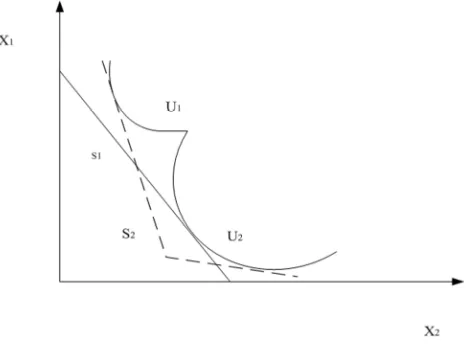
As shown in Figure 1, it is assumed that the market only provides X1 and X2. The price of X1 is higher than X2. There are two consumption classes in the society, namely the wealthy and the masses, and the population and total consumption scale of the masses exceed the wealthy. The indifference curve of the two classes is U1 and U2 respectively. The supply curve of public departments is a full line S1, and the supply curve of private departments is a dotted line S2.
Figure 1. Social welfare function of different classes.
carry out price competition with governmental departments in low-end markets. Therefore, the supply curve of private departments is a bent curve. Cooperation between governmental and social capital can prevent vicious competition and improve service quality and variety.
3.2. Efficiency Loss of Monopoly Needs P1 and P2 Cooperation
3.2.1. Monopoly Index Measurement of Three Industries Yu Liangchun (2007) [7] referred to SCP model of industrial organizational theory and proposed ISCP model to measure the efficiency loss of industry monopoly. Under the analysis framework of ISCP model, I (institution) represents
institution factors; S (structure) represents industrial and market structure; C (conduct) represents administrative monopoly conduct; P (performance) represents performance of monopoly industries. The model is composed of 4 first-level indicators, 12 second-level indicators and 31 third-level indicators. It has detailed indicator system, which covers the main indicators of administrative monopoly industries, and is suitable for quantitative study of large-sized administrative monopoly industries such as electric power, telecommunication and railway. The problem is that it is difficult to objectively and scientifically quantize and compare the institution factors and industrial performance of different industries.
Table 1. Statistics of monopoly degree indicators of three industries.
Industry Index Proportion of
Governmental enterprise
Industry concentration
Proportion of Profit quality
Proportion of Asset size
Electricity and heat production and supply 0.657 0.931 0.873 0.903
Gas production and supply 0.296 0.489 0.449 0.527
Water production and supply 0.611 0.822 0.454 0.804
Data source: China Industrial Statistical Yearbook (2013).
According to the characteristics of the public service market, A = proportion of governmental enterprises, B = industry concentration, C = proportion of profit quality, D = proportion of asset size①
. The four indicators are selected to measure the monopoly degree of public service industry. Due to limitations of data, indicators of industrial enterprises in 2013 were adopted to study electricity and heat production and supply, gas production and supply, water production and supply. Statistical analysis results are shown in Table 1.
According to integrated weighting method, the following formulas are adopted: L1 represents monopoly degree, where
1 2 3+ 4=1
x +x +x x LI = + + ⁄ ∗
⁄ ∗ ⁄ + . Statistics of three
industries in 2013 were adopted for specific judgment. Valuation ②
: x1=0.35 =x2 0.3 =x3 0.25 =x4 0.1 .
Monopoly indicators of three industries are: 0.81, 0.40 and 0.66 respectively. It can be seen that in the public service market, electricity and heat production and supply had the highest monopoly degree, followed by water production and supply. In addition, gas production and supply had certain degree of competition.
3.2.2. Measurement of Efficiency Loss Due to Monopoly Internal efficiency loss generates because technology and management level are not high enough to optimize resource allocation. Efficiency loss caused by rent-seeking behavior refers to the efficiency loss due to the existence of rent-seeking behavior. Social welfare loss is caused by
①A refers to the proportion of governmental enterprises to all enterprises; B refers
to the proportion of the income of governmental enterprises to the income of all enterprises; C refers to the proportion of the profits of governmental enterprises to the profits of all enterprises; D refers to the proportion of asset size of governmental enterprises to the asset size of all enterprises.
②Coefficient valuation was obtained after comparison with expert grading method
and dynamic weighting comprehensive evaluation method. Because of limited space, there is no detail.
monopoly.
Measurement model of internal efficiency loss (IEL): the financial indicator of internal efficiency loss is that the income cost ratio of governmental departments is higher than that of private departments.
2
/ P
IEL=MBC c −MBI
MBI is the income of main business. MBC is the cost of governmental departments.
c
p2 is the income cost ratio of private departments.Measurement model of rent-seeking efficiency loss (RSEL): efficiency loss because of the existence of rent-seeking behaviors; rent-seeking expenses of governmental departments is assumed to hide in management fees and selling expenses. The increase of rent-seeking cost must reduce the profit level of enterprises.
2
* p
RSEL=MBC k −TP
MBC is the cost of main business. kp2 is the cost-profit
ratio of private departments. TP is total profit.
Measurement model of social welfare loss (SWEL): the resources of the whole society cannot be allocated effectively because of monopoly, leading to the overall losses of social welfare. Cowling and Mueller (1978) proposed the model of measuring social welfare loss: DWL 1 * P Q
(
m m Qm)
2 C
= − ,
and the essence is that social welfare loss is the half of the actual profits of enterprises. Then:
1
SWEL= 2(IEL+RSEL TP+ )
SWEL
MEL=IEL+RSEL+
According to above model, monopoly efficiency loss of three industries of public service is estimated, as shown in Table 2.
Table 2. Monopoly efficiency of three industries of public service.
IEL RSEL SWEL MEL
5493.7 1589.89 5079.9 12163.4
-6.46 -55.93 54.98 -7.4
4.69 29.22 43.08 77
Notes: a negative number illustrates that the industry is an economic monopoly industry and increases social welfare.
Comparing the data of Table 1 and Table 2, it can be concluded that the higher the monopoly index is, the greater the efficiency loss of monopoly will be, and the more competitive the market is, the better the social welfare will be. In 2013, electricity, heat production and supply industry brings 1.216339 trillion yuan loss to the whole society's welfare due to the high degree of monopoly, while the gas production and supply industry brings 740 million yuan increase to the whole society's welfare because of full competition.
Through comparative study on efficiency of P1 and P2, it can beconcluded that if government monopolizes the public service market, it will lead to serious monopoly efficiency loss. However, appropriate introduction of private capital can increase the overall social welfare, and private departments can provide efficient public services.
4. Study of Efficiency Source Under PPP
Mode
4.1. The Ultimate of PPP Is Nash Equilibrium
The Nash equilibrium is a state where each of the players in the game chooses their best response strategies, and these optimal response strategies form a mix, which creates the Nash equilibrium. Implementation process of PPP: first, the government releases PPP demands; enterprises make bidding document according to demand conditions. The qualification of suppliers is identified through public bidding, invited tendering, competitive negotiation and single source procurement. After confirming the most suitable partner, the government announces the information and accepts question and supervision. Finally, PPP contract is signed. Signing a contract is not the end of PPP but the beginning.
It can be seen from the implementation process of PPP that PPP is an evolved constant game. Condition and procedure settings aim to guarantee procedure fair and lead to perfect results. That is, fairness and justice of process provide an important support for the fairness and justice of results. Both sides of game of PPP implementation develop their jobs according to the spirit of contract. Each choice is the optimal one of governmental and social capital. The
optimal response strategies form a combination which is Nash equilibrium. At this time, PPP is not a wedding but a marriage.
4.2. Economics of Scope Increases Efficiency
Economics of scope is related to joint production. When an enterprise produces more than one product or service with the same resources, the transverse expansion of the production scope shows that the transformation curve of the coordinate axis is strictly concave to the distant origin, which brings about the enhancement of benefit, the reduction of cost or the increase of profit.
In the public service market, governmental capital is protected by administrative monopoly, not driven by innovation, and provides single commodity or service combination. Social capital is driven by market competition and profit maximization, and provides diversified commodity combinations with the same resource. The invested production factors can be shared, so production processes can be uniformly managed and two types of production process are complementary. As a result, economics of scope comes into being under PPP mode.
4.3. Efficiency Is Realized with Management and Incentive
Under traditional cooperation mode, inconsistency between the objectives of public and private departments promotes the generation of entrustment of an agent. If it is difficult to coordinate objectives, either private or departments or the government will breach the contract. In the public service market, the objective of public departments is livelihood of the people, respect of citizens and civil rights. The objective of private departments is profit maximization or cost minimization. In the public service market, there is also incomplete information. Private departments are more willing to review uncertain information than public departments to find certain relationship and form decision plans.
Under PPP mode, governmental capital and social capital form common values and value orientation through contracts, people's livelihood and profits. Private department incentive mode and comprehensive quality management mode can be introduced to realize common objectives, produce benefits with management, and output efficiency with incentive.
5. Conclusion
References
[1] Joseph Eugene Stiglitz. Economics of Information: Basic Principles [M]. Beijing: China Financial Publishing House, 2001. 1, 8-10.
[2] Janet V. Denhardt. The New Public Service [M]. Beijing: China Renmin University Press, 2004. 6, 40-43.
[3] Yang Qingwang. Analysis of the Meaning of Public Service and Content Reconstruction [J]. Science of Law, 2014. (4), 99-111.
[4] Ding Li. Relationship between Public Service Theory and Clean Government Establishment [J]. Guide to Business, 2014 (12), 27-28.
[5] Dong Li. Study of Evaluation of Basic Public Service Quality [D]. Jilin: Administrative Management of Jilin University, 2015. 6, 1-4.
[6] Yang Rong. It is an inevitable tendency that banks participate in PPP projects, and five models have their own advantages [EB/OL] 2015-08-152015-10-19.
[7] Yu Liangchun. Study of the Degree and Efficiency Loss of China's Industrial Administrative Monopoly [J]. Economic Research Journal, 2010 (3), 16-27.
[8] Gu Lin. 30 Million Tests the Government’s Spirit of Contract [EB/OL] http://www.h2o-china.com/news/231633.html, 2015-10-15/2015-10-19.
[9] Shleifer and Vishny, 1998, The Grabbing Hand, Government Pathologies and Their Cures, Cambridge, MA:Harvard University Press.
[10] Pietro Micheli, Steve Mason, Mike Kennerley, Public Sector Performance: Efficiency or Quality? [J]. Measuring Business Excellence. 2005, 11 (2).
[11] Zhang S, Chan A P C, Feng Y, et al. Critical review on PPP Research–A search from the Chinese and International Journals [J]. International Journal of Project Management, 2016, 34 (4): 597-612.