Chris Yandle is a Landscape Architect
He may be contacted via the
Landscape Architecture Group,
PO Box 84, Lincoln Unit1ersity
Canterbury, Aotearoa New Zealand. Email: [email protected]
The Corner connection: studio experimentation
CHRIS YANDLE
I
s THERE MORE TO DESIGN THAN THE PICTORIAL?If so, how can we design
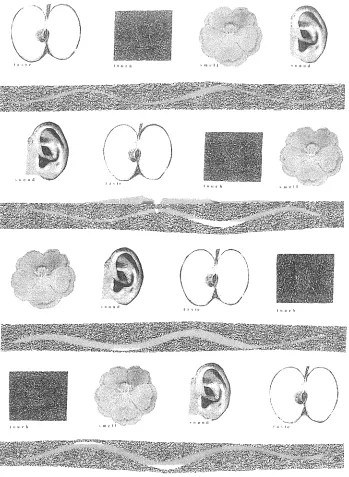
elements other than visual? Such questions aroused my curiosity over the past year while studying landscape architecture at Lincoln University. The stimulus for these questions came from an experimental studio paper that focused on stepping outside normative design and representational processes. Following this studio, I was still unsure of the answers, and undertook a research essay focusing on the theory, design and representational techniques of James Corner.The experimental studio paper focused on the redesign of an existing Garden for the Blind in the Auckland Domain. The brief required us to look outside the common pictorial frame of design and to focus as much on process as on product, on means as much as ends. These requirements threw my world upside down. From my perspective, there were two key areas, the design process and the representation. The two aspects were by no n'leans independent of each other, and during the development of my design, both the design process and representation proceeded simultaneously.
The design phase of the studio required the development of a new design
KEY WORDS process, and clear communication of the design outcomes. One of the key elements Experimental that I developed during this phase was what I term 'moving from a physical
Design process reality'. Instead of concentrating on whether the design was to be formal, informal
Landskip or what it would look like, I concentrated on my idea or theory for the site. Landschaft Consequently, I spent most of my time thinking about theory and site function,
Imaging rather than being concerned about aesthetic appearances. I discuss this process in
Eidetic more detail later in relation to a rural design studio. The result of this process
Liberating was a series of images that represented my ideas for the site, rather than a rendered plan (see image 1).
The second phase of the studio focused on the representation and communication of ideas. We were asked to consider how time, various scales, and senses could be communicated to a range of people, notably those with impaired vision. The communication of ideas was closely related to the design process, because the ideas created in the design section dictated the representation. This may seem to be a simple point, but it is one that I find is often overlooked. In previous projects, I had pictorially designed sites, picturing what would be seen, rather than focusing on communicating the key ideas and theories that precipitated the design. It is, of course, important to 'picture' the design, but to both picture and convey the idea behind it is a challenge. The final design representation consisted of a series of interactive three-dimensional panels, that reflected the theory and interactive activities I proposed for the site (see image 2).
The presentation also had a secondary function in that viewers had to interact
1<111('11
(Huril ,,,,el!
I I I U , ' ! !
observe pictures passively and read lengthy descriptions. From my experiences, the latter can lead to misinterpretation or even loss of interest.
Following the conclusion of the studio paper, I still had many unanswered questions. Would such an unconventional process be viable in day-to-day design practice? Was there room for this mode of representation in the landscape architecntre industry today? To answer some of these questions I decided to explore further, and this is where I made the Corner connection. When reading a range of architectural and landscape articles, Corner's writings stood out, because specific areas of his work seemed very similar to my experience in the studio paper. This prompted lTle to devote my research essay to Corner's design theories and studio
Figure 1: Representational inwge of blind
Figmf 2: Photo of interactil!f presentation
for blind gardens jJroposal.
techniques, while at the same time applying them to a rural design studio. Amongst Corner's papers, several key factors recurred or evolved in his writings, leading to a conclusion in 'Operational Eidetics' (Corner 1998), and his introduction in
Recovering Landscape: Essays in Contemporary Landscape Architecture (Corner 1999).
These writings presented issues of theory, design process and representation that I
found to be highly relevant to my earlier experimental studio encounters.
THEORY
The designing of a sensory garden for the blind demanded an exploration of elements other than the visual and forced me into new ways of thinking about the designed environment. I found interesting parallels between my studies and Corner's writing on Landskip and Landschaft. Corner explains how historically
the old English term 'Landskip' did not initially refer to the landscape, but to a picture of it. Shortly after Landskip paintings began to appear, and the "concept was applied to the land itself", where "large-scale rural vistas, designed estates and ornamental gardens were created" (Corner 1998 p 22). At the time Corner is referring to, land and images became inseparable, giving landscape architects the ability to "construe and construct landscapes" through imaging (Corner 1998 p
22). However, Corner emphasises that landscape architects tend to "prioritize the visual and formal qualities", and this pictorial impulse "denies deeper modes of existence, interrelationship, and creativity" with the earth (Corner 1998 pp
22-23). Corner further advocates that there is another aspect of landscape that has significantly less to do with pictures. This aspect is associated with the term 'Landschaft', "comprising a deep and intimate mode of relationship, not only between buildings and fields but among patterns of occupation, activity and space, which preceded the term Landskip" (Corner 1999 p 154). Corner believes that we should view the landscape in terms of 'Landschaft', as more of an environment with many elements and complex inter-relationships, rather than the common visual 'Landskip'.
'the everyday inhabitants', living in the environment (Landschaft) where they experience the landscape "in a general state of distraction, and more through habit and use than through vision alone" (Corner 1999 p 155). The insiders' own perception of the landscape "is bound into a greater phenomenal range of significance than vision" (Corner 1998 p 23). By not designing to this greater phenomenal range, we detach "the subject from the complex realities of the participating world" (Corner 1999 p 156).
In
contrast "the outsider - the tourist,spectator, designer, planner, and often the State and administrative authority view the landscape as an object, a thing to behold" (Corner 1998 p 23). To design the landscape as a scene, or for its 'scenic beauty' presents the landscape as "little more than an aesthetic object of attention" (Corner 1999 p 156). The viewing of the landscape in terms of Landschaft "necessitates a parallel shift from appearances and meanings to more prosaic concerns for how things work" (Corner 1998 p 24). I could see immediately how to apply this theoretical stance to a
.~-'
Figure 3: Initial diagrammatic image of
French farm proposal exploring relationshiPs
bet1ueen tourists, locals and the biophysical landsca/)e -forming my multi-layer concept
for the site.
Figure 4: Diagrammatic plans of the local
and tourist/biophysical layers in the
rural design studio I was working on. The studio brief was to create a design for French Farm, a small farming community on Banks Peninsula, about a one-hour drive from Christchurch, that would encompass the three broad groups of people in the valley - the community (insiders), local authority, and tourists (outsiders).
Design process
In order to design French Farm beyond the scenic Landskip, I had to devise imaging techniques that would creatively explore the "greater phenomenal range of significance than vision", such as the processes that fOIl1'1 the insiders' environment (Corner
1998 p 2). Corner believes the answer to such design problems lie in "eidetic images". He defines eidetic as referring "to a mental conception that may be picturable, but may be equally acoustic, tactile or imaginative, unlike purely retinal impressions of pictures, eidetic images contain ideas, and lie at the core of processes of creativity" (Corner 1998 p 22). In short, eidetic images work between reality and imagination, and can be best explained by references to one of Picasso's masterpieces:
... when Picasso joins a bicycle handle bar to a down-turned seat, the result suggests not only a bulls head but also a minotaur - a creature part animal, part machine - an image that may even be actualized (Corner 1998 p 25).
But how feasible are such creations? Although Corner argues that he is well aware of "the increasing preponderance of unintelligible, hermetic abstractions on the academic gallery and magazine circuits", he advocates that a range of imaginative and demonstrative eidetic instruments (imaging techniques) "must be developed if landscape and urbanism are to be recovered as significant contemporary practices" (Corner 1999 p 164). By the end of my research paper I had extensively searched for articles or criticisms of Corner's eidetic images, without luck, and began to doubt if all these promising concepts worked in reality. I decided to take the risk and apply Corner's concept of eidetic images, based on the 'Landschaft' theory, to a design section in the rural studio.
5a 5b
5c 5c1
pits have large cranks, which, when turned, scour out debris, helping to maintain a channel running from the sea inland to a depression that would flood at high tide, thus creating an inland salt marsh. This interactive area encourages tourists
or outsiders to become involved in shaping the rural landscape and to realise the intimacies of the insider's landscape at French Farm.
The eidetic image that represented the site processes then became the generative
tool, and dictated the idea for the park by defining its form. As Corner states "what matters is how the form and geometry of a project makes sense with regard to the specific issues it is trying to address and the effects it is trying to precipitate", a point that I experienced and strongly agree with (Corner 1999 p 4). Once I had
resolved the design processes for the waterfront park I returned to the larger master plan and applied the same eidetic image as a generative tool to design the valley (see image Sa, b, c).
Representation? Design communication?
The multi-layered eidetic images had a profound influence on the look of my final representation. This result was similar to the experimental studio, where the ideas had greatly influenced my representation. But, the difference between the two was that I had to go one step further and illustrate the physical layout of
the valley. The 1 :5000 master plan comprised a series of boxed overlays. This layout reflected my design approach, and literally became rny final representation. The see-through overlays allowed the interactions occurring between the layers to
be identified. For example, one could observe interaction between the tourist
F(~llre 5: Photos of multi-b)'ered French
farm /nesentmion.
5a Photo looking thOllgh the top 'tolll'ist'
layer at master plan scale. The mrious eyes
on the plan nwrk the significant t'iewpoints
from the nwin road. One can see the
relationships between the viewpoints and
the insider's landscapes on the transparency
below, with the /Jlacement of vineyards and
tourist attractions in clear vie1v from the
road,
5b Photo of insider's layer. The tourist layer
has been lifted off to reveal information
about the insider's landsea/Je with regorel to
vineyard and residential clevela/mlent. One
can see through this layer and understand
the relationships between the placement of
the residential and vineyard detoe!opment
and the biophysicallandseape.
5c Photo of biophysical layer with
information on topography, land slope, sun,
shade and tides.
5d Photo of hybrid plan/model of detailed
design area. One can lift of! various pieces
to read information and further lLllderstand
and functional layers, whereby viewpoints from the road (indicated with an eye on the tourist layer in the drawing) were lined up with the positioning of the vineyards (indicated by a series of lines) on the underlying functional layer. Furthermore, once the tourist overlay had been lifted off, one could see the interactions between the placement of the vineyards (on the functional layer) and the underpinning biophysical landscape.
This process may seem to be a planning exercise or a return to a McHargian design approach. However, Corner argues for similar techniques as used by Rem Koolhaas because "they differ from quantitative maps of conventional planning in that they image data in knowingly selective ways" (Corner 1998 p 25). The techniques are designed "not only to reveal spatial effects of various shaping forces ... but also construct a particular eidetic argument" (Corner 1998 p 25).
In
mydesign, the drawing justifies itself, and reveals how I approached and considered the making of the French Fann landscape.
I also used this layering system of representation in the 1: 100 'plan view'
detail design of the communal waterfront park at French Farm. To communicate my design intent, I developed a hybrid plan/model (see image Sd). The purpose
of this was two-fold. First, to present the concept (discussed previously) in a standard plan view would have severely limited the level of viewer understanding because of the importance of the contours of the land, and the connection they
had to the overall scheme. I also wanted to represent the process of using eidetic images, and the use of a flat piece of paper would obliterate this. Second, the model was interactive, people could lift off various layers revealing more information associated with each particular level.
On reflection, the French Farm experiment was successful and illustrated how some of Corner's design concepts actually worked in reality. However, do such creations answer questions like 'what does it look like'? Can the client understand such a process? From my experience, yes. Initially, it was challenging and difficult to conceptualise how I would communicate the site in terms of each layer, while still retaining technical requirements. My approach was to create a series of overlays and hybrid model plans that articulated a physical expression of my conceptualisation of the site. In addition to informing the viewer about my design process, I could also see how it would benefit the client through articulating the design elements and thereby encouraging a deeper appreciation of the concept. Because many clients do not have the same skills and knowledge as landscape architects in reading and visualising plans, my approach was beneficial because it reflected the process of how I came to a final concept, thus allowing the client to understand the design at a deeper level.
CONCLUSION
Many times throughout the design process I asked myself 'why do I bother'? 'Why try to change something that the majority of people are happy with'? 'What's so wrong about picturing the landscapes we design'? Some people commented, 'Looks like you are just making work for yourself. However, I believe there is a continuous need to challenge ourselves on how we look at the landscape, go about designing it and subsequently communicate our design ideas. The experience of reading, writing, critiquing and applying Corner's ideas, has fuelled my desire
to step outside the comfort zone, as I did in my experimental studio, in order to "provoke new and alternative ways of seeing" (Corner 1996 p 19).
Although I do not entirely agree with all of Corner's ideas, and at times have struggled to understand the reasoning behind some of them. The simple concept of evolving a philosophy through eidetic images was a turning point in my approach to landscape design. I believe this is a key point in the design of a landscape, because the drawing is the generative tool in forming the designed landscape, just as the Landskip paintings of the seventeenth century had a profound effect on the landscape. Most significantly, the eidetic image explores ideas and concepts rather than the singular pictorial dimensions of the landscape. Thus, through use of such images that explore non-pictorial elements, new landscapes can be created beyond scene or form. Moreover, the images that inspired and created the design can be used to express site concepts to clients, providing them with a greater understanding of the design.
However, the somewhat liberating concept of idea preceding form gives birth to an open-ended design process that is associated with an element of risk, because of the uncertain outcome of the final design. I am now convinced that good design requires a strong theoretical basis. Without theory, there is nothing on which to generate and spur ideas. The development of new theories and ways of applying them is what drives design beyond stagnation. This view is illustrated in Corner's critique of scenic landscapes, he describes them as having a "sentimental and escapist understructure", and the net effect is "personal withdrawal and nostalgia for the presence of the past" (Corner 1999 p 156). Thus, "there is simply nothing to look forward to" (Corner 1999 p 156). Without developing new theories and imaging techniques to explore and manifest them, landscapes will remain unchanged, monotonous, static, stalling the evolution of landscapes, thus, short-changing itself and its inhabitants.
REFERENCES
Corner, James (1996) Taking Measures Across the American Landscape, New Haven: Yale University Press.
Corner, James (1998) Operational Eidetics: Forging New Landscapes, Harl'arcl Design Magazine, Fall, pp 22-26.