(UDC: 004.032.26:616.12)
Mining data from hemodynamic simulations via multilayer perceptron
neural network
M. Radović1 and N. Filipović1,2
1Research and Development Center for Bioengineering ‘BIOIRC’, Kragujevac, Serbia
2Faculty of Mechanical Engineering, University of Kragujevac, Kragujevac, Serbia
Abstract
Arterial geometry variability is present both within and across individuals. A multilayer perceptron neural network was proposed for mining data generated from computer simulations. The proposed approach was applied to analyze the influence of geometric parameters on maximal wall shear stress (MWSS) in the human carotid artery bifurcation. A parametric model was used for generating a set of observational data that contains the maximum wall shear stress values for a range of probable arterial geometries. The data set was mined via a multilayer perceptron making it possible to predict values of the maximum wall shear stress for new geometries that were not in the training data set.
Introduction
After heart disease and cancer, the third most common cause of death is stroke. Probably the most frequent stroke is of the embolic type with a heart disease as the source. The carotid bifurcation stenosis is also a significant cause of stroke, producing the infarction in the carotid region by embolization or thrombosis at the site of narrowing. The thrombosis development and embolization is conditioned by the local hemodynamics which can be investigated experimentally and/or by computer modeling.
Increase of stoke risk is induced by many factors: age, systolic and diastolic hypertension, diabetes, cigarette smoking, etc. Changes of the geometrical vessel dimensions in the region of the carotid artery bifurcation certainly affect the blood flow and may lead to stenosis process (Schulz et al. 2001). It has been shown that the vessel diameter at the carotid artery bifurcation
changes considerably with age (Kojić et al. 2008). There are many CFD simulations which
Simulations of pulsatile flow in human carotid artery have been performed in Perktold papers (Perktold et al. 1986, Perktold et al. 1987, Perktold et al. 1991). Wall shear stress (WSS) has been identified to play a major role in the progression and complication of atherosclerosis (Glagov et al. 1988).
One of the standard approaches for statistical analysis is the Monte Carlo simulation technique where the computer model is run repeatedly for randomly generated values of the inputs, and subsequently, the resulting data is postprocessed to estimate the output statistics (Rubinstein 1981). However, due to the CPU requirement of a large sample-size, this approach becomes computationally prohibitive, particularly when high-fidelity models are used.
Kolachalama used Bayesian Gaussian process emulator to access the relationship between geometric parameters and Maximal Wall Shear Stress (MWSS) and to obtain geometries having
maximum and minimum values of the outputMWSS (Kolachalama et al. 2007).
In the present work, we proposed the multilayer perceptron neural network to study the relationship between geometric factors and hemodynamic metrics MWSS. The structure of
multilayer perceptron is described in (Ranković 2008, Shepherd 1997). The present approach
can be viewed as a computer-based data mining strategy which extracts useful information and synthesizes interesting relationships from data sets generated by running computer simulations on selected cases. The human carotid artery bifurcation was chosen for analysis since it is a common site for arterial disease to occur (Bharadvaj et al. 1982). Large changes in the magnitude of maximum wall shear stress (MWSS) can play a role in the embolic mechanism by which carotid lesions can induce stroke (Lorthois et al. 2000). Hence, it is important to understand the correlation between the geometric variability and MWSS in the human carotid artery. Set of candidate geometries were randomly created for steady state three dimensional flow analysis. The generated data were then used to construct a multilayer perceptron neural network which approximated the MWSS as a function of geometric variables.
Finite element model of the carotid artery bifurcation
Here, we describe the basic concept of generation of the carotid artery bifurcation finite element (FE) models, with appropriate boundary conditions. A 3D finite element model with 3D fluid finite elements (8-node isoparametric elements with velocity calculation at all nodes and pressure calculated at the element level) is generated for the carotid artery geometry as described below. The CFD post-processing results gives an insight into the local hemodynamics, as well as the blood mechanical action on the vessel walls, such as distributions of pressure and shear stress on the wall surfaces.
Fig. 1. Geometrical data for the carotid artery model. The abbrevations here are: CCA – common carotid artery, CBR – carotid bifurcation region, CBRE – carotid bifurcation region external, ECA- external carotid artery, CBRI- carotid bifurcation region internal, ICA- internal
carotid artery, ICB- internal carotid bulbus
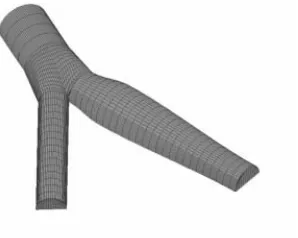
Fig. 2. A FE model of the carotid artery bifurcation generated using the parameters shown in Fig. 1.
Steady state simulation for the 300 geometries were undertaken and MWSS for each geometry was extracted for constructing multilayer perceptron. A parabolic inflow velocity profile was applied at the common artery entering cross-section. Velocity of the central point at the common artery entering cross-section is Vav=93.8 mm/s.
All velocity components at the fixed walls are set to be zero. Also, the velocity components at the plane of symmetry in the direction normal to the plane, are set to zero. The principal assumptions in the present study were to consider the flow as steady, blood as a Newtonian fluid and the walls to be rigid. After obtaining a converged solution, the magnitude of MWSS was extracted for each geometry in order to create the training data for multilayer perceptron neural network.
Multilayer perceptron and backpropagation algorithm
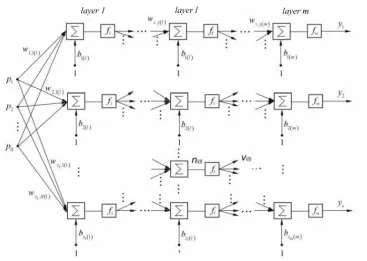
Fig. 3. Multilayer perceptron with m layers of neurons
p1, p2,…, pR – input signals
m – number of layers
z
l– number of neurons in
l
-thlayer
wi,j(l) – weight between i-th neuron in l-th layer and j-th neuron in l-1-th layer.
b
i(l)– bias of
i
-thneuron in
l
-thlayer
vi(l) – output of i-th neuron in l-th layer
fl – activation function of neurons in l-th layer
Backpropagation algorithm requires existing training points defined by their input vectors and vectors of targets.
q1, q2,…,qN– N training points
p1(1), p2(1),…, pR(1) – inputs of training point q1
p1(N), p2(N),…, pR(N) – inputs of training point qN
t1(1), t2(1),…, ts(1) – targets of training point q1
t1(N), t2(N),…, ts(N)– targets of training point qN
First step of backpropagation algorithm is initialization of starting values for weights and biases wi,j(l)(1) i bi(l)(1). These values are chosen randomly within an interval.
After defining the learning rate and criterion for learning stop, one of the training points is being placed on neural network input. Then, the outputs of all neurons are calculated. Output of
( ) ) ( ) ( ) ( k l i l k li
f
n
v
(1)) ( 1 ) ( ) ( ) ( ) 1 ( 1 ) (
, il
z
j k
l
i
w
v
b
n
k l j l l j i
(2)Output of i-th neuron in m-th layer is at the same time i-th output of neural network:
( ) ) ( ) ( ) ( ) ( k m i m k i k mi
y
f
n
v
(3)
1 1 ) ( ) ( ) 1 ( ) ( , ) ( ) ( m z j m i k m j m j i k mi
w
v
b
n
(4)Equations (1)-(4) evaluate outputs from all neurons. Now, adaptation of neural network parameters (weights and biases) can start. Criteria function, which describes how much real outputs disagree with targets, is defined:
21 ) ( ) ( ) ( 2 1 ) ( ) ( 1 2 ) ( ) (
2
1
2
1
2
1
s i k m i k i s i k i k i s i k ik
e
t
y
t
v
E
(5)The objective of adapting parameters is to make real outputs as close as possible to targets. Adaptation of weights between neurons in m-1-th layer (last hidden layer) and neurons in m-th
layer (output layer) is performing iteratively:
)
1
(
)
(
)
1
(
, ( ) , ( ) ) (,
t
w
t
w
t
w
i jm ij m ijm (6))
(
)
1
(
, ( ) ) ( , ) ( ) (,
w
t
w
E
t
w
i jmm j i k m j
i
(7)where α is positive number – momentum constant, which defines influence of previous
modification on a new one. Usually it takes value 0.9. Equation (8) represents adaptation of biases of neurons in output layer.
) ( ) ( ) ( )
(
(
1
)
(
)
m i k m i m i
b
E
t
b
t
b
(8)Adaptation of neural network parameters in other layers is performing according to the equations (9), (10) and (11).
)
1
(
)
(
)
1
(
, () , () ) (,
t
w
t
w
t
w
ijl i jl i jl (9))
(
)
1
(
, () ) ( , ) ( ) (,
w
w
t
E
t
w
i jll j i k l j
i
(10)) ( ) ( ) ( )
(
(
1
)
(
)
l i k l i l i
b
E
t
b
t
b
Adaptation of neural network parameters is performed for all training points. After all training points are presented to neural network epoch is done and criterion for learning stop is checked. If it is satisfied learning stops, otherwise new epoch starts.
Data set for training and testing neural network
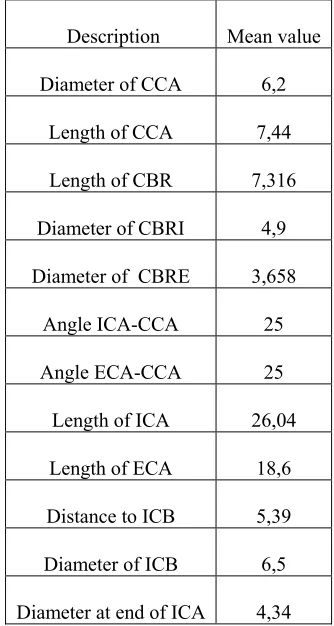
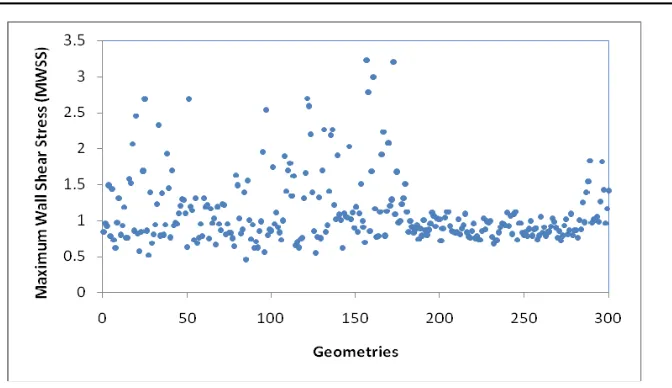
To demonstrate the applicability of multilayer perceptron for assesing the relationships between a wide range of geometric parameters and MWSS, geometric parameters shown in Figure 1 are used as input variables for neural network (12 input variables total). The perturbation of each parameter was taken as 30% of the corresponding mean value given in Table 1. To obtain reasonable data set, 300 geometries were generated. 280 geometries were generated for training neural network, and 20 geometries were generated for testing neural network. The values of geometric parameters for all geometries used for training and testing neural network are shown in the form of a scatter plots in Figure 5.
Description Mean value
Diameter of CCA 6,2
Length of CCA 7,44
Length of CBR 7,316
Diameter of CBRI 4,9
Diameter of CBRE 3,658
Angle ICA-CCA 25
Angle ECA-CCA 25
Length of ICA 26,04
Length of ECA 18,6
Distance to ICB 5,39
Diameter of ICB 6,5
Diameter at end of ICA 4,34
Table 1. Dimensions of human carotid artery bifurcation
All geometries were created by entering corresponding parameters values in FEM software. For each geometry the value of MWSS is extracted. Density of the blood is =1.05 [g/cm3],
Fig. 4. Scatter plot of the MWSS vs geometry cases considered (Units of MWSS in Pa)
Neural network details
In the present work we used multilayer perceptron neural network and we trained it using backpropagation algorithm. For creating and training neural network we used Neural Network Toolbox 4.0 developed for MATLAB 6.0.
Multilayer perceptron with 5 neurons in hidden layer gave the best results. Numbers of neurons in input and output layers are defined by the problem we are solving, hence neural network has 12 neurons in input layer and 1 neuron in output layer (figure 6). This structure of neural network can be shortly written as 12-5-1.
Activation functions of neurons in hidden layer are unipolar sigmoid (which gave better results than bipolar sigmoid functions), while the activation function of neuron in output layer is linear.
In order to improve learning success and learning rate, we used moment method. Momentum constant was define as 0.95 while learning rate was 0.01.
Two criteria for learning stop were defined: mean square error and maximum number of epochs. Mean square error was defined as MS=0,01, while the maximum number of epochs was 19000. Learning stops when first of the two criteria is satisfied. In our case learning stopped after 19000 epochs of learning.
Fig. 6. Structure of used neural network
Results of prediction
MWSS
MWSS
MWSS
'
(12)The differences between calculated and predicted values of MWSS are shown in table 2.
Computed values of Maximum Wall Shear Stress
(MWSS)
Predicted values of Maximum Wall Shear
Stress (MWSS')
∆MWSS ∆MWSS,% MWSS /
1 0.864 0.886 0.022 2.581 %
2 0.763 0.709 0.054 7.064 %
3 1.010 1.279 0.269 26.673 %
4 0.875 0.868 0.007 0.800 %
5 1.250 1.400 0.150 11.984 %
6 0.970 1.050 0.080 8.278 %
7 1.380 1.634 0.254 18.370 %
8 1.540 1.656 0.116 7.500 %
9 1.830 1.758 0.072 3.918 %
10 0.972 0.923 0.049 5.041 %
11 1.020 1.037 0.017 1.637 %
12 1.010 1.006 0.004 0.436 %
13 1.050 0.961 0.089 8.495 %
14 0.987 0.882 0.105 10.659 %
15 1.260 1.393 0.133 10.516 %
16 1.820 1.847 0.027 1.456 %
17 1.430 1.462 0.032 2.224 %
18 0.960 0.999 0.039 4.063 %
19 1.160 1.260 0.100 8.655 %
te
st
ing poi
nt
s
20 1.420 1.462 0.042 2.972 %
Min. 0.004 0.436 %
Max. 0.269 26.673 %
Table 2. Results of predicting MWSS using neural network
Fig. 7. Calculated and predicted values of MWSS for 20 testing points.
Discussion and Conclusion
This work presented a neural network approach for data mining. The methodology was applied on a hemodynamic problem in which the geometric parameters affecting maximal wall shear stress (MWSS) in the human carotid bifurcation were analyzed. The results obtained from computer simulations were used as training data to construct a multilayer perceptron neural network. After neural network was constructed, it was tested on a 20 new geometries that were not in the training data set. The results have shown reasonable small errors, which indicates that the multilayer perceptron is capable of predicting MWSS for different geometries of carotid artery bifurcation. This can be used to aid the assessment of stroke risk for a given patient’s geometry in real time.
References
Bharadvaj B.K., Mabon R.F., Giddens D.P., Steady flow in a model of the human carotid bifurcation, Part I – Flow visualization. Journal of Biomechanics 1982, 15:349-362.
Glagov S., Zarins C., Giddens D.P., Ku D.N., Hemodynamics andatherosclerosis Insights and perspectives gained from studies of human arteries. Archives of Pathology & Laboratory Medicine 1988, 112:1018-1031.
Kojić M., Filipović N., Stojanović B., Kojić N., Computer Modeling in Bioengineering, John Wiley & Sons, Inc., 2008.
Lorthois S., Lagree P.Y., Marc-Vergnes J.P., Cassot .F, Maximal wall shear stress in arterial stenoses: Application to the internal carotid arteries, ASME Journal of Biomechanical Engineering 2000, 122:661-666.
Perktold K., Florian H., Hilbert D., Analysis of pulsatile blood flow: A carotid siphon model, Journal of Biomedical Engineering 1987, 9:46-53.
Perktold K., Peter R.O., Resch M., Langs G., Pulsatile non-Newtonian blood flow in three-dimensional carotid bifurcation models: A numerical study of flow phenomena under different bifur-cation angles. Journal of Biomedical Engineering 1991, 13:507-515.
Ranković V., Intelligent control, Faculty of Mechanical Engineering, Kragujevac, 2008. Rubinstein R.Y., Simulation and the Monte Carlo Method,
John Wiley & Sons, Inc
., 1981. Schulz U.G.R., Rothwell P.M., Sex differences in carotid bifurcation anatomy and thedistribution of atherosclerotic plaque. Stroke2001, 32:1525-1531.
Shepherd J. Adrian, Second-Order Methods for Neural Networks: Fast and Reliable Training Methods for Multi-Layer Perceptrons, Springer, 1997