www.theoryofcomputing.org
Tensor-based Hardness of the
Shortest Vector Problem to within
Almost Polynomial Factors
Ishay Haviv
∗Oded Regev
†Received: August 26, 2011; published: September 25, 2012.
Abstract: We show that unlessNP⊆RTIME(2poly(logn)), there is no polynomial-time algorithm approximating the Shortest Vector Problem (SVP) onn-dimensional lattices in the `pnorm (1≤p<∞) to within a factor of 2(logn)
1−ε
for anyε>0. This improves the previous
best factor of 2(logn)1/2−ε under the same complexity assumption due to Khot (J. ACM, 2005). Under the stronger assumptionNP*RSUBEXP, we obtain a hardness factor ofnc/log logn for somec>0.
Our proof starts with Khot’sSVPinstances that are hard to approximate to within some constant. To boost the hardness factor we simply apply the standard tensor product of lattices. The main novelty is in the analysis, where we show that the lattices of Khot behave nicely under tensorization. At the heart of the analysis is a certain matrix inequality which was first used in the context of lattices by de Shalit and Parzanchevski (2006).
ACM Classification:F.2.2, F.1.3, G.1.6
AMS Classification:68Q17, 52C07, 11H06, 11H31, 05B40
Key words and phrases:lattices, shortest vector problem, NP-hardness, hardness of approximation
∗Supported by the Adams Fellowship Program of the Israel Academy of Sciences and Humanities. Work done while at Tel
Aviv University.
†Supported by an Alon Fellowship, by the Binational Science Foundation, by the Israel Science Foundation, by the European
1
Introduction
Alatticeis a periodic geometric object defined as the set of all integer combinations of some linearly independent vectors inRn. The interesting combinatorial structure of lattices has been investigated by mathematicians over the last two centuries, and for at least three decades it has also been studied from an asymptotic algorithmic point of view. Roughly speaking, most fundamental problems on lattices are not known to be efficiently solvable. Moreover, there are hardness results showing that such problems cannot be solved by polynomial-time algorithms unless the polynomial-time hierarchy collapses. One of the main motivations for research on the hardness of lattice problems is their applications in cryptography, as was demonstrated by Ajtai [3], who came up with a construction of cryptographic primitives whose security relies on the worst-case hardness of certain lattice problems.
Two main computational problems associated with lattices are the Shortest Vector Problem (SVP) and the Closest Vector Problem (CVP). In the former, for a lattice given bysomebasis we are supposed to find (the length of) a shortest nonzero vector in the lattice. The problemCVPis an inhomogeneous variant ofSVP, in which given a lattice and some target point one has to find (its distance from) the closest lattice point. The hardness of lattice problems partly comes from the fact that there are many possible bases for the same lattice.
In this paper we improve the best hardness result known forSVP. Before presenting our results let us start with an overview of related work.
1.1 Related work
In the early 1980s, Lenstra, Lenstra, and Lovász (LLL) [20] presented the first polynomial-time approx-imation algorithm forSVP. Their algorithm achieves an approximation factor of 2O(n), wherenis the dimension of the lattice. Using their algorithm, Babai [7] gave an approximation algorithm forCVP
achieving the same approximation factor. A few years later, improved algorithms were presented for both problems, obtaining a slightly sub-exponential approximation factor, namely 2O(n(log logn)2/logn)[31], and this has since been improved slightly [4,26]. The best algorithm known for solvingSVPexactly requires exponential running time inn[18,4,26]. All the above results hold with respect to any`pnorm
(1≤p≤∞).
On the hardness side, it was proven in 1981 by van Emde Boas [32] that it isNP-hard to solveSVP
exactly in the`∞norm. The question of extending this result to other norms, and in particular to the
Euclidean norm`2, remained open until the breakthrough result by Ajtai [2] showing that exactSVPin the`2norm isNP-hard under randomized reductions. Then, Cai and Nerurkar [10] obtained hardness of approximation to within 1+n−ε for any
ε>0. The first inapproximability result ofSVPto within a
factor bounded away from 1 is that of Micciancio [21], who showed that under randomized reductions
SVPin the`pnorm isNP-hard to approximate to within any factor smaller than p √
2. For the`∞norm, a
considerably stronger result is known: Dinur [14] showed thatSVPisNP-hard to approximate in the`∞
norm to within a factor ofnc/log lognfor some constantc>0.
might be possible to improve this to 2(logn)1−ε, as this is the hardness factor known for the analogous problem in linear codes [16].
Khot’s proof does not work for the`1norm. However, it was shown in [30] that for lattice problems, the`2norm is the easiest in the following sense: for any 1≤p≤∞, there exists a randomized reduction from lattice problems such asSVPandCVPin the`2norm to the respective problem in the`pnorm with
essentially the same approximation factor. In particular, this implies that Khot’s results also hold for the `1norm.
Finally, we mention that a considerably stronger result is known for CVP, namely that for any 1≤p≤∞, it isNP-hard to approximate CVPin the`p norm to withinnc/log logn for some constant
c>0 [15]. We also mention that in contrast to the above hardness results, it is known that for anyc>0,
SVPandCVPare unlikely to beNP-hard to approximate to within apcn/lognfactor, as this would imply the collapse of the polynomial-time hierarchy [17,1].
1.2 Our results
The main result of this paper improves the bestNP-hardness factor known forSVPunder randomized quasipolynomial-time reductions. This and two additional hardness results are stated in the following theorem. Here,RTIMEis the randomized one-sided error analogue ofDTIME. Namely, for a function f we denote byRTIME(f(n))the class of problems having a probabilistic algorithm running in time O(f(n))on inputs of sizenthat acceptsYESinputs with probability at least 2/3, and rejectsNOinputs with certainty.
Theorem 1.1. For every1≤p≤∞the following holds.
1. For every constant c≥1, there is no polynomial-time algorithm that approximatesSVPin the`p
norm to within a factor of c unless
NP⊆RP=[
c≥1
RTIME(nc).
2. For everyε>0, there is no polynomial-time algorithm that approximatesSVPon n-dimensional lattices in the`pnorm to within a factor of2(logn)
1−ε
unless
NP⊆RTIME(2poly(logn)).
3. There exists a c>0such that there is no polynomial-time algorithm that approximatesSVPon n-dimensional lattices in the`pnorm to within a factor of nc/log lognunless
NP⊆RSUBEXP= \
δ>0
RTIME(2nδ).
1.3 Techniques
A standard method to prove hardness of approximation for large constant or super-constant factors is to first prove hardness for some fixed constant factor, and thenamplifythe constant using some polynomial-time (or quasipolynomial-polynomial-time) transformation. For example, thetensor productof linear codes is used to amplify theNP-hardness of approximating the minimum distance in a linear code of block lengthn to arbitrarily large constants under polynomial-time reductions and to 2(logn)1−ε (for anyε >0) under quasipolynomial-time reductions [16]. This example motivates one to use the tensor product of lattices to increase the hardness factor known for approximatingSVP. However, whereas the minimum distance of thek-fold tensor product of a codeCis simply thekth power of the minimum distance ofC, the behavior of the length of a shortest nonzero vector in a tensor product of lattices is more complicated and not so well understood.
Khot’s approach in [19] was to prove a constant hardness factor forSVPinstances that have some “code-like” properties. The rationale is that such lattices might behave in a more predictable way under the tensor product. The construction of these “basic”SVPinstances is ingenious, and is based on BCH codes as well as a restriction into a random sublattice. However, even for these code-like lattices, the behavior of the tensor product was not clear. To resolve this issue, Khot introduced a variant of the tensor product, which he calledaugmented tensor product, and using it he showed the hardness factor of 2(logn)1/2−ε. This unusual hardness factor can be seen as a result of the augmented tensor product. In more detail, for the augmented tensor product to work, the dimension of Khot’s basicSVPinstances grows tonΘ(k), where
kdenotes the number of times we intend to apply the augmented tensor product. After applying it, the dimension grows tonΘ(k2)and the hardness factor becomes 2Θ(k). This limits the hardness factor as a
function of the dimensionnto 2(logn)1/2−ε.
Our main contribution is showing that Khot’s basicSVPinstancesdobehave well under the (standard) tensor product. The proof of this fact uses a new method to analyze vectors in the tensor product of lattices, and is related to a technique used by de Shalit and Parzanchevski [13].Theorem 1.1now follows easily: we start with (a minor modification of) Khot’s basicSVPinstances, which are known to be hard to approximate to within some constant. We then apply thek-fold tensor product for appropriately chosen values ofkand obtain instances of dimensionnO(k)with hardness 2Ω(k).
1.4 Open questions
Some open problems remain. The most obvious is proving thatSVPis hard to approximate to within factors greater thannc/log lognunder some plausible complexity assumption. Such a result, however, is not known forCVPnor for the minimum distance problem in linear codes, and most likely proving it there first would be easier. An alternative goal is to improve on theO(p
n/logn)upper bound beyond whichSVPis not believed to beNP-hard [17,1].
certain number-theoretic conjecture.) Ideas appearing in the recentNP-hardness proofs of the minimum distance problem in linear codes [11,6] might be useful. Finally, we mention that a significant step towards derandomization was recently made by Micciancio [23]: he strengthened our results by showing reductions with only one-sided error.
1.5 Outline
The rest of the paper is organized as follows. InSection 2we gather some background on lattices and on the central tool in this paper—the tensor product of lattices. InSection 3we proveTheorem 1.1. For the sake of completeness,Section 4provides a summary of Khot’s work [19] together with the minor modifications that we need to introduce.
2
Preliminaries
2.1 Lattices
Alatticeis a discrete additive subgroup ofRn. Equivalently, it is the set of all integer combinations
L(b1, . . . ,bm) = (
m
∑
i=1
xibi:xi∈Zfor all 1≤i≤m )
ofmlinearly independent vectorsb1, . . . ,bminRn(n≥m). If the rankmequals the dimensionn, then we say that the lattice isfull-rank. The set{b1, . . . ,bm}is called abasisof the lattice. Note that a lattice
has many possible bases. We often represent a basis by ann×mmatrixBhaving the basis vectors as columns, and we say that the basisB generatesthe latticeL. In such case we writeL=L(B). It is well known and easy to verify that two basesB1andB2generate the same lattice if and only ifB1=B2U for someunimodularmatrixU∈Zm×m(i. e., a matrix whose entries are all integers and whose determinant is±1). Thedeterminantof a lattice generated by a basisBis det(L(B)) =pdet(BTB). It is easy to show
that the determinant of a lattice is independent of the choice of basis and is thus well-defined. Asublattice ofLis a latticeL(S)⊆Lgenerated by some linearly independent lattice vectorsS={s1, . . . ,sr} ⊆L. It is known that any integer matrixBcan be written as[H0]U whereHhas full column rank andUis unimodular. One way to achieve this is by using the Hermite Normal Form (see, e. g., [12, Page 67]).
For any 1≤p<∞, the`pnorm of a vectorx∈Rnis defined askxkp=pp ∑i|xi|pand its`∞norm is
kxk∞=maxi|xi|. One basic parameter of a latticeL, denoted byλ( p)
1 (L), is the`p norm of a shortest
nonzero vector in it. Equivalently,λ1(p)(L)is the minimum`pdistance between two distinct points in
the latticeL. This definition can be generalized to define theithsuccessive minimumas the smallestr such thatBp(r)containsilinearly independent lattice points, whereBp(r)denotes the`pball of radiusr
centered at the origin. More formally, for any 1≤p≤∞, we define
λi(p)(L) =min
n r: dim
span L∩Bp(r)
≥i o
.
In 1896, Hermann Minkowski [28] proved the following classical result, known as Minkowski’s First Theorem. We consider here the`2norm, although the result has an easy extension to other norms. For a simple proof the reader is referred to [24, Chapter 1, Section 1.3].
Theorem 2.1(Minkowski’s First Theorem). For any rank-r latticeL,
det(L)≥
λ1√(L) r
r .
Our hardness of approximation results will be shown through the promise versionGapSVPγp, defined for any 1≤p≤∞and for any approximation factorγ≤1 as follows.
Definition 2.2(Shortest Vector Problem). An instance ofGapSVPγpis a pair(B,s), whereBis a lattice
basis andsis a number. InYESinstancesλ1(p)(L(B))≤γ·s, and inNOinstancesλ1(p)(L(B))>s.
2.2 Tensor product of lattices
A central tool in the proof of our results is thetensor productof lattices. Let us first recall some basic definitions. For two column vectorsuandvof dimensionsn1andn2respectively, we define their tensor productu⊗vas then1n2-dimensional column vector
u1v .. . un1v
.
If we think of the coordinates ofu⊗vas arranged in ann1×n2matrix, we obtain the equivalent description ofu⊗vas the matrixu·vT. More generally, anyn1n2-dimensional vectorwcan be written as ann1×n2 matrixW. To illustrate the use of this notation, notice that ifW is the matrix corresponding towthen
kwk22=tr(W WT). (2.1)
Finally, for ann1×m1matrixAand ann2×m2matrixB, one defines their tensor productA⊗Bas the n1n2×m1m2matrix
A11B · · · A1m1B
..
. ...
An11B · · · An1m1B
.
LetL1be a lattice generated by then1×m1matrixB1andL2be a lattice generated by then2×m2 matrixB2. Then the tensor product ofL1 andL2is defined as then1n2-dimensional lattice generated by then1n2×m1m2matrixB1⊗B2, and is denoted byL=L1⊗L2. Equivalently,Lis generated by the m1m2vectors obtained by taking the tensor product of two column vectors, one fromB1and one fromB2. If we think of the vectors inLasn1×n2matrices, then we can also define it as
L=L1⊗L2={B1X BT2 :X∈Z
with each entry inX corresponding to one of them1m2 generating vectors. We will mainly use this definition in the proof of the main result.
As alluded to before, in the present paper we are interested in the behavior of the shortest nonzero vector in a tensor product of lattices. It is easy to see that for any 1≤p≤∞and any two latticesL1and
L2, we have
λ1(p)(L1⊗L2)≤λ(
p)
1 (L1)·λ(
p)
1 (L2). (2.2)
Indeed, any two vectorsv1andv2satisfykv1⊗v2kp=kv1kp· kv2kp. Applying this to shortest nonzero
vectors ofL1andL2implies inequality (2.2).
Inequality (2.2) has an analogue for linear codes, withλ1(p)replaced by the minimum distance of
the code under the Hamming metric. There, it is not too hard to show that the inequality is in fact an equality: the minimal distance of the tensor product of two linear codes always equals to the product of their minimal distances. However, contrary to what one might expect, there exist lattices for which inequality (2.2) isstrict. More precisely, for any sufficiently largenthere existn-dimensional latticesL1 andL2satisfying
λ1(L1⊗L2)<λ1(L1)·λ1(L2).
The following lemma due to Steinberg shows this fact. Although we do not use this fact later on, the proof is instructive and helps motivate the need for a careful analysis of tensor products. To present this proof we need the notion of adual lattice. For a full-rank latticeL⊆Rn, itsduallatticeL∗is defined as
L∗
={x∈Rn:hx,yi ∈Zfor ally∈L}.
Aself-duallattice is one that satisfiesL=L∗. It can be seen that for a full-rank latticeLgenerated by a
basisB, the basis(B−1)T generates the latticeL∗.
Lemma 2.3([27, Page 48]). For any n≥1there exists an n-dimensional self-dual latticeLsatisfying
λ1(L⊗L∗)≤
√
n andλ1(L) =λ1(L∗) =Ω(
√
n).
Proof. We first show that for any full-rankn-dimensional latticeL,λ1(L⊗L∗)≤
√
n. LetLbe a lattice generated by a basisB= (b1, . . . ,bn). Let(B−1)T = (b˜1, . . . ,b˜n)be the basis generating its dual lattice
L∗. Now consider the vector
∑in=1bi⊗b˜i∈L⊗L∗. Using our matrix notation, this vector can be written
as
B In((B−1)T)T=
B B−1=In,
and clearly has`2norm√n. To complete the proof, we need to use the (non-trivial) fact that for any n≥1 there exists a full-rank,n-dimensional and self-dual lattice with shortest nonzero vector of norm Ω(
√
n). This fact is due to Conway and Thompson; see [27, Page 46] for details.
3
Proof of results
Theorem 3.1. For any1≤p≤∞there exist c,C>0 such that the following holds. There exists a randomized reduction that takes as input aSATinstance and an integer k≥1and outputs aGapSVPγp instance of dimension nCkwith gapγ=2−ck, where n denotes the size of theSATinstance. The reduction
runs in time polynomial in nCkand has two-sided error, namely, given aYES(resp.,NO) instance it outputs aYES(resp.,NO) instance with probability9/10.
In fact, we will only need to prove this theorem for the casep=2 since, as is easy to see, the general case follows from the following theorem (applied with, say,ε =1/2).1
Theorem 3.2([30]). For anyε >0,γ<1and1≤p≤∞there exists a randomized polynomial-time reduction fromGapSVP2γ0 toGapSVPγp, whereγ0= (1−ε)γ.
3.1 BasicSVP
As already mentioned, our reduction is crucially based on a hardness result of a variant ofSVPstemming from Khot’s work [19]. Instances of this variant have properties that make it possible to amplify the gap using the tensor product. The following theorem summarizes the hardness result on which our proof is based. For a proof the reader is referred toSection 4.
Theorem 3.3([19]). There are a constantγ<1and a polynomial-time randomized reduction fromSAT
toSVPoutputting a lattice basis B, satisfyingL(B)⊆Znfor some integer n, and an integer d, such that:
1. For anyYESinstance ofSAT, with probability at least9/10,λ1(L(B))≤γ·
√
d.
2. For anyNOinstance ofSAT, with probability at least9/10, for every nonzero vector v∈L(B),
• v has at least d nonzero coordinates, or
• all coordinates of v are even and at least d/4of them are nonzero, or • all coordinates of v are even andkvk2≥d.
In particular,λ1(L(B))≥
√
d.
3.2 Boosting theSVPhardness factor
As mentioned before, we boost the hardness factor using the tensor product of lattices. For a latticeLwe denote byL⊗kthek-fold tensor product ofL. An immediate corollary of inequality (2.2) is that if(B,d)
is aYESinstance of theSVPvariant inTheorem 3.3, andL=L(B), then
λ1(L⊗k)≤γkdk/2. (3.1)
For the case in which(B,d)is aNOinstance we will show that any nonzero vector ofL⊗khas norm at leastdk/2, i. e.,
λ1(L⊗k)≥dk/2. (3.2)
This yields a gap ofγk between the two cases. Inequality (3.2) easily follows by induction from the
central lemma below, which shows thatNOinstances “tensor nicely.”
1We note that our results can be shown directly for any 1<p<
Lemma 3.4. Let(B,d)be aNOinstance of theSVPvariant given inTheorem 3.3, and denote byL1the lattice generated by the basis B. Then for any latticeL2,
λ1(L1⊗L2)≥
√
d·λ1(L2).
The proof of this lemma is based on some properties of sublattices of NOinstances which are established in the following claim.
Claim 3.5. Let(B,d)be aNOinstance of theSVPvariant given inTheorem 3.3, and letL⊆L(B)be a sublattice of rank r>0. Then at least one of the following properties holds:
1. Every basis matrix ofLhas at least d nonzero rows (i. e., rows that are not all zero).
2. Every basis matrix ofLcontains only even entries and has at least d/4nonzero rows.
3. det(L)≥dr/2.
Proof. Assume thatLdoes not have either of the first two properties. Our goal is to show that the third property holds. Since the first property does not hold, we haver<dand also that any vector inLhas fewer thand nonzero coordinates. ByTheorem 3.3, this implies thatL⊆2·Zn. By the assumption
that the second property does not hold, there must exist a basis ofLthat has fewer thand/4 nonzero rows. Therefore, all nonzero vectors inLhave fewer thand/4 nonzero coordinates, and hence have norm at leastd, again byTheorem 3.3. We conclude thatλ1(L)≥d, and by Minkowski’s First Theorem (Theorem 2.1) andr<dwe have
det(L)≥
λ1√(L) r
r
≥dr/2.
Proof ofLemma 3.4. Letvbe an arbitrary nonzero vector inL1⊗L2. Our goal is to show thatkvk2≥
√
d·λ1(L2). We can writevin matrix notation asB1X B2T, where the integer matrixB1 is a basis of
L1,B2 is a basis ofL2, and X is an integer matrix of coefficients. LetU be a unimodular matrix for whichX= [H0]U, whereH is a matrix with full column rank. Thus, the vectorvcan be written as B1[H0](B2UT)T. SinceUTis also unimodular, the matricesB2andB2UT generate the same lattice. Now remove fromB2UT the columns corresponding to the zero columns in[H0]and denote the resulting matrix byB02. Furthermore, denote the matrixB1HbyB01. Observe that both of the matricesB01andB02 are bases of the lattices they generate, i. e., they have full column rank. The vectorvequalsB01B02T, where
L0
1:=L(B
0
1)⊆L1andL02:=L(B
0
2)⊆L2.
Claim 3.5 guarantees that the lattice L01 defined above has at least one of the three properties mentioned in the claim. We show thatkvk2≥√d·λ1(L02)in each of these three cases. Then, by the fact thatλ1(L02)≥λ1(L2), the lemma will follow.
Case 1: Assume that at leastd of the rows in the basis matrixB01are nonzero. Thus, at leastd of the rows ofB01B02T are nonzero lattice points fromL02, and thus
kvk2≥
√
Case 2: Assume that the basis matrixB01contains only even entries and has at leastd/4 nonzero rows. Hence, at leastd/4 of the rows ofB01B02T are even multiples of nonzero lattice vectors fromL02. Therefore, every such row has`2norm at least 2·λ1(L02), and it follows that
kvk2≥
r d
4·2·λ1(L
0
2) =
√
d·λ1(L02).
The third case is based on the following central claim, which is similar to Proposition 1.1 in [13]. The proof is based on an elementary matrix inequality relating the trace and the determinant of a symmetric positive semidefinite matrix (see, e. g., [9, Page 47]).
Claim 3.6. Let L1 andL2 be two rank-r lattices generated by the bases U = (u1, . . . ,ur) and W =
(w1, . . . ,wr) respectively. Consider the vector v=∑ri=1ui⊗wi in L1⊗L2, which can be written as U IrWT=UWT in matrix notation. Then,
kvk2≥√r· det(L1)·det(L2) 1/r
.
Proof. Define the twor×rsymmetric positive definite matricesG1=UTU andG2=WTW (known as the Gram matrices ofU andW). By the fact that tr(AB) =tr(BA)for any matricesAandBand by equation (2.1),
kvk22=tr (UWT)(UWT)T
=tr(G1G2) =tr G1G1/22 G1/22
=tr G1/22 G1G1/22
,
whereG1/22 is the positive square root ofG2. The matrixG=G1/22 G1G1/22 is also symmetric and positive definite, and as such it hasrreal and positive eigenvalues. We can thus apply the inequality of arithmetic and geometric means on these eigenvalues to get
kvk22=tr(G)≥rdet(G)1/r=r· det(G1)·det(G2)1/
r
.
Taking the square root of both sides of this equation completes the proof.
Equipped withClaim 3.6we turn to deal with the third case. In order to bound from below the norm ofv, we apply the claim to its matrix formB01B02T with the latticesL01andL02as above.
Case 3: Assume that the lattice L01 satisfies det(L10)≥dr/2, where r denotes its rank. Combining
Claim 3.6and Minkowski’s First Theorem we have that
kvk2≥√r· det(L01)·det(L02)1/r≥√r·(dr/2)1/r·λ1√(L02)
r =
√
d·λ1(L02),
3.3 Proof of the main theorem
Proof ofTheorem 3.1. Recall that it suffices to prove the theorem forp=2. Given aSATinstance of size n, we apply the reduction fromTheorem 3.3and obtain in time poly(n)a pair(B,d)whereBis a basis of a poly(n)-dimensional lattice. We then output(B⊗k,dk), whereB⊗kis thek-fold tensor product ofB, i. e., a basis of the latticeL(B)⊗k. The dimension of this lattice is poly(nk), and combining inequalities (3.1) and (3.2) we infer a gap of 2−ck.
Proof ofTheorem 1.1. Foritem 1, choosekto be a sufficiently large constant and applyTheorem 3.1. This shows that any constant factor approximation algorithm toSVPimplies a two-sided error algorithm forSAT. Using known self-reducibility properties ofSAT(see, e. g., [29, Chapter 11]), this also implies a one-sided error polynomial-time algorithm forSAT. Foritem 2, applyTheorem 3.1withk= (logn)1/ε (wherenis the size of the inputSATinstance) and letN=nCkbe the dimension of the output lattice. Since
k=
logN
C 1+1ε
>
logN C
1−ε ,
the gap we obtain as a function of the dimension N is 2Ω((logN)1−ε)
. Therefore, an algorithm that approximatesSVPbetter than this gap implies a randomizedSATalgorithm running in time 2poly(logn), and hence the desired containmentNP⊆RTIME(2poly(logn)). Item 3follows similarly by applying
Theorem 3.1withk=nδ for allδ >0.
4
Proof of
Theorem 3.3
In this section we proveTheorem 3.3. The proof is essentially the same as the one in [19] with minor modifications.
4.1 Comparison with Khot’s theorem
4.2 The proof
The proof ofTheorem 3.3proceeds in three steps. In the first, a variant of the Exact Set Cover problem, which is known to beNP-hard, is reduced to a gap variant ofCVP. In the second step we construct a basis Bintof a lattice which, informally, contains many short vectors in theYEScase, and few short vectors in theNOcase. Finally, in the third step we complete the reduction by taking a random sublattice.
4.2.1 Step 1
First, consider the following variant of Exact Set Cover. Letη>0 be an arbitrarily small constant.
An instance of the problem is a pair(S,d), whereS={S1, . . . ,Sn0}is a collection of subsets of some
universe[n00] ={1, . . . ,n00}, anddis a positive integer. InYESinstances, there existsS0⊆Sof sizeηd
that covers each element of the universe exactly once. InNOinstances, there is noS0⊆Sof size less thandthat covers all elements of the universe. This problem is known to beNP-hard for an arbitrarily small 0<η<1 and forn0=O(d)[8]. Moreover, it is easy to see that the problem remainsNP-hard if
we fixηto be any negative power of 2 and restrictdto be a power of 2. Thus, to proveTheorem 3.3, it
suffices to reduce from this problem.
In the first step we use a well-known reduction from the above variant of Exact Set Cover to a variant ofCVP. For an instance(S,d)we identifySwith then00×n0matrix over{0,1}whose columns are the characteristic vectors of the sets inS. The reduction outputs an instance(BCVP,t), whereBCVPis a basis generating the lattice{y∈Zn
0
:Sy=0}andtis some integer vector satisfyingSt=−(1,1, . . . ,1). (If no suchtexists, the reduction outputs an arbitraryNOinstance.) We note that givenSthe basisBCVPcan be constructed in polynomial time (see, e. g., [22, Lemma 3.1]).
Lemma 4.1. If(S,d)is aYESinstance of the above variant of Exact Set Cover, then there is a lattice vector z∈L(BCVP)such that z−t is a{0,1}vector and has exactlyηd coordinates equal to1. If(S,d)
is aNOinstance, then for any lattice vector z∈L(BCVP)and any nonzero integer j0, the vector z+j0t has at least d nonzero coordinates.
Proof. If(S,d)is aYESinstance then there exists a vectory∈ {0,1}n0 with exactly
ηdcoordinates equal to 1 for whichSy= (1,1, . . . ,1). This implies thatS(y+t) =0, soz=y+tis the required lattice vector. On the other hand, if(S,d)is aNOinstance, then for anyz∈L(BCVP)we haveS(z+j0t) =−j0·(1,1, . . . ,1). This implies that the nonzero coordinates ofz+j0tcorrespond to a coverS0⊆Sof all elements in[n00], and hence their number must be at leastd.
4.2.2 Step 2
The second step of the reduction is based on BCH codes, as described in the following theorem.
Theorem 4.2([5, Page 255]). Let N,d,h be integers satisfying h= (d/2)log2N. Then there exists an efficiently constructible matrix PBCHof size h×N with{0,1}entries such that the rows of the matrix are linearly independent over GF(2)and any d columns of the matrix are linearly independent over GF(2).
Lemma 4.3. Every nonzero vector inL(BBCH) either has at least d nonzero coordinates or all of its coordinates are even. Also, for any r≥1it is possible to find in polynomial time with probability at least 99/100a vector s∈ {0,1}N, such that there are at least
1 100·2h
N
r
distinct lattice vectors z∈L(BBCH)satisfying that z−s is a{0,1}vector with exactly r coordinates equal to1.
Proof. Lety∈L(BBCH)be a nonzero lattice vector. Observe that ifyhas an odd coordinate then its odd coordinates correspond to column vectors ofPBCHthat sum to the zero vector overGF(2). Therefore, their number must be at leastd. This proves the first statement.
We now prove the second statement. Consider the setL(BBCH)∩ {0,1}N whose size is 2N−h(since as a subset ofGF(2)Nit is the kernel ofP
BCHwhose dimension isN−h). In order to chooseswe first uniformly pick a vector in this set and then we uniformly pickrof its coordinates and flip them. For a vectors∈ {0,1}NletA
sdenote the number of ways in the above process to obtainsamong the 2N−h· Nr
possible ways. The probability that the chosenssatisfies
As≤
1 100·2h
N
r
is
∑
ss.t.As≤ 1
100·2h(
N r)
As
2N−h Nr≤2
N·
1 100·2h
N r
2N−h Nr ≤ 1 100,
thus with probability at least 99/100 we obtain ansthat satisfies
As>
1 100·2h
N
r
.
It remains to notice that such ansalso satisfies the requirement in the statement of the lemma (since from each vector in{0,1}Nof Hamming distancerfromswe can obtainz∈L(B
BCH)as in the statement by simply adding 2 to a subset of its coordinates).
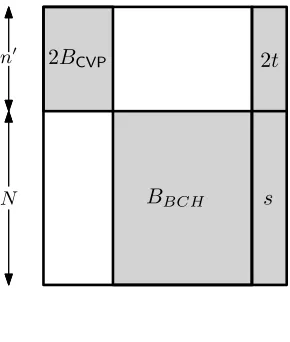
We now construct theintermediate latticegenerated by a basis matrixBint(seeFigure 1). Letηbe a sufficiently small constant, say 1/128. Letr= (3/4+η)dand choosesas inLemma 4.3. We choose the
parameters ofBBCHto beN=d2/η,d, andh= (d/2)log
2N. Consider a matrix whose upper left block is 2·BCVP, whose lower right block isBBCH, and whose other entries are zeros. Adding to this matrix the column given by the concatenation of 2·tands, we obtain the basis matrixBintof the intermediate lattice.
The following two lemmas describe the properties ofL(Bint). The first one states that if theCVP instance is aYESinstance thenL(Bint)contains many short vectors. Defineγ= (3/4+5η)1/2<1. A
nonzero lattice vector ofL(Bint)is calledgoodif it has`2norm at mostγ·
√
d, has{0,1,2}coordinates, and has at least one coordinate equal to 1.
Lemma 4.4. If theCVPinstance is aYESinstance and the vector s has the property fromLemma 4.3, then there are at least 1001·2h
N r
2BCVP 2t
s
BBCH
N N n0
Figure 1:Bint
Proof. Assume that theCVPinstance is aYESinstance. ByLemma 4.1, this implies that there existsy such thatBCVPy−tis a{0,1}vector and has exactlyηdcoordinates equal to 1. Letsbe as inLemma 4.3,
so there are at least1001·2h
N r
distinct choices ofxfor which(BBCH)x−sis a{0,1}vector with exactlyr coordinates equal to 1. For every suchx, the lattice vector2
Bint(y◦x◦(−1)) = 2(BCVPy−t)◦((BBCH)x−s)
has{0,1,2}coordinates, has at least one coordinate equal to 1, and has`2norm
√
4ηd+r=γ·
√
d, as required.
The second lemma shows that if theCVPinstance is aNOinstance thenL(Bint)contains few vectors that do not have the property fromTheorem 3.3, Item 2. We call such vectorsannoying. In more detail, a lattice vector ofL(Bint)is annoying if it satisfiesallof the following:
• The number of its nonzero coordinates is smaller thand.
• Either it contains an odd coordinate or the number of its nonzero coordinates is smaller thand/4.
• Either it contains an odd coordinate or it has norm smaller thand.
Lemma 4.5. If theCVPinstance is aNOinstance, then there are at most dd/4· Nd+/4n0
annoying lattice vectors inL(Bint).
Proof. Assume that theCVPinstance is aNOinstance and letBintxbe an annoying vector with coefficient vectorx=y◦z◦(j0). We have
Bintx=2(BCVPy+j0t)◦(BBCHz+j0s).
ByLemma 4.1, if j06=0 then the vectorBCVPy+j0thas at leastdnonzero coordinates, so it is not an annoying vector. Thus we can assume that j0=0 and thereforeBintx=2(BCVPy)◦(BBCHz).
SinceBintxis annoying we know that it has fewer thandnonzero coordinates, so byLemma 4.3we get that all coordinates ofBintxare even. Again by the definition of an annoying vector, we conclude that fewer thand/4 of the coordinates ofBintxare nonzero and all of them have absolute value smaller thand. Thus, we get a bound ofdd/4· Nd+/4n0
on the number of possible choices forBintx, and this completes the proof of the lemma.
4.2.3 Step 3
In the third step we construct the finalSVPinstance as claimed inTheorem 3.3. ByLemma 4.4, the number of good vectors in theYEScase is at least
1 100·2h
N
r
= 1
100·2(dlog2N)/2
N
(3/4+η)d
≥ N
(3/4+η)d
100·dd·Nd/2 =
N(1/4+η)d
100·dd =:G.
ByLemma 4.5, in theNOcase there are at mostA:=dd/4· Nd+/4n0
annoying vectors. By our choice ofN and the fact thatn0=O(d), for sufficiently largedwe haven0≤Nand hence
A≤dd/4·(2N)d/4≤10−5·G.
Choose a primeqin the interval[100A,G/100]and letw∈Zn
0+N
be a vector whose coordinates are chosen randomly and uniformly from the range{0, . . . ,q−1}. The final output of the reduction is a basis Bof the lattice{x∈L(Bint):hw,xi ≡0 (modq)}.
Lemma 4.6. If theCVPinstance is aYESinstance and the vector s has the property fromLemma 4.3, then with probability at least99/100over the choice of the vector w, there exists a lattice vector inL(B)
with`2norm at mostγ·
√
d.
Proof. If theCVPinstance is aYESinstance andshas the property fromLemma 4.3, then byLemma 4.4
there are at least Ggood vectors in L(Bint), i. e., vectors with `2 norm at most γ·
√
d, coordinates from{0,1,2}, and at least one coordinate equal to 1. For each good vectorx, consider the event that
hw,xi ≡0 (modq). Since a good vector is nonzero, we clearly have that each such event occurs with probability 1/q. Moreover, observe that these vectors are pairwise linearly independent moduloqand therefore these events are pairwise independent. Therefore, using Chebyshev’s Inequality, with probability at least 1−q/G≥99/100, at least one of these events happens, and we are done.
Lemma 4.7. If theCVPinstance is aNOinstance, then with probability at least99/100over the choice of the vector w, for every nonzero lattice vector v∈L(B),
• v has at least d nonzero coordinates, or
• all coordinates of v are even and at least d/4of them are nonzero, or
• all coordinates of v are even andkvk2≥d.
Lemmas4.6and4.7implyTheorem 3.3.
Acknowledgements
We thank Daniele Micciancio and Mario Szegedy for useful comments. We also thank an anonymous referee for suggesting to avoid the use of huge coordinates in Khot’s proof, which in turn madeClaim 3.5
simpler.
References
[1] DORITAHARONOV AND ODEDREGEV: Lattice problems in NP∩coNP. J. ACM, 52(5):749–765, 2005. Preliminary version inFOCS’04. [doi:10.1145/1089023.1089025] 515,516
[2] MIKLÓSAJTAI: The shortest vector problem inL2is NP-hard for randomized reductions. InProc. 30th STOC, pp. 10–19. ACM Press, 1998. ECCC. [doi:10.1145/276698.276705] 514
[3] MIKLÓSAJTAI: Generating hard instances of lattice problems. InComplexity of Computations and Proofs, volume 13 ofQuad. Mat., pp. 1–32. Dept. Math., Seconda Univ. Napoli, Caserta, 2004. Preliminary version inSTOC’96.514
[4] MIKLÓSAJTAI, RAVIKUMAR,ANDD. SIVAKUMAR: A sieve algorithm for the shortest lattice vector problem. InProc. 33rd STOC, pp. 601–610. ACM Press, 2001. [doi:10.1145/380752.380857]
514
[5] NOGA ALON AND JOEL H. SPENCER: The Probabilistic Method. Wiley-Interscience Series in Discrete Mathematics and Optimization. Wiley-Interscience, New York, second edition, 2000. [doi:10.1002/0471722154] 524
[6] PER AUSTRIN AND SUBHASH KHOT: A simple deterministic reduction for the gap minimum distance of code problem. InProc. 38th Internat. Colloq. on Automata, Languages and Programming (ICALP’11), pp. 474–485. Springer, 2011. [doi:10.1007/978-3-642-22006-7_40] 517
[7] LÁSZLÓBABAI: On Lovász’ lattice reduction and the nearest lattice point problem.Combinatorica, 6(1):1–13, 1986. Preliminary version inSTACS’85. [doi:10.1007/BF02579403] 514
[8] MIHIR BELLARE, SHAFI GOLDWASSER, CARSTEN LUND, AND ALEX RUSSELL: Efficient probabilistically checkable proofs and applications to approximations. InProc. 25th STOC, pp. 294–304. ACM Press, 1993. [doi:10.1145/167088.167174] 524
[9] RAJENDRABHATIA:Matrix Analysis. Springer, 1997.522
[10] JIN-YI CAI AND AJAY NERURKAR: Approximating the SVP to within a factor (1+1/dimε) is
[11] QICHENG ANDDAQINGWAN: A deterministic reduction for the gap minimum distance problem. InProc. 41st STOC, pp. 33–38. ACM Press, 2009. [doi:10.1145/1536414.1536421] 517
[12] HENRICOHEN:A Course in Computational Algebraic Number Theory. Volume 138 ofGraduate Texts in Mathematics. Springer-Verlag, Berlin, 1993. 517
[13] EHUD DESHALIT ANDORIPARZANCHEVSKI: On tensor products of semistable lattices, 2006. Preprint available atauthor’s home page. 516,522
[14] IRITDINUR: Approximating SVP∞to within almost-polynomial factors is NP-hard. Theoret.
Com-put. Sci., 285(1):55–71, 2002. Preliminary version inCIAC’00. [ doi:10.1016/S0304-3975(01)00290-0] 514,515
[15] IRITDINUR, GUYKINDLER, RANRAZ,ANDSHMUEL SAFRA: Approximating CVP to within
almost-polynomial factors is NP-hard. Combinatorica, 23(2):205–243, 2003. Preliminary version inFOCS’98. [doi:10.1007/s00493-003-0019-y] 515,516
[16] ILYADUMER, DANIELE MICCIANCIO,ANDMADHUSUDAN: Hardness of approximating the
minimum distance of a linear code. IEEE Trans. Inform. Theory, 49(1):22–37, 2003. Preliminary version inFOCS’99. [doi:10.1109/TIT.2002.806118] 515,516
[17] ODED GOLDREICH AND SHAFI GOLDWASSER: On the limits of nonapproximability of
lat-tice problems. J. Comput. System Sci., 60(3):540–563, 2000. Preliminary version inSTOC’98. [doi:10.1006/jcss.1999.1686] 515,516
[18] RAVI KANNAN: Minkowski’s convex body theorem and integer programming. Math. Oper. Res., 12(3):415–440, 1987. [doi:10.1287/moor.12.3.415] 514
[19] SUBHASH KHOT: Hardness of approximating the shortest vector problem in lattices. J. ACM, 52(5):789–808, 2005. Preliminary version inFOCS’04. [doi:10.1145/1089023.1089027] 514,515,
516,517,520,523
[20] ARJEN K. LENSTRA, HENDRIK W. LENSTRA, JR., AND LÁSZLÓ LOVÁSZ: Factoring
polynomials with rational coefficients. Mathematische Annalen, 261(4):515–534, 1982. [doi:10.1007/BF01457454] 514
[21] DANIELE MICCIANCIO: The shortest vector in a lattice is hard to approximate to within
some constant. SIAM J. Comput., 30(6):2008–2035, 2001. Preliminary version in FOCS’98. [doi:10.1137/S0097539700373039] 514,516
[22] DANIELE MICCIANCIO: Efficient reductions among lattice problems. In Proc. 19th Ann. ACM-SIAM Symp. on Discrete Algorithms (SODA’08), pp. 84–93. ACM Press, 2008. [ACM:1347082.1347092] 524
[23] DANIELEMICCIANCIO: Inapproximability of the shortest vector problem: Toward a deterministic
reduction. Theory of Computing, 8(22):487–512, 2012. ECCC. [doi:10.4086/toc.2012.v008a022]
[24] DANIELEMICCIANCIO ANDSHAFIGOLDWASSER:Complexity of Lattice Problems: A Crypto-graphic Perspective. Volume 671 ofThe Kluwer International Series in Engineering and Computer Science. Kluwer Academic Publishers, Boston, MA, 2002.518
[25] DANIELE MICCIANCIO AND ODED REGEV: Lattice-based cryptography. In D. J. BERN
-STEIN ANDJ. BUCHMANN, editors,Post-Quantum Cryptography, pp. 147–191. Springer, 2009.
[doi:10.1007/978-3-540-88702-7_5] 524
[26] DANIELE MICCIANCIO ANDPANAGIOTISVOULGARIS: A deterministic single exponential time algorithm for most lattice problems based on Voronoi cell computations. InProc. 42nd STOC, pp. 351–358. ACM Press, 2010. ECCC. [ACM:1806689.1806738] 514
[27] JOHNW. MILNOR ANDDALEHUSEMÖLLER:Symmetric Bilinear Forms. Springer, Berlin, 1973.
519
[28] HERMANNMINKOWSKI:Geometrie der Zahlen. I. B. G. Teubner, Leipzig, 1896. 518
[29] CHRISTOSH. PAPADIMITRIOU:Computational Complexity. Addison Wesley Longman, 1994.523
[30] ODEDREGEV ANDRICKYROSEN: Lattice problems and norm embeddings. InProc. 38th STOC, pp. 447–456. ACM Press, 2006. [doi:10.1145/1132516.1132581] 515,520
[31] CLAUS-PETER SCHNORR: A hierarchy of polynomial time lattice basis reduction algorithms. Theoret. Comput. Sci., 53(2-3):201–224, 1987. [doi:10.1016/0304-3975(87)90064-8] 514
[32] PETER VANEMDEBOAS: Another NP-complete partition problem and the complexity of computing short vectors in a lattice. Technical Report 81-04, Math Inst., University of Amsterdam, Amsterdam, 1981. Available atauthor’s home page. 514
AUTHORS
Ishay Haviv
School of Computer Science, The Academic College of Tel Aviv—Yaffo Tel Aviv, Israel
Oded Regev Professor
Blavatnik School of Computer Science, Tel Aviv University,
and
CNRS, ENS Paris
regev di ens fr
http://www.cs.tau.ac.il/~odedr
ABOUT THE AUTHORS
ISHAYHAVIVgraduated fromTel Aviv Universityin 2011 under the supervision ofOded Regev. His research interests include computational aspects of lattices, coding theory, and other topics in theoretical computer science.
ODEDREGEVgraduated fromTel Aviv Universityin 2001 under the supervision ofYossi