Background:
Evidence-based practice is considered as one of the most accepted practice all over the world.
Physiotherapists in Nepal have started evidence-based practice, but there has been no study regarding evidence-based
practice in physiotherapy in Nepal.
Methods:
A cross-sectional study was carried out among 164 physiotherapists working in different clinics and
physiotherapy centers of selected districts of Nepal. A self-reported questionnaire was distributed and collected later.
Results:
It was found that the physiotherapists had a positive attitude towards evidence-based practice with 95.2%
agreeing or strongly agreeing that evidence-based practice is necessary forthe practice of physical therapy and an overall
total mean score of 34.73(72.35%) out of 48 and an overall mean 2.8 out of 4. It was also found that physiotherapists
had moderate knowledge towards evidence-based practice with an overall total mean score of 19.18(68.5%) out of
28 and an overall mean of 2.74 out of 4. It was found that those having a specialization degree had two times greater
knowledge than without specialization. The major barriers to evidence-based practice were obtained insufficient time
and traditional methods of treatment.
Conclusions:
Physical therapists of Nepal stated they had a positive attitude towards evidence-based practice with
the majority of the physiotherapists interested in learning more about the topic. They believed that they needed to
increase the use of evidence in practice. They thought major barrier as insufficient time hence continuous professional
development training that incorporate evidence-based practice were of greater importance.
Keywords:
Attitude; barrier; evidence-based practice; knowledge.
Knowledge, Attitude and Barrier to
Evidence-based practice among Physiotherapists in selected
districts of Nepal
Shristi Bajracharya,1,2 Niraj Singh Tharu,1,2 Doly Bokalial1,3
1Rehabilitation Science Department, Dhaka University Bangladesh, 2Physiotherapy Unit, Rajiv Gandhi
University of Health Sciences, India, 3Physiotherapy Unit, SNDT Women’s University, Maharastra, India.
Correspondence:
Shristi Bajracharya, Rehabilitation Science Department, Dhaka University, Bangladesh Email: [email protected], Phone:ABSTRACT
J Nepal Health Res Counc 2019 Apr-Jun;17(43): 215-21
INTRODUCTION
Evidence-based Practice (EBP) is defined as a good
judgment done according to one’s inner sense with no confusion utilizing the best evidence for patient care.1
According to the Nepal Health Professional Council (NHPC) document, Evidence-based practice started from 1990 in physiotherapy and 2010 in Nepal. There is no research regarding the application of EBP among physiotherapists in Nepal. Evidence-based practice is one of the most important aspects of any profession. It
is much preferred all over the world. Hence, to develop
the base of EBP, it is important to know about the knowledge and attitude regarding EBP and also the major barriers regarding the practice of EBP. 2 EBP involves the integration of the best available research evidence with
clinical expertise and patient values and circumstances
to make the best decision regarding patient care.3
METHODS
A cross-sectional study was conducted from December
2017 to May 2018. The districts included were Kathmandu, Bhaktapur, Lalitpur, Kavre, Gorkha, Jumla, Jiri, Kaski, Rasuwa, Sarlahi, and Chitwan. Kathmandu, the capital city has the maximum concentration of physiotherapists working in different clinics and rehabilitation centers of
Nepal.
According to the data of Nepal Health Professional
Council, there are about 1166 permanently registered physiotherapists in Nepal. Among them, 111 are in specialization level, 889 in level one, 104 in level two and 62 in level three. As the preference was physiotherapists
who had completed a Bachelor’s degree. Hence the
sample size was taken including only the physiotherapists of specialization and level one. Using the prevalence of
DOI
https://doi.org/10.33314/jnhrc.v0i0.1711
Original50% and a precision of 7% the sample size was calculated
164.
The survey tool was the adaptation from self-reported questionnaire adapted by Jette et.al in 2003 which was originally used to study attitudes of physician and general practitioner towards evidence-based medicine and the structured questionnaire used by Yahui & Swami Nathan
in 2017 regarding Knowledge, attitude, and barriers
to evidence-based practice among physiotherapists in Malaysia.
The final structured questionnaire was prepared that
consisted of 2 sections. First, the demographic part and the second section that consisted of questions regarding knowledge, attitude and, barriers to evidence-based practice. Responses to most of the items concerning attitudes and beliefs and knowledge and skills related to evidence-based Practice were addressed using 5 point
Linkert Scale with “strongly disagree” and “strongly
agree” as the anchors
The questionnaires were distributed to the respective
hospitals and rehabilitation centers in Kathmandu and outside Kathmandu, a representative from
NEPTA-Nepal (NEPTA-Nepal Physiotherapy Association) distributed
the questionnaire. Two week time was given to fill
up the form following which they were collected and
checked for completion and entered in Excel sheet. The respective representative from outside Kathmandu
collected the questionnaire and scanned them back to the researcher, and some sent it back with people coming
to Kathmandu. They too were entered in Excel and were
imported in SPSS to analyze using SPSS version 16 for
Microsoft Windows. Data were analyzed considering 95% confidence interval and 5% level of significance. Ethical approval was taken from the Nepal Health Research Council. (Reg no: 517/2017)Consent forms were filled by
all the physiotherapists participating in the study.
RESULTS
The study was carried out among 164 physiotherapists working in various districts of Nepal. Table 1 show that
almost half a percentage of both male (47.6%) and female(52.4%) have been included in the study. Maximum percentage that is around 78.7% are around 20-30 years of age. Maximum of 40.9% see around 5-10 patients in a day.39.6% patients see around less than 5 patients in a day. Maximum number of physiotherapist around 54.3%
are appointed in acute care hospitals. Majority of the
patient treated that is 47.5% are orthopedic cases.
Table 1. Characteristics of respondents (n=164). Characteristics Frequency Percentage Gender of
Physiotherapists
Male 78 47.6
Female 86 52.4
Age of
Physiotherapists
20-30 129 78.7
31-40 27 16.5
41-50 3 1.8
>50 5 3
Number of years working as a Physiotherapist
<2 65 39.6
2-5 55 33.5
6-10 30 18.3
>10 14 8.5
Number of hours worked per week
<20 6 3.7
20-30 11 6.7
31-40 36 22
>40 111 67
Number of patients seen in a day
<5 14 8.5
5-10 67 40.9
11-15 44 26.8
>15 39 23.8
No of
Physiotherapist working in area of practice
<5 65 39.6
5-10 64 39
11-15 22 13.4
>15 13 7.9
An attitude of physiotherapists regarding evidence-based practice was measured by respondents’ indicating their level of agreement to statements in 5 point Linkert scale.(0=strongly disagree;4=strongly agree). Responses are summarized in table 2. Positive attitudes
were reflected by the overall mean score of 2.89 with
the majority of the respondents agreeing or strongly agreeing to positive questions and the majority of the respondents disagreeing or strongly disagreeing to negative questions. The average score was obtained
34.73 out of 48 with a percentage of 73.25%. Respondents
showed they generally had a positive attitude towards evidence-based practice with majority of them sticking to agree or strongly agree in the statements, application of EBP is necessary for the practice of physical therapy
Table 2. Measure of attitude and belief towards EBP.
Statement disagreeStrongly Disagree Neutral Agree Strongly agree Mean (SD)
(N/%) (N/%) (N/%) (N/%) (N/%)
Application of EBP is necessary in the
practice of Physical Therapy 5 (3) 1 (0.6) 1 (0.6) 61 (37.2) 96 (58.5) 3.48 0.81 Literature and research are useful in day
to day practice 4 (2.4) 1 (0.6) 5 (3) 82 (50) 72 (43.9) 3.32 0.7
EBP places unreasonable demand on
Physical Therapists 12 (7.3) 29 (17.7) 40 (24.4) 59 (36) 24 (14.6) 2.33 1.14 I am interested in learning or
improving the skills necessary to Incorporate EBP in my practice.
4 (2.4) 1 (0.6) 11 (6.7) 100 (61) 48 (21.3) 3.14 0.76
EBP improves quality of patient care 6 (3.7) 0(0) 6 (3.7) 88 (53.7) 64 (39) 3.24 0.83 EBP helps me make decision about
patient care 2 (1.2) 2 (1.2) 13 (7.9) 96 (58.5) 51 (31.1) 3.17 0.72
EBP does not take into account patient
preferences 4 (2.4) 32 (19.5) 60 (36.6) 58 (35.4) 10 (6.1) 2.23 0.91
I need to increase use of Evidence in my
daily practice 3 (1.8) 2 (1.2) 14 (8.5) 110 (67.1) 35 (21.3) 3.05 0.71
Literature and research findings help
improve patient care. 1 (0.6) 1 (0.6) 6 (3.7) 91 (55.5) 65 (39.6) 3.33 0.63 I am interested in attending courses
related to EBP. 1 (0.6) 1 (0.6) 11 (6.7) 91 (55.5) 60 (36.6) 3.27 0.66
Mean(SD) 2.89 0.56
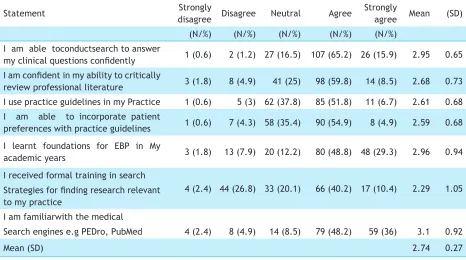
Table 3. Measure of skills and knowledge required for Evidence Based Practice.
Statement disagreeStrongly Disagree Neutral Agree Strongly agree Mean (SD)
(N/%) (N/%) (N/%) (N/%) (N/%)
I am able toconductsearch to answer
my clinical questions confidently 1 (0.6) 2 (1.2) 27 (16.5) 107 (65.2) 26 (15.9) 2.95 0.65 I am confident in my ability to critically
review professional literature 3 (1.8) 8 (4.9) 41 (25) 98 (59.8) 14 (8.5) 2.68 0.73 I use practice guidelines in my Practice 1 (0.6) 5 (3) 62 (37.8) 85 (51.8) 11 (6.7) 2.61 0.68 I am able to incorporate patient
preferences with practice guidelines 1 (0.6) 7 (4.3) 58 (35.4) 90 (54.9) 8 (4.9) 2.59 0.68 I learnt foundations for EBP in My
academic years 3 (1.8) 13 (7.9) 20 (12.2) 80 (48.8) 48 (29.3) 2.96 0.94 I received formal training in search
Strategies for finding research relevant to my practice
4 (2.4) 44 (26.8) 33 (20.1) 66 (40.2) 17 (10.4) 2.29 1.05
I am familiarwith the medical
Search engines e.g PEDro, PubMed 4 (2.4) 8 (4.9) 14 (8.5) 79 (48.2) 59 (36) 3.1 0.92
The measure of knowledge and skills for EBP were carried out by asking respondents to answer the questions in a Linkert Scale of 0 to 4. In table 3, the mean score of 2.74 indicated moderate skills among the physiotherapists to acquire evidence-based practice. The standard deviation was obtained 0.27 which is lesser than the
mean score indicating the significance. The average
score of the total was obtained 19.18 out of 28 with a mean percentage of 68.5.
In the question mentioning the learning of
evidence-based practice during the academic years 78% agreed that they did learn EBP in their academic years.48.8% agreed and 29.3% strongly agreed that they learned
evidence-based practice during their academic
years.68.3% agreed or strongly agreed that they are confident in the ability to critically review professional literature. 81.1% responded that they agreed or strongly
agreed that they can search to answer clinical questions
confidently.
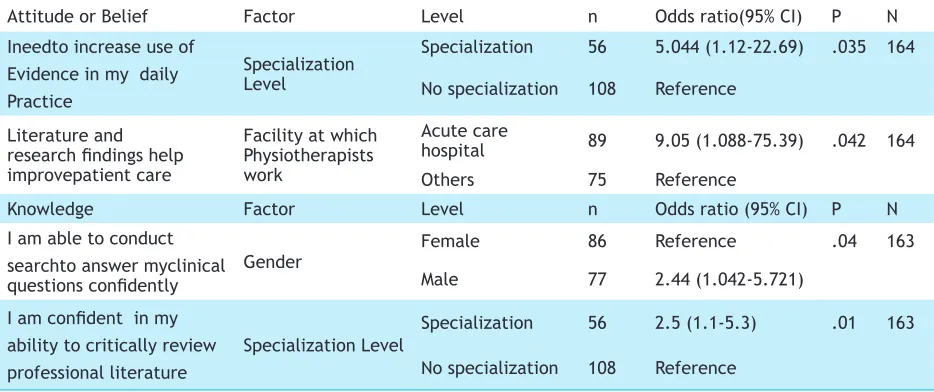
Binary logistic regression analysis was carried out between the variable of attitude and the factors associated with the respondents. In table 4, physiotherapists having specialization level thought it was necessary to increase
the use of evidence in daily practice five times more
than those having no specialization (p =.035, 95% CI:
1.12-22.69). Physiotherapists who worked in an acute
care hospital felt literature and research findings help
improve patient ninth times than those of others. (p=
.04, 95% CI: 1.088-75.39)
Also, Table 4 shows the results of binary logistic regression between knowledge and skills and the factors associated with the respondents. Variable of knowledge
and skill that is physiotherapists ability to search to
answer clinical questions confidently and Gender was found statistically significant. It was found that male
respondents thought they were able to search to answer
clinical questions confidently two times more than
female.
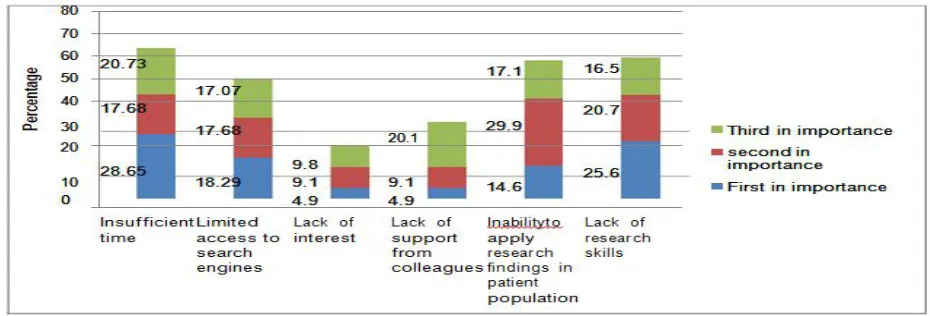
Figure 1 depicts the picture of barriers towards
evidence-based practice. The maximum number of participants that is 67.06% indicated that insufficient time was one of the top three barriers to evidence-based practice.62.8%
of the respondents stated lack of research skills to be among the top three barriers to evidence-based Practice
followed by inability to apply research findings in patient population where 61.6% of the respondents marked it as
the top 3 barriers to evidence-based practice. Limited access to search engines was considered to be the top
3 barriers to evidence-based practice by around 53.04% of the respondents. Around 34.1% of the respondents
ranked lack of support from colleagues as the top three barriers to evidence-based practice. Lack of interest has been stated as the top 3 barriers to evidence-based
Practice by only 23.8% of the respondents which is
the minimum percentage among the 6 options. In the open-ended question with additional barriers patient’s belief towards a traditional method of treatment was considered another major barrier for evidence-based practice.
Figure 2 shows that physiotherapists had a good understanding of the research terms meta-analysis, systematic review, absolute risk, and relative risk. The research terms that the physiotherapists had less
understanding were heterogeneity, confidence interval
and odds ratio.
Table 4. Binary logistic regression analysis for attitude/knowledge and factors associated with the respondent.
Attitude or Belief Factor Level n Odds ratio(95% CI) P N
Ineedto increase use of Evidence in my daily Practice
Specialization Level
Specialization 56 5.044 (1.12-22.69) .035 164
No specialization 108 Reference
Literature and
research findings help
improvepatient care
Facility at which Physiotherapists work
Acute care
hospital 89 9.05 (1.088-75.39) .042 164
Others 75 Reference
Knowledge Factor Level n Odds ratio (95% CI) P N I am able to conduct
searchto answer myclinical
questions confidently
Gender Female 86 Reference .04 163
Male 77 2.44 (1.042-5.721)
I am confident in my
ability to critically review professional literature
DISCUSSION
In the demographic section, total male respondents
were 47.6% and the female respondents were 52.4%.
This percentage varied from the two other studies, 4, 5wherethe total male respondents were 32.8% and
female respondents were 67.2% and where the total male percentage was 25.5% and the female percentage was 73.5%.
Maximum percentage of respondents were in the age
group 21-30 years and similar was found in the study, 5 where the maximum number that is 85.3% of the
respondents lay in the age group 25 to 34. However,
another study,6 found the maximum number of Physiotherapists between 30 to 39 years of age that is
58%.
A study,7 showed that number of physiotherapists
working less than 20 hours per week was 10.7% and
another study,4 showed the number of physiotherapists
who worked less than 20 hours per week was 7.2%.
physiotherapists worked less than 20 hours per week and
62% of the physiotherapists worked more than 40 hours
per week compared to the study,8 where 32.4% worked more than 40 hours per week. But, a study,4 had similar
results where 59.2% worked more than 40 hours per
week.This shows the increased load of the patients to be seen by the physiotherapists in Nepal.
The results obtained suggested that physiotherapists had a generally positive attitude towards evidence-Based Practice. Majority of the physical therapists had thought the application of EBP was necessary for the practice of physical therapy and literature and research was useful in day to day practice. Also, they believed evidence-based practice improved the quality of patient care. A similar survey in Nigeria, 6 reported
that a maximum of 99% agreed or strongly agreed EBP is necessary. Literature is useful to practice (98%), EBP improves quality of patient care (98%), and they need
to increase the use of evidence in their daily practice.
(99%), and evidence helps in decision-making (88%).
Figure1. Barriers towards Evidence Based Practice.
80 70 60 50 40 30 20 10 0
Do not understand
Understand some what
Understaand completely
In a study among nurses,8 regarding the attitude towards evidence-based practice the mean score of 3.6 was considered as positive attitudes towards evidence-based where the score was from 1 to 5. In the researcher’s study, the mean score of 2.89 was obtained for a score from 0 to 4 which indicated apositive attitude in our study as well.8 The mean score of 2.74 was obtained for score measuring from (0 to 4) as compared to the knowledge and skill scores of nurses that was 4.1 measuring from (1 to 6). The knowledge regarding physiotherapists could be considered moderate with a mean percentage of
68.5%.
Another study,4 discussed those having bachelor’s degree
as their highest certificate, were less likely to have the
skills or training required for evidence-based practice compared to those with a master’s degree. Similarly, in our study, those having a specialization degree were
more confident in their ability to critically review
professional literature.
Also, the understanding of certain research terms was associated with the highest degree obtained. As obtained in the study, 4 respondents with baccalaureate degrees had less knowledge of the research terms compared to those having masters’ degree. Similar
findings were obtained in our study where those having
specialization degree were two times more likely to understand the terms rather than those not having
specialization degree. This could be explained by the
fact that those physiotherapist having specialization degree need to perform a research thesis for the sake of
partial fulfillment of their course.
The major barrier was found to be the time in this study
with 28.65% citing as 1st in importance as a major barrier. Another study,9 stated the main barrier towards the adoption of a system was lack of training associated with its use. Another study,4 reported 67% of the respondents’
stated insufficient time as one of the top three barriers.
Likewise, a study among physiotherapists and nurses,8
also described the insufficient time as the most difficult
barrier to overcome for both professionals.When asked regarding the barriers among the physiotherapists in other items, some have stated that time is no barrier to evidence-based practice. Also anarticle,2 showed perceived barriers to implementing change had cognitive factors, an attitude of the physician, social
and organizational context.
Lack of access to full articles also has been one of the major barriers to evidence-based practice.10Also,another factor that the respondents majorly focused on was the quality of the articles published.11
CONCLUSIONS
Physical therapists of Nepal had a positive attitude and moderate knowledge towards evidence-based
practice. There was a significant association between
the variable of attitude and specialization level and facility at which the physiotherapists worked and with specialization level, age and number of years working as a physiotherapists and knowledge and skill variables. The major barrier to evidence-based practice measured
was insufficient time. As the major barrier had been
considered time, continuous professional development
workshops and training could be beneficial to the
physiotherapists
ACKNOWLEDGEMENTS
We would like to thank Centre for Rehabilitation of Paralyzed, Bangladesh for supervising us throughout the study. We also would like to thank all the physiotherapists
who gave their precious time in filling up the form
without any hesitation. Finally, we would like to thank
representative physiotherapists outside Kathmandu who
helped in distribution of the forms as well as collecting and returning them back.