Vol. 2 Issue 7, July - 2016
Assessment of Growth, Nodulation and
Nitrogen Fixation in Different Varieties of
Cowpea in A Humid Tropical Environment
Using N-Difference Method
Ndukwu, B.N.1, Asawalam, D.O.2, Umeh, M.O.3, Ahukaemere, C.M.1
1Department of Soil Science and Technology, Federal University of Technology, Owerri, Nigeria. 2Department of Soil Science and Meterology, Michael Okpara University of Agriculture, Umudike, Nigeria.
3 Department of Natural Sciences, Federal Polytechnic Oko, Nigeria
E-mail address: [email protected]
Abstract—The study aimed at assessing the growth, nodulation and nitrogen fixation of different varieties of cowpea using nitrogen difference methods. A complete randomized design with seven treatments and ten replications were used. The trial was conducted in a green house using soil as growth medium. The treatment consists of six varieties of cowpea (IT93K-734, IT86D – 719, IT84S -2246-4, IT89KD-391, IT90K-227-2, RC1) and a rice variety (RP1045-25-2-1) as control. Seeds were planted and grown under green house condition. At four weeks stage of growth, leaf number, plant height, Nodule number, root and shoot dry matter production were determined. Biologically fixed nitrogen was determined using the N-difference method. Result showed variety IT89KD-391 had the highest number of nodules (66.20g/pot) while RCI had the lowest number of nodules (45.00 g/pot).The variety IT86D-719 gave the highest concentration of Soil N(4.9gkg-1) and subsequently fixed the
highest quantity of nitrogen (550.96kg ha-1) more
than other varieties. Varieties IT90K-277-2 and IT84S-2246-4 produced the highest shoot and root dry matter yield. Hence varieties IT90K-277-2 and IT84S-2246-4 could be considered along with variety IT86D-719 for amelioration of inherent low fertility of the soil through organic matter amendment. Further studies under field condition are recommended to confirm these findings.
Keywords—Assessment, cowpea varieties, Humid tropical, N-difference method, Nitrogen fixation
1. INTRODUCTION
Legumes play a vital role in soil fertility maintenance through biological nitrogen fixation [1]. Of a total of 139 million tons biologically fixed N added to the system annually on a global scale, 25% comes
from legumes [2]. The amounts of N2 fixed and the N
contribution from leguminous crops such as cowpea, soyabean, pigeonpea are influenced by a number of environmental factors, including soil type, nutritional status of soil, species and varieties, water availability and temperature as well as soil and crop management [3]. Under favorable conditions, legume such as cowpea can add nitrogen equivalent between 64 and 131 Kg N ha-1 Yr [4] and 200 Kg N ha-1 of ammonium
sulphate [5].
Cowpea cultivation has become an integral part of the farming systems [6] and is grown in mixtures with other crops in various combinations [7]. Cowpea is an important source of organic fertilizer [8], because it nodulates freely and fixes atmospheric nitrogen in the soil [9]. [10] been reported that indigenous varieties of cowpea contain 22-24% crude protein on dry weight basis while improved varieties contain 23-35% crude protein [11]. [12] noted that the combination of cow dung and NPK 20-10-10 on varieties of cowpea contributed to the differences in number of count obtained per plant of cowpea as well as the amount of N-fixed. However, [13] stressed the capability of bacteria in root nodules of cowpea to convert atmospheric nitrogen to nitrate for plant use. Nitrogen obtained from biological nitrogen fixation is especially important for the subsistence farmer as costs of N fertilizer continue to escalate. Enhanced nodulation tend to lead to increased N2 fixation which, at the long
Vol. 2 Issue 7, July - 2016
In soils of Southeastern Nigeria, pressure due to population increase has led to the intensive use of land for agriculture, resulting to soil quality deterioration as well as soil organic matter losses, low acidity, low nutrient content, structure degradation and low crop yield [16]. The low crop yields are often attributed to low nitrogen content, low organic matter and available phosphorus [17] [18]. Low fertility tends to hinder optimum crop production which has been a problem encountered by most farmers in the area. Organic matter inputs through organic amendment such as incorporation of legumes (Cowpea) as green manure into the soil, to nutrient supply would represent a management strategy that would counteract depletion of organic matter in soils [19]. In addition to nutrient supply, there would be stimulation of microbial diversity and activity [20]. The study therefore was conducted to assess the growth, nodulation, and nitrogen fixation of different varieties of cowpea in a humid tropical environment using N-difference method.
2. MATERIALS AND METHODS
2.1 Study Area
The study was conducted at Michael Okpara University of Agriculture Umudike lying between latitude 070 33’N and longitude 050 29’ E with an
elevation of 122m above sea level. The geological material from which the soil was formed is Coastal Plain Sand [21]. The area is characterized by bimodal rainfall with one peak in July and the second in September and an annual rainfall of 2175 mm. Temperature is high and ranges from 26-310 C.
Tropical rainforest is the dominant vegetation of the area. Farming is a major socio-economic activity and soil fertility regeneration is by bush fallow which is fast disappearing due to population pressure.
2.2 Field Studies
The study was conducted in a green house at Michael Okpara University of Agriculture Umudike. The experiment was a completely randomized design with seven treatments and Ten replications. The treatments consisted of six varieties of cowpea namely IT 93K-734, IT86D-719, IT84S-2246-4, IT89KD-391, IT90K-227-2, RC1 and a rice variety RP 1045-25-2-1 which serve as a control. Varieties IT93K-734, IT86D-719, IT 84S-2246-4, were brought from IITA (Ibadan) while varieties IT 89 KD-391, IT 90K-277-2, RCI and RP 1045-25-2-1 control) were brought from the farm centre at Michael Okpara University of Agriculture Umudike. Soils were randomly collected from different points at a depth of 0-15 cm using an auger. The soil samples were bulked together to form a composite samples. The bulked samples were air-dried and sieved using a 2 mm sieve. Ten kilograms of sieved soils were weighed into different plastic containers. Soil samples were collected from each pot before planting and at harvest for laboratory analyses. Seed viability test was carried out in each variety before planting. Planting was done at the rate of 4 seeds /pot. Germination
commenced four days after sowing. The seedlings were later thinned down to three plants per pot, two weeks after planting. No fertilizer was applied. The plants were watered throughout the duration of the experiment. Weeds were kept under control by hand weeding as necessary. The plants (cowpea varieties and non-fixing reference crop, rice) were kept in pots under daily observation in the green house for six weeks.
At four weeks stage of growth, data were collected on number of leaves per plant, plant height (cm) and number of nodules per pot. At six weeks after planting that is at flowering stage of growth, each plant were gently pulled out from the soil in each pot and placed on a sieve to avoid loss of nodules during cleaning. The roots were washed gently with water to remove the adhering soils. Nodules were then carefully removed from the root, counted and recorded. The harvested plants (cowpea and rice) were dried and subsequently oven-dried at a temperature of 650C for
48hours. The dry weight of shoot and root of each treatment were taken and milled using a milling machine. The total nitrogen in shoot, root and soil was determined using microkjeldahl method. The amount of nitrogen in the cowpea and rice (control) was calculated using N-difference method described by [22] below:
N fixed = Nleg cowpea – Nref (rice) “equation 1”
Where N fixed = fixed nitrogen in the soil
Nleg cowpea = Amount of nitrogen (N uptake in
mg/plant) in legume (cowpea)
Nref( rice)= Amount of nitrogen (N uptake in
mg/plant) in the reference crop (rice).
2.3 Laboratory Analyses
Particle size distribution was determined by hydrometer method [23]. Soil pH was determined in water using 1:2.5 Soil –liquid ratio [24]. Exchangeable cations (Ca, Mg, K and Na) were determined by 1 N Ammonium acetate extraction procedure [24]. Exchangeable potassium (K) and sodium (Na) in the extract were determined by flame photometer while exchangeable calcium (Ca) and Magnesium were determined using atomic absorption spectrophotometer. Exchangeable acidity was measured in 1N KCL [25]. Organic carbon was determined by the wet oxidation method [26]. Total Nitrogen was determined by the Kjeldahl digestion method [27]. Available phosphorus was determined by Bray 2 method [28].
2.4 Data Analysis
Vol. 2 Issue 7, July - 2016
3. RESULTS AND DISCUSSION
3.1 The Physicochemical Properties of Soils of the Study Site
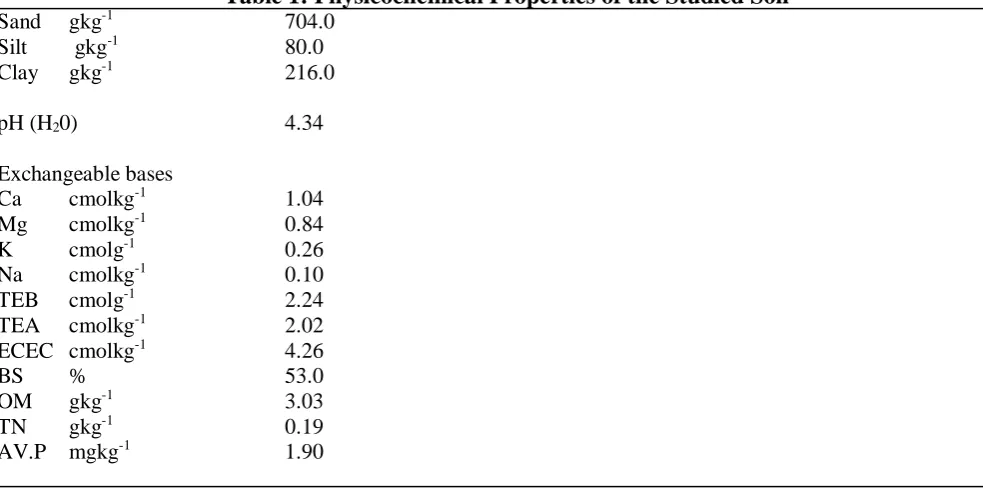
The results of the physico-chemical properties of soil in the study sites as shown in Table 1 indicated that the soils were sandy with coarse sand-sized fraction predominating over silt and clay. The sandiness could be attributed to coastal parent materials from which the soils are derived. Silt and clay contents were low. The soils are strongly acidic with pH value of 4.34, implying occupation of the soils exchange complex with aluminum cations. Exchangeable bases (Ca, Mg, K and Na) were low, suggesting possible influence of climate and land use. High rainfall amount, duration and intensity may have
increased leaching of basic cations [29], leaving the acidic cations. Exchangeable acidity was fairly high (TEA=2.02 cmolkg-1), indicating accumulation of
aluminum at the exchange site and deficiency of calcium and magnesium in the soil. Organic matter was high (OM=3.03 gkg-1) but lower than the critical
level of 20 gkg-1 given by [30] for soil of the humid
tropical region .Total N content was low, indicating high rate of mineralization in the soil. Available p was low (AV. P = 2 .90 mgkg -1) probably due to low pH
(4.34). At pH of 4 and 4.5, p is likely to be fixed by the oxide of Fe and Al [31] indicating reduction of phosphorus availability in soil [32]. Effective cation exchange capacity (ECEC) was generally low (ECEC = 4.26 cmolkg-1) but was higher than the critical value
of 4.00 cmolkg-1 recorded by [33].
Table 1: Physicochemical Properties of the Studied Soil
Sand gkg-1 704.0
Silt gkg-1 80.0
Clay gkg-1 216.0
pH (H20) 4.34
Exchangeable bases
Ca cmolkg-1 1.04
Mg cmolkg-1 0.84
K cmolg-1 0.26
Na cmolkg-1 0.10
TEB cmolg-1 2.24
TEA cmolkg-1 2.02
ECEC cmolkg-1 4.26
BS % 53.0
OM gkg-1 3.03
TN gkg-1 0.19
AV.P mgkg-1 1.90
Ca = Calcium, Mg = Magnesium, K = Potassium, Na = Sodium, TEB = Total exchangeable base, TEA = Total exchangeable acidity, ECEC= Effective cation exchange capacity, BS = base saturation, OM = Organic matter, TN = Total Nitrogen, AV.P = Available phosphorus
The low ECEC of this soil may be attributed to the fact that soils of Southeastern Nigeria are strongly weathered, have little or no content of weathered rock in their Sand and Silt fractions and have predominantly Kaolinite as their clay fraction [34]. Percentage base saturation was above 50% indicating high fertility.
3.2 Growth parameters and dry matter yield of different varieties of cowpea and rice (control) in the study site.
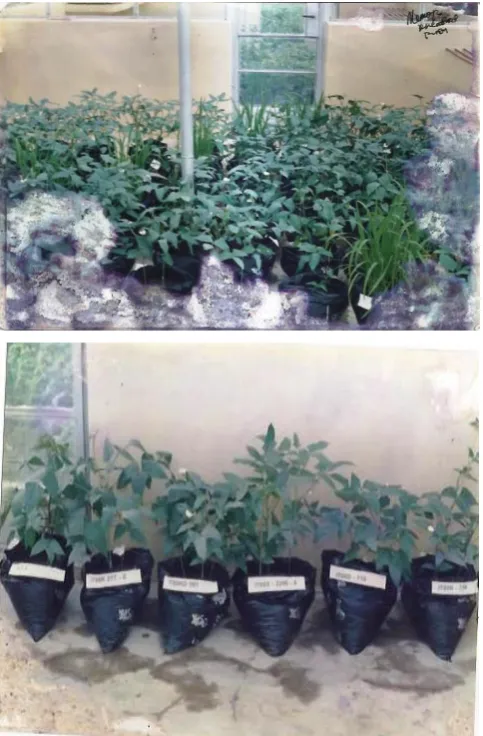
The growth parameters and dry matter yield of different varieties of cowpea and rice (control) given in Table 2 and Plate 1 showed that there were significant differences in the growth habit, nodulation and dry matter production of these plants. For the growth habit, varieties IT 86D-719, IT 84S-2246-4, IT89 KD-391, IT90K-277-2 and RCI were erect while IT93K-734 had a climbing feature (Plate 1). The shoots of
Vol. 2 Issue 7, July - 2016
varieties may be attributed to their growth habit along with environmental conditions and edaphic factors [35]. Variety IT93K-734 had a climbing habit (Plate 1)
which was responsible for its higher height compared to other varieties.
Table 2: Growth Parameters and Dry matter Yield of different Varieties of Cowpea and Rice in the Studied Site.
Plate 1: Growth Parameters and Nodules of different varieties of cowpea and rice
However, the lowest plant height was observed in IT89KD-391 (28.30cm) probably due to the effects of shading from rice (control) and some other cowpea varieties.
Vol. 2 Issue 7, July - 2016
[40]. [39] noted few rhizoid in soils greater than pH 4.2. [41] reported that N-fixation activities of beneficial organisms are inhibited in strongly acidic soils. Additionally, the low starter nitrogen (N) in this soil (low in nitrogen) may have resulted to the lowest nodulation in this variety (RCI). [42] also reported that when initial levels of available soil nitrogen were low, a period of nitrogen hunger can reduce nodulation. However, between RCI and IT93K-734; IT90K-277-2 and IT 93K-734, no significant difference was observed in nodule number per plot.
Furthermore, in the shoot dry matter production in Table 2, variety IT90k-277-2 produced the highest shoot dry matter (16.40 g/pot; P< 0.05) more than other varieties. While the lowest shoot dry matter was observed in RCI (8.60 g/pot; P< 0.05). Comparing the shoot dry matter production in rice (control) and cowpea varieties, a significant difference was observed between shoot dry matter production in control (rice) (15.90 g/pot) and RCI (8. 60 g/pot; P<0.05) compared to other cowpea varieties (Table 2).
Also, in Table 2 control (rice) gave the highest root dry matter production than the cowpea varieties. Similarly, when comparing the cowpea varieties for root dry matter production, variety IT 84S-2246-4 produced the highest root dry matter yield (3.84 g/pot), implying that where the above plant material is harvested for feeding animals, the variety (IT 84S-2246-4) hold good promise for improving soil organic matter through the contribution of the root system.
3.3 Concentration and Fixation of nitrogen in shoot, root and soil of different varieties of cowpea and rice
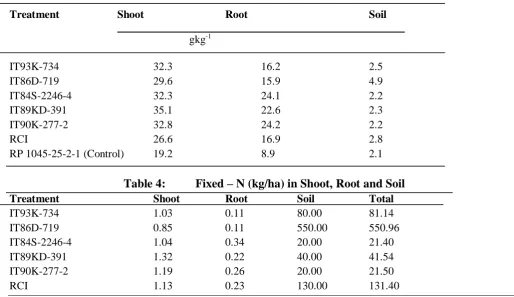
Table 3 and 4 shows the results of the concentration and fixation of nitrogen in shoot, root and soil between the different varieties of cowpea and control (rice). The concentration of N in shoot, root and soil was higher in cowpea varieties than in control (rice) (Table 3). However, between the cowpea varieties, the concentration of N in shoot was highest in variety IT89KD-391 (32.3 gkg-1) and lowest in RCI
(26.6 gkg-1). The lowest concentration of N in shoot in
RCI could be related to the growth performance which includes: Plant height, nodulation, shoot and root dry matter of this variety. Also, in the root system, the amount of nitrogen (N) accumulated was highest in two varieties of cowpea: IT90K-277-2 (N=24.2 gkg-1)
and IT 84S-2246-4 (N=24.1 gkg-1) and lowest in IT
86D-819 (N=15.9 gkg-1) (Table 3). Generally, when
comparing the concentration of N in shoot and roots, the highest concentration of N was in shoot while the lowest was in the roots. This was expected as absorbed plant nutrients are first translocated to the leaves through the stem, the root usually has the least reserve [36]. Indeed, much of the variation in leaf photosynthetic capacity for different cultivars, age of leaves and growth conditions can be attributed directly to differences in leaf N content [43]. Also, the cowpea varieties gave higher soil N than the control (rice) (Table 3). Comparing the soil N among the cowpea varieties, it was observed that variety IT86D-719 produced the highest soil N (4.9 gkg-1) possibly due to
varietal difference as a result of genetic composition [36].
Table 3: Concentration of Nitrogen ( gkg
-1)in Shoot, Root and Soil
Treatment Shoot Root Soil
gkg-1
IT93K-734 32.3 16.2 2.5
IT86D-719 29.6 15.9 4.9
IT84S-2246-4 32.3 24.1 2.2
IT89KD-391 35.1 22.6 2.3
IT90K-277-2 32.8 24.2 2.2
RCI 26.6 16.9 2.8
RP 1045-25-2-1 (Control) 19.2 8.9 2.1
Table 4:
Fixed – N (kg/ha) in Shoot, Root and Soil
Treatment Shoot Root Soil Total
IT93K-734 1.03 0.11 80.00 81.14
IT86D-719 0.85 0.11 550.00 550.96
IT84S-2246-4 1.04 0.34 20.00 21.40
IT89KD-391 1.32 0.22 40.00 41.54
IT90K-277-2 1.19 0.26 20.00 21.50
Vol. 2 Issue 7, July - 2016
Additionally, increase in nitrogenous activity after sowing may have contributed to the high soil N in this variety [44]. The lowest total N in soil was found between varieties IT84S-2246-4 (Soil N=2.2 gkg-1);
IT90K-277-2 (Soil N=2.2. gkg-1) and IT 89KD -391
(Soil N = 2.3 gkg-1) (“Table 3”) and could be
attributable to plant uptake, immobilization and volatilization [45] [46]. Nitrate-N is immobilized by soil flora or fauna [22]. Considering the whole nitrogen fixed by different varieties of cowpea in the soil (Table 4), variety IT86D-719 fixed the highest N in the soil (fixed N = 550.96 kgha-1), followed by RCI (Fixed N =
131.40 kg ha-1) and IT93K-734 (81.14 kg N ha-1). One
would have expected IT89KD-391 with its highest nodule number (nodulation) (66.20) to fix higher N more than other varieties. However, [43] reported that greater nodulation (greater nodule number) does not necessarily lead to greater nitrogen fixation. Therefore, the higher N – fixed in soil by cowpea variety (IT860-719) could be related to the genotype difference, rhizobium strain and differences in rooting characteristics of the cowpea varieties used in this study [12]. [47], asserted that the amount of nitrogen fixed by a legume crop varies widely due to legume
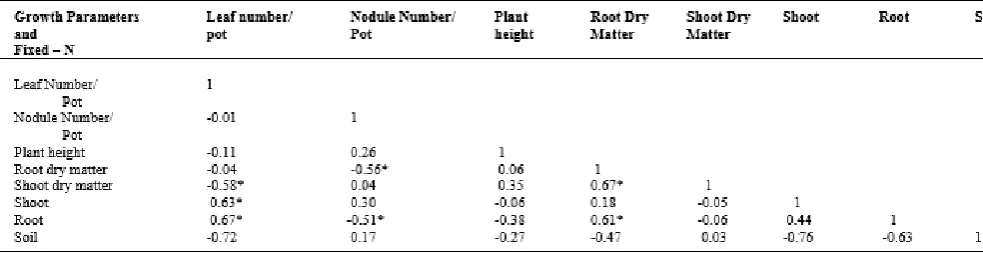
genotype, rhizobium strain and the soil environment. Furthermore, the variety RP 1045-25-2-1 (control) did not contain much N in shoot, root and soil (Table 3), the Nodule number could not be determined and consequently, the fixation of nitrogen was not considerable. However, the low fixation of N in soil was found in varieties IT84S-2246-4 (Fixed-N = 21.40 kgha-1) and IT90K-277-2 (21.50 kg N ha-1) (Table 4) and may be related to soil pH, soil moisture, and shading probably from other varieties and control (rice). [48] noted that moisture stress can greatly reduce nitrogen fixation by reducing the number of bacteria (rhizobium) growth and activities of nodule already formed and restricting the production of new ones. The result of the correlation analysis in Table 5 showed that a significant negative relationship existed between fixed – N in soil and leaf number (r = - 0.72*; P< 0.05).The lack of relationship between fixed – N in soil and other growth parameters (plant height, nodule number, shoot dry matter and root dry matter) indicated that fixation of nitrogen in this soil was characterized by genotype or varietal differences, rhizobium strain, and soil pH.
Table 5: Correlation between growth parameters and the distribution of fixed – N in Shoot, Root and Soil
* = Significant ,P< 0.05.
4. CONCLUSION
Soil of the study site is highly degraded and acidic. Sand sized fraction predominated over other particle size fractions. Cowpea varieties resulted in increased soil N in the study site. The variety IT86D-719 -719 gave the highest concentration of soil N (4.9 gkg-1)
and subsequently fixed the highest quantity of nitrogen (550.96 Kg N ha-1). Varieties IT90K-277-2
and IT84S-2246-4 gave the highest shoot and root dry matter yield and may therefore be considered along with variety IT86D-719 for amelioration of the inherent low fertility of the degraded soils of Umudike through organic matter amendment such as incorporation of the these cowpea varieties as green manure to the
soil. Further studies under field conditions are recommended to confirm these findings.
REFERENCES
[1] Herridge, D; Gemell, G. and Hartley, E. (2002). Legume inoculants and quality
control. In: D. Herridge (Ed.), Inoculants and Nitrogen fixation of legumes in Vietnam. ACIAR Proceedings 109e.
Vol. 2 Issue 7, July - 2016
[3] Ledgard, S.F. and Steele, K.W. (1992). Biological nitrogen fixation in mixed
legume/grass pastures. Plant soil, 141,137-153. [4] Kang, B.T., Nangju, D.J. and Ayanba, A. (1977). Effects of fertilizer use on cowpea and Soyabean nodulation and N – fixation in farming system of the tropics. In: Anyanaba, and P.J. Dart, (Ed). Biological Nitrogen fixation in farming systems in the tropics. John Wiley and Sons, Chichester, Pp. 205-216.
[5] Wrigley, G. (1981). Tropical Agriculture. The development of production 4th Edu. Longman Inc.
New York, PP. 126-223.
[6] Ogbuinya, P. (1997). Advances in Cowpea Research. Biotechnology Development Monitor
33:1012.
[7] Olufajo, O.O. and Singh, B.B. (2002). Advances in cowpea cropping systems research.
[8] Eaglesham, AR; Michin, F.R., Summerfield, R.J., Dart, PA., Huxley, P.A. and Day, J.M (1997). N. nutrition of cowpea. III. Distribution of within effectively nodulated plants. Experimental Agriculture 13,369-380.
[9] Bationo, A., Ndungouru, B.J; Ntare, B.R; Christainson, C.B. and Mokwunye, A.U. (1991). Fertilizer management strategies for legume – based cropping systems in the West African Semi-arid tropics. Johansen C. (Editor), Phosphorus nutrition of grain legumes in the semi-arid tropics. International crops Research Institute for the Semi-Arid Tropics, Patancheru, Andhra Prasad, India. Pp 213-226.
[10] Lucas, E.O. (1982). The growth of three varieties of cowpea (Vigna unguiculata) at two contiguous ecological zones in Nigeria. Niger T. Agric. 17/18,324-341.
[11] FPDD (Fertilizer procurement and Development Division) (1990). Literature on soil fertility investigations in Nigeria. Produced by
the Federal Ministry of Agriculture and Natural Resources, Lagos.
[12] Olatunji, O; Ali, A.and Ibrahim, N.B. (2014). Tolerance of cowpea (Vigna Unguiculata (L) varieties N – fixing ability to Application of cow dung combined with NPK 20-10-10. Journal of Agriculture and veterinary science 7 (1): 93-100.
[13] Rao, N.S. (1993). Biofertilizers in Agriculture and forestry. 3rd Edn. International book publishers,
New York.
[14] Chianu, J.N; Nkonya, E.M; Mairura, F.A; Chianu, J.N. and Akinnifesi, F.K. (2011). Biological nitrogen fixation and socioeconomic factors for legume production in Sub-Sahara Africa: a review.
Agronomy for sustainable Development, 31,139-154. [15] Agbede, O.O. (2009). Understanding soil and plant nutrition. Salamn Press and
Company Nigeria Limited, Keffi, Nigeria Pp 132-134.
[16] Golchin, A; Clarke, P; Oades, J.M and Skjenstad, J.O (1995). The effects of cultivation on the composition of organic matter and structural stability of soils. Australian Journal of Soil Research 33,975-993.
[17] CEC/IFPREB (Centre for cooperative Extension, University of Agriculture, Makurdi/Improved farmer’s participation in Research and Extension in Benue state, Nigeria (1999). Report on basic soil analysis of CEC/IFPREB Project sites (Ai-Inamu, Mbamakem, Mbosholo). Dec. 1999. CEC/IFPREB Report No. MIS17.37Pp.
[18] Egbe, O.M; Kalu, B.A. and Idoga, S. (2009). Contribution of common food legumes to the fertility status of sandy soils of the Moist Savanna Woodland of Nigeria. Report and Opinion, 1, (1),45-62.
[19] Fereras, L;Gomez, E; Toresani, S; Firpo, I. and Rotondo, R. (2009). Effect of organic amendments on some physical, chemical and biological properties in a horticultural soil. Bioresource Technology 97,635-640.
[20] Carpenter – Boggs, L; Kennedy, A.C. and Reganold, J.P. (2000). Organic and
biodynamic management: Effects on soil biology.
Soil Science Society of American journal 54:1651-1659.
[21] Orajaka, S.O (1975). Geology: In: Ofomata, G.E.K (ed). Nigeria in maps: Eastern States Ethiopic Publishing House Benin city Pg 5-7.
[22] Hauser, S. (1992). Estimation of symbiotically fixed Nitrogen using Extended N Difference Method.
In: Biological Nitrogen fixation and sustainability of Tropical Agriculture Mulongoy, K; Geueye, M. Spencer D.S.C (Eds) International Institute of Tropical Agriculture Ibadan/A Wiley Sayce co-Publication New York. Pp,309-321.
[23] Gee, GW and D. Or (2002). Particle Size Analysis. In: Methods of Soil Analysis. Dane, J.H.and G.C. Topp (Eds), Part 4. Physical methods. Soil Science Society of American Book series No. 5 ASA and SSSA, Madison, W1; pp, 255-293.
[24] Thomas, G.W. (1996). Soil pH, Soil acidity, In: Methods of Soil analysis part 3: Chemical methods. L.D. Sparks (eds). Soil Science Society of America Book Series Pp. 159-165.
[25] Mclean, E.O (1982). Aluminum; In methods of soil analysis (Eds.) C.A Black.
Agronomy Madison, WI, pp: 975-998. [26] Nelson, D.W and Sommers, L. E (1996). Total carbon, organic carbon and
Vol. 2 Issue 7, July - 2016 American Book Series No. 5, SSSA, Madison, WI, PP:
961 – 1010.
[27] Bremmer, J.M (1996). Nitrogen Total. In: Methods of Soil Analysis Part. 3, ChemicalMethods. No.5 Sparks, D. L (Ed.) ASA and SSSA, Madison, WI. pp: 1085-1121.
[28] Olson, S.R and Sommers, L. E (1982) Phosphorus In: Methods of soil analysis part 2 (Ed) page A.L., Miller, R.H and Keeney, D.R. American Society of Agronomy, Madison, WI. pp: 15-72.
[29] Oti
[30] Aduayi, E.A; Chude, V.O; Adebusuyi, B.O.and Olayiwola, S.O. (2002). Fertilizer use and Management Practices for crops in Nigeria (3rd ed.).
Federal fertilizer Department, Federal Ministry of Agriculture and Rural Development, Abuja, 188Pp.
[31] Osayande, P.E; Oviasogie, P.O; Awanlemhen, B.E. and Orhue, E.R. (2014). Soil fertility assessment of a Shea (Vitellariaparadoxa C.F.Gaertn) field at. Bida, Niger State. Nigerian Journal of Soil Science 24 (1): 117-124.
[32] Khare, N; Hesterberg, D; Beauchemin, S. and Wang, S. (2004). Xanes determination of adsorbed phosphate distribution between Ferigycharte and boehmite in mixtures. Soil Science Society of American Journal, 68,460-469.
[33] Sanches, P.A. (1976). Properties and Management of Soils in the Tropics. John
Wiley, New York, p 240.
[34] FPDD (Fertilizer procurement and Development Division) (1990). Literature on soil fertility investigations in Nigeria. Produced by
the Federal Ministry of Agriculture and Natural Resources, Lagos.
[35] Asumming – Brempong, S; Wiafe Y and Aggrey Martin, K. (2013). Nodulation of cowpea (Vigna unguiculata (L) Wap) at different levels of phosphorus in a Typic Kandiustalf. Agricultural Science Research Journal 3, (12),387-394.
[36] Egbe, O.M. and Egbo. C.U. (2011). Nodulation, nitrogen fixation and harvest index of extra short and short-duration cowpea varieties intercropped with maize at Otobi, Benue State, Nigeria. Journal of Animal and plant Sciences,
10,1315-1324.
[37] Ayisik, K.K; Mpangane, P.N.Z and Whitbread, A. (2004). Grain yield and symbiotic activity of cowpea cultivars grown in sole and intercropping systems with maize in the Limpopo province of South Africa.
Proceedings of the 4th International Crop Science
Congress, held 26th September – 1st Oct., 2004,
Brisbane, Australia.
[38] Njoku, D.N. and Muoneke, C.O. (2008). Effect of cowpea planting density on growth, yield and productivity of component crops in cowpea/cassava intercropping system. Agro Science 7 (2): 106-113.
[39] Russell, E.W. (1973). Theindividual nutrients needed by plants.In E.W. Russell
(Ed.). Soil conditions and plant growth, 10th
edition. Longman, London and New York. Pp 31-48. [40] Oroka, F.O. (2010). Responses of Rice and Cowpea Intercropping to Nitrogen fertilizer and Plant population (1): Nodulation, Nitrogen fixation and Agronomy Efficiency. World Journal of Agriculture Sciences 6 (2): 154-159.
[41] Isirimah, N.O., Dickson, A. and Igwe, C. (2003). Introductory Soil Chemistry and Biology for Agriculture and Biotechnology. OSIA Int’l Publishers
Limited, Port Harcourt, PP,270.
[42] Omoregie, A.U. and Okpefa, G.O. (1999). Effects of time of application of nitrogen on nodulation, dry matter and mineral nutrition of cowpea Vigna unguiculata L. (Walp) in the Delta area of Nigeria.
Nigerian Agricultural Journal., 30,32-40.
[43] Sinclair, T.R. and Horie, T. (1989). Lead nitrogen, photosynthesis and crop radiation use efficiency: A review, Crop Science 29:90-98.
[44] Kumar Rao, J.V.D.K. and Dart, P.J. (1987). Nodulation, nitrogen fixation and nitrogen uptake in pigeonpea (Cajanus cajan (L.) Mill sp) of different maturity groups. Plant and Soil 99,255-266.
[45] Haynes, R.J. and Sherlock, R. (1986). Gaseous losses of nitrogen Pp. 242-285- In: Mineral nitrogen in the plant – soil system (Haynes, R.J., eds). London U.K. Academic press.
[46] Cameroon, K.C.and Haynes, R.J. (1986). Retention and movement of nitrogen in soils. Pp. 166-220 In: mineral nitrogen in the plant-Soil system
(Haynes, R.J., ed), London, UK: Academic.
[47] Orjiem, O; Vanlavwe, B; de Ridder, N and Geller, K.E. (2007). Niche based assessment of contribution of legumes to the nitrogen economy farms. Plant soil 29 (2): 119-1135.
[48] Sprent, J.I. (1976). Nitrogen fiscation by legumes subjected to water and light stress, In symbiotic nitrogen fication in plants ed. P.S. Nutman,