© 2018 IJSRSET | Volume 4 | Issue 1 | Print ISSN: 2395-1990 | Online ISSN : 2394-4099 Themed Section : Engineering and Technology
Algebra of Morphological Dilation on Intuitionistic Fuzzy
Hypergraphs
Dhanya P. M.
*1, Sreekumar A
2, Jathavedan M
3, Ramkumar P. B.
41,2,3Department of Computer Applications, CUSAT, Kochi, Kerala, India 4Department of Basic Sciences and Humanities, RSET, Kochi, Kerala, India
ABSTRACT
Intuitionistic Fuzzy Hypergraphs (IFHG) are those in which the hypernodes are having membership and non membership degrees , so also the hyperedges. The hypernodes with high membership degrees are more relevant with respect to the hypergraph. Likewise the hyperedges with high membership degrees are more important. The purpose of this work is to define algebraic operations like union, intersection and complement of morphological dilation operation on sub hypergraphs of IFHG. De Morgan’s law is also applied to IFHG provided the sub hypergraphs considered are having common edge(s).
Keywords : Intuitionistic Fuzzy Hypergraph, Morphology, Dilation.
I.
INTRODUCTION
Intuitionistic Fuzzy Sets (IFS) [1] were introduced in 1999, where a non membership degree is also attached with every fuzzy member. A list of open problems [2] using IFS were also discussed. They include constructing an axiomatic system of IFS, extension of IFS modal operators, norm distance, matrices, developing statistical and probabilistic tools for IFS, algorithm for defuzzification etc. Fuzzy traversals of fuzzy hypergraphs, coloring of fuzzy hypergraphs and strongly interconnected hypergraphs were detailed in [3]. Further α – β cut [4] on IFHG, incidence matrix of Hα – β and the dual IFHG
were introduced. The authors further propose to show the importance of α – β cut in graph partitioning. Operations like complement, join, union, intersection, ringsum, cartesian product, composition are defined for intuitionistic fuzzy graphs [5], where the authors further proposed to apply these operations in clustering techniques. Isomorphism between two intuitionistic fuzzy directed hypergraphs (IFDHG) is also discussed [6], where the
authors have introduced IFDHG, its order, in-degree, out-degree, homomorphism, weak isomorphism and co-weak isomorphism between two IFDHGs. Application of IFHG in radio coverage network is also suggested by [7], in which their model can be used to determine station programming and develop marketing strategies. The authors also suggested the use to IFHG for clustering computer networks. An application with Intuitionistic Fuzzy sets for career choice[8] which is a decision making system was developed where the system represented the performance of students using membership μ, non membership υ and hesitation margin п. They applied normalized Euclidian distance to determine the apt career choice.
also done opening, closing, half opening and half closing and morphological filtering [11] on hypergraphs. Intuitionistic fuzzy transversal [12] of IFDGH was done in which they also introduced minimal transversal, transversal of union of IFDGHs, also their intersection, join structural subtraction, cartesian product and composition. Different types of IFDHGs including core, simple, elementary, sectional elementary IFDHGs, (μ; υ)-tempered IFDHGs [13], properties of (μ;υ)- tempered IFDHGs were also implemented.
This paper is organized as follows: Section 2(Background) defines an intuitionistic fuzzy hypergraph with its membership and non membership degrees. Section 3 (Algebra of graph morphology) introduces the hypergraph algebra on dilation operation. Section 4(De Morgan’s law applied to IFHG) test and proves De Morgan’s law considering dilation of subgraphs. Section 5 (Conclusion) is the concluding part where some applications and future work is mentioned and finally the references are included.
II.
BACKGROUND
Let [HIF , (μn , γn), (μe , γe), Hn, He ] be an intuitionistic
fuzzy hypergraph with membership degree μn and
non membership degree γn defined on the set of
hypernodes Hn and membership degree μe and non
membership degree γe defined on a set of hyperedges
He of HIF . The sum of the membership degree and
non membership degree of the hypernode is 1 [4]. ie, μn + γn = 1. So also the sum of the membership degree
and non membership degree of the hyperedge is 1 [4]. ie, μe + γe = 1 .If all the hypernodes in a hyperedge has
μn > 0.5, then μe is the supremum of all μ n in that
edge. In such a case γn = 1 - μn. If there is at least one
hypernode with γn > 0.5, then the γe of that edge is
the supremum of all γn in that edge. In such a case μe
= 1 - γe. Many morphological operators like dilation
with respect to hypernodes, with respect to hyperedges, erosion with respect to hypernodes and
erosion with respect to hyperedges can be defined once we have a sub hypergraph XIF.
Let XIF and YIF be two sub hypergraphs of HIF. We can
define them as [XIF , (μn’ , γn’ ) , (μe’ , γe’), Xn , Xe ] and
[YIF , (μn’ , γn’ ) , (μe’ , γe’), Yn , Ye]. Let XIF be obtained
as a result of α – β cut on HIF. ie, XIF = H α – β where m
< α <= n and β = 1- α . Here α corresponds to the edge membership degree and β corresponds to the edge non membership degree. Let YIF be obtained as a
result of another α – β cut on HIF. ie, YIF = H α – β
where α >= n and β = 1- α. Here morphological dilation is represented using the operator δ. In this paper we are going to introduce many algebraic operations on morphological dilation.
III.
ALGEBRA OF HYPERGRAPH MORHOLOGY
Let us assume m = 0:5; n = 0:8. ie, XIF is a sub
hypergraph which consists of edges with membership degree greater than 0.5, but less than or equal to 0.8. ie, XIF = H α – β /0:5 < α <= 0:8 ; β = 1- α. Also YIF = H α – β / α >= 0:8; β = 1- α. ie, both XIF and YIF are two
priority sub hypergraphs with different cut offs. Our actual HIF is having many non priority nodes whose μ n < 0.5 and medium level nodes whose μ n = 0.5. The
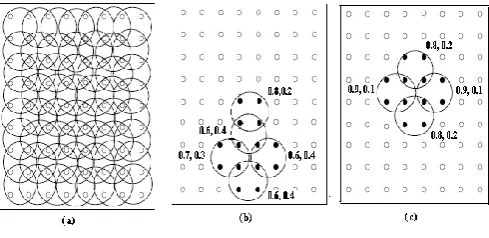
hypergraphs HIF, XIF and YIF are shown in Fig.1.
Figure 1 : (a) Hypergraph HIF, (b)XIF and (c) YIF
The following results hold for the above mentioned sub hypergraphs.
Definition 3.1 Let X and Y be the sub hypergraphs of HIF and δ be the dilation operator defined on
hypergraph. Then node dilation of X Y is defined as
Proof: Consider the union operation of two IFHG sub hypergraphs X and Y, where X and Y are defined as in previous section. In L.H.S of (1), consider X Y = (Zn, Ze) where Zn = Xn Yn and Ze = Xe Ye and the union operation is same as the operation on graph.
δn(XY)e = Zn (2)
by definition of δ n [10]
Also δn (Xe) = Xn and δ n (Ye) = Yn
δn (Xe ) δn (Ye) = Xn Yn = Zn (3)
From eq(2) and eq(3), it implies
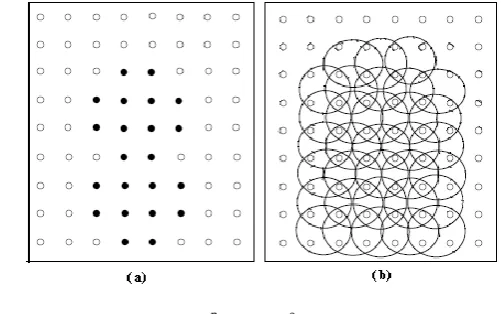
δn(X Y)e = δn(Xe ) δn(Ye). Fuzzy membership and non-membership degrees are invariant under this equation. The result of this operation is shown in Fig. 2 .(a). As seen in the figure, this dilation operation will retrieve all nodes within the priority sub graphs. Since the graphs are of higher priority, the hypernodes retrieved are also of high priority.
Figure 2 : (a) δ n(X Y)e ( b) δe(X Y )n
Example 3.1 : Consider H = (Hn, He)as an IFHG. Hn =
{n1, n2, n3, n4, n5, n6, n7, n8, n9, n10, n11, n12} be the
hypernodes in H. Let He = {e1, e2, e3, e4, e5, e6} be the
hyperedges in H. Let X be a sub hypergraph, where X = (Xn, Xe); where Xn = {n7, n8, n10, n11}and Xe = {e5} . Let
Y be a sub hypergraph, where Y = (Yn, Ye ) ;where Yn
= {n8, n9, n11, n12 } and Ye = {e6}. The membership
degree and non membership degree of the hypernodes and hyperedges of hypergraph H are given as per the Table I. Here we have set X = H α – β /
0.5 < α <=0.9; β = 1 – α. Also Y = H α – β / α >= 0.9; β = 1
– α.
TABLEI. DETAILS OF HYPERGRAPH H
Hyper Edges Membership and non membership degrees Edge
priority Hyper nodes
e1 ( 0.4,0.6)
n1 (0.5,0.5)
n2 (0.5,0.5)
n3 ( 0.4,0.6)
n4 (0.5,0.5)
low
e2 ( 0.5,0.5)
n2 (0.5,0.5)
n4 (0.5,0.5)
n5 (0.5,0.5)
n6 (0.5,0.5)
medium
e3 ( 0.4,0.6)
n3 (0.4,0.6)
n4 (0.5,0.5)
n7 (0.6,0.4)
n8 (0.8,0.2)
low
e4 ( 0.9,0.1)
n4 (0.5,0.5)
n8 (0.5,0.5)
n6 (0.5,0.5)
n9 (0.9,0.1)
high
e5 ( 0.8,0.2)
n7 (0.7,0.3)
n10 (0.5,0.5)
n8 (0.5,0.5)
n11 (0.6,0.4)
high
e6 ( 0.9,0.1)
n8 (0.5,0.5)
n9 (0.9,0.1)
n11 (0.8,0.2)
n12 (0.9,0.1)
high
The result of the operation δ n(X Y)e is
Zn = {n7, n8, n9, n10, n11, n12}. Also same results are
obtained from δn(Xe) δn(Ye) ie, {n7, n8, n10, n11} { n8,
n9, n11, n12 } = { n7, n8, n9, n10, n11, n12 } = Zn. Here the proof
is substantiated with the above example.
Definition 3.2: Let X and Y be the sub hypergraphs of HIF and δ be the dilation operator defined on
δe(X Y)n = δe (Xn) δe(Yn) (4)
Proof: In L.H.S of eq(4), δe(X Y)n is the collection of all edges which contain hypernodes of X Y. As shown in Fig. 2(b), it consists of edges which are of priority and also of non priority. This is because; the hypernodes of sub graphs X and Y are also part of other hyperedges which are of medium priority or low priority. Here we can see that all the edges retrieved by this dilation consist of at least one node of high priority. All other edges are discarded in this operation.
δe (X Y )n = Ze (5)
In R.H.S of eq(4), δe (Xn) = Xe and δe(Yn) = Ye
Hence
δe (Xn) δe(Yn) = Xe Ye = Ze (6)
From eq(5) and eq(6), it implies that δe (XY)n = δ e(Xn) δ e(Yn)
Example 3.2: Consider the same problem defined in example 3.1. Applying it in L.H.S of eq(4), we get (XY)n ={n7, n8, n9, n10, n11, n12}. Now δe(XY)n = { e3, e4,
e5, e6 }. Considering R.H.S, we get δe (Xn) = {e3, e4, e5, e6}
and δe(Yn) = { e3, e4, e5, e6 }. Now δe (Xn) δe (Yn) = {e3,
e4, e5, e6}.
Definition 3.3: Let X and Y be the sub hypergraphs of HIF and δ be the dilation operator defined on
hypergraph. Then node dilation of XY is defined as
δn(X Y)e = δn(X)e δn(Y)e (7)
Proof: Let X = H - X, Y = H - Y, X = (Xn, Xe), Y =
(Yn , Ye). Let (X Y)e be the set of all hyperedges
not in X Y, where X Y = Z. Also Znand Ze are
the hypernodes and hyperedges of Z. Hence
δn (X Y)e = Zn (8)
Also
δn (X)e δn(Y)e = Xn Yn (9)
From eq(8) and eq(9), it implies that
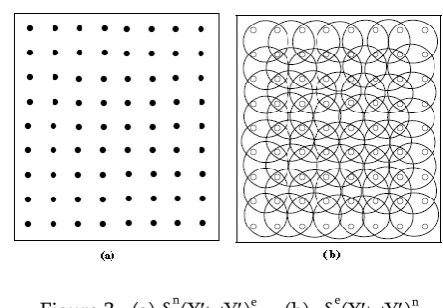
δn(XY)e= δn(X)e δ n(Y)e .Here (X Y)e retrieves all edges which are of high medium and low priority ,so also the dilation operation δn(X Y)e retrieves all nodes within these high, medium and low priority hyperedges. The same is shown in Fig.3 (a)
Figure 3: (a) δn(XY)e (b) δe(XY)n
Example 3.3. Considering L.H.S of eq(7), we obtain (XY)e = {e1, e2, e3, e4, e5, e6}. From that we get
δn (XY)e = { n1, n2, n3, n4, n5, n6, n7, n8, n9, n10, n11, n12}.
Considering R.H.S, we get δn(X)e = { n1, n2, n3, n4, n5, n6,
n7, n8, n9, n11, n12}. Also δn(Y)e = { n1, n2, n3, n4, n5, n6, n7,
n8, n9, n10, n11}. Now δ n
(X)e δ n(Y)e ={ n1, n2, n3, n4, n5,
n6, n7, n8, n9, n10, n11, n12}.
Definition 3.4: Let X and Y be the sub hypergraphs of HIF and δ be the dilation operator defined on
hypergraph. Then edge dilation of XY is defined as
δe(X Y) n = δ e (X)n δ e (Y)n (10)
Proof: Let X = H - X, Y = H - Y, X = (Xn, Xe) , Y =
(Yn, Ye) . (X Y)n be the set of all hypernodes not
in X Y , where X Y = Z. Also Znand Ze are the
hypernodes and hyperedges of Z. Hence
δe (X Y)n = Ze (11)
δe (X)n δe (Y)n = Xe Ye (12)
From eq(11) and eq(12), it implies that δe (X Y)n = δ e (X)n δe (Y)n .
This dilation operation will retrieve all edges which are of high, medium priority and low priority. The same is shown in Fig.3(b).
Example: Considering L.H.S of eq(10), we obtain the result (X Y) n ={n1, n2, n3, n4, n5, n6, n7, n8, n9, n10, n11,
n12}. Now δe(X Y)n = {e1, e2, e3, e4, e5, e6}. Consider
R.H.S, where δe(X)n = {e1, e2, e3, e4, e6}. Now δe(Y)n =
{e1, e2, e3, e4, e5}. From this we get δe(X)n δe (Y)n =
{e1, e2, e3, e4, e5, e6}.
Definition 3.5: Let X and Y be the sub hypergraphs of HIF and δ be the dilation operator defined on
hypergraph. Then node dilation of X Y is defined as
δn (X Y)e = δn (Xe) δn (Y e) (13)
provided there are common edges in X and Y.
Proof: Consider the intersection operation of two IFHG sub hypergraphs X and Y, where X and Y are defined as in previous section. In L.H.S of eq(13), consider X Y = (Zn, Ze) where Zn = Xn Yn and Ze = Xe Ye and the intersection operation is same as the operation on graph.
δn (XY)e = Zn (14)
by definition of δ n
Also δ n (Xe) = Xn and δ n (Y e) = Yn
δn(Xe)δn(Ye) = XnYn = Zn (15)
Eq(13) is implied from eq(14) and eq(15) . Fuzzy membership and non membership degrees are invariant under this equation. The resultant graph is shown in Fig . 4(a). This dilation will retrieve only
the priority hypernodes which are found both in X and Y.
Example 3.5. Since this is true only if there are common edges in X and Y, let us modify X by including a common edge with Y so that now new X=(Xn , Xe ), where Xe = {e5, e6} and Xn ={n7, n8, n9, n10,
n11, n12}.Consider the result of L.H.S of eq(13), where
we get (X Y)e = {e6}, so we get δn(X Y)e = {n8, n9,
n11, n12}. Consider R.H.S, where we get δn(Xe) = {n7, n8,
n9, n10, n11, n12} and δ n
(Y e) = { n8, n9, n11, n12}. Definition
3.5 is proved with the result δn(Xe) δn(Y e) = {n8, n9,
n11, n12}.
Definition 3.6: Let X and Y be the sub hypergraphs of HIF and δ be the dilation operator defined on
hypergraph. Then edge dilation of X Y is defined as
δe(X Y)n = δe (Xn) δ e (Yn) (16)
Proof: In L.H.S of eq(16), (X Y)n is the collection of all hypernodes in X Y. ie,
δ e(X Y)n is the collection of all hyperedges which contains these hypernodes.
δe (X Y)n = Ze (17)
In R.H.S of eq(16), δe (Xn) = Xe and δe (Yn) = Y e Hence
δe (Xn) δe (Yn) = Xe Y e = Ze (18) Eq(16) is implied from eq(17) and eq(18).
The same result is shown in Fig .4(b). As we see in the figure, not all edges are of high priority. It retrieves all kinds of edges. But it ensures that at least one hypernode in that edge is of high priority.
Example 3.6: Consider the X and Y mentioned in example 3.1. In L.H.S of eq(16), while we get (X Y)n = {n8, n9}, we get δe(X Y)n = {e3, e4, e5, e6}.
Considering R.H.S of eq(16), we obtain δe (Xn) = {e3,
e4, e5, e6}; δ e
(Yn) = { e3, e4, e5, e6}. Now δ e
(Xn) δe(Yn)={e3, e4, e5, e6}.
Definition 3.7: Let X and Y be the sub hypergraphs of HIF and δ be the dilation operator defined on
hypergraph. Then node dilation of X Y is defined as
δn (X Y)e = δn (X)e δn (Y)e (19)
provided there common edges in X and Y.
Proof: Let X = H - X, Y= H - Y, X = (Xn, Xe), Y =
(Yn ,Ye). Let (X Y)e be the set of all hyperedges
not in X Y, where X Y =Z. Also Zn and Ze are
the hypernodes and hyperedges of Z . Hence
δn (X Y)e = Zn (20)
Also
δn (X)e δ n (Y)e = Xn Yn (21)
Eq(19) is implied from eq(20) and eq(21). Resultant graph obtained is shown in Fig 5(a)
Figure 5: (a) δ n (X Y)e (b)δn(X Y)e
Example 3.7 .Let us consider the modified X = (Xn, Xe), where Xe = {e5, e6} and Xn ={n7, n8, n9, n10, n11, n12}.Now
in L.H.S of eq(19), we get (X Y)e = {e1, e2, e3, e4}.
Now δn(X Y)e ={n1, n2, n3, n4, n5, n6, n7, n8,
n9}.Consider R.H.S ,where we get δ n
(X)e = {n1, n2, n3,
n4, n5, n6, n7, n8, n9}. δ n
(Y)e ={n1, n2, n3, n4, n5, n6, n7, n8, n9,
n10, n11}. Thus δn (X)e δn (Y)e ={n1, n2, n3, n4, n5, n6, n7,
n8, n9}.
Definition 3.8: Let X and Y be the sub hypergraphs of HIF and δ be the dilation operator defined on
hypergraph. Then edge dilation of X Y is defined as
δe (X’ Y’)n = δe (X’)n δ e (Y’)n (22)
Proof: Let X = H - X, Y = H - Y, X = (Xn, Xe)
, Y = (Yn, Ye). Let (X Y)n be the set of all
hypernodes not in X Y , where X Y’= Z’. Also Zn
and Ze are the hypernodes and hyperedges of Z.
Hence
δe (X Y)n = Ze (23)
Also
δe (X) n δ e (Y)n = Xe Ye (24)
Eq(22) is implied from eq(23) and eq(24).The resultant graph is shown in Fig.5(b).
Example 3.8.Take X and Y defined in example 3.1. Applying it in eq(22), we get (X Y)n ={n1, n2, n3, n4,
n5, n6, n7, n8, n9}. So δe (X Y)n ={ e1, e2, e3, e4, e5, e6}. δe
(X) n ={ e1, e2, e3, e4, e5, e6}. Also δe (Y)n = {e1, e2, e3, e4, e5,
e6}. Thus δe (X)n δe (Y)n ={ e1, e2, e3, e4, e5, e6}.
3.9.1: Generalized associative law for union
Proposition 1. Let X1, X2, X3……. Xn be the sub
hypergraphs of HIF. Letδ be the node dilation operator
defined on X1 , X2, X3……. Xn, then
δn(X1 X2 X3 … Xn)e = δ n
The proof follows from definition 3.1
Similary the edge dilation on (X1 X2 X3 … Xn) is
δe(X1 X2 X3 …Xn)n = δ e
(X1 n X2 n … Xn n) (26)
The proof follows from definition 3.2.
3.9.2: Generalized associative law for intersection Proposition 2. Let X1, X2, X3……. Xn be the sub
hypergraphs of HIF. Letδ be the dilation operator, then
node dilation on (X1 X2 X3 …Xn) is
δn(X1 X2 X3 …Xn)e = δn(X1e X2e ……. Xn e ) (27)
The proof follows from definition 3.5
Similary the edge dilation on (X1 X2 X3 …Xn) is
δe(X1 X2 X3 …Xn)n = δe(X1n X2 n …… Xn n) (28)
The proof follows from definition 3.6
3.9.3: Distributive law
Proposition 3. Let X, Y and T be three sub hypergraphs of HIF. Then
δ n((X Y ) T)e = δ n(X T) e δ n(Y T) e (29) The proof follows from definition 3.1 and definition
3.5.
IV.
DE MORGAN’S LAW APPLIED TO IFHG
4.1:De Morgan’s law applied to dilation with respect to hypernode considering union of subgraphs
Proposition 4 .Let X and Y be the sub hypergraphs of HIF and δ be the dilation operator defined on hypergraph,
then
δ n(X Y ) e = δn(X)e δ n (Y)e (30)
provided there are edge(s) in X Y.
Proof: (X Y) be the sub hypergraph with edges which are not present in X Y.
Let (X Y ) e be the edges in that hypergraph . Hence δn(X Y) e is the set of all hypernodes in the sub hypergraph (X Y). Let it be Zn. Also δn (X)e = set
of all hypernodes in X, δn (Y)e = set of all hypernodes in Y. Let v be an arbitrary node in δn(X Y) e , which implies that v belongs to δn(X)e and v belongs to δ
n
(Y)e.
Hence
δ n(X Y ) e δ n (X)e δ n (Y)e (31)
Let v belongs to δn (X)e δn (Y)e which implies that v belongs to X and v belongs to Y. Hence v X and v
Y.
v X Y
X (X Y)
δn (X)e δn (Y)e δn(X Y ) e (32)
Eq (30) implied from Eq(31) and Eq(32) .
Example 4.1
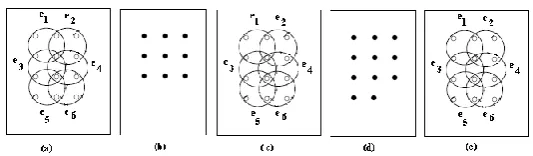
. Consider the hypergraph HIF
given in Table I(also shown in Fig 6(a)). Let X be a sub hypergraphX = (
Xn , Xe), where Xe = { e5, e6} and Xn
={n7, n8, n9, n10, n11, n12}. Let Y be another sub
hypergraph such that Y = (Yn, Ye), where Ye ={e6},
Yn={n8, n9, n11, n12}. Considering L.H.S of eq (30) we
get, (X Y) e = {e1, e2, e3, e4}. Now δ n
(X Y) e = {n1,
n2, n3, n4, n5, n6, n7, n8, n9}. Considering R.H.S of eq (30)
we get, δn (X)e = {n1, n2, n3, n4, n5, n6, n7, n8, n9}. Also δ n
(Y)e = {n1, n2, n3, n4, n5, n6, n7, n8, n9, n10, n11}. Thus we
get δn (X)e δn (Y)e ={n1, n2, n3, n4, n5, n6, n7, n8, n9} as
shown in Fig 6(b).
Figure 6:(a) H 6(b),6(c),6(d) ,6(e) – Results of De Morgan’s law 4.2 : De Morgan’s law applied to dilation with respect to hyperedge considering union of subgraphs. Proposition 5. Let X and Y be the sub hypergraphs of HIF and δ be the dilation operator defined on hypergraph,
δe (X Y )n = δe (X)n δe (Y)n (33)
provided there are edge(s) in X Y.
Proof: Let (X Y) be the sub hypergraph with edges which are not present in X Y. Let (X Y)n be the
nodes in that hypergraph . Hence δe (X Y ) n is the set
of all hyperedges which include such nodes. Let it be Ze.
Also δe(X) n = set of all hyperedges in X , δ e (Y) n =
set of all hyperedges in Y. Let v be an arbitrary node in δe(X Y)n, which implies that v belongs to δe(X)n and
v belongs to δe (Y)n . Hence
δe (X Y )n δe (X)n δe(Y) n (34)
Let v belongs to δe (X) n δe (Y) n which implies that v belongs to X and v belongs to Y. Hence v X and v
Y .
v X Y v (X Y )
δe(X)n δe(Y)n δe(X Y ) n (35)
Eq (33) is implied from Eq(34) and Eq(35) .
Example 4.2. Consider the hypergraphs given in example 4.1. Considering L.H.S of eq (33) we get , (X Y)n = {n
1, n2, n3, n4, n5, n6, n7, n8, n9}. Thus we get
δe(X Y)n = {e
1, e2, e3, e4, e5, e6}. Considering R.H.S of
eq(33), we get δe(X)n = {e1, e2, e3, e4, e5, e6} and δ e
(Y) n ={e1, e2, e3, e4, e5, e6}. Thus δ
e
(X)n δe(Y)n = {e1, e2, e3, e4,
e5, e6}as shown in Fig 6(c).
4.3: De Morgan’s law applied to dilation with respect to hypernode considering intersection of subgraphs
Proposition 6. Let X and Y be the sub hypergraphs of HIF and δ be the dilation operator defined on hypergraph,
then
δn(XY)e=δn(X)eδn(Y)e (36)
provided there are edge(s) in X Y
Proof: Let (XY) be the hypergraph with edges which are not present in X Y. Let (X Y) e be the edges in that hypergraph. Let δn(X Y)e be the set of all nodes in the Sub hypergraph (X Y). Let v be a node in δn(X
Y) e, then it is not a node of X Y ie v X Y.
δn(XY)e X Y (37)
Also δn(X)e is the set of nodes in X as in fig .2. Also δn(Y)e is the set of nodes in Y . Let v belongs to
δn(X)e δn(Y)e which implies that v either belongs to any node in X or v belongs to any node as given in ie, v X Y.
δn(X)e δn(Y)e X Y (38)
Eq(36) is implied from eq(37) and eq(38).
Example 4.3. Consider the hypergraphs given in example 4.1. Considering L.H.S of eq (36) , we get (XY)e= {e1, e2, e3, e4, e5}. δ
n
(XY)e = {n1, n2, n3, n4, n5, n6, n7, n8,
n9, n10, n11}. Now consider R.H.S , where we get
δn(X)e = {n1, n2, n3, n4, n5, n6, n7, n8, n9}. δ n
(Y)e = {n1, n2,
n3, n4, n5, n6, n7, n8, n9, n10, n11}. Now δ n
(X)e δn(Y)e = {n1, n2, n3, n4, n5, n6, n7, n8, n9, n10, n11} as shown in Fig 6(d).
4.4: De Morgan’s law applied to dilation with respect to hyperedge considering intersection of sub graphs
Proposition 7. Let X and Y be the sub hypergraphs of HIF and δ be the dilation operator defined on hypergraph,
then
δe (X Y )n = δe (X)n δe (Y)n (39)
provided there are edge(s) in X Y .
Let (X Y) be a hypergraph with nodes which are not present in X Y. Let (X Y)n be the nodes in that
hypergraph. Let δe(X Y)n be the set of all edges in
the sub hypergraph (X Y). Let e be an edge in δe(X
Y)n , it is not an edge of X Y . ie, e X Y .
δe(X Y ) n X Y (40)
Also δe(X)n is the set of all edges in X. Also δe(Y)n is the set of all edges in Y.Let e belongs to δe(X)n
δe(Y)n ; which implies that e either belongs to X or Y. ie, e X Y .
δe(X)n δe(Y)n X Y (41)
Eq(39) is implied from eq(40) and eq(41).
Example 4.3.
Consider the hypergraphs given in example 4.1. Considering L.H.S of eq(39) we get, δe(X Y)n = {e
1, e2, e3, e4, e5, e6}. Consider R.H.S of eq(39)
where we get δn(X)e = {e1, e2, e3, e4, e5, e6}. Now δ e
(Y)n = {e1, e2, e3, e4, e5, e6}. Thus δ
e
(X)n δe(Y)n = {e1, e2, e3,
V.
CONCLUSION
The paper has proved algebraic operations applied to the morphological operation dilation applied to IFHG. The proofs are also substantiated with a sample hypergraph and sub hypergraphs considering their node and edge membership and non-membership degrees. This type of modeling finds applications in the area of computer networks, image processing and text processing. The algebra of morphological erosion is a future enhancement of this paper.
VI.
REFERENCES
[1]. Atanassov, Krassimir T. 1999. ’Intuitionistic Fuzzy Sets Theory and Applications’ Studies in fuzziness and soft computing , Heidelberg, New York, Physicaverl.
[2]. Atanassov, Krassimir T .2003. ’Intuitionistic fuzzy sets: past, present and future’, In proceedings of EUSFLAT , pp. 12-19.
[3]. Mordeson J N, Premchand S N. 2012. ’Fuzzy graphs and fuzzy hypergraphs’, Physica, Vol .46. ISBN-978-3-7908-1854-3.
[4]. Parvathi R , Thilagavathi S and Karunambigai M G. 2009. ’Intuitionistic fuzzy hypergraphs’, Cybernetics and Information Technologies, Vol. 9, pp.46-53.
[5]. Parvathi R, Thilagavathi S, Karunambigai MG . 2012. ’Operations on intuitionistic fuzzy hypergraphs’, International Journal of Computer Applications , Vol .51.5.
[6]. Parvathi R , Thilagavathi S , Atanassov KT.2013, ’Isomorphism on Intuitionistic Fuzzy Directed Hypergraphs’, International Journal of Scientific and Research Publications ,pp . 278-285.
[7]. Muhammad Akram , Wieslaw A. Dudek .2013. ’Intuitionistic fuzzy hypergraphs with applications’, Information Sciences, Vol .218, pp.182-193.
[8]. Ejegwa P A ,Akubo A J , Joshua OM, ’Intuitionistic fuzzy set and its application in career determination via normalized Euclidean distance method’ ,European Scientific Journal, Vol.No .10 , pp.529-536.
[9]. Samanta T K , Mohinta S. 2014. ’Generalized strong intuitionstic fuzzy hypergraph’, Mathematica Moravica , Vol .18 , pp .55-65. [10]. Kannan B, Bino S, Unnikrishnan A, Ramkumar
P B .2014. ’Morphological filtering on Hypergraphs ‘, arXiv :1402. 4258v1.
[11]. Bino S , Unnikrishnan A , Kannan B , Ramkumar P B.2014. ‘Mathematical morphology on hypergraphs using vertex-hyperedge correspondence’, ISRN Discrete Mathematics, Hindawi publishing corporation, Vol .2014.
[12]. Myithili K K , Parvathi R .2015 .Transversals of intuitionistic fuzzy directed hypergraphs , Notes on IFS, Vol .21.pp .66-79.