Original Research Article
Perception and practices regarding complimentary feeding
among anganwadi workers in Punjab, India
Ritu Rochwani
1*, Aman D. Singh
2INTRODUCTION
Infant and young child feeding (IYCF) practices are the most important determinants of nutritional status of children.1,2 Adequate and appropriate nutrition is the key to proper growth and development during the initial years of life.3 It is estimated that exclusive breastfeeding prevents 13 percent of the estimated under-five deaths while appropriate complementary feeding prevents another 6 percent of under-five deaths.4 The Third
National Family Health Survey (NFHS-3) of India reported that overall 21.5% of children aged under three years were breastfed within one hour of birth, 48.3% of the children aged zero to five months were exclusively breastfed, and 53.8% of the children aged six to nine months received solid or semi-solid food and breast milk.5 Complementary feeding is defined as the process starting when breast milk alone is no longer sufficient to meet the nutritional requirements of infants, and therefore other foods and liquids are needed, along with breast
ABSTRACT
Background: Adequate and appropriate nutrition is the key to proper growth and development during the initial years of life. Appropriate complementary feeding depends on accurate information and skilled support from the family, community and health care system. Anganwadi is the focal point for delivering services to beneficiaries in every urban, rural, slum and tribal areas. Anganwadi workers (AWWs) provide health and nutrition education on various aspects of mother and child health. The objectives of the study were to assess perception and practices among Anganwadi workers regarding complimentary feeding.
Methods: This was a cross sectional study which was conducted in month of April - May 2014. A total number of 1800 workers were under training programme conducted in department of Community Medicine Government Medical College, Patiala. Purposive sampling was used and 218 anganwadi workers were randomly selected (8 anganwadi workers in each batch were randomly selected) and interviewed Data thus collected and entered in Microsoft excel and statically analysed by Epi Info 7.
Results: Only 65.60% anganwadi workers knew correctly about the complimentary feeding that is other food giving in addition to breast feeding. A large percent of anganwadi workers (43.58%) recommended liquid diets for children, nearly all 92.66% anganwadi workers taught mother that during illness feed should not be stopped. Only 43.58% taught mothers regarding consistency of feed to be given to baby.
Conclusions: The perceptions and practices of anganwadi workers regarding frequency, quality and quantity of complementary Feeding were not good.
Keywords: Complimentary feeding, Anganwadi workers, IYCF practices, Quantity
Department of Community Medicine, 1East Point College OF Medical Sciences and Research Centre, Bangalore, Karnataka, 2Government Medical College Patiala, Punjab, India
Received: 30 August 2018
Revised: 02 November 2018
Accepted: 03 November 2018
*Correspondence:
Dr. Ritu Rochwani,
E-mail: [email protected]
Copyright: © the author(s), publisher and licensee Medip Academy. This is an open-access article distributed under the terms of the Creative Commons Attribution Non-Commercial License, which permits unrestricted non-commercial use, distribution, and reproduction in any medium, provided the original work is properly cited.
milk.6,7 Appropriately thick homogenous complementary foods made from locally available foods should be introduced at six completed months to all babies while continuing breastfeeding ad libitum. Consistency of foods should be appropriate to the developmental readiness of the child in munching, chewing and swallowing.6,8 Complementary feeding is required in appropriate
quantity, quality and frequency to fulfil the
recommendations adequately.9 Inappropriate practices such as poor breastfeeding, delayed introduction of complementary foods, low energy and nutrient density of foods offered, feeding in small amounts at meals, and food restrictions due to cultural beliefs are common which leads to high rates of infections, vulnerable to irreversible outcomes of stunting, poor cognitive development. Malnourished children have delayed milestones and impaired cognitive development.6,8,10-12 Appropriate complementary feeding depends on accurate information and skilled support from the family, community and health care system. Keeping improved infant and young child feeding high on the public health agenda is crucial.13 Anganwadi is the focal point for delivering of ICDS packages of services to beneficiaries in every urban, rural, slum and tribal areas.14-21 Anganwadi workers (AWWs) provide health and nutrition education on various aspects of mother and child health. Thus it is important that she has adequate scientific knowledge about complimentary feeding so that she can impart the correct knowledge to the mother beneficiaries.
Aims/objectives
To assess perception and practices among anganwadi
workers regarding complimentary feeding.
METHODS
This was a cross sectional study which was conducted in month of April-May 2014. A total number of 1800 workers were under training programme conducted in Department of Community Medicine Government Medical College, Patiala. Purposive sampling was used and 218 anganwadi workers were randomly selected (8 anganwadi workers in each batch were randomly selected) and interviewed. The purpose & nature of the study was explained to anganwadi workers for their participation. Anganwadi workers were interviewed in local language (Punjabi). Pre designed and pre tested questionnaire was used to collect information regarding their perceptions about breast feeding, complimentary feeding & practices that they follow at their anganwadi canters. Data thus collected and entered in Microsoft excel and statically analysed by Epi Info 7.
RESULTS
Mean age of anganwadi workers was 39 years (range 21-57). Mean years of experience of anganwadi workers was 11 years (range 1-30 years). All anganwadi workers had
received ICDS job. Only 65.60% anganwadi workers knew correctly about the complimentary feeding that is other food giving in addition to breast feeding (Figure no. 1). Almost all (97.71%) anganwadi workers agreed that breastfeeding should continue when complimentary feeding starts. Only 61.47% anganwadi workers mentioned Breast feeding should be continued up to age of 24 months. Around half 45.41% anganwadi workers did not know the energy need from complimentary food for 6 months infants with average breast milk and only 40.83% anganwadi workers mentioned 200kcal\day (Table 1). About 93.12% anganwadi Workers mentioned correct age of initiation of complimentary feeding but 37.61% anganwadi workers did not know that adding food too soon (before 6 months) may result in low nutrient diet. Although 55.96% anganwadi workers recommends food with semisolid consistency, a large
percent of anganwadi workers (43.58%) also
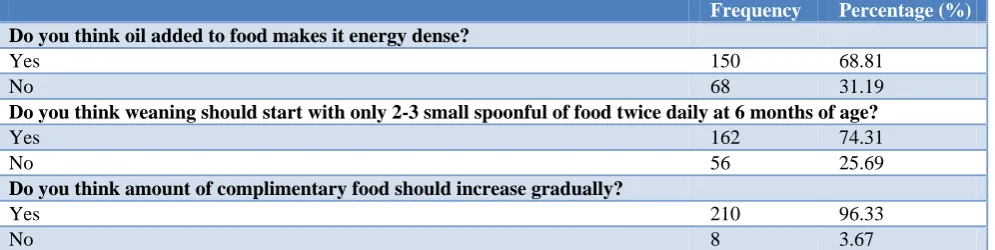
recommended liquid diets for children (Figure 2). About 68.81% anganwadi workers mentioned oil added to food makes it energy dense. Dark green leafy vegetables are rich source of iron and vitamins. About 87.61% anganwadi workers agreed that dark green & yellow vegetables should be given to children as complimentary feed. A majority of anganwadi workers recommended dalia (90.83), khichadi (86.24%), mashed potatoes (86.20%), mashed banana (84.4%), fresh fruits juice (80.73%), biscuits and milk (44.95%) dal water (82.11%), whole cooked dal (16.06%), cerelac (40.37%), lactogen (9.63%), rice(23.39%) as complementary food. More than half 61.93% anganwadi workers agreed that readymade preparations/canned foods should not be given to children as complementary food. Only 11.93% anganwadi workers were aware about the infant milk substitutes, feeding bottles and infant foods (Regulation of Production, Supply and Distribution) IMS Act. About
12.84% anganwadi workers mentioned that
frequency of complimentary feed is 5 times/day. About 43.12% anganwadi workers mentioned that 250ml (1 katori) of complimentary food should be given to 18 month old child (fig. no. 4). In regards of supplementary feeding under ICDS 54.59% anganwadi workers had a correct knowledge about the amount of calories and only 8.72% AWW knew about the amount of proteins should
be given under ICDS for children of 6 months to 3 years i.e. 12-15 g/d, and 30.28% anganwadi workers did not know about amount of proteins should be given under ICDS. About 88.99% anganwadi workers had correct knowledge that supplementary nutrition to be given to children under integrated child development service scheme for 25 days/ month.
Table 1: Perception regarding complimentary feeding.
Frequency Percentage (%)
Breast feeding should be continued up to which age?
6 months 48 22.02
12 months 20 9.17
18 months 16 7.34
24 months 134 61.47
What is energy need from complimentary food for 6 months infants with average breast milk?
300 kcal/day 21 9.63
200 kcal/day 89 40.83
400 kcal/day 9 4.13
Not know 99 45.41
What is the quantity of complimentary food is given to 6 month healthy breastfeeding baby?
1 katori (250 ml) 31 14.22
0.5katori (125 ml) 148 67.89
1.5 katori (375 ml) 6 2.75
Not know 33 15.14
What is the quantity of complimentary food should be given to 18 month old child?
1.5 katori (375 ml) 46 21.10
1 katori (250 ml) 94 43.12
0.5 katori (125 ml) 36 16.51
Not know 42 19.27
An average healthy breastfed infant of 6-8 months age needs complimentary feed for how many times/day?
2 times 35 16.06
3 times 111 50.92
5 times 63 28.90
Not know 9 4.13
An average healthy breastfed child of 15 months age needs complimentary feed for how many times/day?
2 times 3 1.38
3 times 63 28.90
5 times 142 65.14
Not know 10 4.59
Are you aware about infant milk substitute (IMS) act?
Yes 26 11.93
No 192 88.08
Do you know which type of feed can fill the energy gap?
Yes 163 74.77
No 55 25.23
Do you think dark green and yellow vegetables should be given to children as complimentary food
Yes 191 87.61
No 27 12.39
Do you think readymade preparations/canned food/ceralac should be given to children?
Yes 83 38.07
No 135 61.93
Do you think complimentary food should be stopped during illness?
Yes 28 12.84
No 190 87.16
Frequency Percentage (%) Do you think oil added to food makes it energy dense?
Yes 150 68.81
No 68 31.19
Do you think weaning should start with only 2-3 small spoonful of food twice daily at 6 months of age?
Yes 162 74.31
No 56 25.69
Do you think amount of complimentary food should increase gradually?
Yes 210 96.33
No 8 3.67
Table 2: Practices of anganwadi workers.
Frequency Percentage (%)
What is the amount of protein should be given under ICDS for children 6-3 years?
12-15g/d 19 8.72
20-25 g/d 100 45.87
18-20 g/d 33 15.14
Not know 66 30.28
For how many days supplementary nutrition to be given to children under integrated child development service scheme?
25 d/m 194 88.99
30 d/m 7 3.21
15 d/m 5 2.29
Not know 12 5.50
Do you provide supplementary nutrition to children of <2 year of age?
Yes 210 96.33
No 8 3.67
Children of which age group come daily to Anganwadi canter?
6 months-1 year 5 2.29
2 year-3 year 14 6.42
>3 year 199 91.29
Where do you provide supplementary food to children <3 years?
At anaganwadi centers 76 34.86
At home 142 65.14
In which form you provide food to children of 6–8 months?
Solid 22 10.09
Semisolid 182 83.49
Not providing 14 6.42
Figure 1: Perception regarding complimentary feeding.
Figure 2: Perception regarding consistency of complimentary food for 6-12 months.
0.00% 20.00% 40.00% 60.00% 80.00%
g
iv
ing
o
ther
food
in
a
ddit
io
n
to br
ea
st
fe
eding
So
me b
reas
tf
e
ed and
so
me a
rti
ficial f
eed
O
nly
givi
ng
feed
o
ther
t
h
a
n
bre
a
st
feed
Do
n't
know
65.60%
1.83%
32.11%
0.46%
0.00% 10.00% 20.00% 30.00% 40.00% 50.00% 60.00% 70.00%
Liquid Solid Semisolid Don't know 43.58%
55.96%
Figure 3: Perception regarding quantity of complimentary food for 6 months healthy
breastfeeding baby each time.
Figure 4: Perception regarding quantity of complimentary food for 18 months healthy
breastfeeding baby each time.
Table 2 shows practices of anganwadi workers. Nearly all (91.29%) anganwadi workers mentioned that >3 years age group of children were come daily to their anganwadi center. Almost all 96.33% anganwadi workers provide supplementary nutrition to children of <3 year of age. More than half 65.14% anganwadi workers provide supplementary feed to children <3 years at home, as mothers were coming to collect the food. About 83.49% anganwadi workers provide feed to children of 6–8 months in semisolid form. Nearly all 92.66% anganwadi workers taught mother that during illness feed should not be stopped and 97.71% anganwadi workers advised mother to give small frequent meals to her child during
illness. Only 43.58% taught mothers regarding
consistency of feed to be given to baby.
DISCUSSION
Anganwadi worker is a key player with regard to promotion of IYCF practices as she has close and continuous contact with the community. By virtue of her position in the community, anganwadi worker has more chances to interact and to educate the mothers. For that the anganwadi worker should have basic knowledge of child care activities. But very less focus has been given to
assess the knowledge and awareness among anganwadi workers about complimentary feeding. In our study the knowledge of anganwadi workers with regard to key IYCF practices was not good. The major gap was with respect to the knowledge related to early initiation, quantity, quality, frequency of complimentary food. In the present study out of 218 anganwadi workers 93 (42.66%) were in the age group 31-40 years and 100 (45.87%) had experience more than 10 years, whereas study done by Baliga found that 43.4% anganwadi workers were in the age group of 31-40 years.18 In another study conducted by Joshi found 42% anganwadi workers had experience more than 10 years.19 Sondankar found 36.92% of anganwadi workers were in the age group of 30–39 years and 36.35% anganwadi workers had more than 10 years of experience.20 The knowledge regarding timing of initiation of complimentary food was good in our study. Almost all 93.12% anganwadi workers mentioned correct age of initiation of complimentary food. But 37.61% did not know consequences of starting complimentary food before 6 months. In a study by Parikh et al reported that all anganwadi workers (100%) knew the correct age of complimentary food.15 The food given to child should be energy dense. dalia, khichadi, meshed potatoes, meshed banana,fresh fruits juice, biscuits and milk, whole cooked dal, rice are energy dense. But dal water, liquid diet should not given as complimentary food, does not give as much energy. In present study 55.96% anganwadi workers recommends food with semisolid consistency. This is nearly about NFHS 3 data about complimentary food i.e. 53.8% of the children aged six to nine months received semi-solid food and breast milk.in present study nearly half (43.58%) of anganwadi workers also recommended liquid diets for children. These practices in fact are one of the primary reasons which can be attributed to low energy and protein intake during complementary feeding. Less than half of AWWs taught mothers regarding consistency of feed to be given to baby as complimentary food. Parikh et al found 65% anganwadi workers recommended food with thick consistency while 47% recommended liquid diets for children.15 Similar findings were reported by Syed et al who conducted study among 123 women of selected villages and found 53.7% mothers given complementary food in semi-solid form.5 Most AWWs had no correct knowledge about the quality, quantity, energy need of complementary feed. Only 54.59% anganwadi workers knew about the calories & 8.72% knew about the proteins provided under ICDS through the supplementary feeding at anganwadi center. In a study conducted by Dogra found none of anganwadi workers knew about amount of calories providing to children.21 There is a need to disseminate information regarding proper feeding practices such as adequate quantity, quality and frequency of complimentary feed along with average breastfeeding. Anganwadi workers should utilize every opportunity to educate mothers regarding correct feeding practices. The contact during Mamta Diwas should be used to educate mothers regarding the importance of IYCF practices. Visits for immunization and illness 0.00% 10.00% 20.00% 30.00% 40.00% 50.00% 60.00% 70.00% 80.00% 1 Kat o ri ( 2 5 0 ml) 0 .5 K a to ri ( 1 2 5 ml) 1 .5 K a to ri ( 3 7 5 ml) Do n't know 14.22% 67.89% 2.75% 15.14% 0.00% 10.00% 20.00% 30.00% 40.00% 50.00% 3 7 5 ml ( 1 .5 ka tori) 2 5 0 ml (0.5 ka tori) 1 2 5 ml ( 0 .5 ka tori) Do n't know 21.10% 43.12%
provide additional opportunities for reinforcing the advice already given as well as for advising supplementation.
CONCLUSION
The perceptions and practices of anganwadi workers
regarding frequency, quality, and quantity of
Complementary Feeding were not good. It may not be helpful to the community to promote and enhance the key Complimentary Feeding practices to its optimal level. The anganwadi workers were aware of key IYCF practices, however the perceptions with regard to the rationale applicable to the appropriate recommended complimentary feeding practices being promoted was rather poor. This is noted to be a critical gap and needs to be addressed for equipping the ICDS frontline workers for effectively promoting successful adoptions of
complimentary feeding practices by community.
Behavior modification toward improving child feeding practices must pay greater attention. Complementary food bridges the energy, vitamin A and iron gaps which arise in breastfed infants at 6 month of age. Our study brings up the fact that complementary feeding practices are by and large inappropriate in our society which seem to be strongly associated with the lack of proper knowledge among mothers regarding complementary feeding and anganwadi workers can play a vital role to improve the IYCF practices by providing adequate knowledge to mothers.
Recommendations
Inappropriate complementary feeding is one of the major causes of malnutrition in young children in developing countries. Education about food recommended for young children is of great importance in the prevention of chronic malnutrition. Overall, perceptions for promoting of community based complementary feeding practices was not adequate amongst the ICDS frontline workers. Regular reinforcement of training with on-job capacity building, follow-ups with regards to complementary feeding rather than just IEC (Information education and communication) on key IYCF messages is recommended. This probably would accelerate prevention and reduction of under nutrition in community.
Limitation
This study may be helpful in creating an awareness of the advantages of exclusive breastfeeding and timely initiated complementary food which is made from locally available foods. Anganwadi workers should be empowered by basic, scientific information related to IYCF. In this study anganwadi workers were interviewed before the training. No information was collected after completion of training and there was no follow-up at their anganwadi centers. In such a process anganwadi workers might have missed out sharing some knowledge and perceptions they gained during the training. Also the
study was conducted among small number of anganwadi workers. Hence, the findings in this study cannot be generalized to cover the state or India as a whole.
ACKNOWLEDGEMENTS
The author would like to thankfully acknowledge the help, co-operation, assistance and guidance from department of Community Medicine, Government
Medical College, Patiala, Punjab. Authors also
acknowledge the valuable inputs of Dr. Paramjeet Kaur, Dr. Rajinder Singh Balgir, and Dr. Ishan Arora. Author specially thanks and acknowledges all the Anganwadi workers for their support and cooperation in conducting the study.
Funding: No funding sources Conflict of interest: None declared
Ethical approval: The study was approved by the Institutional Ethics Committee
REFERENCES
1. World health organization. Global strategy for
infant and young child feeding. Available at http://apps.who.int/gb/archive/pdf_files/WHA54/ea 547.pdf
2. Sreedhara MS, Banapurmath CR. A study of
nutritional status of infants in relation to their complementary feeding practices. Curr Pediatr Res. 2013;18:39-41.
3. Seksaria SA, Sheth MK. Nutritional Status of the Children below 3 Years of Age in Tribal Villages of Chikhli Taluka, Gujarat. Ind J Res. 2013;2(12):97-9.
4. Ministry of Health and Family Welfare Government
of India. Guidelines for enhancing optimal infant and young child feeding practices, 2013. Available
at: http://www.wcd.nic.in/sites/default/files/
nationalguidelines.pdf. Accessed on 3 June 2018. 5. Mahmood SE, Srivastava A, Shrotriya VP, Mishra
P. Infant feeding practices in the rural population of
north Ind. J Family Community Med.
2012;19(2):130–5.
6. Tiwari S, Rajeshwari K, Bang A, Chaturvedi P, Kumar V, Yadav B. Infant and Young Child Feeding Guidelines: 2010 infant and young child feeding chapter. Indian Acad Pediatr. 2010.
7. World Health Organization.Complementary feeding
in the WHO Multicentre Growth Reference Study WHO multicentre growth reference study group, Switzerland. Available at: http://www.who.int/ childgrowth/standards/Comp_feeding.pdf. Accessed on 3 July 2018.
8. Complementary feeding Report of the global
consultation Summary of guiding principles 2001.
Available at: http://www.who.int/nutrition/
publications/Complementary_Feeding.pdf. Accessed on 3 July 2018.
9. Saxena V, Kumar P. Complementary feeding
Doiwala district Dehradun. Ind J Basic Applied Med Res. 2014;3(2):358-63.
10. Bhandari N, Mazumder S, Bahl R, Martines R,
Black RE, Bhan MK et all. An Educational
Intervention to Promote Appropriate
Complementary Feeding Practices and Physical Growth in infants and Young Children in Rural Haryana. Ind J Nutr. 2004;134(9):2342-8.
11. Sinhababu A, Mukhopadhyay DK, Panja TK, Saren
AB, Mandal NK, and Biswas AB. Infant- and Young Child-feeding Practices in Bankura District, West Bengal, India. J Health Popul Nutrition 2010;28(3):294–9.
12. Khan YM. A study on complementary feeding
Practices in Jammu, Kashmir and ladakh regions. Int J Adv Res Tech. 2013;2(1):1-9.
13. World Health Organization Geneva. Global Strategy
for Infant and Young Child Feeding. Available at: http://www.who.int/nutrition/publications/infantfeed ing/9241562218/en/. Accessed on 3 July 2018.
14. Anuradha KN, Komala M. Influence of
Infrastructural Facilities in Anganwadis on
Promoting the All round Development of Preschool Children. J Hum Ecol. 2003;14(4):287-90.
15. Parikh P, Sharma K. Knowledge & perceptions of ICDS anganwadi Workers with reference to promotion of Community based complementary feeding Practices in semi tribal Gujarat. Nat J Com Med. 2011;2(3):458.
16. Bant DD. Prevalence of protein energy malnutrition
among Aganwadi children’s of Hubli, Karnataka. J Nut Res. 2013;1(1):11-3.
17. Bashir A, Bashir U, Ganie ZA, Lone A. Evaluation
Study of Integrated Child Development Scheme (ICDS) In District Bandipora of Jammu and Kashmir, India. Int R J Social Sci. 2014;3(2):34-6.
18. Baliga SS, Padmaj R. Walvekar. A study on
knowledge of anganwadi workers about integrated child development services at three urban health centers. Int J Community Med Public Health. 2017;4(9):3283-7.
19. Joshi K. Knowledge of Anganwadi workers and
their problems in Rural ICDS block. IP J Paed Nurs Sci. 2018;1(1):8-14.
20. Sondankar PD, Kotnis SD, Kumavat AP. Profile of
anganwadi workers and their knowledge regarding maternal and child health services in an urban area. Int J Med Sci Public Health. 2015;4(4):502-7.
21. Manhas S, Dogra A. Awareness among Anganwadi
Workers and the Prospect of Child Health and Nutrition: A Study in Integrated Child Development Services (ICDS) Jammu, Jammu and Kashmir, India. Anthropologist. 2012;14(2):171-5.