Adaptive e-Learning Environment Based on
Open Source LMS Software
Mostafa Saleh*, Reda Salama, Shehab Gamaledin, Kahild Thabet, Habib Fourdon, Sayed Bokhary
Faculty of Computing and Information Technology, King Abdulaziz University, P.O. Box 80221, Jeddah 21589, Saudi Arabia
*Corresponding Author: [email protected]
Abstract: E-learning is an emmerging trend in today's educational environment. This paper aims at enhancing the efficiency of e-learning to expand its potential by using adaptable Learning Objects that can be used to tailor the course material and its presentation according to the profile and the learning model of both the teacher and the learner. Software tools have been designed and implemented for the purpose of building an educational content library that is based on: ontology representaion of the contents; utilizing student learning style and prefernces; Bloom congitive model; and adaptive assessment model. Thses tools are designed to support the major educational activities to matche both the teaching style of the instructor and and the learning style of student during the course authoring phase and the course delivery phase, respectively. In this research, we adapted an open-source Learning Management System (LMS), namely Moodle, which has been modified to fully integrate with the adaptive e-Learning Model and its technologies.
Keywords: Adaptive e-learning, Cognitive Models, Domain Ontology, Learning Objects, Learning Styles, Student Models, Open Source LMS, Moodle
I. INTRODUCTION
Based on Kolb [1], learning process has a four-stage cycle which identify the approach to perceive, think, feel, and act when new experiences are faced. These four stages include: 1) concrete experience that is gained by being involved in a new experience, 2) reflective observation that is obtained by watching others or developing personal observations about one’s own experience, 3) using abstract conceptualization to create theories for describing observations, and 4) carrying active experiments based on theories for problem solving and decision making [2].
E-Learning is taking a great attention worldwide and in the Arab region as well. It is supposed to contribute to enhance the traditional education if properly implemented. It can be beneficial to most forms of e-Learning, e.g., training, girls’ education, continuing education, open education. It can even be used as a supporter and enhancer for traditional in-class education.
As each learner has different learner’s characteristics; so, utilizing diverse educational settings may be more appropriate for one group of learners than for another. So, adaptive learning is an e-learning system that is more effective by adapting or personalizing the presentation of information to individual learners based on their preferences, knowledge and needs. Adaptive e-Learning systems try to acquire knowledge about a learner and offer personalized services [3]. These notions bring out the idea of Brusilovsky about adaptive e-learning systems [4] as an alternative to the traditional “one-size-fits-all” approach in the development of educational courseware.
considered. First, a detailed profile about the individual learner is used to adapt the content and presentation of the learning material. This profile is called Student Model (SM). Second, the learning materials are composed of small granular multimedia objects referred to as Learning Objects (LOs), to achieve a high level of adaptation. Third, the concept that plays a core role in the adaptation process, especially during the course authoring process, the concept of Domain Ontology Model (DOM). DOM moderates the authoring process throughout its two phases of: syllabus generation and Syllabus adaptation to meet individual learner’s needs.
Student model should be used for tailoring the teaching strategy and learning material for dynamically adapting it according to the student’s abilities and his/her previous knowledge. Student model is often based on various dimensions. In this project, we focus on the student model in one dimension, namely, the cognitive model, especially the learning style. A learning style is defined, among many definitions, as “the unique collection of individual skills and preferences that affect how a student perceives, gathers, and processes learning materials” [5]. Therefore, the concept of student model, especially learning styles, is considered as a central component in this research’s implementation. Course authors should design their courses with their students’ styles in mind, course delivery should match the student style, and student assessment should also be adapted to match each specific student’s learning style, while student portfolio helps identifying the student model.
Learning Objects are stored in what is called Learning Objects Repositories (LOR). Learning objects are drawn from an LOR based on a certain criterion, which is described in terms of metadata attributes that are used to specify the selection criteria of the appropriate required material. In this research we suggested adapting the LO metadata of a standard LO model such as SCORM by adding extra attributes necessary for supporting the concepts of the student model, especially the dimension of the learning styles.
Ontology Model is a structure of the categories of concepts that exist in a certain knowledge domain. It defines the knowledge that is usually used in that specific domain together with their interrelationships. Learning Ontology schemes are usually used by educators and scientists to exchange knowledge about a specific domain. Similarly, in this research, we employed ontology models and ontology nets to aid course authors identify what they teach in a certain course with specific Course Objectives (CO). Adaptive tools were designed to automatically generate the course syllabus given the Course Learning Outcomes (CLO) with the aid of the appropriate Ontology Model (OM). In addition, Ontology models are used during the course delivery process to support structured, and customized search for syntactically different but semantically similar LOs from LORs. However, “Assessment” plays a central role in identifying and adjusting an essential part of the student model, namely, the student’s background knowledge. It initially identifies the state of knowledge that the student knows. However, student’s knowledge is varying as it is changing even during the delivery process; each time the student learns a new topic, the state of his/her background knowledge changes and, hence, his/her Background Knowledge Model should be updated.
Learning management systems (LMS) are used to manage the process of creation, delivery, and assessment of the learning process. Some universities designed and developed their own systems, but most of the educational institutions started with systems off the market, commercial systems such Blackboard [6], or open-source systems such MOODLE [7, 8]. These systems enable fast utilization of the wide functionalities: exchange learning materials, do tests, communicate with each other in many ways, track and trace the progress, and so on.
learning styles. The most significant advantage of these unsupervised neural networks is that they remove the need of an external teacher for presenting a training set. Both the tutoring systems and the neural network can also be exported to mobile devices.
Escudero, and Fuentes [10] showed a novel structure for (Intelligent Tutoring Systems) ITS authoring and an ITS course formation authoring tool free from the ITS that will represent it. Thus, the courses that are produced with the authoring tool will be reusable by any ITS.
Klašnja-Milićević et, al, [11] explored various techniques to help teachers improving the utilization of e-learning systems by giving recommendation module for a programming tutoring system named "Protus". Their system was able to automatically adapt the interests and knowledge levels of learners.
El-Bishouty, et al. [12] made the learning systems more intelligent, adaptive, and customized. For acompishing this goal, they investigated online course structures and developed a complete learner and context profiles. The profiler includes a number of information relevant to learner and his/her context. They exploited learners’ cognitive skills, learning styles, and context. They focused on recognizing students’ working memory capacity automatically by investigating their behavior in a learning management system (LMS). They developed a technique and an interactive tool for investigating course contents in learning management systems (LMSs) based on students’ learning styles.
Atman et al., [13] used Felder and Silverman’s Learning Styles Model and studied only active/reflective and visual/verbal scope of the model. Rather than using questionnaires, they investigated learner behaviors with the help of literature-based methodologies.
Brusilovsky et al., [14] developed user modeling and adaptation in distributed E-Learning systems. They proposed CUMULATE, as a standard student modeling server in the distributed e-Learning architecture, KnowledgeTree. They developed a particular topic-based knowledge modeling methodology and implemented it as an extrapolation agent in CUMULATE and used in QuizGuide that is an adaptive system that facilitates students to select the most appropriate self-assessment quizzes.
Cannataro et al., [15] surveyed and summarized architectures and models used for Adaptive Hypermedia (AH). Also, they discussed the main commonly used techniques for adaption. They concentrated on XML Adaptive Hypermedia Model. Also, they summarized the future directions in AH systems.
Somyürek, Sibel. [16] studied existing work related to adaptive educational hypermedia systems. They studied 56 studies (from 2002 to 2012), for recognizing prominent themes and methodologies. They made content analysis and studied novel technological trends and methodologies. Thus, they gathered them into seven categories: 1) standardization, 2) semantic web, 3) modular frameworks, 4) data mining, machine learning techniques, 5) social web, and 6) device adaptation. They suggested four challenges that need much more investigations for large scale systems: inter-operability, open corpus knowledge, usage across a variety of delivery devices, and the design of meta-adaptive systems.
In this paper, we introduce a framework for adding adaptability to Moodle, by integrating three technologies each of which shares in resolving one dimension of the raised problems: Open Source Learning Management Systems (OSLMS), for instance Moodle, LOR, and a Standard for designing sharable learning material (Adapted SCORM), which will mandate developing some cognition-based e-Learning environment that supports course authoring and delivery.
environment. Section 4 is dedicated to the implementation environment while section 5 presents a case study for a course bout Data Structures. Finally, section 6 is directed to the conclusion.
II. THE ADAPTIVE E-LEARNING ENVIRONMENT ARCHITECTURE
The major objective of this paper is to build an adaptive e-Learning environment. Instead of building from scratch an environment that offers all educational services as most educational institutions require, the decision was to use an Open Source Learning Management System (LMS). Moodle was chosen because of its popularity as it is used in several universities (https://moodle.net/stats/). Moodle also is known as simple and easy to adapt and customize to the needs of the educational system.
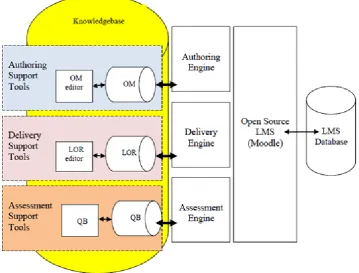
Therefore, Moodle in not adaptable by its nature, so, we are integrating it to many components that were developed to compose the Adaptive e-Learning Environment, as shown in Figure 1.
Fig. 1 Architecture for the adaptive e-Learning Environment
Three main engines in the adaptive e-Learning Environment are integrated to the open source Moodle, namely, Authoring, Delivery, and Assessment engines. Each of those main engines works smartly with the aid of the knowledgebase. It is composed of three main sub-knowledgebases: the Ontology Model (OM); the Learning Object Repository (LOR); and the Question Bank (QB). Lastly, the normal database of Moodle is updated to accommodate more data as required by the environment, such as:
• The student information is updated to accommodate the Student Model (SM) by adding both his/her background knowledge, learning style model, and some other data, such as, preferred language, etc.
• The course information is also updated to include the Course Learning Outcomes (CLO).
• The student page is updated to allow for editing and updating the student model.
• The Teacher page is adapted to allow him to edit the course LOs, CLOs.
When the student registers in a course, the course CLOs are automatically adapted to suit this specific student according to his/her student model. His/her course syllabus and course table of contents are adapted accordingly. Therefore, the Moodle page for the student is adapted to display the student adapted Course Learning Outcomes, the adapted Course Syllabus, and the detailed adapted Course Table of Content.
The Knowledgebase
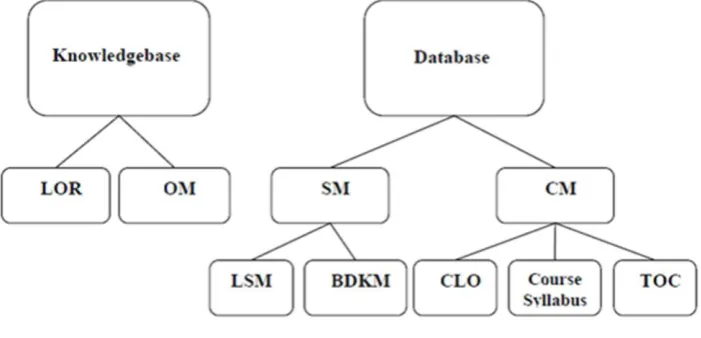
All components of the adaptive e-Learning Environment are centered on the knowledgebase. As shown in Figure 3, the Knowledgebase is composed mainly of three major components: the LO and domain ontology knowledgebase; student database; and course database. The knowledgebase is composed of the Learning Object Repository (LOR) and the Ontology Model. While, database is composed of the Student Model (SM) and the Course Model (CM), which themselves are further decomposed. The SM is composed of two components: the student’s Learning Style Model (LSM) that is defined in terms of the four dimensions of Felder & Silverman Learning Style Model (FSLSM) [17], [18] and the Student’s Background Domain Knowledge (SBDK) representing the knowledge that the student captures with an acceptable cognitive depth for the domain of study. In addition, the Course Model (CM) is composed of three components: the Course Learning Outcomes (CLO), the Course Syllabus, and the Table of Contents (TOC).
Figure 3. The Knowledgebase
The Student Database
The student model is equipped with its database. The Student Model can be described as:
Student Model (SM) = { Background Domain Knowledge Model (BDKM), cognitive model: [Learning Style Model (LSM)], Preferred Language}.
For effective teaching of a topic, the student should master certain prerequisite knowledge that is initially mandated by the course objectives (CLOs) and is usually defined by the course designer. When registering a student in a certain course, his/her BDKM is reviewed to assure mastering all needed prerequisites before the course delivery is attempted. The course syllabus should be adapted for each student based on his/her BDKM. The adaptation takes two directions:
before delivering it.
On the contrary, mastering a topic/concept in a course syllabus will bore the student during course delivery unless it is removed from the course for this specific student, hence, the course syllabus of this specific student is adapted accordingly.
The Student’s BDKM is simply a list of all the concepts that the student is mastering, each of which is represented as a record described by the following formula:
BDKM = {Concept_id, cognitive level, depth level}.
This means that this specific student masters the concept whose id is “Concept_id” at an RBT level of “cognitive level” with a depth of “depth level”. The cognitive levels are the six levels of the RBT model (Remembering, Understanding, Applying, etc), and the depth level could be a grade like (A, B, C, etc). This model is identified by going through an assessment process that the student should go through either at the registration time of each course or at the time of joining the e-Learning system.
The BDKM changes over the time. Each time the student studies a certain concept/topic, his/her level is assessed and, hence, his/her BDKM is updated.
The Student’s Learning Style Model (LSM)
Each student has his/her own learning style model which is defined in terms of the FSLSM’s four dimensions (Visual/Verbal, Global/Sequential, Active/Reflective, Sensing/Intuitive). Since the LSM doesn’t easily change over time, it is identified for each student once, at the time he/she joined the e-Learning system. The LMS is identified through the index of FSLSM questionnaire [18]. It is considered as an easy way to identify the learner’s learning style in more details. This questionnaire contains 44 questions and describes the learning style dimensions by using scales from -11 to +11; while zero indicates the origin of the axis, each direction on the axis refers to one of the two properties of the dimension. This means that no one has a property in the pure but rather most of us are having a mix of the properties at different ratios of the mix. For instance, a student with Visual/Verbal value of +5 is more of a Visual person and prefers to receive visual knowledge which will be more effective for his/her understanding, however, he/she can still understand this same knowledge if presented verbally but not as efficient as if it is visually presented.
Although the model is defined in a scale along each axis, but for simplicity, and instead of dealing with this scale in a fuzzy fashion, we decided to use a binary scale of only one of the two values of each dimension. For example, if the value for a certain student is -5 on the dimension of Visual/Verbal style, then this student is considered Verbal as he/she lies on the Verbal side of the axis. Therefore, as examples, one student may have an LSM like (Visual, Global, Active, Sensing), while another may be (Visual, Sequential, Active, Intuitive), etc. So, we designed a questionnaire by grouping all the items related to the same dimension in one cell in the questionnaire table to select for example Visual or Verbal or Neutral (to mean any style can fit with me).
The Course Model
The Course Model is composed of three components, two of which, namely, the course syllabus and the Table of Contents (TOC) are generated automatically by manipulating the Course Learning Outcomes that are defined by the course designer. More details on the automatic generation of both the course syllabus and the course.
Knowledge Ontology Model. It is generated for all students with no guarantee it matches the student model of any of the students. In addition, the course’s generic TOC is automatically generated to match the teacher’s teaching style (the learning style of the teacher).
On the other hand, the lower level of data of the Course Model are the adapted Student’s Course Learning Outcomes (SLO), the adapted Student Course Syllabus, and the adapted Course TOC, which are adapted for each individual student according to his/her student model. The student’s SBDKM is used to adapt the student’s SLO and Course Syllabus, while his/her LSM is used for adapting the Course TOC as shown in figure 2.
The Course CLO represents the goal outcomes of this course as specified by the course designer. It takes the form of a list of items, each of which is described as follows:
“By the end of this course the student will be able to: <RBT cognitive level> the <Concept name/id> at a complexity level of <depth level>”.
For example, “By the end of this course the student should be able to Apply the concept of Stack at a complexity level of 2”.
With the aid of the SOM, the generic course syllabus will be generated. The syllabus is composed of numbered sections which in turn are composed of subsections, while the TOC adds sub-subsections which go into pedagogical details. For instance, a section on Stack may contain a subsection that explains the concept of “LIFO”, while the TOC may further break down the “LIFO” subsection into many sub-subsections, like a definition, an application of LIFO from real life.
Using the BDKM of the Student Model of a certain student, the CLO will be adapted to match this specific student (hence is named SLO) by adding unknown prerequisite concepts and removing well known concepts. Again, the Authoring System will use the adapted SLO, with the aid of the SOM, to automatically generate the adapted course syllabus, which will then be the input for generating the adapted student’s course TOC.
The Domain Ontology Model
A subject matter expert course author, who is very much familiar and knowledgeable about the subject domain knowledge, knows much invaluable information about those concepts and the best ways of teaching them to a certain group of students with a specific average profile. For instance, the expert author should know what the best break down is for a certain specific topic; what the best sequence for certain topics would be; what topics would achieve the goals of a certain course; what the best depth is for each topic/subtopic; when to introduce exercises, quizzes, tests, etc., to stimulate students’ enthusiasm and learning effectiveness. One goal of this research is to support course authors in doing the authoring job professionally, even if they lack the sufficient expertise.
In the e-Learning Model, that in-depth knowledge regarding a specific knowledge domain is accumulated in the Ontology Model (SOM), which is assumed to be incrementally and/or cooperatively designed by the domain experts. In fact, SOM is a Key Player in the e-Learning Model. It is a comprehensive model of interrelationships among concepts/topics. This comprehension gives more flexibility to the authoring process in composing a course. Moreover, it gives an automation power to the authoring process. In this research, SOM is designed with the objective of supporting not only course authoring but also course delivery as well as many other support tools. To achieve this goal, the traditional Ontology net scheme is extended to accommodate two extra updates to the classical scheme:
1. Adding a measure of depth/complexity to each concept node in SOM [4].
In what follows lights are shed on those SOM extensions, while Section 4 and Section 5 discuss in more details how those proposed extensions will guide and enhance the Adaptive Course Authoring and Delivery processes, respectively.
Complexity Level Extension
The concept’s node is a complex structure in OM, where each node has a complexity value (F=Fundamental | M=Medium | D=Advanced) that guide the design of a course based on its complexity. To explain, a 200-level course wouldn’t have the same topics/concepts as those higher-level courses; as the course higher-level increases as the complexity of the concepts increases. However, usually a higher-level course would also introduce those concepts of a lower complexity. Therefore, the navigation through the SOM net during the course design process follows a simple rule: in a course of a complexity level “c”, all concepts of a complexity higher than “c” wouldn’t be included in this course. For example, for medium-level course, all advanced concepts (Marked with D) would be unnoticed; only F & M concepts are included.
As shown in figure 4, A 200-level Fundamental (“F”) course on AI would include the basic search methods like depth-first and breadth-first search methods, while a 400-Medium-Level AI course would be a bit more complex assuming a complexity level of “M”, hence, would include Iterative Deepening and Depth Limiting search methods, of course, in addition to the two fundamental (“F”) search methods. However, a 600-level course, for instance, should include more advanced (“D”) topics like Games search.
Embedding RBT in SOM
The second enhancement in SOM is including of the Revised Bloom’s Taxonomy (RBT) [20]. Each concept node contains six levels corresponding to Bloom’s levels. Due to this, SOM becomes a multilayered diagram; one layer for each of the Bloom’s levels. This extension guide the course design phase in which the course objectives identify the target Bloom’s level for each concept covered in the course. Consequently, SOM’s layer is employed and the relationship links are tracked. Prerequisite link is the most significant of the links, and it reference a particular layer of another concept as shown in Figure 11,where the "Depth-Limiting Search strategy", for instance, is having complexity level “M” and whose RBT's level of "Understanding" requires, as a prerequisite, "Depth-First Search" at RBT's Level of “Applying”.
Noteworthy, not only the course authoring is intelligently impacted by the extended SOM but also many other components in the Knowledgebase. For instance, the student’s background knowledge model (SBDKM) is updated to accommodate the six levels of RBT. Accordingly, SOM plays a significant role in the adaptation of the course delivery in two ways:
• A more accurate evaluation of the student knowledge as compared to the prerequisite requirements, and
• Compensation of missing prerequisite knowledge.
The LO Model
Each Learning Object is described, and hence selected, using a set of metadata attributes. The LO Metadata Model extends the standard metadata model of SCORM by adding few extra attributes to accommodate the adaptation theme of the e-Learning Model. In other words, the LO Model has extended the standard metadata model of SCORM by:
2. employing some of the SCORM’s characteristics after extending their space of acceptable values.
In general, these Metadata Attributes are used for two main purposes:
1. Searching and retrieving the LOs easily and precisely either manually or automatically.
2. Aiding in the process of adaptation and personalization through choosing the proper LOs meeting specific criteria.
Figure 4: Sample Domain Ontology Model: AI Search Strategies with RBT’s Levels
The Metadata Model
The adaptation process applies different theories such as Learning Style, instructional design, and cognition theories, a knowledge that are usually applied by an expert instructor who happened to know them through study or by experience. Inexpert instructors, on the other hand, though are subject matter experts, usually lack such knowledge. The e-Learning Model attaches a set of metadata attributes to each LO to aid the adaptation process. Those attributes are so simple and naive in such a way that they don’t require an expert to define them yet are used by the expert system to deliver courses with a similar quality like that of an expert instructor.
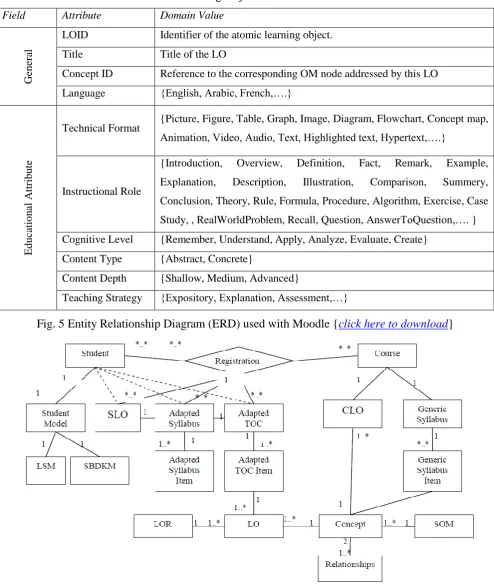
Each LO is described in terms of several metadata attributes. Table 1 demonstrates only the proposed extended “Educational” attributes and their suggested domain values; the attributes used in the adaptation process as of this research. These attributes are used by the LO Model for the selection and ordering of LOs during both the adaptive authoring and delivery processes.
process according to both the student model and the RBT theory. For instance, the "Technical Format" attribute is the basic attribute used for the selection of the LO based on the student's learning style, while the "Instructional Role" attribute plays an important role in sequencing the LOs according to the student's learning style, see Section 5 for more details on the role these attributes play in the adaptation process.
In addition, the "Instructional Role" attribute plays many essential implicit roles. For instance, it is possible to infer the LOs' RBT's cognitive levels according to the assigned value of the attribute as explained below (for the first three levels only):
• Remembering: {Introduction, Overview, Definition, Fact, Remark, List…}.
• Understanding: {Explanation, Description, Illustration, Comparison, Summary, Conclusion, Example…}.
• Applying: {Theory, Rule, Procedure, Algorithm, Exercises, Case study, RealWorldProblem, Applying Example…}.
Therefore, there will be no need for adding an extra attribute—e.g., "Cognitive Level" attribute—to specify the RBT's category of the LO, especially since one of the significant assumptions of the e-Learning Model is that the instructor might not necessarily be aware of the educational and cognitive theories. However, for accurate specification, it is also possible to include such an attribute to avoid conflicts or misclassifications, but with all precautions to avoid any inconsistencies in the values assigned to both attributes of the Instructional Role and the Cognitive Level. For simplicity, and in the first phase of this project, explicit attributes like cognitive level are added to simplify querying LOs.
Similarly, “Content Type” attribute is also added for simplification purpose. This attribute may take one of two values, namely "Concrete" and "Abstract" which are used in sequencing the selected LOs for learning styles like: Sensing/Intuitive styles. In fact, this category can be inferred by the values given to the "Instructional Role" attribute, as explained below:
• Concrete: {Example, CaseStudy, …}
• Abstract: {Definition, Law, Theory, …}
Finally, the "Content Depth" describes how the LO handles the knowledge, either Shallow or Detailed. Moreover, the instructional theory gives attention to both exposition and assessment; therefore, the "Teaching Strategy" attribute is added. It groups the learning objects into three categories—namely, Expository explanation, Inquisitor explanation, and Assessment.
Other attributes are also used by the adaptation engine, though they are found in the metadata model of the hosting standard—SCORM. It is worth noting, however, that h attribute “ConceptId” refers to the same ID of the concept as of the SOM, i.e., each LO must be referring to a SOM-defined concept. On the other hand, both Instructional Role and Technical Format attributes are defined in SCORM but with limited space of values that are extended in this research as needed by the adaptation process.
The Design of the Knowledgebase and its Support Tools
The Knowledgebase Model is implemented using a database to store the data and attributes describing the different entities of the model. Special tools and editors are designed for maintaining the knowledge, e.g., the Learning Object editor and the Ontology structure editor. All other knowledge entities are also maintained through simple editors as discussed in Section 6, the integration to Moodle.
Relationship Diagram (ERD) as implemented. The database tables are all normalized to guarantee data integrity.
Table 1: Learning Object Educational Metadata
Field Attribute Domain Value
G
ene
ra
l
LOID Identifier of the atomic learning object.
Title Title of the LO
Concept ID Reference to the corresponding OM node addressed by this LO
Language {English, Arabic, French,….}
Educat
ion
al
A
tt
ri
bu
te
Technical Format {Picture, Figure, Table, Graph, Image, Diagram, Flowchart, Concept map, Animation, Video, Audio, Text, Highlighted text, Hypertext,….}
Instructional Role
{Introduction, Overview, Definition, Fact, Remark, Example,
Explanation, Description, Illustration, Comparison, Summery,
Conclusion, Theory, Rule, Formula, Procedure, Algorithm, Exercise, Case
Study, , RealWorldProblem, Recall, Question, AnswerToQuestion,…. }
Cognitive Level {Remember, Understand, Apply, Analyze, Evaluate, Create}
Content Type {Abstract, Concrete}
Content Depth {Shallow, Medium, Advanced}
Teaching Strategy {Expository, Explanation, Assessment,…}
Fig. 5 Entity Relationship Diagram (ERD) used with Moodle {click here to download}
Fig. 6: Class diagram for the used Knowledgebase
validation rules when those classes are implementing in Java. Violations of those invariant constraints raise exceptions and error messages for the user during implementing his/her data examples:
• Each Course has many CLOs one for each topic (or chapter) in the course.
• Each CLO item will be expanded into a topic in the course syllabus.
• Each CLO item and its corresponding syllabus’s topic refer to the same concept which in turn refers to a concept in SOM.
• Each LO refers to one concept in SOM.
• Each student must have defined a student model with two components, namely, LSM and SDBDKM.
• Each student must have a specially adapted SLO for each course he/she have registered in.
• Each item in the SLO corresponds to either an item in the CLO of the generic same course, or an additional item corresponding to those missing pre-required concepts that the student is missing. It is also allowed that the student’s SLO ignores some of the items of it corresponding same course under the assumption that the student SBDKM includes them with an acceptable quality.
• Each SLO item will be expanded into a topic in the Adapted Course Syllabus.
• Each SLO item and its corresponding Adapted Syllabus’s topic refer to the same concept which in turn refers to a concept in SOM.
• Each Adapted Syllabus’s topic will correspond to a section in the corresponding TOC.
• Each TOC section is expanded into many subsections in the TOC according to the student’s LSM.
• Each subsection in the TOC corresponds to one or more LOs such that both refer to the same concept.
III. IMPLEMENTATION
Moodle version 1.9.19+ has been downloaded from https://download.moodle.org/releases/legacy/ and its internal structure and design were carefully studied. Moodle is written in PHP and uses MySQL as its database. A seamless integration to the original Moodle system was designed to add the new features supporting our implementation to the e-Learning Model. The seamless integration covered the following directions:
1. In the student definition page, the administrator can define those extra student attributes as required by the Student Model (SM), such as Learning style, and background knowledge in addition to his/her IQ and preferred language of study.
2. In the Course definition page, the administrator and the course coordinator can define the Course Learning Objectives (CLO) among the other regular information about the course.
3. The teacher can view the generic course syllabus as well as its CLO among all other regular information about the course. Editing the course CLOs and hence changing the generic course syllabus is also allowed.
4. Registering a student in a course will trigger the automatic generation of the student’s adapted SLO, Course Syllabus, and TOC as discussed in Section 3 above. Those adapted elements of the course are integrated in the Moodle for the student to view his own stuff.
Table 2: Sample records from the learning object database. {click here to download}
Tools are designed and implemented to augment Moodle with the new features as a proof of concept prototypes, such as the LO editor and the Ontology editor. Other simple tools are also implemented to maintain all the other components of the knowledgebase. The LO editor allows the teacher or the course designer to maintain (add, update, delete, combine, and split) LOs. Other functions are also supported, such as search for an LO by specifying some or all its attributes. An LO is simply the set of attributes of the LO together with the path where the actual learning material (e.g., a file of type ppt, doc, pdf, …) are stored. The attributes are used to specify the LO and, hence, be able to search and select those appropriate learning objects for a certain use. The LO editor allows the teacher to maintain the LO attributes. If the LO is automatically or semi-automatically generated, it is most likely that its attributes are incomplete and requires the instructor intervention to complete the LO definition, hence, the LO is marked as “Incomplete”. All incomplete LOs can be later presented to the teacher upon his/her request for further editing. Also, the Ontology editor allows the teacher or the course designer to define the concept network called the Ontology Model for a certain specific knowledge domain. Ontology editor allows its user to define and maintain both the concepts and their interrelating relationships.
Lectures
To be able to test the ideas as well as the prototype implementations, we have designed sample lectures for the data structure topic of “Stack”. Many other topics, such as Queue and ADT, in the same domain knowledge of Data Structure are also designed for the sake of understanding and assessing the process of developing lectures under the e-Learning model as opposed to the traditional lecture design methods. Table 2 shows some records from the learning object database.
IV. CONCLUSIONS
We have built a framework to add adaptability to the open source LMS (Moodle) by understanding the Smart model and studying the open source LMS “Moodle”. This was achieved by integrating instructional design theories (e.g., RBT) and psychology and learning theories (e.g., Learning style models FSLSM) into the adaptive learning process. Also, employing computer science technology to implement an intelligently adaptive authoring and delivery courses by using technologies such as Ontology, Learning Objects. A reasonable student model was designed to achieve smart adaptivity in delivering courses to each specific student to match his/her profile as possible for more effective and efficient self-learning process.
ACKNOWLEDGMENTS
This work was supported by King Abdulaziz City of Science and Technology (KACST) funding (Grant No. AT-204-34). We thank KACST for their financial support.
Conflict of interest: The authors declare that they have no conflict of interest.
Ethical statement: The authors declare that they have followed ethical responsibilities.
REFERENCES
[1]. Kolb, David A. Experiential learning: Experience as the source of learning and development. FT Press, 2014.
[2]. Behram Beldagli, Tufan Adiguzel, Illustrating an ideal adaptive e-learning: A conceptual framework, Procedia - Social and Behavioral Sciences, Volume 2, Issue 2, 2010, Pages 5755-5761, ISSN 1877-0428, http://dx.doi.org/10.1016/j.sbspro.2010.03.939.
[3]. Chen, C. M. (2009). Personalized E-learning system with self-regulated learning assisted mechanisms for promoting learning performance. Expert Systems with Applications, 36(5), 8816-8829.
[5]. Smith, M. K. (2003). ‘Learning theory’, the encyclopedia of informal education. [http://infed.org/mobi/learning-theory-models-product-and-process/. Retrieved: 1-4-2015].
[6]. Bradford, P., Porciello, M., Balkon, N., & Backus, D. (2007). The Blackboard learning system: The be all and end all in educational instruction?. Journal of Educational Technology Systems, 35(3), 301-314. [7]. Aranda, A. D. (2012). Moodle for distance education. Distance Learning, 8(2), 25–28.
[8]. Horvat, A., Dobrota, M., Krsmanovic, M., & Cudanov, M. (2015). Student perception of Moodle learning management system: A satisfaction and significance analysis. Interactive Learning Environments, 23(4), 515–527.
[9]. Cabada, R. Z., Estrada, M. L. B., & García, C. A. R. (2011). EDUCA: A web 2.0 authoring tool for developing adaptive and intelligent tutoring systems using a Kohonen network. Expert Systems with Applications, 38(8), 9522-9529.
[10].Escudero, H., & Fuentes, R. (2010). Exchanging courses between different Intelligent Tutoring Systems: A generic course generation authoring tool.Knowledge-Based Systems, 23(8), 864-874.
[11].Klašnja-Milićević, A., Vesin, B., Ivanović, M., & Budimac, Z. (2011). E-Learning personalization based on hybrid recommendation strategy and learning style identification. Computers & Education, 56(3), 885-899.
[12].El-Bishouty, M. M., Chang, T. W., Lima, R., Thaha, M. B., & Graf, S. (2015). Analyzing Learner Characteristics and Courses Based on Cognitive Abilities, Learning Styles, and Context. In Smart Learning Environments (pp. 3-25). Springer Berlin Heidelberg.
[13].Atman, N., Inceoğlu, M. M., & Aslan, B. G. (2009). Learning styles diagnosis based on learner behaviors in web based learning. In Computational Science and Its Applications–ICCSA 2009 (pp. 900-909). Springer Berlin Heidelberg..
[14].Brusilovsky, P., Sosnovsky, S., & Shcherbinina, O. (2005). User modeling in a distributed e-learning architecture. In User Modeling 2005 (pp. 387-391). Springer Berlin Heidelberg.
[15].Cannataro, M., & Pugliese, A. (2004). A survey of architectures for adaptive hypermedia. In Web Dynamics (pp. 357-386). Springer Berlin Heidelberg.
[16].Somyürek, S. (2015). The new trends in adaptive educational hypermedia systems. The International Review of Research in Open and Distributed Learning, 16(1).
[17].Felder, R.M., Silverman, L.K.: Learning and teaching styles in engineering education. Eng. Educ. 78(7), 674–681 (1988)
[18].Soloman, B. A., & Felder, R. M. (2005). Index of learning styles questionnaire. NC State University. Available Online at: http://www.Engr.Ncsu.Edu/learningstyles/ilsweb.Html. Last Visited: May 14, 2016. [19].Yarandi, M., Jahankhani, H., & Tawil, A. R. (2013). A personalized adaptive e-learning approach based
on semantic web technology. Webology, 10(2), Art-110.
[20].Al-Otaibi, R., & Gamalel-Din, S. (2010). Intelligent Querying for Adaptive Course Preparation And Delivery In E-Learning. In the Proceedings of the Ninth IASTED International Conference on Web-based Education, Sharm El-Sheikh, 15-17 March