Optimal Rectangular Microstrip Antenna with and
without Air Gaps Design by Means of Particle Swarm
Optimization and Vortex Search Algorithm
U. Ozkaya
*, L. Seyfi
Selcuk University, Department of Electrical & Electronics Engineering, Konya, Turkey.
* Corresponding author. Tel.:+905422870104; email: [email protected] Manuscript submitted January 28, 2016; accepted July 25, 2016.
doi: 10.17706/ijcce.2017.6.1.75-82
Abstract: In this paper, Particle Swarm Optimization and Vortex Search Algorithm are applied to design desired characteristics of rectangular microstrip antenna with and without air gaps. The proposed artificial intelligence algorithms are inspired from natural events or behavior of living things in nature. Resonance frequency and return loss of microstrip antenna are dependence with design parameters. The computed results for dielectric substrate’s height is tuned by Particle Swarm Optimization and Vortex Search Algorithm for optimal design.
Key words: Optimization, particle swarm optimization, rectangular microstrip antenna, vortex search algorithm, with and without air gap.
1.
Introduction
Microstrip antenna applications have increased consistently with last years. It has several advantages such as small size, compatibility with planar and non-planar surfaces, usage of modern print-circuit application, low cost etc. Microstrip patch antenna has been made to integrate successfully in GSM and satellite communication applications. Additionally, it is used in aircraft, medical, missiles and military communication. Since microstrip antenna has narrow bandwidth, it is important to compute the resonant frequency accurately [1]-[5].
Microstrip antennas idea emerged in 1953 and although it received a patent in 1955 but began to attract interest starting in the 1970s. Microstrip antennas on the very thin ground plane consists of quite small height than wavelength placed a metal strip on the dielectric substrate. For the transverse radiation, maximum of radiation pattern is set to be perpendicular to patch plane. At the same time, longitudinal radiation can be performed with a suitable electromagnetic mode selection.
constant and increase in the equivalent dielectric substrate’s height [7]. In addition, a second air gap designs allow the advantage of reduced bandwidth dual band operation.
2.
Theory
Basic Geometry without Air Gap
2.1.
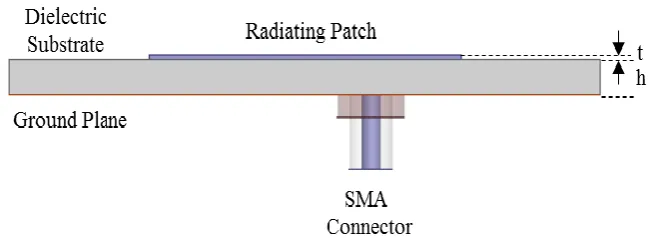
Microstrip antennas are often referred to as the patch antenna. Radiating elements and feed lines are usually made by soldering on the dielectric substrate material as Fig. 1. There are many substrate materials whose dielectric constant is in range of 2.2< Ɛr<10 for patch design. The most preferred dielectric constants
for a good antenna performance is at the lower values of the above range. Despite the limitations of radiation fields, these materials provide better efficieny, higher bandwidth and larger patch sizes.
Patch geometry can have square, rectangular, dipole, circular, elliptical, triangular or can any other type of structure. Square, rectangular and circular patch geometries are quite common due to their simple analysis and production. Thickness of the metallic patch very less than the wave length (t<<λ0) and on top of that h<< λ0 or 0.003λ0 ≤ h ≤ 0.005λ0 is suggested for selection of dielectric substrate’s height [8].
Fig. 1. Cross sectional view of a proposed patch antenna without air gap.
Distribution of electrical field on microstrip antenna is a function of L/h and Ɛr.When L/h is smaller than
1, effect of electrical field on substrate decreases. Most electric field lines are inside substrate material and some lines partially within the air. Electric field lines are mainly located in the substrate as W/h>>1 and
Ɛr>>1. In this case, the electromagnetic field distributions on the physical size of the microstrip patch will
have a larger electrical appearance. L can be usually chosen to be between λ0/3 and λ0/2 for rectangular patch structure. In microstrip antenna design is necessary to be consider the formula below:
0
2
1
W
2f
c
r (1) 0.5 eq eq eff1?
?
10h
1
2
2
W
r r
r (2)
eff eff W 0.262 ( 0.3)? L? h 0.412 W
h ( 0.258)
eff
2
L
L
L
r
(5)Geometry with Air Gap
2.2.
The air gap used in the antenna geometry is possible to obtain dual band. However, the removal of the air gap in the antenna configuration is more useful for narrow bandwidth applications. In Fig. 2, the dielectric constant of the polyimide Quartz substrate material (Ɛr=4) and tangent loss (t=0.0001) are used for the air
gap design. SMA connector design is used to transfer energy from ground plane to patch [9]. Generally, air gap is between ground plane and dielectric substrate in conventional antenna with air gap design.
Fig. 2. Dimensions of rectangular microstrip antenna with air gap.
A rectangular microstrip antenna patch dimensions for multilayer with air gap design mentioned as thickness and dielectric constant each layers are h1, h2, h3 and Ɛr1, Ɛr2, Ɛr3. Multilayer microstrip antenna
with air gap and equivalent dielectric constant layer is showed in Fig. 2.
3.
Artificial Intelligence Algorithm
Particle Swarm Optimization
3.1.
Particle Swarm Optimization (PSO) was firstly proposed by Eberhart and Kennedy in 1995 [10]. It has been developed on the behavior of the animal when they search for food sources. Even members of swarm has no information about food location, they have ability to find sources due to cognitive, social and exploratory policies of swarm [11]. Every member is assumed based on generally accepted expression as a particle. Each particles moves on the search space by means of change in velocity and location. Accordingly, optimum solution of function is found in d-dimensional workspace, searching process is started with initial position and velocity for d-dimensional vector particle.
Xi(t) shows the position of the i th partcile at t time step in search space. t represents th discrete time
steps. Particle position is varied by adding V(t) velocity to actual position in Eq. 6.
(
1)
( )
(
1)
i
t
it
iX
X
V t
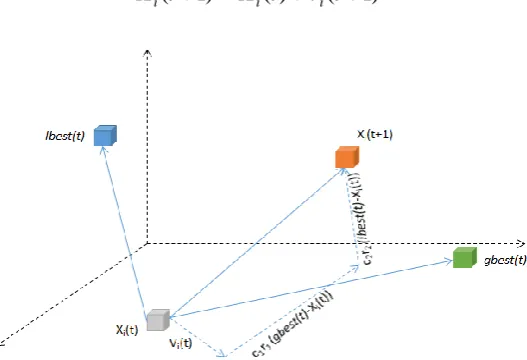
(6)Fig. 3. The change in particle's velocity and position.
The velocity vector directs the optimization process and offers experimental information related to both particle and his neighbor. Each particle’s neighborhood covers the entire swarm for gbest. Social network in
gbest resembles star topology which is based on the particle velocity change in accordance with the information obtained from all particles in the swarm as Fig. 3. In this case, social information is the best position found by swarm. In the PSO, velocity of i th particle is updated by this formula:
V ti( 1) V ti( )c r lbest t1 1. ( i( )X ti( ))c r gbest t2. .(2 i( )X ti( )) (7)
Vi(t) is velocity of i th partcile at t time step. c1 and c2 are positive acceleration constant in order to scale
the contribution of cognitive and social components. r1 and r2 are random distributed numbers in range of 0 and 1 for adding stochastic feature to PSO algorithm [12]. The best position “lbest” in minimization problems is updated by following formula:
, ( (
1))
( ( ))
(
1), ( (
1))
( ( ))
i i i
i
i i i
lbest f x t
f y t
lbest
x t
f x t
f y t
(8)ns is represents the total number of particles in swarm. gbest can be chosen from actual lbest values via
Eq. 9:
gbest
min{ ( ( ),... (
f x t
0f x
ns( )}
t
(9)Vortex Search Algorithm
3.2.
they are widespread due to quick and easy to be implemented. Vortex search algorithm work as mixed fluid swirl pattern which is modelled like nested circle. To find center of the circle (µ0):
0
2
upLim lowLim
µ
(10)upLim and lowLim are dx1 vectors to constrain boundary of solution in d dimensional search space [13]. A number of random solutions Ct(s) are generated by using Gaussian distribution. C0(s)={s1, s2, s3, ….., sk} is
candidate solutions and n represents total number of solution set. σ0 is initial standard deviation of distribution and can be formulated as Eq. 11:
0
max
max(
)?
2
upLim
lowLim
(11)The initial standard deviation (σ0) of the distribution indicates the initial radius of epicycle. The best solution (si) is selected in Ct(s). However, random solutions must be checked in valid boundary of problem
before si is determined as:
.(
)
,
,
.(
)
,
i i i i i
k
i i i i i
k k k
i i i i i
k
rand upLim
lowLim
lowLim s
lowLim
s
s lowLim
s
upLim
rand upLim
lowLim
lowLim s
lowLim
(12)For this purpose, the solutions that exceed the boundaries are transferred into the boundaries [14]. In the selection part, si in the each iteration compares with global best solution (sbest). If si is better than sbest,
it assigns as the sbest which is assumed the center of next random solutions. For next iteration, candidate random solutions with gauss distribution are regenerated in accordance with decremential radius of inner circle. At the end of the algorithm, sbest is the best solution for the optimization problem.
The way of the radius reduction is very important for global search ability. On the other hand, local search ability is capable of finding global solution at the further steps. Inverse incomplete gamma function with chi-square distribution is strategy to reduce vortex radius as Eq. 13:
1
0
( , )
0
x t a
x a
e t
dt
a
(13)a is shape parameter and bigger than zero. x>0 is a random variable. Also, complementary incomplete gamma function is represented in the following formulation:
1
0
( , )
x a
e t
t adt
a
0
(14)(gammainc) and inverse gamma function (gammaincinv). a is the shape parameter of gamma functions in [0,1] and can be calculated by using Eq. 14 at each iteration step:
0
t
a
a
MaxItr
t (15)
Changes in radius depending on the number of iteration is given in Eq. 16. The first half of process has weak locality when the radius changes linearly. In contrast, the algorithm has a strong locality in other half of process.
r
t
0.(1/ ).
x gammaincinv x
( , )
a
t (16)4.
Results
a) b)
c) d)
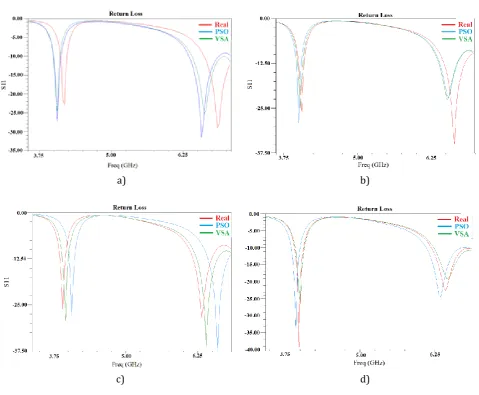
Fig. 4. Comparative HFSS results.
algorithms can be reached the optimum solution quickly and correctly in Fig. 4. Accuracy may not have high rate due to nonlinear correlation between data sets.
References
[1] Lee, K., Ho, K. Y., & Dahele, J. S. (1984). Circular-disk microstrip antenna with air gap. IEEE Transactions on Antennas and Porpagation, 32(8).
[2] Guh, D. (2001). Resonant frequency of circular microstrip antennas with and without air gaps. IEEE Transactıons on Antennas and Propagatıon, 49(1).
[3] Debatosh, G., & Siddiqui, J. Y. (2004). Resonant frequency of equilateral triangular microstrip antenna with and without air gap. IEEE Transactıons on Antennas and Propagatıon, 52(8).
[4] Cooray, F. R., & Kot, J. S. (2006). Analysing radiation from a cylindrical-rectangular microstrip patch antenna loaded with a superstrate and an air gap, using the electric surface current model. Proceedings of Eucap 2006. Nice, France.
[5] Bhardwaj, K. D., Bhatnagar, D., & Sancheti, S. (2008). Square patch microstrip antenna with single notch having an air gap. Proceedings of International Conference on Microwave.
[6] Shama, S., & Kanaujia, B. K. (2011). Optimization of resonant frequency of circular microstrip antenna with and without air gaps using bacterial foraging optimization technique. Proceedings of 2011 Int. Con. On Computational Intelligence and Communication System.
[7] Veeresh, G. K., & Kumar, A. (2013). Dual band coplanar capacitive coupled microstrip antennas with and wtihout air gap wireless applications. Progress in Electromagnetic Research C, 36, 105-117.
[8] Ozkaya, U., & Seyfi, L. (2015). Dimension optimization of microstrip antenna in X/Ku band via artificial neural network. Proceedings of World Conference on Technology, Innovation and Entrepreneurship, Procedia-Social and Behavioral Science: vol. 195 (pp. 2020-2026).
[9] Kennedy, J., & Eberhart. R. (1995). Particle swarm optimization. Proceedings of IEEE International Conference on Neural Networks (pp. 1942-1948).
[10]Eberhart, R., & Shi, Y. (2000). Comparing inertia weights and constriction factors in particle swarm optimization. Proceedings of IEEE Congress on Evolutionary Computation (pp. 84-88).
[11]Kennedy, J., & Eberhart, C. (1997). A discrete binary version of the particle swarm algorithm.
Proceedings of IEEE International Conference on Systems, Man, and Cybernetics (pp. 4104-4108).
[12]Dogan, B., & Olmez, T. (2015). A new metaheuristic for numerical function optimization: Vortex search algorithm. Information Sciences, 293 (2015), 125-145.
[13]Dogan, B., & Olmez, T. (2015). Analog filter group delay optimization using the vortex search algorithm.
Proceedings of the 23th Signal Processing and Communications Application Conference.
[14]Dogan, B., & Olmez, T. (2015). Modified off-lattice AB model for protein folding problem using the vortex search algorithm. International Journal of Machine Learning and Computing, 5(4).
[15]Scholtz, R. A. (1993). The spread spectrum concept. In N. Abramson (Ed.), Multiple Access (pp. 121-123). Piscataway, NJ: IEEE Press.