Analysis Of Development E-Commerce For
Accommodate Students In Developing
Entrepreneurship Mental
Nadia Sigi Prameswari, Menchie Dela Cruz, Joko Lulut Amboro, Novita Wahyuningsih, Mohamad Suharto
Abstract—The demand for graduates of higher education has increased dramatically. Training students to learn soft skills, or the ability of an individual to respond to its environment, and entrepreneurship abilities must be a requirement before graduating from college. Today the Internet has become the sole medium to develop such skills through the e-commerce. This article aims to examine the motivation of students in entrepreneurship to some degree and their ability to produce and develop features of e-commerce that will provide a space dedicated to student entrepreneurship. Using the qualitative method, this study concluded that students often have the motivation to engage in entrepreneurship after graduation, but unfortunately this interest could not be applied because of the discrepancy between knowledge gained while studying and actual situation in the business field. In the survey conducted, most respondents supported the development of e-commerce. Students want the design of e-commerce to be in accordance with the demands of the times, promote ease in the operation of websites, have properties that are efficient, provide attractive offers such as cheap shipping, and develop cooperation with shipping services. All these to facilitate entrepreneurs, such as self-employed students, to send goods to target consumers with relative ease. This research is expected to experience further development in the future, such as coming up with features for professors who want to engage in e-commerce entrepreneurship and opening economic relations with foreign traders through export and import of goods.
Index Terms— students, entrepreneurship, e-commerce.
—————————— ——————————
1 INTRODUCTION
CAMPUS is a scientific environment to produce graduates with character and knowledge through learning interactions [1]. The demand for graduates of higher education has become increasingly heavy. When before the demands of the working world only focuses on the knowledge skills, this time communication skills, leadership skills, teamwork skills, and attitude also come into focus [2]. Soft skills are the ability of an individual to respond to its environment [3]. The ability to utilize interpersonal skills is very important in the workplace. Therefore, training students to learn soft skills must be required before graduating from college to create new entrepreneurs. Entrepreneurs are the people who increasingly improve the value of the resources, manpower, materials and other production factors, and also continue to make changes, innovations, and new ways [4]. Based on data from BPS (Central of Statistics) in 2016, unemployment rate in Indonesia amounted to 7.03 million and 4.87% of them are university graduates. The data supports the statement of the International Labor Organization (ILO) that most of the
unemployed Indonesia are college graduates [5]. Not only in Indonesia, according to Bai [6] there is also an increase in unemployment of college graduates due to economic development and policy making in the system of education of university campuses. Therefore, equipping students with entrepreneurship education is necessary for them to start a business. Problems that occur at this time involve changing the old mindset about the relevance of the educational process in universities to the needs of the actual labor market, what is becoming the new mindset now is to meet the colleges’ ability to produce graduates through job creators. According Vilathuvahna and Nugroho [7] for the students to become entrepreneurs is restrained by three factors: no experience, no capital and not having the ability to take risks. Universities and colleges should take part in educating and preparing its graduates so that they dare to choose entrepreneurship as a professional [8]. The rapid development of IT technology also provides many opportunities for learning entrepreneurial skills [9], or for college students to start planning their own businesses [10]. The Internet has become a medium to develop soft skills and entrepreneurship. The progress of technology has provided resources, information and vast communication [11]. Internet users in Indonesia increased year by year; in 2014 there were only 17:14% of individuals using the internet in Indonesia, the which rose to 21.98% in 2015 (Statistics Indonesia, 2015). Indonesia was the eighth largest Internet user in the world in 2015 (Internet World Statistics), and Internet Live Stats have estimated that Indonesia will be the twelfth largest group of internet users in 2016. Technology applications in business areas such as the opening of broadband impact positively on suppliers and consumers. Therefore, the development of entrepreneurship needs to pay attention to the mastery of soft skills through the adoption of e-commerce [12]. Internet use in the field of business is divided into two parts, namely online business and marketing [13]. The Internet allows people from different organizations or locations to work together as a single virtual team to develop, manufacture, market, and maintain the product or service. The Internet enables the application of Electronic Commerce (EC) to be used on a global network, ————————————————
Nadia Sigi Prameswari is currently lecturer in Visual Arts Department, Semarang State University, Indonesia. E-mail: [email protected]
Menchie Dela Cruz is currently Associate Professor III in College of Communication and Information Technology, President Ramon Magsaysay Technological University, Philippines. E-mail: [email protected]
Joko Lulut Amboro is currently lecturer in Fine Arts Department, Sebelas Maret University, Indonesia. E-mail: [email protected]
Novita Wahyuningsih is currently lecturer in Fine Arts Department, Sebelas Maret University, Indonesia. E-mail: [email protected]
and usually comes with the application Order Processing On-line, Electronic Data Interchange (EDI) for sending business documents, and Electronic Funds Transfer (EFT) for security of payment systems [14]. E-commerce offers an easy way to access companies and individuals with a very low cost to conduct daily business transactions [15]. With the business activities of e-commerce, the company can expand its activities and reach consumers more easily [16]. In Indonesia, the e-commerce is widely used to purchase products and goods, such as fashion, and services, travel booking, which are most popular according to the survey [17]. There has been a lot of research on system e-commerce to develop a spirit of entrepreneurship. Previously referenced research that studied entrepreneurship and innovation in e-commerce stated that there are synergies between entrepreneurship in e-commerce such that entrepreneurship is an important factor in the long-term sustainability of commerce. However, there is no e-commerce site that specifically provide an exclusive space for students, which would be an effective solution especially for small and medium entrepreneurs to penetrate the global market [18]. This study is to analyze the motivation of the students interested on self-employment if there is an e-commerce to provide a special space for students to market their goods and services as learned from college. This study is also to analyze the website e-commerce as to what the students need and want.
2 LITERATURE REVIEW
2.1 Review Stage
E-commerce is the process of buying and selling of products or services using electronic data transmission via the Internet and the World Wide Web [19] (Grandon & Pearson, 2004). The concept of e-commerce is relevant when applied in developing countries even though there are still some constraints, such as infrastructure and other problems associated with the economic and socio-cultural conditions. Padhy and Mishra [20] stated that a remarkable transformation has been taking place in the field of entrepreneurship through the implementation of effective governance in e-commerce. Furthermore, Khan, et. al [21] stated that Omani Entrepreneurs are ready to adopt Ecommerce and that they are aware of the potential benefits which can be achieved by adopting it. Fauzia [22] stated that the research found that e-commerce can be utilized by women entrepreneurs in their effort to expand business to retail sales, wholesalers, agents and distributors of a product or service and also in some remote areas, e-commerce can help some entrepreneurs to jump-start their business through exploring e-commerce to find suppliers. Previous research stated that at present, many colleges and universities have entered the stage where college students start their own business and promote employment by entrepreneurship [23]. So, based on this, entrepreneurship education is very important and must be a part of the students’ curriculum to help them start their own business. According to Miranda [24], teaching, research and entrepreneurial work in a university are interrelated and complementary as important there are synergies between them. Entrepreneurship encompasses acts of organizational creation, renewal, or innovation that occur within or outside an existing organization. Entrepreneurs are individuals or groups of individuals acting independently or as part of a corporate system who create new organization or instigate renewal or
innovation within an existing organization [25]. In the United States, entrepreneurship generally refers to growth-oriented ventures or companies, and entrepreneurship programs promote skills for building, financing, and nurturing high-growth companies [26]. Learning entrepreneurship to support e-commerce can be done by creating a virtual design so that entrepreneurs can start and run a virtual business in a way that is quite similar to the way people are engaged in business in the real world [27]. Martin [28] says that students perceive that entrepreneurship education has improved their entrepreneurial skills, and the greater proportion of students believe that the skills learned and developed by entrepreneurship education are applicable and important to the non-self-employment or business ownership occupations. In previous research work in international journals, Yenisey, et.al. [29] discusses the factors -- determinants of security that can be felt in the e-commerce among Turkish University Students. The results showed that the factors that can give security for consumers, among others, is the website security online shopping policy, managerial commitment, as well as the security of the network website. These would give a sense of security to students at the Turkish University as consumer and part of e-commerce. This is in line with research conducted by Sebora, et.al. [30], the factors that shape the success of e-commerce is the spirit of entrepreneurship and quality of service. Therefore, students should be equipped with entrepreneurship education while in college in order to participate in the utilization of e-commerce. According to Mennecke, et.al. [27] that today the business has become a part of life and students are faced with a dilemma because of globalization, therefore the students need to learn business to be able to deal with the needs of life at present and in the future. Internet entrepreneurship has become a new choice for students to solve the employment, thus, students gradually begin to have feelings and thoughts on entrepreneurship [31].
3 METHODS
This study used a qualitative method, qualitative method is a research procedure that produces descriptive data in the form of words written or spoken of and behavior observed. By using qualitative methods, researchers tried to look at the overall picture of the object of study and interpret the data in a way to make sense of the data obtained. This study took place in Surakarta, at the Sebelas Maret University, an educational institution which has a special program on entrepreneurship development. The program has the mission of generating new entrepreneurs from campus. The research focused on the analysis of students who are interested in becoming self-employed if there is an e-commerce to provide a special space for students to market their goods and services as learned from college. This study also analyzes thee-commerce websites as to what the students need and want. The research subjects are students at the Sebelas Maret University (UNS) who meet the criteria for obtaining the data in the study.
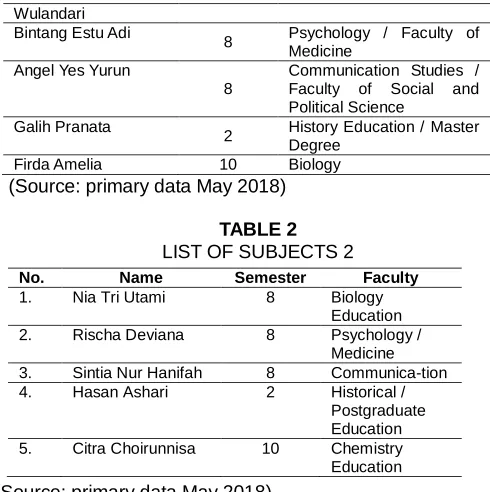
The list of subjects in the study is as follows:
TABLE 1
LIST OF SUBJECTS 1
Name Semester Department / Faculty
Wulandari Bintang Estu Adi
8 Psychology / Faculty of Medicine
Angel Yes Yurun
8
Communication Studies / Faculty of Social and Political Science
Galih Pranata
2 History Education / Master Degree
Firda Amelia 10 Biology (Source: primary data May 2018)
TABLE 2
LIST OF SUBJECTS 2
(Source: primary data May 2018)
According to the table above, the subject of the study is sufficient to provide the information needed in research. This study also used the informant criteria, who are a person who knows the person/subject of research. The informant is required so that data and information are obtained from one source and authenticated as well. The data analysis was conducted using data reduction, that is, aborting some of the data deemed unnecessary and presenting the data in order so that the information can be classified and arranged in an organized manner. Thus, the results of the study analyses the development of e-commerce to enable students to develop entrepreneurship soul.
4 R
ESULT ANDD
ISCUSSIONInstitutions of higher education have developed entrepreneurship programs that contribute to spawn the output of new entrepreneurs in the face of global economic competition. In order to encourage young entrepreneurs, colleges should naturally own and develop entrepreneurship programs. The main objective is to assist student effort in entrepreneurship. Universities are expected to be able to assist students and support activities in entrepreneurship. Support of the university is expected to increase student motivation in entrepreneurship in order to achieve university curriculum goals as a response in developing young entrepreneurs who are ready to create jobs in the future.
4.1.Student Entrepreneurship Motivation
Advances in technology and information created an advanced shopping phenomenon. Use of the media as a marketing tool to transact in shopping has become the most preferred choice by the people of the 21st century, which offers efficiency and all the conveniences to encourage many people to choose to shop online. Besides the many advantages gained by the consumer, not only a few people who choose to become a producer, seller, or reseller took part in creating the phenomenon of online shop. So, utilizing online media is great for students not just for shopping but also in creating business opportunities at the same time. This study highlights the
motivation of students in entrepreneurship. There are few students who use online media to engage in entrepreneurship. However, the presence of cutting-edge technology is expected to continue to encourage and motivate students to become entrepreneurs. Although some students choose to be entrepreneurs while still studying, some also plan to work as employees after they graduated from college, in the sense not choose to be an entrepreneur shortly after graduating from college. As pointed out by Fina, 8th semester student, majoring in Biology and comes from the district Wonogiri. "Since I graduated FKIP (the Faculty of Education), I want to apply for a job first at school and if there was a chance would like to continue her education because the provision of the science of FKIP so would not want to teach." (Interview with Finateli on May 22 2018). Fina continues that he has plans to open an independent business in addition to his teaching duties because are also many other financial needs that must be met. Fina doesn’t teach full time, so he has an opportunity to have a business besides being a teacher. As for the future, he intends to private lessons on the scientific field. At college, Fina already started making scrapbooks, although this didn’t succeed due to lack of experience in creating these products. Another response stated by several students about their motivation after graduating from college is that it is necessary to have a sufficient capital in order to establish a business, so they chose to work as an employee first to raise enough money. This was stated by Angel Yes Yurun, eighth semester student of Faculty of Social Sciences, majoring in Communication Studies which argued that: "The main purpose of working out anyway, because the effort of thinking that surely there must be capital. If the capital of the parents just wrote, there is no difference with the same pass lo has not yet passed, but if for example we've got the capital so that we can open the business. So, the main goal that is first effort but the work first. "(Interview with Angel Yes Yurun on May 22, 2018). Angel continued that her interest after college includes the desire to build his own business, because her familial ready owning a business is whatmotivated her to engage in entrepreneurship. During college Angel has triedhaving a business, although one day she is interested in being an entrepreneur. Angel currently has interest in culinary business because according to her it is always sought. In line with the opinion of Angel, Amelia Firda who is in her final semester in the Faculty of Science (Mathematics and Science) Department of Biology argues that she has a plan to open a business after earning sufficient capital from workingas an employee. "After graduated I have a plan to work in an institution whose expectations are in accordance with my field or my passion. So far, I don’t have venture capital yet to have a business, because to make a business there should be venture capital and so far I have no venture capital to create the business itself. Maybe in the future after I get the capital, there is my possibility to start a business. "(Interview with Firda Amelia on May 23, 2018). According to Firda, if ever she wants to develop business in the future it is in the skincare business because it is a promising venture as skincare is hype in today's global society. Further, after she earned enough money to be used as capital, Firda intends to become a reseller or a dropshipper first to explore the experience of entrepreneurship. Unlike the case with Bintang Estu Adi, a student of 8th semester Faculty of Medicine, Department of Psychology, who argued that: "My plan for the future after graduation I want to try to work, at least there is work
No. Name Semester Faculty
1. Nia Tri Utami 8 Biology Education 2. Rischa Deviana 8 Psychology /
Medicine 3. Sintia Nur Hanifah 8 Communica-tion 4. Hasan Ashari 2 Historical /
experience, but not allow me also want to develop business, with my brother." (Interview with Bintang Estu Adi on May 22, 2018). Bintang has gotten experience in entrepreneurship since she enrolled and has been tutored. She is equipped to manage the business which his uncle pioneered by opening Coffee Shop. Similarly expressed by Galih Pranata, second semester student at the Faculty of Education Graduate Program who have a desire UNS working in agencies as he opened the business after graduating from college. Galih said that: "After graduating S2 I want to try to be a teacher or a lecturer because of my education coincidence. In addition, I also want to have businesses such as tutoring or private, tutoring for elementary, junior or senior high school students. "(Interview with Galih Pranata on May 23, 2018). The business had by actually already been initiated by Galih since college, but stopped because of constraints. According to private business owners tutoring is very important in boosting student achievement. The motivation of students in entrepreneurship must be supported by the technology to develop interest and motivation in entrepreneurship. In this case, the e-commerce would be the best choice. Based on research conducted by researchers through interviews, all respondents agreed that entrepreneurship through e-commerce has many advantages. As proposed by the Bintang: "I prefer it to online anyway, because it’s not complicated, more saving time as well, online more practically we only pay attention via the internet, after that the business runs." (Interview with Bintang Estu Adi on
May 22 2018). Online shop has no doubt become media
shopping facilities and the most popular because of the advantages and benefits that they got. No wonder many people are using these advanced shopping technologies.
4.2.Application of science
The growth in information technology created human cognitive development to produce innovations that can be useful and beneficial. In this case, humans have managed to create innovative online shops that have increasingly global. Stretching online shop through the medium of e-commerce is one of the breakthroughs in the world of business competition. To be able to compete with e-commerce as a medium, there is a need for science and knowledge so that the media can be used optimally and efficiently. E-commerce as an alternative for doing business online has a worldwide reach and has entered into the various layers of global society, not least the students. The Shop online phenomenon has been popular among students as it allows the student to receive more information and knowledge in order to utilize the media e-commerce well. Not only that, students also need to have knowledge in online transactions both as consumers and producers or sellers online. Including a course in entrepreneurship in college therefore would provide great benefits. As told by Bintang Estu Adi: "It can be because of the psychology in the course there is an entrepreneurial psychology, there is a consumer marketing psychology, which means we are entrepreneurship, we must understand the character of people, we must understand the needs of consumers, so I think it could be stock entrepreneurship, especially to understand consumer needs" (Interview with Bintang Estu Adi on May 22, 2018). Many students found entrepreneurship courses as general courses directly aimed at identifying areas of business, how to become entrepreneurs, and other knowledge is quite influential in equipping them with entrepreneurial insights. Words like described by Firda Amelia
difficult because design takes a long time to work on it, we must pay attention to the computer continuously, and if there is a complaint, doing revisions, sometimes first annoyed too, but if it's long, already understand the needs of consumers, already understand the technique of working, more easily divide the time. Design usually I work at week end. "(Interview with Bintang Estu Adi on May 22, 2018).
4.3.E-commerce for Student
E-commerce is growing rapidly and being used increasingly by various elements in Indonesian society. The presence of e-commerce in Indonesia is becoming diverse in innovation and offers convenience for people who access it so that the needs of the population also can be met easily and quickly. At this stage of process, e-commerce seeks to present and develop in the realm of universities and colleges in Indonesia, and the goal is to build student interest and motivation in entrepreneurship. Fulfilling the needs of the community as well as a forum for interest in entrepreneurship, some students support the development of e-commerce in the universities because it can foster the spirit of entrepreneurship and form soft skills among students. "The first supports, because most we do not have a container or place to expand our network, most if we have an online shop that knows the most scope of people we know, but if for example from campus at least one campus know, the online shop is growing "(Interview with Fina on 22 may 2018). In addition, some students also suggested a good feature for the development of e-commerce if it can be developed by the university. "If the features as needed and not complicated, so make it easier for students, so people around the campus can feel e-commerce, UNS neighbor turned out to have good feedback, now people who are technologically literate, if for example the long process is complicated and they must experiencing it becomes rather difficult, the students are easier to teach but not all like that." (Interview with Angel Yes Yurun on May 22, 2018). The ease of transacting online into things that make e-commerce more attractive in society of the 21st century, with cutting-edge technology that is increasingly offering the convenience of shopping online without having to bother to come face to face between the consumer and the seller, is the starting point of e-commerce with a conventional business pattern. In addition to ease of access, features e-commerce must also be developed in accordance with the demands of the times, as proposed by Galih Pranata: "The most important thing that is trendy yes, in terms of young people so that the present so that the design can be accepted by young children, because the role may be young and most importantly easy to access, easy to understand, the student usually do not want complicated. Same concept of transactions more efficient, simpler. "(Interview with Galih Pranata on May 23, 2018). Students, as younger generations, will be interested if e-commerce will be designed as attractively as possible or in accordance with the times. When adapted it will further encourage the development of e-commerce as one that drives the state economy. In addition to an attractive design and ease of access to e-commerce, the cheap price in transactions could be the primary reason in the development of e-commerce. The concept of little or even free postage cost will further encourage consumer interest in online shopping. This is in line with those expressed by Bintang Estu Adi: "Free shipping, like shoppee, quite helpful if there are free features online, continue the same chat seller, can ask to direct sellers, such
olx it directly connected to the number seller. so, can directly contact via whatsapp and can directly transact because if the application is not necessarily, they check the application, sometimes can be a few days new in answer. "(Interview with Bintang Estu Adi on May 22, 2018). The development of e-commerce will increase when in easy access or use by consumers. In addition to inexpensive and sometimes free shipping costs that attract consumers, customers of e-commerce websites can also be directed to the application form. Firda said that: "If in my opinion, maybe for the website is good but if it can be developed again to be a very good application." (Interview with Firda Amelia on May 23, 2018). Firda continued that if e-commerce is in cooperation with the shipping services business will be better because it will even be easier for sellers in e-commerce to send goods to the destination. "More to the delivery service because it is for example the goods are ready in us and that many say there are 50 orders, that if we send it difficult if you have to bring 50 items, if you can cooperation with the delivery agent to pick up the goods to our place, need to go there, there is a courier who here take our goods, more facilitate our efforts, so more time-saving and more energy efficient too.” (Interview with Firda Amelia on May 23, 2018). Developing cooperation between companies is one strategy that is mutually beneficial. As narrated by Firda, sellers on e-commerce need shipping services to deliver products to the destination efficiently in the minimum amount of time. On the other hand, the delivery service businesses will make a profit from each delivery made. So, more shipping means more profit.
5 CONCLUSION AND RECOMMENDATION
This study outlines the student motivation for entrepreneurship after graduation. Entrepreneurial interests have not been fully implemented in college. E-commerce is a medium that can be used by students to develop their business. Most respondents supported the development of e-commerce as a form of concern in University College in accommodating the interest and motivation of students in entrepreneurship. In the process, the students wanted the design of e-commerce to be in accordance with the demands of the times, promote ease in operating websites, have properties that are efficient, provide attractive offers such as cheap shipping, and develop cooperation with shipping services to facilitate ease in sending goods to target customers by entrepreneurs such as self-employed students. This study is expected to progress in the future by reviewing some of the other important aspects of e-commerce developed by the university, as well as the development of features of e-commerce for professors who want to engage in entrepreneurship and open economic relations with foreign traders through export and import features.
REFERENCES
[1] Suryanti, Hera Heru Sri, 2015, Improvement of Student Soft Skill Through Information Services for 2015 Semester II BK FKIP UNISRI Study Program Students, Jurnal Profesi Pendidik, Vol. 2, No. 1.
[3] Manara, M. Untung, 2014, Hard Skills dan Soft Skills pada Bagian Sumber Daya Manusia di Organisasi Industri, Jurnal Psikologi Tabularasa Vol. 9, No.1, pp. 37-47. [4] Utomo, Hardi, 2010, Soft Skill Contribution in Growing the
Entrepreneurial Soul, Jurnal Among Makarti, Vol.3, No.5. [5] Niode, I. Y., 2007, Entrepreneurship As an Alternative
Solution to the Unemployment Problem. Jurnal Inovasi, Vol. 4, No. 1, pp. 91-99.
[6] Limin, Bai, 2006, Graduate Unemployment: Dilemmas and Challenges in China's Move to Mass Higher Education, Journals Cambridge, Vol. 185, pp. 128-144.
[7] Vilathuvahna, A dan Taufik R D A Nugroho. 2015. Student
Entrepreneurship Intention at Trunojoyo Madura
University. Agriekonomika 4(1): 106-118.
[8] Okorie N. N., 2014, Technopreneurship: An Urgent Need in The Material World for Sustainability in Nigeria. European Scientific Journal,Vol. 10 No. 30, pp. 1857-7881.
[9] Zunfeng, L., and Zhang, C. 2011. Research on entrepreneurship education based on e-commerce. Communications in Computer and Information Science, Information and Management Engineering, Vol. 223, pp. 381–388.
[10]Chen, D., Chen,J., and Wang. Y, 2012, Online entrepreneurship and e-commerce experimental teaching. Proceedings of the International Conference on Information Engineering and Applications (IEA) 2012. Lecture Notes in Electrical EngineeringSpringer, Berlin, Heidelberg, Vol. 216 pp. 19–26.
[11]Ahmad, Amar, 2012, Development of Communication and
Information Technology: Revolutionary Roots and
Standard Variations, Journal of Dakwah Tabligh, Vol. 13, No. 1, pp: 137 – 149.
[12]Purnomo, H dan Haryanto. 2011. Intention of Adopting Student E-commerce Entrepreneurship (Study on UNS
Students), Journal of Economic and Entrepreneurship,
Vol. 11, No. 1, pp. 32 – 37.
[13]Situmorang, J. R. 2013. Use of the Internet as a New Media in the Field of Politics, Business, Education and Socio-Culture, Journal of Business Administration (2012), Vol.8, No.1,pp. 73–87.
[14]Yuliana, O. Y., 2000. Use of Internet Technology in Business, Jurnal Akuntansi dan Keuangan Vol. 2, No. 1, Pp. 36 – 52.
[15]Gangeshwer, D. K, 2013, E-commerce or Internet Marketing: A Business Review from Indian Context, International Journal of u- and e- Service, Science and Technology, Vol.6, No.6.
[16]Pradana, Mahir, 2015, Classification of Types of E-commerce Businesses in Indonesia, Jurnal Neo-bis, Vol. 9, No. 2.
[17]Aribawa, Dwitya, 2016, E-Commerce Strategic Business Environment Analysis in Indonesia, International Journal of Economics and Financial, Vol. 6, No. 6, pp. 130-134. [18]Prabandari, dan Misbahuddin. 2011. Effectiveness of
E-commerce Usage as a Support for Business Activities in Small and Medium Enterprises (SMEs) in Malang. Jurnal Aplikasi Manajemen. Vol. 9. No.2. pp. 320-328.
[19]E.E, Grandon, and J.M. Pearson, 2004, E-commerce Adoption: An Empirical Study of Small and Medium US Businesses, Information & Management, Vol. 42, pp. 197– 216.
[20]Padhy, Prabir Chandra, Mishra, Ashiss Kumar, 2016, E-commerce: Promoting Entrepreneurship in India, SCIREA Journal of Agriculture, Vol. 1, No. 2, pp. 43-54.
[21]Khan, Mohammed Abdul Imran, Ahmaruddin, Mohammed, Mohammed, Shariq & Azharuddin, Syed, 2016, Ecommerce for Entreprneurs: Boon or Bane, I J A B E R, Vol. 14, No. 1, pp. 173-180.
[22]Fauzia, Ika Yunia, 2015, Utilization of E-commerce and M-Commerce in Business Among Female Entrepreneurs, Journal of Business and Banking, Vol. 5, No. 2, pp. 237-256.
[23]Hong, Zhou, Hong, Tao, Cui, Zhong and Luzhuang, Wang, 2012, Entrepreneurship Quality of College Students Related to Entrepreneurial Education, Energy Procedia, Vol. 17, pp. 1907 – 1913.
[24]Miranda, Francisco Javier, Mera, Antonio Chamorro, Rubio, Sergio, 2017, Academic Entrepreneurship in Spanish Universities: An Analysis of the Determinants of
Entrepreneurial Intention, European Research on
Management and Business Economics, Vol 23, pp. 113– 122.
[25]Sharma, Pramodita & Chrisman, James J., 1999, Toward Reconciliation of the Definitional Issues in the Field of Corporate Entrepreneurship, Entrepreneurship Theory and Practice, Vol. 23, No. 3, pp. 11–27.
[26]Zhou, Mansheng, Xu, Haixia, 2012, A Review of Entrepreneurship Education for College Students in China, Administrative Sciences, Vol. 2, pp. 82-98.
[27]Mennecke, Brian E., Hassall, Lesya M. & Triplett, Janea, 2008, The Mean Business of Second Life: Teaching Entrepreneurship, Technology and e-commerce in Immersive Environments, MERLOT Journal of Online Learning and Teaching, Vol. 4, No. 3, pp. 339-348. [28]Martin, Catalin, 2015, Entrepreneurs Acting As Mentors In
Online Communities For Students Enrolled In MA Studies, Procedia - Social and Behavioral Sciences, Vol. 197, pp. 645 – 651.
[29]Yenisey, MM, AA Ozok & G Salvendy, 2005, Perceived Security Determinants In E-commerce Among Turkish University Students, Behaviour & Information Technology, Vol. 24, No. 4, July 2005, pp. 259 – 274.
[30]Sebora, Terrence C., Lee, Sang M., & Sukasame, Nittana, 2008, Critical success factors for e-commerce entrepreneurship: an empirical study of Thailand, Springer, Vol. 32, pp. 303–316.
[31]Pan, Hai Lan, Wu, CuiHong, & Lin, ShiWei, 2013,
Analysis of the College Students’ Online