207
Effect Of Extrusion Condition And Defatted
Soybean Inclusion On The Physico-Chemical,
Invitro Digestibility And Sensory Acceptability Of
African Breadfruit (Treculia Africana) Blends
Samaila James, Titus Ugochukwu Nwabueze
Abstract: Effects of extrusion condition and defatted soybean inclusion on the physico-chemical, invitro starch and protein digestibility and sensory acceptability of African breadfruit blends were studied. The experiment had two levels of treatments: blends I and II. Blend I was composed of African breadfruit-undefatted soybean-corn flours; while blend II had African breadfruit-defatted soybean-corn flours. The two flour blends were brought to 21% moisture content by water addition through material balance and separately extruded at 1400C barrel temperature, 140rpm screw speed in a Brabender laboratory single screw extruder fitted with 2mm die nozzle diameter. Extrusion cooking condition and defatted soybean inclusion did not significantly (p>0.05) affect the iron and zinc contents of the extrudates. The molybdenum content was significantly (p<0.05) reduced; while the manganese content was significantly (p<0.05) increased on extrusion. Extrusion cooking condition significantly (p<0.05) increased the protein digestibility by 3.12% and 22.77% in extruded blends I and II respectively; while there was a reduction in invitro starch digestibility from 68.23 to 70.43% and from 56.27 to 72.86% in extruded blends I and II respectively. Extrusion cooking condition and defatted soybean inclusion did not significantly (p>0.05) affect the physical properties (extrudate temperature, flow rate, plug flow, extrudate diameter, deformation strength and expansion ratio) of the extrudates. Extrusion cooking condition and defatted soybean inclusion did not significantly (p>0.005) differentiate the acceptability of the two extrudates. Their general acceptability was rated the same.
Index Terms: African breadfruit, Corn, Extrusion cooking, Invitro digestibility, Physico-chemical, Sensory acceptability, Soybean
————————————————————
1
I
NTRODUCTIONFood extrusion is a thermo-mechanical processing operation that combines several unit operations such as mixing, kneading, shearing, conveying, heating, cooling, forming, partial drying or puffing (Leszek, 2011). The extrusion technology which was initially applied in plastic industry (Mian, 2000) has found application in the 1940’s in developing a wide range of raw materials from cereal flour, starch granules, tubers, legumes etc into semi-cooked or completely cooked acceptable food products such as breakfast cereals, flakes, quick cooking pasta products, texturised vegetable protein and breakfast gruel (Iwe and Ngoddy, 1998; Iwe, 2001, Leszek, 2011). African breadfruit (Treculia africana) a wild tropical ever green tree has immense potential as a nutritional source for man and other domestic animals. The seed is known as ‘Afon’ in the south-west of Nigeria and ‘Ukwa’ in the south-east of Nigeria. The tree grows wildly in the high rainforest zone of Nigeria and other African countries producing enormous seeds during its fruiting season (March to April); a mature tree produces approximately fifty fruits annually measuring five to ten kilograms after processing (Runsewe et al., 2001; Nwabueze and Iwe, 2010). The crop constitutes a strategic reserve of essential food nutrients that are available at certain critical period of the year when common sources of other food nutrients are short in supply or out of season (Nwabueze et al., 2008).
The seeds are often sold shelled or deshelled in local markets using measuring cups. The seeds are traditionally consumed as porridge or sauce meal when cooked with other food ingredients; boiled or roasted and eaten as dessert snacks; or the flour prepared as breadfruit cake (Runsewe et al., 2001; Nwabueze et al., 2008; Nwabueze and Iwe, 2010). Ariahu et al. (1999) reported that African breadfruit and soybean flour blends produced an acceptable weaning diet formula and its positive efficacy in addressing protein energy malnutrition in children has been reported (Runsewe et al., 2001). A number of research work on extruded African breadfruit-soy-corn mixtures by Nwabueze et al. (2007), Nwabueze et al. (2008); Nwabueze and Iwe (2010) have been reported. Blending African breadfruit flour with soybean and corn would give the blend and its extrudate a more balanced nutritional quality requiring less or no treatment before consumption. The objectives of this work were therefore to extrude the flour blends into ready to eat snack and examine the effect of constant extrusion cooking condition and defatted soybean inclusion on the physico-chemical; invitro starch and protein digestibility as well as the sensory acceptability of the extrudates. This will help in determining the nutrient quality of the extrudates; their energy; mineral contributions and acceptability. The product would become a suitable substitute in addressing African traditional gruels which are predominantly made from cereals and the result is gruels that have low nutritional values as they contain inadequate micro and macro nutrients with poor digestibility.
2
M
ATERIAL ANDM
ETHODS2.1 Source of raw materials
African breadfruit (Treculia africana) seeds were purchased from Umuahia main market, Abia State, Nigeria; corn (16DT-across pool) variety was obtained at the International Institute for Tropical Agriculture (IITA) Kano substation; while soybean
_____________________
Author’s name: James Samaila Department of Food Science and Nutrition, Federal University of Technology, PMB 65, Minna, Nigeria.
E-mail: [email protected]
208
(TGX 1740-1 MJ) seeds were obtained from the National Cereal Research Institute, Badegge, Niger State, Nigeria.
2.1.2 Preparation of raw Material
African breadfruit seeds were washed in cold potable water and drained through a local perforated basket. The drained seeds were partially cooked in boiling water for 15min to facilitate the separation of the seed coats from the endosperm. Partially cooked seeds were drained and allowed to stand for 20min to further soften the seed coat and effect cooling. Softened seeds were then decoated in an adjustable disc attrition mill and the fruits were manually separated from the coat on a tray. Dehulled seeds were oven dried at 600C for 17h and properly stored inside high density polyethene bag. Soybean seeds were sorted and winnowed manually in air current. The seeds were soaked in potable water for 18h at room temperature in a stainless steel container. Soaked seeds were gently mashed in a mortar to loosen the seed coat and the coats were separated from the cotyledon via water floatation. The cotyledons were drained and dried in an air convection oven at 600C for 17h. Corn grains were sorted, dry-cleaned and stored in air-tight plastic container. The three processed seeds were stored under refrigeration prior to flour production.
2.1.3 Production of flour
Dry cleaned breadfruit seeds were milled in a disc attrition mill (7hp, China) and the flour passed through a screen of 75µm pore size. The resulting flour was stored at room temperature (28+20C) in a high density polyethene bag. Decoated soybean seeds were milled in a disc attrition mill (7hp, China) and screened through a 75µm pore opening. The resulting flour was stored in high density polyethene bag. While for corn flour, the seeds were further dried in an air convection oven (Gallenkamp, England) at 600C for 6h and pulverized in a disc attrition mill (7hp, China) and passed through a 75µm screen. The resulting flour was stored in an air tight plastic container and stored under refrigeration.
2.1.4 Defatting procedure
Soybean flour was divided in to two portions. One portion was defatted from 17.60% to a known fat level 3.11%. This was done by soaking the flour in a food grade ethanol at 1:3 (flour:ethanol) ratio for 3h at room temperature (28+20C) and centrifuging at 4000rpm for 15min. The flour was separated from the supernatant and was spread under fan to reduce the concentration of ethanol in the sample. The defatted mass was then dried in an air convection oven (Gallenkamp, England) at 600C for 24h to desolventize residual ethanol in the flour. It was then milled in a hammer mill to break flour clumps and stored in an air tight container before blending and subsequent extrusion. The other portion was used as undefatted/whole fat soybean flour in the blend.
2.1.5 Flour blending
The undefatted soybean flour was used to formulate blend I while the defatted soybean flour was used to formulate blend II. The method reported by Nwabueze et al. (2008) was adopted for the formulation. The formulation was in ratio of 70:25:5 (African breadfruit-soybean-corn).
2.1.6 Sample preparation for extrusion
The two flour blends were separately brought to 21% MC by water addition through material balance (Nwabueze and Iwe, 2010). The prepared samples were extruded at selected constant extrusion condition at screw speed of 140rpm and barrel temperature of 1400C in a Brabender laboratory single-screw extruder (Duisburg DCE 330, New Jersey USA).
2.2Extruder preparation
The extruder had grooved barrel length to diameter (L/D) ratio of 20:1 fitted with 2mm die nozzle diameter operated at a constant screw speed (ss) of 140rpm and 1400C barrel temperature. A 4:1 compression ratio screw was employed (Nwabueze, 2007). The die nozzle diameter and length were 2mm and 40mm, respectively. Temperature settings were adjusted using thermostat, such that, feeding, compression, metering and die zone temperatures were 120, 150,170 and 1500C. The extruder was allowed to run to stabilization at a screw speed of 40rpm using corn flour before the experimental runs commenced. The feed was introduced gradually but continuously in to feed hopper equipped with an auxiliary anger screw at 300g/min and received at the die end as strands of pellets.
2.3 Extrusion cooking
The two portions for extrusion selected from blends I and II respectively were extruded at a screw speed (ss) of 140rpm and 1400C barrel temperature in a Brabender laboratory single-screw extruder (Duisburg DCE 330, New Jersey USA) fitted with 2mm die nozzle diameter.
2.4Handling of extrudates
The emerging extrudates as pellets at the die nozzle were collected and spread under fan on the laboratory table at room temperature (28+20C) for 3h. The extrudates were later dried in an air convection oven (Gallenkamp, England) at 600C for 10h. The resulting dried extrudates were packaged inside high density polyethene bags coded according to their runs. Few grammes needed for laboratory analysis were taken from each run and milled in a Brabender roller mill and sieved through a 75µm opening. The resulting extrudates flours were packaged inside coded high density polyethene bags and stored under room temperature (28+20C) until needed for analysis.
2.5 Physico-chemical analysis
209
deformation strength of the extrudates.
2.6 Sensory characteristics
The organoleptic characteristics of the extrudates were determined using a test panelists consisting of 30 judges drawn among the final year students of the Department of Food Science and Nutrition option, Federal University of Technology, Minna. The panelists were asked to evaluate the products for appearance, taste, flavour, texture and overall acceptability. The rating was done on a 9-point Hedonic scale where 9 represent like extremely and 1 represent dislike extremely (Ihekoronye and Ngoddy, 1985).
2.7 Statistical analysis
Data were analyzed by analysis of variance (Steel and Torrie, 1980). The mean values were separated by least significant difference (LSD) test at 5% probability level.
3
D
ISCUSSIONTable 1 shows the trace mineral contents of the raw blends and their extrudates. The iron and zinc contents were not significantly (p>0.05) affected; while copper, molybdenum and manganese contents were significantly (p< 0.05) affected by extrusion. Defatted soybean inclusion did not significantly (p>0.05) affect the trace mineral content of the flour blends and their corresponding extrudates except in copper. Extrusion cooking significantly (p<0.05) reduced copper content from 0.80mg/100g in raw blend I to 0.5mg/100g in its extrudate. The zinc content of both the flour blends and their extrudates was not significantly (p<0.05) affected. Statistically, there were no differences in the zinc contents of the different flour blends and their respective extrudates but, quantitatively there was an increase from 5.53mg/100g in the raw blend I to 7.20mg/100g in its extruded form and an increase from 6.50mg/100g in raw blend II to 6.80mg/100g in its extrudates. The molybdenum content of the extrudates reduced from 0.14mg/100g in raw blend I to 0.10mg/100g in its extruded form and a reduction from 0.13mg/100g in raw blend II to 0.10mg/100g in its extruded form. The reduction can be attributed to heat sensitivity and oxidation tendency of this class of nutrients (Camire, 2000; Anounye et al., 2009). The manganese content of the extrudates significantly (p<0.05) increased from 5.60mg/100g in raw blend I to 8.30mg/100g in its extrudates and from 7.20mg/100g in raw blend II to 9.20mg/100g in its extrudates. The increase can be attributed to the accumulation of this mineral throughout water used during extrusion (Camire, 2000) and contribution by extruder wears (Artz, et. al., 1992; Harper, 1998; Anounye, et. al., 2009). Also, the reason could be attributed to the fact that, this class of nutrient is insensitive to high temperature and high shear rate during extrusion cooking and its non oxidative attributes. The invitro starch and protein digestibility of the raw flour blends and their extrudates are shown in Table 2. Extrusion cooking condition significantly (p<0.05) affected starch and protein digestibility of the flour blends and their extrudates with raw blend II (45.53%) having the highest value and the extruded blend II (27.45%) having the lowest value. Inclusion of defatted soybean in the blend did not significantly (p>0.05) affect starch and protein digestibility. Extrusion cooking significantly (p<0.05) reduced invitro starch digestibility from 31.12% in raw blend I to 28.23% in its extrudates and a reduction of 45.53% in raw blend II to 27.45% in its extruded form. While in protein digestibility, unlike in carbohydrate, extrusion cooking
210
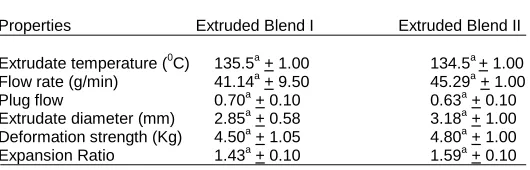
could be attributed increased fat over blend II. Fat reduction increased the viscosity of the feed material in the extruder thereby increasing residence time and decreasing throughput of the extrudates. The plug flow which is a dimensionless quantity is the ratio of the die diameter to the mean extrudate diameter. The value was not significantly (p<0.05) affected by extrusion cooking condition and defatted soybean inclusion. The value has a direct relationship to the mass flow rate of the extrudates out of the extruder die. Extruded blend II (0.63) had the lowest value which translated in to reduced mass flow rate (41.14g/min.) as well as increased extrudates diameter (3.18mm). The deformation strength being a mechanical property important in determining the consumers’ mouth feel perception of the product plays a vital role in product acceptability. The values were not significantly (p<0.05) affected by extrusion condition and defatted soybean inclusion. Extruded blend II (4.80Kg) had the highest deformation strength and extruded blend I (4.50Kg) followed. The values obtained here are high compared to break strength of biscuit (1.28 to 3.30Kg) from blends of tiger nut and pigeon pea flour reported by Chinma et al. (2011). This suggests that, the extrudates can withstand shear force experienced during handling and storage yet, maintaining their intact shapes. Table 4 shows the sensory attributes of the two extrudates. The two products were not significantly (p>0.05) different from each other in all the parameters tested (appearance, flavour, taste, texture and overall acceptability). This shows that extrusion cooking condition and defatting soybean in play no significant role in differentiating the two extrudates from each other based on the test panelist’s judgments of the two products. The overall acceptability of the two samples was rated high but, extruded blend I received the highest general acceptability.
4
C
ONCLUSION:
Mineral composition and invitro starch and protein digestibility of the products showed that the extrudates may be useful in infant feeding and may be of high benefits to group of people requiring low digestible carbohydrates for daily survival. The results of the work showed that, food extrusion significantly influenced the chemical; physical and invitro digestibility of the extrudates. The general acceptability; increased invitro protein digestibility and reduced invitro carbohydrate digestibility of the extrudates implied that the product is appropriate for diabetics.
5 Acknowledgments
The authors are grateful to the Department of Food Science and Technology of Federal Polytechnic Mubi, Nigeria for allowing the usage of their single screw extruder. IITA Ibadan is acknowledged for all the laboratory work.
R
EFERENCE[1]. Aarathi A, Urooj A and Puttaraj S. (2003). In vitro starch digestibility and nutritionally. Important starch fractions in cereals and their mixtures. Starch/Starke, 55:94–99.
[2]. Ali, MAM., El Tinay AH, Mallasy, LO and Yagoub AEA (2010). Supplementation of pearl millet flour with soybean protein: effect of cooking on in vitro protein digestibility and essential amino acids composition. Int. J. Fd. Sci. And Tech., 45:740-744
[3]. Altan, A., McCarthy, K. L. and Maskan, M. (2009). Effects of extrusion cooking on functional properties and Invitro starch digestibility of barley based extrudates from fruit and vegetable by products. Journal Food Science, 74(2):77-86.
[4]. Ariahu, C. C., Ukpabi, U., and Mbayunwa, K. O. (1999). Production of african breadfruit (Treculia africana) and soybean (Glycine max) seed based food formulation: effects of germinatrion and fermentation on microbiological and physical properties,. Plant Foods Hum Nutr 54:207.
[5]. Artz, E.W., Rao, S.K., Robbert, M.S. (1992). Lipid oxidation in extruded products as affected by extrusion Xxxxd Xxxxd temperature and selected antioxidants. In: Food Extrusion Science and Technology (L. Kokini, C.HO and M.V. Karver, Eds. Pp. 449-460.
[6]. Chinma, C. E., James, S., Imam, H., Ocheme, O. B., Anuonye, J. C., Yakubu, C. M. (2011). Physicochemical and sensory properties, and In-vitro digestibility of biscuits made from blends of tigernut (Cyperus esculentus) and pigeon pea (Cajanus cajan). Nigerian Journal of Nutritional Sciences. 32(1): 55-62.
[7]. Harper, J.M. (1989). Food Extruders and Their Applications, in Extrusion Cooking, ed. C. Mercier, P. Linko, J.M. Harper, AACC, St Paul, pp 1–16.
[8]. Hooda, S. and Jood, S. (2005). Organoleptic and nutritional evaluation of wheat biscuits supplemented with untreated and treated fenugreek flour. Food. Chem., 90:427-435.
[9]. Iwe, M. O. (2001). Organoleptic assesment of extruded blends of soy and sweet potatoe flour by response surface analysis. Plants Foods for Human Nutrition, 60:1-14.
[10]. Iwe, M. O. and Ngoddy, P. O. (1998). Proximate composition and some functional properties of extrusion cooked soybean and sweet potatoe blends. Plants Foods for Human Nutrition, 53:121-132. [11]. Jin, Z., Hsieh, F. and Huff, H. E. (1994). ‘Extrusion
cooking of corn meal with soy fiber, salt, and sugar’, Cereal Chem, 71(3), 227–34.
[12]. Leszek Moscicki (2011). Extrusion-Cooking Techniques Applications, Theory and Sustainability. WILEY-VCH Verlag & Co. KGaA, Weinheim, Germany.
[13]. Mian N. Riaz (2000). Extruders in Food Applications. CRC press USA.
211
Food Science and Technology, 40(1):21-29.
[15]. Nwabueze, T. U. and Iwe, M. O. (2007). Energy consumption in single-screw extrusion processing of full fat African breadfruit (Treculia africana) blends. Journal of Food Process Engineering, 30(3):375-395. [16]. Nwabueze, T. U. and Iwe, M. O. (2010). Residence
time distribution (RTD) in a single screw extrusion of African breadfruit mixtures. Food Bioprocess Technology, 3:135-145.
[17]. Nwabueze, T. U., Iwe, M. O. and Akobundu, E. N.T. (2008). Physical characteristics and acceptability of extruded African breadfruit-based snacks. Journal of Food Quality, 31(2):142-155.
[18]. Osabor, V. N., Oga, D. A. and Egbung, G. E. (2009). Profile of the African breadfruit (Treculia africana). Pakistan Journal of Nutrition, 8(7):1005-1008.
[19]. Runsewe, A., Olowu, A. O., Olanrewaju, D. M., Akesode, F. A., (2001). Efficacy of the African breadfruit (Treculia africana) in the nutritional rehabilitation of children with protein energy malnutrition. Nigerian Journal of Paediatrics, 28(4):128-34.
[20]. Steel RDG. and Torrie JH (1980). Principle and Procedures of Statistics. A Biometrical Approach. 2nd edn. McGraw Hill Co. New York, P. 623.
Table 1
Trace mineral composition of raw flour blends and their extrudates
Blend I *Blend II Mineral Raw Extruded Raw Extruded (mg/100g)
Fe 7.20a ± 1.00 7.20a ± 1.00 7.50a ± 1.00 7.60a ± 1.00 Cu 0.80a ± 0.10 0.50b ± 0.10 0.44b ± 0.10 0.40b ± 0.10 Zn 5.3a 3 ± 0.95 7.20a ± 1.00 6.50a ± 1.00 6.80a ± 1.00 Mo 0.14a ± 0.01 0.10c ± 0.02 0.13ab ± 0.01 0.10c ± 0.02 Mn 5.60c ± 1.00 8.30ab ± 1.00 7.20bc ± 1.00 9.20a ± 1.00
Values are means and standard deviations of three determinations. Values not followed by the same superscript in the same column are significantly different
(p<0.05). *with defatted soybean flour.
Table 2
Invitro starch and protein digestibility of raw flour blends and their extrudates
Blend I *Blend II Determination Raw Extruded Raw Extruded
Starch 31.12b ± 2.93 28.23c ± 0.13 45.53a ± 0.37 27.45c ± 0.22 digestibility
Protein 68.23b ± 5.57 70.43ab ± 0.55 56.27c ± 0.41 72.86a ± 0.96 digestibility
Values are means and standard deviations of three determinations. Values not followed by the same superscript in the same column are not significantly different (p>0.05). *with defatted soybean flour.
Table 3
Engineering and physical properties of the extrudates
Properties Extruded Blend I Extruded Blend II
Extrudate temperature (0C) 135.5a + 1.00 134.5a + 1.00 Flow rate (g/min) 41.14a + 9.50 45.29a + 1.00 Plug flow 0.70a + 0.10 0.63a + 0.10 Extrudate diameter (mm) 2.85a + 0.58 3.18a + 1.00 Deformation strength (Kg) 4.50a + 1.05 4.80a + 1.00 Expansion Ratio 1.43a + 0.10 1.59a + 0.10
Values not followed by the same subscript in the same raw are significantly different (p<0.05).
Table 4
Sensory attributes of the extrudates
Sensory Parameter Extruded blend I Extruded blend II
Appearance 7.50a ± 0.85 8.10a ± 0.88 Flavour 7.10a ± 0.88 7.10a ± 1.10
Taste 6.60a ± 1.08 6.50a ± 1.58
Texture 7.40a ± 0.70 7.10a ± 1.20 Overall acceptability 7.50a ± 0.85 7.40a ± 0.97