IJSRR, 7(4) Oct. – Dec., 2018 Page 2602
International Journal of Scientific Research and Reviews
PEBBLING C5xC5
Anil Kumar M S,
Mahatma Gandhi College ,Thiruvananthapuram ,Kerala 695004 Email: [email protected]
ABSTACT:
Given a configuration of pebbles on the vertices of G, a pebbling move consists of talking
two pebbles off some vertex v and putting one of them back on a vertex adjacent to v. A graph is
called pebbleable if for each vertex v there is a sequence of pebbling moves that would place at least
one pebble on v. The pebbling number f(G) of a graph G is the smallest integer m such that G is
pebbleable for every configuration D of m pebbles on G.In this paper we find the pebbling number of
C5XC5.
SUBJECT CLASSIFICATION: Combinatorics 05C50
KEY WORDS: Pebbling, Cycle, C5xC5
*Corresponding author
Anil kumar M S
Associate Professor ,
Department of Mathematics
MahatmaGandhi College ,
Thiruvananthapuram ,Kerala 695004
IJSRR, 7(4) Oct. – Dec., 2018 Page 2603 INTRODUCTION:
Chung1 conjectured that for any connected graph G and H, f(G x H) ≤ f(G) x
f(H). David S Herscovici and Aparna W Higgins2 , proved the conjecture when
G=H=C5. Lourdusamy and Somasundaram 3
, proved the conjecture using linear
programming. In both the references 2 and 3, they broke down the possible
configuration into six steps and verified various situations. Using set pebbling we find
the pebbling number of C5 x C5. This method is better than the previous methods. In
this method, instead of a single target vertex we are in addition using four vertices as
target vertices. The structure of the proof (construction) would help us in proving,
more generally, f(G1xG2x…xGn) = 5 n
.
Lemma 1: If there are at least 5 pebbles placed at the vertices of the graph G1 shown
in Figure(1) below, at least one pebble can be moved to one of the vertex sets {1,2},
{3,4}, {5,6}, and {7,8}.
1 2
8 3
7 4
6 5
Figure 1: Graph G1
Proof : Let S= {1,2} be the target set. If a or b has 2 pebbles then the result is true.
Otherwise, there are at least 3 pebbles remaining. They are to be placed on b or c.
Now (a, b, c, d) has the distribution like (a, b, c, d)= (1,2,1,1), (0,3,2,0), or (1,2,3,0) in
some order. In all cases one pebble can be moved to {1,2}.
Lemma 2: From reference 3 we have, f(P3xP3) = f(P3) x f(P3) = 2 2
x 22 = 16.
IJSRR, 7(4) Oct. – Dec., 2018 Page 2604
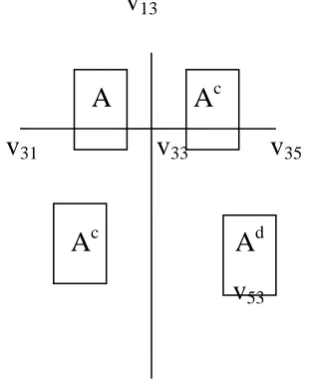
Figure (2) represents the graph of C5 x C5 is another representation of the graph
of C5 x C5. Thus a 5 by 5 grid represents C5 x C5. Let vij, 1 ≤ i,j ≤ 5 represents the
vertex set of C5 x C5 . Without loss of generality we assume v33 as the target vertex.
Let P and Q represent cycles with vertices vi3, 1 ≤ i ≤ 5, and v3j, 1 ≤ j ≤ 5
respectively and Q divides V (C5 x C5)\ V(P
∪
Q) into four parts. Choose one part as A,the parts which are symmetrically opposite to A with respect to P
∪
Q as Ac anddiagonally opposite to A as Ad. The situation is shown in figure (4).
v13
A Ac
v31 v33 v35
Ac Ad
v53
Figure 3 Representation of C5 xC5 as blocks
|V(A)|=|V(Ac)|=|V(Ad)|=4.
Let Vij represents the nth vertex at a distance m from v33. Let S={Vij , 1 ≤ n ≤ 4},
That is S={v23, v32, v34, v43}. The pebbling number of C5 x C5 is the set pebbling
number f(S, 2). That is, by placing 2 pebbles at any vertex in S, one pebble can be
moved to v33. Let Z denotes the set of all vertices in P
∪
Q at a. distance 2 from v33.That is, Z={v13, v31, v35, v53}. For two vertices u and v, the distance d(u,v) is the length x3,3
Figure 2.Representation of C5 XC5
IJSRR, 7(4) Oct. – Dec., 2018 Page 2605
of the shortest path from u to v. Let the cost of a pebble on a vertex u from a vertex v
is 2d(u,v). The cost of the pebbles on a path from u to v, from v is the total cost of all the
pebbles on the path. Hence if the cost of the pebbles on any path with v33 as one of its
end vertices from v is 2d(v,v33 )
, one pebble can be moved to v33. Obviously, diameter of
C5=2 and diameter of C5 x C5 = 2 x diameter of C5=4. Hence if there are at least 16
pebbles on any one of the vertices of C5 x C5 at least one pebble can be moved to any
desired vertex in C5 x C5.
We prove that f(C5 x C5) ≤ 25, by considering various pebbling situation .
Proof :
Notation : By A → Ac we mean, by removing y pebbles from A, x pebbles can
be moved to Ac.
|Z| denotes the number of pebbles in Z and |v| denote the number of pebbles at v.
Assumption: If P is a path with v33 as one end vertex, without loss of generality, we
may assume that the total cost of all the pebbles in the path must be less than 16 with
respect to the other end vertex.
(A): Suppose|Z|=|S|=0
Case 1: Let 14 ≤ |A| ≤ 15.
By assumption, in the worst situation all pebbles must be at v11.
(a) If |Ac| ≥ 2, then v11 → v32, v11 → A c
, Ac → v32, v32 → v33.
(b) If |Ac| ≤ 1, then |Ad| ≥ 8. Here (v44, v45, v54, v55) has any one of the
following configuration.
(v44, v45, v54, v55) = (2,1,0,5), (2,0,0,6), (1,1,1,5), (1,0,0,7).
Now v11 → v32, v11 → A c
, v55 → A c
, Ac → v32, v32 → v33.
Case 2: Let 12 ≤ |A| ≤ 13. By assumption, in the worst situation all pebbles must
be at v11.
(a) If |Ac| ≥ 3, then v11 → v32,v11 → A c
, Ac → v32, v32 → v33.
(b) If 1 ≤ |A| ≤ 2, then |Ad| ≥ 8. Here (v44, v45, v54, v55) has any one of the
following configuration.
(v44, v45, v54, v55) = (2,0,1,5), (2,0,0,6), (1,1,1,5), (1,0,0,7).
x y
1
8 6 3
1 5 1 2
1
8 3 6 2 4
1
5 1 2
1 8
2 4
1 5
1 2
IJSRR, 7(4) Oct. – Dec., 2018 Page 2606
(c) If |Ac| = 0, then 12≤|Ad|≤13.
Let |Ad|=13 and |A|=12. Here (v44, v45, v54, v55) has any one of the following
configuration.
(v44, v45, v54, v55) = (1,0,0,11), (1,1,0,10), (0,0,0,12).
Now v11 → v32, v11 → A c
, v55 → A c
, Ac → v32, v32 → v33
Case 3: Let 10 ≤ |A| ≤ 11. By assumption, in the worst situation all pebbles must be at
v11
(a) If |Ac| ≥ 4, then v11 → v32,v11 → A c
, Ac → v32, v32 → v33
(b) If |Ac| =3, then |Ad| ≥ 8. Here (v44, v45, v54, v55) has any one of the
following configuration.
(v44, v45, v54, v55) = (2,0,1,5), (2,0,0,6), (1,1,1,5), (1,0,0,7)
Now v11 → v32, v11 → A c
, v55 → A c
, Ac → v32, v32 → v33.
(c) If 1 ≤ |Ac| ≤ 2, then |Ad| ≥ 10. Here (v44, v45, v54, v55) has any one of the
following configuration
(v44, v45, v54, v55) = (1,0,0,9), (1,1,0,8), (1,1,1,7), (0,1,1,8), (0,1,0,9), (0,0,0,10)
Now v11 → v32, v11→ A
c
, v55 → A c
, Ac → v32, v32 → v33.
(d) If |Ac| = 0, then |Ad| = 14. Interchange A and |Ad| and follow pebbling steps
accordingly.
Case 4 : Let 8 ≤ |A| ≤ 9. By assumption, in the worst situation all pebbles must be at
v11
(a) If |Ac| ≥ 5, then v11 → v32,v11 → A c
, Ac → v32, v32 → v33.
(b) If 3 ≤ |A| ≤ 4, then |Ad| ≥ 8. Here (v44, v45, v54, v55) has any one of the
following configuration.
(v44, v45, v54, v55) = (2,0,1,5), (2,0,0,6), (1,1,1,5), (1,0,0,7).
Now v11 → v32, v55 → A c
, Ac → v32, v32 → v33.
(c) If |Ac| ≤ 2, then |Ad| ≤ 12. Interchange |A| and |Ad|
Case 5: Le 0 ≤ |A| ≤ 7. Interchange |A| and |Ad
|
1 4 5
8 2 10 5 1 1 2
8 2 5 2
8
1 1 2 1 2 5 1 1 2
1 1
1 1
8
1 1
2
3
5 1
1
6 2
8 4 6 2
8
1 1 2 5 1 1 2
1
1 3 1
IJSRR, 7(4) Oct. – Dec., 2018 Page 2607
(B): Suppose |Z| ≤ 4, |S| = 0
Let |v31| = 1. If |A| ≥ 12, and by assumption that in the worst situation all pebbles
must be at v11, three pebbles can be moved to v13. Now v13 → v33. So we need to
consider 0 ≤ |A| ≤ 11 only.
Case (1): Let 9 ≤ |A| ≤ 11.
A. If |Ac| ≥ 5, then v11 → v32, A c
→ v32, v32 → v33.
B. If |Ac| = 4, then |Ad| ≥ 2
C. Now, v11 → v31, v31 → v32, v11 → A c
, Ac → v32, v32 → v33.
D. If |Ac| = 3, then |Ad| ≥ 4
E. Now, v11 → v31, v31 → v32, v11 → A c
, Ac → v32, v32 → v33.
F. If |Ac| = 2, then |Ad| ≥ 6.
G. Now, v11 → v31, v31 → v32, v11 → A c
, Ac → v32, v32 → v33. If |A
c
| = 1, then
|Ad| ≥ 8
Here (v44, v45, v54, v55) has any one of the following configuration.
(v44, v45, v54, v55) = (1,1,1,5), (1,1,0,6), (1,0,0,7), (0,0,0,8), (0,1,0,7), (0,1,1,6).
Now, v11 → v31, v31 → v32, v11 → Ac, Ac → v32, v32 → v33
(a) If, |Ac| = 0, then |Ad| ≥ 10.
Here (v44, v45, v54, v55) has any one of the following configuration.
(v44, v45, v54, v55)
v11 → v31, v31 → v32, v11 → Ac, v55 → Ac, Ac → v32, v32 → v33.
Case (2): Let 6 ≤ |A| ≤ 8.
(a) If |Ac| ≥ 4, then |Ad| ≤ 5
Now v11 → v31, v31 → v32, v11 → A c
, Ac → v32, v32 → v33.
(b) If |Ac| = 3, then |Ad| ≥ 7
Here (v44, v45, v54, v55) has any one of the following configuration.
(v44, v45, v54, v55) = (2,0,0,5), (2,0,1,4), (2,1,1,3), (1,1,1,4), (1,1,0,5), (1,0,0,6),
(0,0,0,7), (0,1,0,6), (0,1,1,5)
Now, v11 → v31, v31 → v32, v55 → A c
, v11 → A c
, Ac → v32, v32 → v33.
(c) If 1 ≤ |Ac| ≤ 2, then |Ad| ≥ 9
4 1
4
1 1
2
1 2
1
5
1 8 1 5 1 2
1 2
4
1 1
2 1 4 2 5 1 2 4
1 1
2 1 4 2 5 1 2 4
1 1
2 1 4 2 5 1 2 4
1 1
2 1 4 2 5 1 2 6 3 2
4 1 2 1 1 5 1 2
1
2
4
1 1
IJSRR, 7(4) Oct. – Dec., 2018 Page 2608
(v44, v45, v54, v55) = (1,0,0,8), (1,1,0,7), (1,1,1,6), (0,1,1,7), (0,1,0,8), (0,0,0,9)
Now, v11 → v31, v31 → v32, v11 → A c
, v55 → A c
, Ac → v32, v32 → v33.
(d) If |Ac| = 2, then |Ad| ≥ 6.
Case (3): Let 4 ≤ |A| ≤ 5.
(a) If |Ac| ≥ 5, then v11 → v31, v32 → v33, Ac → v32, v32 → v33.
(b) If |Ac| ≤ 2, then |Ad| ≥ 8
Here (v44, v45, v54, v55) has any one of the following configuration.
(v44, v45, v54, v55) = (1,0,0,8), (1,1,0,7), (1,1,1,6), (0,1,1,7), (0,1,0,8), (0,0,0,9)
Now, v11 → v31, v31 → v32, v55 → Ac, Ac → v32, v32 → v33.
(c) If |Ac| ≤ 2, then |Ad| ≥ 12 .. Interchange |A| and |Ad|
Case (4): Let 0 ≤ |A| ≤ 3, Choose A or Ad
with more number of pebbles and do the
pebbling steps accordingly.
(C) Suppose |Z| = 0, |S| ≤ 4
Let |v32| = 1.
(a) If |A| ≥ 5, then A → v32, v32 → v33. So we assume that |A| ≤ 4
(b) If |Ac| ≥ 5, then Ac → v32, v32 → v33
(c) If |Ac| ≤ 4, then |Ad| ≥ 13. Interchange |A| and |Ad|
(D) Suppose |Z| ≤ 4, |S| ≤ 4
Case(1) Let |A|, |Ac| or |Ad| ≥ 5. Suppose |A| ≥ 5. Now A → v32, v32 → v33.
Case(2) Let |A| ≤ 4. If |Ac| ≤ 4, then |Ad| ≥ 9. Interchange |A| and |Ad |
We proved that f (C5xC5) ≤ 25
By placing one pebble each on the vertices of (C5xC5) except the target vertex,
no pebble can be moved on to the target vertex. That is f (C5xC5) ≥ 25 and hence,
f(C5xC5)=25.
4 1
2 5 2
4
1 1
2 4
2
5
4 2 5
1
2
1 1 2 1
1 1
6 1
2
3
1 1 1
1
1 1
1 2
2 5
5
5 2 1
IJSRR, 7(4) Oct. – Dec., 2018 Page 2609
REFERENCE:
1. Chung F.R.K , Pebbling in hypercubes, SIAM J. Discrete Mathematics, 1989; 2(4): 467-472
2. Hercscovici.D and Higgins. A :The pebbling number of C5xC5 ,Discrete Math 1998; 187:
123-135
3. Lourdusamy. A, Studies in graph theory, PhD Thesis, ,MS University Thirunelveli,