Vascular Health and Risk Management 2017:13 263–267
Vascular Health and Risk Management
Dove
press
submit your manuscript | www.dovepress.com 263
R E V I E W
open access to scientific and medical research
Open Access Full Text Article
Quick reference guide to apixaban
Katherine Victoria Hurst John Matthew O’Callaghan Ashok Handa
Nuffield Department of Surgical Sciences, University of Oxford, Oxford, UK
Abstract: Direct oral anticoagulants (DOACs) are being increasingly used in the clinical setting for patients at risk of venous thromboembolism (VTE) and/or stroke. These medications offer valued benefits for long-term use, including a fast onset of anticoagulation, fixed anticoagulation profile (and consequent prescription of specified doses) and no requirement for routine monitor-ing. Apixaban is a selective factor Xa inhibitor, approved for use in the prevention of stroke in patients with nonvalvular atrial fibrillation and in the prevention and treatment of acute VTE. Like many of the DOACs, it has a fast onset of action and works to deliver predictable coagula-tion results. Multiple randomized controlled trials including ARISTOTLE and AMPLIFY have shown apixaban to be noninferior to vitamin K antagonists in the prevention of stroke and VTE, with a good safety profile. This article aims to review the use of apixaban for the prevention and treatment of thromboembolic disease, highlighting the key study results that have led to its current licensing and use.
Keywords: apixaban, stroke management, venous thromboembolism
History and development
In an era of anticoagulation development, more options mean more uncertainty. It is imperative for physicians and surgeons to be aware of the available anticoagulation medication, their licenses, dosing and indications. Familiarity with the systemic effects, bleeding risks and reversal options during the pre-, peri- and postoperative periods is of particular importance to surgeons.
Vitamin K antagonists (VKAs) have long been the preferred choice of anticoagu-lation, but their unpredictable effects, delayed onset of action and need for routine monitoring make them a challenging medication for clinical practice. The advent of the direct oral anticoagulants (DOACs) has revolutionized patient care, supported by multiple randomized controlled trials (RCTs) and meta-analyses prior to the introduc-tion of routine clinical practice.1–3
To date, apixaban, dabigatran, edoxaban and rivaroxaban have gained therapeutic licenses within the UK and USA, and these have been secured on the basis of the RCTs listed in Table 1.
Pharmacokinetics
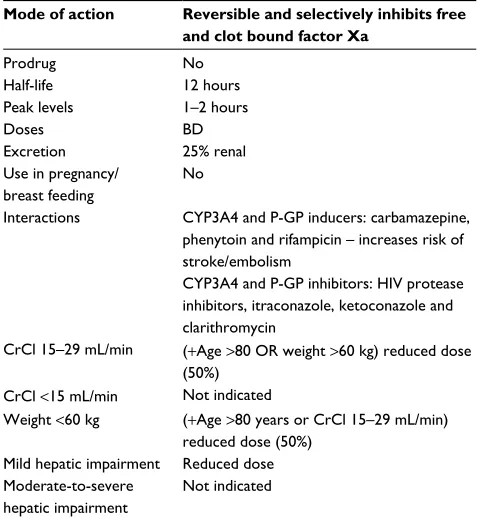
Apixaban is an oral factor Xa inhibitor that reversibly and selectively inhibits free and clot bound factor Xa. It has a rapid onset of action, with peak effects at around 1–2 hours post dose, and a half-life of ~12 hours. With predictable pharmacokinetics, apixaban can be administered as a fixed twice daily (BD) regimen, without the need for
Correspondence: Ashok Handa
Nuffield Department of Surgical Sciences,
John Radcliffe Hospital, Headley Way, Oxford OX3 9DU, UK
Tel +44 1865 22 0302 Fax +44 1865 76 8876
Email [email protected]
Journal name: Vascular Health and Risk Management Article Designation: REVIEW
Year: 2017 Volume: 13
Running head verso: Hurst et al
Running head recto: The use of apixaban in clinical practice DOI: http://dx.doi.org/10.2147/VHRM.S121944
Vascular Health and Risk Management downloaded from https://www.dovepress.com/ by 118.70.13.36 on 27-Aug-2020
For personal use only.
This article was published in the following Dove Press journal: Vascular Health and Risk Management
10 July 2017
Dovepress
Hurst et al
routine monitoring (Table 2).4 Currently available preparations include Eliquis® (Bristol-Myers Squibb Pharmaceuticals Ltd).
Its current licenses include4,5
• Prevention of stroke in patients with atrial fibrillation (AF) + one congestive heart failure, hypertension, age
>75 years, diabetes mellitus, stroke (CHADS) risk factor (5 mg BD).
• Prevention of venous thromboembolism (VTE) in
elective hip/knee surgery (2.5 mg BD for 35/12 days, respectively).
• Treatment of deep vein thrombosis (DVT) and pulmonary
embolism (PE) (10 mg BD for 7 days then 5 mg BD).
• Prophylaxis after recurrent DVT/PE (2.5 mg BD).
Apixaban is eliminated in both urine and feces, with renal
excretion accounting for ~27%. Consequently, it does not
require renal dosing adjustments until the glomerular filtration rate falls below 30 mL/min. In such cases, a half dose (50%) reduction is advised if the patient is >80 years or <60 kg.6
For patients <60 kg, a 50% reduction in dose is also rec-ommended if they are again either >80 years or creatinine clearance (CrCl) is <30 mL/min.
Although there is no significant data available on dosing in mild hepatic impairment, apixaban should be avoided in patients with moderate-to-severe impairment.
The use of apixaban must be reviewed, however, in those patients taking cytochrome P4503 A4 (CYP3A4) and/or P-glycoprotein (P-GP) inducers (such as carbamazepine,
Table 1 DOAC licenses and associated randomized controlled trials
DOAC Randomized controlled trial Licensing
Rivaroxaban EINSTEIN DVT (rivaroxaban vs enoxaparin for DVT)19
Prevention of VTE in elective hip/knee surgery (10 mg OD for 35/12 days, respectively)
Treatment of DVT and PE and prophylaxis after recurrent DVT/PE (15 mg BD for 21 days, then 20 mg OD)
Stroke prevention in patients with AF + one CHADS2 risk factor (20 mg OD) Prevention of atherothrombotic events in adults after acute coronary syndrome (2.5 mg OD)
EINSTEIN PE (rivaroxaban vs enoxaparin for PE)20
ROCKET AF (rivaroxaban vs warfarin for AF)21
Dabigatran RE-COVER (dabigatran vs warfarin for VTE)22
Treatment of DVT or PE after parenteral anticoagulation for 5–10 days (150 mg BD)
Stroke prevention in patients with AF + one of reduced ejection fraction/CHD/ diabetes/<65 (150 mg BD)
Prevention of VTE in elective hip/knee surgery (110 mg 1–4 hours after surgery, then 220 mg OD 9/7)
RE-LY (dabigatran vs warfarin in AF)2
Apixaban ARISTOTLE (apixaban vs warfarin in AF)5
Stroke prevention in patients with AF + one CHADS2 risk factor (5 mg BD) Prevention of VTE in elective hip/knee surgery (2.5 mg BD for 35/12 days, respectively)
Treatment of DVT and PE (10 mg BD for 7 days, then 5 mg BD), or prophylaxis after recurrent DVT/PE (2.5 mg BD)
Prevention of VTE (2.5 mg BD) AMPLIFY (apixaban vs enoxaparin
followed by warfarin for VTE)4
Edoxaban ENGAGE-AF-TIMI (edoxaban
to warfarin in AF)23
Treatment of DVT or PE and prophylaxis after recurrent DVT/PE (60 mg OD)
Prevention of stroke and systemic embolic events in patients with AF (60 mg OD)
Hokusai VTE (edoxaban to warfarin VTE)24
Note: Bold indicates NICE license without US Food and Drug Administration license.
Abbreviations: AF, atrial fibrillation; BD, twice daily; CHADS2, congestive heart failure, hypertension, age=75 years, diabetes mellitus, stroke (doubled); CHD, coronary heart disease; DOAC, direct oral anticoagulants; DVT, deep vein thrombosis; NICE, National Institute for Clinical Excellence; OD, once daily; PE, pulmonary embolism; VTE, venous thromboembolism.
Table 2 Pharmacokinetics of apixaban
Mode of action Reversible and selectively inhibits free
and clot bound factor Xa
Prodrug No
Half-life 12 hours
Peak levels 1–2 hours
Doses BD
Excretion 25% renal
Use in pregnancy/ breast feeding
No
Interactions CYP3A4 and P-GP inducers: carbamazepine, phenytoin and rifampicin – increases risk of stroke/embolism
CYP3A4 and P-GP inhibitors: HIV protease inhibitors, itraconazole, ketoconazole and clarithromycin
CrCl 15–29 mL/min (+Age >80 OR weight >60 kg) reduced dose (50%)
CrCl <15 mL/min Not indicated
Weight <60 kg (+Age >80 years or CrCl 15–29 mL/min) reduced dose (50%)
Mild hepatic impairment Reduced dose Moderate-to-severe
hepatic impairment
Not indicated
Abbreviations: BD, twice daily; CrCl, creatinine clearance; CYP3A4, cytochrome P450 3A4; HIV; human immunodeficiency virus; P-GP, P-glycoprotein.
Vascular Health and Risk Management downloaded from https://www.dovepress.com/ by 118.70.13.36 on 27-Aug-2020
Dovepress The use of apixaban in clinical practice
phenytoin and rifampicin) as these medications may increase the risk of stroke and/or embolism. The opposite is consequently true for CYP3A4 and P-GP inhibitors, such as itraconazole, ketoconazole, clarithromycin and human immunodeficiency virus protease inhibitors, which may increase the risk of bleeding when used in conjunction with apixaban.7
The main RCTs defining the use of apixaban over
war-farin have been the ARISTOTLE and AMPLIFY studies.4,5
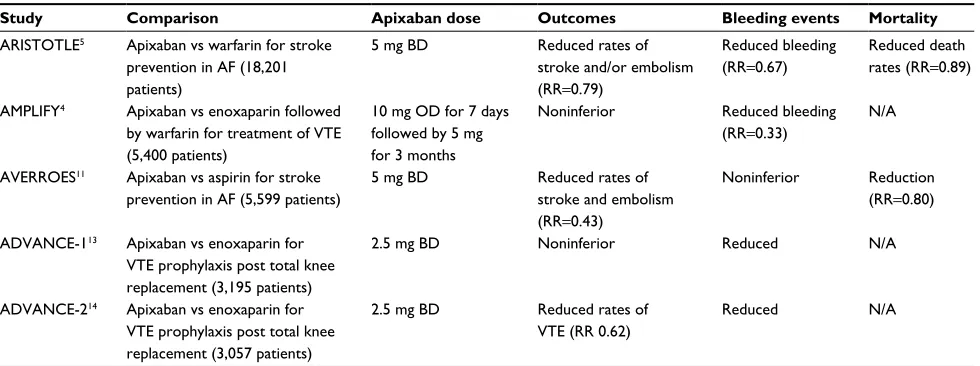
ARISTOTLE reviewed the rates of stroke, death and bleed-ing durbleed-ing the use of apixaban (compared with warfarin) in AF-related stroke prevention. AMPLIFY randomized patients into receiving either conventional enoxaparin and warfarin or apixaban when diagnosed with acute VTE. The outcomes of these studies and drug safety profiles are discussed below.
Efficacy in stroke prevention
It is well known that the prevalence of AF increases with age, with ~10% of the population over 80 years experiencing symptoms.8 The majority of these patients receive oral antico-agulant medication to reduce their risk of AF-related stroke. Previously prescribed medication has included warfarin or other VKAs, but their unpredictable coagulation profile and drug and food interactions limit their therapeutic use.9
With the advent of DOACs, multiple RCTs compared the use of warfarin with DOAC medications. The ARISTOTLE trial compared apixaban with warfarin in the management of AF-related stroke, particularly highlighting the rates of stroke, death and bleeding with both medications.5
For this study 18,201 patients were randomly assigned to either warfarin or 5 mg BD apixaban therapy (2.5 mg BD for dose reduction). Although a small number of participants were lost to follow-up (2.1%), overall results showed that fewer patients experienced symptoms of stroke or
embo-lism on apixaban (1.27% vs 1.60%; P=0.01). There was a
49% relative risk reduction in the number of hemorrhagic
stroke on apixaban (absolute risk reduction [ARR]=0.96%,
P≤0.001), and an 8% relative risk reduction in ischemic
stroke (P=0.42). Overall mortality rates were lower (3.5% vs 3.9%, P=0.047), and major bleeding was significantly lower at 2% with apixaban compared to just over 3% with warfarin (ARR=1%, P<0.001).10
Alongside these results, apixaban has also been compared with aspirin therapy alone (AVERROES study). Results have again highlighted a 55% relative risk reduction (ARR=2.1%, P<0.001) in the rate of stroke or systemic embolism, with no increase in the risk of major bleeding (P=0.07).11
Efficacy in the prevention of VTE
VTE is a significant issue in patients with reduced mobility, particularly after surgery. It is, therefore, important to ensure whether appropriate anticoagulant medication is prescribedto prevent venous thromboembolic disease.12
ADVANCE-1 and ADVANCE-2 trials were phase III clinical trials that evaluated the use of apixaban following total knee replacement. Both studies were noninferiority tri-als, where the ADVANCE-1 trial reviewed the use of apixaban 2.5 mg once daily (OD) (1,599 patients) compared with subcutaneous enoxaparin 30 mg BD (1,596 patients), and ADVANCE-2 randomized 1,528 patients to receive apixa-ban 2.5 mg BD and 1,529 patients to receive subcutaneous enoxaparin 40 mg OD.
Results of both studies highlighted that apixaban was noninferior when compared with enoxaparin with regard
to VTE prophylaxis (ARR=9%, P<0.0001), and showed a
reduction in the rate of bleeding from 5% to 4% (P=0.09).13,14 Although no direct RCTs have been performed for the use of apixaban in the prevention of VTE outside hip and knee surgery, the data shown throughout this article are considered to be strong enough evidence for the use of apixaban for this purpose.13–15
Efficacy in the treatment of VTE
VTE has an annual incidence of 1–2 per million population and is commonly linked to immobility (e.g., surgery or flights>4 hours), coagulation disorders and the oral contraceptive pill.16 Conventional therapy includes initial treatment with enoxaparin and 3–6 months of warfarin therapy dependent on VTE anatomical location. The AMPLIFY study random-ized and double blinded patients into conventional treatment or 10 mg apixaban BD for 7 days followed by 5 mg BD for 3 months.4
Five thousand and four hundred patients were enrolled in the study. Of these, a total of 130 patients experienced further thromboembolic events (2.3% apixaban vs and 2.7% conventional therapy), and a similar percentage in each cohort went on to have a positive diagnosis of PE. Overall bleed-ing rates were again significantly lower followbleed-ing the use of apixaban (0.6% vs 1.8%), highlighting a clinically relevant overall relative risk reduction of 69% (ARR=1.2%, P<0.001).
Safety
Both efficacy and safety are key aspects in the development of new medications. This review highlights the clinical results of apixaban; showing similar efficacy in the treatment of acute thromboembolism, AF-related stroke management and
Vascular Health and Risk Management downloaded from https://www.dovepress.com/ by 118.70.13.36 on 27-Aug-2020
Dovepress
Hurst et al
VTE prophylaxis when compared with more conventional therapeutic techniques, but patient safety of any new medica-tion is paramount.
The majority of the safety profiling for apixaban has been derived from the RCT’s stated above, for example, ARISTO-TLE and AMPLIFY. These studies have confirmed that the use of apixaban (when compared with warfarin) has a sig-nificantly lower rate of mortality, reduced incidence of major bleeding events (Table 3) and few recordable side effects.1
Bleeding and bridging
Reversal agents are currently being trialed, but the only marketed drug at present is idarucizumab (PRAXBIND) for dabigatran.17 Consequently, the same protocol as for major bleeding on warfarin must be adhered to: discontinue the drug, apply manual compression, maintain blood pressure, surgical/radiological intervention if appropriate and replace blood products +/− prothrombin complex concentrate.18
To bridge a DOAC to enoxaparin, the DOAC should be discontinued and enoxaparin commenced at the same time as the next scheduled DOAC dose. When converting to warfarin, all DOACs should be discontinued when the patients’ international normalized ratio is in the therapeutic range. For apixaban, therefore, the medication must be continued until recordable therapeutic levels of warfarin are reached (specific to indication), ensuring full antico-agulation effect.
Conclusion
The DOACs are quickly becoming the preferred treatment in the prevention and management of thromboembolic disease. Apixaban has been shown to be a safe alternative
Table 3 Comparison of the major studies reviewed in the licensing of apixaban
Study Comparison Apixaban dose Outcomes Bleeding events Mortality
ARISTOTLE5 Apixaban vs warfarin for stroke
prevention in AF (18,201 patients)
5 mg BD Reduced rates of
stroke and/or embolism (RR=0.79)
Reduced bleeding (RR=0.67)
Reduced death rates (RR=0.89)
AMPLIFY4 Apixaban vs enoxaparin followed
by warfarin for treatment of VTE (5,400 patients)
10 mg OD for 7 days followed by 5 mg for 3 months
Noninferior Reduced bleeding
(RR=0.33)
N/A
AVERROES11 Apixaban vs aspirin for stroke
prevention in AF (5,599 patients)
5 mg BD Reduced rates of
stroke and embolism (RR=0.43)
Noninferior Reduction (RR=0.80)
ADVANCE-113 Apixaban vs enoxaparin for
VTE prophylaxis post total knee replacement (3,195 patients)
2.5 mg BD Noninferior Reduced N/A
ADVANCE-214 Apixaban vs enoxaparin for
VTE prophylaxis post total knee replacement (3,057 patients)
2.5 mg BD Reduced rates of VTE (RR 0.62)
Reduced N/A
Abbreviations: AF, atrial fibrillation; BD, twice daily; OD, once daily; VTE, venous thromboembolism; RR, relative risk; N/A, not available.
to other oral anticoagulant medications and has a reduced risk of bleeding and stroke when used for AF-related stroke prevention and fewer negative outcomes when used in VTE prophylaxis and treatment (Table 3). With a twice daily dos-ing regimen and no need for routine monitordos-ing, apixaban is a safe and effective alternative to other oral anticoagulant medications.
Disclosure
The authors report no conflicts of interest in this work.
References
1. Halvorsen S, Atar D, Yang H, et al. Efficacy and safety of apixaban compared with warfarin according to age for stroke prevention in atrial fibrillation: observations from the ARISTOTLE trial. Eur Heart J.
2014;35(28):1864–1872.
2. Flaker G, Ezekowitz M, Yusuf S, et al. Efficacy and safety of dabiga-tran compared to warfarin in patients with paroxysmal, persistent, and permanent atrial fibrillation: results from the RE-LY (randomized evalu-ation of long-term anticoagulevalu-ation therapy) study. J Am Coll Cardiol.
2012;59(9):854–855.
3. Halperin JL, Hankey GJ, Wojdyla DM, et al. Efficacy and safety of rivaroxaban compared with warfarin among elderly patients with nonvalvular atrial fibrillation in the rivaroxaban once daily, oral, direct factor Xa inhibition compared with vitamin K antagonism for preven-tion of stroke and embolism trial in atrial fibrillapreven-tion (ROCKET AF).
Circulation. 2014;130(2):138–146.
4. Agnelli G, Buller HR, Cohen A, et al; AMPLIFY Investigators. Oral apixaban for the treatment of acute venous thromboembolism. N Engl J Med. 2013;369(9):799–808.
5. Al-Khatib SM, Thomas L, Wallentin L, et al. Outcomes of apixaban vs. warfarin by type and duration of atrial fibrillation: results from the ARISTOTLE trial. Eur Heart J. 2013;34(31):2464–2471.
6. Eikelboom JW, Connolly SJ, Gao P, et al. Stroke risk and efficacy of apixaban in atrial fibrillation patients with moderate chronic kidney disease. J Stroke Cerebrovasc Dis. 2012;21(6):429–435.
7. Hurst K, Lee R, Handa A. Quick reference guide to the new oral anti-coagulants. J Vasc Surg. 2016;63(6):1653–1657.
8. Heeringa J, van der Kuip DA, Hofman A, et al. Prevalence, incidence and lifetime risk of atrial fibrillation: the Rotterdam study. Eur Heart J.
2006;27(8):949–953.
Vascular Health and Risk Management downloaded from https://www.dovepress.com/ by 118.70.13.36 on 27-Aug-2020
Dovepress
Vascular Health and Risk Management
Publish your work in this journal
Submit your manuscript here: https://www.dovepress.com/vascular-health-and-risk-management-journal Vascular Health and Risk Management is an international,
peer-reviewed journal of therapeutics and risk management, focusing on concise rapid reporting of clinical studies on the processes involved in the maintenance of vascular health; the monitoring, prevention and treatment of vascular disease and its sequelae; and the involvement of
metabolic disorders, particularly diabetes. This journal is indexed on PubMed Central and MedLine. The manuscript management system is completely online and includes a very quick and fair peer-review system, which is all easy to use. Visit http://www.dovepress.com/ testimonials.php to read real quotes from published authors.
Dove
press
The use of apixaban in clinical practice
9. Hart RG, Pearce LA, Aguilar MI. Meta-analysis: antithrombotic therapy to prevent stroke in patients who have nonvalvular atrial fibrillation.
Ann Intern Med. 2007;146(12):857–867.
10. Hylek EM, Held C, Alexander JH, et al. Major bleeding in patients with atrial fibrillation receiving apixaban or warfarin: the ARISTOTLE trial (apixaban for reduction in stroke and other thromboembolic events in atrial fibrillation): predictors, characteristics, and clinical outcomes.
J Am Coll Cardiol. 2014;63(20):2141–2147.
11. Connolly SJ, Eikelboom J, Joyner C, et al. Apixaban in patients with atrial fibrillation. N Engl J Med. 2011;364(9):806–817.
12. NICE [webpage on the Internet]. Venous thromboembolism in adults: reducing the risk in hospital. 2010. Available from https://www.nice. org.uk/guidance/qs3. Accessed June 13, 2017.
13. Lassen MR, Gallus A, Raskob GE, et al. Apixaban versus enoxa-parin for thromboprophylaxis after hip replacement. N Engl J Med.
2010;363(26):2487–2498.
14. Lassen MR, Raskob GE, Gallus A, Pineo G, Chen D, Hornick P; ADVANCE-2 investigators. Apixaban versus enoxaparin for throm-boprophylaxis after knee replacement (ADVANCE-2): a randomised double-blind trial. Lancet. 2010;375(9717):807–815.
15. Mandernach MW, Beyth RJ, Rajasekhar A. Apixaban for the prophylaxis and treatment of deep vein thrombosis and pulmonary embolism: an evidence-based review. Ther Clin Risk Manag. 2015;11:1273–1282. 16. Goldhaber SZ, Bounameaux H. Pulmonary embolism and deep vein
thrombosis. Lancet. 2012;379(9828):1835–1846.
17. Idarucizumab (praxbind) – an antidote for dabigatran. Med Lett Drugs Ther. 2015;57(1482):157–158.
18. Keeling D, Cotter F. Management of bleeding in patients taking FXa and FIIa inhibitors. Br J Haematol. 2013;160(1):1–2.
19. Bauersachs R, Berkowitz SD, Brenner B, et al. Oral rivaroxaban for symptomatic venous thromboembolism. N Engl J Med. 2010;363(26): 2499–2510.
20. Büller HR, Prins MH, Lensin AW, et al; EINSTEIN–PE Investigators. Oral rivaroxaban for the treatment of symptomatic pulmonary embo-lism. N Engl J Med. 2012;366(14):1287–1297.
21. Piccini JP, Hellkamp AS, Lokhnygina Y, et al. Relationship between time in therapeutic range and comparative treatment effect of rivaroxaban and warfarin: results from the ROCKET AF trial. J Am Heart Assoc.
2014;3(2):e000521.
22. Schulman S, Kearon C, Kakkar AK, et al; RE-COVER Study Group. Dabigatran versus warfarin in the treatment of acute venous thrombo-embolism. N Engl J Med. 2009;361(24):2342–2352.
23. Ruff CT, Giugliano RP, Antman EM, et al. Evaluation of the novel factor Xa inhibitor edoxaban compared with warfarin in patients with atrial fibrillation: design and rationale for the effective aNticoaGula-tion with factor xA next generaaNticoaGula-tion in atrial fibrillaaNticoaGula-tion-thrombolysis in myocardial infarction study 48 (ENGAGE AF-TIMI 48). Am Heart J. 2010;160(4):635–641.
24. Said K. Hokusai-VTE: edoxaban for the treatment of venous thrombo-embolism. Glob Cardiol Sci Pract. 2013;2013(4):416–420.
Vascular Health and Risk Management downloaded from https://www.dovepress.com/ by 118.70.13.36 on 27-Aug-2020