The method described in this paper is simple and rapid HPLC-UV method for determination of torsemide in human plasma and found to be precise and accurate; the proposed method was successfully applied for pharmacokinetic studies.
ACKNOWLEDGMENTS
Authors are greatful to M/s Macleods Pharmaceuticals Ltd for providing gift sample of torsemide and Shri. Amrut Modi Research Fund (AMRF) for providing financial support and research facility to conduct study.
REFERENCES
Lessne M, Clerckx-braun F, Dduhoux P, Van Ypersele de Strihou C. 1.
Pharmacokinetic study of torsemide in human: An overview of its diuretic effects. Int J Clin Pharmacol Ther Toxicol 1982;20:382-7. March C, Farthing D, Wells B, Besenfelder E, Karnes HT. Solid-phase 2.
extraction and liquid chromatography of torsemide and metabolites from plasma and urine. J Pharm Sci 1990;79:453-7.
Ghys A, Denef J, De Suray J, Gerin M, George A, Delarge J,
3. et al.
Pharmacological properties of the new potent diuretic torsemide in rats and dogs. Arzneimittelforschung 1985;35:1520-6.
Ventura R, Nadal T, Alcalde P, Pascual JA. Fast screening method 4.
for diuretics, probenacid and other compounds of doping interest.J Chromatogr A 1993;655:233-42.
Barroso MB, Alonso RM, Jimenez RM. Simultaneous determination 5.
of torsemide and its major metabolite M5 in human urine by high-performance liquid chromatography-electrochemical detection. J Chromatogr Sci2001;39:491-6.
Neugebauer G, Besenfelder E, Von Mollendorff E. Pharmacokinetic 6.
and metabolism of torsemide in man. Arzneimittelforschung 1988;38:164-8.
Barroso MB, Meiring HD, De Jong, RM Alonso A, Jimenez RM. 7.
Gas chromatographic-mass spectrometric analysis of the loop diuretic torsemide in human urine. J Chromatogr B Biomed Sci Appl 1997;690:105-13.
Engelhardt S, Meineke I, Brockmoller J. Improved solid-phase 8.
extraction and HPLC measurement of torsemide and its important metabolites. JChromatogr B Analyt Technol Biomed Life Sci 2006;831:31-5.
Accepted 15 August 2008 Revised 24 January 2008 Received 21 April 2007 Indian J. Pharm. Sci., 2008, 70 (4): 519-522
Essential Oil Composition and Antibacterial Studies of
Vitex negundo Linn. Extracts
S. L. KHOKRA*, O. PRAKASH, S. JAIN1, K. R. ANEJA2 AND YOGITA DHINGRA2
University Institute of Pharmaceutical Sciences, Kurukshetra University, Kurukshetra-136 119, India, 1Department
of Pharmaceutical Sciences, Guru Jambheshwar University, Hisar-125 001, India, 2Department of Microbiology,
Kurukshetra University, Kurukshetra, Haryana-136 119, India
Khokra, et al.: Antibacterial Studies of Vitex negundo Linn. extracts and essential oil
Essential oils from fresh leaves, fl owers and dried fruits of Vitex negundo were obtained by hydrodistillation. Using Soxhlet extractor fi ve successive extracts from dried and powdered leaves were also taken. The chemical constituents of essential oil of leaves, fl owers and dried fruits were analyzed by GC-FID and GC/MS techniques. Main constituents identifi ed in leaves oil were δ-guaiene, carryophyllene epoxide and ethyl-hexadecenoate; in fl owers oil - α-selinene, germacren-4-ol, carryophyllene epoxide and (E)-nerolidol while fruit oil showed β-selinene, α-cedrene, germacrene D and hexadecanoic acid as the main constituents. β-Caryophyllene was only the constituent identifi ed as common to all three oils. α-Guaiene and guaia-3,7-diene were identifi ed as common constituents in leaf and dried fruit oil while leaf and fl ower oils showed p-cymene, valencene, caryophyllene epoxide and (E)-nerolidol as common constituent. All the essential oils and successive extracts were evaluated for antibacterial potential against Staphylococcus aureus, Bacillus subtilis, Escherichia coli andPseudomonas aeruginosa bacterial strains. Each of the essential oils and extracts were found to give promising results against B. subtilis and E. coli. Ethyl acetate and ethanol extracts showed prominent antibacterial activity against all the tested strains. Fruits and leaves oil were found to be most active against E. coli and S. aureus, respectively. Only fl owers oil was found to be active against P. aeruginosa.
Key words: Vitex negundo, essential oils, antibacterial studies, α-selinene, germacren-4-ol, carryophyllene oxide, δ-guaiene, carryophyllene epoxide
*For correspondence
Vitex negundo (family: Verbenaceae), is an important
medicinal plant found throughout India. Though almost all of its parts are used in Ayurvedic and Unani systems of medicine, the extracts from its leaves and roots are the most important in the Þ eld of medicine and drug1. Its leaves2 and seeds3 are widely
used externally for rheumatism and inflammations of joints and are also reported to have insecticidal properties. Internally, decoction of its leaves is taken as diuretic, expectorant, vermifuge, tonic and febrifuge4. The chemical components of the essential
oil of leaf isolated from V. negundo5-9 and other Vitex
species10 have been reported by several researchers
in the past. Its essential oil is found to be useful for sloughing wounds and ulcers. The leaves of V. negundo are reported to possess pesticidal, antifungal
and antibacterial properties11 so in the present study,
besides GC/MS analysis of fresh leaves, ß owers and dried fruits, the antibacterial potential of all three different oils and Þ ve successive extracts was studied. This study will be useful to identify the bioactive compounds of the oil, which may be responsible for the various medicinal properties of the plant.
The fresh leaves and flowers of V. negundo were
collected in the month of August and September 2005 while fruits were collected in the month of October and November in the same year, from local areas of Kurukshetra, Haryana (India). The plant got identiÞ ed and authenticated by FRI, Dehradun and a voucher specimen of the sample (Sr. No. 160/Flora of Haryana) has deposited in the NWFP Herbarium collection at Forest Research Institute and College, Dehradun, India.
The freshly collected leaves, ß owers and dried fruits of V. negundo were washed twice with water to
remove dust, just before hydrodistillation. Each of the leaves, ß owers and fruits were then subjected to hydrodistillation separately for 8 h using a closed type Clevenger apparatus for extraction of oils lighter than water. Yellowish oil so obtained was separated from the distillate with the help of hexane and dried over anhydrous MgSO4. Percentage yield of essential oil was calculated and it was stored in sealed glass bottles in a refrigerator until analysis. In case of leaves oil extraction, before subjecting to hydrodistillation, the leaves were treated with a 10% KOH solution for 3 h and then washed twice with fresh water.
Shade dried leaves were pulverized and extracted successively with petroleum ether + ethyl acetate +
CH3OH + C2H5OH + H2O in a Soxhlet extractor for 18 h. The solvents were evaporated under vacuum and percentage yield of each extract was calculated. Each of the extract was stored in a sealed glass bottle in a refrigerator until analysis.
GC analysis was carried out on Shimadzu GC17A GC V3 system, equipped with FID and fitted with a column (30 m×0.25 mm, film thickness 0.2 µm). Temperature parameters: column oven- 100º, injection port- 250º, detector- 300º. Time programming: 100º for 2 min, temperature raised from 20º to 300º for 10 min, total time 22 min. Carrier gas used was He at 600 kPa primary pressure with 3 ml/min purge ß ow, column pressure 100 kPa.
GC/MS analysis was performed on Shimadzu GC/ MS QP 5000 with GC17A GC system fitted with DB-6 chrompack capillary column (30 m × 0.25 mm, film thickness 0.2 µm). Temperature programming: 50º - 300º at 20º/min. Carrier gas used was He at 55 kPa pressure, 53 ml/min ß ow rate. Electron impact mode of ionization with ionization energy 70 eV and ion source temperature 170º. Peaks were identified by comparison of relative GC retention times with standards from literature, retention indices on BP - 1 column12-13, peak enrichment on co-injection with
authentic standard wherever possible and comparison of mass spectra with literature data14-16. Relative
percentage amounts were computed from GC peak areas without FID response factor correction.
The bacteria used for antibacterial tests were Gram (+) Staphylococcus aureus (MTCC 3160), Bacillus subtilis (MTCC 0121) and Gram (-) Escherichia coli
(MTCC 0051), Pseudomonas aeruginosa (MTCC
of the inhibition zones was calculated in mm. The average of diameter of the inhibition zones of each sample was taken called clearing zone (CZ) and the antimicrobial index (AI) was computed as the clearing zone (CZ) minus the diameter of the hole divided by the diameter of the hole.
Out of thirty six constituents shown in GC spectra of leaf essential oil, only twenty constituents were identiÞ ed. The identiÞ ed constituent- p-cymene, cis
-ocimene, citronellal, β-curcumene, β-caryophyllene,
α-guaiene, guaia-3,7-diene, δ-guaiene, valencene, caryophyllene epoxide, ethyl-9–hexadecenoate, palmitic acid, (E)-nerolidol, humulene epoxide 1, globulol, humulene epoxide 2, epi-α-cadinol, α-muurolol,
α-cadinol and α-bisabolol acetate represented about 85.5% of total composition of the essential oil of leaf. Out of twenty three constituent, twelve identiÞ ed constituent in ß ower essential oil were formic acid, n-heptane, p-cymene, β-caryophyllene, trans-α
-bergamotene, valencene, α-selinene, β-selinene, germacren-4-ol, caryophyllene epoxide, (E)-nerolidol and p-(1,1-dimethylethyl) toluene represented about
65% of total composition of the oil. The thirteen constituents namely α-copaene, β-caryophyllene,
α-cedrene, α-guaiene, guaia-3,7-diene, α-humulene, aristolene, germacrene D, β-selinene, caryophyllene oxide, n-hexadecanoic acid, palmitolic acid and traces of acetyl lactyl glycerate were identified in dried fruit oil out of seventeen. IdentiÞ cation of aristolene, n-hexadecanoic acid, palmitolic acid and acetyl lactyl
glycerate was tentative. The chemical compositions
TABLE 1: CHEMICAL COMPOSITION OF LEAVES, FLOWER AND DRIED FRUIT ESSENTIAL OIL OF VITEX NEGUNDO
Leaf oil Retention Peak Flower oil Retention Peak Dried Fruit oil Retention Peak Constituents index Area (%) Constituents index Area (%) Constituents index Area (%)
p-cymene 1006 0.8 formic acid* --- 0.7 α-copaene 1364 5.4
cis-ocimene 1027 3.3 n-heptane* --- 5.2 β-caryophyllene 1403 5.0
citronellal 1126 2.3 p-cymene 1009 0.1 α-cedrene* 1409 14.0
β-curcumene* --- 0.3 β-caryophyllene 1403 5.2 α-guaiene 1419 1.5
β-caryophyllene 1403 5.0 trans-α-bergamotene* 1436 0.2 guaia-3,7-diene* 1430 2.0
α-guaiene 1420 1.3 valencene* 1471 2.4 α-humulene 1434 4.0
guaia-3,7-diene* 1430 0.9 α-selinene* 1470 17.0 Aristolene 1455 8.0
δ- guaiene* --- 18.0 β-selinene 1473 0.3 germacrene D 1459 8.0
valencene* 1471 2.3 germacren-4-ol* 1530 9.0 β-selinene 1464 22.0
caryophyllene epoxide* 1550 10.2 caryophyllene epoxide 1550 15.2 caryophyllene oxide 1555 3.0
ethyl-9-hexadecenoate* --- 28.5 (E)-nerolidol 1552 8.0 n-hexadecanoic acid --- 8.0
palmitic acid* --- 5.2 p-(1,1-dimethylethyl) --- 1.2 palmitoleic acid ---- 3.0
toluene*
(E)-nerolidol 1552 3.0 acetyl-lactylglycerate ---- 1.5
humulene epoxide 1* 1575 1.0
globulol 1585 0.8
humulene epoxide 2* 1608 t
epi-α-cadinol* 1640 0.7
α-murolol* 1648 1.0
α-cadinol 1653 t
α-bisabolol acetate* 1798 0.8
t - trace (<0.1%), *Newly reported in this oil
Fig. 1: Antibacterial activity of Vitex negundo Linn. extracts (A) Againt Pseudomonas aeruginosa, 5-ethylacetate extract (AI=1.4), 7-ethanolic extract (AI=1.2), C-DMSO (AI=0) and (B) against
Escherichia coli 2-ß owers oil (AI=0.8), 4-petroleum. ether extract (AI=1.8), C-DMF (AI=0)
A
of the essential oil have been presented in Table 1. In dried fruit oil three major constituents β-selinene,
α-cedrene and germacrene D were representing approximately 50% (by GC peak area) of the total composition. The constituents α-cedrene, guaia-3,7-diene, palmitolic acid and acetyl lactyl glycerate were being reported for the first times in oils of
V. negundo. Ethyl-9–hexadecenoate, caryophyllene
epoxide, δ-guaiene, β-caryophyllene and palmitic acid were the most abundant constituents in leaf essential oil while α-selinene, caryophyllene oxide, germacren-4-ol, (E)-nerolidol, β-caryophyllene and n-heptane were the major constituents of flower essential oil. β-Caryophyllene was only the constituent identified as common to all three oils in the same proportion. α-Guaiene and guaia-3,7-diene were identiÞ ed as common constituents to leaf and dried fruit oil while leaf and ß ower oils showed p-cymene,
valencene, caryophyllene epoxide and (E)-nerolidol as common constituent. An earlier analysis of essential oil of V. negundo leaf6, 9 indicated presence
of β-caryophyllene, caryophyllene oxide, globulol, sabinene, and viridiflorol as major constituents. The results of present investigation matches with the results of earlier findings except in that one constituent namely viridiflorol was not found in these studies. The major constituents named ethyl-9–hexadecenoate, δ-guaiene, caryophyllene epoxide, valencene, α-selinene and germacren-4-ol were found first time along with thirteen minor constituents in essential oil of leaf of V. negundo. Limonene,
1,8-cineole, citral, cinnamic aldehyde, eugenol, terpinen-4-ol5,10, sabinene and viridiß orol6,9, which were reported
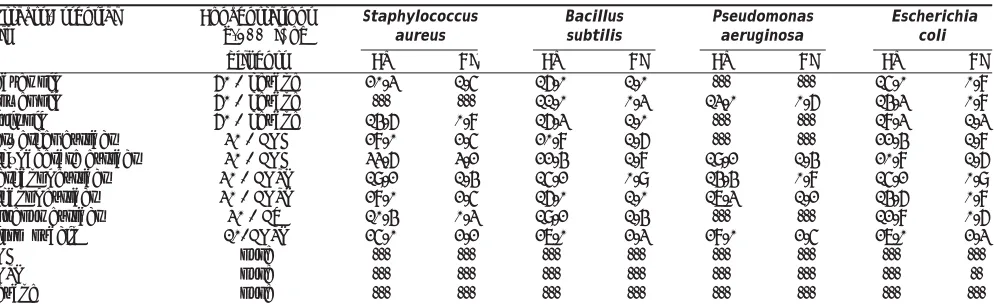
as major constituents of the oil of leaves could not be detected in the present studies. Fig. 1 shows the results of well diffusion test and zone of inhibition of tested
TABLE 2: ANTIBACTERIAL ACTIVITY OF ESSENTIAL OILS AND SUCCESSIVE EXTRACTS OF VITEX NEGUNDO
Extracts/Essential Concentrations Staphylococcus Bacillus Pseudomonas Escherichia
oils (μg/100μl) of aureus subtilis aeruginosa coli
diluents CZ AI CZ AI CZ AI CZ AI
Leaves oil 60 / hexane 20.3 1.5 16.0 1.0 --- --- 15.0 0.8
Flower oil 60 / hexane --- --- 11.0 0.3 13.0 0.6 14.3 0.8
Fruit oil 60 / hexane 14.6 0.8 16.3 1.0 --- --- 18.3 1.3
Pet. ether extract 30 / DMF 28.0 2.5 20.8 1.6 --- --- 22.4 1.8
Ethyl acetate extract 30 / DMF 33.6 3.2 22.4 1.8 19.2 1.4 20.8 1.6
Methanol extract 30 / DMSO 19.2 1.4 15.2 0.9 14.4 0.8 15.2 0.9
Ethanol extract 30 / DMSO 28.0 2.5 16.0 1.0 17.3 1.2 14.6 0.8
Aqueous extract 30 / DW 10.4 0.3 19.2 1.4 --- --- 12.8 0.6
Ciproßoxacin 10/DMSO 25.0 2.2 27.0 2.3 28.0 2.5 27.0 2.3
DMF pure
---DMSO pure - - -
--Hexane pure
---: no inhibition zone, DMF: dimethyl formamide, DMSO: dimethylsulfoxide, DW: distilled water, AI- Antimicrobial index, CZ - Clearing zone (mm). The average of diameter (mm) of the inhibition zones called clearing zone (CZ) and the antimicrobial index (AI) was computed as the clearing zone (CZ) minus the diameter of the hole divided by the diameter of the hole.
samples against blank. The blank solvents DMSO, DMF and hexane did not show any zone of inhibition. All the extracts and essential oils were found to be highly effective in inhibiting the growth of bacteria at a minimum concentration of 30 and 60 μg/100 μl, respectively (Table 2). Each of the essential oil and extracts were found to be active against B. subtilis
and E. coli with antimicrobial index (AI) ranging from
0.3 to 1.8. Leaf essential oil inhibited S. aureus with
maximum AI of 1.5 while fruit essential oil showed its inhibition against E. coli and B. subtilis with AI
of 1.3 and 1.0, respectively. Flower oil did not show any activity against S. aureus while leaf and fruit oils
were ineffective against P. aeruginosa. Ethyl acetate
extract was found to be most potent among all the extracts tested. Petroleum ether and aqueous extracts did not show any activity against P. aeruginosa while
all the extracts were found potent against S. aureus.
Ciprofloxacin was used as positive standard control and the results of tested samples were very promising in comparision to standard drug ciproß oxacin.
ACKNOWLEDGEMENTS
The authors are thankful to Prof. M. Ali, Jamia Hamdard, New Delhi and Hemant Bhutani, Ph.D. scholar, NIPER for their valuable contribution in carrying out analysis and interpretation of GC/MS data.
REFERENCES
Lal S, Jain S, Prakash O, Jain N. Shambhalu: An important medicinal 1.
Plant. J Sci Pharm 2006;7:45-55.
Dharmasiri MG, Jayakody JR, Galhena G, Liyanage SS, Ratnasooriya 2.
WD. Anti-inß ammatory and analgesic activities of mature fresh leaves of Vitex negundo. J Ethnopharmacol 2003;87:199-206.
Accepted 16 August 2008 Revised 26 January 2008 Received 28 May 2007 Indian J. Pharm. Sci., 2008, 70 (4): 522-526 and anti-inflammatory activity of Vitex negundo seeds. J Nat Prod
1992;55:163-7.
Gupta M, Mazumdar UK, Bhawal SR. CNS activity of
4. Vitex negundo
L. in mice. Indian J Exp Biol 1999;37:143-6.
Basu NK, Singh GB. A note on the chemical investigation of
5. Vitex
negundo L. Indian J Pharm 1944;6:71-4.
Mallavarapu GR, Ramesh S, Kaul PN, Bhattacharya AK, Rajeswara 6.
Rao BR. Composition of the essential oil of the leaves of Vitex negundo. Planta Med 1994;60:583-4.
Singh AK, Naqvi AA.
7. Vitex negundo L.- Leaf volatiles from
north Indian plains and lower Himalayan region. Indian Perfumer 2004;48:415.
Singh V, Dayal R, Bartley JP. Volatile constituents of
8. Vitex negundo
leaves. Planta Med 1999;65:580-2.
Taneja SC, Gupta RK, Dhar KL, Atal CK. The essential oil of
9. Vitex
negundo Linn. Indian Perfumer 1979;22:162.
Leopold J, Gerhard B, Christiane P, Mohamed PS, Nambiar MK, 10.
Geetha. Analysis of the essential oils of the leaves of the medicinal plants Vitex negundo var. negundo and Vitex negundo var. purpurescens from India. Acta Pharm 1998;48:179.
Rasaga CY, Morales E, Rideout JA. Antimicrobial compounds from 11.
Vitex negundo. Philipp J Sci 1999;128:21-9.
Jennings W, Shibamoto T. Qualitative analysis of ß avour and fragrance 12.
volatiles by Capillary Gas Chromatography. New York: Academic Press; 1980.
Ramaswamy SK, Briscese P, Gargiullo RJ, Van Geldern T. 13.
Sesquiterpene hydrocarbons: From mass confusion to orderly line-up. In: Lawrence BM, Mookherjee BD, Willis BJ. Flavors and Fragrances: A world perspective. Amsterdam: Elsevier Sci Pub 1988. p. 951. Adams RP. Identification of Essential Oils by Ion Trap Mass 14.
Spectroscopy. New York: Academic Press Inc; 1989.
Adams RP. Identification of Essential Oil compounds by gas 15.
chromatographic / mass spectroscopy. Carol Steam, Illinois: Allured Publishing Co; 1995.
Massada Y. Identification of Essential Oil by gas chromatography / 16.
spectrometry. New York: John Wiley and Son; 1976.
Development of Mouth Dissolving Tablets of Clozapine
Using Two Different Techniques
R. S. MASAREDDY*, R. V. KADIA AND F. V. MANVI
Department of Pharmaceutics, K. L. E. S’s College of Pharmacy, Nehrunagar, Belgaum-590 010, India
Masareddy, et al.: Mouth Dissolving Tablets of Clozapine
Mouth dissolving tablets constitute an innovative dosage form that overcomes the problems of swallowing and provides a quick onset of action. In view of enhancing bioavailability an attempt has been made to study two different methods direct compression and sublimation in formulation of mouth dissolving tablets of clozapine. Total four formulations using various superdisintegrants and subliming agents were prepared. All prepared formulations were evaluated for physico-chemical parameters. The formulations exhibited good disintegration properties with total disintegration time in the range of 25 to 35 s. Comparative evaluation of two methods showed direct compression method is a better alternative to sublimation method as its formulations rapidly disintegrate in oral cavity. In vitro
cumulative percentage drug release for formulations prepared by direct compression with explotab superdisintegrants shows 99.79 while sublimation method using camphor 93.58 release in 12 min. Kinetic studies indicated that all the formulations followed fi rst order release with diffusion mechanism.
Key words: Clozapine, direct compression, sublimation, mouth dissolving
*For correspondence
E-mail: [email protected]
The oral route of administration is considered as the most widely accepted route. But the most evident drawback of the commonly used oral dosage forms like tablets and capsules is difÞ culty in swallowing, leading to patients incompliance particularly in case of pediatric and geriatric patients1. Thus, a new delivery
system known as oral fast dissolving/disintegrating
(FDDS)/melt-in-mouth tablets gaining importance. These oral dosage forms dissolve rapidly in saliva and can be swallowed without the need of drinking water2.
Elimination of bitterness is an important criterion in product formulation of mouth dissolving tablets3.
Superdisintegrants added in the formulation increase the dissolution characteristics thus increasing the bioavailability of drug4.Mouth dissolving tablet