INTERNATIONAL RESEARCH JOURNAL OF PHARMACY
www.irjponline.com
ISSN 2230 – 8407
Research Article
FORMULATION AND EVALUATION OF RECONSTITUTABLE ORAL SUSPENSION OF
CEFPODOXIME PROXETIL USING NATURAL SUSPENDING AGENTS
Akiladevi D
1*, Umadevi S
1, Raman Suresh Kumar
2, Arunkumar N
31
Department of Pharmaceutics, School of Pharmaceutical Sciences, Vels Institute of Science, Technology and Advanced
Studies (VISTAS), Pallavaram, Chennai, India
2
Department of Pharmaceutics, JSS College of Pharmacy, Ootacamund 643001, India
3
Department of Pharmaceutics, KMCH College of Pharmacy, Kovai state, Kalapatti Road, Coimbatore, India
*Corresponding Author Email: [email protected]
Article Received on: 17/11/18 Approved for publication: 22/01/19
DOI: 10.7897/2230-8407.100256
ABSTRACT
Aim: The aim of the research study was to formulate and evaluate a reconstitutable oral suspension of Cefpodoxime proxetil using different natural suspending agents. Methods: Nine formulations of Cefpodoxime proxetil suspension containing varying proportions of acacia, Trigonella foenum graecum mucilage and xanthan gum as the suspending agent were prepared and the suspensions were evaluated for pH, sedimentation volume, redispersibility test, particle size analysis, flow rate and viscosity. Results: From the resulting study, the formulation F6 showed a lower flow rate of 0.714 m/sec, higher viscosity 0.0424 poise, with lower particle size of 44µm and sedimentation volume nearly 1. The redispersibility test resulted that F4-F6 formulations showed good physical stability. The pH values of the formulations showed an optimum pH range of 6.21 to 6.39. Discussion and Conclusion: The present study revealed that the optimum formulation F6 of cefpodoxime proxetil containing Trigonella foenum graecum mucilage as a natural suspending agent showed greater flocculation, good flow rate with easy redispersibility characteristics. Moreover on increasing concentration of suspending agent the suspending property was increased. Trigonella foenum graecum has antidiabetic activity and antilipidemic action and along with antibiotic drug such as cefpodoxime proxetil, the formulation can be consumed by the diabetic patient. It was concluded that formulated cefpodoxime proxetil suspension with natural suspending agent Trigonella foenum graecum F6 showed superior stability over other formulations.
Key words: Sedimentation volume, Trigonella foenum, swelling index, Xanthan gum, particle size, flow rate, viscosity
INTRODUCTION
Dry suspension is commercial dry mixtures that require addition of water at the time of dispensing. It is also defined as an intimate mixture of dry, finely divided drug with excipients, which, upon the addition of suitable vehicle, yields a suspension. Reconstitutable suspension is reconstituted at the time of use and thus can be use as liquid formulation which avoids swallowing problem1. The most common reason for the formulation of
suspensions for reconstitution is inadequate chemical stability of the drug in an aqueous vehicle. Cefpodoxime2-4 proxetil is a third generation cephalosporin antibiotic and the compound belongs to the class of organic compounds known as cephalosporins. The drug is sparingly soluble in water, slightly soluble in methanol and its oral bioavailability is 45-50 %. Cefpodoxime proxetil is indicated for the treatment of the following infections, genito urinary tract, respiratory, gastro-intestinal, Skin and soft tissue infections. The purpose of the study was to formulate and evaluate a new, effective natural suspending agent that can be used as an effective alternative for the formulation of pharmaceutical suspension. Trigonella foenum5 graecum
(Family: Leguminosae) seeds, also known as fenugreek seeds, has mucilage in greater amount and forms viscous tacky mass and swell up when exposed to fluids. Therefore the potential of fenugreek seeds as suspending agent can be exploited for use in suspensions of cefpodoxime proxetil.
methyl cellulose sodium, sodium phosphate, methyl paraben were purchased from Sri Ragavendra enterprises, Pondicherry. Fenugreek seed were obtained from local market Pondicherry. All the other chemicals and reagents were used of analytical grade. Deionised distilled water was used throughout the study.
METHODOLOGY Preformulation studies
Characterization of Cefpodoxime proxetil
Organoleptic character
The color, odour and taste of the Cefpodoxime proxetil were as per Pharmacopoeia.
Loss on drying
Loss on drying is the loss of weight expressed as percentage w/w resulting from water volatile matter of any kind that can be driven off under specified condition6.
Loss on drying = Initial weight of substance – final weight of substance / Initial weight of substance × 100
Melting point
Development of standard calibration curve of cefpodoxime proxetil in methanol
UV- visible spectroscopy (λ max)
The absorption maximum of the standard solution of cefpodoxime proxetil was scanned between 200-400 nm regions on UV-visible spectrophotometer.
Preparation of standard stock solution
An accurately weighed quantity of about 50 mg of cefpodoxime proxetil was taken in a 50ml volumetric flask and dissolved in sufficient quantity of methanol to obtain the concentration of 1000µg/ml. From this solution, 5ml was pipette out in a 50 ml volumetric flask and the volume was made up with methanol to obtain a concentration of 100µg/ml.
Preparation of calibration curve
From the stock solution, aliquots 1, 2, 3, 4 and 5 ml appropriate aliquots were pipetted out from standard stock solution into the series of 10 ml volumetric flask and the volume made up to the mark with methanol to get concentration of 10-50µg/ml. The absorbance at various concentrations was measured with methanol as blank at 232 nm using UV- visible spectrophotometer8.
Preparation of mucilage from Trigonella foenum graecum seeds
Initially seeds of Trigonella foenum graecum were powdered by using simple mixer. The crushed seeds were soaked in distilled water for 12 hours and boiled in water bath to prepare slurry. Further slurry was cooled and was allowed to settle down unwanted material. Upper portion was collected and concentrated in water bath and after cooling acetone was added in it with continuous stirring. The precipitate was collected and dried at room temperature for 24 hours. The air dried material further subjected to size reduction by using mortar and pestle and passed through sieve no.60 and stored in desiccators for further formulation of suspension and evaluation9.
Evaluation of mucilage
Determination of swelling index
About 1g of fenugreek seed powder was taken in a china dish and then 10 ml of distilled water was added and the mixture was shaken and allowed to stand for 1 hour. After 1 hour the
remaining water in China dish was discarded and the weight of increase of the (natural suspending agent) fenugreek seed was rated10.
Swelling index = W1 – W2 / W1×100
Where;W1= Weight of seed at time ‘0’, W2= Weight of seed at time‘t’
Phytochemical test for fenugreek seed powder11
1. Test for carbohydrates (Molisch’s test): The fenugreek mucilage was mixed with a small amount of molisch reagent was taken in a test tube and few drops of concentrated sulphuric acid were added at the sides of the test tubes. The positive reaction is indicated by appearance of a purple ring at the junction layer.
2. Test for tannins (Ferric chloride test): The fenugreek mucilage was treated with the ferric chloride blue colour will appear if tannins are present.
3. Test for proteins (Ninhydrin test): The fenugreek mucilage was added with few drops of ninhydrin solution and heated for 2 minutes; a violet colour will be produced.
4. Test for alkaloids (Wagner’s reagent): Alkaloids give reddish brown precipitate when the fenugreek mucilage test solutions are treated with the Wagners reagent (iodine and potassium iodide solution).
5. Test for glycosides (Keller Kiliani test): The fenugreek mucilage was extracted with chloroform and evaporates to dryness. To the above solution 0.4 ml of glacial acetic acid containing trace amount of ferric chloride and 0.5 ml of sulphuric acid were added to the sides of the test tube. The acetic acid layer showed blue colour.
6. Test for mucilage (Ruthenium red test): The fenugreek mucilagewas treated with ruthenium red solution pink colour was formed.
7. Test for reducing sugar (Fehling’s solution): The fenugreek mucilagewas added with few amounts of Fehling’s reagent and for 2 to 3 minutes. A red colour precipitate was produced.
Formulation of suspension
Method of preparation of dry suspension
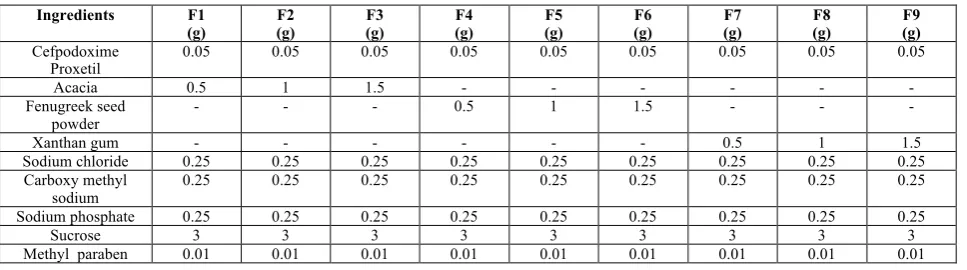
An experimental study of nine formulations of cefpodoxime proxetil dry suspension (each of 50 ml) were prepared using three suspending agent such as acacia, Trigonella foenum graecum
mucilage and the xanthan gum at varying concentration. The amount of each excipient used in each formulation was listed in Table 1.
Table 1: Formulation composition of Cefpodoxime proxetilsuspension
Ingredients F1 (g) F2 (g) F3 (g) F4 (g) F5 (g) F6 (g) F7 (g) F8 (g) F9 (g) Cefpodoxime
Proxetil 0.05 0.05 0.05 0.05 0.05 0.05 0.05 0.05 0.05
Acacia 0.5 1 1.5 - - - -
Fenugreek seed
powder - - - 0.5 1 1.5 - - -
Xanthan gum - - - 0.5 1 1.5
Sodium chloride 0.25 0.25 0.25 0.25 0.25 0.25 0.25 0.25 0.25
Carboxy methyl sodium
0.25 0.25 0.25 0.25 0.25 0.25 0.25 0.25 0.25
Sodium phosphate 0.25 0.25 0.25 0.25 0.25 0.25 0.25 0.25 0.25
Sucrose 3 3 3 3 3 3 3 3 3
Method of Preparation of cefpodoxime proxetil suspension
The powder blends of cefpodoxime proxetil (50mg/5ml) were prepared by triturating all the ingredients in mortar and pestle (as tabulated it Table 1) and were passed through sieve no 40. The dry powder was reconstituted with distilled water12.
Evaluation of suspension
Particle size analysis
The particle size was determined by optical microscopy method. The eye piece micrometer was calibrated. A drop of formulated suspension was placed on a glass slide and was covered with a cover slip without any air bubbles and was observed under microscope. Each particle diameter was measured and recorded for at least 100 particles.
Determination of sedimentation volume
The prepared cefpodoxime proxetil suspensions was transferred into a measuring cylinder and was kept aside without disturbing and the height of the sediment was observed at a regular time intervals of 0, 10, 20, 30, 40, 50, 60 minutes and the sedimentation volume was calculated by using the following formula.
F = 100 Hu/Ho
Where, Hu is ultimate or final height of sediment as suspension settles, Ho is initial height of suspension13
Determination of viscosity
The viscosity of the sample of suspension was determined by using Ostwald viscometer. A definite volume of preparation was poured into the bulb with the pipette. The liquid was sucked up to the top of next limb. The liquid was then release to flow back into the bulb. The time from A to B of the markings were noted with the stopwatch. The viscosity was calculated by using the formula14.
ɳ ρ dρ x tρ --- ⁼ ---
ɳw dw x tw
where;ɳρ – viscosity of the sample, dρ – density of the sample, tρ – time in seconds to flow from mark A to B, ɳw – viscosity of water and dw – density of water.
Determination of flow rate
The time required for each suspension sample to flow through a 10 ml pipette was determined and the apparent viscosity was calculated using the equation.
Volume of pipette (ml) Flow rate = ---
Flow time (s)
Determination of pH
The pH of suspension was determined by using digitalpH meter. The prepared dry suspension was reconstituted with distilled water and pH of the suspension was determined.
Redispersibility test
ml) was kept in test tubes which were stored at room temperature for various time intervals (1, 5, 10, 15, 20 days). At regular interval one tube was removed and shaken vigorously to redistribute the sediment and the presence of deposit (if any) was recorded15.
RESULTS AND DISCUSSION
Characterization of Cefpodoxime proxetil
Organoleptic properties
There was no apparent change in colour and odour of Cefpodoxime proxetil.
Loss on drying (LOD)
The Percentage loss on drying for cefpodoxime proxetil was found to be 0.2 %. The LOD of the given sample was within the limit of not more than 0.5%.
Melting point
Themelting point values of Cefpodoxime proxetil were found to be 110°c. It complies with the Pharmacopoeial standard which implies the purity of the drug.
Solubility
The drug was found to be freely soluble in dehydrated ethanol, soluble in acetonitrile and in methanol, slightly soluble in ether and very slightly soluble in water.
UV- visible spectroscopic studies
Determination of max of cefpodoxime proxetil in methanol
The UV-Visible absorption spectrum of cefpodoxime proxetil in methanol showed λmaxat 232 nm which were illustrated in Figure 1.
Figure 1: λmax for Cefpodoxime proxetil in methanol
Linearity and range for calibration curve of cefpodoxime proxetil in methanol
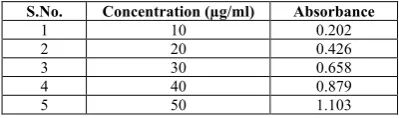
The straight line calibration graph was obtained in the concentration 10-50µg/ml of the cefpodoxime proxetil in methanol. The linear regression equation of Cefpodoxime proxetil in methanol was y=0.022x-0.010 with correlation coefficient of 0.9994. The calibration curve was illustrated in Figure 2 and the calibration data are tabulated in Table 2. From the linear regression equation and r2 valueit can be concluded that
the analyzed concentration of the drug solution followed linearity.
Table 2: Calibration data for cefpodoxime proxetil in methanol
Figure 2: Calibration curve for Cefpodoxime proxetil in methanol
Swelling index of fenugreek
Swelling Index % (SI) = (W2 – W1/W1) x 100
⁼ (25 – 10 / 10) x 10 = 150% W1= weight of fenugreek powder at “time o”,
W2= weight of fenugreek powder at “time t”
From the above result it was showed that the increase in time causes swelling index to be increased, because weight gain by mucilage was proportional to rate of hydration. The direct relationship was observed between swelling index and mucilage
concentration, when the mucilage concentration was greater, the swelling index was increased.
Phytochemical test for the fenugreek seed mucilage
Preliminary tests were performed to confirm the nature of the mucilage obtained. In view of phytochemical test, fenugreek mucilage contains carbohydrate, alkaloids, and proteins as illustrated in Table 3.
Table 3: Phytochemical test for the fenugreek seed mucilage
S.No. Tests Observation
1 Test for carbohydrates (Molisch’s test) positive 2 Test for tannins (Ferric chloride test) negative 3 Test for proteins (ninhydrin test) positive 4 Test for alkaloids (Wagner’s test) positive 5 Test for glycosides (Keller-Kiliani test) negative 6 Test for mucilage (Ruthenium red test) positive 7 Test for reducing sugar (Fehling’s test) negative
Particle size determination
The comparative particle size distribution for F1-F9 formulations are illustrated in Table 4 and Figure 3. It was observed that the average particle size for F6 formulation was found to be 44µm. Further it was concluded that the F6 which contain fenugreek seed powder as suspending agent showed better homogeneity and easily absorbable when compared to other formulations.
Table 4: Comparison of particle size analysis for F1-F9 formulations of Cefpodoxime Suspension
S.NO. F1 (µm) F2 (µm) F3 (µm) F4 (µm) F5 (µm) F6 (µm) F7 (µm) F8 (µm) F9 (µm)
1 76.8 69.1 67.4 58 49 44 69.4 61 60
Determination of Sedimentation volume
By comparing the sedimentation volume data of all the F1-F3, F4-F6, F7-F9 formulations (tabulated in Table 5, 6, 7 and illustrated in Figures 4, 5 and 6) it was concluded that F6 is more stable than other formulation F1, F2, F3, F4, F5, F7, F8 and F9, as it has higher volume of sedimentation ratio of nearly equal to 1 indicating that it has higher suspendibility and the suspension formed was stable.
Table 5: Sedimentation volume for F1, F2, and F3 of Cefpodoxime proxetil Suspension
Time HU/HO (F1) HU/HO (F2) HU/HO (F3)
0 1 1 1
10 0.5 0.7 0.96
20 0.4 0.4 0.6
30 0.36 0.4 0.48
40 0.34 0.38 0.42
50 0.32 0.36 0.4
60 0.32 0.34 0.38
Figure 4: Comparison of sedimentation volume between F1, F2 and F3, formulations of Cefpodoxime proxetil Suspension
Table 6 : Sedimentation volume for F4,F5,and F6 of Cefpodoxime proxetil Suspension
Time HU/HO (F4) HU/HO (F5) HU/HO (F6)
0 1 1 1
10 0.98 0.98 0.99
20 0.96 0.97 0.99
30 0.93 0.94 0.99
40 0.9 0.92 0.98
50 0.88 0.92 0.98
60 0.84 0.91 0.98
Figure 5: Comparison of sedimentation volume between F4, F5 and F6 of Cefpodoxime proxetil Suspension
Table 7: Sedimentation volume for F7, F8, and F9 of Cefpodoxime proxetil Suspension
Time HU/HO (F7) HU/HO (F8) HU/HO (F9)
0 1 1 1
10 0.84 0.86 0.89
20 0.65 0.72 0.81
Figure 6: Comparison of sedimentation volume between F7, F8 and F9 of Cefpodoxime proxetil Suspension
Measurement of viscosity
Table 8: Viscosity for F1-F9 formulations of Cefpodoxime proxetil suspension
S.No. Viscosity(poise)
F1 0.0194
F2 0.0248
F3 0.0313
F4 0.0294
F5 0.0318
F6 0.0424
F7 0.0243
F8 0.0288
F9 0.0318
Figure 7: Viscosity for F1-F9 of Cefpodoxime proxetil Suspension
By comparing the viscosity of all the nine formulations (As shown in Table 8 and Figure 7) it was concluded that F6 has more viscous property than other formulations.
Flow rate
Table 9: Flow rate for F1-F9 of Cefpodoxime proxetil Suspension
S.No. Flow rate(ml/sec)
F1 1.42
F2 1.25
F3 1.11
F4 0.90
F5 0.83
F6 0.714
F7 1.42
F8 1.66
Figure 8: Flow rate for F1-F9 of Cefpodoxime proxetil Suspension
From the above results as shown in Table 9 and Figure 8 it was concluded that formulation F6 having a high viscosity and lowest flow rate than the other formulations.
pH determination
The pHfor F1- F9 formulated suspensions were measured by using digital pHmeter and the results are shown in Table 10. The pH values of the formulations ranged in between 6.21 to 6.39, so it shows that all formulations have optimum pH range.
Table 10: pHfor F1-F9 of Cefpodoxime proxetil Suspension
S.No. pH
F1 6.30
F2 6.29
F3 6.28
F4 6.39
F5 6.25
F6 6.23
F7 6.21
F8 6.28
F9 6.27
Redispersibility test
The redispersibility test were done for fenugreek mucilage formulations F4,F5 and F6 (as indicated in Table 30) at day 1, 7, 10 and after 15 days. With the lower concentration of Trigonella foenum Graecum mucilage (F4) 2 shakes (as shown in Table 11) were enough to redisperse the suspension entirely whereas with the higher concentration of Trigonella Foenum Graecum
mucilage, at least 4 shakes were required to redisperse fully. It must be noted due to greater percentage of suspending agent, it was expected that greater number of shaking times would be required to redisperse the suspension formulation but it was not needed to be shaken as many times as expected, as they were in a flocculated state already. From the redispersibility results, it was evident that that F4-F6 suspension formulated showed good physical stability.
Table 11: Redispersibility test of the F4, F5 and F6 of Cefpodoxime proxetil suspension
FC Concentration of fenugreek mucilage
Redispersibility (day 1)
Redispersibility (day 7)
Redispersibility (day 10)
Redispersibility (day 15)
F4 0.5g Easily
Redispersable After shaking 2
Times
Easily Redispersable After shaking 2
Times
Easily Redispersable After shaking 3
Times
Easily Redispersable After shaking 3
Times
F5 1g Easily
Redispersable After shaking 2
Times
Easily Redispersable After shaking 2
Times
Easily Redispersable After shaking 3
Times
Easily Redispersable After shaking 3
Times
F6 1.5g Easily
Redispersable After shaking 2
times
Easily Redispersable After shaking 2
Times
Easily Redispersable After shaking 4
Times
Easily Redispersable After shaking 4
Times
CONCLUSION
The present study was aimed at comparing evaluation parameters by using three natural gums such as acacia, Trigonella foenum graecum (Family: Leguminosae) seeds, also known as fenugreek
has more viscosity value which shows that it has more viscous property. The pH of all the formulations was found to be similar (approximately 6). The suspensions were easily redispersible after shaking only twice even after 15 days and the flow rate of the F6 suspensions shows low flow rate due to its high viscous nature when compared to other formulations.
Even though F4, F5 formulations gave good results over the F1, F2, F3, F7, F8 and F9 formulations, it can be concluded that F6 formulation is the optimum formulation with greater flocculation, good flow rate and easily redispersibility characteristics along with small particle size so the study reveals that the potential of
Trigonella foenum graecum mucilage as a natural suspending agent and also showed on increasing the concentration, the suspending property was increased. Since Trigonella foenum graecum has many advantages like antidiabetic activity and antilipidemic action etc., along with antibiotic drug cefpodoxime proxetil, the formulation can be consumed by the diabetic patient. These formulations should be compared with the market preparations for further evaluation. It concluded that formulated cefpodoxime proxetil suspension with natural suspending agent
Trigonella foenum graecum F6 showed superior stability over other formulation. Increase in concentration of suspending agent increases the viscosity of suspension which ultimately reduces sedimentation and contributes to the stability of suspension. The objective of developing a patient-compliant dosage form was achieved. This novel formulation would be helpful for patients who suffer from dysphasia or those who have difficulty in swallowing solid oral dosage forms.
REFERENCES
1. Avari JG, Bhalekar M. Cation exchange resin for taste masking and rapid dissolution of Sparfloxacin. Indian drugs 2004; 41:19-23.
2. Indian Pharmacopoeia Volume II Government of India. 7th
ed. New Delhi: Indian Pharmacopoeia commission publisher; 2014.
3. JEF Reynolds. Martindale: The Extra Pharmacopoeia, 30th ed.
London: The Pharmacopeial press publisher; 1993. 4. O'Neil, Maryadele J. The Merck Index. An Encyclopedia of
chemicals, drugs and biologicals 14th ed. NJ: White house
Station publisher; 2006.
5. Bhosale R, Osmani RA. Natural gums and mucilage’s. A review on multifaceted excipients in Pharmaceutical science and research. International journal of Pharmacognosy and Phytochemistry research; 2014; 6: 901-912.
6. Indian Pharmacopoeia Volume 1 Government of India. 7th ed.
New Delhi: Indian Pharmacopoeia commission publisher; 2014.
7. Manavalan R, Ramasamy C. Physical Pharmaceutics. 1st ed.
India: Vignesh publisher; 2015.
8. Siddalinga Swamy MS, Sathish Kumar Shetty A, Anil kumar SM. UV-Visible Spectrophotometric Methods for the estimation Of Cefpodoxime proxetil in Bulk Drug and Pharmaceutical Dosage Form. International Journal of PharmTech Research 2012; 4: 750-756.
9. Nayak AK, Pal DJ. Pradhan T. Ghorai. The potential of
Trigonella foenum-graecum L. Seed mucilage as suspending agent, Indian Journal of Pharmaceutical Education and Research. 2012; 46: 312-317.
10.Richardson JC, Dettmar PW, Hampson FC. Oesophageal bioadhesion of sodium alginate suspension: particle swelling and mucosal retention. European. Journal of Pharmaceutical Sciences 2004; 3: 49-56.
11.Khandelwal KR. Practical Pharmacognosy, Techniques and Experiments. 9th ed. Nirali Prakashan publisher; 2002.
12.Jain DK, Darwhekar GN, Choudhary N. Formulation and Evaluation of Reconstitutable Oral Suspension of Ambroxol HCl and Azithromycin. International Journal of PharmTech Research 2011; 3: 741-746.
13.AM Suthar, MM Patel. Formulation and evaluation of taste masked suspension of metronidazole. International Journal of Applied Pharmaceutics 2011; 3:16-19.
14.Puri, Sharma, Pathania. Principles of physical chemistry 34thed. Vishal publisher; 1993.
15.Panda Madhulita et al. Effect of β-cyclodextrin on physical stability of Nimesulide suspension. International Journal of Drug Development and Research 2010; 2: 669-675.
Cite this article as:
Akiladevi D et al. Formulation and evaluation of reconstitutable oral suspension of cefpodoxime proxetil using natural suspending agents. Int. Res. J. Pharm. 2019;10(2):126-133
http://dx.doi.org/10.7897/2230-8407.100256
Source of support: Nil, Conflict of interest: None Declared
Disclaimer: IRJP is solely owned by Moksha Publishing House - A non-profit publishing house, dedicated to publish quality research, while every effort has been taken to verify the accuracy of the content published in our Journal. IRJP cannot accept any responsibility or liability for the site content and articles published. The views expressed in articles by our contributing authors are not necessarily those of IRJP editor or editorial board members.