Review Article
POST-CONCEPTION CARE THROUGH AYURVEDA
Meeta Jhala1, Sushma Shankar2
1Assistant professor, Dept. of Prasuti Tantra and Stri Roga, Dr. S. R. Rajasthan Ayurveda University, Jodhpur,
Rajasthan, India
2Associate Professor, Dept. of Prasuti Tantra and Stri Roga, Patanjali Bhartiya Ayurvigyan Evum
Sansthan, Patanjali Yogpeeth, Haridwar, Uttarkhand, India
Email:[email protected]
ABSTRACT
Post-Conception Care is a type of preventive health care. It has been mentioned in Ayurveda
paricharya thousands of years ago. Pregnancy and childbirth are a special phase in any women’s life. It can also be a challenging phase of life as the mother’s body goes through numerous changes in order to create and support the development of the new life. It has been also called as Antenatal Care or simply a Pregnant Woman Care. A urveda prescribes some set of guidelines which can help make this period more enjoyable and easy for the women. There have been advised specific
during the different stages of pregnancy. Such advises aim to support the physical, mental, emotional and spiritual aspects of both the mother and her baby. Such recommendations regarding the general manageme
have been given in both Charaka and Sushruta Samhitas under the subject of
is cautioned to be very vigilant during the management of pregnancy. If a cup filled with oil right up to the brim is to be carried without spilling even a single drop, every step has to be taken with care. Ayurveda advises the same degree of care and attention in the management of pregnant women.
Keywords: Garbhini-paricharya, ahara, vihara, aushadh
INTRODUCTION
Post-conception care is a type of preventive health care which should be given to all pregnant The aim of such care is to treat and prevent potential health problems throughout the course of the pre nancy and to promote healthy lifestyle which ben fits both mother and the growing foetus. So conception care also called antenatal care is of every pregnant lady. This specific care of a pre nant woman has been given a special term in ou Ayurveda classics as Garbhini-Paricharya
MEDICAL JOURNAL
ISSN: 2320 5091
CONCEPTION CARE THROUGH AYURVEDA
Assistant professor, Dept. of Prasuti Tantra and Stri Roga, Dr. S. R. Rajasthan Ayurveda University, Jodhpur,
Associate Professor, Dept. of Prasuti Tantra and Stri Roga, Patanjali Bhartiya Ayurvigyan Evum Sansthan, Patanjali Yogpeeth, Haridwar, Uttarkhand, India
Conception Care is a type of preventive health care. It has been mentioned in Ayurveda
thousands of years ago. Pregnancy and childbirth are a special phase in any women’s life. It can also be a challenging phase of life as the mother’s body goes through numerous changes in order to create and support
f the new life. It has been also called as Antenatal Care or simply a Pregnant Woman Care. A urveda prescribes some set of guidelines which can help make this period more enjoyable and easy for the women. There have been advised specific ahara (nutrition), vihara and aushadh which a woman should follow during the different stages of pregnancy. Such advises aim to support the physical, mental, emotional and spiritual aspects of both the mother and her baby. Such recommendations regarding the general manageme
have been given in both Charaka and Sushruta Samhitas under the subject of Garbhini-Vyakarana
is cautioned to be very vigilant during the management of pregnancy. If a cup filled with oil right up to the brim is without spilling even a single drop, every step has to be taken with care. Ayurveda advises the same degree of care and attention in the management of pregnant women.
paricharya, ahara, vihara, aushadh
care is a type of preventive health care which should be given to all pregnant ladies. aim of such care is to treat and prevent potential health problems throughout the course of the preg-nancy and to promote healthy lifestyle which bene-the growing foetus. So, post-care is a need This specific care of a preg-nant woman has been given a special term in our
Paricharya.
Pregnancy is a joyous time of life for every Healthy progeny and safe conferment is every pregnant woman. Also it is
physiological, immunological and endocrinal tions of body functions for benefit of and the growing baby inside.
Garbhini- Paricharya refers to with special recommendations plan), vihara (normal daily activities procedures) and aushadh (medicines)
Impact Factor: 4.018
Assistant professor, Dept. of Prasuti Tantra and Stri Roga, Dr. S. R. Rajasthan Ayurveda University, Jodhpur,
Associate Professor, Dept. of Prasuti Tantra and Stri Roga, Patanjali Bhartiya Ayurvigyan Evum Anusandhan
Conception Care is a type of preventive health care. It has been mentioned in Ayurveda as
Garbhini-thousands of years ago. Pregnancy and childbirth are a special phase in any women’s life. It can also be a challenging phase of life as the mother’s body goes through numerous changes in order to create and support f the new life. It has been also called as Antenatal Care or simply a Pregnant Woman Care. Ay-urveda prescribes some set of guidelines which can help make this period more enjoyable and easy for the
which a woman should follow during the different stages of pregnancy. Such advises aim to support the physical, mental, emotional and spiritual aspects of both the mother and her baby. Such recommendations regarding the general management of Pregnancy
Vyakarana. The physician is cautioned to be very vigilant during the management of pregnancy. If a cup filled with oil right up to the brim is without spilling even a single drop, every step has to be taken with care. Ayurveda advises the same
Pregnancy is a joyous time of life for every woman. Healthy progeny and safe conferment is a dream of Also it is associated with , immunological and endocrinal
adapta-for benefit of both mother
Garbhini-IAMJ: Volume 6, Issue 8, August - 2018 1801 paricharya if properly followed would result in good
health of the foetus, smooth and minimal or painless delivery and also good health of the mother so that she may withstand the strains of labour and the post-partum phase.
Objectives
To promote and maintain the health of mother
To prevent the fear and anxiety during delivery.
To facilitate healthy growth and development of
the foetus.
To minimize the complications during
preg-nancy and labour.
Different aspects of Post-Conception Care
Aahara management
Aahara (diet) affects the expectant mother and the growing foetus in all dimensions like physical, be-havioural and psychological setup. For the achieve-ment of full term healthy baby, a proper nutrition is essential. An inadequate and improper diet and life routine may lead to any defect or even death of the implanted foetus. The pregnant lady’s diet should be increased in quantity as well as quality.
The diet of pregnant women should be balanced in terms of all essential food factors like calories, min-erals, vitamins and others.
The dietetic requirements of expectant mother should be according to her place of living, seasonal variations and digestive capacity etc.
Mother’s diet should contain all six rasas which give strength and good complexion to the foetus. In Ay-urveda, it has been said that whatever diet a pregnant woman takes, that becomes congenial to the foetus, so she should always take healthy diet. Fresh green leafy vegetables, fruits, whole grains, cereals, dairy products are the mainstay of pregnant woman’s diet. The pregnant lady should always use butter, ghee,
milk (medicated with Jeevaneeya and Madhur varg
drugs like Shatavari, Madhuyashti and Kakoli etc). Sweet, cold, liquid or palatable diet should be taken in first three months preferably like fresh juices, co-conut water, flavoured milk, buttermilk etc. Milk provides nourishment and stability to the foetus.
Wherever ghrita is mentioned, it means preferably cow’s ghrita. It has jeevaniya properties which is good for ojo-vardhan and varna-prasadan. Honey
works as immunomodulator. Jangal mansarasa is an
excellent source of proteins. It acts as antioxidant, supplies good number of calories, helps in muscular tissue formation of the foetus and iron, beta-carotene formation, helps in blood formation.
In second trimester, Shashtik rice with milk (kheer), rice with curd, milk with honey, milk with butter and milk with ghee can be given. Also, soup made with different cereals mainly moong for vegetarians and
soup made of wild animal’s meat (mansarasa) give
more calories to pregnant women who prefer non- vegetarian diet.
In eighth month of pregnancy, sweet gruel made of rice, sooji, wheat, vermicelli should be taken. Use of dried grapes, soaked almonds, anjeer, khajoor with milk is also beneficial in third trimester.
Following Ayurvedic regimen from conception till delivery will nourish the pregnant lady and help in proper growth and development of the foetus as well. Some food items like packed juices, bakery products, frozen food, junk food, aerated drinks, pa-paya, kiwi, aloevera etc. should be avoided.
Vihar (lifestyle and therapeutic procedures)
According to Ayurveda, some special guidelines of daily activities and therapeutic procedure should be followed by a pregnant woman. This comes under
vihar.
1. Personal care:
To wear clean and comfortable garments,
un-broken ornaments and flat heeled shoes.
Excessive sexual intercourse during early and late pregnancy should be avoided.
Lifting heavy things or remaining in a bending posture should be avoided.
Travelling in a jerky vehicle on rough roads should be avoided.
Daily bathing will not only refresh and relax but also helps prevent infections.
IAMJ: Volume 6, Issue 8, August - 2018 1802 strokes, very gently with oil to the abdomen.
Massage of the nipples is also recommended af-ter 4th months.
2. Emotional support
The psychological status and emotional activi-ties are also responsible for healthy mother and foetal outcome.
A pregnant lady should be provided with a
pleasing environment.
The behaviour of husband and other family
members should be good, loving and caring which helps in the maintenance of pregnancy.
Any type of mental stress should be avoided.
Pregnant lady should perform religious rites and
she should be supported with positive thinking and meditation also.
3. Rest and sleep:
Rest is especially needed in the first two and last two months of pregnancy. Rest should be fre-quent and before feeling tired.
Adequate rest with foot-end elevation position and left lateral position is more beneficial.
Pregnant lady should be in bed for about 10 hrs
(8 hrs at night and 2 hrs in noon) 4. Exercise:
Regular exercise during pregnancy can improve
health and reduces the risk of excess weight gain, back-pain and it may make the process of delivery easier.
Moderate exercise during pregnancy can
im-prove her stamina, decrease fatigue and consti-pation, boost mood and energy level enhance sleep and improve muscle strength.
Walking, indoor stationary cycling, prenatal
yoga and low impact aerobics are suitable activi-ties during pregnancy. These are safe to perform in uncomplicated pregnancies and the lady can do them as long as she feels comfortable, but no overdo allowed.
Meditation may also be done for mental and physical relaxation
5. Tobacco and alcohol restriction:
Smoking or tobacco chewing either before or during pregnancy is associated with a wide range of poor pregnancy outcomes and increases risk of pregnancy complications.
When a pregnant women drinks alcohol, it also
enters the bloodstreams of the foetus and when excessive amounts of alcohol are consumed they can have damaging effects on the foetus.
6. Local treatment on abdomen and breasts:
During the seventh month, the abdominal skin gets stretched due to growing foetus and pro-duces itching and striations on abdomen and breast which are known as ‘Kikkis’. This should be treated by local application of the pulp of sandalwood, lotus, neem, basil and manjishtha
medicated oil or butter.
Irrigation of abdomen and breasts should be done with decoction of either patol, nimb, man-jishtha for cleansing and anti-itching action.
7. Asthapan Vasti:
In third trimester of pregnancy, most women feel
constipation due to the pressure of gravid uterus over the bowel and as an effect of high proges-terone level. For cleaning of the retained faeces
due to prolonged constipation and for anuloman
of apana vata, Asthapan vasti has been advised by acharya Sushruta in eighth month of preg-nancy. Also asthapana vasti helps balance the
apana vata which is a key for maintaining the pregnancy as well as smooth delivery of the baby at the time of labour. Asthapana vasti
means administration of drugs decoction through anus. Decoction of badri mixed with bala, ati-bala, shatapushpa, palala, (pestle sesame seeds), milk, curd, mastu (sour butter), oil, salt,
madanphal, honey and ghruta should be given.
8. Anuvasana Vasti:
It should be given in eighth and ninth month.
IAMJ: Volume 6, Issue 8, August - 2018 1803 also known as unctuous enema. The body of a
pregnant woman thus treated becomes unctuous. She gains strength and delivers vaginally with-out complications. This procedure also balances
apana vata. After anuvasana vasti, she should be given unctuous gruels and meat-soup of wild animals. This type of enema should be given to the woman in bent or humpback position be-cause in this position the passage becomes di-lated and the medicines enter properly.
9. Vaginal tampooning:
In ninth month, vaginal tamponing with medi-cated oil like Bala tail, Ksheerabala tail, Ka-dammash tail should be given.
Vaginal tampoon of this oil should be given for
lubrication of garbha-sthana and garbha-marga
(uterus, vaginal canal and perineum). It also de-stroys pathogenic bacteria of vaginal flora and thus prevents puerperal sepsis.
Regular use of vaginal tampoon till delivery might influence autonomic fibres governing myometrium and help in regulating their func-tions thus help in normal labour.
10. Amulet for pregnant woman:
The pregnant woman should wear the amulet
made of Trivrit in her waist. It acts by special ef-fect known as ‘Prabhava’. This procedure or act will be beneficial for maintenance of pregnancy as Garbhasthapak.
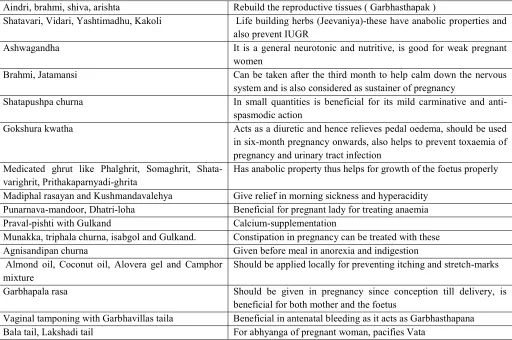
Table 1:Aushadh (Medicines)
Aindri, brahmi, shiva, arishta Rebuild the reproductive tissues ( Garbhasthapak )
Shatavari, Vidari, Yashtimadhu, Kakoli Life building herbs (Jeevaniya)-these have anabolic properties and also prevent IUGR
Ashwagandha It is a general neurotonic and nutritive, is good for weak pregnant women
Brahmi, Jatamansi Can be taken after the third month to help calm down the nervous system and is also considered as sustainer of pregnancy
Shatapushpa churna In small quantities is beneficial for its mild carminative and anti-spasmodic action
Gokshura kwatha Acts as a diuretic and hence relieves pedal oedema, should be used in six-month pregnancy onwards, also helps to prevent toxaemia of pregnancy and urinary tract infection
Medicated ghrut like Phalghrit, Somaghrit, Shata-varighrit, Prithakaparnyadi-ghrita
Has anabolic property thus helps for growth of the foetus properly
Madiphal rasayan and Kushmandavalehya Give relief in morning sickness and hyperacidity Punarnava-mandoor, Dhatri-loha Beneficial for pregnant lady for treating anaemia Praval-pishti with Gulkand Calcium-supplementation
Munakka, triphala churna, isabgol and Gulkand. Constipation in pregnancy can be treated with these Agnisandipan churna Given before meal in anorexia and indigestion Almond oil, Coconut oil, Alovera gel and Camphor
mixture
Should be applied locally for preventing itching and stretch-marks
Garbhapala rasa Should be given in pregnancy since conception till delivery, is beneficial for both mother and the foetus
IAMJ: Volume 6, Issue 8, August - 2018 1804
DISCUSSION
Dietetic and other regimens advocated in samhitas for pregnant lady are of great significance. Special type health care of pregnant lady helps in the elimi-nation of major waste products of the body, the metabolic changes result in proper relaxation of genital area and its surrounding to accommodate the gradual growth of the foetus and promote the rigour throughout the pregnancy.
Use of cold, sweet, liquid rich diet and milk prevents dehydration and helps supply required nutrition in first trimester. Garbhini-paricharya considers milk as an ideal element of diet for pregnant woman as it is a rich source of calcium, lactose and butter-fat. Pregnant women should not get constipated, there-fore mild laxatives and enema is recommended. Fourth month onwards, pregnant woman requires more protein which may be supplied by using meat-soup. Use of Gokshur in sixth month of pregnancy prevents water retention as well as pregnancy in-duced hypertension and other related complications. Medicated ghrita help in maintaining health of mother and foetus. Use of medicated enema in eighth month helps relieve constipation and in bal-ancing apana-vata during pregnancy and at the time of labour.
Use of tampoons of oil may soften vaginal passage so that delivery of baby becomes comparatively easy with less or no vaginal and perineal tear.
Anuvasana-vasti is recommended for lubrication of cervix, vaginal canal and perineum also.
Various types of Garbhasthapak dravyas are pre-scribed during pregnancy for proper development of the foetus.
Pregnant health care through Ayurveda is an impor-tant aspect in Prasuti tantra as it helps in the proper development of the foetus, its delivery, the health of the mother and facilitates easy delivery and healthy post-partum period.
Pregnant health care reflects on the quality and health of the offspring.
CONCLUSION
Post-conceptional care has been mentioned thou-sands of years ago in our Ayurvedic texts as
Garbhini-paricharya. It is a type of preventive health care which has been recommended by WHO to provide every pregnant lady under the term Ante-natal care. Proper diet and lifestyle management and various external and internal medicine administra-tion are the different aspects of this Post-conceptional care. Aahar affects the health of both- the expecting mother as well as the growing fetus. It should be balanced in all aspects. Dietetic require-ments also vary according to the habitat, seasonal variations and digestive capacity of the pregnant lady. These all should be considered during the post-conceptional care. Vihar management is also equally important. She should be advised to take proper per-sonal care. Emotional support, rest and sleep are equally important. Some sort of exercise should also be done. Aaddiction like tobacco, alcohol, beedi, etc. need to be strictly discouraged. In third trimester,
Asthapan and Anuvasan basti can also be given. Though pregnancy is a physiological process, certain medicines (which do not harm the foetus) can be given according to the need of the patient. Thus, we conclude that proper post- conceptional care is very useful. And if properly followed, most of the time may result in a healthy outcome with little or no se-vere hazard to the lady. So, it is a need of the present world.
REFERENCES
1. Yadavji Trikamji, editor, commentary Vidyotini hindi commentary of Acharya Kashinath Shastri and Gorakhnath Chaturvedi on Charaka Samhita, Sharir sthana Chapter 8, verse no. 32,22nd edition, Varanasi, Chaukhambha Bharti Academy,1996,P-937
2. Yadavji Trikamji, editor, commentary,Ayurveda Tatva Sandipika Hindi Commentary of Acharya Am-bika Dutta Shastri on Sushruta Samhita, Sharir Sthana, Chapter 10,verse no. 3, 3rd edition, Varanasi,
IAMJ: Volume 6, Issue 8, August - 2018 1805 3. Vagbhat Commentary, Indu commentary of Vaidya
Anant Damodar Athavate on Ashtang SangrahSharir Sthana,Chapter 3,verse no.4, 1st edition, Pune
4. Vagbhat commentary, Vidyotini Hindi of Brahman-and Tripathi on Ashtang Hridaya,sharir Sthana Chap-ter 1,verse 44-47
5. Kashyap Commentary Hindi Commentary of Shrisat-yapal Bhishagacharya commentator on kashyap Samhita sharira sthana Chapter 10 verse 181
6. Kashyap Commentary Hindi Commentary of Shrisat-yapal Bhishagacharya commentator on kashyap Samhita sharira sthana Chapter 5, verse 16-20 7. Jha Kajal concept of Antenatal care in Ayurveda,
Garbhini-paricharya, Ayur Info, special ISS No. 2067, march 2011 cited on 25/07/13
8. Tiwari P V, Ayurvediya Prasuti Tantra and Stree-roga,1st part,2nd edition P-213,214,215,218-231.
9. Vijay Lakshmi, Savita Srivastava; Garbhin Paricharya: Antenatal Care in Ayurveda, journal of Ayurveda and Holistic medicine, ISSN:2321-1563 10. Ayurvedamritam blogspot.in- Garbhini Paricharya-
Antenatal care in Ayurveda, 28 nov.2017.
11. Sujata P dhoke, Mahesh K Vyas, Nilesh A. Vyas: Role of Ayurveda towards Antenatal care; Interna-tional journal of Applied Ayurveda Research ISSN 2347-6362, vol.2nd, issue 7, may-june, 2016.
12. Garbhini-Paricharya-Antenatal care in Ayurveda: All about Ayurveda (ayurvedamritam.blogspot.in)
Source of Support: Nil
Conflict Of Interest: None Declared
How to cite this URL: Meeta Jhala & Sushma Shankar: Post-Conception Care Through Ayurveda. International Ayurvedic Medical Journal {online} 2018 {cited August, 2018} Available from: