AUTHORS:Susan L. Bannister, MD, MEd,aHayley M. Wickenheiser, BKin, and David A. Keegan, MDb
Departments ofaPaediatrics andbFamily Medicine, University of Calgary,
Alberta, Canada
Address correspondence to Susan L. Bannister, MD, MEd, Department of Paediatrics, Alberta Children’s Hospital, 2888 Shaganappi Trail NW, Calgary AB, T3B 6A8, Canada. E-mail: [email protected]
Accepted for publication Nov 18, 2013
KEY WORDS
teamwork, leadership, interprofessionalism, medical education
Drs Bannister and Keegan conceptualized the article, and together with Ms Wickenheiser, they developed the framework described in the manuscript. Dr Bannister wrote thefirst draft of the manuscript. All authors contributed to the literature search, reviewed and revised the manuscript, and approved the
final manuscript as submitted. doi:10.1542/peds.2013-3734
Key Elements of Highly Effective Teams
The Council on Medical Student Educa-tion in Pediatrics (COMSEP) is an orga-nization that values—and appreciates the benefits of—teams. COMSEP’s best work comes as a result of highly effective teamwork.
A team is more than 1 person working together toward a common goal. There-fore, every physician is on multiple teams, ranging from a small team of himself or herself and a patient and family, to pri-mary care medical home teams, to in-patient care teams with various levels of trainees and different professionals, to clinical and basic science research teams, to hospital boards, university committees, and organized community initiatives. Knowing the key elements of highly ef-fective teams is relevant to every clinician, no matter where he or she practices.
In health care, team communication fail-ures contribute to health care errors.1 Effective teams decrease length of stay, result in fewer unanticipated admissions, improve coordination of care, decrease wait times, increase patient satisfac-tion, and improve health outcomes.2
The literature on teams is complex. A wide variety of conceptual frameworks3 have been developed independently, and as a result, they are not aligned with each other.4 In the health care
literature specifically, a large number of team models have been proposed.5–7
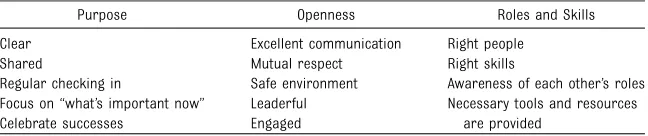
In this article, we present a novel way to think about team effectiveness that is easy to remember and can be used to set your team up for success and resolve common barriers. Drawing on the business, sports, and inter-professional health care literature, we have identified 3 key elements: pur-pose, openness, and roles and skills (Table 1 summarizes the features of each of these elements). This framework can be applied in physicians’ clinical, educational, and administrative roles to assist with team effectiveness.
KEY ELEMENTS OF HIGHLY EFFECTIVE TEAMS
Purpose
Having a common purpose that all team members can articulate is fundamen-tal.8It could be “diagnosing what’s
go-ing on with Emily,” “caring for our team of inpatients while completing the objec-tives of the rotation,”or“efficiently man-aging resources in an outpatient clinic.” Teams need to involve all members in purpose development; everyone should be able to articulate the team’s purpose and be committed to it.9If team mem-bers have different understandings of what their common purpose is, fric-tion, confusion, and a waste of resources and effort are inevitable, and it will be harder to get the team back on track.
An important challenge teams face occurs when the original purpose is superseded by a new, different purpose. Effective teams know shifts in purpose can occur. As a result, they check in regularly with both their members and external stakeholders to ensure that the purpose is still right. By checking in, teams determine whether they need to change their purpose or direction. For instance, in a clinical setting, the goal of
TABLE 1 Summary of Key Elements of Highly Effective Teams
Purpose Openness Roles and Skills
Clear Excellent communication Right people Shared Mutual respect Right skills
Regular checking in Safe environment Awareness of each other’s roles Focus on“what’s important now” Leaderful Necessary tools and resources
are provided Celebrate successes Engaged
184 BANNISTER et al
at Viet Nam:AAP Sponsored on August 28, 2020
www.aappublications.org/news
a specific patient’s care may change from diagnosis to cure, and later to optimizing the patient’s quality of life; on a committee, a new external mandate may require the team to change its focus.
Deciding whether to change purpose can be challenging. According to for-mer Notre Dame football coach Lou Holtz, a team has to concentrate on W.I.N.:“what’s important now.”10In this approach, a team openly discusses events, new information, and changing circumstances and asks, “What’s im-portant now?”This approach helps the team distinguish between things that should trigger a change in strategy and things that should be ignored or coped with. Effective teams ask themselves,
“Does this need to be dealt with now?” (If yes, deal with it.) “Does this issue have the power to impede the team’s progress?”(If yes, deal with it now.)8
As progress toward a goal is made, it is important to celebrate achievements, even small ones; it helps keep the focus on the main purpose and builds team identity and momentum.8,11
Openness
We think of openness as encompassing excellent communication (including the ability to say “I don’t know”), mutual respect and promoting a “leaderful team.”7,9,12
Poor team communication can result in incomplete or inaccurate informa-tion being exchanged, important issues not being resolved, and key members being excluded.13 Closed-loop commu-nication is 1 way to address these issues.14Originally used in the military and most frequently used in health care in code situations, it requires team members to confirm they have heard instructions correctly and enables all members to be aware of what is happening.14
An important predictor of a team’s success is the team’s pattern of communication
and the energy and engagement of the group outside team meetings.15 Successful teams ensure that all members speak, and listen, and connect to one another. Pentland15 emphasizes the importance of face-to-face communication, stating that 35% of the variation in a team’s per-formance is related to the number of face-to-face exchanges between team members.
Members of an open team feel safe enough to speak up and raise addi-tional or contrary opinions, or declare their areas of uncertainty and igno-rance, with the knowledge that their concerns will be listened to care-fully.16,17 Leaders can promote an open team by posing thoughtful questions to the group and by de-claring their own risk of making errors in judgment.16
To have a high degree of engagement, a team must function with mutual respect at all times. This can be
dif-ficult because of members’ differing perspectives, arising from different backgrounds and group cultures.7 However, different perspectives also enable a team to spot previously un-recognized opportunities and chal-lenges; as a result, they should be sought out, shared, and respected.16
The culture of an open team naturally enables it to be“leaderful”12in that all members feel empowered to jointly share in leadership tasks, such as ensuring that viewpoints have been explored and difficult issues raised. A leaderful team can have more than 1 leader operating at a time, and they do so in a collective manner, striving for the common purpose.12Leaderful practice is collaborative; members operate in good faith and seek to en-sure that all members are engaged.12
Changing a traditional leadership cul-ture to a leaderful one is challenging. It takes time, an open culture, a leader who is willing to allow others to lead,
and team members who are willing to lead even when they do not feel comfortable.12
Roles and Skills
Teams that are purpose oriented and open still need 1 more element to be successful: they need to have the right people with the right skills. Team members need to know who is on the team and what they each contribute in terms of skills and knowledge.18Each team member must understand his or her role and those of others on the team.9Any tools or resources needed to enable team members to fulfill their roles must be provided.18,19
The team needs to be aware of any gaps between the skills present on the team and the skills needed to ac-complish the purpose. This knowledge will directly drive additional training or the targeted recruitment of addi-tional team members.
WHEN THINGS GO WRONG
Sometimes things do not work well. For instance, the team may not func-tion well, the team may not have been set up for success, or external events may have derailed the team’s prog-ress. To find out what went wrong, a team should ask the following questions based on the 3 key ele-ments described in this article:
Do we have a clear purpose? Are we fostering an openenviron-ment?
Do we have the necessary people with the necessary skills and resources on our team? Do they know their (and others’) role?There will always be challenges in a team environment; having a plan to respond to them is crucial.8Effective teams get back on track by explor-ing what went wrong and lookexplor-ing for the opportunities that lie within setbacks.8,9
MONTHLY FEATURE
PEDIATRICS Volume 133, Number 2, February 2014 185
at Viet Nam:AAP Sponsored on August 28, 2020
www.aappublications.org/news
CONCLUSIONS
All physicians are members of teams. The teams that have a clear, shared purpose, that are open and leaderful (including encouraging every member to contribute regardless of his or her status), and whose members have role awareness and the right skills are the ones that are set up for success.
REFERENCES
1. Sutcliffe KM, Lewton E, Rosenthal MM. Communication failures: an insidious con-tributor to medical mishaps. Acad Med. 2004;79(2):186–194
2. Mickan SM. Evaluating the effectiveness of health care teams.Aust Health Rev. 2005;29 (2):211–217
3. Salas E, Stagl K, Burke CS. 25 years of team effectiveness in organizations: research themes and emerging needs. In: Cooper CL, Robertson IT, eds.International Review of
Industrial and Organizational Psychology.
New York, NY: Wiley; 2004:47–91
4. Rousseau V, Aubé C, Savoie A. Teamwork behaviors: a review and an integration of
frameworks.Small Group Res. 2006;37(5): 540–570
5. Lo L. Teamwork and Communication in
Healthcare: A Literature Review. Edmonton,
AB, Canada: Canadian Patient Safety In-stitute; 2001
6. Mickan S, Rodger S. Characteristics of ef-fective teams: a literature review. Aust Health Rev. 2000;23(3):201–208
7. Mickan SM, Rodger SA. Effective health care teams: a model of six characteristics de-veloped from shared perceptions.J Interprof Care. 2005;19(4):358–370
8. Wickenheiser H. Gold Medal Diary:
In-side the World’s Greatest Sports Event.
Vancouver, BC, Canada: Greystone Books Ltd.; 2010
9. Benincasa R. How Winning Works: 8
Es-sential Leadership Lessons From the
Toughest Teams on Earth. Don Mills, ON,
Canada: Harlequin; 2012
10. Holtz L. Winning Every Day. New York, NY: Harper Business; 1998
11. Kouzes JM, Posner BZ. The Leadership Challenge: How to Make Extraordinary
Things Happen in Organizations. 5th ed.
San Francisco, CA: Jossey-Bass; 2012
12. Raelin JA. The Leaderful Fieldbook: Strate-gies and Activities for Developing Leadership
in Everyone. Boston, MA: Davies-Black;
2010
13. Lingard L, Espin S, Whyte S, et al. Commu-nication failures in the operating room: an observational classification of recurrent types and effects. Qual Saf Health Care. 2004;13(5):330–334
14. Burke CS, Salas E, Wilson-Donnelly K, Priest H. How to turn a team of experts into an expert medical team: guidance from the aviation and military communities.Qual Saf Health Care. 2004;13(1 suppl):i96–i104
15. Pentland A. The new science of building great teams: the chemistry of high-performing groups is no longer a mystery. Harv Bus Rev. 2012;3:61–70
16. Edmondson AC. Teamwork on thefly: how to master the new art of teaming.Harv Bus Rev. 2012;3:72–80
17. Gardner HK. Coming through when it mat-ters most: how great teams do their best work under pressure.Harv Bus Rev. 2012;3: 83–91
18. Bohlman LG, Deal TE.Re-framing Organiza-ions: Artistry, Choice and Leadership. 5th ed. San Francisco, CA: Jossey-Bass; 2012
19. Hertzberg F, Mausner B, Snyderman B.The
Motivation to Win. 2nd ed. New York, NY:
John Wiley & Sons; 1959
FINANCIAL DISCLOSURE:The authors have indicated they have nofinancial relationships relevant to this article to disclose.
FUNDING:No external funding.
POTENTIAL CONFLICT OF INTEREST:The authors have indicated they have no potential conflicts of interest relevant to this article to disclose.
186 BANNISTER et al
at Viet Nam:AAP Sponsored on August 28, 2020
www.aappublications.org/news
DOI: 10.1542/peds.2013-3734 originally published online January 20, 2014;
2014;133;184
Pediatrics
Susan L. Bannister, Hayley M. Wickenheiser and David A. Keegan
Key Elements of Highly Effective Teams
Services
Updated Information &
http://pediatrics.aappublications.org/content/133/2/184 including high resolution figures, can be found at:
References
http://pediatrics.aappublications.org/content/133/2/184#BIBL This article cites 10 articles, 2 of which you can access for free at:
Subspecialty Collections
http://www.aappublications.org/cgi/collection/professionalism_sub
Professionalism
e_management_sub
http://www.aappublications.org/cgi/collection/administration:practic
Administration/Practice Management
dev_sub
http://www.aappublications.org/cgi/collection/teaching_curriculum_
Teaching/Curriculum Development
b
http://www.aappublications.org/cgi/collection/medical_education_su
Medical Education following collection(s):
This article, along with others on similar topics, appears in the
Permissions & Licensing
http://www.aappublications.org/site/misc/Permissions.xhtml in its entirety can be found online at:
Information about reproducing this article in parts (figures, tables) or
Reprints
http://www.aappublications.org/site/misc/reprints.xhtml Information about ordering reprints can be found online:
at Viet Nam:AAP Sponsored on August 28, 2020
www.aappublications.org/news
DOI: 10.1542/peds.2013-3734 originally published online January 20, 2014;
2014;133;184
Pediatrics
Susan L. Bannister, Hayley M. Wickenheiser and David A. Keegan
Key Elements of Highly Effective Teams
http://pediatrics.aappublications.org/content/133/2/184
located on the World Wide Web at:
The online version of this article, along with updated information and services, is
by the American Academy of Pediatrics. All rights reserved. Print ISSN: 1073-0397.
the American Academy of Pediatrics, 345 Park Avenue, Itasca, Illinois, 60143. Copyright © 2014 has been published continuously since 1948. Pediatrics is owned, published, and trademarked by Pediatrics is the official journal of the American Academy of Pediatrics. A monthly publication, it
at Viet Nam:AAP Sponsored on August 28, 2020
www.aappublications.org/news