ENERGY FROM KITCHEN WASTE
Pooja Sinha
1, S.K.Singal
2 1M.Tech (EMRL) II Year Student,
2Associate Professor, AHEC, IIT Roorkee, (India)
ABSTRACT
Due to rapid increase of population and industrialization, generation of waste and demand of fuel is increasing.
The accumulation of solid organic waste is considered to be reaching critical levels in almost all regions of the
world. These organic wastes are required to be managed in a sustainable way to avoid depletion of natural
resources, minimize risk to human health, reduce environmental burdens and maintain an overall balance in the
ecosystem. Kitchen waste is one of the wastes having high calorific value and can be used for solving the
problem of increased demand of fuel and waste disposal. The use of biogas using kitchen waste as feedstock can
help solving the problem of energy deficit and at the same time; allow safe disposal of kitchen waste which is
often unscientifically dumped or discarded. The present study has been carried out in IIT Roorkee campus boys
and girls hostel messes. The study included the collection of daily data of waste generated and the consumption
of fuel in the messes. An analytical study has been carried out for selection of biogas plant using kitchen wastes.
The savings in terms of energy and fuel consumption have also been worked out in the study.
Keywords: Biogas Plant, Cooking Fuel, Kitchen Waste, Solid Organic Waste, Waste To Energy.
I. INTRODUCTION
Waste generation is directly related to the economy of a country. Increasing population levels, booming economy, rapid urbanization and the rise in community living standards have greatly accelerated the municipal solid waste generation rate in developing countries. These organic wastes need to be managed in a sustainable way to avoid depletion of natural resources, minimize risk to human health, decreasing environmental stresses and keeping an overall equilibrium in the ecosystem1. There are various types of solid waste including municipal (residential, institutional, commercial), agricultural, and special (health care, hazardous wastes, sewage sludge). Waste management along with water and energy management is one of the key controversies encircling any municipality. According to some current researches, the estimated quantity of municipal solid waste (MSW) generated worldwide is 1.3 to 1.9 billion tonnes per year2. The municipal waste complication is a matter of concern to industrialised nations, but specifically intense in developing countries, accounting more than 70% of the world's population2.
The impending scarcity of petroleum threatens the world’s fuel supply. Mankind can face this threat successfully with the help of other sources such as biogenous methane, but the world is yet to take full advantage of this technology, because its practitioners have so far ignored the basic tenet of science – viz. output of work is dependent on the energy available for doing that work. Biogas can be produced from nearly all kind of biological feedstock types and various organic waste streams generated by the society.
waste has high calorific value and moisture content; hence it can be anaerobically digested. Efficient disposal of kitchen waste can be eco friendly as well as cost effective.
The use of biogas generated from kitchen waste as feedstock can help in solving the problem of energy deficit and as well as allow the safe disposal of kitchen waste which is often unscientifically dumped or discarded. Most of the families in India depend on liquid petroleum gas (L P G) for cooking and the demand is increasing day by day. The biogas produced from kitchen waste can be used to supplement the fuel requirements of the kitchens that generate it. Kitchen waste is the best alternative for biogas production in a community level biogas plant. It is produced when bacteria degrade organic matter in the absence of air. The biogas contains around 55‐65% of methane, 30‐40% of carbon dioxide having calorific value appreciably high (around 4700 kcal or
20 MJ at 55% methane content)3. This gas can be effectively utilized for generation of power through a biogas based power generation system after dewatering and cleaning of the gas.
II. BIO METHANIZATION PROCESS
Bio methanization is a natural process that takes place in the absence of air (oxygen). It involves biochemical decomposition of complex organic material by various biochemical processes with release of energy rich biogas and production of nutritious effluents. The diverse microbial populations degrade organic waste, which results in the production of biogas and other energy-rich organic compounds as end products. A series of metabolic reactions such as hydrolysis, acidogenesis, acetogenesis and methanogenesis are involved in the process of anaerobic decomposition4. Anaerobic digestion is applicable for a wide range of material including municipal, agricultural and industrial wastes, and plant residues. Furthermore, this process has some advantages over aerobic process due to a low energy requirement for operation and a low biomass production. It is considered a viable technology in the competent treatment of organic waste and the simultaneous production of a renewable energy .The anaerobic digestion of organic waste is also an environmentally useful technology. The benefits of this process is to reduce environmental pollution in two main ways; primarily the sealed environment of the process prevents exit of methane into the atmosphere and secondly, burning of the methane will release carbon– neutral carbon dioxide (no net effect on atmospheric carbon dioxide and other greenhouse gases)5.
III. STUDY AREA
Indian Institute of Technology Roorkee (IITR), the premier engineering institute, located at Roorkee in the state of Uttarakhand, has played a vital role in higher technical education and pursuit of research in the country. The campus has bachelor’s hostels for boys and girls, residences for faculty and staff along with various academic departments.
Fig.1 Map of IIT Roorkee Campus
6IITR is spread over a sprawling 320 acres of land area as shown in Fig. 1. The magnificent Main Administrative Building is a reminder of the institute’s glorious past. Supporting 18 different departments, the IITR campus is unique. It includes an Institute Computer Centre, a state-of-art library, a sports complex and a huge Lecture Hall Complex where most of the lectures are held. All the hostels and even some of the departments are wi-fi enabled giving you access to high speed internet. The campus includes ten boys’ Bhawan and two girls’ Bhawans along with accommodation facilities for married students as given below.
A. Ten Boys' Hostels, 1. Azad Bhawan 2. Cautley Bhawan 3. Ganga Bhawan 4. Govind Bhawan 5. Jawahar Bhawan 6. Radhakrishnan Bhawan 7. Rajendra Bhawan 8. Rajiv Bhawan 9. Ravindra Bhawan 10. Malviya Bhawan B. Two Girls' Hostels 1. Sarojini Bhawan 2. Kasturba Bhawan
IV. INVESTIGATION FOR KITCHEN WASTE AND FUEL REQUIREMENT
selling the pig farm owners. The current method of disposal of food waste has certain drawbacks, which are as follows
1. Health hazards, insects rodents etc. 2. Bad odour problem.
3. Economic drawbacks
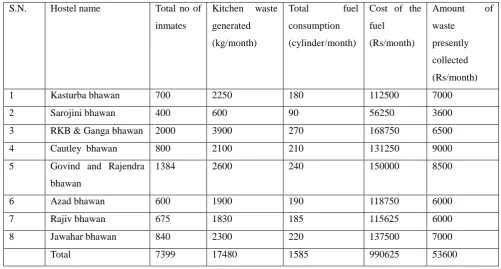
The detailed data collection on food waste as well as fuel consumption of all hostels at IIT Roorkee campus are given in Table 1. The cost of one cylinder of fuel has been considered Rs. 625/- as prevailing.
Table 1 Food waste and fuel consumption details
S.N. Hostel name Total no of inmates
Kitchen waste generated (kg/month)
Total fuel consumption (cylinder/month)
Cost of the fuel
(Rs/month)
Amount of waste
presently collected (Rs/month)
1 Kasturba bhawan 700 2250 180 112500 7000
2 Sarojini bhawan 400 600 90 56250 3600
3 RKB & Ganga bhawan 2000 3900 270 168750 6500
4 Cautley bhawan 800 2100 210 131250 9000
5 Govind and Rajendra bhawan
1384 2600 240 150000 8500
6 Azad bhawan 600 1900 190 118750 6000
7 Rajiv bhawan 675 1830 185 115625 6000
8 Jawahar bhawan 840 2300 220 137500 7000
Total 7399 17480 1585 990625 53600
V. ANALYSIS AND CALCULATION
The biogas generated by using kitchen waste contains 60-65 % of methane having calorific value of 55 MJ/kg with density of 0.668m3 /kg. A plant of 1 m3 capacity produces 0.7 m3 of gas per day which will be equivalent to 15.4 MJ. From Table 1, it is found that the daily kitchen waste generated from the institute messes is 582 kg. By using this waste, 82.1 kg of biogas with net energy equivalent to 2709.3 MJ can be generated.
The detailed analysis of fuel consumption and biogas generated from the kitchen waste of IITR messes is given below.
Calorific Value of methane = 55 MJ/kg
Density of Methane at normal temperature and pressure (NTP) = 0.668 kg/m3 Therefore, Calorific value of methane = 55 x 0.668 = 36.74 MJ/m3
Considering, Methane content in biogas as 60%
Calorific value of LPG = 50 MJ/kg Weight of one LPG cylinder = 14.2 kg
Therefore, net energy of 1 LPG cylinder = 14.2 x 50 MJ Number of cylinders required per day = 52.8
Total daily fuel consumption in IITR messes =738 kg
Daily net energy used for cooking (LPG) = 14.2*52.8x50=36900MJ Total daily food waste generated =582 kg
Total biogas generated daily by food waste=82.1kg Daily net energy in 82.1kg of biogas = 2709.3MJ Equivalent LPG cylinder to 2709.3 MJ = 4
Daily Total Cost Saved Using Biogas = 4* 625=Rs 3633.09/-
Monthly saving = Rs 108992.8/- which is about 11% of the monthly fuel consumption.
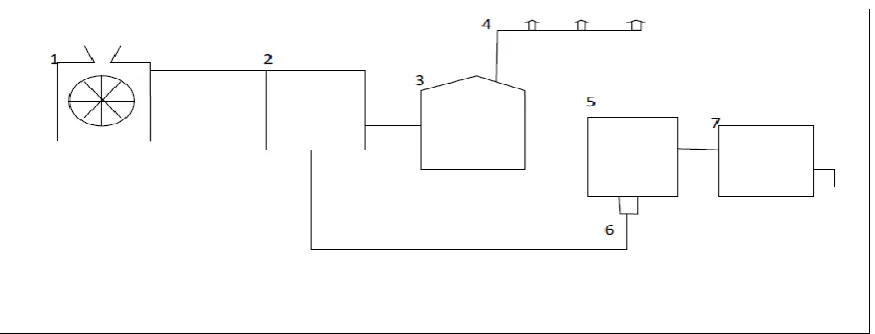
Fig 2 shows the adopted model of biogas plant which is specially designed for the waste organic materials with less retention time and most suitable for biogas generation by using kitchen waste as the commonly used biogas plant having feed as dung will results into lower efficiency in case kitchen waste is used in place of dung.
Fig.2 Biogas Plant-Kvic Model
1. Pulveriser 2.Sludge Drying Bed1 (SDB) 3.Digestion Tank 4. Gas Burners 5. SDB2 6. Sludging Pump 7. Filter Tank
VI. RESULTS AND DISCUSSION
The results from the above study are helpful to save a lot of energy and money. By using kitchen waste in biogas plant not only results in saving money and energy it is also beneficial on the environment point of view. The benefits of using kitchen waste for biogas generation results in reducing environmental pollution, the sealed environment of the process prevents exit of methane into the atmosphere and burning of the methane will release carbon–neutral carbon dioxide (no net effect on atmospheric carbon dioxide and other greenhouse gases).
been found that huge amount of energy can be saved by using this kitchen waste for biogas generation. Waste generated from the IIT Roorkee hostels on the monthly basis is approximately 17480 kg and by using it for biogas generation on a daily basis 2709.3 MJ energy can be saved and for a month it will be equal to approximately 81,300 MJ. The above energy mentioned is equivalent to 6 LPG cylinders daily and 180 cylinders monthly. So in total the money saved per day is Rs 3633 which monthly becomes approximately Rs.1, 10,000.
VII. CONCLUSION
A detailed study was carried out for fuel requirement and generation of biogas from the kitchen waste of IIT Roorkee messes. Kitchen waste has substantial calorific value which can be used for solving the future crisis of fuel as well as problem of disposing the waste. The current method of disposing the kitchen waste at IITR campus solves the problem of disposal of waste however, it is neither environment friendly nor economic. By replacing the current method of waste disposal by producing biogas using kitchen waste generated inside the campus, a substantial amount can be saved in environment benign manner.
From this study, it can be concluded that by using of kitchen waste in biogas plant in order to replace the conventional cooking fuel i.e. LPG is a sustainable and eco friendly way of disposal as well as utilization of kitchen waste. Unlike gobar gas plant biogas plant based on kitchen waste takes less amount of time for generation of biogas and its efficiency is also high compared to the other biogas plants. From the present study, it can be concluded that use of kitchen waste for biogas plant is very efficient, economical and environment friendly. From the above study it is found that about 11% of the fuel consumption can be met by the biogas generated from the kitchen waste of IIT Roorkee messes.
REFERENCES
[1] A.H. Igoni, M.F.N. Abowei, M.J. Ayotamuno and C.L. Eze. ,Comparative Evaluation of Batch and Continuous Anaerobic Digesters in Biogas Production from Municipal Solid Waste , Agricultural Engineering International: the CIGR Ejournal. Manuscript EE 07 011. Vol. X. September, 2008.
[2] Walter Leal Filho, Luciana Brandli , Harri Moora, Jolita Kruopien,2015,Benchmarking approaches and methods in the field of urban waste management: A Review ,Journal of cleaner production xxx 1-10. [3] P.A.Gadge , Dr A.C.Waghmare , V.R. Ninave, Biogas Generation Plant Based On Kitchen Waste Material,
International Journal of Engineering Trends and Technology (IJETT) – Volume 8 Number 3- Feb 2014 ISSN: 2231-5381 .
[4] Park, Y., Tsuno, H., Hidaka, T., Cheon, J., 2008. Evaluation of operational parameters in thermophilic acid fermentation of kitchen waste. J. Mater. Cycl. Waste Manage. 10, 46–52.
[5] Rao, P.V., S.S. Baral, R. Dey and S. Mutnuri, 2010, Biogas generation potential by anaerobic digestion for sustainable energy development in India, Renewable and Sustainable Energy Reviews 14:2086-2094. [6] Jain, S. and M.P. Sharma, 2011, Power generation from MSW of Haridwar city: A feasibility study,