Open Access
Research
Partitioning clustering algorithms for protein sequence data sets
Sondes Fayech*, Nadia Essoussi and Mohamed Limam
Address: Department of Computer Science, LARODEC Laboratory, Higher Institute of Management, University of Tunis, Tunis, Tunisia
Email: Sondes Fayech* - [email protected]; Nadia Essoussi - [email protected]; Mohamed Limam - [email protected]
* Corresponding author
Abstract
Background: Genome-sequencing projects are currently producing an enormous amount of new sequences and cause the rapid increasing of protein sequence databases. The unsupervised classification of these data into functional groups or families, clustering, has become one of the principal research objectives in structural and functional genomics. Computer programs to automatically and accurately classify sequences into families become a necessity. A significant number of methods have addressed the clustering of protein sequences and most of them can be categorized in three major groups: hierarchical, graph-based and partitioning methods. Among the various sequence clustering methods in literature, hierarchical and graph-based approaches have been widely used. Although partitioning clustering techniques are extremely used in other fields, few applications have been found in the field of protein sequence clustering. It is not fully demonstrated if partitioning methods can be applied to protein sequence data and if these methods can be efficient compared to the published clustering methods.
Methods: We developed four partitioning clustering approaches using Smith-Waterman local-alignment algorithm to determine pair-wise similarities of sequences. Four different sets of protein sequences were used as evaluation data sets for the proposed methods.
Results: We show that these methods outperform several other published clustering methods in terms of correctly predicting a classifier and especially in terms of the correctness of the provided prediction. The software is available to academic users from the authors upon request.
Background
In bioinformatics, the number of protein sequences is more than half a million, and it is necessary to find meaningful partitions of them in order to detect their functions. Early approaches of comparing and grouping protein sequences are alignment methods. In fact, pair-wise alignment is used to compare and to cluster sequences. There are two types of pair-wise sequence alignments, local and global [1,2]. Smith and Waterman local alignment algorithm [3] helps
in finding conserved amino acid patterns in protein sequences. Needleman and Wunsch global alignment algo-rithm [4] attempts are made to align the entire sequence using as many characters as possible, up to both ends of each sequence. In order to cluster a large data set of proteins into meaningful clusters, the pair-wise alignment is compu-tationally expensive because of the large number of com-parisons carried out. In fact, each protein of the data set should be compared to all others of the data set.
Published: 2 April 2009
BioData Mining 2009, 2:3 doi:10.1186/1756-0381-2-3
Received: 13 November 2008 Accepted: 2 April 2009
This article is available from: http://www.biodatamining.org/content/2/1/3
© 2009 Fayech et al; licensee BioMed Central Ltd.
For this reason the pair-wise alignment methods are not efficient to cluster a large set of data. These approaches do not consider the fact that the data set can be too large and may not fit into the main memory of some computers.
The main objective of the unsupervised learning tech-nique is to find a natural grouping or meaningful parti-tion using a distance funcparti-tion [5,6]. Clustering is a technique which has been extensively applied in a variety of fields related to life science and biology. In sequence analysis, clustering is used to group homologous sequences into gene or protein families.
Many methods are currently available for the clustering of protein sequences into families and most of them can be categorized in three major groups: hierarchical, graph-based and partitioning methods. Among these various methods, most are based on hierarchical or graph-based techniques and they were successfully established. In fact, COG [7] uses a hierarchical merging of clusters and a manual validation to prevent chaining of multi-domain families. ProtoNet [8] uses a special metric as described by Sasson et al. [9] to merge clusters. Picasso [10] uses multi-ple alignments as profiles which are then merged hierar-chically. ClusTr [11] and GeneRage [12] use standard single linkage clustering approaches. SYSTERS [13] com-bines hierarchical clustering with graph-based clustering. ProtoMap [14] and N-cut [15,16] methods use graph-based clustering approaches. ProClust [17] uses an exten-sion of the graph-based clustering approach proposed by [18]. ProClust algorithm is based on transitivity criterion and it is capable of handling multi-domain proteins. TribeMCL [19] applies the Markov clustering approach (MCL) described by Van Dongen [20]. This method oper-ates on a graph that contains similarity information obtained by pair-wise alignment of sequences.
A small amount of partitioning techniques is used in the protein sequence clustering field. Guralnik and Karypis [21] have proposed one method based on a standard k-means approach where proteins are represented by vec-tors. However, no tool or database resulting from this interesting work has been made available to the scientific community. JACOP [22] uses the partitioning algorithm implemented under the name PAM (Partitioning Around Medoids) in the R statistical package [23]. JACOP is based on a random sampling of sequences into groups. It is available on the MyHits platform [24] where user can sub-mit his own data set. Methods presented bellow are not generally tools since they cannot be applied to cluster a user-provided data set. In fact, several of these methods have been applied to large known data sets and user can only consult the resulting classifications stored in data-bases. Among the protein sequence clustering methods defined bellow only ProClust, TribeMCL and JACOP are
accessed by the community and user can classify his own sequence set.
The main idea here is to design and develop efficient clus-tering algorithms based on partitioning techniques, which are not very investigated in protein sequence clustering field, in order to cluster large sets of protein sequences. In fact, the number of protein sequences available now is very important (in the order of millions) and hierarchical methods are computationally very expensive so they can-not be extended to cluster large protein sets. However, partitioning methods are very simple and more appropri-ate to cluster large data sets [22]. For these reasons, we propose here new clustering algorithms based on tioning techniques which aim to find meaningful parti-tions, to improve the classification's quality and to reduce the computation time compared to the published cluster-ing tools, ProClust, TribeMCL and JACOP, on different data sets.
Several partitioning clustering algorithms have been pro-posed in literature. K-means [23,25-27] is a standard par-titioning clustering method based on K centroids of a random initial partition which is iteratively improved. LEADER [28,29] is an incremental partitioning clustering algorithm in which each of the K clusters is represented by a leader. CLARA (Clustering LARge Applications) [23] is a partitioning algorithm based on a combination of a sam-pling approach and the PAM algorithm. CLARANS (Clus-tering Large Applications based on RANdomized Search) [30] algorithm views the process of finding optimal medoids as searching through a certain graph, in which each node represents a set of medoids.
We adapted the partitioning algorithms cited bellows to protein sequence data sets. These proposed algorithms are named: Kmeans, LEADER, CLARA and Pro-CLARANS. Performance measures are used to evaluate the proposed methods and to compare them with ProClust, TribeMCL and JACOP results.
Methods
Algorithms Implementation
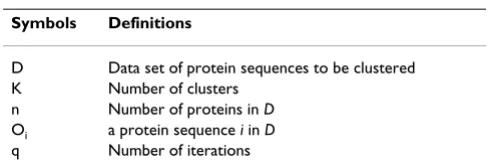
To facilitate subsequent discussion, the main symbols used through the paper and their definitions are summa-rized in Table 1.
Table 1: Summary of symbols and definitions
Symbols Definitions
D Data set of protein sequences to be clustered
K Number of clusters
n Number of proteins in D
Oi a protein sequence i in D
The main objective in the proposed algorithms Pro-Kmeans, Pro-LEADER, Pro-CLARA and Pro-CLARANS is to produce K clusters from a data set D of n protein sequences, so that the objective function f(V) is maxi-mized.
f(V) is the global score function that evaluates the cluster-ing quality and it is as follows
Where Ri is the centroid of the group i for which belong the object Oj and Score (Oj, Ri) is the alignment score of the protein sequences Oj and Ri, calculated as follows
Where S (Ai, Bj) is the substitution score of the amino acid
Ai by Bj as determined from a scoring matrix and g(n) is the total cost of penalties for a gap length n. The gap is defined as follows
Where Po is the gap opening penalty and Pe is the gap extension penalty.
We chose Smith and Waterman local alignment algorithm for computing alignment score. The choice of this algo-rithm was motivated by the sensitivity for low-scoring alignments [31] compared to heuristic algorithms such as FASTA [32] and BLAST [33], and by execution time [34] compared to Needleman and Wunsch global alignment algorithm.
We present here Pro-Kmeans, Pro-LEADER, Pro-CLARA and Pro-CLARANS partitioning clustering algorithms for protein sequence sets.
Pro-Kmeans algorithm
The Pro-Kmeans algorithm proposed here, starts by a ran-dom partition of the data set D into K clusters and then uses the Smith Waterman algorithm to compare proteins of each cluster Si(i ∈ [1..K]) and to compute SumScore(Si, Oj) of each protein j in Si as follows
Where m is the size of the subset Si, for which belongs the object Oj.
The sequence Oj in each cluster Si which has the maximum
SumScore(Si, Oj) is considered as the centroid Ri of the cluster. The Smith Waterman algorithm is used here also
to compare each protein Oh of the data set D with centro-ids and to assign the object to the nearest cluster where the
Ri have the maximum score of similarity with the object
Oh. Pro-Kmeans proceeds to this procedure for a number of times, q, in order to maximize the f(V) function. Input parameters are the number of clusters, K, and of iterations,
q, and as outputs the algorithm returns the best partition of the training base D and the center, or mean, of each cluster Si. Pro-Kmeans algorithm is illustrated in Figure 1.
Pro-LEADER algorithm
Pro-LEADER is an incremental algorithm which selects the first sequence of the data set D as the first leader, and use the Smith Waterman algorithm to compute the simi-larity score of each sequence in D with all leaders. The algorithm detects the nearest leader Ri to each sequence Oj
and compares the score, Score(Ri, Oj), with a pre-fixed
Threshold. If the similarity score of Ri and Oj, is more than the Threshold, Oj is considered as a new leader and if not, the sequence Oj is assigned to the cluster defined by the leader Ri. Pro-LEADER is thus an incremental algorithm in which each of the K clusters is represented by a leader. The
K clusters are generated using a suitable Threshold value. Pro-LEADER aims also to maximize the f(V) function. Input parameter is the similarity score Threshold to con-sider an object Oj as a new leader, and as outputs the algo-rithm returns the best partition of the training base D and the K leaders of the obtained clusters. The Pro-LEADER algorithm is fast, requiring only one pass through the data set D. Pro-LEADER algorithm is depicted in Figure 2.
Pro-CLARA algorithm
Pro-CLARA relies on the sampling approach to handle large data sets [23]. Instead of finding medoids for the entire data set, Pro-CLARA algorithm draws a small sam-ple S of 40 + 2K sequences from the data set D. To generate an optimal set of medoids for this sample, Pro-CLARA applies the proposed PAM algorithm for protein sequence data sets, Pro-PAM algorithm,
The Pro-PAM algorithm proposed here, selects randomly K sequences from the data set as clusters, and then use the Smith Waterman algorithm to compute the total score TSih of each pair of selected sequence Ri and non selected sequence Oh. TSih is as follows
Where Sjih is the differential score of each pair of non-selected object Oh in D and selected object Ri(i ∈ [1..K]) with all non-selected objects Oj in D. Sjih is as follows
f V( )= ∑j∈[ .. ]1 n Score O R( j, i), (1)
Score A B( , )= ∑i j, S A B( i, j)− ∑ng n( ), (2)
g n( )=Po+(n−1) *Pe, (3)
SumScore S O( ,i j)= ∑w∈[ .. ]1m≠jScore O O( j, w), (4) TSih = ∑j∈[ .. ]1m Sjih, (5)
Pseudo code for Pro-Kmeans algorithm Figure 1
Pseudo code for Pro-Kmeans algorithm.
Input: A training set D, D = {O
h}
h=1.. n; n is the size of D
Initialize: f (V)
max= 0; iteration = 0;
Repeat
1. Partition randomly D into K nonempty subsets;
2. For each i [1..K] do
x
Compute the similarity score of each pair of proteins in the subset S
iusing
Smith Waterman algorithm;
x
Compute the SumScore(S
i, O
j) of each protein j in S
i;
x
The protein j which have the maximum SumScore(S
i, O
j) in S
iis considered as
the centroid R
iof the subset S
i;
3. For each O
h D do
x
Compute the similarity score of O
hwith each centroid R
i (i [1..K]), using Smith
Waterman algorithm;
x
Assign O
hto the cluster with the nearest R
i; (The R
iwhich have the maximum
score of similarity with the object O
h)
4. Compute f (V);
5. If f (V) < f (V)
maxthen
iteration = iteration + 1;
Else
f (V)
max= f (V);
BestSets = CurrentSets; (CurrentSets are Subsets obtained in this partition)
Go back to Step 2;
Until iteration = q;
End
Output: BestSets; BestSets is the best partition of D into K clusters; each cluster is
Pro-PAM selects the maximal TSih, MaxTSih. If MaxTSih is positive, the corresponding non selected sequence Oh will be selected, otherwise Smith Waterman algorithm is used to compare each protein Oh of the data set with all medoids Ri(i ∈ [1..K]), and to assign the sequence Oh to the nearest cluster. Input parameter of Pro-PAM is the number of clusters, K, and as outputs the algorithm returns the best partition of the protein sequence base and the medoid of each cluster. Pro-PAM algorithm is depicted in Figure 3.
Pro-CLARA uses the optimal set of medoids Ri(i ∈ [1..K]) obtained by Pro-PAM and the Smith Waterman algorithm to compare each protein Oh of the data set D with all medoids Ri(i ∈ [1..K]), and to assign the sequence Oh to the nearest cluster. In order to alleviate sampling bias, Pro-CLARA repeats the sampling and the clustering process a pre-defined number of times, q, and subsequently selects as the final clustering result the set of medoids with the maximal f (V). Input parameters of Pro-CLARA algorithm are the number of clusters, K, and of iterations, q, and as
Pseudo code for Pro-LEADER algorithm Figure 2
Pseudo code for Pro-LEADER algorithm.
Input: A training set D, D = {O
j}
j=1.. n; n is the size of D
Initialize: LeaderList =
;
1. Select the first sequence, L, as a leader;
2. LeaderList = LeaderList
L;
3. For each j
[2..n] do
x
Compute the similarity score of O
jwith all leaders in LeaderList using Smith
Waterman algorithm;
x
Find in LeaderList the nearest leader R
ito O
j;
xIf Score (R
i, O
j) > Threshold then
Assign O
jto the set of the leader R
i;Else
LeaderList = LeaderList
O
j;
4. Compute f (V);
End
outputs the algorithm returns the best partition of the training base D and the K medoids of the obtained clus-ters. Pro-CLARA algorithm is detailed in Figure 4.
Pro-CLARANS algorithm
Pro-CLARANS algorithm starts from an arbitrary node C
in the graph, C = [R1, R2,..., Rk], which represents an initial set of medoids. Pro-CLARANS randomly selects one of C
neighbors, C*, which differs by only one sequence. If the
total score of the selected neighbour, TSih (Equation (5)), is higher than that of the current node TS'ih, Pro-CLARANS proceeds to this neighbor and continues the neighbor selection and comparison process. Otherwise, Pro-CLAR-ANS randomly checks another neighbor until a better neighbor is found or the pre-determined maximal number of neighbours to check, Maxneighbor, has been reached. In this study Maxneighbor is defined as proposed by [30]
Pseudo code for Pro-PAM algorithm Figure 3
Pseudo code for Pro-PAM algorithm.
Input: A sample S of the training set D; S = {O
h}
h=1.. m; m is the size of S
1. Select K objects arbitrarily from S: R
i (i [1..K]);
2. For each pair of non-selected object O
hin S and selected object R
ido
x
Calculate the total score TS
ih;
3. Select the maximal TS
ih: MaxTS
ih, and mark the corresponding objects R
iand O
h;
4. If MaxTS
ih> 0 then
R
i= O
h;
Go back to Step 2;
Else
For each O
h
S do
x
Compute the similarity score of O
hwith each centroid R
i (i [1..K]), using Smith
Waterman algorithm;
x
Assign O
hto the cluster with the nearest R
i;
End
Output: BestSets; BestSets is the best partition of S into K clusters; each cluster is
Pseudo code for Pro-CLARA algorithm Figure 4
Pseudo code for Pro-CLARA algorithm.
Input: A training set D, D = {O
h}
h=1.. n; n is the size of D
Initialize: f (V)
max= 0; iteration = 0;
Repeat
1. Draw a sample S of 40 + 2K sequences randomly from D;
2. Call Pro-PAM algorithm to find K medoids of S: R
i (i [1..K]);
3. For each O
h
D do
x
Compute the similarity score of O
hwith each medoid R
i (i [1..K]), using Smith
Waterman algorithm;
x
Assign O
hto the cluster with the nearest R
i;
4. Compute f (V);
5. If f (V) < f (V)
maxthen
iteration = iteration + 1;
Else
f (V)
max= f (V);
BestSets = CurrentSets; (CurrentSets are Subsets obtained in this partition)
Go back to Step 2;
Until iteration = q;
End
Where the maximal number of neighbours must be at least a threshold value 250 or obtained using the number of clusters K and the number of sequences, n, in the data set as: 1.25%*K*(n-K).
Pro-CLARANS algorithm aims to maximize the total score, TSih
Pro-CLARANS algorithm use then the Smith Waterman algorithm to compute the similarity score of each sequence Oh in D with each medoid Ri(i ∈ [1..K]) and to assign it to the nearest cluster. The algorithm repeats the clustering process a pre-defined number of times, q, and selects as the final clustering result the set of medoids with the maximal f (V). Input parameters of Pro-CLARANS algorithm are the number of clusters, K, and of iterations,
q, and as outputs the algorithm returns the best partition of the training base D and the K medoids of the obtained clusters. Pro-CLARANS algorithm is detailed in Figure 5.
The proposed algorithms presented here have been imple-mented in Java package. All of these algorithms used the EMBOSS ftp://emboss.open-bio.org/pub/EMBOSS/ implementation of the Smith and Waterman local align-ment algorithm for computing alignalign-ment score.
BLOSUM62 (Blocks Substitution Matrix) [35] was chosen to compute amino acids substitution scores [36]. We chose the default penalties proposed by Smith and Water-man EMBOSS implementation as gap opening (Po) and gap extension penalties (Pe) (Po = 10 and Pe = 2).
Performance measure
To evaluate the Pro-Kmeans, Pro-LEADER, Pro-CLARA and Pro-CLARANS clustering algorithms, a large data set, Training data set, is used. We obtained from the training phase K clusters and each cluster is defined by a medoid (centroid or leader). The training phase results are used to cluster a different data set named, Test data set. Smith Waterman algorithm is used to compare each protein sequence on the test data set with all medoids Ri(i ∈ [1..K]) obtained from the training phase, and to assign each sequence to the nearest cluster. The predicted family group of each sequence is which of the nearest medoid.
The results obtained from the test phase are used to calcu-late the Sensitivity and the Specificity of each algorithm and to compare them with results of the published clustering tools, ProClust, TribeMCL and JACOP, tested on the same set: "Test data set".
Sensitivity specifies the probability of correctly predicting a classifier and it is defined as
and Specificity the probability that the provided prediction is correct and it is defined as
where TP (True Positives) is the number of correctly identi-fied true homologues pairs, FN (False Negatives) is the number of not identified true homologues pairs and FP
(False Positives) is the number of non-homologue pairs pre-dicted to be homologue. A pair of sequences is considered truly homologous, if both are in the same family group.
Protein sequence data sets
To evaluate the performance of the proposed clustering algorithms Pro-Kmeans, Pro-LEADER, Pro-CLARA and Pro-CLARANS, and to compare their results with the avail-able graph-based clustering tools ProClust and TribeMCL and the only available partitioning clustering tool JACOP, protein sequence families with known subfamilies/groups are considered. Protein sequences of HLA protein family have been collected from ftp://ftp.ebi.ac.uk/pub/data bases/imgt/mhc/hla. From this set, we have randomly selected 893 sequences named DS1 and grouped into 12 classes. Protein sequences of Hydrolases protein family have been collected from http://www.brenda-enzymes.org/. Hydrolases protein family sequences are categorized into 8 classes according to their function and 3737 sequences, named DS2, have been considered from this family. From Globins protein family [37], sequences have been collected randomly from 8 different classes and 292 sequences, named DS3, have been selected from the data set IPR000971 in http://srs.ebi.ac.uk. Thus, totally 28 different classes containing sequences are considered as they have been classified by scientists/experts.
The data set considered has a total of 4922 sequences, named DS4, out of which 3500 sequences (practically 70% of the dataset DS4) are randomly for training, and 1422 for testing (practically 30% of the dataset DS4). The same method to obtain the training and the test sets are used on DS1, DS2 and DS3: randomly 70% of the set is selected for the training set and 30% for the test set [see Additional file 1].
Results and Discussion
Experiments are conducted on Intel Pentium4 processor based machine, having a clock frequency of 2.4 GHZ and 512 MB of RAM. Experimental results are obtained using default values as follows. In Pro-Kmeans, Pro-CLARA and Pro-CLARANS algorithms, the number of iterations q is fixed to 5 [30] and the number of clusters K is fixed to 28. After a number of simulations, we find that the best
clus-Maxneighbor =Max(( .1 25% *K*(n−K));250). (7)
Sensitivity=TP/(TP+FN), (8)
Pseudo code for Pro-CLARANS algorithm Figure 5
Pseudo code for Pro-CLARANS algorithm.
Input: A training set D, D = {Oh}h=1.. n ; n is the size of D
Initialize: f (V) max = 0; iteration = 0;
Repeat
1 Set C an arbitrary node from D; (C = [R1, R2, …, Rk])
2. Set j =1;
3. Repeat
x Consider a random neighbor C* of C;
x Compute TSih of C* and TS’ihof C;
x If TSih > TS’ih then
C = C*;
j = 1;
Else
j = j + 1;
Until j = Maxneighbor;
4. For each object Oh
D dox Compute the similarity score of Oh with each medoid Ri (i[1..K]), using Smith Waterman algorithm;
x Assign Ohto the cluster with the nearest Ri ;
5. Compute f(V);
6. If f(V)
d
f(V) maxtheniteration = iteration + 1;
Else
f(V) max= f(V) ;
BestSets = CurrentSets;
Go back to Step3;
Until iteration = q;
End
Output: BestSets; BestSets is the best partition of D into K clusters; each cluster is
tering results are obtained when the parameter K = 28 [38]. In Pro-LEADER algorithm, the Threshold value is fixed to 350 after a number of simulations [28].
Experimental results of Kmeans, LEADER, Pro-CLARA, Pro-CLARANS, ProClust, TribeMCL and JACOP algorithms on DS1, DS2, DS3 and DS4 are summarized in Table 2.
In our experiments, the use of partitioning clustering methods Kmeans, LEADER, CLARA, Pro-CLARANS and JACOP have improved sensitivity and spe-cificity of hierarchical methods, ProClust and TribeMCL.
We have demonstrated the performance of the proposed Pro-Kmeans, Pro-LEADER, Pro-CLARA, Pro-CLARANS algorithms for the clustering of protein sequences using similarity.
Experiments show also that on the considered data sets DS1, DS2, DS3 and DS4, the higher probability of correctly predicting a classifier (Sensitivity) is obtained using JACOP method. Pro-CLARA method gives the higher probability that the provided prediction is correct (Specificity) although that, Pro-Kmeans, Pro-LEADER, and, Pro-CLARANS obtain also good results. The use of Pro-LEADER method on very large and heterogeneous set, DS4, is not very valuable. In fact the number of not identified true homologues pairs (False Negatives) is very important for that, the obtained
Sensitivity is limited to 23.34.
Pro-Kmeans, Pro-LEADER, Pro-CLARA and Pro-CLARANS result confirm that those proposed partitioning methods are valuable, reliable tools for the automatic functional clustering of protein sequences. The use of these methods instead of alignment methods or the classic known cluster-ing methods by biologists can improve the clustercluster-ing sensi-tivity and specificity and reduce significantly the computational time. The proposed methods can be used by new biologists especially to cluster a large data set of pro-teins into meaningful clusters in order to detect their
func-Conclusion
Similar protein sequences probably have similar bio-chemical function and three dimensional structures. If two sequences from different organisms are similar, they may have a common ancestor sequence and hence they are said to be homologous. Protein sequence clustering, using Kmeans, LEADER, CLARA and Pro-CLARANS methods helps in classifying a new sequence, retrieve a set of similar sequences for a given query sequence and predict the protein structure of an unknown sequence. We noticed that the classification of large pro-tein sequence data sets using clustering techniques instead of only alignment methods reduce extremely the execu-tion time and improve the efficiency of this important task in molecular biology.
Competing interests
The authors declare that they have no competing interests.
Authors' contributions
SF incepted and directed the research and wrote the man-uscript. NE and ML participated in the coordination and the direction of the whole study. All authors read and approved the final manuscript.
Additional material
Additional File 1
Training and test data sets. The file contains text files which correspond to the used data set in this study in fasta format. The file contains two directories: the training base which has 3500 sequences and the test base which has 1422 sequences. The considered data set, named DS4, has a total of 4922 sequences out of which 3500 sequences (practically 70% of the dataset DS4) are randomly selected for training, and 1422 for testing (practically 30% of the dataset DS4). This dataset contains proteins selected from HLA (DS1), Hydrolases (DS2) and Globins (DS3) protein families.
Click here for file
[http://www.biomedcentral.com/content/supplementary/1756-0381-2-3-S1.zip]
Table 2: Performance of the three other tools (ProClust, TribeMCL and JACOP) and our four proposed methods on DS1, DS2, DS3 and DS4 data sets with respect to two clustering quality measurements: Sensitivity (Sens.) and Specificity (Spec.)
Algorithms DS1 DS2 DS3 DS4
Sens. Spec. Sens. Spec. Sens. Spec. Sens. Spec.
ProClust 50.64 56.77 48.71 61.86 46.09 55.14 46.39 51.07
TribeMCL 46.09 52.89 41.42 52.14 41.04 47.48 51.22 56.46
JACOP 99.92 66.27 99.96 70.06 99.96 73.96 99.92 94.42
Pro-Kmeans 92.38 99.90 55.32 98.01 63.30 96.92 56.06 99.56
Pro-LEADER 90.21 91.40 53.15 91.24 52.96 74.06 23.34 95.70
Pro-CLARA 93.60 99.92 73.28 99.26 81.53 98.60 77.84 99.66
Pro-CLARANS 93.10 99.90 78. 62 98.70 76.24 97.34 62.06 99.09
Publish with BioMed Central and every scientist can read your work free of charge "BioMed Central will be the most significant development for disseminating the results of biomedical researc h in our lifetime."
Sir Paul Nurse, Cancer Research UK
Your research papers will be:
available free of charge to the entire biomedical community peer reviewed and published immediately upon acceptance cited in PubMed and archived on PubMed Central yours — you keep the copyright
Submit your manuscript here:
http://www.biomedcentral.com/info/publishing_adv.asp
BioMedcentral
References
1. Clote P, Backofen R: Computational Molecular Biology – An Introduction. John Wiley & Sons, Ltd; 2000.
2. Mount DW: Bioinformatics – Sequence and Genome Analysis.
Cold Spring Harbor Laboratory Press, New York; 2002.
3. Smith TF, Waterman MS: Identification of common molecular subsequences. J Mol Biol 1981, 147:195-197.
4. Needleman SB, Wunsch CD: A general method applicable to the search for similarities in the amino acid sequence of the proteins. J Mol Biol 1970, 48:443-453.
5. Cabena P, et al.: Discovering Data Mining: From Concept to Implementation. Prentice Hall PTR, Upper Saddle River, NJ; 1998. 6. Fayyad UM: Data mining and knowledge discovery: Making
sense out of data. IEEE Expert 1996, 11:20-25.
7. Tatusov R, Fedorova N, Jackson J, Jacobs A, Kiryutin B, Koonin E, Kry-lov D, Mazumder R, Mekhedov S, Nikolskaya A, Rao B, Smirnov S, Sverdlov A, Vasudevan S, Wolf Y, Yin J, Natale D: The COG data-base: an updated version includes eukaryotes. BMC Bioinfor-matics 2003, 4:41.
8. Kaplan N, Sasson O, Inbar U, Friedlich M, Fromer M, Fleischer H, Por-tugaly E, Linial N, Linial M: ProtoNet 4.0: a hierarchical classifi-cation of one million protein sequences. Nucleic Acids Res
2005:D216-8.
9. Sasson O, Linial N, Linial M: The metric space of proteins-com-parative study of clustering algorithms. Bioinformatics 2002,
18(Suppl 1):S14-21.
10. Herger A, Holm L: Picasso: generating a covering set of protein family profiles. Bioinformatics 2001, 17(3):272-9.
11. Kriventseva E, Servant F, Apweiler R: Improvements to CluSTr: the database of SWISS-PROT + TrEMBL protein clusters. Nucleic Acids Res 2003, 31(1):388-9.
12. Enright A, Ouzounis C: GeneRAGE: a robust algorithm for sequence clustering and domain detection. Bioinformatics 2000,
16(5):451-7.
13. Krause A, Stoye J, Vingron M: Large scale hierarchical clustering of protein sequences. BMC Bioinformatics 2005, 6:15.
14. Yona G, Linial N, Linial M: ProtoMap: automatic classification of protein sequences and hierarchy of protein families. Nucleic Acids Res 2000, 28(1):49-55.
15. Shi J, Malik J: Normalized cuts and image segmentation. Pro-ceedings of the IEEE conference on Computer Vision Pattern Recognition
1997:731-737.
16. Wu Z, Leahy R: An optimal graph theoretic approach to data clustering: theory and its application to image segmentation. PAMI 1993, 11:1101-1113.
17. Pipenbacher P, Schliep A, Schneckener S, Schönhuth A, Schomburg D, Schrader R: ProClust: improved clustering of protein sequences with an extended graph-based approach. Bioinfor-matics 2002, 18(Suppl 2):S182-91.
18. Bolten E, Schliep A, Schneckener S, Schomburg D, Schrader R: Clus-tering protein sequences-structure prediction by transitive homology. Bioinformatics 2001, 17(10):935-41.
19. Enright A, Van Dongen S, Ouzounis C: An efficient algorithm for large-scale detection of protein familes. Nucleic Acids Res 2002,
30(7):1575-84.
20. Van Dongen S: Graph clustering by flow simulation. In Phd The-sis University of Utrecht, The Netherlands; 2000.
21. Guralnik V, Karypis G: A scalable algorithm for clustering sequential data. SIGKDD Workshop on Bioinformatics, BIOKDD 2001. 22. Sperisen P, Pagni M: JACOP: a simple and robust method for the automated classification of protein sequences with mod-ular architecture. BMC Bioinformatics 2005, 6:216.
23. Kaufman L, Rousseeuw P: Finding Groups in Data: An Introduc-tion to Cluster Analysis. John Wiley & Sons, Inc., New York; 1990.
24. Pagni M, Ioannidis V, Cerutti L, Zahn-Zabal M, Jongeneel C, Hau J, Martin O, Kuznetsov D, Falquet L: MyHits: improvements to an interactive resource for analyzing protein sequences. Nucleic Acids Res 2007:W433-37.
25. Anil KJ, Richard CD: Algorithms for Clustering Data. Prentice-Hall; 1988.
26. Faber V: Clustering and the continuous k-means algorithm. Los Alamos Science 1994, 22:138-144.
27. Hartigan J, Wong M: Algorithm AS136: A k-means clustering algorithm. Applied Statistics 1979, 28:100-108.
28. Can F: Incremental clustering for dynamic information processing. ACM Trans Inf Syst 1993, 11(2):143-164.
29. Spath H: Cluster analysis algorithms. Ellis Horwood, Chichester, UK; 1980.
30. Ng R, Han J: Efficient and Effective Clustering Methods for Spatial Data Mining. In Proceedings of International Conference on Very Large Data Bases Santiago, Chile; 1994:144-155.
31. Brenner SE, Chothia C, Hubbard TJ: Assessing sequence compar-ison methods with reliable structurally identified distant evolutionary relationships. Proc Natl Acad Sci USA 1998,
95:6073-6078.
32. Pearson WR, Lipman DJ: Improved tools for biological sequence comparison. Proc Natl Acad Sci USA 1988, 85:2444-2448. 33. Altschul S, Gish W, Miller W, Myers E, Lipman D: Basic local
align-ment search tool. J Mol Biol 1990, 215:403-410.
34. Essoussi N, Fayech S: A comparison of four pair-wise sequence alignment methods. Bioinformation 2007, 2:166-168.
35. Henikoff S, Henikoff J: Performance evaluation of amino acid substitution matrices. Proteins 1993, 17:49-61.
36. Schneckener S: Positionsgenaues Alignment von Proteinse-quenzen. In PhD Thesis Universität zu köln; 1998.
37. Cathy H: The Universal Protein Ressource (UniProt): an expanding universe of protein information. Nucleic Acids Res
2006, 34:87-191.
38. Dubes RC: How many clusters are best? Pattern Recogn 1987,