Animals #2 Pracitce Test
Modified True/False
Indicate whether the statement is true or false. If false, change the identified word or phrase to make the statement true.
____ 1. Detritivores in both terrestrial and aquatic habitats get nutrients by consuming plants or parts of plants. ____________________
____ 2. In animals with digestive systems, nutrients are absorbed by the small intestine. _________________________
____ 3. Digestion in sponges is intracellular because it takes place inside specialized cells . _________________________
____ 4. Herbivores have rumina that are adapted for tearing cell walls to expose cell contents for digestion. _____________________
____ 5. The concentration of oxygen must be greater in the blood than in the alveoli for diffusion into a mammal’s lungs to occur. _________________________
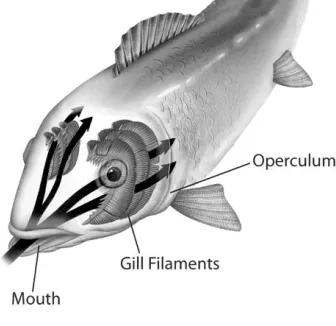
Figure 27–5
____ 6. Study the illustration in Figure 27–5. The blood flowing through gill filaments will absorb oxygen from the water that is pumped across the gills. ________________________
____ 7. Stale air does not get trapped in amphibian lungs because it flows through a system of tubes and air sacs. ________________________
____ 8. Structures such as alveoli and book lungs increase the surface area of respiratory membranes. _____________________________
____ 9. Gas exchange in mammals takes place in the trachea. _________________________
____ 11. Oxygen diffuses directly into body tissues from blood in animals with an open circulatory system. _________________________
____ 12. The four-chambered heart prevents mixing of oxygen-rich and oxygen-poor blood. _________________________
____ 13. Kidneys maintain ammonia balance while removing nitrogenous wastes from the body. _________________________
____ 14. A freshwater fish regulates its salt levels by pumping salt outward across its gills. ______________________
____ 15. Spiders and scorpions are ideally suited to living in a desert environment because they excrete uric acid.
_________________________
____ 16. A neuron that passes information to other neurons is called a(an) motor neuron. _________________________
____ 17. A mammal will begin to shiver when its body temperature drops below a certain point. Therefore, low body temperature is a stimulus for shivering behavior. _________________________
____ 18. The vertebrate brain is a collection of motor neurons connected to each other and other types of neurons in the head and throughout the body. _______________________________
____ 19. Some birds navigate by detecting Earth’s magnetic field. _________________________
____ 20. The process in which an arthropod sheds its skeleton and manufactures a larger one is called flexing. _________________________
____ 21. A ligament is a place where bones are held together by connective tissue and can move with respect to one another. _________________________
____ 22. A paleontologist reconstructing a fossil skeleton would look for the places where tendons attached to bones to determine how an animal’s muscles and skeleton worked together to produce movement.
_______________________________
____ 23. An animal that changes from one sex to another during its lifetime is a medusa. _____________________
____ 24. A male salamander that deposits a sperm packet for later collection by a female is taking part in a form of internal fertilization. _________________________
____ 25. If an insect exists as a nymph before becoming an adult, the insect goes through complete metamorphosis. _________________________
____ 26. The seahorse is an unusual example of a(an) oviparous species because the male incubates the eggs in a pouch before giving birth to fully formed live offspring. _________________________
____ 28. a(an) immune system that does not function properly could prevent an animal from maintaining homeostasis by allowing the animal to become sick. _________________________
____ 29. Large lizards are unlikely to survive in polar regions because they are ectotherms. _________________________
____ 30. A budding cnidarian polyp is reproducing asexually. _________________________
Completion
Complete each statement.
31. Leeches are classified as ____________________ because they obtain food by feeding on the blood of animals to which they are attached.
32. In some invertebrates, digestive and circulatory processes take place in the tissues that line the ______________________.
33. Chemical digestion is carried out by ___________________ secreted by the digestive tract.
34. Animals that “chew their cud” most likely have a ____________________ or similar specialized organ as part of their digestive tract.
35. Carbon dioxide cannot diffuse into the blood from an animal’s cells unless the blood has a ____________________ concentration of carbon dioxide.
36. ____________________ are structures that allow gas exchange between an animal’s blood and water.
37. Sea turtles must come to the surface regularly to breathe because they rely on ____________________ for gas exchange.
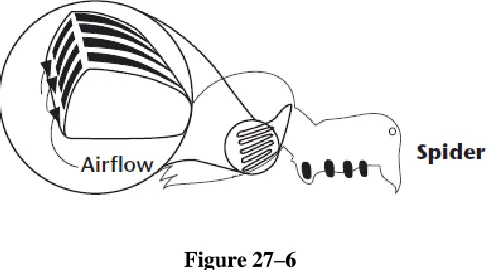
Figure 27–6
38. Study the spider respiratory system in Figure 27–6 above. The structure where gas exchange takes place is called a ____________________.
39. Annelids have a(an) ____________________ circulatory system, in which blood is contained in a network of blood vessels.
41. A student is dissecting a three-chambered heart. When she discovers that the ventricle has no partitions, she should conclude that the heart belonged to a(n) _________________.
42. __________________ is a nitrogenous waste that animals must either eliminate immediately or convert to a less-toxic compound.
43. To conserve water, an animal’s kidneys can pump salt ions across cell membranes, making water follow by _____________________.
44. Small freshwater invertebrates excrete ammonia from their bodies through the process of _______________________.
45. In invertebrates, both nitrogenous and digestive wastes are eliminated through the anus because the ________________________ empty into the gut rather than outside the body.
46. Your eye blinks when the muscle in it receives a signal from a(an) ______________ neuron.
47. The smell of blood in water is an example of a(an) _____________________ for a hungry shark.
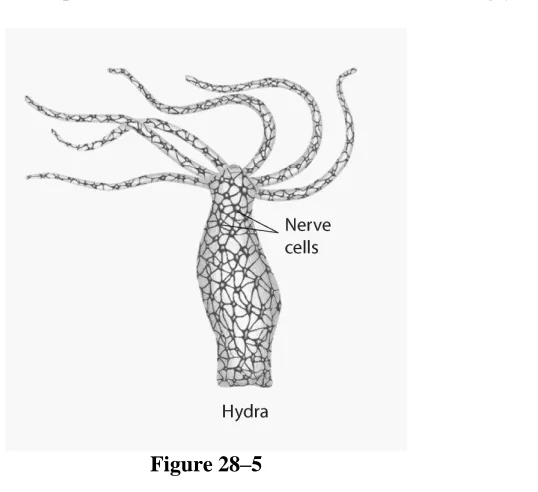
Figure 28–5
48. Study Figure 28–5. The nervous system in the hydra is a ______________________.
49. A sense organ is made up of ___________ and other cells that help gather information.
50. Because the skeleton of arthropods is external, they must ____________________ in order to grow.
51. A marine biologist finds hard fragments of an endoskeleton and determines that they belong to an echinoderm when testing shows they are not made of cartilage or __________________.
53. A DNA test that shows an offspring’s DNA comes from two parents indicates that the offspring was produced by _______________________.
54. Salmon reproduce by __________________ fertilization, because a female salmon releases her eggs onto the riverbed before the male covers them with his sperm.
55. A marsupial is a ____________________ species because it gives birth to live young that obtained nutrients from their mother’s body before being born.
56. An immature grasshopper resembles an adult grasshopper but does not have wings. Therefore, grasshoppers undergo ____________________ metamorphosis.
57. A chicken farmer can hatch chicks away from their mothers by keeping the eggs warm with the heat from a light bulb. This is possible because chickens produce ____________________ eggs, which can develop outside the mother’s body in a dry environment.
58. An organism is able to survive because its systems work together to maintain __________________.
59. Hormones that are released by __________________________ help maintain homeostasis by regulating body activities such as growth.
60. An animal that grows a thicker fur coat to stay warm during the winter months is a(an) ____________________.
Short Answer
61. Does a parasite have a beneficial or harmful effect on its host? Explain.
62. Which type of digestive system can perform both chemical and mechanical digestion?
63. What is the difference between mechanical and chemical digestion?
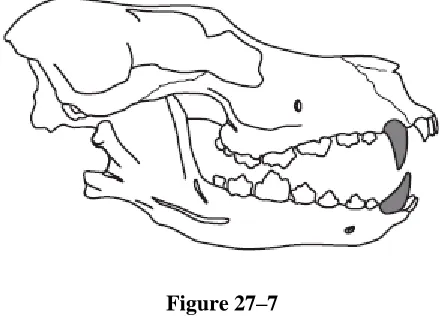
Figure 27–7
65. Suppose you uncovered the fossilized skull of an animal. How could you use its teeth to help determine whether it was a carnivore or a herbivore?
66. What are the three main requirements for a gas-exchange membrane in a respiratory system?
67. What would happen if the relative concentrations of oxygen inside the lung and in the blood became equal to each other?
68. Through what two types of body structures can oxygen diffuse into an aquatic invertebrate’s body?
69. An earthworm tunnel floods during a rainstorm, and the earthworm washes out onto the grass. Why will the earthworm die if it cannot get back into a tunnel quickly?
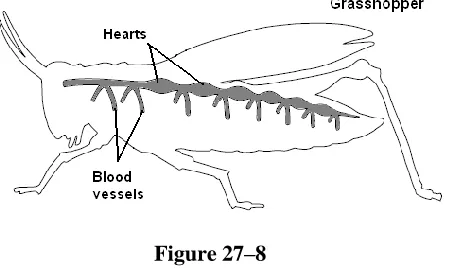
Figure 27–8
70. What kind of circulatory system is illustrated in Figure 27–8? How do you know?
71. What is one purpose of the partition between the two ventricles in a mammal’s heart?
72. What are the two main functions of an excretory system?
73. What is one way that a saltwater fish controls the concentration of salt in its body?
74. How are the nephridia of an annelid similar to human kidneys?
75. How do the excretory systems of animals that secrete uric acid differ from those of animals that excrete urine?
76. What path does information take from the time you touch a hot surface with your finger until you react by moving your finger away from the heat?
77. Which part of your brain controls your ability to balance on a bicycle?
78. List four senses shared by most vertebrates.
79. What characteristic is shared by the eyes of cephalopods, arthropods, and mammals?
82. What would happen if both muscles in an opposing muscle pair contracted at the same time?
83. How does parthenogenesis differ from other forms of asexual reproduction?
84. Describe two ways internal fertilization occurs in invertebrates.
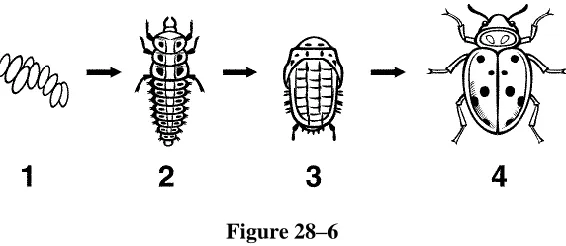
Figure 28–6
85. What type of metamorphosis is illustrated in Figure 28–6?
86. If you found a caterpillar of a species you had never seen before, why would it be difficult to predict what the adult of that species would look like?
87. Which membrane in an amniotic egg regulates gas exchange?
88. Why is it important for the immune system to be able to tell the difference between the animal’s own cells and pathogens?
89. A student spots a fly clinging to the outside of a classroom window on a cool spring morning. As the sun warms the window, the fly becomes more active. Should the student hypothesize that the fly is an endotherm or an ectotherm? Why?
90. How are feathers important to an endotherm?
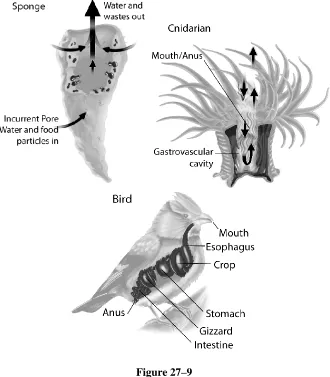
Figure 27–9
91. Classify The cnidarian in Figure 27–9 is a sea anemone, which uses the stinging tentacles around its mouth to catch prey and guide it into its gastrovascular cavity. Would you classify this cnidarian as a filter feeder, a herbivore, or a carnivore?
92. Interpret Visuals Figure 27–9 shows the three types of digestive systems found in animals. Which animal relies on intracellular digestion?
93. Interpret Visuals Which animal in Figure 27–9 has an organ designed to grind seeds? What is the organ?
94. Compare and Contrast Compare the flow of food and wastes in the three organisms in Figure 27–9.
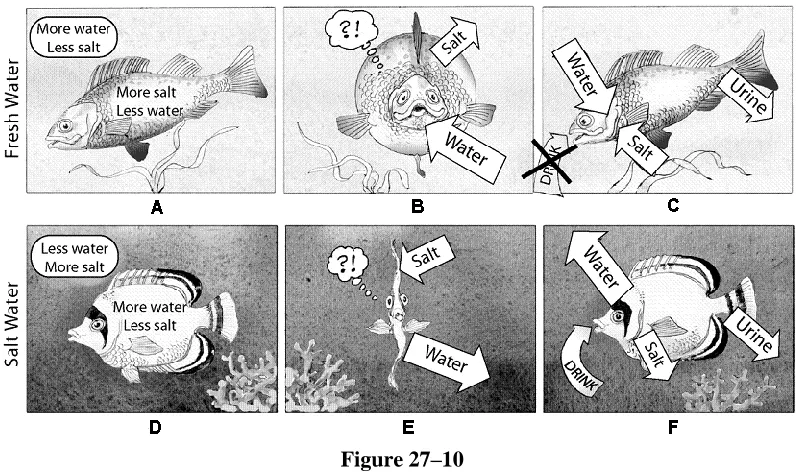
Figure 27–10
96. Interpret Visuals What organ is responsible for regulating the concentration of water in the bodies of the fishes shown in Figure 27–10?
97. Interpret Visuals In Figure 27–10, which fish’s body has a greater salt concentration compared to the water that surrounds it? Explain your answer.
98. Predict Using Figure 27–10, predict what happens to fish when water becomes slightly less salty?
99. Relate Cause and Effect In Figure 27–10, what is happening to the fish in panel E? Explain your answer.
100. Predict When a fish that spends most of its life in the ocean enters a river and migrates upstream to breed, what adjustments are necessary for survival?
101. Interpret Visuals Are the circulatory systems shown in Figure 27–11 open or closed? How do you know?
102. Classify What type of animals would you expect to have a circulatory system like the one labeled A in Figure 27–11? Why?
103. Classify Would you expect to find the circulatory system labeled B in Figure 27–11 in a terrestrial invertebrate or a terrestrial vertebrate? Why?
104. Sequence In the system labeled B in Figure 27–11, where does oxygen-poor blood go after leaving the heart? Why?
105. Compare and Contrast In Figure 27–11, why do you think system B is a better system for mammals than system A would be?
Figure 28–7
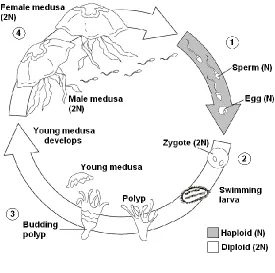
106. Interpret Visuals Which type of reproduction is represented by step 4 in Figure 28–7?
107. Interpret Visuals In Figure 28–7, what information indicates that meiosis takes place during the jellyfish’s reproductive cycle?
108. Infer What kind of fertilization is occurring at step 4 in Figure 28–7? Based on this information, when do you think this part of a jellyfish’s reproductive cycle is most likely to occur?
110. Infer Study Figure 28–7. Does this organism go through metamorphosis? Explain your answer.
Figure 28–8
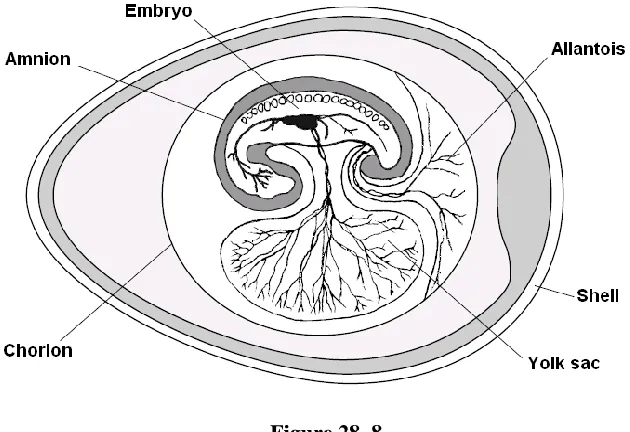
111. Interpret Visuals List the three groups of animals that have evolved the type of egg shown in Figure 28–8.
112. Interpret Visuals Study Figure 28–8. Which membrane surrounds the other membranes?
113. Infer Which structure of the egg shown in Figure 28–8 ensures that an embryo will develop in a watery environment?
114. Compare and Contrast How does the shell of the amniotic egg in Figure 28–8 resemble a respiratory membrane? How does it differ?
Figure 28–9
116. Interpret Visuals Study Figure 28–9. Which three groups of animals are likely to rely most heavily on their sense of smell?
117. Interpret Visuals Which region of the brains shown in Figure 28–9 is responsible for controlling the functioning of many internal organs?
118. Compare and Contrast In Figure 28–9, what two changes are happening to the cerebrum from bony fishes, through amphibians and reptiles, to birds and mammals? Why are these changes important?
119. Predict Study Figure 28–9. Suppose you examined the brain of an animal species that was completely blind and relied entirely on its sense of smell to find food. How would you expect its olfactory bulbs to compare to its optic lobes?
120. Infer Study the cerebellums of the groups shown in Figure 28–9. Why is it important that birds and mammals have larger cerebellums than the other groups? Give an example of when balance would be important to a bird or mammal.
121. Explain how cows and the microorganisms in their rumina each benefit from their relationship. Give the name of that sort of symbiosis.
122. Cows do not have front teeth (incisors) on their upper jaw. Instead, they have a tough region of gum called a dental pad. When they graze, they draw grass into their mouth with their tongues, then clamp the grass between their lower incisors and the dental pad so they can tear the leaves from the plant. Why wouldn’t these mouthparts work for a lion?
123. Explain why it is important for respiratory membranes to be thin and have a large surface area. What effect do you think a thick membrane would have on gas diffusion?
124. A student observed a fish resting in the classroom fish tank. The fish’s mouth was opening and closing regularly as it pumped water over its gills. Why was the fish pumping water over its gills? What do you think would happen if it stopped?
Figure 27–12
Figure 27–13
126. Identify each circulatory system in Figure 27–13 as open or closed. Which system is more efficient at moving oxygen to the tissues? Why?
127. Explain why maintaining water balance is part of the process of excreting nitrogenous wastes.
128. Salmon are born in fresh water, but migrate to oceans to live as adults. They return to fresh water to
reproduce. Explain how salmon manage water and salt levels in the ocean. What adjustments do their systems make when they move back into fresh water?
129. Why do you think keeping saltwater shellfish such as clams and mussels in fresh water kills them?
130. Why might having an excretory system that excretes urine be a disadvantage in a desert environment? How can desert animals overcome this disadvantage?
131. Describe the relationship between stimuli and sensory neurons. How does this relationship explain why some birds and insects can see ultraviolet light, but humans cannot?
132. What is the relationship between cephalization and the development of sense organs?
133. Compare and contrast the three types of skeletons.
Figure 28–10
134. Figure 28–10 shows the sequence of events in a soccer kick. Describe what is happening in each image. What happens to the opposite muscles in the muscle pair during each stage of the kick?
135. One of the disadvantages of reproducing sexually is the potential difficulty in finding a mate. How might being a hermaphrodite solve this problem?
136. Every November, tens of thousands of Sally Lightfoot crabs on Christmas Island leave their rainforest habitats at the same time. They march across the island to the sea in huge groups, arriving just in time to mate at high tide. About a month later, tens of thousands of baby crabs march back across the island to the
138. An echidna is a monotreme that incubates its eggs in a pouch on its stomach. When the baby echidnas hatch, they are very immature and mature in the pouch for a few more weeks, drinking milk produced by their mother. Explain the similarities and differences between this monotreme and a marsupial such as a kangaroo.
139. Explain why endocrine glands are important for maintaining homeostasis in animals such as insects and mammals.
Animals #2 Pracitce Test
Answer Section
MODIFIED TRUE/FALSE
1. ANS: F, Herbivores
PTS: 1 DIF: L1 REF: p. 782
OBJ: 27.1.1 Describe the different ways animals get food. STA: UT.BIO.1.3.a BLM: comprehension
2. ANS: T PTS: 1 DIF: L1
REF: p. 785 OBJ: 27.1.2 Explain how digestion occurs in different animals. STA: UT.BIO.3.1.a | UT.BIO.3.1.b | UT.BIO.3.1.c BLM: knowledge
3. ANS: T PTS: 1 DIF: L1
REF: p. 784 OBJ: 27.1.2 Explain how digestion occurs in different animals. STA: UT.BIO.3.1.a | UT.BIO.3.1.b | UT.BIO.3.1.c BLM: comprehension 4. ANS: F, mouthparts
PTS: 1 DIF: L2 REF: p. 786 | p. 787 OBJ: 27.1.3 Describe how mouthparts are adapted for an animal's diet.
STA: UT.BIO.3.1.a | UT.BIO.3.1.d | UT.BIO.3.2.e BLM: comprehension 5. ANS: F, carbon dioxide
PTS: 1 DIF: L3 REF: p. 789
OBJ: 27.2.1 Describe the characteristics of respiratory structures that all animals share. STA: UT.BIO.3.1.d | UT.BIO.3.2.e BLM: analysis
6. ANS: T PTS: 1 DIF: L2
REF: p. 788 OBJ: 27.2.2 Explain how aquatic animals breathe. STA: UT.BIO.3.1.d | UT.BIO.3.2.e BLM: analysis
7. ANS: F, bird
PTS: 1 DIF: L2 REF: p. 790
OBJ: 27.2.3 Identify the respiratory structures that enable land animals to breathe. STA: UT.BIO.3.1.d | UT.BIO.3.2.e BLM: comprehension
8. ANS: T PTS: 1 DIF: L2
REF: p. 789 | p. 790
OBJ: 27.2.3 Identify the respiratory structures that enable land animals to breathe. STA: UT.BIO.3.1.d | UT.BIO.3.2.e BLM: application
9. ANS: F, alveoli
PTS: 1 DIF: L1 REF: p. 790
OBJ: 27.2.3 Identify the respiratory structures that enable land animals to breathe. STA: UT.BIO.3.1.d | UT.BIO.3.2.e BLM: comprehension
OBJ: 27.3.1 Compare open and closed circulatory systems. STA: UT.BIO.3.1.d | UT.BIO.3.2.e BLM: comprehension
11. ANS: T PTS: 1 DIF: L2
REF: p. 791 OBJ: 27.3.1 Compare open and closed circulatory systems. STA: UT.BIO.3.1.d | UT.BIO.3.2.e BLM: application
12. ANS: T PTS: 1 DIF: L3
REF: p. 793 OBJ: 27.3.2 Compare patterns of circulation in vertebrates. STA: UT.BIO.3.1.d | UT.BIO.3.2.e BLM: evaluation
13. ANS: F, water
PTS: 1 DIF: L2 REF: p. 795
OBJ: 27.4.1 Describe the methods animals use to manage nitrogenous wastes. STA: UT.BIO.3.1.d | UT.BIO.3.2.e BLM: analysis
14. ANS: F, inward
PTS: 1 DIF: L2 REF: p. 796
OBJ: 27.4.2 Explain how aquatic animals eliminate wastes. STA: UT.BIO.3.1.d | UT.BIO.3.2.e BLM: comprehension
15. ANS: T PTS: 1 DIF: L3
REF: p. 797 OBJ: 27.4.3 Explain how land animals eliminate wastes. STA: UT.BIO.3.1.d | UT.BIO.3.2.e BLM: evaluation
16. ANS: F, interneuron
PTS: 1 DIF: L1 REF: p. 809
OBJ: 28.1.1 Describe how animals respond to stimuli. STA: UT.BIO.3.1.d | UT.BIO.3.2.e BLM: comprehension
17. ANS: T PTS: 1 DIF: L3
REF: p. 808 OBJ: 28.1.1 Describe how animals respond to stimuli. STA: UT.BIO.3.1.d | UT.BIO.3.2.e BLM: application
18. ANS: F, interneurons
PTS: 1 DIF: L2 REF: p. 811
OBJ: 28.1.2 Summarize the trends in the evolution of nervous systems in animals. STA: UT.BIO.3.1.d | UT.BIO.3.2.e BLM: comprehension
19. ANS: T PTS: 1 DIF: L1
REF: p. 813 OBJ: 28.1.3 Describe some of the different sensory systems in animals. STA: UT.BIO.3.1.d | UT.BIO.3.2.e BLM: knowledge
20. ANS: F, molting
PTS: 1 DIF: L1 REF: p. 815
OBJ: 28.2.1 Describe the three types of skeletons in animals.
STA: UT.BIO.3.1.d | UT.BIO.3.2.c | UT.BIO.3.2.e BLM: knowledge 21. ANS: F, joint
PTS: 1 DIF: L1 REF: p. 816
OBJ: 28.2.1 Describe the three types of skeletons in animals.
STA: UT.BIO.3.1.d | UT.BIO.3.2.c | UT.BIO.3.2.e BLM: comprehension
22. ANS: T PTS: 1 DIF: L2
23. ANS: F, hermaphrodite
PTS: 1 DIF: L2 REF: p. 820
OBJ: 28.3.1 Compare asexual and sexual reproduction. STA: UT.BIO.4.1.b BLM: comprehension
24. ANS: T PTS: 1 DIF: L2
REF: p. 821 OBJ: 28.3.2 Contrast internal and external fertilization. STA: UT.BIO.4.1.a BLM: application
25. ANS: F, incomplete
PTS: 1 DIF: L2 REF: p. 823
OBJ: 28.3.3 Describe the different patterns of embryo development in animals. STA: UT.BIO.5.3.b BLM: comprehension
26. ANS: F, ovoviviparous
PTS: 1 DIF: L3 REF: p. 822
OBJ: 28.3.3 Describe the different patterns of embryo development in animals. STA: UT.BIO.5.3.b BLM: application
27. ANS: F, allantois
PTS: 1 DIF: L2 REF: p. 825
OBJ: 28.3.4 Explain how terrestrial vertebrates are adapted to reproduction on land. STA: UT.BIO.5.3.b BLM: application
28. ANS: T PTS: 1 DIF: L3
REF: p. 828 OBJ: 28.4.1 Explain how homeostasis is maintained in animals. STA: UT.BIO.3.2.b BLM: comprehension
29. ANS: T PTS: 1 DIF: L2
REF: p. 830 OBJ: 28.4.2 Describe the importance of body temperature control in animals. STA: UT.BIO.3.2.b BLM: application
30. ANS: T PTS: 1 DIF: L1
REF: p. 820 OBJ: 28.3.1 Compare asexual and sexual reproduction. STA: UT.BIO.4.1.b BLM: comprehension
COMPLETION
31. ANS: parasites
PTS: 1 DIF: L2 REF: p. 783
OBJ: 27.1.1 Describe the different ways animals get food. STA: UT.BIO.1.3.a BLM: application
32. ANS: gastrovascular cavity
PTS: 1 DIF: L2 REF: p. 784
OBJ: 27.1.2 Explain how digestion occurs in different animals.
STA: UT.BIO.3.1.a | UT.BIO.3.1.b | UT.BIO.3.1.c BLM: comprehension 33. ANS: enzymes
STA: UT.BIO.3.1.a | UT.BIO.3.1.b | UT.BIO.3.1.c BLM: comprehension 34. ANS: rumen
PTS: 1 DIF: L2 REF: p. 786
OBJ: 27.1.3 Describe how mouthparts are adapted for an animal's diet.
STA: UT.BIO.3.1.a | UT.BIO.3.1.d | UT.BIO.3.2.e BLM: application 35. ANS: lower
PTS: 1 DIF: L2 REF: p. 787
OBJ: 27.2.1 Describe the characteristics of respiratory structures that all animals share. STA: UT.BIO.3.1.d | UT.BIO.3.2.e BLM: analysis
36. ANS: Gills
PTS: 1 DIF: L1 REF: p. 788
OBJ: 27.2.2 Explain how aquatic animals breathe. STA: UT.BIO.3.1.d | UT.BIO.3.2.e BLM: comprehension
37. ANS: lungs
PTS: 1 DIF: L3 REF: p. 788
OBJ: 27.2.2 Explain how aquatic animals breathe. STA: UT.BIO.3.1.d | UT.BIO.3.2.e BLM: application
38. ANS: book lung
PTS: 1 DIF: L1 REF: p. 789
OBJ: 27.2.3 Identify the respiratory structures that enable land animals to breathe. STA: UT.BIO.3.1.d | UT.BIO.3.2.e BLM: analysis
39. ANS: closed
PTS: 1 DIF: L1 REF: p. 792
OBJ: 27.3.1 Compare open and closed circulatory systems. STA: UT.BIO.3.1.d | UT.BIO.3.2.e BLM: knowledge
40. ANS: atrium
PTS: 1 DIF: L1 REF: p. 792
OBJ: 27.3.2 Compare patterns of circulation in vertebrates. STA: UT.BIO.3.1.d | UT.BIO.3.2.e BLM: comprehension
41. ANS: amphibian
PTS: 1 DIF: L2 REF: p. 793
OBJ: 27.3.2 Compare patterns of circulation in vertebrates. STA: UT.BIO.3.1.d | UT.BIO.3.2.e BLM: application
42. ANS: Ammonia
PTS: 1 DIF: L2 REF: p. 794
OBJ: 27.4.1 Describe the methods animals use to manage nitrogenous wastes. STA: UT.BIO.3.1.d | UT.BIO.3.2.e BLM: comprehension
43. ANS: osmosis
PTS: 1 DIF: L3 REF: p. 795
STA: UT.BIO.3.1.d | UT.BIO.3.2.e BLM: comprehension 44. ANS: diffusion
PTS: 1 DIF: L1 REF: p. 794 | p. 796
OBJ: 27.4.2 Explain how aquatic animals eliminate wastes. STA: UT.BIO.3.1.d | UT.BIO.3.2.e BLM: comprehension
45. ANS: Malpighian tubules
PTS: 1 DIF: L3 REF: p. 797
OBJ: 27.4.3 Explain how land animals eliminate wastes. STA: UT.BIO.3.1.d | UT.BIO.3.2.e BLM: application
46. ANS: motor
PTS: 1 DIF: L1 REF: p. 809
OBJ: 28.1.1 Describe how animals respond to stimuli. STA: UT.BIO.3.1.d | UT.BIO.3.2.e BLM: application
47. ANS: stimulus
PTS: 1 DIF: L2 REF: p. 808
OBJ: 28.1.1 Describe how animals respond to stimuli. STA: UT.BIO.3.1.d | UT.BIO.3.2.e BLM: application
48. ANS: nerve net
PTS: 1 DIF: L2 REF: p. 810
OBJ: 28.1.2 Summarize the trends in the evolution of nervous systems in animals. STA: UT.BIO.3.1.d | UT.BIO.3.2.e BLM: application
49. ANS: sensory neurons
PTS: 1 DIF: L1 REF: p. 812
OBJ: 28.1.3 Describe some of the different sensory systems in animals. STA: UT.BIO.3.1.d | UT.BIO.3.2.e BLM: comprehension 50. ANS: molt
PTS: 1 DIF: L2 REF: p. 815
OBJ: 28.2.1 Describe the three types of skeletons in animals.
STA: UT.BIO.3.1.d | UT.BIO.3.2.c | UT.BIO.3.2.e BLM: comprehension 51. ANS: bone
PTS: 1 DIF: L3 REF: p. 815
OBJ: 28.2.1 Describe the three types of skeletons in animals.
STA: UT.BIO.3.1.d | UT.BIO.3.2.c | UT.BIO.3.2.e BLM: analysis 52. ANS:
pairs groups
PTS: 1 DIF: L1 REF: p. 816
OBJ: 28.2.2 Explain how muscles produce movement in animals.
PTS: 1 DIF: L3 REF: p. 820
OBJ: 28.3.1 Compare asexual and sexual reproduction. STA: UT.BIO.4.1.b BLM: analysis
54. ANS: external
PTS: 1 DIF: L1 REF: p. 822
OBJ: 28.3.2 Contrast internal and external fertilization. STA: UT.BIO.4.1.a BLM: application
55. ANS: viviparous
PTS: 1 DIF: L2 REF: p. 822
OBJ: 28.3.3 Describe the different patterns of embryo development in animals. STA: UT.BIO.5.3.b BLM: application
56. ANS: incomplete
PTS: 1 DIF: L2 REF: p. 823
OBJ: 28.3.3 Describe the different patterns of embryo development in animals. STA: UT.BIO.5.3.b BLM: comprehension
57. ANS: amniotic
PTS: 1 DIF: L3 REF: p. 825
OBJ: 28.3.4 Explain how terrestrial vertebrates are adapted to reproduction on land. STA: UT.BIO.5.3.b BLM: application
58. ANS: homeostasis
PTS: 1 DIF: L1 REF: p. 827
OBJ: 28.4.1 Explain how homeostasis is maintained in animals. STA: UT.BIO.3.2.b BLM: comprehension 59. ANS: endocrine glands
PTS: 1 DIF: L1 REF: p. 828
OBJ: 28.4.1 Explain how homeostasis is maintained in animals. STA: UT.BIO.3.2.b BLM: comprehension 60. ANS: endotherm
PTS: 1 DIF: L2 REF: p. 829
OBJ: 28.4.2 Describe the importance of body temperature control in animals. STA: UT.BIO.3.2.b BLM: application
SHORT ANSWER
61. ANS:
A parasite has a harmful effect on its host because it feeds on the host’s blood and tissues. In some cases the parasite can cause disease in the host.
PTS: 1 DIF: L2 REF: p. 783
OBJ: 27.1.1 Describe the different ways animals get food. STA: UT.BIO.1.3.a BLM: synthesis
digestive tract
PTS: 1 DIF: L3 REF: p. 785
OBJ: 27.1.2 Explain how digestion occurs in different animals.
STA: UT.BIO.3.1.a | UT.BIO.3.1.b | UT.BIO.3.1.c BLM: analysis 63. ANS:
Mechanical digestion physically breaks down food into smaller particles by crushing or breaking it. Chemical digestion uses enzymes to release nutrients from the food particles.
PTS: 1 DIF: L3 REF: p. 785
OBJ: 27.1.2 Explain how digestion occurs in different animals.
STA: UT.BIO.3.1.a | UT.BIO.3.1.b | UT.BIO.3.1.c BLM: analysis 64. ANS:
These teeth are adapted for a carnivorous diet, for cutting and slicing meat into small pieces.
PTS: 1 DIF: L2 REF: p. 785
OBJ: 27.1.3 Describe how mouthparts are adapted for an animal's diet. STA: UT.BIO.3.1.a | UT.BIO.3.1.d | UT.BIO.3.2.e BLM: analysis 65. ANS:
If the teeth have sharp, pointed edges that can slice, hold, and tear meat, the animal is most likely a carnivore. If the molars have flattened surfaces, the animal most likely is a herbivore.
PTS: 1 DIF: L2 REF: p. 786
OBJ: 27.1.3 Describe how mouthparts are adapted for an animal's diet.
STA: UT.BIO.3.1.a | UT.BIO.3.1.d | UT.BIO.3.2.e BLM: evaluation 66. ANS:
It needs to be moist, have a large surface area, and be selectively permeable to oxygen and carbon dioxide.
PTS: 1 DIF: L2 REF: p. 787
OBJ: 27.2.1 Describe the characteristics of respiratory structures that all animals share. STA: UT.BIO.3.1.d | UT.BIO.3.2.e BLM: comprehension
67. ANS:
Oxygen would stop diffusing into the blood.
PTS: 1 DIF: L3 REF: p. 787 | p. 789
OBJ: 27.2.1 Describe the characteristics of respiratory structures that all animals share. STA: UT.BIO.3.1.d | UT.BIO.3.2.e BLM: analysis
68. ANS:
body surfaces and gills
PTS: 1 DIF: L1 REF: p. 788
OBJ: 27.2.2 Explain how aquatic animals breathe. STA: UT.BIO.3.1.d | UT.BIO.3.2.e BLM: comprehension
69. ANS:
The earthworm’s skin will dry out if it remains exposed to air. If its skin dries out, oxygen and carbon dioxide will not be able to diffuse across it. The earthworm will die from lack of oxygen.
PTS: 1 DIF: L3 REF: p. 789
70. ANS:
The grasshopper has an open circulatory system, because the blood vessels have open ends. They are not closed loops.
PTS: 1 DIF: L2 REF: p. 791
OBJ: 27.3.1 Compare open and closed circulatory systems. STA: UT.BIO.3.1.d | UT.BIO.3.2.e BLM: analysis
71. ANS:
The partition keeps oxygen-rich blood from remixing with oxygen-poor blood before it is pumped out to the body.
It transforms one pump into two parallel pumps.
PTS: 1 DIF: L2 REF: p. 793
OBJ: 27.3.2 Compare patterns of circulation in vertebrates. STA: UT.BIO.3.1.d | UT.BIO.3.2.e BLM: comprehension
72. ANS:
An excretory system eliminates toxic (nitrogenous) wastes and maintains water balance.
PTS: 1 DIF: L2 REF: p. 794 | p. 795
OBJ: 27.4.1 Describe the methods animals use to manage nitrogenous wastes. STA: UT.BIO.3.1.d | UT.BIO.3.2.e BLM: comprehension
73. ANS:
It actively excretes salt across its gills. It drinks.
It produces very small amounts of concentrated urine.
PTS: 1 DIF: L1 REF: p. 796
OBJ: 27.4.2 Explain how aquatic animals eliminate wastes. STA: UT.BIO.3.1.d | UT.BIO.3.2.e BLM: comprehension
74. ANS:
Both structures are responsible for filtering wastes from bodily fluids and excreting the wastes as urine.
PTS: 1 DIF: L2 REF: p. 797
OBJ: 27.4.3 Explain how land animals eliminate wastes. STA: UT.BIO.3.1.d | UT.BIO.3.2.e BLM: analysis
75. ANS:
The excretory systems of animals that excrete uric acid all empty into the gut, while the systems of animals that secrete urine have a separate opening or openings to the outside of the animal’s body.
PTS: 1 DIF: L3 REF: p. 797
OBJ: 27.4.3 Explain how land animals eliminate wastes. STA: UT.BIO.3.1.d | UT.BIO.3.2.e BLM: analysis
76. ANS:
It moves from sensory neurons in your finger to one or more interneurons to motor neurons in your finger muscle.
PTS: 1 DIF: L2 REF: p. 808 | p. 809
OBJ: 28.1.1 Describe how animals respond to stimuli. STA: UT.BIO.3.1.d | UT.BIO.3.2.e BLM: synthesis
cerebellum
PTS: 1 DIF: L2 REF: p. 811
OBJ: 28.1.2 Summarize the trends in the evolution of nervous systems in animals. STA: UT.BIO.3.1.d | UT.BIO.3.2.e BLM: application
78. ANS:
taste, hearing, smell, vision
PTS: 1 DIF: L2 REF: p. 813
OBJ: 28.1.3 Describe some of the different sensory systems in animals. STA: UT.BIO.3.1.d | UT.BIO.3.2.e BLM: comprehension 79. ANS:
The eyes of all three types of animals can detect color.
PTS: 1 DIF: L3 REF: p. 812
OBJ: 28.1.3 Describe some of the different sensory systems in animals. STA: UT.BIO.3.1.d | UT.BIO.3.2.e BLM: analysis
80. ANS:
A hydrostatic skeleton relies on muscles and water instead of a hard substance such as chitin, bone, or cartilage.
PTS: 1 DIF: L2 REF: p. 814
OBJ: 28.2.1 Describe the three types of skeletons in animals.
STA: UT.BIO.3.1.d | UT.BIO.3.2.c | UT.BIO.3.2.e BLM: analysis 81. ANS:
The tendon is attached on the outside of the bone.
PTS: 1 DIF: L1 REF: p. 816
OBJ: 28.2.2 Explain how muscles produce movement in animals.
STA: UT.BIO.3.1.d | UT.BIO.3.2.c | UT.BIO.3.2.e BLM: comprehension 82. ANS:
The joint limb would be unable to bend.
PTS: 1 DIF: L2 REF: p. 817
OBJ: 28.2.2 Explain how muscles produce movement in animals.
STA: UT.BIO.3.1.d | UT.BIO.3.2.c | UT.BIO.3.2.e BLM: analysis 83. ANS:
In parthenogenesis, an unfertilized egg (gamete) develops into an embryo, but in other forms of asexual reproduction the offspring develops from part of the parent’s body.
PTS: 1 DIF: L3 REF: p. 819
OBJ: 28.3.1 Compare asexual and sexual reproduction. STA: UT.BIO.4.1.b BLM: analysis
84. ANS:
Female aquatic invertebrates can take in sperm from the surrounding water. In arthropods, the male can deposit sperm directly inside the female.
PTS: 1 DIF: L1 REF: p. 821
85. ANS:
The figure shows complete metamorphosis.
PTS: 1 DIF: L1 REF: p. 823
OBJ: 28.3.3 Describe the different patterns of embryo development in animals. STA: UT.BIO.5.3.b BLM: application
86. ANS:
A caterpillar is a type of larva. Larvae do not resemble adult insects.
PTS: 1 DIF: L2 REF: p. 823
OBJ: 28.3.3 Describe the different patterns of embryo development in animals. STA: UT.BIO.5.3.b BLM: application
87. ANS: chorion
PTS: 1 DIF: L1 REF: p. 825
OBJ: 28.3.4 Explain how terrestrial vertebrates are adapted to reproduction on land. STA: UT.BIO.5.3.b BLM: comprehension
88. ANS:
If the immune system cannot tell the difference, it might attack the body’s own cells.
PTS: 1 DIF: L3 REF: p. 828
OBJ: 28.4.1 Explain how homeostasis is maintained in animals. STA: UT.BIO.3.2.b BLM: application 89. ANS:
The student should hypothesize that the fly is an ectotherm, because if it were an endotherm it would probably have been active before the sun warmed up the window.
PTS: 1 DIF: L2 REF: p. 829
OBJ: 28.4.2 Describe the importance of body temperature control in animals. STA: UT.BIO.3.2.b BLM: evaluation
90. ANS:
Feathers are a form of insulation, which helps an endotherm maintain a constant body temperature.
PTS: 1 DIF: L3 REF: p. 829 | p. 830
OBJ: 28.4.2 Describe the importance of body temperature control in animals.
STA: UT.BIO.3.2.b BLM: analysis
OTHER
91. ANS: a carnivore
PTS: 1 DIF: L2 REF: p. 782
OBJ: 27.1.1 Describe the different ways animals get food. STA: UT.BIO.1.3.a BLM: analysis
92. ANS: the sponge
OBJ: 27.1.2 Explain how digestion occurs in different animals.
STA: UT.BIO.3.1.a | UT.BIO.3.1.b | UT.BIO.3.1.c BLM: comprehension 93. ANS:
The bird uses its gizzard to grind seeds.
PTS: 1 DIF: L2 REF: p. 785
OBJ: 27.1.2 Explain how digestion occurs in different animals.
STA: UT.BIO.3.1.a | UT.BIO.3.1.b | UT.BIO.3.1.c BLM: application 94. ANS:
The sponge and bird have separate openings through which food enters and wastes are eliminated, so food and wastes flow through both animals is one direction. The cnidarian has a single opening that serves as both a mouth and anus.
PTS: 1 DIF: L3 REF: p. 784
OBJ: 27.1.2 Explain how digestion occurs in different animals.
STA: UT.BIO.3.1.a | UT.BIO.3.1.b | UT.BIO.3.1.c BLM: synthesis 95. ANS:
The crop would allow birds to “eat” while flying, rather than stopping for meals. This way they can keep their bodies supplied with energy and cover more distance before stopping to rest and feed.
PTS: 1 DIF: L3 REF: p. 785
OBJ: 27.1.2 Explain how digestion occurs in different animals.
STA: UT.BIO.3.1.a | UT.BIO.3.1.b | UT.BIO.3.1.c BLM: evaluation 96. ANS:
kidney
PTS: 1 DIF: L1 REF: p. 795 | p. 796
OBJ: 27.4.1 Describe the methods animals use to manage nitrogenous wastes. STA: UT.BIO.3.1.d | UT.BIO.3.2.e BLM: application
97. ANS:
The fish in the top row has a greater salt concentration than the water that it is in, because its body has a higher concentration of salt than fresh water does.
PTS: 1 DIF: L1 REF: p. 796
OBJ: 27.4.2 Explain how aquatic animals eliminate wastes. STA: UT.BIO.3.1.d | UT.BIO.3.2.e BLM: analysis
98. ANS:
The fish drink less water and gain water through osmosis as in B.
PTS: 1 DIF: L2 REF: p. 796
OBJ: 27.4.2 Explain how aquatic animals eliminate wastes. STA: UT.BIO.3.1.d | UT.BIO.3.2.e BLM: evaluation
99. ANS:
Because the fish’s body has a lower concentration of salt than the surrounding water, it absorbs salt and loses water by osmosis.
PTS: 1 DIF: L2 REF: p. 796
The fish stops drinking water and excretes excess water in very dilute urine.
PTS: 1 DIF: L3 REF: p. 796
OBJ: 27.4.2 Explain how aquatic animals eliminate wastes. STA: UT.BIO.3.1.d | UT.BIO.3.2.e BLM: evaluation
101. ANS:
Both systems are closed circulatory systems, because the blood is traveling through closed loops of blood vessels. There are no sinuses or open blood vessels present.
PTS: 1 DIF: L1 REF: p. 792
OBJ: 27.3.1 Compare open and closed circulatory systems. STA: UT.BIO.3.1.d | UT.BIO.3.2.e BLM: application
102. ANS:
Vertebrates with gills; the art shows gill capillaries and one heart in a single-loop circulatory system
PTS: 1 DIF: L2 REF: p. 792
OBJ: 27.3.2 Compare patterns of circulation in vertebrates. STA: UT.BIO.3.1.d | UT.BIO.3.2.e BLM: application
103. ANS:
You would find this system in a terrestrial vertebrate, because invertebrates do not use lungs for respiration.
PTS: 1 DIF: L1 REF: p. 792
OBJ: 27.3.2 Compare patterns of circulation in vertebrates. STA: UT.BIO.3.1.d | UT.BIO.3.2.e BLM: analysis
104. ANS:
Oxygen-poor blood goes to the lungs (lung capillaries) to pick up oxygen and get rid of carbon dioxide.
PTS: 1 DIF: L3 REF: p. 792
OBJ: 27.3.2 Compare patterns of circulation in vertebrates. STA: UT.BIO.3.1.d | UT.BIO.3.2.e BLM: synthesis
105. ANS:
The double-loop system is better able to pump blood through the more complex circulatory system of mammals. This is important because many mammals are larger than fish, and have a greater need for oxygen to maintain their metabolic rate because of increased activity and the need to maintain their body temperature.
PTS: 1 DIF: L3 REF: p. 792 | p. 793
OBJ: 27.3.2 Compare patterns of circulation in vertebrates. STA: UT.BIO.3.1.d | UT.BIO.3.2.e BLM: evaluation
106. ANS:
sexual reproduction
PTS: 1 DIF: L1 REF: p. 821
OBJ: 28.3.1 Compare asexual and sexual reproduction. STA: UT.BIO.4.1.b BLM: analysis
107. ANS:
The female and male medusas are diploid (2N), and the sperm and egg each are haploid (N).
PTS: 1 DIF: L1 REF: p. 821
108. ANS:
External fertilization; this part of a jellyfish’s reproductive cycle is most likely to occur when the release of eggs and sperm can be synchronized, such as during a particular tide, moon phase, or season.
PTS: 1 DIF: L2 REF: p. 823
OBJ: 28.3.2 Contrast internal and external fertilization. STA: UT.BIO.4.1.a BLM: synthesis
109. ANS:
The offspring of the medusas have a mix of genes from both parents, while the offspring of the polyp are genetically identical to the parent. In neither case do the offspring resemble the parent—the medusas’ offspring go through a larval stage, and then become polyps, neither of which resemble the parent medusas. The newly produced medusas do not resemble the polyp parent, either.
PTS: 1 DIF: L3 REF: p. 820 | p. 823
OBJ: 28.3.3 Describe the different patterns of embryo development in animals.
STA: UT.BIO.5.3.b BLM: synthesis
110. ANS:
The organism goes through metamorphosis during the sexual part of its reproductive cycle. The larval stage changes into a mature polyp, which does not resemble the larva.
PTS: 1 DIF: L3 REF: p. 823
OBJ: 28.3.3 Describe the different patterns of embryo development in animals.
STA: UT.BIO.5.3.b BLM: synthesis
111. ANS:
reptiles, birds, and a few mammals
PTS: 1 DIF: L1 REF: p. 825
OBJ: 28.3.4 Explain how terrestrial vertebrates are adapted to reproduction on land. STA: UT.BIO.5.3.b BLM: comprehension
112. ANS: Chorion
PTS: 1 DIF: L1 REF: p. 825
OBJ: 28.3.4 Explain how terrestrial vertebrates are adapted to reproduction on land.
STA: UT.BIO.5.3.b BLM: analysis
113. ANS:
The embryo develops in a fluid-filled sac called the amnion.
PTS: 1 DIF: L2 REF: p. 825
OBJ: 28.3.4 Explain how terrestrial vertebrates are adapted to reproduction on land. STA: UT.BIO.5.3.b BLM: application
114. ANS:
The shell of an amniotic egg is selectively permeable to oxygen and carbon dioxide, but unlike a respiratory membrane it is not moist—in fact, the shell is waterproof.
PTS: 1 DIF: L2 REF: p. 825
OBJ: 28.3.4 Explain how terrestrial vertebrates are adapted to reproduction on land.
The amniotic egg is attached to the embryo through a circulatory system, and it provides the embryo with a way to obtain nutrients, exchange gases, and remove wastes. It also gives the embryo a favorable environment in which to grow.
PTS: 1 DIF: L3 REF: p. 825 | p. 827 OBJ: 28.4.1 Explain how homeostasis is maintained in animals.
STA: UT.BIO.3.2.b BLM: synthesis
116. ANS:
bony fish, reptiles, and amphibians
PTS: 1 DIF: L2 REF: p. 811
OBJ: 28.1.2 Summarize the trends in the evolution of nervous systems in animals. STA: UT.BIO.3.1.d | UT.BIO.3.2.e BLM: analysis
117. ANS:
Medulla oblongata
PTS: 1 DIF: L1 REF: p. 811
OBJ: 28.1.2 Summarize the trends in the evolution of nervous systems in animals. STA: UT.BIO.3.1.d | UT.BIO.3.2.e BLM: comprehension
118. ANS:
The cerebrum gets larger, and it gets more wrinkled. The changes are important because they mean that the surface area of the cerebrum is increasing. Greater surface area indicates a greater number of interneurons, which means that more information can be processed and that behaviors can be more complex.
PTS: 1 DIF: L3 REF: p. 811 | p. 809
OBJ: 28.1.2 Summarize the trends in the evolution of nervous systems in animals. STA: UT.BIO.3.1.d | UT.BIO.3.2.e BLM: analysis
119. ANS:
The olfactory bulbs would probably be highly developed and large compared to the optic lobes. The optic lobes would probably be quite small in comparison.
PTS: 1 DIF: L2 REF: p. 811
OBJ: 28.1.2 Summarize the trends in the evolution of nervous systems in animals. STA: UT.BIO.3.1.d | UT.BIO.3.2.e BLM: evaluation
120. ANS:
The cerebellum is responsible for balance and movement. Birds and mammals have a greater need to maintain balance than fish, reptiles or amphibians. They perform more complex movements and often are in situations where balance is extremely important. For example, birds balance on small twigs and wires, often in windy conditions. Balance is important in predatory mammals such as the big cats, who have to catch fast and agile prey.
PTS: 1 DIF: L3 REF: p. 811
OBJ: 28.1.2 Summarize the trends in the evolution of nervous systems in animals. STA: UT.BIO.3.1.d | UT.BIO.3.2.e BLM: synthesis
ESSAY
Cows benefit from the microorganisms breaking down cellulose into nutrients the cows can use for growth and energy. The microorganisms benefit from having food supplied to them by the cows and also by having a place to live. The relationship is mutualism.
PTS: 1 DIF: L2 REF: p. 783
OBJ: 27.1.1 Describe the different ways animals get food. STA: UT.BIO.1.3.a BLM: synthesis
122. ANS:
These mouthparts would not work for a lion because a lion needs to be able to grip and hold its prey. The lion also needs to be able to cut and chew through the prey’s skin and muscles as it eats. This requires sharp teeth that can slice the meat into smaller pieces. A dental pad would not give lions a secure grip on their prey and would not be able to cut through the prey’s skin and muscles.
PTS: 1 DIF: L3 REF: p. 785 | p. 786 OBJ: 27.1.3 Describe how mouthparts are adapted for an animal's diet.
STA: UT.BIO.3.1.a | UT.BIO.3.1.d | UT.BIO.3.2.e BLM: evaluation 123. ANS:
Respiratory membranes need to be thin and have a large surface area so that gases can diffuse across them easily and efficiently. If the membrane were thick, it would probably be harder for gases to diffuse easily through the membrane. This might make it more difficult for animals to obtain oxygen and release carbon dioxide.
PTS: 1 DIF: L2 REF: p. 787
OBJ: 27.2.1 Describe the characteristics of respiratory structures that all animals share. STA: UT.BIO.3.1.d | UT.BIO.3.2.e BLM: synthesis
124. ANS:
The fish was pumping water over its gills so that oxygen could diffuse from the water into the blood across the membranes of the gill filaments and so carbon dioxide could diffuse from the blood into the water. If the fish stopped pumping water over its gills, it would get less oxygen than it needed, and might suffocate. Also, since the gills have excretory functions, the fish might be unable to maintain its proper water balance.
PTS: 1 DIF: L3 REF: p. 788 | p. 796
OBJ: 27.2.2 Explain how aquatic animals breathe. STA: UT.BIO.3.1.d | UT.BIO.3.2.e BLM: evaluation
125. ANS:
The amphibian lung is the simplest lung, because it is a simple sac with ridges that increase the surface area of the respiratory membranes. The reptile lung is more complicated, and is divided into chambers to increase the surface area. The most complicated lung is the mammalian lung, which is large and has many branches in the airways. The lung is full of air sacs called alveoli, giving it the greatest surface area of the three types of lung. This is necessary because the mammal has the greatest metabolic rate of the three animals and needs much more oxygen to maintain that rate.
PTS: 1 DIF: L3 REF: p. 790
OBJ: 27.2.3 Identify the respiratory structures that enable land animals to breathe. STA: UT.BIO.3.1.d | UT.BIO.3.2.e BLM: synthesis
126. ANS:
PTS: 1 DIF: L2 REF: p. 791 | p. 792
OBJ: 27.3.1 Compare open and closed circulatory systems. STA: UT.BIO.3.1.d | UT.BIO.3.2.e BLM: analysis
127. ANS:
Water is needed to excrete nitrogenous wastes, but animals need to keep the amount of the water in their bodies at the correct level. This means that animals need to eliminate excess water but avoid eliminating too much water while still getting rid of the nitrogenous wastes. Urea is more soluble in water than uric acid, so animals that convert ammonia to uric acid excrete less water than animals that convert ammonia to urea.
PTS: 1 DIF: L3 REF: p. 794 | p. 795 | p. 796 OBJ: 27.4.1 Describe the methods animals use to manage nitrogenous wastes. STA: UT.BIO.3.1.d | UT.BIO.3.2.e BLM: synthesis
128. ANS:
In the ocean, the bodies of the salmon have a lower salt concentration than the water that surrounds them. This means that they absorb salt by diffusion, so they drink a lot of water to balance the salt, and they excrete very concentrated urine to conserve water. They also excrete excess salt back into the ocean. When they move into fresh water, the salt concentration of their bodies is greater than the concentration in the water. So they absorb water by osmosis. They stop drinking water, and they excrete large amounts of dilute urine. They also actively pump salt inward across their gills because salt is diffusing out of their bodies.
PTS: 1 DIF: L3 REF: p. 796
OBJ: 27.4.2 Explain how aquatic animals eliminate wastes. STA: UT.BIO.3.1.d | UT.BIO.3.2.e BLM: synthesis
129. ANS:
Saltwater clams and mussels are marine invertebrates, so their body fluids have water and salt concentrations similar to seawater. If they are put into fresh water, they will most likely absorb water faster than they can eliminate it because their body systems are adapted to a saltwater environment. This would prevent them from maintaining homeostasis.
PTS: 1 DIF: L3 REF: p. 796
OBJ: 27.4.2 Explain how aquatic animals eliminate wastes. STA: UT.BIO.3.1.d | UT.BIO.3.2.e BLM: evaluation
130. ANS:
Urine contains urea, which requires water for excretion. In a desert environment, an animal that excretes urine instead of uric acid has to work harder to maintain water balance. Desert animals can overcome this
disadvantage by excreting highly concentrated urine and absorbing as much water as possible from their feces.
PTS: 1 DIF: L2 REF: p. 797 | p. 798
OBJ: 27.4.3 Explain how land animals eliminate wastes. STA: UT.BIO.3.1.d | UT.BIO.3.2.e BLM: synthesis
131. ANS:
Stimuli are information from an animal’s environment that make an animal react. Sensory neurons are the nerve cells that detect this information. An animal must have sensory neurons that can detect specific stimuli in order to react to those stimuli. This means that the birds and insects that can see ultraviolet light have sensory neurons that are specific for ultraviolet light in their eyes. Since humans cannot see ultraviolet light, this means that humans do not have sensory neurons for ultraviolet light in their eyes.
PTS: 1 DIF: L3 REF: p. 808
BLM: analysis 132. ANS:
The more cephalized an animal is, the more complex its nervous system is, and a complex nervous system is capable of processing more sensory stimuli. In highly cephalized animals, sensory neurons are organized into organs such as eyes, ears, and noses. These animals have evolved complex nervous systems capable of processing all the information detected by these varied sense organs and necessary to develop responses to widely varied stimuli.
PTS: 1 DIF: L2 REF: p. 810 | p. 811 | p. 812 | p. 813 OBJ: 28.1.3 Describe some of the different sensory systems in animals.
STA: UT.BIO.3.1.d | UT.BIO.3.2.e BLM: synthesis 133. ANS:
The three types of skeletons are hydrostatic skeletons, exoskeletons, and endoskeletons. All three skeletons provide structural support for animals. However, only the hydrostatic skeleton can cause drastic changes in the shape of the animal’s body. It is also the only skeleton that relies on fluid to control movement and provide support, and does not need joints to provide flexibility. Both exoskeletons and endoskeletons are rigid, jointed skeletons. Exoskeletons are external and must be shed by the animal for it to be able to grow, while an endoskeleton is internal and can grow with the animal. Exoskeletons are made of a protein called chitin or of calcium carbonate, but endoskeletons are made of calcified plates, cartilage, or a combination of bones and cartilage. Unlike hydrostatic skeletons, which use contractile cells to control movement,
exoskeletons and endoskeletons use muscles that are usually arranged in opposing pairs or groups. Both endoskeletons and exoskeletons have joints and move when pairs or groups of muscles pull across the joints in different directions.
PTS: 1 DIF: L2 REF: p. 814 | p. 815 OBJ: 28.2.1 Describe the three types of skeletons in animals.
STA: UT.BIO.3.1.d | UT.BIO.3.2.c | UT.BIO.3.2.e BLM: analysis 134. ANS:
In image A, the flexor muscle on the back of the leg contracts, pulling on the back of the lower leg. This causes the knee joint to flex and draws the lower leg back. In image B, the extensor on the front of the leg contracts, pulling on the front of the lower leg. This causes the knee to straighten and pulls the lower leg forward, causing the foot to strike the soccer ball. During each motion, the opposite muscle in the muscle pair relaxes as its partner contracts.
PTS: 1 DIF: L2 REF: p. 817
OBJ: 28.2.2 Explain how muscles produce movement in animals.
STA: UT.BIO.3.1.d | UT.BIO.3.2.c | UT.BIO.3.2.e BLM: synthesis 135. ANS:
A hermaphrodite is an animal that is either both male and female at the same time, or changes from one sex to another during its lifetime. If a species is the first type of hermaphrodite, individuals would never face a shortage of either males or females—any other member of the species is always a potential mate. This availability is especially important if the individuals in the species live alone instead of in groups or colonies. If a species tends to live in groups or colonies, then either type of hermaphrodite would increase the chances of there always being an adequate number of mates available within the group.
PTS: 1 DIF: L2 REF: p. 820
External fertilization is most likely occurring, because the crabs are all going to the sea at the same time, and mating occurs at high tide during a specific season. This evidence suggests that the crabs are synchronizing their release of gametes, a characteristic of external fertilization. Since the baby crabs all return across the island in a massive group, this also supports the idea that the crabs’ mating is synchronized, and that fertilization is external.
PTS: 1 DIF: L3 REF: p. 822
OBJ: 28.3.2 Contrast internal and external fertilization. STA: UT.BIO.4.1.a BLM: evaluation
137. ANS:
Metamorphosis in both groups of animals results in change between the larval form of the animal and the adult form, and is regulated by hormones. In arthropods, metamorphosis can be complete or incomplete. In complete metamorphosis, the adult arthropod looks completely different from the larval stage. In incomplete metamorphosis, the young are called nymphs and look more like the adults. By contrast, metamorphosis in amphibians would be considered only complete metamorphosis, because the larvae not only look different from the adults but are aquatic, while the adults are terrestrial.
PTS: 1 DIF: L3 REF: p. 824
OBJ: 28.3.3 Describe the different patterns of embryo development in animals.
STA: UT.BIO.5.3.b BLM: synthesis
138. ANS:
The echidna and kangaroo are both mammals, meaning they produce milk for their young. Both have pouches and have embryos that do much of their developing in the pouch. However, the echidna is oviparous and the kangaroo is viviparous. Also, since monotremes secrete milk from the skin on their stomachs and kangaroos have nipples in their pouches, the baby echidnas will not attach to a nipple while they are maturing in their mother’s pouch.
PTS: 1 DIF: L3 REF: p. 822 | p. 825 | p. 826
OBJ: 28.3.4 Explain how terrestrial vertebrates are adapted to reproduction on land.
STA: UT.BIO.5.3.b BLM: synthesis
139. ANS:
Endocrine glands produce hormones, which are chemicals that regulate many body activities in animals. In insects, they control growth, development, and metamorphosis. In mammals, they regulate growth,
development, and reproduction, as well as the way the body stores and mobilizes energy. They also are responsible for water balance and regulating the amount of calcium in bones. Maintaining an adequate amount of energy, calcium, and water balance are all part of maintaining homeostasis.
PTS: 1 DIF: L2 REF: p. 828
OBJ: 28.4.1 Explain how homeostasis is maintained in animals.
STA: UT.BIO.3.2.b BLM: synthesis
140. ANS:
The lizard is an ectotherm, and the dog is an endotherm. The lizard had to move out of the sun in order to reduce its body temperature by letting the excess heat escape into its environment. The dog was able to stay in place and reduce its body temperature by panting, because the dog’s body has the ability to reduce its body temperature by combining panting with controlling its own heat production.
PTS: 1 DIF: L2 REF: p. 829