PHYSIOLOGICAL PARAMETERS GOVERNING DROUGHT TOLERANCE IN MAIZE
MEENA KUMARI*, SAIN DASS, Y. VIMALA AND PAWAN ARORA
CCS, Haryana Agricultural University, Regional Research Station, Karnal-132001
Received on 28 Feb., 2002, Revised on 11 June, 2004
Sixty diverse genotypes of maize comprising of inbreds, hybrids and composites were evaluated under drought environments for different physiological parameters viz. chlorophyll stability index, stomatal diffusive resistance, leaf temperature and transpiration rate. Results revealed that flowering and grain filling were the critical growth stages, at which the drought had the maximum adverse effects. Under severe stress, the anthesis-silking-interval range for resistant and susceptible genotypes was 3-5 and 9-17 days, respectively. Chlorophyll stability index decreased with increasing water stress in most of the genotypes. Tolerant lines showed less leaf temperature under stress but transpiration rate was comparatively high. The drought tolerant inbreds and hybrids identified for various physiological traits were HI-209, 295, 536, 1040 (inbreds), 536 x 295, 552 x 645, 1035 x 645, 1027 x 745 (hybrids). These lines can be used in the future breeding for developing drought tolerant maize genotypes.
Key words : Chlorophyll stability index, drought tolerance, Zea mays.
SHORT COMMUNICATION
* Corresponding author
Maize is an important food, feed and industrial crop in India as well as other countries of the world. The productivity of maize in India is quite low (<2.0 t/ha) as compared to U.S.A. (< 7.5 t/ha) and China (< 5.0 t/ha). Moisture stress in the form of drought is the universal abiotic stress reducing the maize yield. In India, maize is predominantly grown as rainfed crop. Indian monsoon is characterized by unpredictable rainfall which results into moisture stress at different growth stage of maize. Each day of delay between pollen shed and silk emergence reduce the rate of sexual fertilization and increase barrenness. So far, in India no maize variety specifically possessing drought tolerant traits has been developed. Thus, developing drought tolerant varieties considering the ecosystem under which it is grown can stabilize maize productivity. The selection of tolerant lines for drought in maize depends largely on efficient selection criteria. Different physiological traits like stomatal diffusive resistance, leaf temperature, chlorophyll stability index along with morphological traits viz. anthesis-silking-interval (ASI), leaf senescence, cobs per plant, chlorophyll and
grain yield are of great adaptive value for selection of drought tolerant lines.
Sixty different genotypes of maize including inbreds (developed at CCS, HAU, RRS, Karnal), hybrids and composites were taken in the present studies. These genotypes were grown in the artificially created drought conditions in a randomized block design. Following treatments of drought were given :
(i) Irrigation limited at flowering stage and further irrigation released as per schedule (IR1) (ii) Irrigation limited at grain filling stage only (IR2) (iii) No irrigation after knee height stage (severe
stress) (IR3)
(iv) Control (Well Watered) (WW)
In the first crop season (Feb.1998) the material was evaluated in the Field conditions and controlled water regimes were created. All the environments were distanced from each other by a buffer channel followed by bund and polythene sheets to check the seepage. Selected material was re-evaluated under controlled water conditions (Feb.-99, Kharif, 99) in the field and rain-sheltered cemented drought plots. The chlorophyll content was measured following the methods of Hiscox and Israelstam (1979) and calculated using the formula given by Arnon (1949).
Chlorophyll stability index (CSI) was calculated by comparing the chlorophyll a and b content of the plants before and after the drought treatments by the formula :
All the lines and hybrids were compared for various morpho-physiological traits at different critical stages of drought.
Chlorophyll content as well as stability index decreased for both inbreds and hybrids in different artificially created drought environments. (Table 1). There was reduction of 30 to 60% in the chlorophyll content when the stress was applied at flowering (IR1) whereas the reduction up to 50% was noticed when stress was given at grain filling (IR2). Tolerant lines either resisted decrease in chlorophyll content during stress conditions or showed very little reduction, in contrast, the susceptible lines showed large reduction in the chlorophyll content under drought environments (Table 1). Both the inbreds and hybrids showed decreased chlorophyll a and b content in stressed environments. Gutierrez et. al. (1998) and Abdel Rasoul et. al. (1989) also recorded decrease in chlorophyll in maize under drought conditions.
This parameter could not be studied due to complete drying of leaves at severe stress (IR3). A few lines like 536, 1035, 1040 (inbreds) 1035 x 645 & 1094 x 1324 (hybrids) showed very less decrease in chlorophyll content under the stress conditions as compared to control. These lines also produced some yield under severe stress and were considered as drought tolerant.
CSI = Chl. before the stress – Chl. at 10
th day of stress Chl. before the stress
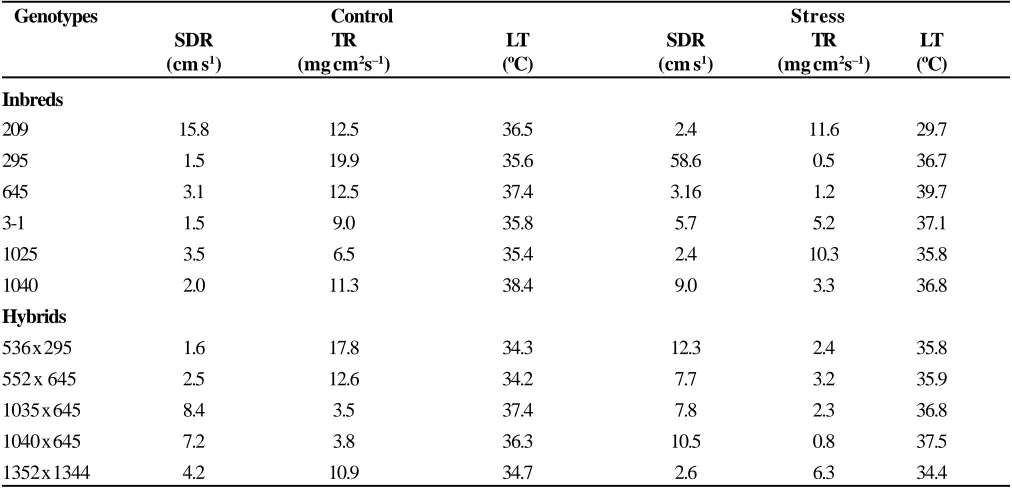
Stomatal diffusive resistance of different genotypes was studied in control and severe stress conditions. Observations were recorded with the help of LI-1600 steady state Porometer of Li Cor Inc in the bright sun light between 11-12 noon for the plants under well watered and stress conditions. Comparative results of the two environments (Table 2) showed that stomatal diffusive resistances increased under severe stress as compared to control. Higher values of stomatal diffusive resistance were obtained for 295, 1025 and 1040 x 645 whereas the line 209 and hybrid 1035 x 645 showed decreased stomatal diffusive resistance under severe stress.
In majority of the genotypes, transpiration rate decreased under severe stress (IR3) as compared to control (WW) and leaf temperature increased by 2-4ºC. Genotypes having moderate transpiration rates and less increase in leaf temperature were considered desirable to some extent (Table 2). Kirkham et al. (1984), Ristic and Cass (1991) supported the similar views. Genotypes viz., 209, 295, 536 x 295 and 1352 x 1344 had more transpiration rate under severe stress but showed less increase in leaf temperature (0.5 – 1ºC). This may be probably due to cooling of the leaf surfaces because of excessive loss of water though transpiration that resulted less leaf temperature which help the plant to tolerate the excessive heat of the sun (Bolanoes et. al. 1993). Some times when the drought prevails for longer period, then excessive loss of water may result in the desiccation injury and damage the crop.
Table 1.
Pattern of variation for different traits in drought tolerant and susceptible genotypes of maize under different drought enviro
nments. Genotypes Anthesis-silking-interval (days) Yield/plant (g) CSI Tolerant I R 1 IR2 IR1 IR2 W W IR 1 IR 2 IR 3 W W IR 1 IR 2 IR 3 Chla Chlb Chla Chlb 3-1 2 5 2 8 55 30 45 10 0.58 0.68 0.63 0.69 2 0 9 2 5 3 5 42 35 28 10 0.62 0.72 0.58 0.65 2 9 5 2 5 2 5 75 30 60 14 0.58 0.56 0.75 0.82 5 3 6 2 4 4 8 50 30 38 10 0.56 0.69 0.58 0.62 1025 2 4 2 5 85 65 74 20 0.69 0.75 0.85 0.80 1035 2 6 3 8 70 50 62 20 0.62 0.60 0.78 0.84 1040 1 3 4 8 80 25 44 10 0.50 0.68 0.72 0.80 1324 1 3 3 5 78 30 48 15 0.52 0.58 0.65 0.72
536 x 295
3 5 3 7 80 50 75 25 0 .6 0 0 .6 5 0 .6 8 0.75
552 x 645
2 4 3 8 90 50 60 25 0 .6 3 0 .6 2 0 .6 5 0.60
1015 x 645
3 6 3 6 90 60 62 25 0 .6 5 0 .7 9 0 .5 9 0.65
1027 x 645
2 4 3 7 82 50 58 21 0 .6 0 0 .8 0 0 .7 2 0.79
1035 x 645
3 6 4 7 84 48 54 17 0 .5 2 0 .5 2 0 .8 9 0.82
1040 x 645
1 4 3 8 85 50 62 25 0 .5 2 0 .5 6 0 .7 2 0.75
1094 x 1324
2 3 3 6 1 0 0 53 62 20 0 .5 5 0 .7 2 0 .5 8 0.65 Susceptible 88 3 6 3 12 60 28 50 0 0.36 0.35 0.52 0.50 4 6 4 4 -6 -70 0 40 0 0.25 0.25 0.48 0.52 5 5 1 2 5 3 12 80 10 45 0 0.30 0.35 0.39 0.45 6 4 5 3 5 3 -45 20 36 0 0 .32 0 .24 0 .50 0.62 1344 4 6 5 -87 28 56 6 0 .35 0 .28 0 .42 0.54 1351 3 8 4 15 80 20 45 0 0.30 0.32 0.46 0.49
1352 x 1344
3 5 2 8 75 28 40 0 0 .4 8 0 .3 5 0 .4 5 0.48
1011 x 645
3 6 4 12 82 35 65 15 0 .5 0 0 .4 8 0 .5 9 0.52 GM 2.39 4.91 3.26 8.00 75.00 35.87 52.57 12.52 Range 1 -4 3 -8 2 -6 5-15 42-100 0-65 28-75 0-25 S E m 0.21 0.40 0.21 0.55 6.50 5.39 6.38 2.03 C V 15 14 11 12 15 26 21 28 C D 5 % 0.57 1.09 0.57 1.52 17.84 14.79 17.51 5.56
Table 2. Stomatal diffusive resistance (SDR), transpiration rate (TR) and leaf temperature (LT) under control and severe stress conditions in drought tolerant and susceptible genotypes of maize
Genotypes Control Stress
SDR TR LT SDR TR LT
(cm s1) (mg cm2s–1) (ºC) (cm s1) (mg cm2s–1) (ºC)
Inbreds
209 15.8 12.5 36.5 2.4 11.6 29.7
295 1.5 19.9 35.6 58.6 0.5 36.7
645 3.1 12.5 37.4 3.16 1.2 39.7
3-1 1.5 9.0 35.8 5.7 5.2 37.1
1025 3.5 6.5 35.4 2.4 10.3 35.8
1040 2.0 11.3 38.4 9.0 3.3 36.8
Hybrids
536 x 295 1.6 17.8 34.3 12.3 2.4 35.8
552 x 645 2.5 12.6 34.2 7.7 3.2 35.9
1035 x 645 8.4 3.5 37.4 7.8 2.3 36.8
1040 x 645 7.2 3.8 36.3 10.5 0.8 37.5
1352 x 1344 4.2 10.9 34.7 2.6 6.3 34.4
Lines were having variability in yield potential. Under different stress condition, all the genotypes showed reduction in yield. More than 80% reduction was reported in highly susceptible lines while in relatively tolerant genotypes reduction was upto 50%. Some of the lines did not show much difference in yield under normal conditions but in stress conditions, the grain yield of the resistant lines was higher than the susceptible genotypes. Similar findings have been reported by Dass et al. (1999, 2001), Frederick et al. (1989), Ribaut et al. (1997). Under severe stress conditions, lines 209, 205, 536, 1025 (inbreds), 536 x 295 & 1040 x 645 (Hybrids) produced some yield. Hybrids were more tolerant to drought in comparison to inbreds probably due to their strong and vigorous plant type and might be possessing favourable genes for drought tolerance.
Genotypes giving the adaptive value for chlorophyll and other physiological traits were also possessing erect leaves and stay green trait. Because in these lines less leaf surface is exposed to sun which helps in reducing the water losses. Dark green plants also gave lesser reduction in the stress conditions. This suggested the role of plant
type in determining the drought tolerating ability. The drought tolerant lines selected on the basis of physiological traits can be used in the future breeding to constitute germplasm population for identification of productive and drought tolerant lines, increase the level of resistance among the desirable lines; these lines can be involved in the development of drought tolerant and productive single cross hybrids. Productive and drought tolerant single cross hybrids can be directly used for general cultivation after confirming its potential through multilocational testing.
REFERENCES
Abdel-Rasoul, M.; Gabar, A.I., EI-Zeiny, H.A. and Raffat, A. (1989). Effect of CCC & B-9 at different water regimes on some metabolic aspects of maize plants. Ann. Agri. Sci.
Cairo 33: 49-65.
Arnon, D.I. (1949). Copper enzymes in isolated chloroplasts. Polyphenol oxidase in Beta vulgaris. Plant Physiol. 24: 1-15.
Bolanos, J.; Edmeades, G.O. and Martinez, L. (1993). Eight cycles of selection for drought tolerance in lowland tropical maize. 111. Responses in drought adaptive physiological & morphological traits. Field Crop Res. 31: 269-286.
Dass, Sain, Meena Kumari and Arora, P. (1999). Morphological traits associated with drought tolerance in maize (Zea
mays L.). Ann. Agri. Bio. Res. 4: 193-196.
Dass, Sain, Arora, P., Meena Kumari and Dharam Pal. (2001). Morphological Traits determining drought tolerance in maize (Zea mays L.) J. Agri. Res. 35(3): 90-93.
Edmeades, G.O.; Bolanoes, J., Hernandez, M. and Bello, S. (1993). Causes for silk delay in lowland tropical maize. Crop Sci.
33: 1029-1035.
Frederick, J.R., Hesketh, J.D., Peters, D.B. and Below, F.E. (1989). Yield and reproductive traits responses of maize hybrids to drought stress. Maydica. 34: 319-328.
Gutierrez-Rodriguez, M., San-Miguel-Chavez, R. and Larque-Saavedra-A. (1998). Physiological aspects in Tuxpeno
maize with improved drought tolerance. Maydica. 43: 137-141.
Hiscox, J.D. and Israelstam, G.F. (1979). A method for extraction of chlorophyll from leaf tissues without maceration.
Canadian J. Bot. 57: 1332-1334.
Kirkham, M.B.; Suksayretrup; Wassom, C.E. and Kanemasu, E.T., (1984). Canopy temperature of drought resistance and drought sensitive genotypes of maize. Maydica. 29: 287-303.
Ristic, Z. and Cass, D.D. (1991). Leaf anatomy of Zea mays L. response to water shortage and high temperature : a comparison of drought resistant and drought susceptible lines. Botanical Gazette Chicago. 152: 173-185.
Ribaut, J.M.; Hoisington, D.A.; Deutsch, J.A.; Jiang, C. and Gonzalez-de-leon, D. (1997). Identification of quantitative trait loci under drought conditions in tropical maize. I. Flowering parameters and the anthesis-silking-interval.