AN IMPROVED HAZE REMOVAL METHOD FOR THE APPLICATION OF GEO-GRAPHICAL DATA ANALYSIS
Anju J. Prakash, A. Ferdin and Christopher
Deptartment of Computer Science and Engineering, Noorul Islam University, India [email protected], [email protected]
Article received 16.5.2018, Revised 30.10.2018, Accepted 8.11.2018 ABSTRACT
The images taken in ghastly climatic conditions is a lot tainted owing to the occurrence of haze. It may also affect heavily, such images used in the ground of computer visualization, object recognition etc. As an aim to resolve this problem in this paper a better image enhancement as well as classification method is employed. The projected work takes benefit of SVD as this solo value allow us to characterize the picture with a minimal set of value that shrink storage space and progress the quality. For a superior quality and feature improvement a rate-based alteration is completed with the help of gaussian filter. The eventual dehazed image is then classified using an improved knn as part of geographical data analysis.
Keywords: Gradient, Artifacts, Hazy image, Halo effects.
1. INTRODUCTION
Effective haze removal has grown to become a highly demanded area in the field of image recognition. This work proposes a novel approach that deal with foggy image enhancement and classification in a sophisticated way and generate a better efficient output than all the presented system so far.
2. EXISTING METHODS FOR HAZY
IMAGE ENHANCEMENT
Existing hazy image enhancement method inclu-des single image approaches as well as multiple image approaches. Some approaches (Kopf et al., 2008) are not apt for real world due to some controls imposed on the acquisition of scene depth information.
Multiple image approaches (Schechner et al., 2003) took additional images of the same sight, which are captured with the help of special hard-ware devices, like polarizing filter, to build upthe scene depth information of foggy images. But, the use of these multiple image approaches usually requires either unnecessary hardware expense or extra special devices.
In the recent years only, studies started focus on single-image approaches. Tan (2009) came up a with a method that restore foggy imagery through single-key image by maximizing the local dispa- rity of the image. After comparing the clear image with the foggy image (Tan, 2009) enhanced the image by maximizing the local contrast of the restored image.
Rannan Fattal, (2008) then came up with the esti-mation of scene radiance and from that obtained the transmission image. But this method could not process gray level images as it lacks color infor-mation.
Xu et al., (2012) also employed dark channel prior method but it used fast bilateral filter to get maximum efficiency. It is obtained by replacing the time-consuming soft matting part.
Kaiming and Jian, (2011) proposes an advanced guided filter method to improve the efficiency when working with video. In the fattal’s,2008 method an image deprivation model is designed which is able to handle smallest input image. Tarel and Hautiere, (2009) came up with a new algorithm which is able to handle gray level and colour but it proved to be complicated dealing with real images.
He, Sun and Tang, (2011) introduced a new image enhancement technique using dark channel prior. In this method there exist no surface shading in the key image and the output image is free of halos Tan, 2009). It can analyze the thickness of haze, but it may not work for some particular images like images having sun rays present. Ancuti’s (2013) method first introduced the deco-mposition method where image is decomposed into 2 parts where the most significant features resides in one layer.
Li (2012) idea of gradient enhancement first intro-duced where the method of dynamic range com-pression caused the enhanced image becoming dark.
2.1 EXISTING METHODS FOR DEHAZING-DRAW-BACKS
Zetian (2016) clearly stated that manipulating or enhancing the gradient makes low-dynamic range image into high-dynamic range. After restoration the image becomes shadowy or over exposure so that it diminishes and affects the quality of the entire image. As a remedy a simple linear dyna-mic range compression is used but will slightly
blur part of the details as well as the quality of the image. Zetian also suggested an improved color correction method so that an optimal quality wise enhanced dehazed image can be obtained. So in the proposed work an improved hazy image enhancement is used for edge preservation and tone mapping in HDR images (Zetian, 2016).
Fig 1: Steps in classification 2.2 EXISTING METHODS FOR
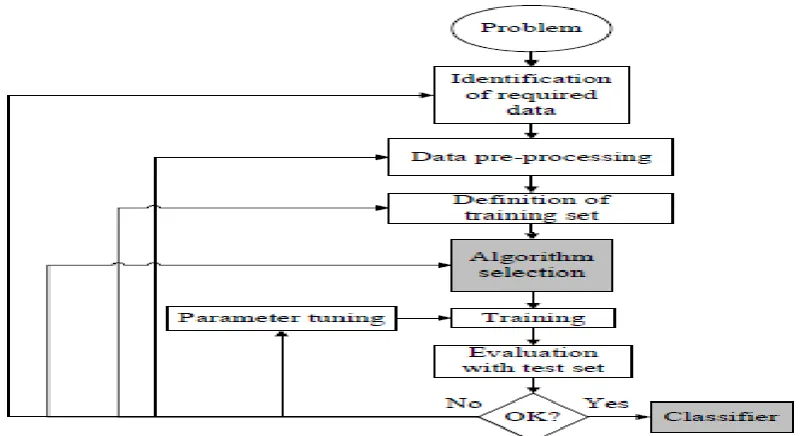
CLASSIFI-CATION DRAWBACKS: There are many exist-ing methods which works well on image classi-fication including supervised as well as unsuper-vised method. In the unsuperunsuper-vised classification the classification is done without the help of a trained data set. But in the case of supervised classification trained data set is used for finding out in which class it belongs and when compared supervised classification yields better result. Such a type of supervised classification step is depicted in fig 1.
The first and foremost step in any image classification is the data acquisition. After that the collected data is filtered, pre-processed or enhan-ced. Then it is trained by feature extraction. From the trained data set by giving an input we can find out in which class it belongs to.
K-nearest Neighbor rule (KNN) has been one of the most well-known supervised learning algori-thms in pattern classification, since it was first introduced (Fix,1951). The Nearest Neighbor rule (NN) is the simplest form of KNN when k=1. KNN has several advantages: simplicity, useful-ness, intuitiveness and competitive classification performance in many domains. However, the number of available samples in real applications is usually too small to obtain a good asymptotic
performance, which often leads to dramatic degra-dation of the classification accuracy, especially in the small sample size cases with the curse dimen-sionality (Fernandez, 2008) and existing outliers (Fukunaga, 1990). If k is very small, the local esti-mate tends to be very poor owing to the data sparseness and the noisy, ambiguous or mislabe-led points. In order to further smooth the estimate, we can increase k and take into account a large region around the query. Unfortunately, a large value of k easily makes the estimate over smoo-thing and the classification performance degrades with the introduction of the outliers from other classes. To deal with the problem, the related rese-archworks have been done to improve the classi-fication performance of KNN.
in the proposed work are 1) image dehazing 2) image enhancement 3) classification
Fig 2: Work Flow of proposed system
3.1 IMAGE DEHAZING: Image dehazing is done like the method mentioned in(Zetian, 2016). The original hazy image is converted into a CIE-LAB color space. By using weighted least square filtering (WLS) decompose the input image into one detail and two base layers. Enhance the cont-rast of two detail layers in gradient domain. Reco-nstruct the detail layers in gradient domain and synthesize the two reconstructed detail layers and gamma corrected base layer. The resultant is a dehazed image.
3.2 IMAGE ENHANCEMENT: Image
enhance-ment includes two main techniques. 1. Abetter compression suggested in Zetian, (2016) and an improved color correction technique. Here in the reconstructed dehazed image in order to reduce over enhancement a lossy compression is applied. In general, a singular value decomposition method which is applied can alter matrix A into product USV transpose, which allows refactoring a digital image into three matrices. This will help in repre-senting the image with a minimal set of values and also reduces noise, storage, improves quality and conserve valuable features of the original image.
Fig 3: Representation of SVD
Where U=orthogonal matrix whose columns are left singular vectors, S=crosswise matrix with singular values crosswise and V=orthogonal mat-rix whose columns are left singular vectors.
As part of value-based color correction we are employing a color correction method using Gaus-sian filter which is highly used for detail enhan-cement and tone mapping in HDR images (Chang, 2016). After applying the Gaussian filter Gradient is considered. According to the gradient or direct-ional change the reflectance as well as illumine-nce are updated with the help of 2D fourier trans-form and beta-gamma value correction respect tively.
3.3. CLASSIFICATION: As mentioned by Fukunaga (1990) if k is very small, the local esti-mate tends to be very poor owing to the data spar-seness and become noisy. To deal with this, the related researchworks have been done to improve the classification performance of KNN Inorder to overcome the disadvantages we have introduced a weighted voting scheme for KNN, called the wei-ghted k-nearest neighbor rule (WKNN). In WK-NN, the closer neighbors are weighted moreheav- ily than the farther ones, using the distance-weighted function. The weight wi for i-th nearest neighbor of the query x′ is defined as follows:
Then, the classification result of the query is made by the majority weighted voting.
4. RESULTS
Test image 1: mountain Test image 2:forest
Fig 4: Test input 1 a) Hazy image b) Dehazed image c) improved image
e) Rail/Road f)Tree-fog h) Mt./Grassland
`
i) Rail/Road i) Rail/Road
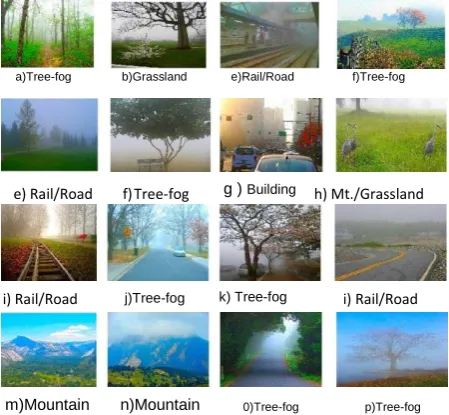
Fig 5: Classification result of dehazed image
a)Tree-fog b)Grassland e)Rail/Road f)Tree-fog
g ) Building
j)Tree-fog k) Tree-fog
4.1 COMPARISON WITH PREVIOUS WORKS: Quality analysis is done with the help of 3 main descriptors. e= rate of new visible edges (%), ṝ=mean ratio of the gradient at obser-
vable edges or quality ofcontrast renovation,σ =% of saturated pixels. For a high-quality image high values of e and ṝ and low values of σ are anticipated.
Table 1: Indicators computed on the image
RESULT OF IMAGE 1 RESULT OF IMAGE 2
e(RATE) σ(%) ṝ(RATIO) e(RATE) σ(%) ṝ(RATIO)
Fattal [9] 0.04 0.01 1.3 0.07 0.79 1.95
Tareal & Harutiere [10] 0.02 0 2.09 0.13 0.01 1.97
He et al., [11] 0.08 0.01 1.33 0.14 0.01 1.12
Ancuti & Ancuti [12] 0.07 0.01 1.19 0.01 0.03 1.07
Li et al., [13] 0.04 0 0.77 0.28 0 0.85
Zetian [1] 0.08 0.02 1.43 0.08 0.02 1.34
Ours 0.12 0.0009 1.16 0.24 0.0016 0.8
Quality evaluation ensures that the plan of the improvement technology is to enhance the cont-rast with no oversaturation and trailing much image information. The indicator e computed by our method maintains a comparatively higher value in the 2 test input images that is shown in Table 1.Single value decomposition works as an algorithm which prevent over saturation and Gau-ssian filter enabled color correction helps in boun-dary protect smoothing and as a outcome more edges becomes visible(high value for e).All the measured technique together with our’s (except Fattal’s,2008) in forest image yield small values close to zero for σ descriptor. The descriptor prod-uces a small value like other method (Tarel and Hautiere, 2009), while this sightless judgment did not take specious boundaries and artifact into
report. For ratio of contrast restoration a value higher than 2 was obtained only in Tarel and Hau-
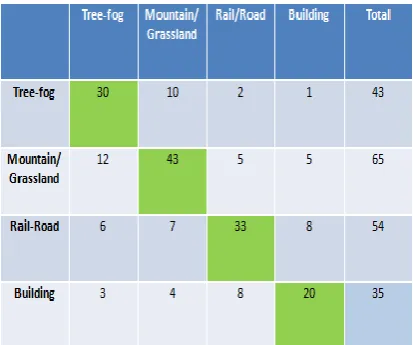
Fig 5: a) Confusion matrix before dehazing
tiere, (2009) but it performs poor in obtaining e value (rate of new visible edges).From the desc-riptor values in Table 1 it is clearly evident that our proposed work yields a good result especially in terms of e value.
4.2 MODEL EVALUATION USING
CONFU-SION MATRIX: In order to analyze the perfor-mance of a training data set we are using confu-sion matrix. For the evaluation training data set of 274 hazy images are taken. Hardware requireme- nts include Processor: Intel core i5 7200U CPU, Clock speed:2.50 Ghz, 16 GB RAM. Categories for classification are 1) Tree-fog 2) Mountain/ Grassland 3) Rail-road 4) Building. As depicted in fig 5 performance evaluation is done using confu-sion matrix. From the values obtained, it is clear that classification was done in a better way after dehazing ie more categories are classified corre-ctly.
b) Confusion matrix after dehazing
5. CONCLUSION AND FUTURE WORK In this thesis we have presented an improved image dehazing & traffic information mining sys-tem as a purpose of metropolitan computing. When compared to the recent methods in single image dehazing we have introduced an advanced image dehazing technique. We also defined an advanced color correction method using gaussian filter that shares the nice property of edge-prese-rve smoothing by removing almost all the block artifacts. In this paper, we present a new distance-weighted k-nearest neighbor rule. In our approach, we concentrate on dealing with the sensitivity of different choices of k, with the goal of improving the classification performance. As an upcoming work filter applied for pre-processing as well as edge protection can replace with a superior one having minimal time utilization.
6. REFERENCES
Ancuti, C.O. and C. Ancuti, Single image dehaz-ing by multi-scale fusion. IEEE Trans. Image Process 22 (8): 3271–3282 (2013).
Arunkumar R. and Nagraj Balakrishnan, Medical image classification for disease diagnosis by DBN methods. Pak. J. Biotechnol. 14(1): (2017).
Chang Liu and Zhaowei Shang, An adaptive tone mapping algorithm based on gaussian filter, IEEE International conference on cloud Com-puting and big data (2016).
Fattal, R., Single image dehazing. ACM Transac-tions on Graphics (TOG) 27(3): 72 (2008). Fern´andez F. and P. Isasi, Local feature
weight-ing in nearest prototype classification. IEEE Transactions on Neural Networks 19(1): 40-53 (2008)
Fix, E. and J.L. Hodges, Discriminatory Analysis, Nonparametric Discrimination: Consistency Properties,Technique Report No. 4, U. S. Air Force School of Aviation Medicine, Randolf Field Texas Pp. 238-247 (1951)
Fukunaga, K., Introduction to Statistical Pattern Recognition, second ed., Academic Press, (1990).
He, Kaiming, Jian Sun and Xiaoou Tang, Single image haze removal using dark channel prior. IEEE Transactions on Pattern Analysis and Machine Intelligence 33(12): 2341-2353 (2011).
Kaiming He, Jian Sun and Xiaou Tang, Guided Image Filtering. IEEE Transactions on Pattern Analysis and Machine Intelligence 35(6): 1397-1409 (2013).
Kopf, J. et al., Deep photo: Model-based photo-graph enhancement and viewing. ACM Trans. Graph. 27(5): 116-1–116-10 (2008).
Li, W.J., Gu, B., Huang, J.T., et al., Single image visibility enhancement in gradient domain. IET Image Process 6(5): 589–595 (2012). Narasimhan S.G. and S.K Nayar, Contrast
restoration of weather degraded images. IEEE Trans.pattern Anal. Mach. Intell. 25(6): 713-724 (2003).
Rannan Fattal, Single Image Dehazing. ACM Transactions on Graphics (TOG) 27: 72 (2008).
Schechner, Y.Y., S.G. Narasimhan and S.K. Nayar, Polarization based vision through haze Appl. Opt. 42(3): 511–525 (2003).
Tan, R.T., Visibility in Bad Weather from a Single Image, Proceedings IEEE Conference on Computer Vision Pattern Recognitions, pp. 1–8 (2008).
Tarel, J.P. and N. Hautiere, Fast visibility restoration from a single color or gray level image, IEEE 12th Int. Conf. on Computer Vision Pp. 2201–2208 (2009).
Xu, H., J. Guo, Q. Liu, and L. Ye, Fast image dehazing using improved dark channel prior, Proc. IEEE Int. Conf. Inf. Sci. Techno. Pp. 663-667 (2012).