(PLATES 17-27)
D URING THE SPRING and summer of 1979 excavation at Corinth was continued in areas probed during 1978.1 Work was limited to the south side of the Roman Forum and was focused within the South Stoa, within the Southeast Building at the east end of the stoa, and along the north side of the Punic Amphora Building to the northwest of the west end of the stoa.
The investigations connected with the South Stoa now show that during the Greek period a stairway to the second floor had been built against the west end wall of the stoa colonnade, that the service rooms behind storerooms II through XXXII of the stoa were built late within the 3rd or in the 2nd century B.C., and that the date of finds
within a newly found pre-stoa reservoir south of storeroom XXI, destroyed, apparently, when the stoa was built, agrees with the date of the latest such deposits excavated at the west end of the stoa. Discovery of the reservoir supplies an argument for construc- tion of the stoa later than the mid-4th century, or perhaps as late as the 320's B.C.2
'The effective operation of the excavations of the American School of Classical Studies in Corinth over the years has been much the result of the help offered by the Greek Archaeological Service. Thanks for this cooperation, good will, and interest in the past and continuing during 1979 are here gratefully extended to Dr. N. Yalouris, Inspector General of Antiquities, and to Mrs. K. Krystalli-Votsi, Ephor of Antiquities of the Argolid and Corinthia.
I record gratitude as well to Prof. H. Immerwahr, Director of the American School of Classical Studies at Athens, for his aid and advice in all aspects connected with the operation in Corinth. His attentions have made my labors both more pleasant and more productive.
Excavation could not be conducted with its present standard of efficiency without the unfailing cooperation and enthusiasm of the Corinth staff, especially of Dr. N. Bookidis, Secretary of the Corinth Excavations. Others of that staff this past year were S. Bouzaki, conservator, N. Didaskalou, A. Pa- paioannou, and G. Arberores, pot-menders, and Ph. Notes, excavation foreman. D. Lewis made; innumer- able pot profiles; Ioannidou and Bartzioti did the end of the season photography.
I also acknowledge with gratitude the work that was done by members of the American School who dug at Corinth during the spring of 1979: Misses J. Bentz, C. Dufner, J. Evans, M. Margolies, N. Moore, S. Morris, M. Payne, and A. Steiner, Messrs. V. Hanson, N. Kennell, D. Levine, W. Murray, T. McNiven, S. Oberhelman, and B. Strauss, and Mrs. D. Kazazis.
Summer excavation within the Roman Southeast Building exposed what Roman remains and cuttings were still unexcavated after probes made in the summer of 1978. Again I owe thanks to M. Katzev for his careful work during the 1979 season. Many fragments of fresco, including pieces decorated with large- and small-scale human compositions and architectural motifs were recovered. A complete study of the frescoes is being undertaken by Dr. U. Pappalardo.
2G. R. Edwards, Corinth VII, iii, Corinthian Hellenistic Pottery, Princeton 1975, p. 197. Much of the east end and the middle section of the South Stoa had been cut into the high bedrock of the area. See, for example, Fig. 3, section A-A. In the process of leveling the site for the construction of the stoa, much of the latest occupation material there was cut away and removed. At the west end, however, the stoa was built over the lower ground of the upper Lechaion Road Valley. Here construction fill had to be dumped in over the latest occupation levels of Buildings II through IV in order to bring the area up to the stoa floor level. As a result the latest material was preserved at the west end of the stoa while not at the east. Only
Hesperia 49, 2
American School of Classical Studies at Athens is collaborating with JSTOR to digitize, preserve, and extend access to
Hesperia
108 CHARLES K. WILLIAMS, II
In connection with the work within the stoa, Building IV which underlies the east end of the South Stoa was further explored. As last year, again this year the foundation blocks of the structure were found to have been eliminated totally from their trenches. A cement floor, however, with central pebble-mosaic panel was discovered partially in- tact in one room on the north side of the building. In the southwest quarter of that room stands the wellhead for well 1979-2. The shaft was not cleared this year because of lack of time. More work is to be done in this area.
Northwest of the South Stoa, excavation within the northeast corner of the Punic Amphora Building clarified the shape of the northeast corner of the structure. At the same time the south side of a building to its north was exposed. Some pottery from a well and earth floor are, at present, the only datable finds yet recovered from destruc- tion levels associated with the structure.
The present report does not include in it a discussion of the excavation carried out within the Southeast Building. That work will be presented separately.
PUNIC AMPHORA BUILDING AND ITS NORTHERN NEIGHBOR
(Fig. 1, P1. 17:a)
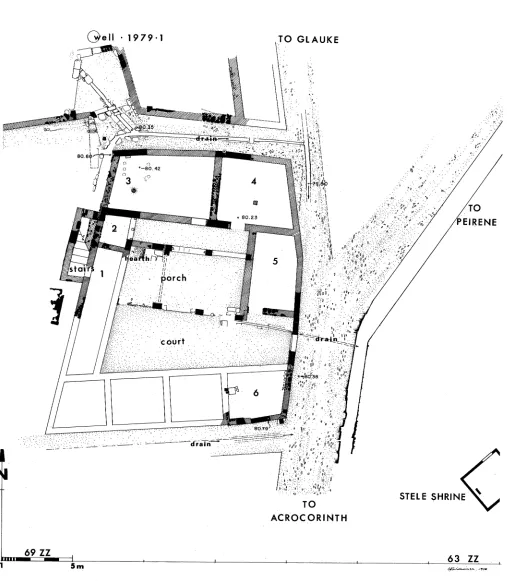
The Punic Amphora Building, investigated during the 1977 and 1978 excavation seasons, was further examined during the spring of 1979.3 A correction to the plan presented in the 1978 report can be made because of this new work: the north wall of room 4 of the Punic Amphora Building was clearly revealed this year, although in a poor state of preservation; the east wall has also been identified, although less clearly so
(Fig. 1).
What had originally been thought to be the north wall of room 4, a line of badly disturbed rubble, is in fact the north wall of an earlier building that underlies the Punic Amphora Building. The preserved top of this earlier wall is flush with the floor of room 4 of the later building. The north wall of the Punic Amphora Building is, itself, a line of poros blocks bedded on earth and built against the north face of the earlier rubble wall.
The east wall of room 4 was traced this year as a line that veers northwest from the fragment of fieldstone wall hypothesized last year to be the east wall of that room (see plan, Fig. 1). The fieldstone wall, in reality, is a north-south wall of the building that underlies room 4 of the Punic Amphora Building.
The two early walls previously identified as belonging to room 4 are part of a structure of the Early Protocorinthian period. The date for the use of this early building has been deduced from pottery excavated in levels below the floor of room 4, some
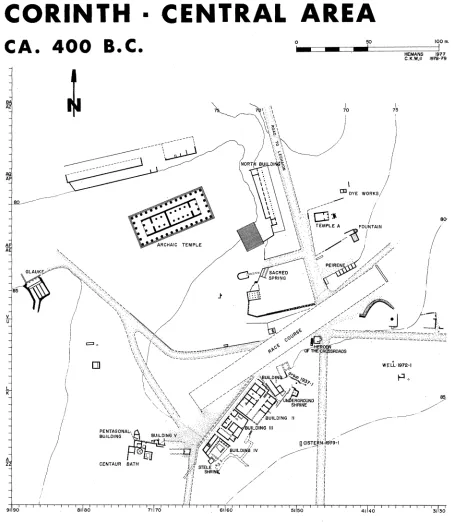
well 1972-1, datable within the third quarter of the 4th century B.C. (see plan, Fig. 2) but excavated after
Edwards' pottery study, and one reservoir, cistern 1979-1, have yet produced extensive evidence for occupation of the eastern part of the stoa site after the middle of the 4th century.
Well 1972-1 lies half north of and half within the rock-cut foundation trench that held the blocks for the north stylobate of the South Stoa. This well was immediately north of Ionic column 4 of the colonnade. The cistern is from the area south of South Stoa service area XXI. See below, p. 121.
Qell 1979 -1 TO GLAUKE
(IA~~~~~~~~~~~~~~~~~~~~~~~~~~~~~~~~~~~~~~~~~~~
80.6&'t- 1\
49~
~14
_r~~~~~~
4TO
I: PE EIRENE
1 / . ~porch" - ,
,/<
t 14 6 jSl ' E
'~~~~~~~~~~~~~:O" ' J
0 $0 - it- t _ =----
- ~. A- U
2C ?
0
TO , ~-.t,<,:~.STELE
SHRINEK
TOV
ACROCORINTH
69 ZZ ZZ
Sm
110 CHARLES K. WILLIAMS, II
sherds from one bottle-shaped storage pit,4 some from a rectangular pit, and others from a deep circular pit.
As last year, again this year large segments of fish scales were found on the earth floor of room 4.
North of the Punic Amphora Building runs an east-west road. The road, two meters wide, has a cut-poros drain sloping toward the east, laid along its center line. The drain emptied its water into a north-south drain that is built into the center of the street that passes along the east side of the Punic Amphora Building (Fig. 1). This street is restored in the plan as being ca. two meters wide. Its exact width, however, has yet to be established. A width of two meters is attested for the roads at the north and south sides of the Punic Amphora Building and thus is used also for the street east of the building.
Thus far only the southernmost walls of one structure north of the Punic Amphora Building have been cleared, with the possibility that a second building exists to the west of the first. Very little of the interior of the structure north of the Punic Amphora Building has been investigated. This building was found to have less protective fill over it than its southern neighbor had had. In fact, because of the poor condition of the walls and the closely superimposed use levels, it is hard to discuss in precise detail the stratigraphy of the area. Still, two building phases have been distinguished, although their levels are not in such clear relationship one to the other that restored phase plans can as yet be made.
The house north of the Punic Amphora Building has its carriage entrance opening from the east-west road that separates it from the Punic Amphora Building (P1. 17:a). The south exterior wall of the house is preserved at foundation level and, in places, for one course above the socle, except at the southeast exterior corner of the building where the walls, floor, and foundations are totally missing. In the plan (Fig. 1) this corner is restored to be in line with the east wall of the Punic Amphora Building.
The carriage entrance to the house is 10.50 m. west of its hypothetical southeast corner. The entrance gives access to a small court across which is built a drain (P1. 17:a). This drain passes under the threshold of the carriage entrance and empties into the street drain. The drain within the house, still not completely understood, was designed to carry off water from around the house well, well 1979-1, and was used even after the well went out of use.
Well 1979-1 belongs to the first phase of use of the house; it was sealed by a hard, poros-chip floor at the end of that phase. The contents were disappointing. Very little was recovered from the well except for Corinthian roof tiles, building debris, and over half of the basin -of a Corinthian-made perirrhanterion, C-1979-53. The well apparently was the depository for debris after some disaster by fire, perhaps after the earthquake of
420 B.C.5 Sealed with fill between the floors of phases one and two of the well room was
found a Corinthian-made imitation of an Attic bolsal, 1.
Almost all evidence that might have been gained in excavation of the room immediately east of the court has been eliminated by a Byzantine bothros that later was sunk from levels over the room down into bedrock. In the southeast corner of the building were found two Corinthian kotylai, 2 and 3. Although the finds from this house supply a meager sample, the evidence points to use in the middle of the second half of the 5th century, and suggests a destruction not later than 420 B.C. for phase one
of this newly found building.
A second exterior door for carriages is preserved opening onto the road north of the Punic Amphora Building. This door stretches in a north-south direction and blocks any westward continuation of the road north of the Punic Amphora Building. This entrance may be for a separate residence, but little can be said about the possibility of a third building in the vicinity before expanding the excavation.
POTTERY FROM BUILDING NORTH OF THE PUNIC AMPHORA BUILDING
1. Corinthian bolsal P1. 17
C-1979-40. H. 0.046, D. of foot 0.06, D. of lip 0.107 m.
Flaring ring foot, inner face in continuous curve with undersurface. Wide body above foot; upper wall rises in slight flare to tapered vertical lip. Hor- izontal loop handles in early horseshoe form. Re- served undersurface with dot and two concentric circles. Bolsal floor stamped with four linked palm- ettes, framed by two incised concentric circles.
Close to B. A. Sparkes and L. Talcott, The Athe- nian Agora, XII, Black and Plain Pottery, Princeton 1970, no. 541, figs. 6, 22, ca. 420 B.C. Later than M. Z. Pease, "A Well of the Late Fifth Century at Corinth," Hesperia 6, 1937, pp. 274-275, no. 41. The contents of the well are dated between 460 and 420 B.C.
2. Corinthian semiglazed kotyle. P1. 17
C-1978-230. H. 0.070, D. of foot 0.049, D. of lip 0.093 m.
Small flaring ring foot, slightly convex walls with maximum diameter at tapered lip. Two hori- zontal loop handles attached immediately below lip. Undersurface with central dot and one ring, line on body above foot. Upper two thirds of body glazed. Thin red band below handles, wider band below lip on interior.
Cf. H. Palmer, Corinth, XIII, The North Ceme- tery, Princeton 1964, pp. 256-257, no. 374-1, third quarter of the 5th century.
3. Corinthian semiglazed kotyle. P1. 17
C-1978-231, H. 0.078, D. of foot 0.054, D. of lip 0.094 m.
Small flaring ring foot, body convex, less flaring than C-1978-230. Maximum diameter at tapered lip. Two horizontal loop handles just below lip. Paint poorly preserved. Line just above foot. Up- per two thirds preserves trace of glaze.
Cf. Palmer, Corinth XIII, p. 253, pl. 58, no. 364-5, dated within the third quarter of the 5th century.
PREDECESSOR OF THE SOUTH STOA
Building IV (Figs. 2 and 3, P1. 18)
Building IV6 lies beneath the west end of the South Stoa, extending from Ionic pier 32 to the west end wall of the colonnade. Over half of Building IV was excavated in the 1978 season. At that time a four-sided cellar, dug almost two meters into the soft bedrock of the area, was completely cleared. A stairway was cut into its south wall.
112 CHARLES K. WILLIAMS, II
CA*
400B.C.
HEMN5097C, . KWHI 1978-?9
BA
71 70~~~~~~t 75
- - - - - ~~~~~~~NORT BU D
APH
H~~~~~~~3 DYE WORKS/
TEMPLE A FOUNTAIN
A~~~~~~~~~~~~~~~~~~~~~~~~~~~~~~~~~~~~~~~~~~~
AE
PEIREN
GLAUK
;~~~~~~~~~~~~~~~~~ACRED.
SPRINE
85~~~~~~~~~~/I BILIGI
u~~~~/ PNTGNLN I
7~~~~~~~~~~~~~~~~~~~~~~77
9180 BI/SO 71170 BIIBO 51150 ________________________H____SROAD L
BUILDING - - - -- - - -- - -- IV- BUILDING II
.780.15
weil 79-2_ wll7
I ~~~~~~80. -7I2 . ...well
.79.46 II L-~~~~-- - -- - -- - -? -- - -- - - - ---
ii~~~~~~~~~~~~~~~~~~j
-1 -~~~~~~~~~~~~~~~~~~~~~~~~~~~--- - .- ~ ~ ~ ~ ~ ~ ~ ~ ~ ~ ~ ~ ~ ~ -- --- ---
STELE SHRINE
-i8O. 41FLOORL 78.50 L8-I 1.IJ I
FL. 81.16 well 33- 9',-.,.. ei
~~~~~~~~~0
~~~~~~~~~~~~~~~~80.38 ?9 ~ Hwell
72.5
I 1 ~~~8I ~ 08FLOORQ 80.28 --
N RESERVOIR. SYS
114 CHARLES K. WILLIAMS, II
The cellar appears not to have been roofed; at least no evidence has yet been found to indicate that it had been covered. It was not paved or stuccoed, nor was it equipped with a drain. A trench ca. 0.90 m. wide surrounds the cellar. This probably held the blocks of a foundation for a peristyle, of which little can be said because nothing remains in situ of its original fabric. Only groups of shallow stone foundations remain along the outside edge of this trench, probably indicating where the columns or piers once stood.
Because of the work done in 1978, one can now see that the deep foundation trench for the colonnade existed only on the north, south, and east sides of the cellar. No trace of any deep foundation trench has been found on the fourth side. Excavation has determined, instead, that the foundation trench on the north side of the cellar continues without interruption or branching to the west end of Building IV, rather than turning to enframe the cellar on its west side. What in 1978 had been thought to be the foundation trench on the fourth side is in fact the edge of a shallow pit associated with the casting pit excavated in 1978.7
A second foundation trench is parallel to and 1.20 m. north of the first foundation trench north of the cellar. This second trench is 1.10 m. wide, or 0.20 m. wider than the first, but like the first it has been completely emptied of its foundation blocks. It probably was originally dug to support a dividing wall between a colonnade on its south and rooms on its north. Traces of one of those rooms has been found in the area now covered by the northwest corner of the colonnade of the South Stoa. A third line of foundation, parallel to and north of the first and second trenches, can be restored here to support the north wall of the building. This trench could not be found, however, because foundations for the colonnade of the Doric portico of the South Stoa would have covered or removed all traces of any such cuttings. The line of the north wall of Building IV can be restored with due certainty, however, since the line would have been continuous with the north facade of Buildings II and III (see plans, Figs. 2 and 3).
Only part of one room has been distinguished in the area between the second and third foundation trenches north of the cellar (Fig. 3). The room is paved with a cement floor that has a pebble-mosaic panel set in it (Pls. 18:b, 19:a) and houses well 1979-2, which at the present moment remains unexcavated. The cement floor of the room has its southwest corner preserved. The cement breaks along a straight line toward the north and toward the east. The break and trace of a slight turn-up in the surface at the break might be restored as the edge of the floor and the turn-up against the wall of the room. The edge of the cement lies between 10 and 15 cm. north of the north edge of the foundation trench that held the blocks for the south wall of this room. At about two and a quarter meters from the corner, following the break along the south side of the room, is preserved the molding for a low, raised platform or dais, only a corner of which is preserved. This projects into the room from the south edge of the cement floor for a distance of about 0.53 m. The dais probably is not for a couch but may be for a bench.
The pebble-mosaic panel is set into the cement floor at 0.87 m. from the south edge of the cement and 0.78 m. from the west edge. The panel is about 1.16 m. wide in its east-west direction. The north edge has been destroyed along with the rest of the north side of the room by the construction of the north stylobate of the South Stoa. A central palmette decorates the south side of the panel, pointing to the northeast corner of the poros wellhead of well 1979-2. The palmette has eleven pointed leaves turning inwards (P1. 19:a). The other floral decoration appears to be honeysuckle, the best preserved example being on the east side of the panel. The whole panel is framed by two lines of white stones. No colored pebbles appear to have been used in the mosaic; at least no such areas are now preserved. The southeast corner of the mosaic panel is in bad repair, a condition that developed during the life of Building IV. Apparently the loosening of pebbles from the cement matrix in this area had bothered the occupants of Building IV enough that they had a thin coat of lime cement put over this part of the mosaic to stop any further deterioration.
By style the mosaic can be dated within the 4th century, although not as late as within the last quarter, for Building IV, in which it was found, was abandoned before the construction of the South Stoa. The form of the palmette used in. the mosaic is to be found on the early 4th-century marble replacement antefixes of the Temple of Poseidon at Isthmia, as well as later on the antefixes of the Temple of Athena Alea at Tegea, of the Tholos, the Temple of Artemis, and the Propylaia at Epidauros, and in terracotta at Delphi and at Corinth, all within the 4th century.8 The inturning leaf has a
81sthmia: 0. Broneer, Isthmia, I, Temple of Poseidon, Princeton 1971, pp. 93-96, pls. 25, 35, 36. These palmettes are very close in shape to that of the mosaic of Building IV.
Tegea: Ch. Dugas, J. Berchmans, M. Clemmensen, Le sanctuaire d'Alea Athena a Tegee, Paris 1924, pls. XLVI, LXXXVI.
Epidauros: Tholos, ca. 340 B.C. G. Roux, L'architecture de lArgolide aux IVe et IIIe siecles avant J.-C.,
Paris 1961, pl. 43; Temple of Artemis, ibid., pl. 50; Propylaia, ibid., pl. 76; the last two are dated 300-270
B.C. All of these Epidaurian designs use nine, not eleven, leaves. Also note the roundness of the whole
profile of the later examples as compared to the more elongated proportions of the palmette used on the Tholos and in the mosaic of Building IV.
Delphi: for palmettes in terracotta, see Ch. Le Roy, J. Ducat, Fouilles de Delphes, II, Topographie et architecture, iii, Divers. La sculpture decorative en terre cuite, Paris 1967, p. 165, esp. note 2 where the form is identified as Peloponnesian, and pl. 58.
Corinth: S-50, a nine-leafed palmette. I. Thallon-Hill, L. S. King, Corinth, IV, i, Decorated Architec- tural Terracottas, Cambridge, Mass. 1929, p. 28, fig. 30.
Other examples of the palmette with nine inturned petals, although not necessarily of 4th-century date, are mentioned here only to show the more than Peloponnesian popularity of the type. Numerous examples exist in Samothrace and Priene:
Samothrace: Anaktoron, P. W. Lehmann, Samothrace 3, The Hieron I, Princeton 1969, p. 187, fig. 145.
Samothrace: Hieron, ibid., p. 178, fig. 131. Note the closeness of the diamond-shaped central petal of the palmette used on the south raking sima to that used in the Sikyon mosaic published by Salzmann. See footnote 10, below.
Priene: Temple of Zeus (Asklepios Temple), soffit, T. Wiegand, H. Schrader, Priene, Berlin 1904, p. 144, fig. 114; raking sima, p. 145, fig. 116.
116 CHARLES K. WILLIAMS, II
longer life than that cited above, appearing on akroterion A of the Parthenon in 5th- century Athens and used as a canonical antefix on the Middle Stoa in the Agora of Athens in the second quarter of the 2nd century B.C.9
Parallels in pebble mosaics are to be found both at Eretria and at Sikyon.10 The Eretria example is dated within the first third of the 4th century, the Sikyon mosaic at the end of the Classical period. The Sikyon palmette is of a style later than that of Building IV. Its axial leaf is not curved but, rather, diamond-shaped at its end. More- over, it uses trumpet flowers as filling ornament, a device not used in the Corinth example.
The mosaic floor of Building IV might best be considered from the above parallels to have been constructed within the first quarter of the 4th century, if it is dated by style. Ceramic evidence is, at the moment, lacking and cannot supply a verification of this date.
THE SOUTH STOA
In the original publication of the South Stoa, 0. Broneer discussed the area along the back or south side of the South Stoa with accuracy and precision, even though late Hellenistic evidence preserved in that area was minimal. With the remains that were exposed at the time, Broneer was able to determine that the whole area had been divided into 31 service units, one for each suite of stoa shops except those at the ends, I and XXXIII. Each service unit housed a latrine, which was drained by the deep east- west sewer that had been dug parallel to and against its back wall: The units were constructed as part of an alteration of the original design of the Stoa, most probably made in the 3rd century B.C. to replace some simpler facility."
Priene: Temple of Athena Polias, on Ionic capital, ibid., p. 93, fig. 60; soffit, p. 104, fig. 73; raking sima using a variant form, p. 108, fig. 78.
Priene: anta capital, ibid., p. 133, fig. 103.
The type is common elsewhere along the coast of Asia Minor; see for example:
Troy: Temple of Athena, raking geison, F. W. Goethert, H. Schleif, Denkmdler antiker Architektur, X, Der Athenatempel von Ilion, Berlin 1962, pls. 16, 32.
For a seven-petal palmette of this type in a house mosaic of the irregular technique (palmette area is in pebble technique) from the area around Qeame, see K. M. D. Dunbabin, "Technique and Materials in Hellenistic Mosaics," AJA 83, 1979, pp. 271-272, note 42, pl. 44, fig. 17.
9Athens: akroterion A from the Parthenon. See I. Mark, "New Fragments of the Parthenon Acro- teria," Hesperia 46, 1977, pp. 241-244, pl. 56. For crowning member of the monument to those who fell at Corinth and Koroneia, 394 B.C., see J. Travlos, Pictorial Dictionary of Ancient Athens, London 1971, p. 239,
fig. 306. Similar design used for palmette of the 4th-century Temple of Apollo at Delphi; see M. F. Courby, Fouilles de Delphes, II, Topographie et architecture. La terrasse du temple, Paris 1927, p. 21, fig. 20, pl. IX. This group is not a single palmette design, but two "half' palmettes meeting. The leaves, however, are of the inturning type used in the Building IV mosaic. The 2nd-century antefixes of the Middle Stoa of the Athenian Agora, however, are of conventional design; see Travlos, op. cit., p. 239, fig. 306.
10Eretria: P. Ducrey, "La maison aux mosafques 'a Eretrie," AntK 22, 1979, pls. 1:2, 2:1. Seven-leaf palmette, from house dated within the first third of the 4th century B.C.
Sikyon: D. Salzmann, "Ein Wiedergewonnenes Kieselmosaik aus Sikyon," AA (JdI 94), 1979, pp. 290-303, fig. 13.
During the 1979 excavation season a concentrated effort was made to define better the functions of the individual service areas behind the storerooms of the stoa. One test had already been made in the spring of 1978; this test indicated that new information could be had by further excavation, even though the latrine areas that had already been excavated to their original floor level had been found to be in extremely poor condition or so overbuilt that little detailed information could be obtained. This year the service areas behind shops XX, XXI, XXXI, and XXXII were selected for excavation because they, of all that were covered by a protective overburden, had the most potential for contributing new information to a more detailed understanding of the service areas.
Service Area, Shop XX (Fig. 4, P1. 19:b)
The Greek service area and storeroom of shop XX had been excavated before the Second World War to below the destruction level dated to the incursion of the Heru- lians.12 At that time the area left undisturbed was at various levels thereunder. Part of the south wall of the Greek service area and the east-west drain to the south had been exposed in the earlier excavation.'3 A small fragment of waterproof cement floor of the pre-Roman phase was found in situ at an elevation of 81.74 m. above sea level, cemented against the toichobate of the east wall of the room. All the rest of the Greek floor appeared to have been destroyed early in the Roman reoccupation of the building. This year the whole of the service area was cleared to its earliest phase. The toichobates of its east and south walls have been revealed, but that of the west wall is missing; in its place are blocks of a Roman rebuilding. No more of the original cement floor was found, but a section of the stone underflooring was found in situ along the south toichobate. It slopes from all directions to a hole cut through the south toicho- bate, one meter from the southeast corner of the room. Water was drained through this from the floor into the east-west drain. For a similar but better preserved example of the same arrangement see the service area behind shop XXXI, where the whole of the subflooring of stone paving is preserved in situ.
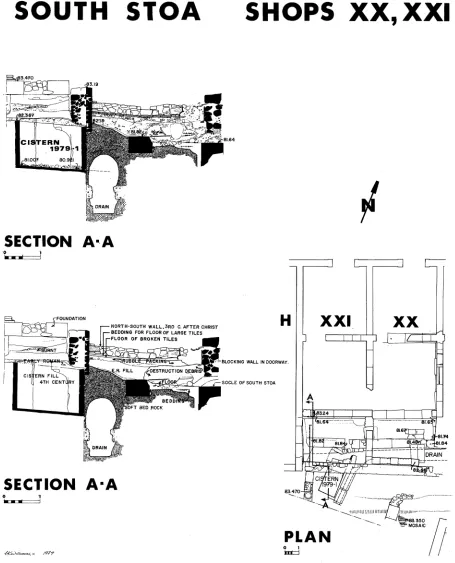
Bedrock supported the subflooring in the service area. The toichobate blocks for both the service area and the storeroom were laid into narrow foundation trenches cut into the bedrock. No Greek strata predating the construction of the stoa were preserved in this area. Apparently bedrock originally rose quite high in this section of the site. Indeed, at about a meter south of the south toichobate of service area XXI bedrock rises to a height of 82.19 m. above sea level, while the toichobate itself is at +81.82 m. (see section A-A, Fig. 4). The elevation of the toichobate of the south wall of service area XX slopes from +81.84 at the east to +81.853 m. at the west. This toichobate level is 20 centimeters higher than the back-wall toichobate of storeroom XX.
Most of the pre-Roman stone subflooring was removed in the Augustan period or slightly thereafter, when it was replaced with an earth packing and bed of sand. Over
12Ibid., pp. 132-138.
118 CHARLES K. WILLIAMS, II
SOUTH
STOA
SHOPS
XX,XXI
583.470
8319
8.387
218~~~~~~~~~~~~~~~16
'81'0;7 so.'
) RAIN
SECTION AkA
'0 i
1=t ~~~FOUNDATION u_vE
FOUDATION - NORTH-SOUTH WALL.3RD C AFTER CHRIST
H
X
XI
X X
BEDDING FOR FLOOR OF LARGE TILES 4.
t . -FLOOR OF BROKEN TILES R... W NT
FILL ;c DESTRUCTION_DEB1 -BLOCKING WALL IN DOORWAY. CIS ERN FILL -
F
4TH CIENT RY SOCLE OFSOUTH STOA
-s ~ ~ ~ ED A e .I I*
81.84
SECTION A
A
8ct70. 1 - ... .
- MOSAIC
PLAN
the sand was laid a layer of coarse sherds embedded in cement, all at an elevation of +81.79 m. This later floor served, apparently, until some extensive alterations were undertaken, at which time a series of north-south foundations was added, perhaps to carry marble slabs for a more elaborate paving of the area. Expansion of the whole suite, described by Broneer in the original publication, dates from this time, for a new back wall to the service area was built between 0.60 and 0.85 m. south of the original south wall of the service area.14
The new south wall of the expanded complex is plastered and decorated with a dado, white speckled with gray to imitate stone, crowned with a black line, two red lines, and another black line. Above the lines the wall appears to have been white. Against this wall, once it was painted, was placed a "bench-like structure."
Service Area XXI (Pl.. 20:b)
The excavation of the service area of shop XXI supplies almost no additional information concerning the original Hellenistic arrangement of the spaces behind the storerooms of the stoa. The toichobate of the east wall of service area XXI has been removed and reset. Bedding for stone floor slabs and one earth floor were found close to bedrock within the service area, but there are no indications that the earth floor was Greek in date. The bedding for the Roman earth floor was in large part of trimmed and ground-up bedrock. This fill covered the footing trenches for the original foundations of the South Stoa.
The original socle and west wall of the service area were completely eliminated, as was the very west end of the south socle of the room, during the construction of room H of the South Stoa. Room H is a Roman redesign of the area originally occupied by South Stoa suites XXII through XXIV. Once built, the new east wall of room H served as the western limit for the area behind storeroom XXI.
Two facts of interest did appear with the complete excavation of service area XXI. The first is that the area has a drainage hole through its south toichobate, as do the service areas of shops XX, XXXI, and XXXII, all cleared this year. The drainage holes all were found to be about one meter west of the southeast corner of the service areas. Apparently the service areas were originally designed to be similar one to another and were altered only later to individual needs.
The second fact revealed by excavation this year is that the first alteration of service area XXI probably was made very early in the life of the Roman colony. The original Hellenistic stone paving was removed and the space was made into a storage room with earth floor, but still entered by the Hellenistic doorway from storeroom XXI. The end of this phase came apparently as a surprise, with the shattering and fire scarring of amphoras and the destruction of utility pots and early Roman fine wares (4-18). Much ash was found covering part of the floor; directly overlying the pottery debris was found a fill of mud brick and Roman roof tiles. Pottery and architectural
120 CHARLES K. WILLIAMS, II
debris were limited to the confines of the room, in fact piled in such a manner as to suggest that the south wall stood for at least a while after the destruction and therefore served to contain the debris within the ruined service area.
An archaeological sequence can be set forth now for the area in the period after the destruction by fire. Suite XXII, the western neighbor of the area under discussion, was modified not long after the fire. The party wall between service areas XXI and XXII was removed and replaced by a new wall built of reassembled wall blocks of the South Stoa.15 This was set within a trench that had been dug through the piled destruction debris in service area XXI before the south wall of that area had been disassembled. Soon thereafter the original south wall of service area XXI was eliminated without further disturbing the destruction debris in the area.
After room H was constructed, the service area behind shop XXI was abandoned, and the doorway from it into storeroom XXI was blocked up. A new east-west wall was erected between 3.25 and 3.35 m. south of shop XXI, not quite parallel to what had been the original south wall of its service area. Although this new south wall was built against and abutted the southeast corner of room H, it apparently had nothing to do with the functioning of the South Stoa. Rather it was designed as a terrace wall for a building that stretched toward the south. The area that was thus defined by this terrace wall, by the east wall of room H, and by the south wall of shop XXI was left open to the sky, with its ground level raised above the destruction debris that still covered the space to a depth of over 0.50 m. above the original service-area floor. The new court now served suite XX, by which it was entered. The south face of the south wall of shop XXI and the blocking of its door were covered with a heavy coat of cement. Slightly later a floor of broken sherds on a rubble bed (P1. 20:b) was laid throughout the area, with tile patches in two places. A later floor was laid over the first, this one on a good cement bedding. The bedding supported large, squared floor tiles and served as the waterproof surfacing for the court until the time of the Herulian disaster.
Area South of Suites XX and XXI (P1. 20:a)
The fill on the south side of the terrace wall has been studied by J. Hayes and dated to the Neronian period.16 With more extensive excavation this year in the area, it has been determined that the lowest Roman stratum excavated, over a newly discov- ered reservoir of the Classical period, is of Augustan date, or perhaps slightly later. The underlying reservoir, cistern 1979-1, had been dug into bedrock and apparently was
15Ibid., pp. 134-145. This is the east wall of Roman Room H, which is dated to the Antonine period; see pp. 142-143. The date is given by a coin of Lucius Verus, found in a drain associated with use of the room. The results of the 1979 excavation, however, suggest that the east wall of Room H was erected in the Neronian period or slightly earlier, not later.
16J. W. Hayes, "Roman Pottery from the South Stoa at Corinth," Hesperia 42, 1973, pp. 416-470,
abandoned in the end of the third or beginning of the fourth quarter of the 4th century
B.C. In its original form the cistern was ca. three by 1.22 m. and oriented almost exactly
north-south. Its walls now are preserved to a height of ca. 1.40 m., but originally the walls may have risen somewhat higher, for no Classical floor levels were found in the area that can be associated with the cistern. All such Classical remains were eliminated by the Roman rebuilding.
The cistern was built of large poros slabs, and the walls were waterproofed with a good, thick coat of cement (P1. 20:a). A cross wall later was built in the east-west direction at 1.75 m. from the original south end of the reservoir, apparently at the time when the South Stoa was built. This new cross wall was built upon the floor of the original cistern but was not stuccoed. It thus did not serve as a new south wall for a truncated reservoir. Rather, it appears, the cross wall served as a foundation for a new house wall that replaced the original north wall of the structure after it was abbreviated by the building of the South Stoa. During this alteration the part of the cistern that lay south of the cross wall was filled with earth, pottery, and figurines from bottom to top, or from +80.92 to ca. +82.35 m. This activity apparently took place in the 330's or early in the last quarter of the 4th century. The latest skyphos from the reservoir fill is similar in shape to C-1975-167, from a pit in Forum Southwest, and to C-1971-105, from the drain between Buildings I and II.
The Roman stratum that sealed the fill of the cistern was hard packed and may have been the floor of a court or a pathway, in use contemporaneously with the storage areas behind shops XX and XXI. Above the hard-packed level was found a softer fill, not the accumulation of use but one dump. This was covered by a stratum of burnt material, pottery and carbon flecks, perhaps a level that should be associated with the destruction of the storage area behind storeroom XXI. This was covered in turn by a second, rather deep fill, the top of which had an elevation of +83.10 m. On this rests a foundation of isolated poros blocks, one of which still supports a marble Ionic column base, connected by rubble foundations (section, Fig. 4). The top of this foundation is at an elevation of ca. + 83.47 m., or at about the same level as a black-and-white tesselated floor preserved six meters to the east and probably belonging to the same house. The rubble and poros-block foundation is similar in construction technique to the south or back wall of suite XX as expanded in the Roman period. The terrace wall, the foundation supporting the marble Ionic column base, and the fragmentary mosaic floor are the only architectural remains that at present can be associated with the complex that extends southward behind suites XX and XXI of the South Stoa. The floor level associated with this building is the top of the fill that is dated by Hayes as Neronian.17
Features other than those described above also indicate that, in this area, the ground level south of the terrace wall was not raised by a single dumping but 'was the result of accumulations at different times. One such element of this rather complex
122 CHARLES K. WILLIAMS, II
stratigraphy is a long east-west trench, ca. one meter wide, which was cleared south of service areas XX and XXI (plan, Fig. 4). This apparently was a foundation trench that had been cut into the soft bedrock for a wall, all blocks of which had been removed in the Augustan period. Thereafter the trench had lain open and abandoned for some time, for the soft rock of the trench sides eroded and collapsed inward, partially filling it. The resultant shallower trench finally was completely buried by the dumping of debris, including cut animal bones, fine and cooking wares, and amphoras. Nothing of the ceramic finds can be dated far into the reign of Tiberius (see catalogue, 16 through 18). From this fill were recovered sherds which have been joined with fragments published by Hayes in his deposit A.18
POTTERY FROM AREA SOUTH OF SUITES XX AND XXI
Debris within Service Area XXI
4. Plate with low foot, Eastern Sigillata P1. 21 B.
C-1979-23. H. 0.023, D. of foot 0.035, D. of rim 0.051 m.
Orange clay (2.5YR 6/7) with much mica, flaked dark orange glaze (2.5YR 5/8) without mica.
Thin rib as ring foot, flat undersurface, low flar- ing wall, flange, vertical wall above with outward thickened rim, rectangular stamp 0.003 by 0.005 m. at center of floor in two lines: M A T / P E 0 Y. The plate has cavetto-molded transition from floor to wall, groove on inside of rim.
Close to example in Neronian deposit in Cor- inth, Hayes, Hesperia 42,. 1973, p. 453, no. 137 (gray clay).
5. Multiridged beaker, Eastern Sigillata P1. 21 B.
C-1979-70. Est. D. of foot 0.048, est. max. D. of body 0.104 m.
Tan clay (2YR 6/6), good but flaking orange glaze (IOR 5/8), fine flecks of mica in clay, more in glaze.
Very small ring foot, undersurface preserving two concentric grooves; horizontal ribs separated each by a raised line, top rib divided from plain vertical rim by two raised lines. Lip is not pre- served.
For examples in Neronian deposit at Corinth, see Hayes, Hesperia 42, 1973, p. 455, nos. 157,
158, pl. 87.
6. Sigillata hemispherical bowl with hor- P1. 21 izontal rim.
C-1979-71. H. 0.04, D. of foot 0.039 m.
Fine, buff-tan clay (5YR 7/4), brownish red glaze (IOR 4/6), no mica.
Ring foot, hemispherical body, flaring rim, top surface grooved. Interior, center of floor missing; inscribed circle at lower bowl wall.
7. Arretine hemispherical bowl with P1. 21 horizontal rim, stamped.
C-1979-72. H. 0.057, D. of foot 0.061 m.
Pinkish tan clay (2.5YR 6/7), reddish glaze (1OR 4/8).
Flaring ring foot with slight bevel on outside, stepped on inside; hemispherical body crowned by outward thickened rim, flat on top, decorated by partially preserved applied fibula spiral. Inside of floor, stamp on center surrounded by circle; sec- ond circle beyond diameter of ring foot. In rectan- gular stamp, in single line:
NAEVI
See A. Oxe, H. Comfort, Corpus Vasorum Arreti- norum (= CVArret.), Bonn 1968, no. 1081.
8. Arretine bowl, Haltern type 11, with P1. 21 horizontal rouletted rim
C-1979-73. Est. D. of rim 0.12 m.
Tan clay (2.5YR 6/6), brownish red glaze (5YR 4/8), no mica.
Double convex body, cavetto between, offset outturned rim. Top of rim convex, groove along lip, rest rouletted. Inside, incised circle at edge of floor.
For type in Neronian deposit at Corinth, see Hayes, Hesperia 42, 1973, p. 430, nos. 58, 59
(Hayes form 17).
9. Brown gritty brittle-ware bowl. P1. 21
C-1979-74. D. of foot 0.047, max. D. of body 0.126 m.
Clay brown to reddish brown on outside upper body, sandy inclusions. Part of outside and core IOYR 5/4, rest 5YR 5.5/5.
Low disk foot, undersurface grooved just inside bearing edge. Almost straight flaring lower body abruptly curving to straight, slightly inward rising upper wall. Bowl grooved just above body curve. Fragment of vertical rim preserves raised line 0.01 m. below rounded lip.
10. Barbotine, rouletted open bowl. P1. 21
C-1979-15. H. 0.058, D. of foot 0.05, max. D. of body 0.118 m.
Dark gray clay with no inclusions, metallic black-glazed surface.
Very low disk foot, slightly concave undersur- face. Hemispherical body going inward at top; rounded lip grooved on outside. Lower half of body rouletted; upper zone decorated with three rows of barbotine applique. Slightly scratched on body from final turning.
Similar to Hayes, Hesperia 42, 1973, p. 461, no. 187, but no. 187 is unglazed.
11.. Unglazed rouletted pitcher. P1. 21
C-1979-76. D. of base 0.108, max. D. of body 0.192 m.
Tan clay (7.5YR 7/4) with many fine, white in- clusions, slightly sandy in texture.
Disk foot with two concentric grooves near bearing edge, central area slightly concave. Ovoid
body covered with horizontal rouletting, maxi- mum diameter below mid-point. Narrow concave neck articulated from body by two ribs, two oth- ers at mid-point of neck. Vertical handle from upper body to mid-neck.
Two other rouletted pitchers in Corinth Excava- tions collection, but of different fabric: C-1962-73
(upper body rouletted) and C-1936-787 (partially rouletted body).
12. Globular pitcher. P1. 21
C-1979-77. H. 0.22, D. of foot 0.082, D. of body 0.18, D. of neck 0.071 m.
Buff, fine, slightly sandy clay with dark sand grit (2.5Y 8/3 to IOYR 5/3).
Ring foot with wide, shallow depression at cen- ter of undersurface. Globular body with cylindrical neck articulated from shoulder. Neck has two grooves at 0.013-0.017 m. below top of rounded, outward thickened lip. Vertical handle from shoul- der to just under neck grooves. Glaze on outside surface of neck, top of shoulder, rest reserved.
13. Round-mouthed cooking-ware P1. 22
pitcher.
C-1979-75. H. 0.135, D. of foot 0.096, D. of lip 0.08 m.
Gray-brown clay (2.5YR 5/8) with mottled sur- face, at lightest, tan (5YR 5/1).
Top of cylindrical neck and rim preserved, with handle. Rim flares at 0.011 m. below lip, then con- tracts to almost vertical lip. Vertical handle oval in section with three grooves on top surface; handle attached just above maximum diameter rises to attach at 0.011 m. below lip.
14. Trefoil cooking-ware pitcher. P1. 22 C-1979-78. H. 0.218, max. D. of body 0.195, D. of neck at shoulder 0.169 m.
Clay same as C-1979-75 (13).
Flat bottom with concave undersurface, angled from wide ovoid body, cylindrical neck articulated from shoulder, with upper neck flaring in trefoil rim. Rim folded to interior, top of folded surface slightly concave to hold lid. Neck has two wide grooves at mid-point and two under lip.
124 CHARLES K. WILLIAMS, II
15. Semiglazed lekane. P1. 23
C-1979-22. H. 0.148, D. of foot 0.094, max. D. of rim 0.294 m.
Local pinkish clay (5YR 6.5/6) with orange glaze fired brownish in streaks on rim.
Flaring ring foot, two scratched concentric cir- cles inscribed on shallow conical undersurface. Ovoid body with inset rim which flares to rounded lip. Inside glazed.
16. Casserole. P1. 22
C-1979-80. H. 0.081, max. D. of body 0.226, max. D. of rim 0.206 m.
Rough, reddish brown clay (5YR 5/4) with sandy inclusions, fire scarred black.
Wide-flaring, round bottom on a low body that turns abruptly into narrow shoulder; vertical rim, inwardly thickened with top of rim flat, sloping slightly inward; inside wall of rim concave, hori- zontal handle, applied to shoulder against vertical rim, rising to lip.
17. One-handled micaceous water jar. P1. 22
C-1979-79. Pres. H. 0.436, D. of foot 0.066, max. D. of body 0.25, D. of neck 0.053 m.
Slightly sandy pinkish clay; core (5YR 7/4) to buff surface (9YR 7.5/6). Numerous small lime inclusions, much fine mica, largely golden; three sherds fire-scarred dark gray.
Water jar with false ring foot, nippled undersur- face; ovoid body with maximum diameter at H. 0.28 m.; curves in an uninterrupted profile from foot to narrow cylindrical neck. Single vertical strap handle, 0.04 m. wide, with depressed central trough, looping from mid-shoulder to base of neck.
18. Wheelmade lamp, fluked nozzle, P1. 22 Broneer type XVI.
L-1979-4. H. of body 0.030, D. of base 0.035, max. D. of body 0.069 m.
Reddish brown clay (3YR 5/6) with lime and sparkling inclusions, unglazed.
String-cut base, wide body contracting slightly to vertical rim, flat horizontal disk with central pour hole 0.015 m. in diameter. Vertical strap handle from maximum body to top of rim, fluked nozzle fire scarred from use.
Close to L-1976-13, L-1976-37 from fill with- in cellar of Cellar Building at southwest corner of forum, clean-up from earthquake of A.D. 77. For type, see 0. Broneer, Corinth, IV, ii, Terracotta Lamps, Cambridge, Mass. 1930, nos. 218-225.
Debris from East-West Trench South of Roman Terrace Wall behind Suites XX and XXI
19. Arretine hemispherical cup, P1. 23 stamped.
C-1979-88. H. 0.58, D. of foot 0.058, D. of rim 0.122 m.
Bowl with ring foot beveled to bearing edge. Hemispherical body with outward thickened rim, convex on top with applied spiral decoration. Hori- zontal rouletting 0.012 m. wide on body under rim, framed on top and bottom by single groove. Center of floor, rectangular stamp in two lines,
0.01 by 0.009 m.:
P A C 0 / N I U S.
Concentric groove at edge of floor. Cf. CVArret., no. 1219.
20. Shallow basin with two handles. P1. 23
C-1979-86. H. 0.103, D. of base 0.230, D. of rim 0.393 m.
Corinthian cream to pink clay.
Flat bottomed, wide basin with straight, flaring, wheel-ridged walls rising at ca. 650 to outward flaring, horizontal rim; top of rim triple grooved. Two horizontal handles applied against underside of rim, rising at edge slightly above rim. Across mid-point of handle is single impressed groove on diameter of pot. Red-to-black wash brushed on in- side of body and on top of rim, rest reserved.
21. Fafence plate. P1. 23
MF-1979-27. Pres. max. dim. 0.056 m.
22. Cooking-ware two-handled jar with P1. 23 piecrust rim.
C-1979-85. H. 0.215, D. of foot 0.103, D. of lip 0.190 m.
Cooking fabric.
Jar with ring foot and centrally depressed under- surface with nipple. Ovoid body with maximum diameter at 0.114 m.; wide, short neck rises verti- cally, slightly concave, all in continuous profile.
Outward thickened rim with piecrust decoration on bottom edge of projection, groove above, just below vertical lip. Shallow recessed band on inside below lip. Two grooves on shoulder at handle lev- el, two horizontal handles rise vertically to level of piecrust.
Cf. C-1973-255, from 1st-century (after Christ) context from Demeter Sanctuary. I thank K. S. Wright for this parallel.
Service Area XXXI (Pls. 24, 25)
The service area to the south of storeroom XXXI of the South Stoa still is paved with casually aligned poros blocks,19 except in one damaged area where the paving was destroyed by a pit dug from a higher level. The blocks appear to have been reclaimed as underflooring from some earlier use. As laid, the underflooring (P1. 25:a) slopes from every direction toward a drain that is cut into the south toichobate of the room, ca. one meter from the -southeast corner of the service area. The drain would have emptied water or sewage into the deep east-west drain that stretches the whole length of the south side of the stoa.
The casually laid poros blocks and the poorly founded socle of the south wall of the service area are of much different quality from the construction techniques found in the main part of the stoa. The subflooring varies in shape of blocks, many set casually with joints neither parallel with nor at right angles to the enclosing toichobates (Fig. 5). Such casualness would not, however, have been visible to any user of the service area, for the poros blocks served only as a bedding for waterproof cement, ca. five centimeters thick, over the slabs. Little is left of that cement floor; only one segment is preserved in the southeast corner of the service area, around a hemispherical basin of terracotta.
A door connects the service area with storeroom XXXI, cut into the west end of the dividing wall between the two rooms. A stone threshold was added upon the toichobate of this wall in order to allow the bottom of the door to be higher than the paved and cement floor of the service area. In this service area the floor is at +81.57 m. or higher. The toichobate of the back wall of the original stoa here is at an elevation of +81.55 m.
Service Area XXXII
Although poorly preserved, of all service areas as yet fully examined that of suite XXXII offers perhaps the most information about its original use.
126 CHARLES K. WILLIAMS, II
The complete toichobate of the south wall of service area XXXII is preserved in situ, as well as one partially destroyed orthostate. Parts of the toichobates of the east and west walls and one toichobate block of the north wall, which is also the south wall of storeroom XXXII, are preserved in situ. An orthostate at the southeast corner of storeroom XXXIII serves as part of the west wall of service area XXXII; this is in place and is preserved to its full height. A mosaic of cement with random pebbles is preserved as the floor at the west end of the area. Waterproof cement is preserved as well on the inside face of the socle and on the orthostates of the south and west walls of the space.
From these remains the following deductions can be made. First, this service area was built as an addition to the original fabric of the South Stoa. This can be seen in the south toichobate of the service area, which is only one course deep, constructed of roughly squared blocks, with a top elevation 15 centimeters higher than the toichobate of the original back wall of the stoa. The top of the toichobate of the south wall of the service area is at +81.70, that of the stoa at +81.55 m. No foundation or underpinning exists for the south wall of the service area. This is unlike the multicoursed foundations of the stoa itself. Finally, the toichobate of the south wall of the service area meets the southeast corner of storeroom XXXIII with less than a five-centimeter overlap. Bonding is not used here nor can the upper wall of the service area have abutted the stoa for its full thickness. This jointing does not follow the principles of construction for strength and durability which are hallmarks of the South Stoa.A0
The second fact that can be deduced from excavation in this area is that service area XXXII was a latrine, at least in its first altered phase. One can say only that in the original phase an indeterminable portion of the east end of the service area of shop XXXII was paved in pebble-cement mosaic and bedded on crushed poros fragments. The floor bedding was laid directly on bedrock. The floor was drained through a cutting at floor level in the south toichobate of the service area, between 0.50 and 1.00 m. from the southeast corner of the room. The cutting, probably once lined with cement, drained water into the east-west drain behind the stoa. In the first alteration, a ce- mented trough was built against the western half of the south wall of the service area, sloping from the east. It was drained at its west end through a hole in the southeast corner orthostate of storeroom XXXIII, the waste passing under the Roman floor of the storeroom but above the toichobate of storeroom XXXIII, then through the foundation for the back wall of the storeroom and into the east-west drain. Slightly later, it appears, a second outlet was cut through the south toichobate of the service area, this time in order to add a cemented terracotta pipe from the east end of the cement trough to the east-west drain behind the stoa. Whether or not the two drains worked at the same time cannot now be determined; one can be sure, however, that this drainage arrange- ment is Roman in date.
From the above evidence a late Greek phase can be hypothesized for the service areas, constructed after the erection of the stoa, with a restoration in the Roman period. In the Greek phase of service area XXXII water was used in the room and was emptied into the east-west drain behind the stoa. One cannot be sure that the service areas were used primarily to house latrines. In fact, from the evidence derived from service area XXXI, one might assume that the spaces were meant to be used in a number of ways. In the Roman reconstruction of the stoa, it is clear that service area XXXII was con- verted into a latrine. Seats can be restored over the remains of the cement trough that is preserved along the western part of the south wall of the service area. It is just as clear, however, that service area XXXI was converted in the Roman period into a store- room. The Romans reconstructed each service area to individual specifications. They did not use the rooms of the stoa in the way that those spaces were used before 146 B.C.
Portico, West Stairway (Fig. 5)
Evidence exists along the west wing wall of the portico of the South Stoa that shows that a stairway was constructed against its east face before the sack of Corinth in 146 B.C.21 The wing wall itself had a length of ca. 10 meters from the front wall of shop XXXIII to the anta of the west wing wall. The stair rose toward the north along the east face of the wall (see elevation, Fig. 5). Cuttings for the lowest two steps of the flight are preserved in the fifth orthostate of the wall at 5.40 m. south of the position where the anta once stood (P1. 27:a). At the south end of the flight, just under the cuttings for the steps, and just south of the projection in the foundation of the wing wall built to carry the wall anta, as well as in one other place, altogether four foundation blocks that once supported the stair are still preserved in situ. These are recorded in solid black in the elevation of Fig. 5. None of the blocks bonds with the foundation of the west wing wall, but the blocks do fit closely against the east face of the top course of foundations of the wing wall, which was trimmed back to receive them. The top of the lower course of stair foundations, to judge from the four preserved stair foundation blocks, was flush with the bottom of the toichobate and carried another course on it; all blocks of this course now are missing. The two stairway foundation blocks in situ below orthostate 5 project eastward from the face of the toichobate course of the wall for 1.30 m. The toichobate itself projects from the face of the orthostate for about 0.10 m. From the extent of the eastward projection of the stair foundation one can suggest a restored width of ca. 1.40 m. for the flight.
Angle of ascent can be restored from the evidence supplied by the cuttings for the stairway as preserved on orthostate 5 of the wing wall. The bottom of the lowest step cutting starts at ca. 0.06 m. above the top of the toichobate, with its top ca. 0.23 m. above the toichobate, giving a riser height of 0.17 m. The riser height of the second step cutting also is ca. 0.17 m., while the tread is between 0.31 and 0.33 m. wide.
128 CHARLES K. WILLIAMS, II
SOUTH
STOA
WEST
END
, ~~~~~~~~~~~~~~~~~~~~~~~I
aa~~~~~~~~~~~~~~g
--- V~~~~ER IC ArES 0 -3t - 40 ---
STEL ESHEVATIO
L~
~~~~PA
/rn,'\
PLAN
FIG. 5. Plan: West end of South Stoa, including Shops XXXI-XXXIII. Elevation: West wall of Stoa
\ t//~~~~~~~~~~~~~~~~~~
,,,
/s,
~~~~~~~~~~A\0
/~~~~~~~~~~~~~~oX~~~~~~~~/
/
r-4
r 0~~~~~~~~~~~r
;D0~~~~~~~~~~~~~.
130 CHARLES K. WILLIAMS, II
If one uses all of the above material one can restore a flight of 13 or 14 steps rising from the lowest step cutting to the wall anta, including a landing between 1.30 and 1.40 m. wide. At this landing one turns 1800 and ascends toward the south, toward the shop wall, and to the second floor (Fig. 6).
Destruction of the stairway foundation was effectively achieved, apparently, in the Roman period when manhole 1952-1 of the Peirene system had to be re-opened for some reason. This manhole lies directly under the foundation of the west wing wall of the portico.22 Evidence exists, however, that the stairwell had been eliminated earlier, probably just after the sack of Corinth by Mummius. Then a foundation block was removed from the underpinnings of the stair; within the pit made by the removal of that block were a number of late Hellenistic pots, including molded relief bowls 23 and 24, and one plate, 25 (P1. 25).
By analysis of the traces of use and wear on the orthostates of the west wing wall of the stoa, especially on orthostates 4 and 5, one can see that most of the cutting for the bottom step of the flight now under discussion is below a line of fire scarring on orthostate 4 (Fig. 3). This line is between 0.20 and 0.25 m. above the toichobate. The level of burning is to be associated with a floor used at the same time as a Roman step and doorway cut through orthostate 4. This doorway can be dated, at the latest, to the 3rd century after Christ by strata associated with its use on the west side of the end wall of the stoa (Fig. 5, elevation).
A fourth fact shows that the stairway of the portico cannot have been used late in the Roman period, and, most probably, not in the Roman period at all. Much of the cutting for the steps in orthostate 5 is filled with a gritty tan cement that is to be associated with a general Early Roman refurbishing of the stoa. This demands the conclusion that the stairway was removed completely by the time of the replastering of the wall.23
22Broneer, Corinth I, iv, recorded on plan XI, section a, showing west end of stoa, marked as "Well, 4.65 to water".
23If the stairway in the colonnade is a Hellenistic feature of the South Stoa, then one must re-examine the evidence for the dating of the stairs within Shops I and XXXIII. Evidence has been published to suggest that these two stairs are part of the Roman refurbishing of the stoa after 44 B.C., and not part of
the original Greek design.
The stairways within the shops are published by Broneer in Corinth I, iv, pp. 68-70, 97. Only two blocks and a cutting on the toichobate remain of the stone sill of the eastern stair. The stratigraphy for the room is discussed by Edwards in Corinth VII, iii, pp. 224-225, deposit 94. The fill rested on bedrock and appears to have been without stratification. "A slight amount of material may represent activities in the early days after the establishment of the Roman colony in 44 B.C. ... In fact, some of the latest material