D. Satyavati et al. J Sci Res Pharm, 2018;7(3):24-29
World Inventia Publishers
Journal of Scientific Research in Pharmacy
http://www.jsrponline.com/
Vol. 7, Issue 3, 2018 ISSN: 2277-9469
USA CODEN: JSRPCJResearch Article
VALIDATED RP-HPLC METHOD FOR SIMULTANEOUS ESTIMATION OF LORNOXICAM AND THIOCOLCHICOSIDE IN
BULK AND TABLET DOSAGE FORM
Dr. D. Satyavati 1 *, K. Shanthi 1, B. Madhavi Latha 1, Dr. A. Madhukar 2
1 Department of Pharmacy, Brilliant Group of Technical Institutions, Abdullapurmet, Hyderabad, Telangana, INDIA. 2 Associate Professor, Avanthi Institute of Pharmaceutical Sciences, Gunthapally, R.R. Dist., Hyderabad, Telangana, INDIA.
Received on: 26-02-2018; Revised and Accepted on: 15-03-2018
ABSTRACT
A
rapid and precise reverse phase high performance liquid chromatographic method has been developed for the validated of Thiocolchicoside and Lornoxicam, in its pure form as well as in tablet dosage form. Chromatography was carried out on a Altima C18 (4.6 x 150mm, 5µm) column using a mixture of Methanol and water (5:95% v/v) as the mobile phase at a flow rate of 1.0ml/min, the detection was carried out at 285nm. The retention time of the Thiocolchicoside and Lornoxicam was 2.088, 6.068 ±0.02min respectively. The method produce linear responses in the concentration range of 5-25 µg/ml of Thiocolchicoside and 10-50 µg/ml for Lornoxicam. The method precision for the determination of assay was below 2.0 %RSD. The method is useful in the quality control of bulk and pharmaceutical formulations.KEYWORDS: Thiocolchicoside, Lornoxicam, RP-HPLC, Validation.
INTRODUCTION
L
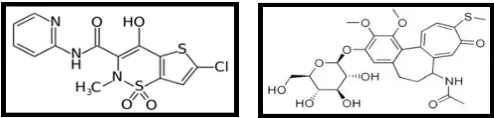
ornoxicam is chemically6-chloro-4-hydroxy-2-methyl-1,1-dioxo-N-pyridin-2-ylthieno[2,3-e]thiazine-3-carboxamide and it is a nonsteroidal anti-inflammatory drug (NSAID) of the oxicam class with analgesic (pain relieving), anti-inflammatory and antipyretic (fever reducing) properties. It is available in oral and parenteral formulations. Lornoxicam is used for the treatment of various types of pain, especially resulting from inflammatory diseases of the joints, osteoarthritis, surgery, sciatica, and other inflammations [1].
Thiocolchicoside is chemically N-[(7S)-1,2-dimethoxy-10-methylsulfanyl-9-oxo-3-[(2S,3R,4S,5S,6R)-3,4,5-trihydroxy-6-(hydroxyl methyl)oxan-2-yl]oxy-6,7-dihydro-5H-benzo[a]heptalen-7-yl]acetamide
is a muscle relaxant with anti-inflammatory and analgesic effects [2-5]. It
acts as a competitive GABAA receptor antagonist and also glycine
receptor antagonist with similar potency and nicotinic acetylcholine
receptorsto a much lesser extent [6, 7]. It has powerful convulsant activity
and should not be used in seizure-prone individuals [8, 9].
Fig. 1: chemical Structure of Lornoxicam and Thiocolchicoside
*Corresponding author:
Dr. D. Satyavati
Department of Pharmacy,
Brilliant Group of Technical Institutions, Abdullapurmet, Hyderabad, Telangana, INDIA. * E-Mail: [email protected]
DOI: https://doi.org/10.5281/zenodo.1203673
There is plenty of literature available on the effect of
lornoxicam on chronic and acute pain management [10]. Various HPLC
assay methods are reported in the literature for the estimation of Thiocolchicoside and Lornoxicam individually and in-combination with other drugs [11-16]. According to literature survey there is no official method for the simultaneous estimation of Thiocolchicoside and Lornoxicam by RP-HPLC in combined tablet dosage forms. In this study, an HPLC method was optimized and validated for simultaneous estimation and validation of Thiocolchicoside and Lornoxicam in tablet
formulation in accordance with the ICH guidelines [17, 18].
MATERIALS AND METHODS
Chemicals:
Thiocolchicoside, Lornoxicam, Water and Methanol for HPLC, Acetonitrile for HPLC.
Instrumentation:
Waters HPLC, software: Empower 2, Alliance 2695 separation module. 996 PDA detector, pH meter and Weighing machine employed for analysis. Chromatographic data was acquired using empower software. The column used was C18 column, ODS and Zodiac column. Altima C18 (4.6×150mm, 5µ).
Method Development: Preparation of mobile phase:
Accurately measured 950ml (95%) of hplc Water and 5ml of Methanol (5%) were mixed and degassed in digital ultrasonicater for 10 minutes and then filtered through 0.45 µ filter under vacuum filtration.
Diluent Preparation: The Mobile phase was used as the diluent.
Preparation of Standard Solution:
Further pipette 0.15ml of Thiocolchicoside and 0.3ml of Lornoxicam from the above stock solutions into a 10ml volumetric flask and dilute up to the mark with diluents.
Preparation of Sample Solution:
Take average weight of Tablet and crush in a mortar by using pestle and weight 10 mg equivalent weight of Thiocolchicoside and Lornoxicam sample into a 10mL clean dry volumetric flask and add about 7mL of Diluent and sonicate to dissolve it completely and make volume up to the mark with the same solvent.
Further pipette 0.3 ml of Thiocolchicoside and Lornoxicam above stock solution into a 10ml volumetric flask and dilute up to the mark with diluent.
Method Validation: Linearity:
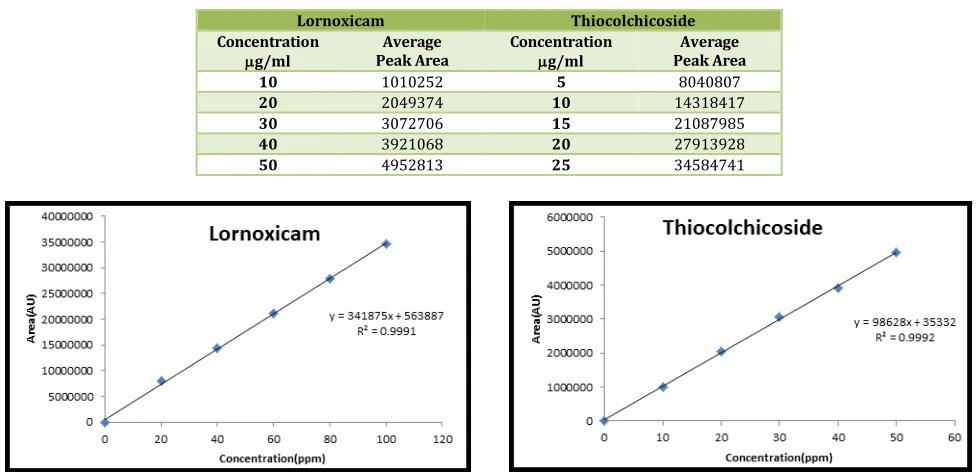
To establish the linearity a series of dilutions ranging from 5-25µg/ ml of Thiocolchicoside and 10-50 µg/ml for Lornoxicam were prepared separately and calibration graph was plotted between the mean peak area Vs respective concentration and regression equation was derived.
Accuracy:
The accuracy of the method was carried out by adding known amount of each drug corresponding to three concentration levels 50%, 100% and 150% of the label claim along with the excipients in triplicate.
Precision:
Precision of the method was checked by analyzing the samples on different times of the same day as well as on different days.
Limit of Detection and Limit of Quantization:
LOD and LOQ are calculated by using the values of slopes and intercepts of the calibration curves for both the drugs.
Robustness:
Robustness was performed by deliberately changing the chromatographic conditions. The flow rate of the mobile phase was changed and composition of the buffer in mobile phase was changed.
Ruggedness:
Ruggedness of the method was performed by two different analysts using same experimental and environmental conditions.
RESULTS AND DISCUSSION
T
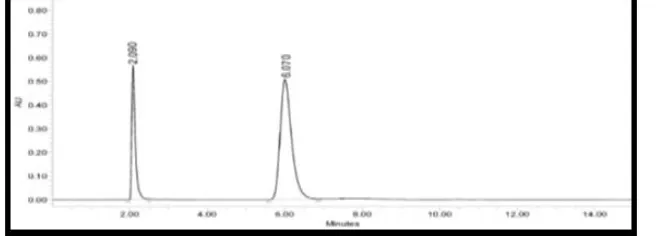
he proposed chromatographic system was found suitablefor effective separation and quantization of Thiocolchicoside and Lornoxicam was 2.088, 6.068min respectively.
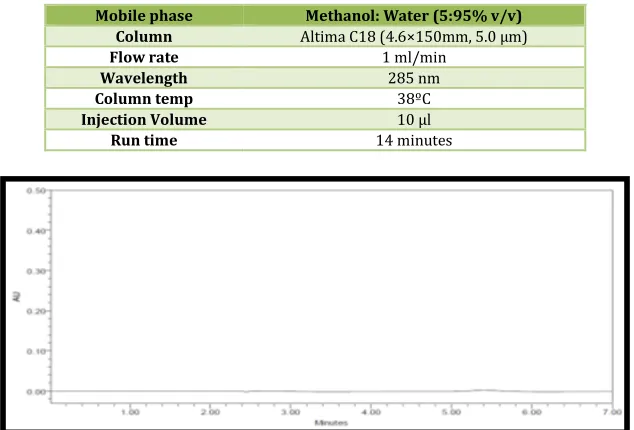
Table No. 1: Optimized Chromatographic Conditions
Mobile phase Methanol: Water (5:95% v/v)
Column Altima C18 (4.6×150mm, 5.0 µm)
Flow rate 1 ml/min
Wavelength 285 nm
Column temp 38ºC
Injection Volume 10 µl
Run time 14 minutes
Fig. 2: Chromatogram showing blank (mobile phase preparation)
Fig. 4: Optimized Chromatogram Sample
VALIDATION: System suitability:
Table No. 2: Results of system suitability for Lornoxicam
S.No Name Rt Area Height USP plate count USP Tailing
1 Lornoxicam 2.080 3569412 567917 5568.0 1.0
2 Lornoxicam 2.080 3465125 517719 6359.2 1.1
3 Lornoxicam 2.080 3598154 567933 5565.5 1.0
4 Lornoxicam 2.081 3586491 517733 5355.2 1.1
5 Lornoxicam 2.081 3582694 567917 6348.0 1.0
Mean 3560375
Std. Dev 54225.61
% RSD 1.523031
Table No. 3: Results of system suitability for Thiocolchicoside
S.No Name Rt Area Height USP plate count USP Tailing
1 Thiocolchicoside 6.056 3582264 567917 5568.0 1.0
2 Thiocolchicoside 6.056 3586491 517719 5359.2 1.1
3 Thiocolchicoside 6.056 3598154 567933 5565.5 1.0
4 Thiocolchicoside 6.057 3564125 517733 5355.2 1.1
5 Thiocolchicoside 6.057 3569412 562173 5568.0 1.0
Mean 3580089
Std. Dev 13609.81
% RSD 0.380153
Specificity:
The ICH documents define specificity as the ability to assess unequivocally the analyte in the presence of components that may be
expected to be present, such as impurities, degradation products, and matrix components.
Analytical method was tested for specificity to measure accurately quantitate Lornoxicam and Thiocolchicoside in drug product.
Table No. 4: Peak results for assay standard
S.No Name Rt Area Height USP Resolution USP Tailing USP plate count Injection
1 Lornoxicam 2.087 3425681 567917 1.0 5568.0 1
2 Thiocolchicoside 6.067 16235984 517719 2.5 1.1 5359.2 1
3 Lornoxicam 2.088 3425413 567933 1.0 5565.5 2
4 Thiocolchicoside 6.068 16298543 517733 2.5 1.1 5355.2 2
5 Lornoxicam 2.088 3465423 567933 1.0 5545.5 3
6 Thiocolchicoside 6.068 16265213 517733 2.5 1.1 5352.1 3
Table No. 5: Peak results for Assay sample
S.No Name Rt Area Height USP Resolution USP Tailing USP plate count Injection
1 Lornoxicam 2.089 3469821 567917 1.0 6568.0 1
2 Thiocolchicoside 6.069 16259845 517719 2.5 1.1 5359.2 1
3 Lornoxicam 2.090 3468547 567933 1.0 5565.5 2
4 Thiocolchicoside 6.070 16287531 517733 2.5 1.1 5355.2 2
5 Lornoxicam 2.090 3468143 567813 1.0 5391.1 3
Linearity:
Table No. 6: Linearity results of Lornoxicam and Thiocolchicoside
Lornoxicam Thiocolchicoside
Concentration
g/ml
Average Peak Area
Concentration
g/ml
Average Peak Area
10 1010252 5 8040807
20 2049374 10 14318417
30 3072706 15 21087985
40 3921068 20 27913928
50 4952813 25 34584741
Fig. 5: calibration graph for Lornoxicam Fig. 6: calibration graph for Thiocolchicoside
Precision:
The precision of an analytical procedure expresses the closeness of agreement (degree of scatter) between a series of measurements obtained from multiple sampling of the same homogeneous sample under the prescribed conditions.
Repeatability
Obtained Five (5) replicates of 100% accuracy solution as per experimental conditions. Recorded the peak areas and calculated % RSD.
Table No. 7: Results of repeatability for Lornoxicam
S.No Name Rt Area Height USP plate count USP Tailing
1 Lornoxicam 2.080 3569412 567917 5568.0 1.0
2 Lornoxicam 2.080 3465125 517719 6359.2 1.1
3 Lornoxicam 2.080 3598154 567933 5565.5 1.0
4 Lornoxicam 2.081 3586491 517733 5355.2 1.1
5 Lornoxicam 2.081 3582694 567917 6348.0 1.0
Mean 3560375
Std. Dev 54225.61
% RSD 1.523031
Table No. 8: Results of method precession for Thiocolchicoside
S.No Name Rt Area Height USP plate count USP Tailing
1 Thiocolchicoside 6.056 3582264 567917 5568.0 1.0
2 Thiocolchicoside 6.056 3586491 517719 5359.2 1.1
3 Thiocolchicoside 6.056 3598154 567933 5565.5 1.0
4 Thiocolchicoside 6.057 3564125 517733 5355.2 1.1
5 Thiocolchicoside 6.057 3569412 562173 5568.0 1.0
Mean 3580089
Std. Dev 13609.81
% RSD 0.380153
Intermediate precision:
Table No. 9: Results of Intermediate precision for Lornoxicam
S.No Name Rt Area Height USP plate count USP Tailing
1 Lornoxicam 2.081 3481579 567917 5568.0 1.0
2 Lornoxicam 2.082 3458121 517719 5359.2 1.1
5 Lornoxicam 2.085 3451476 567917 5568.0 1.0
6 Lornoxicam 2.085 3452106 567514 5359.2 1.1
Mean 3455929
Std. Dev 18188.92
% RSD 0.5
Table No. 10: Results of Intermediate precision for Thiocolchicoside
S.No Name Rt Area Height USP plate count USP Tailing
1 Thiocolchicoside 6.061 15481579 567917 5568.0 1.0
2 Thiocolchicoside 6.062 15369852 517719 5359.2 1.1
3 Thiocolchicoside 6.063 15248454 567933 5565.5 1.0
4 Thiocolchicoside 6.064 15874692 517733 5355.2 1.1
5 Thiocolchicoside 6.064 15236547 567933 5568.0 1.0
6 Thiocolchicoside 6.064 15217547 567133 5359.2 1.1
Mean 15404779
Std. Dev 251289.4
% RSD 1.6
Table No. 11: The accuracy results for Lornoxicam
%Concentration (at specification Level)
Area Amount Added
(ppm)
Amount Found (ppm)
% Recovery Mean Recovery
50% 1543793 15 15.2 101.9
100.9%
100% 3035883 30 30.4 101.4
150% 4451005 45 44.7 99.4
Table No. 12: The accuracy results for Thiocolchicoside
%Concentration (at specification Level)
Area Amount Added
(ppm)
Amount Found (ppm)
% Recovery Mean Recovery
50% 1084420 7.5 30.07 100.2
99.6%
100% 2096069 15 59.6 99.4
150% 3112684 22.5 89.3 99.3
Limit of Detection:
The detection limit of an individual analytical procedure is the lowest amount of analyte in a sample which can be detected but not necessarily quantitated as an exact value of 0.17µg/ml for Lornoxicam and 0.085µg/ml for Thiocolchicoside.
Limit of Quantitation:
The quantitation limit of an individual analytical procedure is the lowest amount of analyte in a sample which can be quantitatively determined as an exact value of 0.56µg/ml for Lornoxicam and 0.28µg/ml for Thiocolchicoside.
Robustness:
The robustness was performed for the flow rate variations from 0.9 ml/min to 1.1ml/min and mobile phase ratio variation from more organic phase to less organic phase ratio for Lornoxicam and Thiocolchicoside. The method is robust only in less flow condition and the method is robust even by change in the Mobile phase ±5%. The standard and samples of Lornoxicam and Thiocolchicoside were injected by changing the conditions of chromatography. There was no significant change in the parameters like resolution, tailing factor, asymmetric factor, and plate count.
Table No. 13: Lornoxicam Results for Robustness
Parameter used for sample analysis
Peak Area Retention Time Theoretical plates Tailing factor
Flow rate of 1.0 mL/min 3425413 2.088 5568.2 1.0
Flow rate of 0.9 mL/min 3425282 3.111 5922.2 1.2
Flow rate of 1.1 mL/min 3517879 1.880 5868.8 1.2
Less aqueous phase 3175485 3.101 5836.2 1.2
More aqueous phase 3365431 1.881 5282.6 1.1
Table No. 14: Thiocolchicoside Results for Robustness
Parameter used for sample analysis
Peak Area Retention Time Theoretical plates Tailing factor
Flow rate of 1.0 mL/min 2029854 6.068 5359.2 1.1
Flow rate of 0.9 mL/min 1738319 7.101 5999.1 1.2
Flow rate of 1.1 mL/min 1638304 5.007 5989.2 1.1
Less aqueous phase 1973724 7.108 5387.2 1.1
CONCLUSION
I
n the present investigation, a simple, sensitive, precise andaccurate RP-HPLC method was developed for the quantitative estimation of Thiocolchicoside and Lornoxicam in bulk drug and pharmaceutical dosage forms. This method was simple, since diluted samples are directly used without any preliminary chemical derivatisation or purification steps. Thiocolchicoside and Lornoxicam was freely soluble in ethanol, methanol and sparingly soluble in water. Methanol and Water (5:95% v/v) was chosen as the mobile phase. The solvent system used in this method was economical. The %RSD values were within 2 and the method was found to be precise. The results
expressed inTablesfor RP-HPLC method was promising. The RP-HPLC
method is more sensitive, accurate and precise compared to the Spectrophotometric methods. This method can be used for the routine determination of Thiocolchicoside and Lornoxicam in bulk drug and in Pharmaceutical dosage forms.
REFERENCES:
1. Haberfeld H. Austria-Codex (in German) (2009/2010 ed.).
Vienna: Österreichischer Apothekerverlag. Xefo Filmtabletten,
2009. ISBN 3-85200-196-X.
2. Tüzün F, Unalan H, Oner N, et al. Multicenter, randomized,
double-blinded, placebo-controlled trial of thiocolchicoside in acute low back pain. Joint, Bone, Spine: Revue Du
Rhumatisme 2003;70(5):356–61.
doi:10.1016/S1297-319X(03)00075-7. PMID 14563464.
3. Ketenci A, Basat H, Esmaeilzadeh S. The efficacy of topical
thiocolchicoside (Muscoril) in the treatment of acute cervical myofascial pain syndrome: a single-blind, randomized,
prospective. Phase IV clinical study. J the Turk Soci Algol 2009;
21(3):95–103. PMID 19780000.
4. Soonawalla DF, Joshi N. Efficacy of thiocolchicoside in Indian
patients suffering from low back pain associated with muscle
spasm. J the Ind Medi Assoc 2008;106(5):331-5.
PMID 18839644.
5. Ketenci A, Ozcan E, Karamursel S. Assessment of efficacy and
psychomotor performances of thiocolchicoside and tizanidine in patients with acute low back pain. Int J Clin Prac 2005;59(7): 764–70.
doi:10.1111/j.1742-1241.2004.00454.x. PMID 15963201.
6. Carta M, Murru L, Botta P, et al. The muscle relaxant
thiocolchicoside is an agonist of GABAA receptor function in the
central nervous system. Neuropharmacol 2006;51(4):805-15.
doi:10.1016/j.neuropharm.2006.05.023. PMID 16806306.
7. Mascia MP, Bachis E, Obili N, et al. Thiocolchicoside inhibits the
activity of various subtypes of recombinant GABA(A) receptors
expressed in Xenopus laevis oocytes. Eur J Pharmacol 2007;
558(1-3):37–42.
doi:10.1016/j.ejphar.2006.11.076. PMID 17234181.
8. De Riu PL, Rosati G, Sotgiu S, Sechi G. Epileptic seizures after
treatment with thiocolchicoside. Epilepsia 2001;42(8):1084-6.
doi:10.1046/j.1528-1157.2001.0420081084.x. PMID 11554898.
9. Giavina-Bianchi P, Giavina-Bianchi M, Tanno LK, Ensina LF,
Motta AA, Kalil J. Epileptic seizure after treatment with
thiocolchicoside. Therap and Clini Risk Manag 2009;5(3):635–7.
doi:10.2147/tcrm.s4823. PMC 2731019. PMID 19707540. 10. G. Sushila, RK. Srivastava, G. Rajesh and B. Garima. J Drug Del
Ther 2013;3(2):145- 148.
11. AR. Umarkar, NS. Rewatkar, MS. Charde, RM. Charde and AV.
Kasture. J Pharm Res 2011;4(5):1307-1308.
12. S. Kumar, A. Joshi, R. Thakur, AK. Pathak and K. Shah. Acta Pol
Pharm 2011;68(6):839-845.
13. KR. Gupta and RR. Joshi. Pharm Sin 2010;1(2):44-51.
14. SR. Dhaneshwar, VK. Bhusari and ST. Patil. Int J Pharma Bio Sci
2011;2(2):482-490.
15. E. Nemutlu, S. Demircan and S. Kır. Pharmazie 2005
;60(6):421-425.
16. YH. Kim, HY. Ji, ES. Park, SW. Chae and HS. Lee. Arch Pharm Res
2007;30(7):905-910.
17. International Conference on Harmonisation, Guidelines for the
Photostability Testing of New Drug Substances and Products,
Step 4, Q1B 1996.
18. International Conference on Harmonisation, Validation of
Analytical Procedures: Text and Methodology, in ICH
Harmonized Tripartite Guidelines Q2 (R1) 2005.
How to cite this article:
D. Satyavati et al. VALIDATED RP-HPLC METHOD FOR SIMULTANEOUS ESTIMATION OF LORNOXICAM AND THIOCOLCHICOSIDE IN BULK AND TABLET DOSAGE FORM. J Sci Res Pharm 2018;7(3):24-29. DOI: https://doi.org/10.5281/zenodo.1203673