INTRODUCTION
Rocuronium bromide1 is a non-depolarizing neuromuscular blocking agent2 used as anaesthetic in surgeries. The reported synthesis3, 4 of Rocuronium bromide 1 involved base-catalyzed condensation of diepoxide 2 and pyrrolidine in methanol in the presence of sodium hydroxide followed by in-situ reduction of keto intermediate to give the corresponding secondary alcohol 3. Opening of epoxide ring of 3 using morpholine and subsequent selective acetylation of resulted 2-morpholinyl-3, 17-dihydroxy steroidal derivative 4 furnished 17-acetoxy derivative 5 which on reacting with allyl bromide provided Rocuronium bromide 1 in 19.6% overall yield. Several column chromatography purifications and usage of commercially unacceptable solvents made this reported process less attractive and commercially non- viable. Now we worked on this process and made appropriate process modifications, obviating
Oriental Journal of Chemistry Vol. 24(3), 989-994 (2008)
Development of an efficient and scalable process for
rocuronium bromide: A neuromuscular blocking agent
NETI SRINIVASAN¹
-², VIJAYAVITTHAL T. MATHAD¹,
VURIMINDI HIMABINDU² and JAYDEEPKUMAR LILAKAR¹*
¹Dr.Reddy’s Laboratories Ltd., Integrated Product Development, Innovation Plaza, Bachupalli, Qutubullapur, R R District - 500 072 (India).
²Centre for Environmental Sciences, JNT University, Kukatpally, Hyderabad - 500 072 (India).
(Received: October 21, 2008; Accepted: December 11, 2008)
ABSTRACT
An efficient, scalable and high yielding process is developed for a neuromuscular blocking agent Rocuronium bromide 1 by studying various process parameters. The process involves simple work up and obviates column chromatography purification and usage of commercially unacceptable solvents.
Key words: Rocuronium Bromide, neuro muscular blocking agent, diepoxide, acetylation, allylation.
the column chromatography purifications and replacing some of the solvents with commercially acceptable ones, rendering the process effective and scalable. The details are described in this paper.
EXPERIMENTAL
The 1H-NMR spectra were recorded in CDCl3, on a Varian Gemini 400 MHz FT NMR spectrometer and the chemical shifts are reported in δ ppm relative to TMS. The Mass spectra (70 eV) were recorded on HP-5989 LCMS spectrometer. The CHN analysis was carried out on a Perkin-Elmer model 2400S analyzer.
Preparation of (2a, 3a, 5a 16b, 17b) 2,3-epoxy-16-(1-pyrolidinyl)-androstan-17-ol 3
reaction mixture. Solution was heated under reflux for 20 minutes, cooled to 5°C and sodium borohydride (4.0 kg, 105.8 mol) was charged at below 10°C. The solution was stirred at 30-35°C for 1 hr and the reaction mass was quenched into chilled water (480 L). Obtained solid was dissolved in dichloromethane (36 L), organic layer was separated and washed with NaCl solution (1.2 kg) in (13.2 L). The solution was filtered through celite and the celite was washed with dichloromethane (12 L). Organic layer was concentrated, acetone (60 L) was charged to the crude and solution was stirred at reflux for 30 minutes, cooled to 32-35°C and further stirred for 1 hr. Solid was filtered and washed with acetone (19.2 L) to provide compound 3. (Yield: 9.6 kg, HPLC purity: 98.4%); 1H NMR (CDCl3, δ ppm) : δ 3.35 (d, 1H), 3.1 (br q, 2H), 2.9 (q, 1H), 2.7 (t, 2H), 2.45 (t, 2H), 1.85 (m, 5H), 1.6(m, 10H), 1.3 (m, 10H), 0.8 (m, 4H); Mass: 359 (M+1); C H N Analysis Calcd. for C23H37NO2; C, 76.83; H, 10.37; N, 3.90% Found : C, 76.42; H, 10.11; N, 3.68%; [α]20
D: +33° (C=1.05 CHCl3).
Preparation of (2b, 3a, 5a 16b, 17b) 2-(4-morpholinyl)-16-(1-pyrolidinyl)-androstane-3, 17-diol 4
A mixture of compound 3 (11 kg, 30.64 mol) and morpholine (63.8 L, 729.5 mol) in water (6.6 L) was heated under reflux for 68 hrs. Reaction mass was cooled to 25°C, quenched into water (165 L) and stirred for 1.5 hrs. Solid was filtered and washed with water (22 L). The wet solid was slurried in acetone (55 L), filtered, washed with acetone (11 L), recrystallized from methanol (33 L) to give compound 4 as a white crystalline powder. (Yield: 9.9 kg, HPLC purity: 97.8%); 1H NMR (CDCl
3, δ ppm) : δ 3.85 (q, 1H), 3.65 (br t, 4H), 3.4 (t, 1H), 2.9 (q, 1H), 2.4 (m, 9H), 1.9 (m, 4H), 1.7 (s, 6H), 1.5 (m, 10H), 1.2 (m, 2H), 0.8 (m, 8H); Mass: 446 (M+1); C H N Analysis Calcd. for C
27H46N2O3; C, 72.60; H, 10.38; N, 6.27% Found : C, 72.42; H, 10.31; N, 6.20 %; [α]20
D: +86.5° (C=1.02 CHCl3). Preparation of (2b, 3a, 5a 16b, 17b) 2-(4-morpholinyl)-16-(1-pyrolidinyl)-androstane-3, 17-diol-17-acetate 5
Acetyl chloride (1.67 L, 23.5 mol) was added to a solution of compound 4 (10 kg, 22.4 mol), in dichloromethane (300 L) and reaction mixture was stirred for 3 hrs. Solvent was stirred
under reduced pressure and dichloromethane (50 L) was charged to the resultant crude. Solution was cooled to 5°C, stirred for 1 hr. and unreacted compound 4 was filtered off. Filtrate was diluted with dichloromethane (100 L) and water (40 L), pH of the solution was adjusted to 6.5-7.0 with 5% sodium carbonate solution. Solution was stirred for 20 minutes and organic layer was separated. Organic layer washed with water (80 L), dr ied and concentrated under vacuum and crude was recrystallized from acetonitrile (50 L). The dried solid was taken in acetone (30 L) and heated to reflux for 30 minutes. The homogeneous solution was cooled to 0°C. Solid was filtered, washed with chilled acetone (10 L) and dried the solid at 55°C for 6 hrs to provide compound 5. (Yield: 7.8 kg, HPLC purity: 98.5%); 1H NMR (CDCl
3, δ ppm) : δ 3.7 (s, 4H), 3.2 (d, 1H), 2.6 (t, 4H), 2.4 (m, 4H), 2.15 (s, 3H), 1.75 (m, 4H), 1.6(m, 6H), 1.2 (m, 13H), 0.8 (m, 9H); Mass: 488 (M+1); C H N Analysis Calcd. for C29H47N2O4; C, 71.27; H, 9.90; N, 5.73% Found : C, 71.05; H, 9.73; N, 5.64%; [α]20
D: +53.2° (C=1.03 CHCl3).
Preparation of 1-[17b-(acetyloxy)-3a-hydroxy- 2b-(morpholin-4-yl)-5a-androstan-16b-yl]-1-(prop-2-enyl) pyrolidinium bromide 1
A mixture of 5 (15 kg, 30.7 mol), dichloromethane (375 L), allyl bromide (27.6 L, 319.1 mol) and water (7.5 L) was stirred for 12 hours. Volatiles were evaporated under reduced pressure and dichloromethane (75 L) was charged to the resulted crude and solvent was distilled under reduced pressure. Obtained crude was purified with the mixture of dichloromethane (75 L) and methyl t-butyl ether (450 L). Solid was filtered, washed with methyl t-butyl ether (75 L), dried for 30 minutes, and this operation repeated. Solid was dried at 40°C for 7 hours under vacuum (10 mbar) to give compound 1. (Yield: 16.9 kg, HPLC purity: 99.8%); 1H NMR (CDCl
3, δ ppm) : δ 6.18 (dd, 1H), 5.72 (m, 2H), 5.22 (d, 1H), 4.35 (m, 1H), 4.17 (m, 1H), 3.88 (m, 4H), 3.70 (m, 4H), 2.62 (m, 4H), 2.46 (m, 2H), 2.29 (m, 1H), 2.28 (m, 4H), 2.24 (s, 3H), 1.82 (m, 4H), 1.59 (m, 5H), 1.22 (m, 8H), 1.03 (m, 1H), 0.85 (m, 7H); Mass: 609 (M+1); C H N Analysis Calcd. for C32H53BrN2O4; C, 63.04; H, 8.76; N, 4.59% Found : C, 62.91; H, 8.69; N, 4.48%; [α]20
Reagents and conditions: (i) Pyrollidine, Methanol, NaOH, reflux (ii) NaBH4, Methanol, 30-35°C (iii) Morpholine, Water, reflux (iv) Acetyl chloride, Dichloromethane, 25-30°C (iv) Allyl bromide, Dichloromethane, 25-30°C
Scheme 1 Preparation of (2b, 3a, 5a 16b, 17b) 2-(4-morpholinyl)-16-(1-pyrolidinyl)-androstane-3, 17-diol 4 from the mother liquor of compound 5.
To the crude of the filtrate of compound 5 (90 g, 0.16mol), added 10 % aq. Potassium
Reagents and conditions: (i) aq. KOH, methanol, reflux (ii) Methanol (ii) Methanol, reflux
hydroxide (0.45 L), methanol (0.9 L) and the mass was stirred at reflux for 5 hours, cooled to 30°C. Solid was filtered, washed with methanol (0.2 L). Recrystallized the resultant solid in methanol (0.45 L) to give the pure product 4
Compounds 7, 8 & 9
European pharmacopoeia Impurity Structures
Compound 4= Impurity A and Compound 3= Impurity G
RESULTS AND DISCUSSION
We made a detailed study of process parameters in each stage of the synthetic sequence and optimized the process conditions (Scheme 1). Conversion of diepoxy ester 2 in to epoxy alcohol derivative 3 involved nucleophilic addition of pyrrolidine at C-16 –OH and concomitant ester hydrolysis followed by NaBH4 reduction of intermediate ketone. While quenching the NaBH4 following reported process, lot of emulsion was formed making the filtration operation very difficult. Extra water washing and usage of celite pad has alleviated the emulsion problem enabling the smooth filtration of reaction mass.
Temperature of 32-35ºC was found to be an apt range of temperature for the isolation of the product in better yield and quality. At room temperature, significant amount of emulsion in the reaction mass hindered the filtration through the filter pad.
Transfor mation of compound 3 to 4
involved nucleophilic addition of morpholine at C-2 in refluxing aqueous media. In this stage we have observed that, distillation of morpholine as per the literature procedure resulted in enhanced levels of impurities. Instead, pouring the reaction mass in to water at ambient temperature, isolation of product and crystallization from acetone yielded the compound 4 in 65-73% with 96-98% purity.
As per the chemistr y involved, an equimolar ratio of the acetyl chloride is required for the conversion of 4 to 5. When we conducted the acetylation reaction of 4 using 1.2 moles of acetyl chloride, following literature process, significant amount of diacetyl derivatives 6 is formed as by-product. We have optimized the mole ratio of acetyl chloride and reaction time to minimize the formation of diacetyl product 6.
The acetylation reaction was monitored by online HPLC (Table 1). The HPLC data indicated that, using 1.05 molar ratio of acetyl chloride the reaction yielded 76% of desired product 5 along with 8% of diacetyl derivative and 15% of unreacted
Table 1: HPLC data of acetylation reaction using 1.05-mole ratio of acetyl chloride
Exp. Reaction Mass 4 5 6
No maintenance (%) (%) (%)
time (hr).
4 2 15.02 76.74 8.16
5 4 15.08 76.46 8.37
6 5 15.21 76.33 8.39
7 8 15.23 76.28 8.41
8 10 15.28 76.25 8.41
Table 2 : Acetonea purification HPLC Data
Exp. Before After Yield
Purification Purification No 4 (%) 3 (%) 4 (%) 3 (%) 1 75.51 12.15 96.51 0.91 66% 2 93.18 3.04 98.52 0.14 70% 3 82.16 5.65 96.92 0.27 68% a Acetone qty. 5 times to the batch size and the temperature
25-30°C
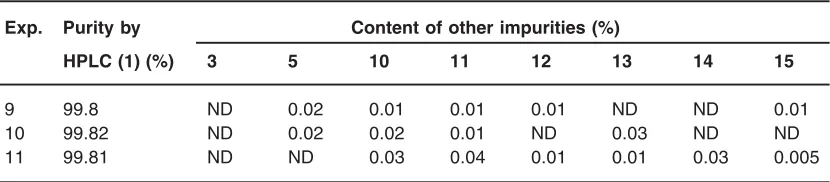
Table 3: The final quality of rocuronium bromide drug substance
Exp. Purity by Content of other impurities (%)
HPLC (1) (%) 3 5 10 11 12 13 14 15
9 99.8 ND 0.02 0.01 0.01 0.01 ND ND 0.01
10 99.82 ND 0.02 0.02 0.01 ND 0.03 ND ND
11 99.81 ND ND 0.03 0.04 0.01 0.01 0.03 0.005
4. Further, similar conversion trend is observed irrespective of the reaction time. Unreacted diol 4 was isolated from the reaction mass with appropriate work up. The mother liquor of compound 5 contains excess of compound 6 and a minimum level of compound 5. The filtrate was evaporated and heated with aqueous alkali and methanol to provide compound 4, which was further purified from methanol yielded the diol compound 4 in 60-65% with 96-98% purity (scheme-2).
Compound 5 contained five process related impurities 4, 6-9 at the level of 0.1 % when synthesized at a commercial batch level. In order to control all these impurities at this stage, compound 5 was isolated from acetonitrile and all the impurities are controlled up to less than 0.1% in lab as well as plant batches. As we observed that, the acetonitrile used for the isolation of 5 is trapped in Active Pharma Ingredient (API) 1 as residual solvent in 5. Recrystallization of 5 from acetone resolved this problem (Table 2). In reported process, compound 5 was isolated by using column chromatography and recrystallized from a mixture of diethyl ether and n-hexane. We have eliminated this column chromatography unit operation in our process.
Conversion of compound 5 in to Rocuronium bromide 1 by reacting with allyl bromide in dichloromethane is the final stage in the synthetic sequence. Getting the API 1 having a purity meeting
the regulatory requirement without using column chromatography is the major challenge in this process. The reaction of 5 and allyl bromide in dichloromethane and catalytic amount of water at 25-30ºC provided the drug substance 1 in 90% yield. Reported reaction time of 22-24 hrs was shortened to 10 hrs by adding catalytically amount of water to the reaction mixture.
Unreacted allyl bromide was removed as azeotropic combination with dichloromethane under vacuum and compound 1 was isolated using an optimized ratio of mixture of dichloromethane and methyl tertiary butyl ether and further purified using the same mixture of solvent to furnish the drug substance 1 with 99.8% purity. Eight impurities 3, 5, 10-15 are well under control (Table-3).
CONCLUSION
We have provided an industrially viable and scalable manufacturing process for Rocuronium bromide having the purity meeting regulatory requirements.
ACKNOWLEDGEMENTS
We thank the management of R&D-IPDO, Dr. Reddys Laboratories Ltd., for supporting this work. Cooperation from the colleagues from analytical research development is highly appreciated.
1. Khuehl-Brady, K.S.; Rocuronium the ideal non-depolarizing muscle relaxant, Anaesthesist, 42: 757 (1993).
2. (a) Khuenl-Brady, K.S.; Castagnoli, K.P.; Canfell, P,C.; Caldwell, J.E.; Agoston, S.; Miller, R.D. The neuromuscular blocking effects and pharmacokinetics of Org 9426 and Org 9616 in the cat.Anaesthesiology 72: 669, (1990). (b) Cooper, R.A., Mirakhur, R.K.,
REFERENCES
Maddineni, V.R.Neuromuscular effects of rocuronium bromide (Org 9426) during fentanyl and holothane anaesthesia. Anaesthesia 48: 103 (1993).
3. Wishaw T. S.; Savage D. S.; Mearns New; Carlyle I. C. U. S. Patent 4 894369 (1988). 4. Osnago A. M.; Grisenti P. U. S. Patent 5:
808051, (1997).