Does Health Accelerate Economic Growth in Pakistan?
Naeem Ur Rehman Khattak (Dean, Faculty of Social Sciences, University of Peshawar, Pakistan)
Jangraiz Khan (Ph. D Scholar, Department of Economics, University of Peshawar, Pakistan)
506 Author (s)
Naeem Ur Rehman Khattak Dean, Faculty of Social Sciences,
University of Peshawar, Pakistan. Email:[email protected]
Jangraiz Khan Ph. D Scholar, Department of Economics,University of Peshawar, Pakistan.
Email: [email protected]
Does Health Accelerate Economic Growth in Pakistan? Abstract
This paper has been designed to investigate whether health accelerate economic growth in Pakistan. The study is using Growth Accounting Method, Ordinary Least Squares and Johansen Cointegration Test as analytical techniques. The Results show that Total Factor Productivity, Capital and health contributed 46.61%, 43.15% and 2.61% to growth rate of GDP per capita during 1971-2008. The Ordinary Least Squares results showed health, labour and Research and Development as the significant determinants of economic growth in Pakistan. The results further indicate that real GDP per capita, R&D, education and health institutions affect heath in Pakistan. The Cointegration test results confirmed the existence of long run relationship between health and economic growth. Therefore, the study concludes that health accelerates economic growth in Pakistan and this relationship also exists in long run. The study suggests increase in public expenditure on health and R&D. It is also suggests further research on the determinants of Total Factor Productivity
Key words: Health, Economic Growth, Growth Accounting, Ordinary Least Squares, Pakistan
Introduction
The development of new growth theories opened new directions for empirical research in economics. The economists in developing countries are trying to explore the non-conventional factors which foster economic growth. Education is believed to be one of such most important non-traditional factors but not the end of this exploration1. Knowles and Owen (1995) introduced health as human capital in the model of economic growth. Poor health leads to less human capital development and lowers productivity which affects economic growth2. Nakamura (1981), Schultz (2003), Bloom et al 2004 and a number of other studies3 also emphasized the role of health in economic growth. Barro and Sala-i- Martin (1995) found that 1.4% increase in GDP per capita increases with 13 years
1 Mankiw et al (1992) extended the Solow (1956) model
by introducing education as human capital.
2 See Simons and Alexander (1978), Behram et al (1981)
and Peri (1984) for details.
3 Schultz (1961), Arrow (1962), and Romer (1986) found
health as another form of human capital.
increase in life expectancy while Bloom et al (2004) found 4% increase in output due to one year increase in life expectancy. Edwards and Grossman (1979), and Shakotko et al (1980) argued that health affects cognitive development of children. Children with poor family background will have lower Intelligence Quotient (IQ) than those who belong to rich family. McDonald and Jennifer (2002), and Bhargava et al (2001) supported the view that life expectancy is meaningful in macroeconomic context. Wand and yudong (2003) recommended high priority to human capital accumulation and productivity growth to keep china on path of sustained economic growth.
507 expenditures or life expectancy does not affect
economic growth in longrun.
Besides paramount significance of health for sustained economic growth, it failed to get mandatory consideration in Pakistan. Pakistan, still lies in group of countries which are low ranked on Human Development Index (HDI) scale4.
The provision of health facility is mainly the responsibility of government in Pakistan. The private sector is sharing this responsibility with the government and it is emerging as a major contributor of health facilities. Pakistan experienced fluctuations in health expenditure during its history. The health expenditure which was on average 0.492 % of GDP during the period 1961-65 increased to 0.762% of GDP during the period 1981-85. The health expenditure as a percentage of GDP remained higher during the period 1986-90 which was on average 1.054 % of GDP per annum (SBP, 2005). It again fell to 0.54% of GDP during the period 2006-08. The demographic indicators of Pakistan are improving with reasonable pace. The Total Fertility Rate fell from 7.0 in 1972 to 3.0 in 2008 (Economic Survey of Pakistan, 2008-09). Similarly birth rate and Infant Mortality Rate (IMR) also showed reasonable turn down.
The life expectancy at birth in Pakistan which was 49 years for both sexes, 50 years for male and 49 years for female in 1960 increased to 67 years for both sexes, 67 years for female and 66 for male in 2008. The rising life expectancy in Pakistan is an indicator of human development but, it is still gripped into a number of health problems like poor sanitation, lower life expectancy, malnutrition, high infant mortality rate and poor living conditions. The successive governments are continuously trying to cope with these problems but due lack of funding and non application of health policies the progress doesn‟t seem exemplary. Unfortunately, the importance of health in economic growth has been rarely addressed in Pakistan.
4 HDI is Human Developed Index computed by United
Nations Development Programme (UNDP)
The present study is being designed to find the role of health in economic growth of Pakistan. It will investigate empirically whether health accelerates economic growth in a developing economy like Pakistan. The paper will also present sound suggestions for formulation of economic policies in Pakistan.
Materials and Methods
This paper is based on secondary data for the period 1971-2008.The data has been taken from Economic Survey of Pakistan (Different Issues), World Development Indicators (Different issues) and State Bank of Pakistan (2005). Before going to the empirical model for economic growth, it will be fruitful to explore the contribution of TFP to economic growth in presence of health as human capital. The present study is using the most widely used technique Growth Accounting Method (GAM)5 for this purpose. The technique starts with the standard production function as given below
(1)
The equation for Total Factor Productivity (TFP) has been derived from equation (1) by using Khan (2012) methodology as given below
(2)
Where
Where „y‟ stands for growth rate of GDP per Capita, „l‟ growth rate of labour and „ growth rate of human capital in form of health.
are shares of capital and labour in output. Similarly „k‟ is the growth rate of physical capital. The physical capital has been measured by Gross Fixed Capital (GFC) and labour by total labour force in the economy. Life expectancy has been used as a proxy for health in this paper.
After finding the contribution of health to GDP per capita, we are interested in finding the contribution of health through other econometric techniques. The empirical
5
508 model for the study has been derived from the
seminal work of Weil (2005) with little addition.
(3)
Where K shows the physical capital, H shows health and A stands for technological progress. By taking ln and simplification we get
(4)
In order to find the macro determinants of health, we have used the following model
(5)
The data has been analyzed by using the method of Ordinary Least Squares and Johansen Cointegration test. The results have been presented in form of tables.
Results and Discussion
The results obtained from Growth Accounting showed that Total Factor Productivity (TFR) is chief contributor to GDP per capita at the beginning of the study period (1971-75). It shared 68.85% of GDP per capita. The second major component was capital and it contributed 25.03% to GDP per capita while the share of health remained 1.56%. TFP, capital and health added 9.59%, 79.52%, and 2.22% respectively to economic growth during 1976-80. The share of health increased while that of capital declined during 1981-85. The fluctuations in shares of TFP, capital and health continued till end of the study period. The over shares of TFP, Capital and health remained 46.61%, 43.15% and 2.61% during 1971-2008. The results are displayed in Table I.
The regression results show that health, labour and Research and Development are the major factor among the set of explanatory variables which affect GDP Per Capita in Pakistan. The physical capital as expected showed positive relationship with economic growth, however the result is statistically insignificant. The results supported the view that health
positively affects economic growth and the result is significant at 1% level of significance. This is the support of the view that increase in life expectancy helps in achievement of sustained economic growth.
Table-I The contribution of TFP in presence of Health
Period
Contribution to GDP Per Capita (%)
TFP Capital Health
1971-75
68.85 25.03 1.56
1976-80
9.59 79.52 2.22
1981-85
46.28 43.02 3.03
1986-90
42.06 45.80 0.69
1991-95
57.64 38.11 1.91
1996-00
50.98 38.67 1.06
2001-05
58.73 29.15 0.57
2006-08
37.88 56.29 0.00
1971-2008
46.61 43.15 2.61
Source: Author‟s Calculations from the data obtained from World Development Indicators (Various issues), Economic Survey of Pakistan (Various issues), Sate Bank of Pakistan(2005)
The importance of health for economic growth necessitates increasing investment in health. Labour force emerged as significant determinant of economic growth and its positive sign shows its positive contribution to economic growth in Pakistan. Expenditure in Research and Development also appeared as significant variable which affect economic growth in Pakistan. The values of R-Sq and Durban-Watson Statistic support the results of the present study. The DW Statistic is 1.81 which is closer to 2 rejecting the presence of autocorrelation in the model. The results are shown in Table II.
509 education and health institutions affect health
in Pakistan. The results indicate that GDP per capita (real) is a significant determinant of health. The health status improves with increased GDP per capita which stimulates life expectancy. The Research and Development (R&D) also emerged as a significant determinant of health which means that R&D is also a helpful tool for improvement of health status of masses. Education is considered a pivotal factor for a large number of socio-economic indicators. Keeping in view the significance of education, it is introduced in health model. The results show that education positively affects public health. It may be due to the fact that educated people are more careful about their health, and are cautious in selection of food and other eatables. The health conditions also depend upon the access to health institutions. The results show that health institutions play a significant role in health status and life expectancy. The higher the number of institutions, the easier will be access to hospitals and other institutions and the better will be the health standard.
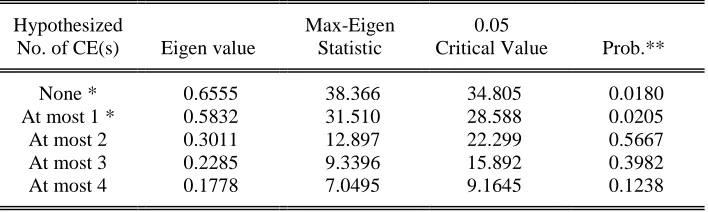
In order to investigate the longrun relationship between health and economic growth, Johansen Cointegration technique is followed in this study. The conitegration results show the existence of at most two cointegrating equations which reject the null hypothesis of no Cointegration. This further confirms that there is long run relationship between health and economic growth. In other words there exists long run relationship between health and economic growth. Eigen Value and Max-Eigen Statistic have been used for this purpose. The results are shown in Table IV.
The cointegration results for health equation shows the existence of at most two cointegrating equations which confirm the long run relationship of health and its determinants. The results are displayed in Table V.
Conclusion and Suggestions
This paper concentrated on the role of health in economic growth of Pakistan. Total factor productivity appeared as the largest contributor to GDP per Capita and physical capital as the second largest contributor. Health contributes 2.61% to GDP per Capita in Pakistan. The regression results showed that along with health, physical capital, labout force and R&D play a significant role in determination of GDP per capita. Moreover, an interesting finding is that education, GDP per capita, R&D and health institutions are significant determinants of health in Pakistan. The Cointegration test results confirmed the existence of health and economic growth in long run.
It is therefore concluded that health accelerate economic growth in Pakistan and this relationship also persists in long run. It is therefore, recommended to increase expenditure on health to provide easy access to health settlements and increasing the life expectancy. The contribution of TFP should be kept in mind while developing economic policies. The R&D sector is not given much attention in Pakistan and the pace of R&D needs to be accelerated to improve the health conditions in the country and gain sustained economic growth.
Table-II Results of Economic Growth Model
Variable Coeffient Std.Error T-stat Probability
LGFCF 0.102790 0.061380 1.674658 0.1035
LHEALTH 2.649692 0.850796 3.114367 0.0038* LTLF 0.914044 0.274796 3.326263 0.0022*
LRD 0.123670 0.043913 2.816226 0.0081*
C -18.91307 4.057598 -4.661150 0.0000* R-squared 0.937462 DW Statistic 1.81 F-statistic 123.67 Prob (F-statistic) 0.0000
510 Table-III Regression Results with Health as Dependent Variable
Variable Coefficient Std. Error t-Statistic Prob.
LRGDPPC 0.0643 0.0239 2.6817 0.0100*
LRD 0.0152 0.0066 2.2836 0.0290**
LENRHM 0.0458 0.0183 2.4996 0.0176**
LHEINS 0.0401 0.0175 2.2841 0.0289**
C 2.7454 0.0859 31.947 0.0000*
R-squared 0.965 DW Stat 1.92 F-statistic 232.61 Prob (F-stat) 0.0000
Table -V Cointegration Test Results the Model with Health as Dependent Variable
Hypothesize
d Max-Eigen 0.05
No. of
CE(s) Eigenvalue Statistic
Critical
Value Prob.**
None * 0.727789 45.54127 30.43961 0.0003 Table-IV Results of Johanson Cointegration Test
Hypothesized Max-Eigen 0.05
No. of CE(s) Eigen value Statistic Critical Value Prob.**
None * 0.6555 38.366 34.805 0.0180
At most 1 * 0.5832 31.510 28.588 0.0205
At most 2 0.3011 12.897 22.299 0.5667
At most 3 0.2285 9.3396 15.892 0.3982
At most 4 0.1778 7.0495 9.1645 0.1238
511 At most 1 * 0.568465 29.41426 24.15921 0.0088
At most 2 0.231871 9.232923 17.79730 0.5685
At most 3 0.201605 7.880313 11.22480 0.1822 At most 4 0.001308 0.045814 4.129906 0.8608
* denotes rejection of the hypothesis at the 0.05 level **MacKinnon-Haug-Michelis (1999) p-values
References
Arrow, K. J., (1962). “The Economic Implications of Learning by Doing”. The Review of Economic Studies. Vol. 29, No. 3, pp. 155-173.
Barro, R. J., G. N. Mankiw and X. Sala-i-Martin., (1995), “Capital Mobility in Neoclassical Growth Models”. American Economic Review, Vol.85, pp.103-115. Behrman, J., B. Wolfe , I. Tunali (1981), “Determinants of women's earnings in a developing country: a double selectivity, extended human capital approach”. Institute for Research on Poverty, Discussion Paper 5, pp. 96-80.
Bhargava,A, D. T. Jamison., L.J. Lau., and C.J.L.Murray., (2001), “Modeling the Effects of Health on Economic Growth”, Journal of Health Economics, Vol. 20, pp. 423–440
Bloom, D. E., D. Canning and J. Sevilla., (2004). “The Effect of Health on Economic Growth: A Production Function Approach”. World Development, Vol.32, No.1, pp. 1-13. Edwards, L,N., and G. Man (1979), “The relationship between children's health and intellectual development. In: Health: what is it worth?” Elmsford, NY, Pergamon Press,. Government of Pakistan, Economic Survey of Pakistan (various issues), Economic Advisors wing, Ministry of Finance, Islamabad.
Hartwig, J., (2009), “Is health capital formation good for long-term economic growth? – Panel Granger-causality evidence for OECD countries”, Journal of Macroeconomics, Vol. xxx
Khan,J., (2011), “The Role of Human Capital in Economic growth of Pakistan (1971-2008)”, Ph. D in Economics Thesis Submitted to
Department of Economics, University of Peshawar, Pakistan.
Knowles, S., and P. D. Owen., (1995), “Health Capital and Cross Country variation in Income Per Capita in Mankiw-Romer-Weil Model”, Economic Letters, vol.48, pp.99-106 Mankiw, N. G., D. Romer and D. N. Weil., (1992), “The Empirics of Economic Growth”, Quarterly Journal of Economics, Vol.107, No. 2, pp. 407-435.
McDonald, S., and J. Roberts., (2002), “Growth and multiple forms of human capital in an augmented Solow model: a panel data investigation”, Economics Letters, Vol. 74, pp.
271–276
Nakamura, J, I., (1981), “Human Capital Accumulation in Premodern Rural Japan”, The Journal of Economic History, Vol. 41, No. 2, pp. 263-281
Ozkan, S. K., H. E. Ryder and D. N. Weil., (2000). “Mortality Decline, Human Capital Investment and Economic Growth”. Journal of Development Economics, Vol. 62, pp. 1-23. Perri, L., (1984), “Health and schooling decisions of young men”, Economics of Education Review, Vol.3,
Rico, A. A. and I. A. Guerrra-Turrubiate., (2005). “Empirical Evidence of the Impact of Health on Economic Growth”, Issues in Political Economy, Vol.14.
Romer. P. M., (1986). “Increasing Returns and Long-Run Growth” .The journal of Political Economy, Vol. 94, No. 5, pp. 1002-1037. The University of Chicago Press. Schultz, T. W., (1961), “Investment in Human Capital”, The American Economic Review, Vol. 51, No. 1, pp. 1-17
Schultz, T. P., (2003). “Human Capital, Schooling and Health”. Economics and Human Biology, No.1, pp. 207-221.
512 relationship between health and cognitive
development in adolescence”. NBER Working Paper No. 454
Simmons J, Alexander L. (1978), “The determinants of school achievement in developing countries: a review of the research”, Economic Development and Cultural Change,No.26, Vol 16.
Solow. R. M., (1956). “A Contribution to the Theory of Economic Growth”, The Quarterly Journal of Economics, Vol. 70 No. 1, Feb 1956, pp. 65-94, MIT Press.
State Bank of Pakistan (2005), A Handbook of Statistics on Pakistan Economy ,Statistics
and Data Warehouse Department. Wand, Y., and Y.Yao., (2003), “Sources of China‟s Economic Growth 1952– 1999:Incorporating Human Capital Accumulation”, China Economic Review, Vol. 14, pp. 32– 52