IJEDR1801051
International Journal of Engineering Development and Research (
www.ijedr.org
)
305
An Efficient Classification of Leaves and Based On
Leaf Architecture Using MLPNN Algorithm
D.Keerthika, K.Nandhinipriya, S.Sivaranjani Assistant Professor, Assistant Professor, Assistant Professor
Department Of Computer Science,
K.S.R College of Arts and Science, Tiruchengode, India
________________________________________________________________________________________________________
Abstract— Plant classification has a broad application prospective in agriculture and medicine, and is especially
significant to the biology diversity research. As plants are vitally important for environmental protection, it is more important to identify and classify them accurately. Plant leaf classification is a technique where leaf is classified based on its different morphological features. Most of the existing system introduced a various method for classification. But it does not achieve satisfactory result. To solve this problem the proposed system introduced a firefly algorithm based biological species classification. This research focuses on using digital image processing for the purpose of automate classification and recognition of plants based on the images of the leaves. The system consists of 5 main modules, 1) image acquisition, 2) image preprocessing, 3) image feature extraction 4) feature selection and 5) classification. In the image acquisition module leaf image is captured by using digital camera. In the image preprocessing module, various image processing techniques are applied for preparing a leaf image for the features extraction process. Then texture, shape, Eccentricity and leaf perimeter are extracted from enhanced image. Then optimal features are extracted by using firefly algorithm. In the image recognition, the leaf images are classified by using single MLPNN with Levenberg-Marquardt back-propagation algorithm. In the display result module displays the recognition results. The experimental results show that the proposed system achieves higher performance compared with the existing system in terms of accuracy, precision and recall.
Index Terms—Component, formatting, style, styling, insert. (key words)
________________________________________________________________________________________________________ I.INTRODUCTION
Image processing is the recent growing technique in the world. It refers to the processing of digital images by means of a digital computer. Images play a major role in human perception. Image analysis is between image processing and computer vision. There are no clear boundaries for in continuum with image processing and computer vision.
Image processing basically includes the following three steps:
1. Importing the image with optical scanner or by digital photography.
2. Analyzing and manipulating the image which includes data compression and image enhancement and spotting patterns that are not to human eyes like satellite photographs.
3. Output is the last stage in which result can be altered image or report that is based on image analysis.
The main objective of the project is to develop a leaf classifier which works on the principle of extracting information based on its architecture using image processing to classify correctly in the plant kingdom.
Plants play an important role for the development of human society. The urgent situation is that due to environmental degradation, many rare plant species on the earth are still unknown and are at the margin of extinction, so it is necessary to keep record for plant protection.
This research focuses on using digital image processing for the purpose of automate classification and recognition of plants based on the images of the leaves.
This research focuses on using digital image processing for the purpose of automate classification and recognition of plants based on the images of the leaves. The system consists of 4 main modules, 1) image acquisition, 2) image pre-processing, 3) image recognition and 4) display result. In the image acquisition module leaf image is captured by using digital camera. In the image pre-processing module, various image processing techniques are applied for preparing a leaf image for the features extraction process. In the image recognition module, various features are extracted from the leaf image and recognize it. In the display result module displays the recognition results. 12 kinds of leaves were taken to carry out the experiment.
We have to take two algorithms for identifying the leaf images. The algorithms are MLPNN Algorithm and Firefly algorithm. In this project to identify the leaf images then classify the images to select a correct leaf .First, image segmentation was done on the leaf images; then eight geometric features such as rectangularity, circularity, eccentricity, and seven moment invariants were extracted for classification. Finally, these shape features was addressed using a hyper sphere classifier. The next phase in the plant leaf identification is the feature extraction phase. The main advantage of this stage is that it removes redundancy from the image and the leaf images are represented by a set of numerical features. The classifier used these features to classify the data. The Texture Feature Extraction is one of the main subjects in pattern recognition. We used GLCM for texture feature extraction.
IJEDR1801051
International Journal of Engineering Development and Research (
www.ijedr.org
)
306
IMAGE PRE-PROCESSING
Pre-processing usually contains a series of sequential operations which includes prescribing the image size, conversion of gray-scale images to binary images (monochrome) file and modifying the scaling and rotation factors of the image. The images pre-processing steps used in this research are as follows
a) The images are reduced to 200 x 200 pixel dimensions in order to decrease computation load.
b) The grey-scale images are converted to binary image. The binary images are often produced by thresholding a gray-scale or , the image is saved using the .jpg format. The weighted averaging method is used in order to separate an object in the image from the background. The formula used to convert RGB value of a pixel into its gray scale value:
Gray = 0.2989 *R + 0.5870 * G + 0.1140 * B Where R, G, B corresponds to the color of the pixel, respectively.
IMAGE ENHANCEMENT
The aim of image enhancement is to improve the interpretability or perception of information in images for human viewers, or to provide `better' input for other automated image processing techniques. These enhancement operations are performed in order to modify the image brightness, contrast or the distribution of the grey levels. Examples of enhancement operations:-Removing blurring and noise, increasing contrast, and revealing details.
REMOVING NOISE FROM IMAGES
Digital images are prone to a variety of types of noise. Noise is the result of errors in the image acquisition process that result in pixel values that do not reflect the true intensities of the real scene. This sub-module clears noise in the leaf picture for easily to extract their features. The system uses the erosion and dilation technique to clear the noises.
FEATURE EXTRACTION
The next phase in the plant leaf identification is the feature extraction phase. The main advantage of this stage is that it removes redundancy from the image and the leaf images are represented by a set of numerical features. The classifier used these features to classify the data. The Texture Feature Extraction is one of the main subjects in pattern recognition. We used GLCM for texture feature extraction. The GLCM functions characterize the texture of an image by calculating how pairs of pixel with specific values and in a specified spatial relationship occur in an image.
The following features are used for doing leaves classification.
Extraction of Isoperimetric Quotient:
In order to extract the isoperimetric quotient, extraction of the area and the perimeter of leaves are required. Given a binary leaf image, the area of the given leaf is calculated as the number of pixels in the foreground. Canny edge detector provides the edge image for the foreground region and perimeter is calculated as the number of pixels in the boundary of the foreground region.
Extraction of Eccentricity:
Region-based method is used to estimate the best fitting ellipse for the extraction of eccentricity. Fig. illustrates a best fitting ellipse to a polygon. It also shows the major axis, Ma and the minor axis, Mi of the best fitting ellipse.
Extraction of Aspect Ratio:
For a rectangular shape, aspect ratio is defined as the ratio of its breadth by length. For leaves having irregular shapes, the aspect ratio is defined as the ratio of the minor axis to the major axis of the best fitting ellipse.
Leaf Area:
The value of leaf area is evaluated by counting the number of pixels having binary value 1 on smoothed leaf image. It is denoted as A.
Leaf Perimeter:
It is evaluated by counting the number of pixels containing leaf margin
Area ratio of perimeter:
Ratio of Area to perimeter, It is defined as the ratio of leaf Area A and leaf perimeter P, is calculated by A/P.
Solidity: It is defined as the ratio of areole area to convex area.
Length of the major and minor axes: Area of the ellipse that just encloses the region.
Upper and Lower triangle area of the leaf:
The leaf is divided into two half by a horizontal line by the system, and then the system finds an upper- triangle area by dividing the upper leaf area by the upper-half image area. Similarly, a lower triangle area is calculated by dividing the lower leaf area by the lower-h0alf image area.
Boundary feature:
IJEDR1801051
International Journal of Engineering Development and Research (
www.ijedr.org
)
307
III.LEAF CLASSIFIER
The single MLPNN with Leven berg-Marquardt back-propagation algorithm is used to classify the plant species. The single hidden layer is chosen. In hidden layer and output, the sigmoid activation function is used. The features computed are used for classification.
Two algorithms are used for classification and also known as classifiers
Artificial Neural Network (ANN)
Artificial Neural Network (ANN) has been the successfully used classifier in numerous fields. So, it is of interest to use it for leaf analysis. It can be modelled on a human brain.
The basic processing unit of brain is neuron which works identically ANN. The typical structure of neural network is shown in Fig.4 which consists of m input neurons in general and n hidden neurons with single hidden layer. The output layer has only three neurons. The network is called as fully connected network when all the neurons are connected with the adjacent neurons.
Multilayer Perceptron Neural Network (MLPNN)
The ability of classifying the non-linearly separable classes in a supervised manner enables it as a mostly used neural network for classification purpose. It uses the error correction rule known as back propagation algorithm.
Back Propagation Algorithm Step: 1 Initialization
Set all the weights and biases to small real random values.
Step: 2 Presentation of input and desired output
Present the input vector x(1), x(2), . . . , x(N) and corresponding desired response d(1), d(2), . . . , d(N), one pair at a time, where N is the number of training patterns.
Step: 3 Calculation of actual outputs
Equation (1) below is used to calculate the output signals y1, y2…... yNM Where wij are the weights and bi are the biases.
Step: 4 Adaptation of weights (wij) and biases (bi)
In which xj (n) = output of node j at iteration n, l is layer, k is the number of output nodes of neural network, M is output layer, φ is activation function. The learning rate is represented by μ.
Back propagation Training Algorithm: Leven berg-Marquardt (train lm)
Back propagation algorithm utilizes the Leven berg-Marquardt algorithm for training of the network. The ‗trainlm‘is a network training function that updates weight and bias values according to Leven Marquardt optimization. The Leven berg-Marquardt consists basically in solving (H + λI) δ = g with different λ values until the sum of squared error decreases. So, each learning iteration (epoch) will consist of the following basic steps:
1. Compute the Jacobin (by using finite differences or the chain rule) 2. Compute the error gradient
g = JtE
3. Approximate the Hessian using the cross product Jacobin H = JtJ
4. Solve (H + λI)δ = g to find δ
5. Update the network weights w using δ
6. Recalculate the sum of squared errors using the updated weights
7. If the sum of squared errors has not decreased, discard the new weights, increase λ using v and go to step 4. 8. Else decrease λ using v and stop.
Variations of the algorithm may include different values for v, one for decreasing λ and other for increasing it
IV.FIREFLY BASED FEATURE SELECTION
Irrelevant, noisy and high dimensional data, containing large number of features, degrades the performance of data mining and machine learning tasks. One of the methods used in data mining to reduce the dimensionality of data is feature selection. The proposed system introduced a firefly algorithm for feature selection. All fireflies are unisexual, so that any individual firefly will be attracted to all other fireflies; Real fireflies produce a short and rhythmic flash that helps them in attracting (communicating) their mating partners and also serves as protective warning mechanism.
IJEDR1801051
International Journal of Engineering Development and Research (
www.ijedr.org
)
308
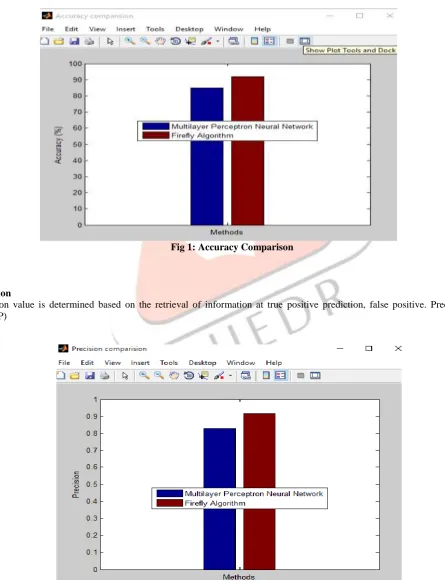
Accuracy
The Accuracy of the system is calculated with the values of the True Negative, True Positive, False Positive, False negative actual class and predicted class outcome it is defined as follows,
Accuracy = 𝑇𝑟𝑢𝑒 𝑝𝑜𝑠𝑖𝑡𝑖𝑣𝑒+𝑇𝑟𝑢𝑒 𝑛𝑒𝑔𝑎𝑡𝑖𝑣𝑒
𝑇𝑟𝑢𝑒 𝑝𝑜𝑠𝑖𝑡𝑖𝑣𝑒+𝑇𝑟𝑢𝑒 𝑛𝑒𝑔𝑎𝑡𝑖𝑣𝑒+𝐹𝑎𝑙𝑠𝑒 𝑝𝑜𝑠𝑖𝑡𝑣𝑒+𝐹𝑎𝑙𝑠𝑒 𝑛𝑒𝑔𝑎𝑡𝑖𝑣𝑒
Fig 1: Accuracy Comparison
Precision
Precision value is determined based on the retrieval of information at true positive prediction, false positive. Precision =TP/ (TP+FP)
IJEDR1801051
International Journal of Engineering Development and Research (
www.ijedr.org
)
309
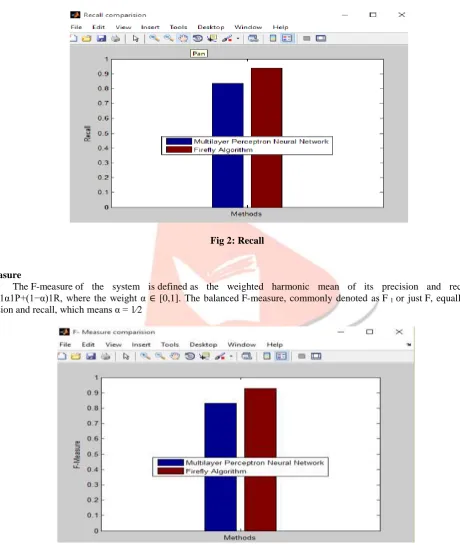
Recall
Recall value is determined based on the retrieval of information at true positive prediction, false negative. Recall =TP / (TP+FN)
Fig 2: Recall
F measure
The F-measure of the system is defined as the weighted harmonic mean of its precision and recall, that is, F=1α1P+(1−α)1R, where the weight α ∈ [0,1]. The balanced F-measure, commonly denoted as F 1 or just F, equally weighs
precision and recall, which means α = 1∕2
Fig 4: F-Measure
VI.CONCLUSION
IJEDR1801051
International Journal of Engineering Development and Research (
www.ijedr.org
)
310
[1]. D. Warren, ―Automated leaf shape description for variety testing in chrysanthemums,‖ in Proc. 6th Int. Conf. Image Process. And Its Applicant, Duping, Ireland, 1997.[2]. Z. Miao et al., ―An oopr-based rose variety recognition system,‖ Engineering Applications of Artificial Intelligence, vol. 19, issue 5, Amsterdam, Elsevier, 2006, pp. 78-101.
[3]. B. C. Heymans et al., ―A neural network for Opuntia leaf-form recognition, ‖IJCNN, vol. 3, pp. 2116-2121, 1991
[4]. X. F. Wang et al., ―Recognition of leaf images based on shape features using a hyper sphere classifier,‖ ICIC, vol. 3644/2005, pp. 87-96, 2005.
[5]. Y. Nam et al., ―Elis: An efficient leaf image retrieval system‖, in Proc. Advances in Pattern Recognition Int. Conf., Kolkata, India, 2005.
[6]. Jyotismita Chaki, Ranjan Parekh (2011)‖ Plant Leaf Recognition using Shape based Features and Network classifiers‖ (IJACSA) International Journal of Advanced Computer Science and Applications, Vol. 2.
[7]. Bivashrestha (2000) ‖ Classification of plants using images of their leaves‖ ICPR, vol. 2, pp. 2507-2510.
[8]. Stephen Gang Wu, Forrest Sheng Bao, Eric You Xu, Yu-Xuan Wang, Yi-Fan Chang and Qiao-Liang Xiang (2007)―A Leaf Recognition Algorithm for Plant Classification Using Probabilistic Neural Network‖,arXiv:0707.4289v1 [cs.AI] .
[9]. R. E. Gonzalez and R. E. Woods. Digital Image Processing.Addison-Wesley, 1993.
[10]. N.K Bose.neural network fundamentals with graphs,algorithms and applications, p.Liang, 1994. [11]. http://en.wikipedia.org/wiki/confusionmatrix