1264 |
P a g e
FEATURE LEVEL FUSION BASED
MULTI-BIOMETRIC CRYPTOSYSTEM USING FUZZY
VAULT FOR WIRED NETWORK
Ms. Ketaki N. Bhoyar
1, Mrs. Manasi K. Kulkarni
21
Department of Computer Engineering, Progressive Education Society’s Modern College of Engg.,
Shivajinagar, Pune,( India)
2
Asst. Prof., Department of Computer Engineering,
Progressive Education Society’s Modern College of Engg., Shivajinagar, Pune, (India.)
ABSTRACT
User authentication is necessary these days to prevent the unauthorized access by the malicious users.
Multi-biometric systems accumulate evidence from more than one Multi-biometric trait (e.g., face, fingerprint and iris) in
order to recognize a person. They provide higher recognition accuracy and larger population coverage.
Multi-biometric systems require storage of multiple Multi-biometric templates for each user, which results in increased risk
to user privacy and system security. The method to secure the individual biometric template by using the fusion
method to store the data in the fuzzy vault is proposed. Now the same multi-biometric cryptosystem should be
reliably used over the internet and other networks. This paper proposes a multi-biometric cryptosystem over
wired network to support various applications where user authentication is necessary. The Server side encoding
and client side decoding with more complex fusion module is also proposed in this paper.
Keywords: Feature Level Fusion, Fuzzy Vault, Multi-biometric Cryptosystem, Template Security,
Wired Network.
I. INTRODUCTION
In today’s modern society, all types of public and private services are dependent on computer networks supporting them. The two best examples are electronic voting and electronic commerce. The role of authentication techniques to prevent unauthorized access by malicious users becomes more significant, because crimes and incidents over networks are increasing rapidly [1].
1265 |
P a g e
It is useful to build a network based multi-biometric cryptosystem which can be used by many applications and commonly applicable to different types of biometrics authentication technologies. This paper proposes a multi-biometric cryptosystem using network authentication to support various applications where user authentication is necessary. In particular, it provides secured services to individual biometric data and to the data to be secured.II. RELATED WORK
Abhishek Nagar, Karthik Nandakumar and Anil K. Jain in their paper Multibiometric Cryptosystem based on feature level fusion, explained the multi-biometric cryptosystem using both fuzzy vault and fuzzy Commitment. Also they proposed different embedding algorithms for transforming biometric representations. [2]
Umut Uludag, Sharath Pankanti, Anil K. Jain in their paper Fuzzy Vault for Fingerprints, explained the unibiometric authentication system using fingerprint minutiae as the single biometric trait. For the encoding and decoding to work they used the new cryptographic construct called Fuzzy Vault [7].
Haiping Lu, Karl Martin, Francis Bui, K. N. Plataniotis, Dimitris Hatzinakos in their paper Face Recognition with biometric encryption for privacy enhancing, explained a combination of face recognition and simple biometric encryption using helper data system. Their main objective was to address the privacy concern in a self exclusion scenario of face recognition [12].
Ae-Young Kim, Sang-Ho Lee in their paper Authentication Protocol using Fuzzy Eigenface Vault based on MOC, proposed a fuzzy vault based on the eigenfaces. For this scheme, they use a feature vector, which is called an eigenface, from a face image. The eigenface is calculated by the principle component analysis method [14].
Jules and Sudan in their paper A fuzzy vault scheme, proposed the concept of fuzzy vault. It is a logical constraint which is used to store the transformed data. It acts as the locking agent viz. whenever the fuzzy vault is created the data is considered to be locked [9].
III.
THE PROPOSED FRAMEWORK1266 |
P a g e
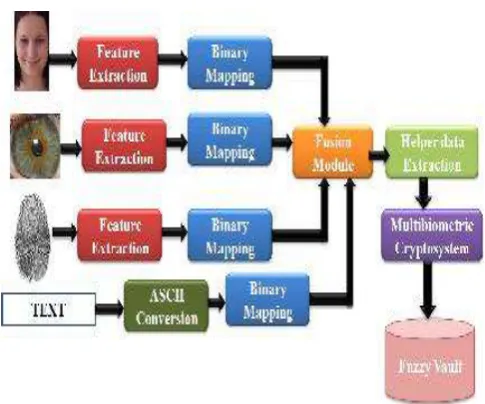
Figure 1. System Overview of Feature Level based Multibiometric Cryptosystem
Overview of the system as shown in figure 1 consists of three stages. The first stage is the registration stage. This stage will take place at the server side of the wired network. The registration stage will accept all three biometric templates viz. iris, face and thumb print and a textual password. Then the facial features are extracted using the Canny Edge Detection Algorithm in which edge segmentation is performed. Then features from iris are extracted using ICA also the thumb print features are extracted using the angle method in which angle Ө is found. After this step binary mapping is performed and all the data including the textual string will be converted into binary format. Using the binary format the biometric templates are fused with the entered textual string and they are stored in the Fuzzy Vault. Once the fuzzy vault is created at the server side the data is locked.
Now at the client side while accessing the same locked data authentication stage is performed. In this stage user trying to access the data is authenticated. At this stage he needs to enter only thumb print. From which the features are extracted and the password is retrieved. Using the password the other biometric templates are also retrieved and thus if they all are matched then the user is authenticated. Then the system enters the access stage. At this stage using the retrieved password and the features of the biometric templates data is accessed at the client side. For this system to work two things should be ready viz. Client Server Configuration and the Network Protocols.
3.1 Encoding at Server Side
1267 |
P a g e
coefficient of the polynomial being formed i.e.P
(
u
)
C
8u
8
C
7u
7
C
6u
6
...
Cu
C
0 [3][4].Now the feature vector for the fingerprint is considered. The length of the feature vector is too long to perform the calculation. So the Finite Field Arithmetic Algorithm (FFA) is used. In that algorithm the standard polynomial stated by Galois is considered. The polynomial is
C
16u
16
C
5u
5
C
2u
2
1
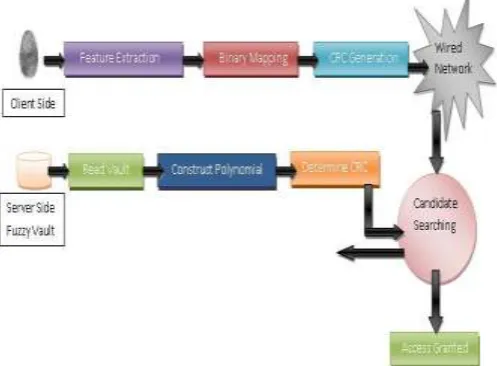
. The standard valuefor the polynomial is 40961. Applying the FFA algorithm will reduce the normal value and make the calculations easier. This will give the variable of the polynomial. The constant of the polynomial is calculated by calculating the Cyclic Redundancy Check (CRC) of the feature vector of the fingerprint. Thus the complete value of the polynomial for one feature is obtained. In order to store all the values of the polynomials in the vault which is stored at the server side, some security measures are necessary. So we are including the chaff points here in order to confuse the hackers. The chaff will be scrambled with the original genuine points viz. is the combination of the value of the polynomial and the variable of the polynomial and hence the value will be stored on the server. The vault will be created and the user’s registration is now complete. The complete process is illustrated in the following figure 2.
Figure 2. Encoding at Server Side
3.2 Decoding at client side
1268 |
P a g e
P
*(
u
)
(
u
v
2)(
u
v
3)...(
u
v
D1)
w
(
v
1
v
2)(
v
1
v
3)...(
v
1
v
D1)
1
(
u
v
1)(
u
v
3)...(
u
v
D1)
w
2
...
(
v
2
v
1)(
v
2
v
3)...(
v
2
v
D1)
(
u
v
1)(
u
v
2)...(
u
v
D)
w
D1
(
v
D1
v
2)(
v
D1
v
3)...(
v
D1
v
D)
One last coefficient among the polynomial is the constant which is the CRC. Thus the decrypted CRC and this CRC are matched. If they are matched then the access is given to the client otherwise user is stated to be invalid. The process is explained in the following figure 3.
Figure 3. Decoding at client side
3.3 Algorithmic Approach
1. Encoding Algorithm
2. Step 1: Extract facial features (A) 3. Step 2: Extract iris features (B) 4. Step 3: S = Secret key (Textual String) 5. Step 4: Extract fingerprint features (C) 6. Step 5: A|B = Coefficient of P(u) 7. Step 6: S|C = Variable of P(u) 8. Step 7: Generate 16-bit CRC
9. Step 8: P(u) = Polynomial Constructed
10. Step 9: Generate Genuine Set G
{(
u
1,
P(
u
1)), (
u
2,
P(
u
2)),..., (
u
n,
P(
u
n))}
11. Step 10: Generate Chaff points
C
{
c
1,
c
2,...,
c
m}
12. Step 11: Generate Random points D
{
d
1,
d2,...,
dm}
1269 |
P a g e
1 1 2 2 m m
15. Step 14:
G
C
16. Step 15: Scramble the list generated
17. Step 16: The final vault set generated is VS
{(
v
1,
w1), (
v
2,
w
2),..., (
v
nm,
wnm)}
18. Step 17: Save vault [4].
2. Decoding Algorithm
Step 1: Extract fingerprint features Step 2: Form Genuine Set
Step 3: Let
V
l be the Vault points wherel
1,2,3,...,
m
n
Step 4: Genuine Set from encoding is GS
{
u
1,
u2,...,
un}
Genuine Set from decoding is GS*
{
u
1*,
u2*,...,
un*}
Step 5:
Step 6: Match Step 7: Form
K
such thatStep 8: Matched points
(
v
l,
w
l)
are added to the list ofK
Step 9:
D
Degree of Polynomial and unique projections areD
1
Step 10: Form setC
{
K
,
D
1}
Step 11: Apply LaGrange’s Interpolation polynomial for each combination
L
{(
v
1,
w
1), (
v
2,
w
2),..., (
v
D1,
w
D!)}
Step 12: Calculate CRC for
L
1,
L
2,...,
L
DStep 13: Compare with CRC from encoding and if matched, key will be retrieved
3.4 Implementation Results
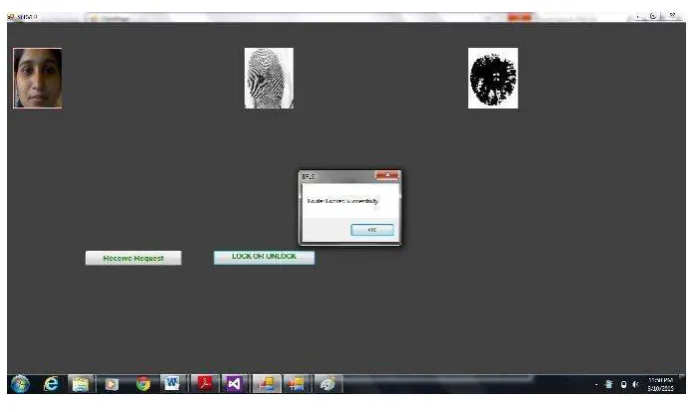
Data transfer over the client server configuration takes place securely maintaining data integrity, confidentiality and authenticity. This system secures individual biometric template data along with the data stored at specific location. It decodes with less response time.
Figure 4.1. Locking at server side
K
n
u1*and Vl
1270 |
P a g e
Figure 4.2. Locking at server side
3.5
Future Work
In future the same security system can be designed which will work for mobiles and secure mobile data on wireless mode.
IV. CONCLUSION
Thus a feature-level fusion framework for the design of Multi-biometric cryptosystems that simultaneously protects the multiple templates of a user using a single secure sketch is proposed. The Multi-biometric cryptosystem and the feature level fusion model on wired network based on Client Server Configuration are also proposed.
V. ACKNOWLEDGEMENT
A large measure of any credit for the “Feature Level Fusion based Multi-biometric Cryptosystem using Fuzzy Vault for Wired Network” must go to our guide Mrs. Manasi Kulkarni, Asst. Prof., and our ME coordinator Ms. Deipali Gore who with the author has assisted in the preparation of this paper. We admire their infinite patience and understanding that they guided us in field we had no previous experience. We are grateful to them for having faith in us.
REFERENCES
[1] Shoichiro Seno, Tetsuo Sadakane, Yoshimasa Baba, Toshihiro Shikama, ”A Network Authentication System with Multi-Biometrics”, 2003, vol no.03.
[2] Abhishek Nagar, Karthik Nandakumar, Anil K. Jain, “Multibiometric Cyptosystems based on Feature Level Fusion”, IEEE, Feb 2012.
[3] Ketaki N. Bhoyar, “Biometric Folder Locking System using Fuzzy Vault for Face ”,IJCA, Vol No. 57, Nov 2012.
1271 |
P a g e
Cryptosystem: Model structure and Performance Analysis”, IEEE Transactions on Information Forensics and security, Vol. 4, No. 4, Dec 2009.[6] Youn Joo Lee, Kang Ryoung Park, Kwanghyuk Bae and Jaihi Kim, “A New Method for Generating Invariant Iris Private Key based on Fuzzy Vault System”, IEEE Transactions on System, MAN and Cybernetics art B: Cybernetics, Vol. 58, no. 5, Oct. 2008.
[7] Umut Uludag, Sharath Pankanti, Anil K. Jain, “Fuzzy Vault for Fingerprints”, Exploratory Computer Vision Group, IBM T.J. Watson Research Centre, Yorktown Heights, NY, 10598.
[8] A. Ross, K. Nandakumar, and A. K. Jain, ”Handbook of Multi-biometrics”, Springer, 2006.