High Harmonic ECH Experiment for Extension of Heating
Parameter Regime in LHD
∗
)
Takashi SHIMOZUMA, Hiromi TAKAHASHI, Shin KUBO, Yasuo YOSHIMURA, Hiroe IGAMI,
Masaki NISHIURA, Shinya OGASAWARA, Ryohei MAKINO, Hiroshi IDEI
1),
Nikolai B MARUSHCHENKO
2), Yuri TURKIN
2)and Takashi MUTOH
National Institute for Fusion Science, 322-6 Oroshi-cho, Toki 509-5292, Japan
1)Research Institute for Applied Mechanics, Kyushu University, 6-1 Kasuga-koen, Kasuga, Fukuoka 816-8580, Japan 2)Max-Planck-Institut f¨ur Plasmaphysik, EURATOM-Association, Greifswald, Germany
(Received 7 December 2012/Accepted 1 April 2013)
High harmonic electron cyclotron resonance heating (ECH) can extend the plasma heating region to higher density and higherβcompared to the normal heating scenario. In this study, the heating characteristics of the second-harmonic ordinary (O2) and third-harmonic extraordinary (X3) modes and the possible extension of heat-ing regime are experimentally confirmed. At the same time, a comparative study usheat-ing ray-tracheat-ing calculation was performed in the realistic three-dimensional configuration of the Large Helical Device. The O2 mode heating showed a 40% absorption rate even above the X2 mode cut-offdensity. The X3 mode heating using powerful 77 GHz gyrotrons demonstrated an increase of about 40% in the central electron temperature in the plasmas at
β-value of about 1%. These results were quantitatively explained to some extent by ray-tracing calculations.
c
2013 The Japan Society of Plasma Science and Nuclear Fusion Research
Keywords: electron cyclotron heating, ECH, high harmonic heating, gyrotron, absorption rate, ray-tracing, LHD DOI: 10.1585/pfr.8.2402073
1. Introduction
High harmonic electron cyclotron heating (ECH) is an effective method of extending the operational regime to high density and highβby alleviating the density limitation due to some cut-offs of EC wave propagation even in a low magnetic field [1–4]. Instead of the normally used funda-mental ordinary (O1) mode and the second-harmonic ex-traordinary (X2) mode heating procedures, an adequate ab-sorption rate will be expected using the second-harmonic ordinary (O2) mode and the third-harmonic extraordinary (X3) mode heating scenarios, when the temperature and density of a target plasma are sufficiently high [5]. For example, the cut-offdensities of X3 and O2 mode wave propagation are 4/3 times and twice the X2 mode cut-off density, respectively. The objective of this research is to confirm the effectiveness of the X3 and O2 mode heat-ing scenarios experimentally in the Large Helical Device (LHD).
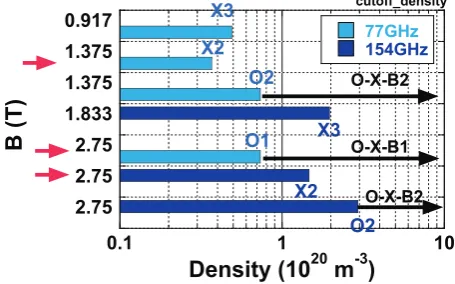
In LHD, two frequencies, i.e., 77 GHz and 154 GHz are being used for ECH. For these frequencies, Fig. 1 indi-cates the extent of the plasma density to be heated for each heating mode and EC resonant magnetic field strength. The normally used heating scenarios, O1 and X2, are in-dicated by red arrows in Fig. 1, and good absorption is expected for these modes. At low magnetic fields (be-low 1.375 T), O2 and X3 mode heating using 77 GHz gy-author’s e-mail: [email protected]
∗)This article is based on the presentation at the 22nd International Toki
Conference (ITC22).
Fig. 1 Relation between heating mode and possible hearing ex-tent using 77 and 154 GHz gyrotrons in LHD.
rotrons can extend the heating region to the higher den-sity and higher βarea. Furthermore, at higher magnetic fields (around 1.833 and 2.75 T), the cut-offdensities for X3 and O2 mode propagation using 154 GHz reach the fusion-relevant densities, 2.2×10²⁰m−3and 3×10²⁰m−3,
respectively.
2. ECH System in LHD and Achieved
Injection Power
Fig. 2 Present (2012) ECH system in LHD.
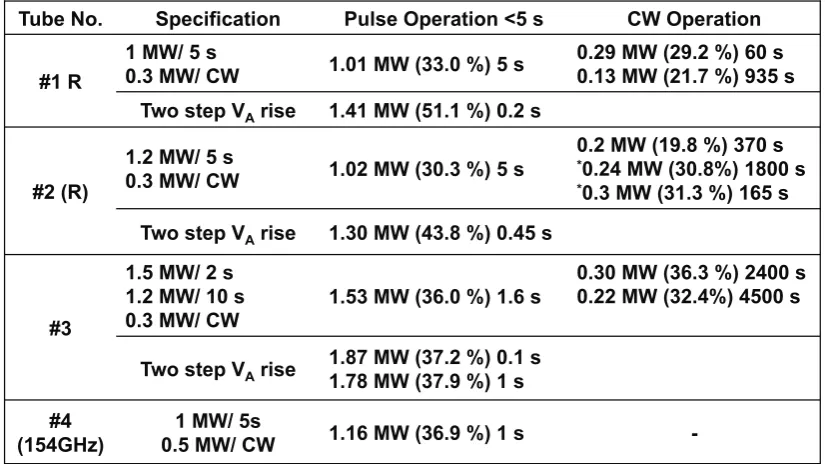
Table 1 Achieved parameters of the developed gyrotrons: three 77 GHz gyrotrons and one 154 GHz gyrotron.
gyrotrons under collaboration with the University of Tsukuba. A schematic view of the present ECH system in LHD is shown in Fig. 2. The ECH system is composed of seven gyrotron systems. There are three 77 GHz gy-rotrons and one 154 GHz gyrotron with more than 1 MW of output power. The other gyrotrons operate at 84 GHz with 0.2 MW/CW, 84 GHz with 0.8 MW/3 s and 82.7 GHz with 0.45 MW/2 s.
Three types of antenna are used. One is a top-launching antenna composed of four mirrors at the upper port of LHD, which is called the U-port antenna. The other is a lateral injection one consisting of two mirrors at the lat-eral outer port of LHD, the so called O-port antenna. The third type of antenna is a bottom-launching one at a lower port. The final mirror of each antenna can be steered to
change the focal position in the plasma. The millimeter-wave power is transmitted through evacuated corrugated waveguides 88.9 mm or 31.75 mm in diameter as shown in Fig. 2.
3. Experimental Results and
Compar-ison with Ray-Tracing Calculations
3.1
Second-harmonic ordinary (O2) mode
heating above plasma cut-o
ff
density
A target plasma was sustained by neutral beam in-jection (NBI) power, and its density was ramped up from 2×10¹⁹m−3 to 6×10¹⁹m−3 above the X2 cut-offdensity (3.7×10¹⁹m−3) in a discharge time of 2 s. O- and X- mode polarized waves were injected from the O-port antenna, which was installed in the horizontally elongated plasma cross section. In this configuration, the wave could be in-jected almost perpendicularly to the electron cyclotron res-onance (ECR) layer, and the inflection effect of the wave was expected to be small. The magnetic strength at the magnetic axis of 3.6 m was 1.43 T. Five ECH pulses with pulse width 200 ms and power 1 MW were injected every 300 ms. During the shot, the central electron temperature decreased from 1.5 to 1 keV with the electron density in-crease. The absorption rate of the O2 and X2 mode power for each pulse could be estimated by calculating the incre-ment dWp/dtjust before and after the turn-on and turn-off
timing of each ECH pulse. The density dependence of the absorption rate is plotted in Fig. 3.
The vertical dashed line corresponds to the cut-off density of the X2 mode (3.7×10¹⁹m−3). For this mode,
the maximum absorption rate reaches 80%, whereas it is 50% for the O2 mode. Above the cut-offdensity of the X2 mode, however, the absorption rate of the O2 mode ex-ceeds that of the X2 mode. This indicates effective heating of the O2 mode above the cut-offdensity of the X2 mode. Non-absorbed RF signals detected by a sniffer probe [6,7], which is installed in the same port as the antenna, show a continuous increase over the cut-offdensity for X2 mode injection. In contrast, the non-absorbed electro-magnetic wave signal for O2 mode injection does not change very much over a wide density range. The behavior of the
snif-Fig. 3 Dependence of absorption rate and scattered power on line-averaged density. The scattered RF power was de-tected by a sniffer-probe.
fer probe signals indicates that O2 mode absorption is not affected by the X2 cut-offdensity, although its absorption is determined mainly by the low electron temperature.
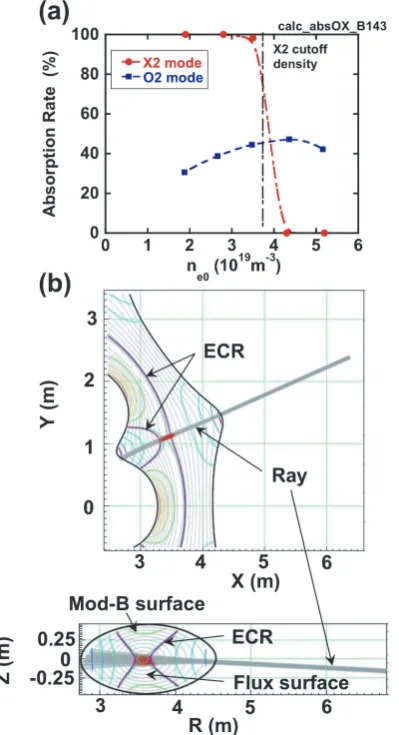
Ray-tracing calculations using the TRAVIS code [8] were also performed for the same magnetic and injection conditions. In Fig. 4 (a), the results show 100% absorp-tion of the X2 mode below the X2 mode cut-offdensity and a sharp decrease in the absorption to zero just above the cut-off. In contrast, the absorption of the O2 mode increases gradually with the density and reaches a maxi-mum of about 40% around 4.5×10¹⁹m−3. Figure 4 (b)
clearly indicates the effective absorption between the two resonances in the lateral injection case.
These behaviors agree qualitatively with the exper-imental results. However, the variation in the electron temperature with the density and a multi-reflection effect should be considered to explain the difference in the abso-lute values of the absorption.
3.2
Optimization of third harmonic
extraor-dinary (X3) mode heating
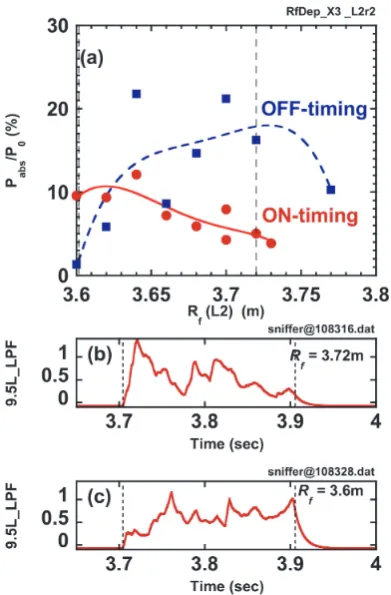
For ECH power injection from the U-port antenna in a vertically elongated plasma cross-section, the heating po-sition and efficiency depend strongly on the focal position of the beam. For X3 mode heating, the dependence of the absorption rate on the focal position of the U-antenna in-jection was investigated. A target plasma was sustained by NBI; its electron density, temperature andβ-value were 0.7×10¹⁹m−3, about 1.2 keV and 0.6%, respectively. The absorption rate was evaluated at the on- and off-timing of the ECH pulses. Figure 5 (a) shows the absorption rate,
Pabs/P0, as a function of the radial focal position on the
equatorial planeRf of the U-port antenna (9.5U port). The
third-harmonic ECR exists atR=3.74 m. The absorption rate has maxima aroundRf ∼ 3.64 m for on-timing
esti-mation and aroundRf ∼ 3.7 m for off-timing estimation,
although the data points are slightly scattered. The time variations in the non-absorbed electro-magnetic wave sig-nals that were detected by a sniffer probe installed at the lower port (9.5L port) just opposite the U-port antenna are
Fig. 5 (a) Absorption rate for U-port antenna (9.5U) as a func-tion of radial focal posifunc-tionRf(m). The values were eval-uated at the on- (closed circles) and off-timing (closed squares) of the ECH pulse. (b) Time variation in low-pass-filtered sniffer probe signal detected at L-port for Rf =3.72 m. (c) Time variation in sniffer probe signal forRf = 3.6 m. ECH was on between dashed vertical lines in (b) and (c).
also plotted in Fig. 5 (b) and 5 (c) forRf ∼3.72 m and for
Rf ∼3.6 m, respectively. The signals were time-averaged
by a low-pass-filter. ForRf = 3.72 m shown in Fig. 5 (b),
the sniffer probe signal exhibits a decreasing trend dur-ing the ECH pulse, indicatdur-ing that wave absorption im-proved toward the end of the pulse. On the other hand, forRf =3.6 m shown in Fig. 5 (c), the sniffer probe signal
gradually increased, suggesting that wave absorption dete-riorates toward the end of the pulse. The sniffer probe sig-nal levels around the ECH on- and off-timings can partly explain the difference in the absorption rate evaluated at the on- and off-timings for Rf = 3.6 m and Rf = 3.72 m
indicated by the vertical dashed lines shown in Fig. 5 (a). This suggests that changes in the temperature and density at the focal point strongly affect the wave trajectory and absorption. The experimental results yield the information on the optimum antenna setting for the best absorption.
A change in the hitting position on the graphite target plate installed in the 9.5L-port opposed the U-port antenna with and without plasma clearly shows a deflection of the wave beam by the plasma and the necessity of feedback control of the antenna focal point according to changes in the plasma parameters.
Figure 6 shows the electron temperature and density profiles before and during stair-like ECH power injection. Using three 77 GHz gyrotrons, a total of 2.9 MW of power was injected during the highest-power injection period. The central electron temperature increased significantly by about 40% with almost constant density.
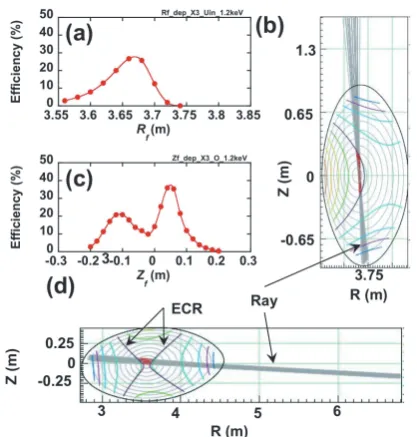
Ray-tracing analyses were performed for the same plasma parameters as in the experiment. In Fig. 7, the fo-cal position dependences of the absorption rate are plot-ted for injection from the U-port antenna in (a) and from the O-port antenna in (c). The typical ray trajectories are shown in (b) for U-port injection and in (d) for O-port in-jection. The focal position yielding the peak absorption differs slightly between the experimental and ray-tracing results shown in Figs. 5 (a) and 7 (a). In addition, a
%$%# % # $
%$!" $
!
%$!" $
! ! % $ % $
Fig. 7 Ray-trace calculation of X3 mode heating, (a) Focal posi-tion dependence of absorpposi-tion rate and (b) rays for U-port injection (Rf=3.65 m). (c) Focal position dependence of absorption rate and (d) rays for O-port injection (Zf=0).
crepancy in the value of the absorption rate also exists. The calculated ray trajectories shown in Fig. 7 (b) correspond to the ray trajectories that achieved the maximum absorption rate (Rf =3.66 m). The rays cross the ECR line twice and
pass through the slightly higher-field side of the ECR line on the equatorial plane. Figure 7 (c) shows a double peak in theZf dependence. This result implies that there is an
optimum distance between the two ECR layers that yields the maximum absorption rate, as shown in Fig. 7 (d).
4. Summary
The heating characteristics of high harmonic ECH, in particular second ordinary (O2) and third extraordinary (X3) mode heating, were experimentally investigated to confirm the effectiveness of heating in higher-density and higher-βplasmas. In O2 mode heating of plasmas above the X2 mode cut-offdensity (3.7×10¹⁹m−3), the
absorp-tion rate of the O2 mode exceeded that of the X2 mode, showing an extension to a higher-density region. In the X3 mode heating experiment, an optimized antenna
fo-cal position from the U-port antenna could be obtained. The optimal focal positions were observed to shift dur-ing the ECH pulse. Deflection of the wave beam was ex-perimentally observed using a target plate installed oppo-site the antenna. A maximum central temperature rise of about 40% was attained by 2.9 MW injection into a plasma withTe0 ∼ 1.2 keV and a line-averaged electron density
of ∼ 0.7×10¹⁹m−3. Ray-tracing calculations using the TRAVIS code were conducted and compared with the ex-perimental data.
Acknowledgement
The authors gratefully acknowledge the LHD exper-iment group for their operation of LHD, and the heating and diagnostic devices. They also thank Doctors R. Mi-nami, T. Kariya and T. Imai at the University of Tsukuba for the development of the powerful gyrotrons. This work was supported by NIFS under ULRR701, 801, and 804. This work was also supported by a Grant-in-Aid for Scien-tific Research from the Ministry of Education, Science and Culture of Japan (24560066).
[1] U. Gasparino, H. Idei, S. Kubo, N. Marushchenko and M. Rom´e, Nucl. Fusion38, 223 (1998).
[2] T. Shimozuma, H. Idei, S. Kubo, T. Takita, S. Kobayashi, S. Ito, Y. Mizuno, M. Sato, K. Ohkubo, Y. Yoshimuraet al., 27th European Physical Society Conference on Controlled Fusion and Plasma Physics, Budapest, Hungary, June 12-16, 2000, P4.019.
[3] S. Alberti, T. P. Goodman, M.A. Henderson, A. Manini, J.-M. Moret, P. Gomez, P. Blanchard, S. Coda, O. Sauter, Y. Peysson and TCV Team, Nucl. Fusion42, 42 (2002). [4] S. Alberti, G. Arnoux, L. Porte, J.-P. Hogge, B. Marletaz,
P. Marmillod, Y. Martin, S. Nowak and TCV Team, Nucl. Fusion45, 1224 (2005).
[5] T. Shimozuma, S. Kubo, H. Igami, Y. Yoshimura, T. No-take, N.B. Marushchenko, Y. Turkin, T. Mutoh and LHD Experiment Group, Plasma Fusion Res.3, S1080 (2008). [6] H. Igami, S. Kubo, H.P. Laqua, K. Nagasaki, S. Inagaki, T.
Notake, T. Shimozuma, Y. Yoshimura, T. Mutoh and LHD Experiment Group, Rev. Sci. Instrum.77, 10E931 (2006). [7] F. Gandini, S. Cirant, M. Hirsch, H.P. Laqua, S. Nowak,
A. Bruschi, G. Granucci, V. Erckmann, V. Mellera, V. Muzzini, A. Nardone, A. Simonetto, C. Sozzi and N. Spinicchia, Fusion Eng. Des.56-57, 975 (2001).