Correspondence author: [email protected]
COMPARATIVE STUDY OF PGA AND INAA FOR
ANALYSES OF METEORITE SAMPLES
Wee Boon Siong*1,2and Mitsuru Ebihara2
1
Malaysian Nuclear Agency, Bangi, 43000 Kajang, Selangor, Malaysia.
2
Tokyo Metropolitan University, Minami-ohsawa 1-1, Hachioji-shi, 192-0397 Tokyo, Japan.
ABSTRACT
Prompt gamma-ray analysis (PGA) and instrumental neutron activation analysis (INAA) are essential for the study of rare samples such as meteorites because of non-destructivity and relatively being free from contaminations. The objective of this research is to utilize PGA and INAA techniques for comparative study and apply them to meteorite analyses. In this study, 11 meteorite samples received from the Meteorite Working Group of NASA were analyzed. The Allende meteorite powder was included as quality control material. Results from PGA and INAA for Allende showed in good agreement with literature values, signifying the reliabilities of these two methods. Elements Al, Ca, Mg, Mn, Na and Ti were determined by both methods and their results are compared. Comparison of PGA and INAA data using linear regression analysis showed correlations coefficients r2 > 0.90 for Al, Ca, Mn and Ti, 0.85 for Mg, and 0.38 for Na. The PGA results for Na using 472 keV were less accurate due to the interference from the broad B peak. Therefore, Na results from INAA method are preferred. For other elements (Al, Ca, Mg, Mn and Ti), PGA and INAA results can be used as cross-reference for consistency. The PGA and INAA techniques have been applied to meteorite samples and results are comparable to literature values compiled from previously analyzed meteorites. In summary, both PGA and INAA methods give reasonably good agreement and are indispensable in the study of meteorites.
Keywords: Instrumental neutron activation analysis, meteorites, prompt gamma-ray analysis
INTRODUCTION
75
reanalyzed by other methods. Thus, combination of PGA and INAA is essential to obtain many useful elemental data from a sample.
In the study of meteorites, the chemical composition is very important for classification of meteorites into different groups. Meteorites are very rare and samples are very limited for chemical analysis. Therefore, non-destructive method such as PGA and INAA are vital in obtaining initial chemical composition data of meteorites. The objective of this study is to analyze meteorite samples using both PGA and INAA methods. Elements (Al, Ca, Mg, Mn, Na and Ti) common for both methods are compared and discussed.
MATERIALS AND METHODS
Many new howardites and polymict eucrites have been recovered from hot and cold deserts each year and provide a good opportunity for gathering more information on HED meteorites. In this study, meteorite samples were requested from National Institute of Polar Research (NIPR), Japan, and Meteorite Working Group of NASA, U.S.A. There are twelve howardites namely CRE 01400, EET 87503, EET 87513, EET 99400, LAP 04838, LEW 85313, MET 96500, QUE 97001, QUE 97002 QUE 99033, Y-7308 and Y-691573. Chip samples of these meteorites were crushed and homogenized in acid-cleaned agate mortar. The powdered samples were then packed using FEP films and were irradiated for about 2 hours at the PGA facility of the JRR-3 reactor of the Japanese Atomic Energy Agency (thermal flux ~ 107 ncm-2s-1). High purity chemical reagents of B, Co, Cr, Mg, Ni, Na2SO4 and
NH4Cl were included along with JB-1 (basalt reference material prepared by Geological Survey of
Japan) as comparative standards. After appropriate cooling period, samples from the PGA experiments were repacked into PE bags for INAA short irradiation (10 s) at the JRR-3 with neutron flux of about 1013 n cm-2s-1. A relative method using JB-1 as reference standard was used for quantification. Radionuclides for quantification of elemental concentrations are listed in Tables 1 and 2, respectively.
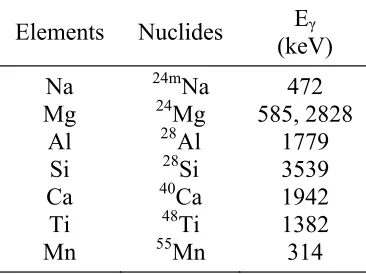
Table 1: List of radionuclides determined using PGA (arranged in atomic number)
Elements Nuclides E
(keV)
Na 24mNa 472
Mg 24Mg 585, 2828
Al 28Al 1779
Si 28Si 3539
Ca 40Ca 1942
Ti 48Ti 1382
76
Table 2: List of radionuclides for INAA determination after 10 s irradiation.
RESULTS AND DISCUSSION
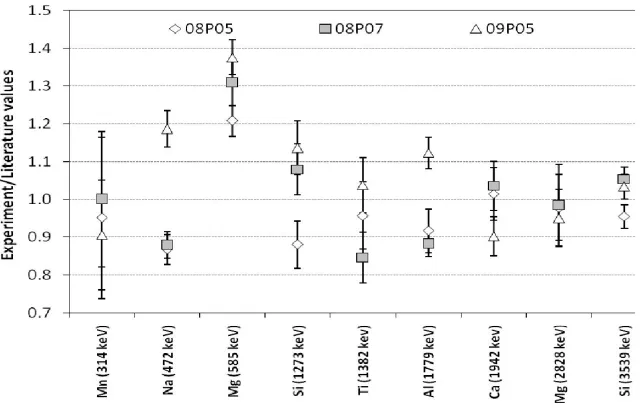
The PGA results of Allende are in agreement with literature values for most of the elements as presented in Table 3 and Fig.1 [Jarosewish et al., 1987; Kallemeyn., 1987]
counting statistics are about 10% except for K which is about 50% due to low sensitivity using PGA. For elements Mg and Si, results using two different gamma-ray energies are in good agreement and those using higher gamma-ray energies showed lower uncertainties and better accuracy. The Al and Na are blank corrected (concentrations in blank: Al = 0.28 % and Na = 0.01 %). Results from experiment 09P05 showed high Na and Al, which may be due to contamination. The results of Na using PGA were less accurate due to Doppler effects of B.
Table 3: Comparisons of literature and experimental values of Allende obtained from PGA
Elements keV Allende* ± Unit
Allende (08P05)
Allende
(08P07) Allende (09P05)
Conc. ± Conc. ± Conc. ±
Mn 314 0.145 0.001 % 0.138 0.031 0.145 0.026 0.131 0.021
Na 472 0.329 0.001 % 0.285 0.013 0.289 0.012 0.390 0.016
Mg 585 14.9 0.1 % 18.0 0.6 19.5 0.9 20.5 0.7
Si 1273 16.0 0.1 % 14.1 1.0 17.3 1.1 18.200 1.131
Ti 1382 0.0899 0.0007 % 0.086 0.008 0.076 0.006 0.093 0.007
Al 1779 1.77 0.02 % 1.59 0.10 1.53 0.06 1.95 0.07
Ca 1942 1.85 0.04 % 1.87 0.13 1.91 0.12 1.66 0.10
Mg 2828 14.9 0.1 % 14.5 1.3 14.6 1.6 14.1 1.1
Si 3539 16.0 0.1 % 15.3 0.5 16.9 0.5 16.6 0.5
* Literature values from Kallemeyn et al. [1989] except Si and Ti values from Jarosewich et al. [1987]
Elements Nuclides Half-life E
(keV)
Na 24Na 15.02 h 1369
Mg 27Mg 9.46 m 1014
Al 28Al 2.24 m 1779
Ca 49Ca 8.72 m 3084
Ti 51Ti 5.8 m 320
V 52V 3.76 m 1434
77
Fig. 1: Comparisons of Allende results of PGA and those of literature. Error bars = 1 .
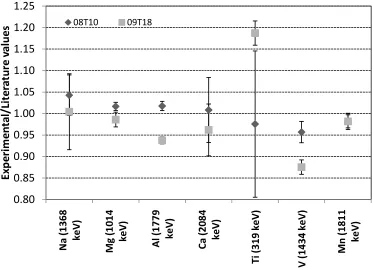
The Allende results from INAA (Table 4 and Fig. 2) showed in good agreement with literature values [Jarosewish et al., 1987; Kallemeyn, 1987]. Most of the results showed less than 5% deviations from literature values signifying the precision and accuracy of the INAA method. It is evidence that results of Ti showed larger uncertainties maybe due to lower concentrations in Allende powder. The Ti data from PGA has better experimental/literature values than those of INAA.
Table 4: Comparisons of literature and experimental values of Allende obtained from INAA
Elements keV Allende* ± Unit Allende (08T10) Allende (09T18)
Conc. ± Conc. ±
Ti 319 0.0899 0.0007 % 0.089 0.015 0.107 0.003
Mg 1014 14.9 0.1 % 15.1 0.1 14.7 0.3
Na 1368 0.329 0.001 % 0.343 0.016 0.330 0.029
V 1434 98 1 ppm 94 2 86 2
Al 1779 1.77 0.02 % 1.80 0.02 1.66 0.01
Mn 1811 0.145 0.001 % 0.140 0.002 0.142 0.003
Ca 2084 1.85 0.04 % 1.87 0.14 1.78 0.11
78
Fig 2: Comparisons of Allende data of INAA and those of literatures. Error bars = 1
Meteorite samples were analyzed using both PGA and INAA methods and elements Al, Ca, Mg, Mn, Na, Ti are compared by using linear regression lines. Regression analysis of PGA and INAA data is presented in Table 5. The regression analysis showed that INAA and PGA gives good agreement for elements Al, Ca, Mg, Mn and Ti with r2 of better than 0.8486 except for Na (r2 = 0.3802). Results from PGA could be used as cross-reference to those of INAA and vice versa. This is very essential to ensure the consistency of data using both methods. Results from INAA show better precision than those of PGA and are generally preferred. In the case of Si, PGA results are used.
Table 5: Regression analysis of INAA and PGA results for meteorite samples
INAA (x-axis) PGA (y-axis) Regression equation r2
Mg (1014 keV) Mg (2828 kev) y = 0.7662x 0.8486
Ca (3084 keV) Ca (1942 keV) y = 0.9874x 0.9621
Na (1369 keV) Na (472 keV) y = 0.8137x 0.3802
Al (1779 keV) Al (1779 keV) y = 0.8843x 0.9159
Mn (1811 keV) Mn (314 keV) y = 1.085x 0.9273
Ti (320 keV) Ti (1382 keV) y = 0.8338x 0.9500
Data from PGA and INAA are compiled and compared to literature values for bulk composition of other howardites which are plotted in Fig. 3. The major elemental data from this experiment are in accord with literature values for howardites. The Mn and Si of howardites are very similar even in different meteorite samples. The distributions of elemental abundances in howardites are mainly due to
0.80 0.85 0.90 0.95 1.00 1.05 1.10 1.15 1.20 1.25
79
current results showed that meteorites samples analyzed in this study have similar chemical compositions to those of howardites.
Fig 3: CI-normalized data of howardite samples (n = 12) analyzed in this study (symbols) and ranges of literature values (rectangular shapes). CI values from Anders and Grevesse [Anders et al., 1989]
CONCLUSION
The PGA and INAA methods are very essential and are complimentary to each other. Elements common for both PGA and INAA such as Al, Ca, Mg, Mn and Ti have been compared using simple regression analysis and their results are reliable. However, INAA still prove to be more superior than PGA except for Si analysis. Both methods are nonetheless very useful especially when analyzing rare samples such as meteorites. Thus, applications of PGA and INAA have been beneficial to obtain useful elemental data for meteorite studies.
ACKNOWLEDGMENTS
Samples from NIPR and NASA are greatly appreciated. We also thank the Japan Atomic Energy Agency (JAEA) for irradiation facilities. BSW thanks the Monbukagakusho (Japan) for a graduate scholarship.
REFERENCES
Anders, E. and Grevesse, N. (1989), Abundances of the elements: meteoritic and solar. Geochim. Cosmochim. Acta 53, 197 214.
80
Kallemeyn, G.W., Rubin, A.E., Wang, D. and Wasson, J.T. (1989), Ordinary chondrites: bulk compostions, classification, lithophile-element fractionation, and composition-petrographic type relationships. Geochim. Cosmochim. Acta 53, 2747 2767.
Latif, S.A., Oura, Y., Ebihara, M., Kallemeyn, G.W., Nakahara, H., Yonezawa, C., Matsue, T., and Sawahata, H. (1999), Prompt gamma-ray analysis (PGA) of meteorite samples, with emphasis on the determination of Si. J. Radioanal. Nucl. Chem. 239, 577 580.
Paul, R.L. (1995), The use of element ratios to eliminate analytical bias in cold neutron prompt gamma-ray activation analysis. J. Radioanal. Nucl. Chem. 191, 245 256.