Performance Analysis in Wireless Powered
D2D-Aided Non-Orthogonal Multiple Access Networks
Dinh-Thuan Do
Faculty of Electronics Technology, Industrial University of Ho Chi Minh City,Vietnam 12 Nguyen Van bao, Go Vap Dist., Ho Chi Minh City, Vietnam
Abstract: This paper examine how to integrate energy harvesting (EH) to non-orthogonal multiple access (NOMA) networks. Recently, device-to-device (D2D) underlaying licensed network is introduced as novel transmission mode to perform two nearby user equipment units (UEs) communicating directly without signal processing through the nearest base station (BS). By wireless power transfer, they can be further operational to D2D communications in which a UE may harvest energy from RF signal of dedicated power beacons (PB) to help EH assisted UEs communicate with each other or assist these UEs to communicate with the BS. In particular, we investigate outage and throughput performance in a scenario of D2D communications powered by RF signal where one UE may help other two UEs to exchange information with optimal throughput..
Keywords: D2D; energy harvesting; throughput; outage.
1.
Introduction
In recent years, D2D communications have been investigated, which support proximate cellular UEs to connect with each other directly under the control of BSs. The high channel quality of short-range D2D links produce high data rates for local services. However, they strictly require more power to remain its operation and in order to prolong UEs battery lives, and offload dense traffic of BSs the literature introduced the self-powered architecture so-called energy harvesting (EH). As in [1]–[8], the works have lately adopted some transmission policies for EH cooperative networks. EH relays were first implemented in cooperative communication [1]. In [2]–[4], the authors normally adopt a model in which a deterministic EH for the fixed energy arrival time and the volume of harvested energy are pre-defined in transmitter for EH, regarding EH relay systems, there were some power allocation policies given. Nevertheless, due to the random energy arrival time and the amount of harvested energy, the deterministic EH model seems to be abstract.
In this paper, we study the D2D communications, where the low-power D2D transmitters with one antenna must harvest energy from the power beacon furnished with multiple antennas to assist transmission in direct link of D2D. The power beacon often designed with multiple antennas while D2D transmitters equipped with one antenna. In the considered situation, all D2D transmitter transmit information signals concurrently over the same spectrum resource. Our aim is to examine how harvested energy to supply enough for direct transmission related to energy harvesting policy and harvesting power control scheme, while satisfying the energy causality constraints. For solving the effective quality of such transmission, we develop a
2.
Related Works
While the aforementioned research contributions have laid a solid foundation with providing a good understanding of energy harvesting and cooperative NOMA in separated problems, the novel of this paper for investigating the potential benefits by integrating these two promising technologies including power beacon energy harvesting and NOMA are still in their infancy.
Rethinking role of D2D, D2D underlaying a licensed cellular network can afford more service guarantee under initial controlled procedure, empowers a user equipment unit (UE) to communicate in separated D2D link with another nearby UE directly. In general, D2D communication allows UEs perform fast access to the radio spectrum which are controlled under interference levels and guarantees four types of gain, namely proximity, reuse, hop, and paring [13]. The typical D2D communication applications are proposed to apply in peer-to-peer file sharing, local voice service, high-definition video, and content-aware software. In [14], energy harvesting-assisted cognitive radio (CR) networks embedded in D2D communication was investigated by using strong mathematical tool of stochastic geometry. It was proved that acceptable outage value of D2D link in wireless communication was obtained without affecting the conventional cellular network. In cellular networks, adding another level of protection contribute to improve physical layer security. As an example, secure downlink transmission in such networks was investigated in [15]. While the authors in [16], the cell association and location information of mobile users are proved their impacts on secrecy performance in scenario of multi-cell environments. It was shown in [17] that the interference from D2D transmission can be evaluated in physical layer security performance of cellular communications. In [18], such topology can be applied in long term evolution (LTE) networks.
In other line of research, non-orthogonal multiple access (NOMA) has been highly suggested as the encouraging access scheme in the fifth generation networks to provide improved spectral efficiency, the high data rate, and connected multiple devices [19]. Thanks to the successive interference cancellation (SIC) operation, advantage of NOMA systems can be seen with procedure of the multi-user interference cancellation at the receivers and then help of signal processing related to the superposition coding at the transmitters [20, 21]. As a result, spectrum efficiency and the reliability of communication are main attractive features to introduce significant improvement in NOMA.
Different from [20, 21], we present a comprehensive investigation on adopting near user intends to communicate with the far user in D2D link to improve the reliability of proximate transmission. More specifically, we attempt to explore the potential ability of the near user in NOMA networks with capability of energy harvesting to transmit its own signal to the far user. We consider system model identifying the following key impact factors.
• Will D2D NOMA bring reasonable performance as multiple antennas are equipped? If yes, what is the number of antennas for acceptable performance?
• What is the impact of outage/throughput performance on
the considered system? Will it significantly improve the network performance in terms of outage probability and throughput?
Motivated by novel analysis in [23], this paper consider self-powered D2D assisted user in the NOMA networks in which the EH-D2D transmitters are able to use only the harvested RF energy from the ambient beacon signal that results from the concurrent downlink transmissions by the dedicated power beacon (PBs). After harvesting sufficient energy, each EH-D2D transmitter performs spectrum sensing to opportunistically access a predefined nonexclusive D2D
channel. Based on our proposed
D2D NOMA systems, the primary contributions of this paper are summarized as follows:
We derive the closed-form expressions of outage probability for the near user and far user, respectively. For obtaining more insights, we further derive the asymptotic outage probability of two users
We confirm that impact of multiple antennas on outage performance in simulation is significant factors.
Matching analytical and simulation results provide exactness of the derived expressions
The rest of the paper is organized as follows. In Section 2, the system model of D2D NOMA is set up and the analytical expressions for outage probability, is derived and analyzed. In Section 3, the performance for D2D transmission supporting NOMA is evaluated in terms of outage and throughput under considering the number of antennas. Section 4 concludes the paper.
3.
System model and Performance Analysis
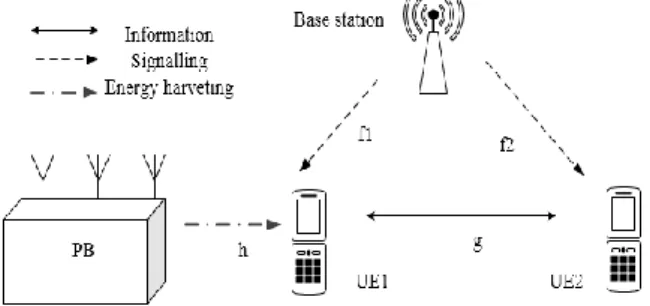
We consider a scenario of D2D communications underlaying a cellular network, in which UE1 expects to interchange information with UE2. This task requires different transmission modes, as shown in Fig. 1, we only consider one case: communication as direct (one-hop) D2D between UE1 and UE2 under controlling by the BS. The channel gains of the BS to control D2D users of the corresponding two nodes are assumed reciprocal and represented as follows: f1,f2 denote the channel gain between UE1, UE2 and BS;
h
denotes the channel matrix the PB and UE1 andg
is the channel gain between UE1 (so-called as EH-UE) and UE2. Regarding time allocation for energy harvesting is followed by time switching relaying protocol. We model all channel gains between two nodes as Rayleigh fading channels.In this mode, UE1 and UE2 will exchange information through direct one-hop D2D link within two time slots. The received signals at UE1 and UE2 are
1 1 U 2a 2 U 2b 1,
y g a P x a P x n (1)
2 1 U 1a 1 U 1b 2,
y g a P x a P x n (2) where a a1, 2 are power allocation factors for different services in NOMA satisfying a1a2 1, andxia,x iib, 1, 2 are the transmitted signals from UEi and
n
i is the additive white Gaussian noise (AWGN),n n
1,
2 are denoted for the information symbol with unit energy, and the correspondingvariance of
N
0. For the consideration of same received SNR at UE1 and UE2, we set two transmit power of each user are equal and set byP
U.For wireless power transfer, during the energy harvesting phase, the received signal at EH-UE (i.e. UE1) can be expressed as
1
,
U m E U
P
y n
d
hx (3)
where P is the transmit power at the PB, d1 denotes the distance between PB and UE1, m is the path loss exponent,
E
x
is signal vector N × 1, andn
Uis the additive white Gaussian noise (AWGN) with varianceE n n
U U*
2. In wireless power technique using short power transfer distance the link between the PB and EH-UE experience line of-sight path and hence, the Rician distribution is modeled for channels. Due to difficulty in the complicated Rician fading probability density function (pdf), it is need be replaced simple distribution as the Nakagami-m fading distribution which provides a very respectable approximation to the Rician distribution. Motivated by this, and to simplify the analysis, we adopt the Nakagami-m fading to model the PB to EH-UE channel in this paper h
hi ,i1, 2,K, Nand N is the number of antenna at PB, are assumed to be independent and identically distributed (i.i.d.) with uniformly distributed phase and the magnitude. We denote d d1, 2 are the distance between PB and EH-UE, EH-UE and UE, respectively, g is the channel coefficient following complex Gaussian distribution with zero-mean and unit variance,i
x h following a Nakagami-m probability density function (PDF)
2
2 1
( )
,
0,
2
k k
x k
x
k
p x
x
e
x
k
(4)where
. represents the gamma function,
2 2 2 2 , var E xk E x
x
. Since the PB is furnished with multiple antennas, the system deploy energy beamforming to increase the effectiveness of energy transmission, i.e.
,
E
s
ex
w
(5)where
w
is the beamforming vector with w 1 whiles
eis the energy symbol with unit power. In principle, the optimal beamforming vector is specified by
†
h w
h (6)
Following RF signal for energy transfer, the total received energy at the EH-UE in the first phase can be calculated as
2 1 n m P T E d
h (7)
As a result, the transmit power at the EH-UE can be expressed as
2 2
1 1
1 1
U m m
P T P
P Td d h h (8) In which 0
1 is the energy conversion efficiency. In next part, we focus on outage performance. In the information processing phase, EH-D2D user transmits information to the other normal D2D user using the energy harvested in the first phase. Hence, the received signal at normal D2D user
2
2 1 1 2 1 2
1 2
1 m m a b
P
y g a x a x n
d d h (9)
Assuming that all signal with unit power,
i.e.
2 21a 1b 1
E x E x . Therefore, the end-to-end signal to noise ratio (SNR) at normal D2D user for detecting x1a can be computed as
2 2 2 2 0 1 1 2 2 1 2 (1 ) (1 ) m m m m g SNR g N P a d d P a d d
h h (10a)where 0,1 for advanced SIC is applied and normal SIC is performed, respectively. In this paper, we propose advanced SIC in which device eliminate the other signal’s interference perfectly and then detecting its own signal. In case of advanced SIC, we obtain new SNR as
2 2
0
1
1 2
(1 ) m m g
SNR N P a d d
h (10b)Proposition 1: The outage probability of the system for D2D link considering at normal D2D user is given by [23]
0
/2 /2
Pr
2 (1 ) (1 ) k
1 2 ,
( ) out Nk Nk Nk P SNR
k c c
K Nk (11)
whereKn
x is the modified Bessel function of the second kind [22] and 1 2 0 01
m m
d d N c
Pa
,
0
2
Rc
1
, the constant ratec
R is at the source.
Proof: See in the appendix
Based on outage probability, we can evaluate throughput performance as below.
2 2
2
1 2 0
1
log
1
(1
)
I m m
a
g P
d d N
h
(12)Furthermore, this section is also consider limited throughput performance where delay-limited scenario is investigated. This paper introduce the achievable average throughput of wireless powered communication network illustrated in the closed-form expression. For delay limited transmission, to satisfy the constant rate Rc the source transmits to approach
throughput, which can be demonstrated in expression related to outage probability. Hence, the average throughput in delay limited mode can be assessed as
DL
(1
P
out)
R
c(1
),
(13)4.
Numerical and simulation discussion
In this section, Monte Carlo simulation results are presented to validate the analytical expressions derived in the previous sections. All the simulation results are obtained by averaging over 106 independent trials. Unless otherwise specified, the following set of parameters were used in simulations: time switching fraction is 0.5 (50% time for energy harvesting),
1( / )
c
R bps hz , hence the outage SNR threshold is given by
0 2 1
c
R
. The energy conversion efficiency is set to be 0.4
, and power allocation factors are1 0.95, 2 0.05
a a while the path loss exponent is set to be 3
m , the Nakagami-m parameter is set to be k4
20 30 40 50 60 70 80
0 0.1 0.2 0.3 0.4 0.5 0.6 0.7 0.8 0.9 1 P/N 0(dB) O u ta g e p ro b a b il it y (b it /s/ H z) simulation analytical N=30,20,10
Figure 2. Outage performance versus SNR.
20 30 40 50 60 70 80
0 2 4 6 8 10 12 14 P/N 0(dB) In st a n ta n e o u s T h ro u g h p u t (b it /s/ H z) N=10,20,30
Figure 3. The instantaneous throughput performance versus SNR.
20 30 40 50 60 70 80
0 0.05 0.1 0.15 0.2 0.25 0.3 0.35 0.4 0.45 0.5 P/N 0(dB) th ro u g h p u t( b it /s/ H z) simulation analytical N=10,20,30
Figure 4. The throughput performance in delay-limited transmission mode versus SNR.
20 30 40 50 60 70 80
0 0.05 0.1 0.15 0.2 0.25 0.3 0.35 0.4 0.45 0.5 P/N 0(dB) th ro u g h p u t( b it /s/ H z) simulation analytical =0.5 =0.7
Figure 5. Comparison of the throughput performance with different time switching coefficients in in delay-limited transmission mode versus SNR.
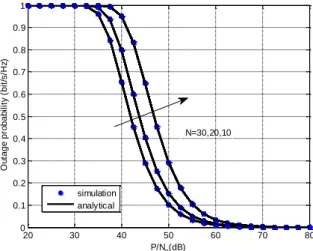
Fig. 2 illustrates the outage performance versus the transmit SNR at PB. In concerned figure, it can be readily observed that putting more antennas at the PB can significantly improve the outage performance. However, in case of the transmit power is adequately large, the assistance of accumulation extra antennas quickly reduces. The reason is that increasing the number of antennas can deliver higher energy beamforming gain, and which results in the amount of the collected energy at the EH-assisted D2D user improves, which leads to decrease the outage event. In contrast, with satisfactorily large transmit power, the system is no longer energy limited and hence the system performance is restricted by the constant transmission rate. For instance, given transmit SNR is greater than 55dB1, outage probability is very small as displayed result in the Fig. 2. In addition, it can be seen that the analytical results remain appropriately tight match with simulation results.
he impact of time allocation for energy harvesting is investigated in Fig. 5. At low transmit power level, a larger time switching coefficient is preferred, while at high transmit power level, the opposite holds. This is also intuitive, since to assurance trustworthy information transmission, i.e., to preserve low outage probability, a minimum amount of source energy is compulsory. As such, when the transmit power level is low, it is necessary to spend more time to harvest energy, when the transmit power is high, only a smaller portion of time is needed for energy harvesting.
5.
Conclusion
In this paper, device-to-device transmission in NOMA networks with an energy constrained transmitter harvesting energy with help of wireless power beacon was presented. Motivated by the research trends in the recently widely implemented time switching receiver and the theory of power beacons, we investigate outage and throughput performance in the power transfer model, including the instantaneous throughput and delay-limited throughput. This paper used the closed-form expressions to provide a complete framework to model, analyze, and evaluate the performance of the proposed network. New analytical expressions in terms of power outage probability, achievable throughput are derived to determine the system performance. Numerical results were presented to verify our analysis and provide useful insights into practical design. Our future work will attention on adjusting the network design parameters (e.g., information transmission time fraction and expected transmit power).
APPENDIX
The key is to obtain the outage probability of the system, which can be written as
2 2 0
0(1 )
Pr Pr
out
c
P SNR g
h (A.1)
As in theory, h 2 is a Gamma random variable with PDF given by
1 ( )
( ) Nk
Nk kx k
p x x e
Nk
, for
x
0
(A.2)Conditioned on
h
2, the CDF in this case is given by2
2 0 0
2 2
(1 ) (1 )
Pr
g
c c
OP g
F
h
h
(A.3)
In which, we define
2 2
( | ) 1 z
F z e
h
h
To this end, averaging over h 2, with the help of [22, Eq. 3.471.9], the unconditional CDF can be computed as
k 2 2(k )
( ) 1 2 k
( k) N
Nk x
F x K x
N
(A.4)
The desired result can be then obtained after some simple algebraic manipulations
References
[1] B. Medepally and N. B. Mehta, “Voluntary energy harvesting relays and selection in cooperative wireless networks,” IEEE
Trans. Wireless Commun., vol. 9, no. 11, pp. 3543–3553, Nov. 2010.
[2] H.-S. Nguyen, A.-H. Bui, Dinh-Thuan Do and M. Voznak, "Imperfect Channel State Information of AF and DF Energy Harvesting Cooperative Networks", China Communications, Vol. 13, No. 10, pp.11-19, 2016
[3] T.-L. Nguyen, Dinh-Thuan Do, "A new look at AF two-way relaying networks: energy harvesting architecture and impact of co-channel interference", Annals of Telecommunications, Vol. 72, No. 11, pp. 669-678, 2017
[4] Tan N. Nguyen, Dinh-Thuan Do, P. T. Tran and M. Voznak, "Time Switching for Wireless Communications with Full-Duplex Relaying in Imperfect CSI Condition," KSII Transactions on Internet and Information Systems, vol. 10, no. 9, pp. 4223-4239, 2016
[5] I. Ahmed, A. Ikhlef, R. Schober, and R. K. Mallik, “Joint power allocation and relay selection in energy harvesting AF relay systems,” IEEE Wireless Commun. Lett., vol. 2, no. 2, pp. 239–242, Apr. 2013.
[6] Dinh-Thuan Do, H.-S. Nguyen, "A Tractable Approach to Analyze the Energy-Aware Two-way Relaying Networks in Presence of Co-channel Interference", EURASIP Journal on Wireless Communications and Networking, 2016:271. [7] K. T. Nguyen, Dinh-Thuan Do, X. X. Nguyen, N. T. Nguyen,
D. H. Ha, "Wireless information and power transfer for full duplex relaying networks: performance analysis," in Proc. of Recent Advances in Electrical Engineering and Related Sciences (AETA 2015), HCMC, Vietnam, pp. 53-62, 2015. [8] Y-K. Shih, M.-J. Shih and H.-Y. Wei, “Energy efficient D2D
discovery for energy harvesting proximal IoT devices,” IEEE Vehicular Technology Conference (VTC), 2017.
[9] K. Huang and V. K. N. Lau, “Enabling wireless power transfer in cellular networks: Architecture, modeling and deployment,” IEEE Trans. Wireless Commun., vol. 13, no. 2, pp. 902–912, Feb. 2014.
[10]S. Lee, R. Zhang, and K. Huang, “Opportunistic wireless energy harvesting in cognitive radio networks,” IEEE Trans. Wireless Commun., vol. 12, no. 9, pp. 4788–4799, Sep. 2013. [11]I. Flint, X. Lu, N. Privault, D. Niyato, and P. Wang,
“Performance analysis of ambient RF energy harvesting: A stochastic geometry approach,” in Proc. IEEE GLOBECOM, pp. 1471–1476, 2014.
[12]I. Krikidis, “Simultaneous information and energy transfer in large-scale networks with/without relaying,” IEEE Trans. Commun., vol. 62, no. 3, pp. 900–912, Mar. 2014.
[13]G. Fodor et al., “Design aspects of network assisted device-to-device communications,” IEEE Commun. Mag., vol. 50, no. 3, pp. 170–177, Mar. 2012
[14]A. H. Sakr and E. Hossain, “Cognitive and energy harvesting-based D2D communication in cellular networks: Stochastic geometry modeling and analysis,” IEEE Trans. Commun., vol. 63, no. 5, pp. 1867–1880, May 2015.
[15]G. Geraci, H. S. Dhillon, J. G. Andrews, J. Yuan, and I. B. Collings, “Physical layer security in downlink multi-antenna cellular networks,” IEEE Trans. Commun., vol. 62, no. 6, pp. 2006–2021, Jun. 2014.
[16]H. Wang, X. Zhou, and M. C. Reed, “Physical layer security in cellular networks: A stochastic geometry approach,” IEEE Trans. Wireless Commun., vol. 12, no. 6, pp. 2776–2787, Jun. 2013.
[17]C. Ma, J. Liu, X. Tian, H. Yu, Y. Cui, and X. Wang, “Interference exploitation in D2D-enabled cellular networks: A secrecy perspective,” IEEE Trans. Commun., vol. 63, no. 1, pp. 229–242, Jan. 2015.
[19]I. Khan, “Performance analysis of 5G cooperative NOMA for IoT Intermittent communication,” International Journal of Communication Networks and Information Security (IJCNIS), vol. 9, no. 3, pp. 314–322, 2017.
[20]G. Song, X. Wang, and J. Cheng, “A low-complexity multiuser coding scheme with near-capacity performance,” IEEE Trans. Veh. Technol., vol. 66, no. 8, pp. 6775–6786, Aug 2017. [21]Y. Zhang, H. M. Wang, T. X. Zheng, and Q. Yang,
“Energy-efficient transmission design in non-orthogonal multiple access,” IEEE Trans. Veh. Technol., vol. 66, no. 3, pp. 2852– 2857, March 2017.
[22]I. S. Gradshteyn and I. M. Ryzhik, Table of Integrals, Series, and Products, Orlando, FL: Academic Press, 5th ed., 1994 [23]C. Zhong, X. Chen, Z. Zhang and G. K. Karagiannidis,